Showing posts with label Vinnie Sperrazza. Show all posts

Friday, March 18, 2022

Michael Formanek Drome Trio - Were We Where We Were (March 18, 2022 Circular File Records)

Were We Where We Were is a recording of set of compositions by Michael Formanek, and performed here by him, saxophonist and clarinetist Chet Doxas, and drummer Vinnie Sperrazza, collectively as the Michael Formanek Drome Trio. These pieces were loosely grouped together as Palindrome Series 1 and Palindrome Series 2, from 2020. They started out as a series graphic scores that were then reinterpreted as conventionally notated music for this trio. The Drome trio learned the music and rehearsed outside during the pandemic of 2020, and then recorded in the studio in early December of 2020. Since then the trio continues to work and develop the music whenever possible.

The incredible artwork on the physical packages are by Stewart III, and design is by Stephen Byram and Warren Linn.

Were We Where We Were will be released by Circular File Records on Vinyl, CD and digital formats on March 18th, 2022.
PROGRAM NOTES

Like most of the musicians I know, the initial pandemic lockdowns of March 2020 were a huge wakeup call on many levels. Levels on which I’m still trying to sort out. As I write this in mid-September of 2021, things still largely unresolved, the return to any kind of normalcy seems unlikely. By that I mean, the already abnormal version of the freelance musician is a lifestyle in which a regular income has always been a difficult thing to count on, only to be further compromised by the pandemic. Musicians learn to thrive when things are good, but also learn to remain creative and productive when they are not. In fact, during the good times, the musicians on my end of the musical spectrum tend to reinvest their earnings back into their own creative work, even if this work lacks the chance at being profitable. Outside of music, to even consider this as a possibility, could be viewed as a folly. But such is the life of an artist; passion over reason.

One thing the pandemic did afford creative musicians though was time….lots and lots of time! Time to learn how to teach private students on Zoom. Time to work on remote projects with other like-minded collaborators. Time to practice your instrument, or to learn one that you hadn’t even played before. Time to compose and experiment with ideas that, outside of a global shutdown, would otherwise seem impractical due to the usual lack of rehearsal and time for players to embrace them. Thanks to the availability of unemployment payments and several other funding sources, many musicians were able to weather the storm and continue to increase their levels of proficiency.

In mid-Summer 2020, I noticed that my perception of the passage of time had changed and was affecting the way I heard and thought about music. I was hearing music that included voices that moved at differing velocities, sometimes in sync by specific metric ratios, others freely moving with more fluid temporal relationships, and at other times completely random. I was also starting to hear fragments of music that moved forwards and backwards through time. While contemplating these musical fragments, the initial effect that struck me reminded me of the sound of playing a recording of a short music phrase forwards then immediately backwards. Upon further study, I started to become interested in the reversal of all of the musical information afforded to me: pitches, rhythms, dynamics, notation and group interaction. This eventually turned into a fascination and mild obsession with musical palindromes.

The early versions of the Palindrome Series compositions were conceived by using the technique of graphic notation. This is a method of composition that uses pictorial representations to convey musical information rather than the typical five-lined staff. I began composing the suite by drawing two musical staffs onto an iPad with an Apple Pencil. The first staff was in black and white, and was roughly the shape of a horseshoe lying on its side but with the bottom of one side extending vertically upwards towards the beginning, but without touching it. I had seen many beautiful examples of contemporary graphic scores that were very carefully drawn and with the utmost of precision. These were clearly not that, and were never intended to be. My intention was to write down my musical ideas and consciously bend them back around to where they started. This psychological trick that I played on myself was to try and keep me from thinking only in a strictly linear way. As I completed the first staff I wrote the words “repeat backwards or forwards” into the score because I wasn’t yet sure how the material would be interpreted by the performers, only that it would somehow involve bi-directionality. In writing the second staff I incorporated two different colors, red and blue. I drew a treble clef symbol in red at the beginning (upper left corner) of the staff, and a reversed bass clef in blue at the end of the staff so it would not only be interpreted as the beginning of a part. With this second staff my original idea was to have the treble part moving forward and the bass part moving backwards. These visual works are what ultimately led to creating the written palindromic material for the suite, please see Ex.1 of graphic scores.
I then printed out copies of both staves, #1 and #2, and began to compose directly onto them, constantly hearing the music going in both directions. Once I had several versions of these études, I chose ones that I thought worthy of further exploration and translated them using conventional music notation. These newly notated scores allowed the performers to read the music in a format that they were more accustomed to, without having to decipher the hieroglyphic nature of the graphic scores. Furthermore, since the graphic versions included almost no bar lines, I could take more liberties in the process of writing these notated parts. The result was one of a more abstracted flow which included just enough organization to frame and contain the form of the statements. Finally, staying true to the original concept of the graphic scores, the written material (and for that matter, the work in its entirety) can be performed exactly the same way left to right as right to left.

I was now ready to get to work on developing these ideas into something playable by humans. To my surprise and delight, in mid-August of 2020, I was notified by the Jazz Coalition that I was among fifty composers to be awarded their recently established commission grant. It just so happened that during this same period two of my favorite humans (who also happened to be great musicians) had begun to make weekly treks from Brooklyn to my home in Northern New Jersey. Chet Doxas, a fantastic tenor and soprano saxophonist, clarinetist, and composer and I had been playing together occasionally before the lockdowns, and we had already started to develop a musical rapport. Drummer and composer, Vinnie Sperrazza, and I have been playing together for several years. During 2017-18 my wife, Sandi, and I were planning our move back to the New York area after many years away, first in rural Pennsylvania and then in Baltimore. I was actually Vinnie’s tenant at his apartment in Kensington, Brooklyn, and having Vinnie’s place during that period was amazingly beneficial for my return to the freelance creative musician life that I had been away from for many years. Playing duo with Vinnie in his music studio before heading out to do our daily rehearsals, sessions and gigs was one of my favorite things to do during that time. This period greatly served to help build the foundation that supports this recording and many of the other projects in which we continue to be involved with together.

To stay on the safe side, during the height of the pandemic Chet, Vinnie and I began playing weekly sessions outside in my backyard. Our repertoire ranged from jazz tunes, to standards, and free improvisations. It would be months before we began playing the palindromic pieces that would eventually become the music on the album Were We Where We Were. Special thanks to my gracious neighbors in West Orange, New Jersey for their generosity and enthusiasm while we rehearsed, especially since I know that this music did not sound so great in the beginning. I really appreciate that no one complained about it! After all, it was a very unusual time for all and we seemed to be working it, one day at a time.

Michael Formanek

Tracks for Digital and CD Release:
1. Tattarrattat - (Formanek) 27:00
2. Never Odd or Even (Formanek) 12:10
3. Is It What It Is (Formanek) 6:28
4. Tattarrattat (Vinyl Version) (Formanek) 19:22

Michael Formanek - Double Bass
Chet Doxas - Tenor and Soprano Saxophones, Clarinet
Vinnie Sperrazza - Drums

Recorded on December 02, 2020 at Sound On Sound Studio, Montclair, New Jersey by David Amlen
Mixed by Chet Doxas in January-February 2021
Mastered by Alex DeTurk
Produced by Michael Formanek

Art: Stewart III - Design: Stephen Byram & Warren Linn

Tattarrattat was composed with support of the Jazz Coalition Commission Grant in August 2020

Thursday, October 21, 2021

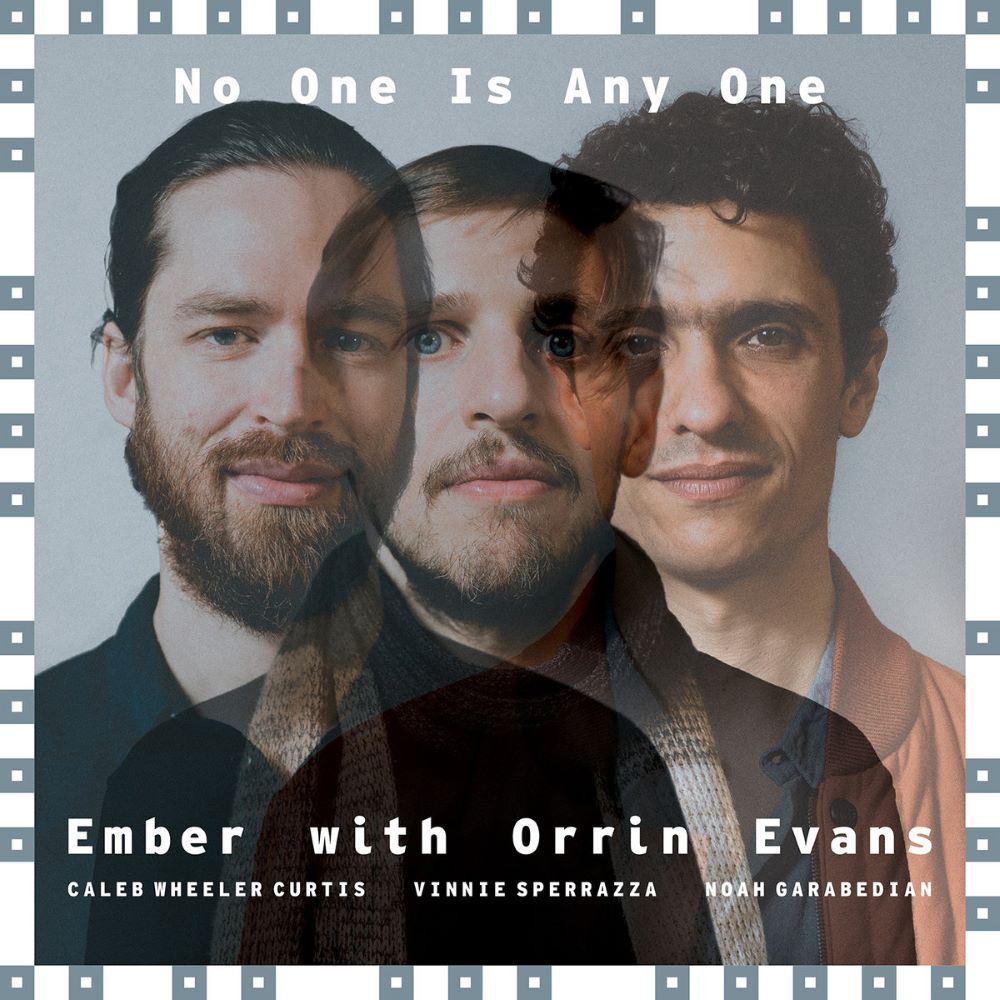
Ember with Orrin Evans - No One Is Any One (October 29, 2021 Sunnyside Records)

Music making is enhanced when the music is made with friends. The ability to involve peers who are experiencing life in a similar way makes communication and organization more natural. The Ember band is composed of three Brooklyn based jazz musicians and comrades. The group’s new recording, No One Is Any One, shows that the bond and aesthetic that the members have built is solid yet expandable, with the addition of pianist Orrin Evans for a handful of tracks.

Ember came together in 2017 when saxophonist Caleb Curtis, bassist Noah Garabedian, and drummer Vinnie Sperrazza began to assemble at rehearsals that would become as much conversations on music and values as actual playing. The members realized quickly that their openness and stylistic breadth led them quickly to a place of comfort in performance, their deep relationships leading to their understanding of musical needs and inspiring hopes of further development.

Garabedian and Sperrazza came from backgrounds in grooving, instrumental R&B music, while Curtis was more devoutly in the jazz world. The Brooklyn jazz scene provides a hospitable, if maybe under-recognized, scene of musicians who can reach across genre boundaries to make creative music.

Ember’s initial recording, New Year, came out under the names of the three members in 2018. The group’s first thought for recording was to approach the process casually, perhaps recording an album of standards. Instead, the members decided to write their own music, music that felt like standards rather than the overly complicated exercises that many in their community focus on. Ember wanted their music to be approachable in their everyday, musical life. Tunes that they could return to as part of their own canon.

A South Arts Grant in 2019 allowed Ember to tour and be clinicians for two weeks. The musicians developed a new set of music for the tour and committed it to memory, so that they would be naked on stage. Just the music and the possibilities within. Ember had intentions of recording the new material in March 2020 when the pandemic struck.

After months of isolation, Curtis, Garabedian, and Sperrazza began to meet in Brooklyn’s Prospect Park in impromptu rehearsals as performances. The organic nature of the meetings and the group’s desire to move forward led them to set up a recording at the Samurai Hotel studio at the end of July.

Curtis invited his friend and frequent collaborator Orrin Evans to join the group on the recording session. The involvement of Evans could be seen as an intermingling of two musical scenes, as the Philly based pianist has become well known for his post-bop inflected original music and for becoming the Bad Plus’s second pianist. But, in reality, it was a mutually beneficial arrangement that solidified Ember’s aesthetic and accessibility.

The recording begins with Curtis’s “Reanimation (Zombie Tune),” a tongue in cheek piece with a humble but rocking bassline from Garabedian, the ear taught tune establishing Ember’s sound identity immediately. Garabedian’s solo bass introduces his “Josephine and Daphne,” a piece inspired by Jack Lemmon and Tony Curtis’s characters from Some Like It Hot, who find meaning in their lives when they adopt female personas to be in an all-woman jazz band. The blues-forward sound of Sperrazza’s “No One Is Any One” finds its essence in simplicity; its title is derived from the writer’s discourse on, and eschewal of, the cult of personality. “Pilot Light” shows another element of Ember’s identity, composing in real time through collective improvisation.

Curtis’s sharp and snappy “Glass House” is inspired by woodwind legend Thomas Chapin’s groundbreaking trio, the song approximating the group’s ability to balance chaos and fragility. Curtis’s mesmerizing “Peace of Deoxygenated Sleep” comes from his hour-long piece, Bottom Feeders, and is meant to mirror the quiet at the bottom of the ocean. Orrin Evans’s gorgeous sound adds additional resonance to the weight of the piece. Evans returns on Curtis’s “Thomas,” another unsettled, attention grabbing piece that once again channels Thomas Chapin’s fearlessness.

Written in a sudden burst of inspiration in a 15-minute span, Sperrazza’s “Graceful Without Grace” is a thoughtful piece that reflects on the Protestant idea of God’s grace being inherent. Garabedian’s “Chia-Sized Standing Desk” is evocative of something never heard before, an experimental composition that shows Ember’s appreciation for the AACM’s meditative sound worlds. The recording concludes with Sperrazza’s “Harvey Pekar” from his suite called One Day, the composition taking its name from the well-known jazz critic who had a talent of finding beauty where there usually wasn’t any.

The depth of the band Ember’s collaborative energy and understanding are eye and ear opening. Caleb Curtis, Noah Garabedian, and Vinnie Sperrazza create music that is inspirational and meaningful on their new recording, No One Is Any One. 

1. Reanimation (Zombie Tune)
2. Josephine and Daphne
3. No One Is Any One
4. Pilot Light
5. Glass House
6. Peace of Deoxygenated Sleep
7. Thomas
8. Graceful Without Grace
9. Chia-Sized Standing Desk
10. Harvey Pekar

Caleb Wheeler Curtis - alto saxophone
Noah Garabedian - bass
Vinnie Sperrazza - drums
Orrin Evans - piano (6-9)

Friday, July 23, 2021

Hank Roberts Sextet - Science of Love (July 23, 2021 Sunnyside Records)

Creation can be a lonely process. The meticulous crafting of art frequently requires isolation for focus, but the process can be aided by the spark of a change of location or meeting new collaborators. Cellist/composer Hank Roberts believes that the acts of creating and sharing music help bring positivity needed to balance the world. In essence, bringing more of a particular life-sustaining energy into the world, namely, love. How better to spread love than through enthusiastic participation with friends in artistic endeavors?

Roberts’s new recording, Science of Love, finds the longtime stalwart of the creative Downtown music scene returning to New York City, after raising a family in Ithaca, NY, in an effort to rekindle the vital, creative energy that only the metropolis can provide. Roberts discovered inspiration in droves, which allowed him to create a unique program of original music unlike anything he had done in the past.

Of course, Roberts has been well known for playing alongside music greats, like Bill Frisell, Tim Berne, and Joey Baron. He has also put together singular and celebrated ensembles of his own that cover a wealth of musical ground, including folk, rock, modern classical, gospel, and world music influences.

In the summer of 2015, Roberts decided to return to New York City. A renewed sense of urgency in creation had struck him and he felt that his burgeoning work should be heard. The pieces heard on Science of Love were already begun prior to Roberts’s arrival but they really blossomed as soon as he began to fit himself back into the rhythms of the City. Immediately, he was seized by inspiration and found himself awakening at 4AM to compose, attaining a near sensual experience as he set his ideas to paper.

It didn’t take long for Roberts to begin meeting invigorating new collaborators. Trombonist Brian Drye was one of the earliest, as Drye asked Roberts to perform with his group at a local concert. Woodwind expert Mike McGinnis and pianist Jacob Sacks were musicians Roberts had been following and with whom he quickly established ties. Drummer Vinnie Sperrazza was introduced by McGinnis, and he met violinist Dana Lynn while performing with her in another group.

The assembly of what would become the Hank Roberts Sextet was entirely organic, evolving out of chance meetings, preexisting friendships between members, and a quick understanding of the leader’s goals. All of the musicians shared similar languages, interacting comfortably between jazz, improv, and classical musical idioms. The group proved to be a perfect size for the emerging music, a reasonably sized ensemble that could sound large.
As a former trombonist, Roberts has always been attracted to the instrument’s possibilities (as can be heard on his debut solo album, Black Pastels) and Drye’s impeccable playing aligned perfectly with the composer’s ideas. The combination of trombone with cello and piano allowed Roberts to experiment with low pitch clusters, unique phrasing, and intonation, all of which brought a lot of energy to the music through their natural tension.

As the music for Science of Love began to emerge, Roberts was reflecting on the energies at work in the world and in the universe, from the wind rustling leaves in a tree to the consciousness shared between all human beings. His takeaway was that love was an important power in the universe and that artists are proponents in spreading that power through their work. These thoughts manifested in Roberts’s desires to push his work farther and to step into a more active role as a conduit for expressing these feelings.

Roberts’s initial phase of composing these pieces began by constructing series of chords or small melodies and expanding them day after day into larger frameworks. His level of focus propelled him into another level of preparation. Roberts’s move to New York and assembly of his Sextet brought the project full circle, as he had a regular outfit for rehearsals and performances where the pieces really began to bloom as he continued to sculpt them with the aid of the other musicians’ specialties.

Many of the compositions are extremely complex, the harmony and voicings meticulously arranged, extending farther and farther into organic abstractions, and balanced relative to traditional forms, as well. Even with this framework, Roberts wanted to maintain the instrumentality of improvisations. He created the materials but gave the performers the opportunity to more deeply clarify and expand their meanings.

The recording begins with “Sat/Sun Pa Tu X,” an amazing expansion of the piece “Saturday/Sunday” from Little Motor People (JMT, 1993) with a controlled added abstraction. “G” is a 14-piece suite of sorts that began as small piece that kept building. The titles reflect the codes that generated the pieces and, occasionally, descriptive elements of the pieces reflected by the performers. Among the many pieces, the leading “The Sharp Peak of The Science of Love” is a fantastic example of the breadth of the suite, with fantastic solos by Sacks and Drye that fit the drive of the music. Dynamic strings and close harmony highlight “Shifting Paradigms in Pre GLC 3,” while the slow “Shuffle of GLC Magnetic Floating Stripper” provides an intriguing dynamism for weaving the ensemble with McGinnis’s soaring soprano saxophone. The delicate “205” concludes the program with tart sentimentality.

A life change allowed Hank Roberts to undertake one of the most meaningful projects in his life. The journey may have begun as a move to New York City, but it evolved into something deeper, the fostering of new friendships and a new, collection of music. Science of Love is a testament to Roberts’s craft, perseverance, and ability to propel the power of love through music. 

1. SAT / SUN PA TU X
2. G - The Sharp Peak of The Science of Love
3. G - Human Circuits
4. G - One Floor Axis
5. G - Equatorial Conductivity
6. G - Earth Sky Realms
7. G - D23
8. G - Levity Village
9. G - Second First
10. G - Story
11. G - Shifting Paradigms In Pre GLC 3
12. G - GLC Magnetic Floating Stripper
13. G - 17
14. G - B45 L
15. G - Circular Rejuvenation
16. 205

Hank Roberts - cello
Brian Drye - trombone
Dana Lyn - violin
Mike McGinnis - clarinet, soprano saxophone
Jacob Sacks - piano
Vinnie Sperrazza - drums

Monday, July 9, 2018

Vinnie Sperrazza · Jacob Sacks · Masa Kamaguchi - Play Benny Golson (FRESH SOUND NEW TALENT RECORDS 2018)


01. Along Came Betty 7:18
02. Are You Real? 3:16
03. Blues March 6:37
04. Reggie of Chester 2:42 
05. Killer Joe 5:27
06. Just by Myself 3:50
07. Domingo 8:25
08. I Remember Clifford 7:40
09. Stablemates 6:00
10. Fair Weather 6:40

Vinnie Sperrazza (drums)
Jacob Sacks (piano)
Masa Kamaguchi (bass)

Wednesday, November 15, 2017

CONCERTOS PORTA-JAZZ: Sábado 18 Nov - Jacob Sacks Trio + Programação Festival Porta Jazz


JACOB SACKS TRIO - CONCERTO SALA PORTA-JAZZ  18/11

Formação:
Jacob Sacks - piano
Demian Cabaud - contrabaixo
Vinnie Sperrazza - bateria

Jacob Sacks é um pianista em destaque no panorama nova-iorquino actual. Liderou o projecto Two Miles a Day, com Eivind Opsvik, Mat Maneri e Paul Motian.

Tocou com músicos como Clark Terry, Charles Gayle, Christian McBride, Brian Blade, Joe Maneri, Ben Monder, Chris Potter, Tony Malaby e Okkyung Lee.

Os seus mais recentes projectos têm sido aclamados pela crítica internacional.


(Sessões iniciam às 19:00h e às 22:00h)


+

8º FESTIVAL PORTA-JAZZ -  CONHEÇA AQUI A PROGRAMAÇÃO COMPLETA

8º FESTIVAL PORTA-JAZZ -  CONHEÇA AQUI A PROGRAMAÇÃO COMPLETA

O Festival Porta-Jazz está de regresso com a sua maior edição de sempre!

Concertos, lançamentos de discos, oficinas e jam sessions.

Os bilhetes para os concertos da 8.ª edição do Festival Porta-Jazz estão à venda nas respectivas salas e custam 5€ (preço por sessão única ou dupla).

A ENTRADA é LIVRE para os membros da associação*.

De 2 a 9 de Dezembro, o Porto vai receber 70 músicos profissionais, 20 dos quais estrangeiros, numa programação composta por 17 concertos entre estreias e parcerias artísticas. O Rivoli, a Casa da Música, a FEUP (Faculdade de Engenharia da Univ. do Porto), o Passos Manuel e a Sala Porta-Jazz – sede da associação – vão ser os palcos da 8.ª edição do festival. Haverá ainda oficinas na ESMAE (Escola Superior de música, Artes e Espectáculo) e um encontro de escolas de jazz no Conservatório de Música do Porto.

2 Dez.
18h00 Sala Porta-Jazz :: Gysler-Perez-Nick Trio (CH) - AMR
19h00 Sala Porta-Jazz :: The Nada (PT)
22h00 Sala Porta-Jazz :: Controvento (CH) - AMR

3 Dez.
21h30 Casa da Música :: Coreto, lançamento de "Analog" (PT)
22h30 Casa da Música :: In Love With de Sylvain Darrifourcq (FR)

5 Dez
21h30 Passos Manuel :: Mirrors (Guimarães Jazz / Porta-Jazz #3) (PT, ES)
22:30 ESMAE :: Jam Session

6 Dez.
21h30 FEUP :: Ariel Bringuez Quarteto present "Jazzing the Classics" (CU, AG)

7 Dez.
21:30 Rivoli, Ricardo Toscano Quarteto (PT)
22h30 Rivoli :: Grande Auditório :: Eduardo Cardinho Group (PT, NL)
23h30 Rivoli, Café :: Gomes/Rosado/Monteiro (PT) + Jam session

8 Dez.
18h00 Rivoli, Pequeno Auditório :: AP Quarteto (PT)
19h00 Rivoli, Pequeno Auditório :: LAMA (PT, CA)
21h30 Rivoli, Grande Auditório :: Porto-Barcelona Connection feat. Marco Mezquida
22h30 Rivoli, Grande Auditório :: AXES (PT)
23h30 Rivoli, Café :: ESMAE Ensemble + Jam Session

9 Dez.
19h00 Sala Porta-Jazz :: Bode Wilson, lançamento de "Lascas" (PT, AR)
22h00 Sala Porta-Jazz :: Ricardo Formoso, lançamento de "Origens" (PT, ES)

Actividades escolas

5 dez 14h00, ESMAE :: Oficina com Virxilio da Silva
3 dez 11h00, Conservatório de Música do Porto :: Encontro Escolas (Oficinas)
3 dez 14h30, Conservatório de Música do Porto :: Encontro Escolas (concertos combos)

*Poderá tornar-se Membro Porta-Jazz à entrada de cada concerto do Festival e também nos concertos da Sala-Porta  Jazz.

*portajazz.com/about/membros/ - cotas válidas por 1 ano: Membro amigo 40 euros; Membro músico/estudante 25 euros.

Monday, May 8, 2017

Vinnie Sperrazza - Juxtaposition (POSI-TONE RECORDS 2017)


Everyone is invited to expand their musical horizons and enjoy a musical exploration of “Juxtaposition" when drummer Vinnie Sperrazza bravely embarks on a novel and ambitious course with his first record as a bandleader for Posi-Tone. Sperrazza provides a contrast of strong rhythmic and harmonic concepts with unstoppably gentle melodic sensibility which help him to succeed in making bold statements of stunning musicianship. When placed in the hands of the capable accompaniment of saxophonist Chris Speed, pianist Bruce Barth and bassist Peter Brendler, Sperrazza conducts our ears through an exciting presentation of carefully crafted originals and cover compositions. Whether one is already familiar with the music of Sperrazza, or discovering him for the first time, "Juxtaposition" will surely intrigue and inspire imaginations into flights of fancy, and deliver bright moments of straight forward musical delight to listeners everywhere.


01. Chimes (V. Sperrazza) 
02. St. Jerome (V. Sperrazza) 
03. House On Hoxie Road (V. Sperrazza) 
04. Juxtaposition (V. Sperrazza)
05. Alter Ego (J. Williams) 
06. This Night This Song (T. Williams)
07. One Hour (V. Sperrazza) 
08. Somewhere (L. Bernstein) 
09. Warm Winter (V. Sperrazza) 
10. Hellenized (V. Sperrazza) 
11. Solitary Consumer (V. Sperrazza) 
12. Say The Secret Word (V. Sperrazza)

Vinnie Sperrazza - drums
Chris Speed - tenor sax
Bruce Barth - piano
Peter Brendler - bass


Monday, April 10, 2017

Vinnie Sperrazza / Jacob Sacks / Masa Kamaguchi - Play Lee Morgan (FRESH SOUND NEW TALENT 2017)


01. The Procrastinator 9:08
02. The Lion and the Wolff 4:34
03. Heavy Dipper 6:12
04. Carolyn 6:13
05. Stop Start 3:59
06. Most Like Lee 3:55
07. Pisces 6:42
08. Desert Moonlight 8:02
09. Search for the New Land 6:38
10. Morgan the Pirate 6:59

Vinnie Sperrazza (drums)
Jacob Sacks (piano)
Masa Kamaguchi (bass)