Showing posts with label Caroline Davis. Show all posts

Tuesday, November 2, 2021

Pedway - Vitalic (November 2, 2021 Ears & Eyes Records)

Pedway was born in Chicago in 2006 when its members first became regular collaborators in the Chicago jazz scene. Caroline Davis (alto saxophone), Matthew Golombisky (acoustic/electric bass), and Quin Kirchner (drums) decided to form a trio that would only perform completely improvised sets. While sometimes bending towards abstraction, they chose to also remain firmly rooted in rhythm, melody & harmony. Throughout the 15 years that have followed, and even after Caroline & Matthew left Chicago for New York & Buenos Aires respectively, the members of Pedway have continually managed to reconvene from time to time to pick up where they left off.

August 2017 was the last such occasion, manifesting in shows in Chicago at Logan Square establishments The Whistler and Cafe Mustache. Culled from the 3 hours of recorded material those performances produced, Vitalic is a window into the aural communication these players have developed over time. Their 3rd full-length album once again blends elements of rock, jazz, minimalism and abstract expressionism together to form a unique take on the classic sax trio sound. While no two Pedway performances are alike, the musical rapport among its members is always evident and represents the through-line connecting all their work. Vitalic is available both digitally and as a super-limited 12" LP on ears&eyes Records.

1. Personal Floatation Device
2. Segmented Eye
3. Vapor
4. Refresher
5. Film as Dream, Film as Music
6. The Infrared
7. If we opened people up, we´d find landscapes
8. Home of Levi Coffin
9. Channels

Pedway is:
Caroline Davis - alto saxophone
Matthew Golombisky - electric bass
Quin Kirchner - drums

Recorded live by Dave Zuchowski at The Whistler & Cafe Mustache in Chicago IL, USA, August 29 & 30, 2017
Mixed & Mastered by Florencio Justo at Estudio Doctor F. in Buenos Aires, Argentina
Digital Album Mastered by Mikey Young in Melbourne, Australia
Art & Design by Daphné Essiet

All music improvised by Pedway

Friday, August 27, 2021

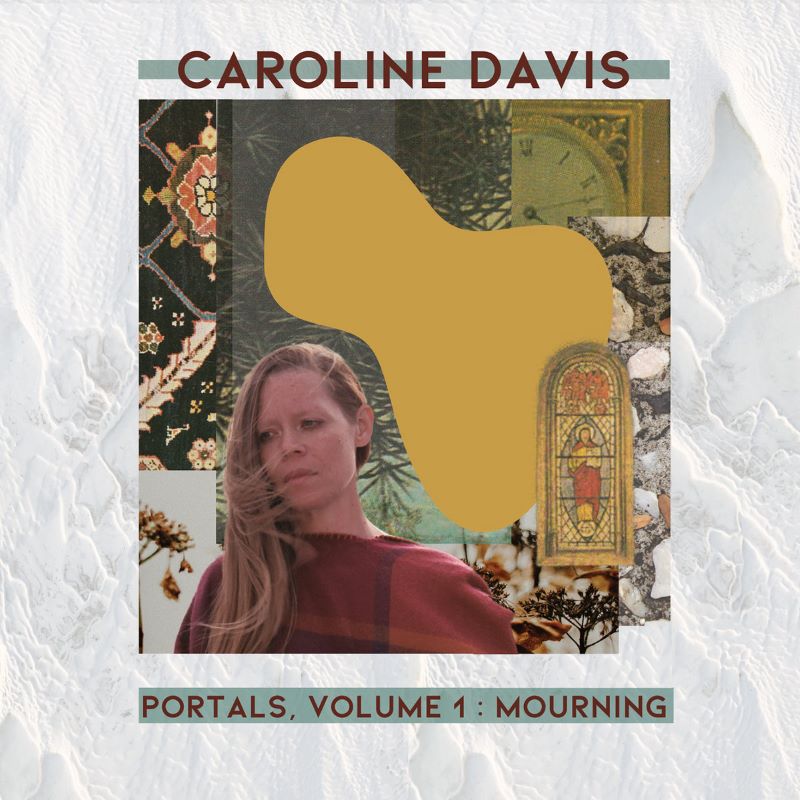
Caroline Davis - Portals, Volume 1: Mourning (August 27, 2021 Sunnyside Records)

One challenge of this frustrating time has been finding methods to handle grief. The loss of loved ones, enforced isolation, and abounding uncertainty have only heightened anxiety and its painful effects. Learning how to cope with grief and work through it is imperative for one’s mental health.

Saxophonist and composer Caroline Davis has done much to try to allay her own emotions after the harsh period she dealt with in 2019. Davis lost her father early in the year and was trying to cope with this devastating event when the pandemic descended. She turned to research and creation to work herself out again. Her new recording, Portals, Volume 1: Mourning, is a culmination of a year of suffering, accepting, and channeling her mourning through a unique process to find equilibrium through composition and reflection.

Davis has always found ways to deepen her musical work by allowing her current preoccupations drive the generation of her art. When her father suddenly passed, Davis was stunned and needed to find a way to express her feelings. She read about grief and trauma, studying the work of Bessel van der Kolk, Mary Oliver, Resmaa Menakem, and Margaret Stroebe. Kübler-Ross’s five stages of grief did not occur in a similar sequence for Davis, so she looked toward the self-help and mystical teachings her father expressed interest in, even up until his passing.

Looking back on her time with her father, Davis began to realize that she must deal not only with the immediate results of his passing but with the legacy of residual pain that he inflicted, intentionally or not. Living at a distance from one another, and his workaholic lifestyle, made things difficult in their relationship. Davis was still wrestling with this.

A welcome aid to Davis’s recovery and work was a residency at the McDowell Artists’ Colony in New Hampshire. At McDowell, she was able to begin sculpting what would become the pieces on Portals, Volume 1. A grant from the Jerome Foundation made it possible for her to complete the remainder of the compositions and recording in 2020.

Portals, Volume 1 is a collection of pieces that Davis wrote for her current quintet along with a string quartet, her first time orchestrating for this instrumentation. The quintet has been her regular group since 2019 and features trumpeter Marquis Hill, pianist Julian Shore, bassist Chris Tordini, and drummer Allan Mednard. For the string quartet, Davis knew that she desired string players who placed improvisation at the center of their practice. Having had the good fortune to work previously with a number of multi-talented players, she was able to recruit violinists Mazz Swift and Josh Henderson along with violist Joanna Mattrey and cellist Mariel Roberts.
The recording was made at Oktaven Audio in Mt. Vernon, New York during December 2020. The studio was a perfect environment for the musicians, and each had COVID tests prior to the dates. Engineer Ryan Streber offered advantageous assistance, helping with pacing and following the musical scores, insuring that every nuance was captured.

The music that Davis composed followed three distinct themes, all tied to recovering from the effects of trauma. The first refers to the intellectual thinking brain and how grief can reorganize one’s memories. The other two focus on the emotional and somatic impacts of grief, one relating to the experience of love and the other associated with bodily and chemical reactions to traumatic events. The experience of trauma is remembering, and reflecting on the past helps to consolidate, as feelings can be complicated and change over time. Examining her bodily reactions and re-drawing physical elements like heart rate, breathing, and eye movements, became a central part of Davis’s practice. These strategies recognized the full scope of using her body as a portal in the process of healing.

The recording begins with “Yesterday’s Seven Thousand Years,” a dynamic piece for the quintet that builds from the rhythm of a quatrain from The Rubaiyat of Omar Khayyám, a poem that Davis discovered when looking back at her father’s photo, accompanied by a quote from this poem as the caption, in his high school yearbook. The next two pieces, “Hop On Hop Off” and “Highlighter Hearts,” are paired, and reflect on specific memories of Davis’s father, fond memories that are also tied to discontent. The first mirrors a hop on, hop off bus tour, the rhythm is the bus slowing down and speeding up, skipping and extending through the piece before halting for a cello feature from Roberts. The swirling “Highlighter Hearts” refers to loving but rushed letters that her father used to send, written in highlighter as it was at hand in the quick, as he was always working.

Davis meditated on nature frequently during her process, especially on textures that could be transferred to human experience. Though her approach to texture in rhythm and harmony can be heard on every piece, “On Stone” is the most representative of this grief as tactile manifestation, as Davis asked the string players to express this hard nature in their improvisations. Continuing that thought, “How to Stop a Drop of Water from Evaporating” takes the rhythm and rationale of one of her father’s riddles (the answer is to throw the water into the sea) and construct a groove-based tune. This piece and “Acephalous Placebo” channel Davis’s father’s interest in energy and faith-based healing, the latter utilizing the ratio of 5:6 to inform the harmonic and rhythmic directions of the composition.

The quiet “Respite” is just that and a thematic foreshadowing of the recording’s conclusion. The tense “Left” deals with the apprehension of being abandoned as a child and the anxiety of not knowing what to do, a violin feature building into an intense ensemble explosion. The subtle “Faced” is entirely improvised and leads to “The Inflated Chariot Awaits Defeat,” a moving meditation on pride and its senselessness with Davis’s poetry and saxophone driving into a dramatic ensemble workout. The recording concludes with the haunting “Worldliness and Non-Duality,” which honors Davis’s father’s last words to her, about his attempts to accept non-duality.

Caroline Davis’s Portals, Volume 1: Mourning is simultaneously melancholy and bright. This is entirely appropriate as the best way to conquer grief is to face the trauma and mindfully engage in its bodily affectations, a message to reflect on as the world begins to blossom again.

1. Yesterday's Seven Thousand Years
2. Hop On Hop Off
3. Highlighter Hearts
4. On Stone
5. How To Stop a Drop of Water From Evaporating
6. Acephalous Placebo
7. Respite
8. Left
9. Faced
10. The Inflated Chariot Awaits Defeat
11. Worldliness and Non-Duality

Caroline Davis - alto saxophone
Marquis Hill - trumpet
Julian Shore - piano
Chris Tordini - bass
Allan Mednard - drums
Mazz Swift - violin
Josh Henderson - violin
Joanna Mattrey - viola
Mariel Roberts - cello

Recorded by Ryan Streber at Oktaven Audio (December 2020)
Mixed & Mastered by Dave Darlington
Original Artwork by Alexa Lima
35mm Photography by Attis Clopton

Thursday, October 25, 2018

Paul Bedal - Mirrors (BACE RECORDS 2018)


"Mirrors" is Chicago based pianist Paul Bedal's second album as a leader and presents a selection of compositions written from 2015 to 2016. On this recording Paul features Jean Caze (trumpet), Caroline Davis (alto saxophone), Dion Kerr (double bass) and Matt Carroll (drums). The band formed as a combination of his closest collaborators, playing a run of shows in Miami and New York in January of 2016. This effort culminated with a recording at Michael Brorby's "Acoustic Recording" in Brooklyn, NY.


Jean Caze - Trumpet
Caroline Davis - Alto Saxophone
Paul Bedal - Piano
Dion Kerr - Upright Bass
Matt Carroll - Drums

1. Aura 05:38
2. Fall Rose 04:47
3. Glendale 07:55
4. Miami Feels 06:18
5. Modicum 04:55
6. Six Across 06:06
7. Titian Sun 04:20

Compositions by Paul Bedal (BMI)
Recorded by Michael Brorby
Mixed by Dan Pierson
Mastered by Paul Bedal
Artwork by Stephanie Benhaim


Sunday, March 4, 2018

Caroline Davis - Heart Tonic (SUNNYSIDE RECORDS March 23, 2018)


Born in Singapore to a Swedish mother and British father, Davis grew up in the United States from the age of six, settling first in Atlanta, then Texas and ending up in Chicago, where she attended Northwestern University and received a Ph.D in Music Cognition. It was in Chicago that Davis became engrained within the local jazz and improvisatory music community, one that is tight knit, diverse and particularly open to each player’s musical inclinations. 

Davis’s Chicago experience was instrumental in her development as a player. Regularly hearing local greats, like saxophonist Von Freeman, guitarist Bobby Broom, and pianist Ron Perrillo, playing in wide ranging musical contexts and interdisciplinary collaborations helped to shape her into a well balanced and genre defying artist. Davis was also privy to a range of artists, including one of her biggest influences, the iconoclastic composer/conceptualist Steve Coleman. 

Upon her move to New York City in 2013, Davis found herself as an outsider looking in. It was difficult to come from a place where she was established to an entirely different community, especially one as fractious as New York’s. Though, Davis soon showed that she was equal to its demands.


The roller coaster lifestyle of working as a professional musician in New York was challenging. Davis quickly saw that her days would have some career highpoints alongside humbling lows of everyday musician life. Friends like drummer Jay Sawyer helped her overcome her blues by coming along to sessions and gigs, thus helping establishing herself in the scene. Soon, Davis began to play more regularly with a diverse group of musicians, including Matt Mitchell, Greg Saunier, Billy Kaye, and Curt Sydnor. 

It was about this time that Davis found out that her father had heart arrhythmia. The news prompted her to do detailed research on the physical aspects of the human heart. 

It was with all of this in mind that Davis decided to compose this music, using the heart for its emotional connotation or utilizing ventricular rhythms as metrical devices. Composing helped not only in her emotional transition but also focused her study on biological aspects of the body. Heart Tonic finds Davis employing more standard jazz elements than in the music of her previous work, including formal harmonic changes and shifting meters. 


To assist in the recording, Davis employed a brilliant ensemble of young musicians, more aligned to swinging, straight ahead jazz, but who could also handle the challenges the composer posed for them in her idiosyncratic music. Pianist and keyboard player Julian Shore and percussionist Rogerrio Buccato had been friends with Davis since her time at Litchfield Jazz Camp nearly a decade ago. Trumpeter Marquis Hill is a Chicago contemporary and a perfect foil for Davis’s lithe alto. Originally from Israel, Tamir Shmerling is unwavering on acoustic and electric bass, while longtime friend and drummer Jay Sawyer always insures the music is remarkably propulsive. 


The recording begins with the churning “Footloose and Fancy Free,” a piece that relies on a cyclical bassline echoing the cycle of the heart’s superior and inferior vena cava leading to the brain and back but with an unconstrained melody singing above that anchor. The plaintive “Loss” is an introspective and emotional piece that was written quickly after a truncated musical connection in Chicago after Davis’s move, featuring Rogerrio Boccato on percussion. The swinging “Constructs” is a suite concerned with the insistency to make up words for the intangible, like using “heart” as a metaphor for honesty, bravery or sympathy. The waltzing “Fortune” is a thankful tribute to the new people and projects Davis has been involved with since relocating. It also features Benjamin Hoffmann on organ. “…TuneFor” is a drum feature for Sawyer stemming from “Fortune.” 

Wayne Shorter’s “Penelope” lent itself to the project as its heart beat like pulse is reminiscent of the rhythms her father’s arrhythmia was making in his own heart. Originally written for another album, Davis rewrote “Dionysian” in New York with a new mindset eschewing the filters of frustration that had limited her on her arrival; it provides an emphatic proclamation of place. The haunting “Air” floats on a bassline in 7 while the rest of the instruments play in 4, thus generating an ambiguous but stable cycle and bedrock for Shore’s lovely piano solo. The stirring “Ocean Motion” closes the recording with a piece in 9/4 in three sections, which leaves the listener with a healing final melody and incendiary drum solo. 

Caroline Davis’s new Heart Tonic is a moving and pulse livening journey through Davis’s emotional relocation from Chicago to New York and her investigation of the biology of the heart.

1. Footloose and Fancy Free
2. Loss
3. Constructs
4. Fortune
5. ...TuneFor
6. Penelope
7. Dionysian
8. Air
9. Ocean Motion

Releases March 23, 2018 

Caroline Davis - alto saxophone
Marquis Hill - trumpet
Julian Shore - piano, Fender Rhodes, Yamaha DX7, Roland JD-Xi
Tamar Shmerling - acoustic & electric bass
Jay Sawyer - drums
Rogerio Boccato (percussion 2, 9)
Benjamin Hoffman - organ (4, 5)