Showing posts with label Allan Mednard. Show all posts

Friday, February 25, 2022

Marta Sanchez - SAAM (Spanish American Art Museum) February 25, 2022 Whirlwind Recordings

Marta Sanchez’s creative voice is strikingly original – circling rhythms, elaborate forms and criss-crossing counterpoint distinguishes her sonic signature on the crowded New York contemporary music scene. Following three critically acclaimed quintet releases, the Madrid-born pianist-composer presents SAAM (Spanish American Art Museum) on Whirlwind Recordings, an album driven by emotional candour and boundary-pushing compositions.

A talented cast realises her knotty, technical writing – frontline partners Alex Lore and Roman Filiu meet Sanchez, Rashaan Carter andAllan Mednard on backline duties.

SAAM riffs on the Smithsonian American Art Museum, on an album that’s an exhibition of Sanchez’s life in musical form: “It’s made up of all the elements of society from both countries [Spain and America] that impact my life and make me who I am.” Matters internal and external are realised in musical expositions of complex feelings. The pieces took shape in lockdown, as Sanchez exchanged fortnightly composition tasks with a pen- pal. “Those compositions express all the phases I was going through at that time. I was reflecting super deeply on what’s important, and how we might give some sense to life.”

Most of the album draws on those precisely realised emotions. The colouristic, texturally driven opener ‘The Unconquerable Areas’ describes parts of herself “that are still vulnerable. These weak parts of myself; even though I’ve been dealing with them for a long time, they’re still there.” Similarly reflective is ‘Dear Worthiness’, a “sad ballad that reflects on my self worth” – it features beautifully lithe melodies, but melancholy is never far away. ‘SAAM’ cuts through that smoothness, in a jagged, Schoenberg- inspired outburst full of intense feelings and dense clusters, built around an essential pain.
A different form of pain features in ‘The Eternal Stillness’ – mournful sighs and cries emanate from the saxophones, as layered textures shift underneath. Then something very different comes along – ‘Marivi’, featuring Ambrose Akinmusire and Camila Meza, offers a warm tribute to Sanchez’s mother, who died during lockdown. “I tell her things I could never tell her,” says Sanchez of the lyrics. “I loved my mum but it was really hard to tell her the deep things.”

‘If You Could Create It’ strikes a lighter tone, with cascading torrents of tenor sax sound, before ‘The Hard Balance’ offers reflection, both musically and personally – the track is finely balanced on an intricate polyrhythm, that reflects the difficulties of maintaining a work-life balance. ‘December 11th’ is the day Sanchez’s mother died, a personal tribute featuring an extended, heartfelt piano solo.

The album concludes with ‘When Dreaming is Only’, the most complex tune on the album; insistent piano rhythms and duelling saxophones give way to a band texture that’s bustling, brimming with energy. “Sometimes I just take the vibe, compose the atmosphere, and sometimes I focus on something super specific.” Sanchez’s ability to tap into emotional expression through detailed instrumental music is without parallel – this collage of moods and feelings is testament to that.

1. The Unconquered Vulnerable Areas
2. Dear Worthiness
3. SAAM (Spanish American Art Museum)
4. The Eternal Stillness
5. Marivi
6. If You Could Create It
7. The Hard Balance
8. December 11th
9. When Dreaming Is The Only

Alex LoRe - alto saxophone
Roman Filiu - tenor saxophone
Marta Sanchez - piano
Rashaan Carter - bass
Allan Mednard - drums
Camila Meza - voice and guitar (5)
Ambrose Akinmusire - trumpet (5)
Charlotte Greve - synths (5)

Recorded by Chris Allen at Sear Sound
(March 15/16, 2021)
Mixed by Dave Darlington
Mastered by Dave Darlington
Produced by Marta Sanchez
Executive Producer - Michael Janisch
Liner Notes - Michael Formanek
Photography by Kimberley M Wang
Graphic Design by Dave Bush

Friday, August 27, 2021

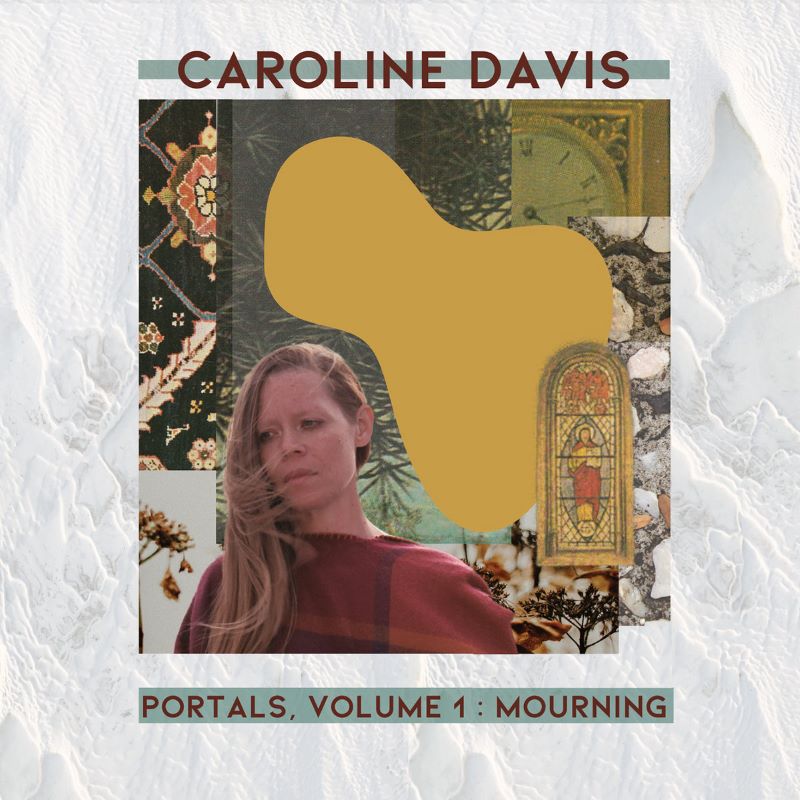
Caroline Davis - Portals, Volume 1: Mourning (August 27, 2021 Sunnyside Records)

One challenge of this frustrating time has been finding methods to handle grief. The loss of loved ones, enforced isolation, and abounding uncertainty have only heightened anxiety and its painful effects. Learning how to cope with grief and work through it is imperative for one’s mental health.

Saxophonist and composer Caroline Davis has done much to try to allay her own emotions after the harsh period she dealt with in 2019. Davis lost her father early in the year and was trying to cope with this devastating event when the pandemic descended. She turned to research and creation to work herself out again. Her new recording, Portals, Volume 1: Mourning, is a culmination of a year of suffering, accepting, and channeling her mourning through a unique process to find equilibrium through composition and reflection.

Davis has always found ways to deepen her musical work by allowing her current preoccupations drive the generation of her art. When her father suddenly passed, Davis was stunned and needed to find a way to express her feelings. She read about grief and trauma, studying the work of Bessel van der Kolk, Mary Oliver, Resmaa Menakem, and Margaret Stroebe. Kübler-Ross’s five stages of grief did not occur in a similar sequence for Davis, so she looked toward the self-help and mystical teachings her father expressed interest in, even up until his passing.

Looking back on her time with her father, Davis began to realize that she must deal not only with the immediate results of his passing but with the legacy of residual pain that he inflicted, intentionally or not. Living at a distance from one another, and his workaholic lifestyle, made things difficult in their relationship. Davis was still wrestling with this.

A welcome aid to Davis’s recovery and work was a residency at the McDowell Artists’ Colony in New Hampshire. At McDowell, she was able to begin sculpting what would become the pieces on Portals, Volume 1. A grant from the Jerome Foundation made it possible for her to complete the remainder of the compositions and recording in 2020.

Portals, Volume 1 is a collection of pieces that Davis wrote for her current quintet along with a string quartet, her first time orchestrating for this instrumentation. The quintet has been her regular group since 2019 and features trumpeter Marquis Hill, pianist Julian Shore, bassist Chris Tordini, and drummer Allan Mednard. For the string quartet, Davis knew that she desired string players who placed improvisation at the center of their practice. Having had the good fortune to work previously with a number of multi-talented players, she was able to recruit violinists Mazz Swift and Josh Henderson along with violist Joanna Mattrey and cellist Mariel Roberts.
The recording was made at Oktaven Audio in Mt. Vernon, New York during December 2020. The studio was a perfect environment for the musicians, and each had COVID tests prior to the dates. Engineer Ryan Streber offered advantageous assistance, helping with pacing and following the musical scores, insuring that every nuance was captured.

The music that Davis composed followed three distinct themes, all tied to recovering from the effects of trauma. The first refers to the intellectual thinking brain and how grief can reorganize one’s memories. The other two focus on the emotional and somatic impacts of grief, one relating to the experience of love and the other associated with bodily and chemical reactions to traumatic events. The experience of trauma is remembering, and reflecting on the past helps to consolidate, as feelings can be complicated and change over time. Examining her bodily reactions and re-drawing physical elements like heart rate, breathing, and eye movements, became a central part of Davis’s practice. These strategies recognized the full scope of using her body as a portal in the process of healing.

The recording begins with “Yesterday’s Seven Thousand Years,” a dynamic piece for the quintet that builds from the rhythm of a quatrain from The Rubaiyat of Omar Khayyám, a poem that Davis discovered when looking back at her father’s photo, accompanied by a quote from this poem as the caption, in his high school yearbook. The next two pieces, “Hop On Hop Off” and “Highlighter Hearts,” are paired, and reflect on specific memories of Davis’s father, fond memories that are also tied to discontent. The first mirrors a hop on, hop off bus tour, the rhythm is the bus slowing down and speeding up, skipping and extending through the piece before halting for a cello feature from Roberts. The swirling “Highlighter Hearts” refers to loving but rushed letters that her father used to send, written in highlighter as it was at hand in the quick, as he was always working.

Davis meditated on nature frequently during her process, especially on textures that could be transferred to human experience. Though her approach to texture in rhythm and harmony can be heard on every piece, “On Stone” is the most representative of this grief as tactile manifestation, as Davis asked the string players to express this hard nature in their improvisations. Continuing that thought, “How to Stop a Drop of Water from Evaporating” takes the rhythm and rationale of one of her father’s riddles (the answer is to throw the water into the sea) and construct a groove-based tune. This piece and “Acephalous Placebo” channel Davis’s father’s interest in energy and faith-based healing, the latter utilizing the ratio of 5:6 to inform the harmonic and rhythmic directions of the composition.

The quiet “Respite” is just that and a thematic foreshadowing of the recording’s conclusion. The tense “Left” deals with the apprehension of being abandoned as a child and the anxiety of not knowing what to do, a violin feature building into an intense ensemble explosion. The subtle “Faced” is entirely improvised and leads to “The Inflated Chariot Awaits Defeat,” a moving meditation on pride and its senselessness with Davis’s poetry and saxophone driving into a dramatic ensemble workout. The recording concludes with the haunting “Worldliness and Non-Duality,” which honors Davis’s father’s last words to her, about his attempts to accept non-duality.

Caroline Davis’s Portals, Volume 1: Mourning is simultaneously melancholy and bright. This is entirely appropriate as the best way to conquer grief is to face the trauma and mindfully engage in its bodily affectations, a message to reflect on as the world begins to blossom again.

1. Yesterday's Seven Thousand Years
2. Hop On Hop Off
3. Highlighter Hearts
4. On Stone
5. How To Stop a Drop of Water From Evaporating
6. Acephalous Placebo
7. Respite
8. Left
9. Faced
10. The Inflated Chariot Awaits Defeat
11. Worldliness and Non-Duality

Caroline Davis - alto saxophone
Marquis Hill - trumpet
Julian Shore - piano
Chris Tordini - bass
Allan Mednard - drums
Mazz Swift - violin
Josh Henderson - violin
Joanna Mattrey - viola
Mariel Roberts - cello

Recorded by Ryan Streber at Oktaven Audio (December 2020)
Mixed & Mastered by Dave Darlington
Original Artwork by Alexa Lima
35mm Photography by Attis Clopton

Saturday, March 13, 2021

Jeremy Pelt - Griot: This Is Important! (2021 HighNote Records)

It is only natural that Jeremy Pelt's voracious curiosity would lead him to investigate the West African Griot tradition where stories, reminiscences and accomplishments from times past are handed down as oral histories. Researchers such as Art Taylor, William Russell and Alan Lomax have preserved interviews with older jazzmen but for his Griot odyssey, Pelt turns to his own peer group to record their thoughts on creating jazz, playing jazz and experiencing the life of a jazz musician of color in our own time.

Each brief interview is followed by a composition by Pelt which perfectly captures the sentiments and emotions of it's spoken-word prelude. To help him bring his vision to life, Pelt has assembled a hand-picked group of colleagues, featuring vibraphonist Chien Chien Lu, pianist Victor Gould, bassist Vicente Archer, harpist Brandee Younger and others. The tunes themselves run the gamut from the remarkable mixing of the sacred and the secular in "Carry Christ Wherever You Are," to the Monk-like gallumphing opening unison in "Don't Dog the Source," and the urgent, "Underdog." As Pelt himself says, "I want people to understand that this is for everybody," that the project was undertaken to perhaps help them "understand that whatever they might be going through, their perspectives might run parallel to those of people who are generations apart from them. Maybe, to a certain extent, these younger people will find themselves in these stories."

1 Griot - Intro (Words by Jeremy Pelt) (Music with Commentary)
2 Words by Paul West (Spoken Commentary)
3 Carry Christ Wherever You Are (Instrumental)
4 Words by Larry Willis (Spoken Commentary)
5 Underdog (Instrumental)
6 Words by JD Allen (Spoken Commentary)
7 Don't Dog the Source (Instrumental)
8 Words by Bertha Hope (Spoken Commentary)
9 A Seat at the Table (Words by Bertha Hope) (Music with Commentary)
10 Words by Harold Mabern (Spoken Commentary) [Explicit]
11 Solidarity (Instrumental)
12 Words by René Marie (Spoken Commentary) [Explicit]
13 A Beautiful (F*cking) Lie (Instrumental)
14 In Spite of... (Words by Warren Smith) (Music with Commentary) [Explicit]
15 Words by Ambrose Akinmusire (Spoken Commentary)
16 Relevance (Instrumental)

Jeremy Pelt – trumpet (all tracks except spoken commentary)
Chien Chien Lu – vibraphone (tracks 1, 3, 5, 7, 9, 11, 13, & 16)
Victor Gould – piano (tracks 1, 3, 5, 9, 11, 13, & 16), nord keyboard (track 14),
Vicente Archer – bass (all tracks except spoken commentary)
Allan Mednard – drums (tracks 1, 3, 5, 7, 9, 11, 13, & 16)
Ismel Wignall – percussion (tracks 1, 3, 9 & 11)
Brandee Younger – harp (track 13)

Monday, October 1, 2018

Saxophonist Kyle Nasser's Persistent Fancy via ROPEADOPE RECORDS (October 5, 2018)


Saxophonist/Composer Kyle Nasser Strikes a Vivid Balance Between the Cerebral
and the Sensual on New Album

Persistent Fancy, out October 5, 2018 on Ropeadope, draws inspiration from literature and
philosophy as well as personal experience and struggle, with a stellar band

“[Nasser’s] exquisitely balanced works reflect both his ardent creativity and his urbane artistic composure.”
– Hrayr Attarian, All About Jazz

“Kyle Nasser… is intelligent and soulful, has a sense of freedom yet understands the concept of structure and is
a leader with a finely tuned sense of organization and order… vital new music.”
– Donald Elfman, The New York City Jazz Record

CD Release Dates:
• Thurs. Oct. 11 – Café 939 Berklee College of Music, Boston, MA
• Fri. Oct. 12 – Greasy Luck Brewpub, New Bedford, MA
• Sat. Oct. 13 – Cornelia Street Café, NYC

“’Tis no sin for a man to labour in his vocation.” The words of Sir John Falstaff, Shakespeare’s great
tragicomic rogue, grace the inside cover of Persistent Fancy, the latest release by saxophonist/composer
Kyle Nasser. Granted, Nasser’s passionate pursuit of jazz is more easily defensible than Falstaff’s chosen
profession of purse-snatching, but The Bard’s use of eloquent language in the mouth of such an incorrigible,
gluttonous rascal has a strong appeal for the saxophonist, who strikes his own musical balance between the
cerebral and the sensual.

Persistent Fancy, due out October 5, 2018 via Ropeadope, is highlighted by a pair of three-part suites that
straddle that boundary: the “Baroque Suite,” inspired in particular by Shostakovich’s Preludes and Fugues,
foregrounds the elegance of classical composition, while the “Eros Suite” dwells on the carnal, tracing the
stages of desire from initial attraction through consummation to reflection. As with all of Nasser’s music,
however, the intellectual and the emotional coexist vividly in both, epitomizing the same mix of impulses that
makes Shakespearean characters like Prince Hal so compellingly complex.

“Prince Hal had a very dissolute upbringing, palling around with Falstaff, this fat, comic philosopher, then has
to leave that behind to become King Henry V,” explains Nasser, who explores the prince’s maturation in his
piece “The Ascent of Henry Monmouth.” The wry wisdom of Falstaff echoes that of Svidrigailov in Crime and
Punishment, whose words provided the epigraph for Nasser’s previous release, Restive Soul. “I always find
that the best insight in literature comes from the most evil characters, or at least the characters that live
outside the mainstream.”

In assembling the ensemble to breathe life into the music of Persistent Fancy, Nasser surrounded himself
with stellar musicians who can deftly navigate the blend of intricacy and fire that these compositions require.
Guitarist Jeff Miles and keyboardist Dov Manski return from Restive Soul; drummer Allan Mednard has
worked with the likes of Kurt Rosenwinkel and Melissa Aldana, bassist Nick Jost swerves between acoustic
jazz virtuosity and powerhouse electric playing with heavy metal band Baroness, and Cuban-born alto
saxophonist Roman Filiú is an innovative voice who has performed with Henry Threadgill, David Murray,
and Chucho Valdés.

Much as Shakespeare’s young prince changed paths to follow his life’s true calling, Nasser switched gears
at a key moment in his own life – albeit somewhat less dramatically. Where Hal left behind a misspent youth
to rule a kingdom, Nasser changed his focus from Economics and Political Philosophy, which he studied at
Harvard, to pursue his love of jazz after crossing paths with iconic pianist Hank Jones. He went on to
Berklee College of Music and hasn’t looked back since, though he’s never wholly turned his back on his
intellectual and literary interests.

Persistent Fancy, in fact, takes its title from an idea posited by the poet and philosopher Samuel Taylor
Coleridge (best known for “The Rime of the Ancient Mariner”), who contrasted the invention of new concepts
(imagination) versus the assembling of pre-existing thoughts or notions (fancy). Nasser comes down on the
side of 20th century critic T.E. Hulme, who countered that modern art should thrive on fancy as it relates to
familiar experience rather than high-flown fantasies.


“I was thinking about the way that thoughts tend to recur over and over again,” Nasser says. “Even if they’re
not the deepest thoughts in the world, they can be insistent and keep coming back so that you can’t shake
them. That’s not imagination, it’s not earth-shattering, it’s fancy – persistent fancy.” The title track is built on
that sort of insistent recurrence, with recurring melodic lines over a cyclical ostinato.

Playing from the gut is one way of praising impassioned musicality, but it became a very literal struggle for
Nasser during the writing of this album. Persistent pain prevented him from playing for a time, until a
physical therapist finally discovered that scar tissue in his abdomen was the cause; it was during Nasser’s
recovery that several of the pieces on Peristent Fancy were composed, including the opening piece, “Split
Gut,” which celebrates the recovery of his voice in dialogue with Roman Filiú’s alto.

The surging “Arrival” was initially written for a trio gig in Chile, where Nasser was collaborating with his
bandmate in the collective quartet Beekman, Chilean drummer Rodrigo Recabarren. Miles is given free rein
to shred over the bombastic grooves of Jost and Mednard on “Sticky Hipster,” named in homage to the rockinclined
denizens of Nasser’s Brooklyn neighborhood.

Despite following the “Eros Suite,” Nasser’s “3-Way” takes its title from a radio term, not a sexual innuendo.
On the air it refers to a conversation between three people, reflecting the tripartite melodic voices of the
composition. The album’s sole non-original tune is “Arioso,” an excerpt from German composer Paul
Hindemith’s “Ludus Tonalis.” Finally, the ebullient “Coffee and Cannabis” ends the album on a joyful note,
finally giving in to those minor vices that may not provide a vocation but can make life that much more
enjoyable.


A Massachusetts native and graduate of both Harvard and Berklee, Kyle Nasser has been described as
possessing "superlative musicianship as a performer, writer and a bandleader…ardent creativity and urbane
artistic composure” (All About Jazz). Since moving to New York City in 2010, he has played at some of the
city's most prestigious venues – including the Blue Note, Smalls, Iridium, 55 Bar, and Cornelia St. Cafe –
and has toured the U.S. and South America. Nasser has shared the stage with jazz luminaries such as Jim
Hall, Hank Jones, Joe Lovano, Dave Douglas, Rich Perry, Ethan Iverson, Michael Formanek, and Ben
Monder, among others. In addition to leading his own group, he also plays with and composes for the
international collective Beekman, whose sound has been described as "a joyful and continued speculation
flowing in almost all facts with surprising ease” (Jazz, ese ruido). Nasser's 2015 debut, Restive Soul,
features his quintet presenting "a collection of sophisticated and complex modern jazz originals" (Jazz
Weekly). The album's songs weave together sonata forms, baroque to 20th century counterpoint, and
modern rhythms with modern jazz vocabulary. "The saxophonist's debut is knotty with a contrapuntal weave
of voices, bumpy mixed meters, and alternating rhythmic currents that nonetheless groove, sometime with a
rocking edge" (Boston Globe).


Sunday, March 4, 2018

Perry Smith Quintet - New Angel (2018)


Guitarist Perry Smith Makes
Quintet Recording Debut with New Angel


At the core of everything that guitarist/composer Perry Smith does is the desire to create personal and musical connections with the artistic community. That’s true of the community he’s built around his inclusive weekly series in Brooklyn, “The Nest Session;” it’s behind his decision to use social media as a means of reaching out, not cutting off. And it lies at the very heart of his third album as a leader, New Angel — both in the close relationships he shares with his bandmates and in his desire to make the sometimes heady concepts of modern jazz something accessible and deeply personal.

New Angel (due out March 2 via Smith’s own Smith Tone Records imprint) marks the debut of the gifted guitarist’s stellar new quintet, which features saxophonist Jon Irabagon, pianist Glenn Zaleski, bassist Matt Aronoff and drummer Allan Mednard. While they’ve all played together in a variety of contexts, Smith’s decision to bring together this particular group stems directly from their shared experiences at Nest Sessions jams, which he and Aronoff have co-led for more than three years.

“It’s been a really wonderful experience,” Smith says. “I’ve been able to play with so many incredible musicians each and every week, so I’ve formed a lot of strong musical relationships. Beyond my own quintet, though, it’s really about bringing the community together and trying to create a diverse and inclusive space for every jazz artist in the city to feel welcome.”


The creative and the activist stem from the same instincts in Smith’s work. Though he insists that he didn’t set out to make a “social justice” record per se, his response to our current divisive political moment comes through in meditative solo “vignettes” interspersed throughout the album. Titles like “Lullaby for Freedom” and “Hope for Peace” tell the (ultimately optimistic) story.

“I wanted a few of the tracks to represent the message that I wanted to get across,” Smith explains. “One of the challenges you face as an artist is to figure out how you can make a difference with your art — especially in jazz, which can be so theoretical and complex. How you can go beyond that to create work that has a deeper, greater meaning is something that I’ve been passionate about for a long time.”

Translating similar instincts from the social to the musical lies behind Smith’s decision to assemble his quintet. Following his two earlier quartet recordings, Stars and Cars (2009) and Street Sense (2013), he became drawn to composing for more voices, so the versatility offered by the combination of a guitar, piano and saxophone frontline became especially compelling. He found the specific possibilities offered by weaving his own voice with those of Irabagon and Zaleski, paired with the rhythmic imaginations of Aronoff and Mednard, especially thrilling. The album was co-produced by Sam Minaie, who played bass on both of Smith’s previous releases and provided the unique insight of a sharp listener with a deep knowledge of Smith and his music.

In addition, the entire session was filmed and will be released as a series of videos through Smith’s social media outlets. Seeing the shift in the way that listeners take in music, the guitarist wanted to be sure his music reached the widest possible audience in the most easily accessible form. While the full album will be available in more traditional forms, he hopes these videos will make a more immediate connection.

The band’s thrilling chemistry is vividly apparent from the opening moments of “Rise and Fall,” whose title makes the tune’s shifting moods and tempos sound deceptively simple. The gentle, memorable melody is prime evidence of Smith’s gift for crafting compositions that embrace the listener while providing plenty of spark for improvisation.


“Deep Water” is a much knottier outing; its title, in fact, reflects the challenge that confronts the quintet in its harmonic complexity and sharp, treacherous angles. “Playing this song can feel like, ‘We’re in deep water right now,'” Smith admits. “That’s always been a tradition in jazz: the idea that you’re pushing yourself to try to explore something new while still trying to create something musical.”

If the title track seems to hang in the air like an unanswered question, that may be due to the fact that it’s the earliest piece on the album, one that Smith started working on as he turned 30, met the woman who would become his wife, and found himself facing many of the larger “what ifs” in life. “New Angel” may be a reference to his now-wife, but more broadly it’s a reference to a spirit of freshness and change.

The spikiness of “Monk’s World” immediately evokes the keen-edged genius and eyebrow-arched joy of the great Thelonious Monk. Smith wrote the piece on the chord changes of Monk’s classic “Epistrophy” as a way of paying homage to the legendary pianist’s outsized influence. “In my experience on the jazz scene in New York,” Smith says, “musicians are always more excited about playing Monk’s tunes than anybody else’s — more than even Coltrane or Wayne Shorter or Herbie. I think it has to do with the playful nature of his songs and the cool, creative melodies that he wrote, which open a lot of freedom in the landscape.”

Presaged by Smith’s introspective, soulful “Notes for Nostalgia,” “The Old Road” is a wistful rumination on the composer’s early days growing up in the California Bay Area. A similarly reflective spirit pervades “Lucid Night,” where the incisive melody suggests a certain brooding clarity.

“Graceful Spirit” returns the album to the theme of connection and community. It was specifically inspired by the eloquence and example of former President Barack Obama, but more generally muses on the idea of grace and empathy as powerful and necessary qualities in a leader — whether of the free world or of a scintillating and passionate jazz quintet.


1. Rise and Fall 07:01
2. Deep Water 06:45
3. New Angel 07:30
4. Lullaby for Freedom 01:20
5. Monk's World 06:23
6. Notes for Nostalgia 00:45
7. The Old Road 08:41
8. Graceful Spirit 06:37
9. Lucid Night 07:16
10. Hope for Peace 01:22

Perry Smith, guitar
Jon Irabagon, sax
Glenn Zaleski, piano
Matt Aronoff, bass
Allan Mednard, drums

All compositions written by Perry Smith

Recorded on February 5th, 2017 at the Bunker Studio in Brooklyn, NY

Co-Produced, Engineered, Mixed and Mastered by Sam Minaie


About Perry Smith

Guitarist Perry Smith combines the tradition of jazz with broad influences from R&B, rock and folk to create his indelible signature style. Originally from California, Smith is now based in Brooklyn where he leads his own groups and is a sideman for several jazz and contemporary artists. He is also a founding member of the critically acclaimed New West Guitar Group, which has been performing internationally for 10 years and has been recognized as one of the premier guitar ensembles in the country. Smith received his Bachelor of Music degree from the Flora L. Thornton School of Music at the University of Southern California and completed his Masters in Music at New York University, studying with the great John Scofield. His extensive performance resume includes notable venues and festivals such as the Blue Note Jazz Club, The Village Vanguard, Dizzy’s Club Coca-Cola at Lincoln Center, the Montreal Jazz Festival, Java Jazz Festival in Indonesia, and the Philippine International Jazz Festival. Smith hosts a weekly series in Brooklyn called “The Nest Session”, performing with a different group of NYC’s finest jazz musicians every Wednesday, generously supported by a grant from KeyedUp.org in conjunction with the Jazz Foundation of America.

Monday, February 12, 2018

James Hall - Lattice (OUTSIDE IN MUSIC February 9, 2018)


Trombonist/Composer James Hall Weaves Together Diverse Styles and Inspirations To Form the Intricate and Stirring Lattice

Hall's second album as a leader, set for release February 9, 2018 from Outside In Music,
beautifully melds trombone and flute, chamber music and jazz, passion and complexity

 "James Hall and his band [have] an eclectic, but inviting, voice. Their music is accessible, but weaves in and out of some of the highest realms of Jazz and Classical tradition."
- Makoto Fujimura, International Arts Movement


Intricately weaving together voices, melodies, ideas and genres, Lattice is the alluring and inventive sophomore release from trombonist/composer James Hall. Due out February 9, 2018 from Outside In Music, the album is built around the harmonious combination of Hall's dexterous trombone and the virtuosic flute playing of Jamie Baum, a study in contrasts that proves remarkably pliable and expressive through Hall's inspired vision.

Lattice follows Hall's acclaimed debut, Soon We Will Not Be Here, in which he and his Thousand Rooms Quartet set the work of contemporary New York City-based poets to Third Stream-inspired music that struck a delicate balance between modern jazz and contemporary classical music. Lattice eschews the vocals of its predecessor and veers in a more recognizably jazz direction, though Hall's richly detailed writing maintains the sophisticated architecture of chamber music without forsaking the passion and propulsion of the best modern jazz.

To achieve those ends, Hall enlisted a skilled band with an elusive chemistry to breathe life into his compositions. In addition to Baum, he's joined by keyboardist Deanna Witkowski (Donny McCaslin), bassist Tom DiCarlo (Claudio Roditi, Sean Jones), and drummer Allan Mednard (Kurt Rosenwinkel, Aaron Parks). On two tracks the band is supplemented by in-demand saxophonist Sharel Cassity (Herbie Hancock, Wynton Marsalis), whose fiery alto adds a new flavor to the often more contemplative styles of Hall and Baum.

A lattice necessarily begins with two pieces crossing, and for Hall that second piece was his now-wife, Kristen, to whom Lattice is dedicated. Their romance, engagement and marriage provided the spark that inspired him to begin writing this music. "I wanted to compose a project for two voices," Hall explains. "The idea of two voices in close counterpoint seemed like a nice parallel to the love story that was happening in my life at the time. It all came together with the interweaving of melody lines reflecting the interweaving of two lives."

More direct musical inspiration came from a few sources that Hall had long admired. One was legendary trombonist/composer/arranger Bob Brookmeyer's writing for two voices, exemplified by his work with Stan Getz and Jim Hall. Another was the interplay of bass trombone and flute on Herbie Hancock's classic album Speak Like a Child. Baum shared Hall's love for that album, and their bonding over it was key to her signing on for the project.

Two strands are not enough to make a latticework, however, and as a number of pieces intersect to form a pattern, so Hall's project expanded to encompass other voices and inspirations. He crossed paths with Mednard while both were touring with the retro-pop ensemble Postmodern Jukebox, while DiCarlo was suggested by Baum. Witkowski was introduced to Hall at the release concert for Soon We Will Not Be Here, and her interest in his music was matched by her gifts for interpreting it on both piano and Rhodes.


The scale of Hall's concerns expanded and intersected as well. While a new love - not to mention wedding planning - can be all consuming, eventually the outside world intrudes. Never has that been more true than in recent years, as a project conceived on an intimate personal scale inevitably took on a broader scope as harsh realities came to light. The injustices brought to light by the Black Lives Matter movement and the divisive aftermath of the 2016 presidential election forced Hall to widen his perspective. Again, Herbie Hancock proved inspirational; Speak Like a Child was released in the politically tumultuous year of 1968, its hopeful call for a more childlike and loving perspective a conscious refutation of the day's clashing ideologies.

"It's a pretty album produced at an ugly time," Hall says. "So as the world was sliding into an abyss and I was working on what for me was 'pretty' music, I was thinking of Herbie as a precedent."

The lilting melody of "Shoy" opens the album, tipping its hat to another form of interweaving - the hybridization of grapes to create new wine varietals. While living in Germany more than a decade ago, Hall worked on a vineyard that specialized in the Sheurebe grape - the title is a transliterated shortening of the name - which is a cross between Riesling and Silvaner. Cassity's supple alto kicks off Joe Henderson's familiar "Black Narcissus," which floats on Witkowski's airy Rhodes while being driven by Mednard's subtly roiling rhythm.

The title track is patient about bringing its divergent voices together, finally melding into a hopefully melodious theme at the song's halfway point. The simmering swing of "Brittle Stitch" muses on the fragility of any relationship and the care and attention they require, while "Gaillardia" does some of that work by hinting at Hall's wife's maiden name in the form of a flower. The elegiac "Traveler" is dedicated to the composer's great-uncle, whose passion for roaming the world and unconventional pairing with Hall's great-aunt both offered models to emulate. "Kind Folk" is one of a few gorgeous Kenny Wheeler tunes that entered Hall's songbook after the late trumpet great served as artist-in-residence during Hall's time at Lawrence University, while the bluesy "Terrace," featuring the full-throated moan of Hall's muted trombone, closes the album with a portrait of his adopted neighborhood in Brooklyn.

"A lattice is made up of many intersecting parts," Hall concludes. "As this project matured, even if I composed a piece thinking about myself and my wife, the lattice grew to incorporate everyone I met, everyone I engaged with. It touches on the question of where I sit in the lattice that is New York City, or on a larger scale, that is America in the 21st century. I take heart in the fact that there can be as many strands and intersections in a lattice as there are people or relationships in my life. Maybe it starts with me and my life or my family, but it doesn't have to end there."


James Hall

A trombonist and composer from Nebraska based in New York City, James Hall is a versatile musician and composer whose projects have spanned jazz, classical, Latin, and popular music. As a composer and bandleader, James was named a finalist in the ASCAP Morton Gould Young Composer Competition, won three ASCAPlus Awards for composition, and was a featured performer/composer at the 2012 Chelsea Music Festival. He has appeared on several recordings with Postmodern Jukebox, with whom he has toured Europe and the United States. His first CD as a composer/bandleader, Soon We Will Not Be Here, was released in October 2013 and featured his Thousand Rooms Quartet. James holds degrees from the Lawrence Conservatory of Music in Wisconsin and Aaron Copland School of Music in New York. His teachers have included Luis Bonilla, Hal Crook, Michael Dease, Nick Keelan, Ed Neumeister, and Fred Sturm.