Clark Terry (1920-2015) was one of the most prolific Jazz trumpeters in history, performing with Count Basie, Duke Ellingston, Quincy Jones, Thelonious Monk, Charles Mingus, Oscar Peterson, Billie Holiday, and Ella Fitzgerald. His lasting legacy on the medium of Jazz will continue to be felt for generations to come. We're honored to present you with this collection of his greatest musical achievements as a member of the Chesky family.
While conceived as a series of tonal paintings, somehow David Chesky's cornucopia of oblique ruminations on TRIO IN THE NEW HARMONIC suggest to this scribe something more declamatory, and poetically austere, like some non-denominational evening service at a distant Northern latitude and longitude, bathed in a wintery glow, with the faint promise of spring colors peeking through the firmament-illuminating a largely black and white canvas with pastel intimations of some elusive wakening. As such, the sonic pedigree of Chesky's conceptions, informed as they are on one hand by a tonality redolent of the Second Viennese School of Arnold Schonberg, Alban Berg and Anton Webern, and a collective improvisational sensibility which evokes the prayerful impressionistic ruminations of Bill Evans, Herbie Hancock and Paul Bley, suggests elements of both 20th Century Classicism and of Modern Jazz in its most chamber like iterations. But the more I immerse myself in the pointillistic hues of Chesky's pianistic abstractions-mated as they are to the elegant earthen countenance of Peter Washington's bass and Billy Drummond's veiled invocations of skin and bronze-the less the music puts me in mind of European classicism or of a piano trio in the Modern Jazz sense, and the more it suggests subliminal streams of Americana in the iconoclastic tradition of a composer such as Charles Ives-plugged in as he was to undercurrents of a rustic past, which spoke to something half-remembered in our mythological unconscious, yet betokening a future barely imaginable when this renegade composer first fashioned his own iteration of the new harmonic, straddling as it did the 19th and 20th century, while shrugging off many of those well-travelled European conventions with intimations of some bold new beyond. Chesky's own new harmonic evokes a sense of time and place less quaintly rural and small town than that of the Tribal Elder Ives-more rooted as it is in a decidedly urban sense of…becoming. Chesky's is a chamber music chrysalis seeking to be reborn as a post-modern jazz trio in the left wing traditions of those American pianists, who while they were surely informed by the harmonic cycles of Tin Pan Alley song forms, and a blues/ragtime/swing based tradition of the piano in its virtuoso approximation of post-bop orchestral power, were not beholden to it; seeking instead to depict a more abstract canvas, a painterly sense of the piano's potential for said chamber music sensibility in which, while there is considerable heat applied to the collective improvisational pot, things are consciously never quite fired up to a full boil. Reflecting as it does the pianist's fascination with cubist chordal juxtapositions-in lieu of more traditional diatonic steeplechases-repeated immersions into the highways and byways of Chesky's new harmonic reward the listener with fresh epiphanies, unwilling as David is to reveal all of his secrets in a single sitting.
Still, for those listeners who have already taken a dip into the turbulent waters of Chesky's more large scale works, such as his Piano Concerto #2, the tonal clusters, polytonal juxtapositions and calculated rhythmic apposition of David's two-fisted keyboard vocabulary will seem as old friends, though the more muted, pensive approach (not unlike the second movement in the above work) better suits the conversational intimacy of a trio. Which is why it is surely a mitzvah for Chesky to be able to engage such attentive, self-effacing listeners as Peter Washington and Billy Drummond in celebration of what I might blithely characterize as the esteemed art of comprovisation (okay, okay, so I made the word up by conflating composition and improvisation…sue me). But as one who has lived with this trio for some time, and who has heard Washington and Drummond on numerous occasions-both together and separately, improvising for all they are worth in pedal to the metal bebop throw-downs-their innate ability to step up and counter-punch or to quietly recede into a more passive, supple posture, is perfectly suited to Chesky's oblique musings, as he vectors purposefully between the reactive and the reflective. And as such-again, in the spirit of collective comprovisation-one is hard pressed to divine what aspects of their trio colloquies are composed, classically speaking, or spontaneously conceived in the best sense of what it means to be an improvising jazz musician. Be that as it may, it is not incumbent upon the listener to deconstruct the architectonic aspects of the creative process; rather, enjoy the luminous colors writ large upon this collective canvas, and enter into the conversation as an equal-an active, engaged listener. - Chip Stern
David Chesky - Piano
Billy Drummond - Drums
Peter Washington - Bass
1. Painting No. 1 04:45
2. Painting No. 2 06:34
3. Painting No. 3 06:59
4. Painting No. 4 05:14
5. Painting No. 5 04:59
6. Painting No. 6 03:52
7. Painting No. 7 06:37
8. Painting No. 8 06:24
Produced by; David Chesky
Executive Producer: Norman Chesky
Recorded, Edited, and mastered by Nicholas Prout
Second Engineer: Janelle Costa
Assistant Engineer: Rich Cerbini
Piano Tuner: Kazuya Tsujio
Recorded Match 13th at The Good Shepard Church , New York
Equipment used : AEA Stereo Ribbon mic, Forssell Technologies mic pre amp, MSB A/D converter, Crystal microphone cables.
Special Thank to Gilbert Soulodre for his brilliant technical assistance.
All compositions by David Chesky (PAMALUC Music)[ASCAP]
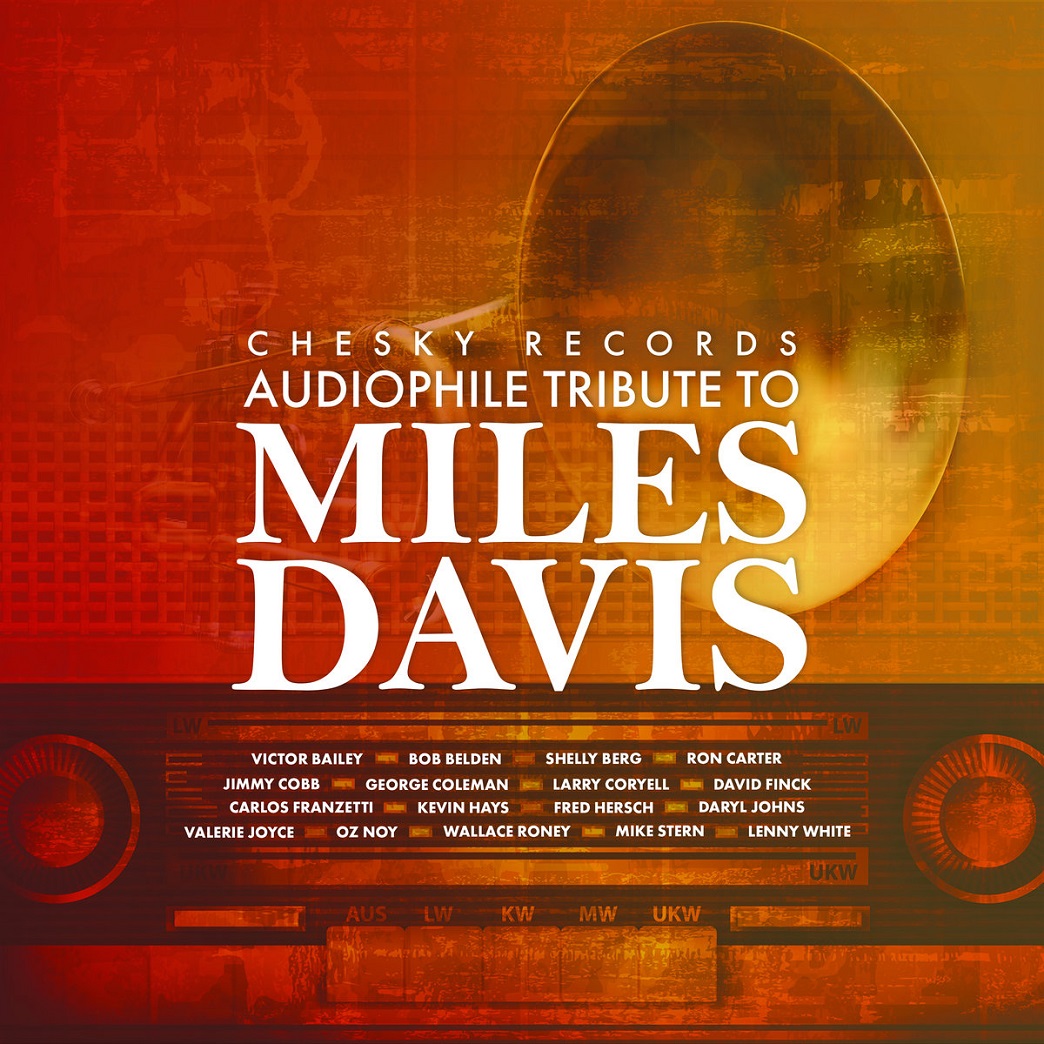
Miles Davis is synonymous with the history of Jazz. With a discography that includes over 80 albums, Davis' catalog is as expansive as it is timeless. On this Chesky Records compilation, we've assembled Jazz luminaries' interpretations of his works in tribute to the immortal greatness of Miles Davis. Add to the beautiful music that it was pristinely captured for an audiophile audience, and you have a classic album for the ages.
1. Shh Peaceful 11:21
Wallace Roney, Bob Belden, Oz Noy, Kevin Hays, Daryl Johns, Lenny White
2. Circle 05:17
Carlos Franzetti
3. So What 06:17
Victor Bailey, Larry Coryell, Lenny White
4. It's About That Time 14:29
Wallace Roney, Bob Belden, Oz Noy, Kevin Hays, Daryl Johns, Lenny White
5. Solar 02:32
Shelly Berg & David Finck
6. Blue In Green 04:31
Valerie Joyce
7. Mademoiselle Mabry 10:05
Wallace Roney, Bob Belden, Oz Noy, Kevin Hays, Daryl Johns, Lenny White
8. Milestones 03:51
The Fred Hersch Trio
9. Blue in Green 07:28
George Coleman, Mike Stern, Ron Carter, Jimmy Cobb
10. All Blues 07:03
George Coleman, Mike Stern, Ron Carter, Jimmy Cobb
11. Eighty One 06:30
George Coleman, Mike Stern, Ron Carter, Jimmy Cobb
12. Freddie Freeloader 06:34
George Coleman, Mike Stern, Ron Carter, Jimmy Cobb
"You’re hard-pressed to find rising talents more exciting than Camille Thurman."
- New York Times
Following up her Chesky debut, Inside the Moment, which debuted #25 on the Billboard Jazz Albums Chart, Camille Thurman returns for her sophomore Chesky effort. Supported by Jazz veterans Cecil McBee (Bass), Jack Wilkins (Guitar), Steve Williams (Drums), and Jeremy Pelt (Trumpet), Camille showcases her remarkable talent and potential both vocally and on saxophone on this collection of Jazz standards entitled Waiting for the Sunrise. Part of the Chesky Binaural + Series, all recorded with a single microphone, the band appears right before you with this spacious, lush and multi-dimensional recording. Now headphone users will hear the same three-dimensional sound and imaging as audiophiles have for the past 25 years with Chesky Recordings. Also these new Binaural+ Series albums capture even more spatial realism for the home audiophile market, bringing you one step closer to the actual event. You will hear some of the most natural and pure music ever recorded.
Come along for the ride as Chesky Records transports you to the Lower East Side of Manhattan for a live Jazz performance from Mark Whitfield and his band consisting of Billy Drummond and Ben Allison. Recorded live at Rockwood Music Hall, experience the interplay between three seasoned Jazz veterans embracing the moment on Live & Uncut. Mark Whitfield has been a celebrated guitarist for nearly three decades, performing with Dizzy Gillespie, Art Blakey, Quincy Jones, Ray Charles, Herbie Hancock, Carmen McRae, Gladys Knight, Burt Bacharach, Jimmy Smith, Clark Terry, Shirley Horn, Wynton Marsalis, Branford Marsalis, Joe Williams, Stanley Turrentine and his greatest teacher and mentor George Benson.
Released September 1, 2017
1. Without A Song 10:16
2. Invitation 07:32
3. Willow Weep For Me 09:36
4. Changes For Monk and Trane 08:05
5. Jackie-ing 06:17
6. Dubai 07:43
Band:
Ben Allison: Bass
Billy Drummond: Drums
Mark Whitfield: Guitar
Produced by: David Chesky
Executive Producer: Norman Chesky
Recorded, edited, and mastered by Nicholas Prout
Second Engineer: Mor Mezrich
Assistant Engineer: Janelle Costa
A&R: Jeff Lanier
Recorded February 19th, 2017 at Rockwood Music Hall, New York
The duo album has tremendous lineage throughout Jazz history and on Chesky Records. The Deep adds another timeless pairing with Shelly Berg and David Finck complimenting each other on fourteen stunning new cuts, many of which were improvised on the spot. We are hearing them react to each other and create in real time with no discussion other than with their instruments, showcasing a lifetime of masterfully honed skill and experience. That this improvised material works so well with the standards they chose is further testament to the musicianship of Berg and Finck.
GRAMMY Nominated Shelly Berg is widely known for his collaborations with vocalists. He has performed, recorded, or arranged for Gloria Estefan, Patti Austin, Bobby McFerrin, Kurt Elling, Michael Feinstein, Renée Fleming, Gregory Porter, Aretha Franklin, Tierney Sutton, Janelle Monáe, Queen Latifa, Lorraine Feather, Monica Mancini, Rita Moreno, Ricky Martin, Kevin Spacey, Dionne Warwick, Carmen Bradford, and many more. Shelly is also the music director of The Jazz Cruise and maintains a busy, worldwide schedule of jazz festival and club performances.
Music can only be described with words, but for David Finck, music is a language all its own. He has played and recorded with Dizzy Gillespie, Aretha Franklin, Sinead O'Connor, Natalie Cole, Rod Stewart, Herbie Hancock, Ivan Lins, Al Jarreau, Tony Bennett, Paquito D'Rivera, George Michael, Rosemary Clooney and Andre Previn, to name just a few. Over the years, David has become one of the most sought-after musicians in Manhattan, equally revered for his work in jazz, popular, Brazilian and classical music. He's bridged musical diversity through his skills -- but even more so through his ability to hear music as language in an almost literal sense.
Part of the Chesky Binaural + Series, all recorded with a single microphone, the band appears right before you with this spacious, lush and multi-dimensional recording. Now headphone users will hear the same three-dimensional sound and imaging as audiophiles have for the past 25 years with Chesky Recordings. Also these new Binaural+ Series albums capture even more spatial realism for the home audiophile market, bringing you one step closer to the actual event. You will hear some of the most natural and pure music ever recorded.
"This is extra cool music. Especially we would like to highlight a grand rendition of Dark Eyes which just soaks you up into the music."- Jazz Messengers The shadows of the Sonny Rollins trio and Joe Henderson trio (both having recorded classic albums at the Village Vanguard) hover over this sparse, revealing trio outing with Jackson, Carter and Drummond. And like his sax playing elders, Jackson put his own stamp on a set of well chosen jazz standards while also showcasing a few originals. “Sonny being a big influence on me, obviously there would be some things in there that would be reminiscent, or have that spirit anyway,” says Jackson, who just hit the half century mark this June.
And while playing without a chordal instrument was a challenge in some respects for the saxophonist, he explains that Carter’s presence more than made up for the absence of piano on this Chesky release. “Ron is kind of like a symphony behind you. He’s the bass player, but he’s the piano at times, he’s the drums and he’s out front with the melody. So he can be several things at once. With him there, there are so many colors that are available to me. So it’s not out of disrespect to the piano, it’s just that with Ron, we have a lot of opportunities. This trio setting just allows him to kind of roam a little bit and be more of a free safety, to use a football analogy.”
Part of the Chesky Binaural + Series, all recorded with a single microphone, the band appears right before you with this spacious, lush and multi-dimensional recording. Now headphone users will hear the same three-dimensional sound and imaging as audiophiles have for the past 25 years with Chesky Recordings. Also, these new Binaural+ Series albums capture even more spatial realism for the home audiophile market, bringing you one step closer to the actual event. You will hear some of the most natural and pure Jazz music ever.