Showing posts with label Kenny Barron. Show all posts

Saturday, March 19, 2022

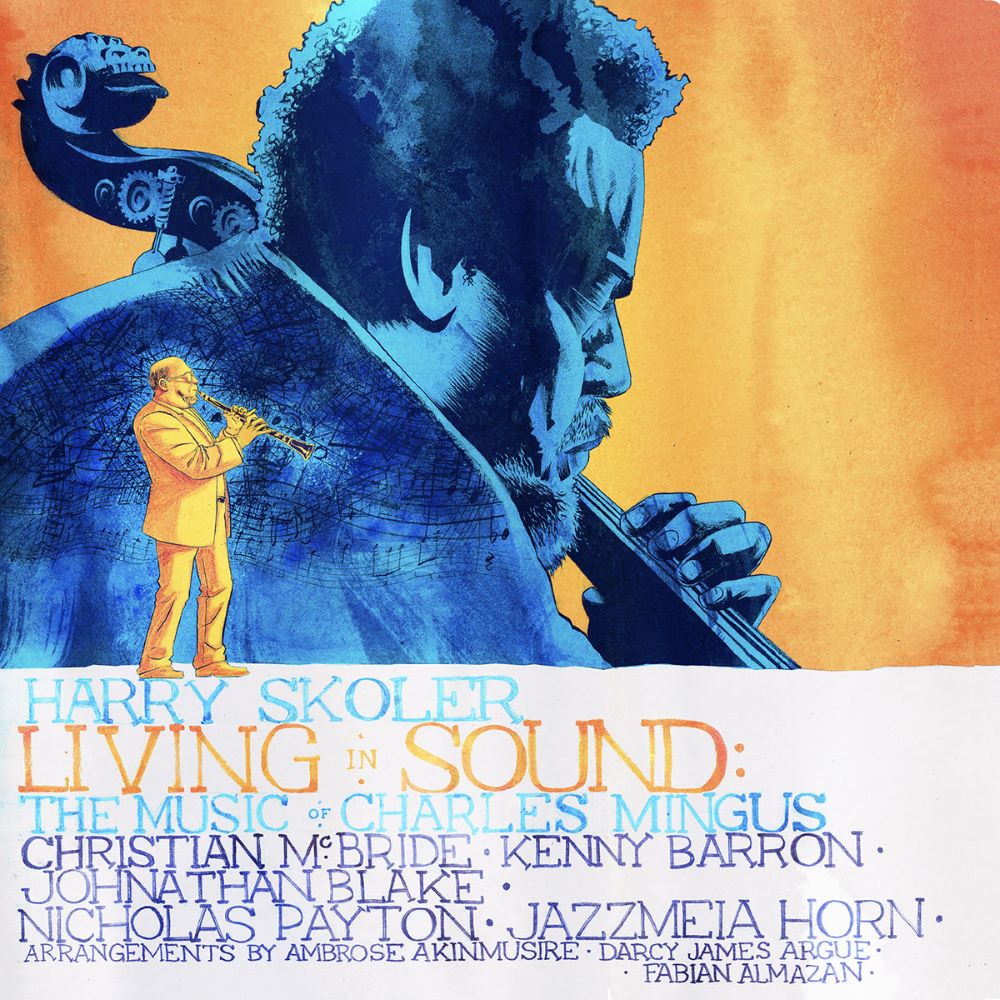
Harry Skoler - Living In Sound: The Music of Charles Mingus (April 22, 2022 Sunnyside Records)

The righteous and bombastic nature of the great bassist/composer Charles Mingus made him a polarizing personality. His unique personality, combined with his groundbreaking music, were magnetic for open-minded listeners. Clarinetist Harry Skoler discovered Mingus and his music early in life. This discovery would change his entire trajectory as a person and musician, which Skoler celebrates on his new recording, Living In Sound: The Music of Charles Mingus.

Skoler had a challenging adolescence while growing up in Syracuse, New York during the 1960s and early 1970s. While seeking solace from a traumatic event, he discovered the world of Charles Mingus, initially from the bassist’s Mingus Moves LP (Atlantic, 1974). The overwhelming impact on Skoler led him to investigate both Mingus’s legendary musical oeuvre and his autobiography, Beneath the Underdog. Mingus’s words and music resonated with the young musician. It is as though he had found truth in the work of one artist.

It wasn’t long before Skoler was able to experience Mingus in the flesh at Syracuse University’s Jabberwocky student club. The experience was beyond anything that Skoler had experienced up until then. Mingus’s powerful presence and command were larger than life. The experience was imprinted deeply on Skoler and is represented in an original graphic story by Dave Chisholm included with Living In Sound.

Over forty years later, Skoler already had a wonderful career as a working musician and professor at the celebrated Berklee College of Music. In 2018, his life was saved from a ruptured artery; then depression set in. This is when Skoler met saxophonist Walter Smith III. Meeting Smith proved to be the catalyst and spark that Skoler needed. Skoler immediately felt that he needed to record again and asked Smith if he would be willing to produce a new album, to which Smith agreed.

It was the collaborative effort of Skoler and Smith that proposed a project celebrating Mingus with strings. Skoler was excited by the possibilities and the project went forward with Smith suggesting the string quartet, jazz accompanists, and arrangers for the pieces. The producer was able to gather an all-star group, which included pianist Kenny Barron, bassist Christian McBride, drummer Johnathan Blake, trumpeter Nicolas Payton, and vocalist Jazzmeia Horn. A string quartet of violinists Megan Gould and Tomoko Omura, with violist Karen Waltuch and cellist Noah Hoffeld was also commissioned.

The recording features arrangements by some of the brightest compositional minds in jazz, namely Darcy James Argue, Ambrose Akinmusire, and Fabian Almazan. The pieces to be performed were selected ad hoc by the arrangers or by Skoler and Smith. The arrangers were trusted to do whatever they wanted in the arrangements. The pieces were ready in August 2021, when Skoler met the band and string quartet at Sear Sound for two days of recording.

The recording begins with Fabian Almazan’s arrangement of “Goodbye Pork Pie Hat,” bittersweet strings leading to Skoler’s laid back reading of one of Mingus’s most beloved tunes. Darcy James Argue twists “Peggy’s Blue Skylight” dramatically, as the rhythmic strings bounce intricately off one another and McBride and Barron stretch out on their individual solos. Argue created a perfect showcase for Skoler on “Duke Ellington’s Sound of Love,” providing an at times lush, then spare, arrangement allowing the clarinetist to dial into the same wistful feelings of respect and love for Mingus’s hero, Duke Ellington, with the aid of McBride’s supportive bass.

Mingus’s striking “Remember Rockefeller at Attica” is filled by Almazan’s pen with the chilling effect and violence that its namesake event inspired; Skoler’s pained screaming through his clarinet, and Payton’s thoughtful trumpet are highlights of the recording. Akinmusire’s arrangement of Don Pullen’s “Newcomer” is nuanced and deep, the tune being from the Mingus Moves LP that was the origin of Skoler’s Mingus appreciation. Brilliant vocalist Jazzmeia Horn brings Doug Hammond’s “Moves” to life, the subtlety and strength of her voice amplified by the meditative tone poem arranged by Almazan.

Argue chose to tackle “Sue’s Changes” for a thrilling and inventive suite with ever changing emotions and transitions, played masterfully by the ensemble and providing Payton some true solo highlights. “Invisible Lady” is a gorgeous, mysterious piece loved by Skoler; Akinmusire’s arrangement provides languid, noirish tones. Skoler’s original, “Underdog,” was completed under the wire, although the conception was developed over months. The composer wrote the piece just prior to the final recording session as a sketch that provides freedom for all the musicians to express themselves without hindrance.

The music that Harry Skoler, Walter Smith III, and their brilliant cast recorded on Living In Sound captures the many moods of the iconoclastic Charles Mingus. There are shades of tumult, harmonic depth, conceptual depth, and abandon. A perfect tribute to the legend to mark his centennial year. 

1. Goodbye Pork Pie Hat
2. Peggy's Blue Skylight
3. Duke Ellington's Sound of Love
4. Remember Rockefeller at Attica
5. Newcomer
6. Moves
7. Sue's Changes
8. Invisible Lady
9. Underdog

Harry Skoler - clarinet
Kenny Barron - piano
Christian McBride - bass
Johnathan Blake - drums
Jazzmeia Horn - vocals
Nicholas Payton - trumpet
Megan Gould - violin I
Tomoto Omura - violin II
Karen Waltuch - viola
Noah Hoffeld - cello

Friday, October 1, 2021

Joe Farnsworth | "City of Sounds" | Available October 1 via Smoke Sessions Records

Drummer Joe Farnsworth Celebrates the Fortitude of
New York City’s Jazz Community with
Second Release for Smoke Sessions Records

Due Out October 1, City of Sounds Features
Kenny Barron and Peter Washington

Prior to the events of 2020, it may have been easy to take New York City’s thriving and diverse music scene for granted. But when clubs went dark and an unsettling silence descended on the metropolis, it served as a stark reminder of just how vitally important it is to keep the music alive. Drummer Joe Farnsworth determined to do just that, and remained a stalwart jazz warrior throughout the pandemic. His celebratory new album, City of Sounds, is both a testament to his efforts and a heartfelt tribute to the musical melting pot he’s called home for more than three decades.

Due out October 1 via Smoke Sessions Records, City of Sounds was captured onstage at Smoke Jazz & Supper Club with a superb trio featuring legendary pianist Kenny Barron and bass titan Peter Washington. The three are reunited from Farnsworth’s Smoke Sessions debut, Time To Swing, which also included Wynton Marsalis in the line-up. Here Farnsworth sticks to the core trio, a format in which he’s thrived throughout his storied career – including collaborations with McCoy Tyner, Cedar Walton, Harold Mabern, Hank Jones, David Hazeltine and ELEW, among many others.

“I've learned so much from this city,” Farnsworth declares. “Then the city got rocked, so I wanted to try to give back. One of the ways I could do that was by staying here and playing whenever and however I could to keep the sounds alive.”

The performance represented by City of Sounds is just one example of that effort. A thrilling live concert from Farnsworth’s birthday week in February 2021, it bears the traces of the strange period we’re just now emerging from, with musicians in masks and separated by plastic barriers, playing to an empty club for an audience of virtual listeners streaming the music live at home.

Not that any of those inconveniences are reflected in the music. The trio plays with as much vigor, wit and muscularity as if the place was packed throughout a rollicking set that spans the stylistic spectrum. That’s one of – if not the main – reasons that Farnsworth remains so dedicated to his adopted hometown, and one that he was proud to see survive the travails of a turbulent period.

“I went on a Black Lives Matter march from Inwood through Harlem that ended up at a park on the West Side Highway,” he recalls. “As we marched, people were flying the flags of the Dominican Republic, and Puerto Rico, and you’d hear salsa music playing from their windows. Then you went through Harlem and heard funk and soul and rap music. Everyone was cheering for the same thing, but there were all these different sounds. You can't get that anywhere else in the world.”

If that trek can be summed up in a single tune, it’s here in Barron’s “Bud-like,” a tribute to bebop pioneer Bud Powell that also bears a slight Latin tinge. Farnsworth continues the Latin feel with his sultry original “Ojos Cariñosos.” Translated as “brown eyes,” the tune is dedicated to a Dominican friend and was inspired by his collaborations with percussionist/bandleader Bobby Sanabria and lessons learned from Miguel “Mike” Amadeo, the Puerto Rican-born songwriter and proprietor of Casa Amadeo, the city’s longest-running Latin music store.

The set gets off to a brisk and swinging start with Barron’s “New York Attitude.” The song was originally recorded on the pianist’s 1996 album of the same name, but it’s an apt kick-off to an exhilarating evening dedicated to the toughness and tenacity of the jazz mecca’s steadfast musical community.
“We're at Smoke and there's no one there, there're baffles between us, and we have masks on – Kenny Barron, who is royalty and could easily have decided just to stay home and not deal with this, is across the stage with a double mask on. But he's out there. That’s the fortitude of the New York musician. You have to have it to be here because you get smacked around by so many different things, but you just keep showing up.”

The flip side of that attitude is the tenderness and grace that Barron brings to a classic standard like “The Surrey with the Fringe on Top,” buoyed by Washington’s fleet basslines and the airy touch of Farnsworth’s nimble brushwork. “Moonlight in Vermont” is taken at an achingly slow pace, inspired by an encounter that Farnsworth shared with vocalist Betty Carter while playing at the now-defunct Greenwich Village club Sweet Basil in Benny Golson’s band. Album closer “Softly, as in a Morning Sunrise,” meanwhile, takes on an uncharacteristic brightness that represents the dawn after the darkness.

“Kenny suggested that tune,” Farnsworth says. “Everybody was so worried about the future at that point. We were constantly talking about taking things day by day. That's all you heard during the pandemic, but it’s something you should hear every day. So ‘Softly’ is a reminder that today is a new day.”

Farnsworth’s “City of Sounds” is a woozy blues that hints at an after hours jam session, while the blistering “No Fills” recounts a formative lesson taught to him by saxophonist George Coleman. “After the set George asked me, ‘Do you want some butter with them rolls?’ I was playing too much. He wanted me to be more like Billy Higgins. If you listen to Hank Mobley’s Straight No Filter, they do a tune called ‘Soft Impressions’ where McCoy Tyner is on fire but Billy never plays a fill. It's just straight through the top like George was talking about. For me, that's really the bible of no fills.”

The continuity of tradition represented by the album is also captured in its cover photo, which was taken in Weehawken, New Jersey at the same spot where saxophonist Benny Golson is depicted on the cover of 1959’s New York Scene. Golson was one of Farnsworth’s earliest employers, and the site is not far from the homes of Thelonious Monk and Barry Harris, which Farnsworth says affected the very atmosphere of the place.

“People ask all the time if it's still relevant to come to New York anymore,” Farnsworth concludes. “Without a doubt, if you were to spend a year here, you would be a better musician. Why? Charlie Parker's not here, but you still feel him. Monk's not here, but you still feel him. Their presence flows through the streets. It flows through the people. It’s the ultimate power source.”

"City of Sounds" was produced by Paul Stache and Damon Smith,
recorded live at Smoke Jazz & Supper Club, NYC from February 19-21, 2021
and mastered to ½” analog tape using a Studer mastering deck.

Joe Farnsworth · City of Sounds
Smoke Sessions Records · Release Date: October 1, 2021

For more information on other Smoke Sessions Records releases, please visit:

Friday, August 6, 2021

NEW RELEASE: Gerry Gibbs / Thrasher Dream Trio - Songs From My Father (August 6, 2021 via Whaling City Sound)

Celebrated Drummer and Bandleader Gerry Gibbs Announces the Release of Songs From My Father

A Celebration of the Music of Bebop Luminary Terry Gibbs,
Prominently Featuring Musical Titan Chick Corea, In His Final Recording


Songs From My Father is the much-anticipated new album from renowned musical polymath Gerry Gibbs. On his thirteenth release as a leader, drummer - percussionist - bandleader - arranger Gibbs presents a smashing double-disc masterwork featuring four iterations of his acclaimed Thrasher Dream Trio. Under his astute direction, this band of jazz titans pays homage to the musical legacy of Gerry's 96-year-old father, Terry Gibbs. To honor Terry, one of the last living architects of bebop and innovators of the vibraphone, Gerry selected 18 tunes from his father’s vast discography and interpreted the timeless material through his own refined compositional lens with inventive, modern arrangements. Notably, Songs From My Father features the last recorded performance of the great Chick Corea, and includes one of Chick's tunes composed specifically for this project. With Gibbs in the drum chair, his Thrasher Dream Trios include Chick Corea and Ron Carter; Kenny Barron and Buster Williams; Patrice Rushen and Larry Goldings; and Geoff Keezer and Christian McBride; along with percussionist Kyeshie Gibbs.

A global pandemic could not slow down this jazz luminary - instead it inspired an impressive stint of creative output. Gibbs presents Songs From My Father fresh off the heels from his 2019 epic, genre-defying opus Our People, hailed by Philip Booth of JazzTimes as “Artfully layered pieces often verg[ing] on the cinematic...Quite a feat,” as well as 2020’s Emotional Pandemic, an 18-track album fully composed, engineered and performed (all eight instruments!) by Gibbs and released, free-of-charge, to a select 500 friends and collaborators. In fact, it was this release that piqued the attention of the legendary Chick Corea who initially inquired about Gibbs’ process for writing and recording all of the instruments. The conversation evolved to the possibility of collaboration, and the concept was born of releasing a double disc filled with the product of Gibbs’ collaborations with four astounding trios, including a collaboration with Corea and Ron Carter. Corea would later ask to be more deeply involved in the music that was being recorded, composing an original piece in dedication to Terry Gibbs “Tango For Terry”, and arranging two pieces for the album.
Gerry Gibbs by Joan Carroll

Gibbs remarks “What I wanted to do seemed almost impossible with COVID, fear, traveling, safety precautions as well as logistics. How do you coordinate four trios when a disease was spreading all over America?” In the throes of a global pandemic, Gibbs found himself on a several-month nationwide journey to capture recordings of himself alongside a long list of his friends and collaborators - the finest improvisers of our time. NEA Jazz Master Ron Carter notes, “one of the fun things that I look forward to, when playing with Gerry is what part of drum history will I be able to identify when he plays...what an unfortunate surprise that the trio recording that I was a part of with Gerry would be Chick's last recording. Chick and I played on several recordings together and I cherish those moments even more now.”

“To record my challenging music,” Gibbs notes, “and not being able to rehearse because of safety protocols seemed unrealistic, so I changed course and thought it would be best to play music that would be great vehicles to do what these 8 of the greatest improvisers on the planet are known for doing, improvise!” Ultimately, the bandleader decided to perform material written by one of his all-time favorite musicians and composers, someone’s music that was deeply integrated within his own musical upbringing and the history and lineage of the jazz idiom  - the archetypal works of his own father Terry Gibbs.

Terry Gibbs first earned international recognition touring with Chubby Jackson, Buddy Rich and Woody Herman. In 1951, he joined the Benny Goodman Sextet. Subsequently, he toured with his own quartet where he won the title of "# 1 Vibraphonist in the world," in both the Downbeat and Metronome polls from 1950 to 1955. Gibbs also played a role in breaking down the race and sex barrier in music by employing pianists Terry Pollard, who he often featured in vibe duos, Pat Moran, and Alice Coltrane. Throughout his illustrious career Gibbs has enjoyed world acclaim playing with greats such as clarinetist Buddy DeFranco, Charlie Parker, Dizzy Gillespie, Horace Silver, Max Roach, Art Blakey, Elvin Jones and Tito Puente. With 65 albums to his credit, Gibbs is the composer of 300+ compositions that were recorded by Nat “King” Cole, Les Brown, Cannonball Adderly, Count Basie, George Shearing and many more. 

Gibbs indicates that  “for the longest time, I wanted to do a tribute to him while he was still here. He is getting ready to turn 97 this year and still in great shape. He is, of course, known for being one of the last original BeBoppers alive and innovators of the vibraphone. As you will hear, he composes in many different ways making it a lot of fun to reimagine his music through these 8 true giants in music - his melodies inspired some incredible solos from all 9 of us.”

During the process of recording, a huge tragedy occurred with the untimely and completely unexpected passing of Chick Corea. Gibbs notes “I, like everyone that’s my age, grew up learning from and idolizing Chick. For the last 5 months of his life we spoke weekly on the phone. Sometimes it was about future plans to do more music together, sometimes it was to talk about new music he or I was working on. Sometimes it was just to say hello. What an honor to have had those last 5 months becoming friends with him.” Songs From My Father is the last recording Chick Corea played on, a testament to Corea’s stellar creative output right up until the very end.
Gerry Gibbs by Joan Carroll

Disc 1 of Songs From My Father features Chick Corea and Ron Carter on “Bopstacle Course”, composed in 1974 and “Sweet Young Song of Love” composed in 1985, and arranged by Gibbs and Corea. The first disc’s final track, “Hey Chick”, is a special homage to the memory of Chick Corea. Conceived and compiled by Gerry Gibbs, this monumental performance features every musician from all four iterations of the Thrasher Dreams Trio as well as the audio from Terry Gibbs’ original 1961 recording of the composition, then titled “Hey Jim” (which also included pianist Pat Moran bassist Max Bennett and Mike Romero on drums). The melody of the piece is first stated by a trio with Geoff Keezer, Ron Carter and Gibbs on drums, seamlessly transitioning into the track’s first solo which features a recording of several choruses from Terry Gibbs’ solo from the original 1961 recording, which Gerry Gibbs fused with overdubbing from Larry Goldings on organ, and himself on drums. The piece then transitions through five additional solos featuring various trios with Gerry Gibbs alongside Larry Goldings and Ron Carter; Kenny Barron and Buster Williams; Patrice Rushen and Larry Goldings; Geoff Keezer and Christian McBride; and Ron Carter, Buster Williams, Larry Goldings and Christian McBride respectively. Upon listening to this special compilation of masterful performers, Gerry and Terry discussed the matter and decided to retitle the tune “Hey Chick” as a dedication to the late musical titan. The Thrasher Dream Trio iteration with the inimitable Kenny Barron and Buster Williams is featured on the album opener “Kick Those Feet” and “Take It From Me” both composed in 1964. “Smoke Em Up” (1968) and “Lonely Days” (1955) both feature Gibbs alongside pianist Patrice Rushen and organist Larry Goldings. Gibbs performs with pianist Geoff Keezer and bassist Christian McBride on 1955’s “Nutty Notes”, and 1958’s “The Fat Man”.

Disc 2 provides audiences with further arrangements of timeless Gibbs compositions including 1949’s “T & S” and 1955’s “Lonely Dreams” featuring Barron, Gibbs and Williams; 1978’s “Townhouse 3”, 1961’s “Hippie Twist” and 1958’s “Pretty Blue Eyes” featuring Rushen, Gibbs and Goldings; 1978’s “4 A.M”, 1961’s “For Keeps” and 1955’s “Gibberish” featuring Keezer, Gibbs and McBride; and 1964’s “Waltz For My Children”  featuring and arranged by Chick Corea, alongside Gibbs and Carter as well as the final piece on the album - “Tango For Terry” written and performed by Corea for his old friend Terry Gibbs.

After 10 months and 15,000 miles of car travel to assemble the recordings for this masterpiece, Gerry Gibbs’ newest outing will finally be in the hands of listeners. Songs From My Father acts as a document to the memory of the fallen jazz titan who graces many of its tracks, Chick Corea, and the legacy of the luminary whose work the album reflects, bebop architect Terry Gibbs. With this monumental new recording, Gerry Gibbs cements his standing as one of the most creative and forward-thinking musicians on the contemporary jazz scene.

TRACKS – Disk 1
1. Kick Those Feet
2. Smoke 'Em Up
3. Bopstacle Course
4. Nutty Notes
5. Take It From Me
6. Sweet Young Song Of Love
7. The Fat Man
8. Lonely Days
9. Hey Chick

TRACKS – Disk 2
1. Townhouse 3
2. T & S
3. 4 A.M.
4. Waltz For My Children
5. Hippie Twist
6. Lonely Dreams
7. For Keeps
8. Pretty Blue Eyes
9. Gibberish
10. Tango For Terry

Featured

Thrasher Dream Trio #2
disc 1 – tracks 1,5 / disc 2 – 2,6

Gerry Gibbs / drums, percussion

Chick Corea/ acoustic piano, minimoog

Ron Carter/ acoustic bass

Thrasher Dream Trio #2
disc 1 – tracks 1,5 / disc 2 – 2,6

Gerry Gibbs / drums, percussion

Kenny Barron/ acoustic piano

Buster Williams/ acoustic bass

Thrasher Dream Trio #3
disc 1 – tracks 2,8 / disc 2 – 1,5,8

Gerry Gibbs / drums, percussion

Patrice Rushen/ acoustic piano

Larry Goldings/ Hammond B3 organ

Thrasher Dream Trio #4
disc 1 – tracks 4,7 / disc 2 – 3,7,9

Gerry Gibbs / drums

Geoff Keezer/ acoustic piano

Christen McBride/ acoustic bass

Friday, August 24, 2018

Steve Turre - The Very Thought of You (SMOKE SESSIONS RECORDS August 24, 2018)


Virtuoso Trombonist Steve Turre Displays

Brilliant Artistry with Heartfelt Ballads on New Release,

The Very Thought of You

Available August 24 via Smoke Sessions Records

on Double Vinyl LP, Deluxe 8-Panel

Gatefold CD Digipak, and Hi-Res Download


The thought of Steve Turre inevitably conjures the image of a dauntless virtuoso. Over the course of a remarkable career spanning more than five decades, Turre has proved time and time again that he’s one of the foremost masters of the trombone, able to steer his challenging instrument through breakneck turns and imaginative leaps at dizzying speed.

On The Very Thought Of You, Turre shows off a less celebrated side of his brilliant artistry: his moving, heartfelt way with a ballad. Luxuriating in timeless melodies and swathed in lush strings, Turre makes his horn sing with delicate lyricism and subtle beauty. Of course, the irrepressible trombonist can’t help but unleash his fiercely swinging side, peppering his ballad set with a few pulse-quickeners here and there.

Due out August 24, 2018 via Smoke Sessions Records, The Very Thought Of You features a stellar quartet ideal for a session that calls for a light touch combined with the soul-stirring depth of feeling that Turre brings to everything that he plays. Turre is joined by pianist Kenny Barron, bassist Buster Williams, and drummer Willie Jones III, supplemented on four of the pieces by a string octet conducted by veteran arranger Marty Sheller. An outstanding pair of guests, legendary tenor saxophonist George Coleman and guitar great Russell Malone, both lend their breathtaking mastery to the music as well.

“There’s a challenge to playing ballads on any instrument,” Turre admits. “It’s not about showing off; it’s about trying to play beautiful, to touch somebody with your sound and with your phrasing. The reason I wanted to do it is because I’ve never done it before. I’ve done so many records where I play fast and complicated. It was time to play ballads.”

Especially on the four immortal classics to which Sheller added strings – “Never Let Me Go,” “Shadow of Your Smile,” “Danny Boy,” and the title track – Turre likened his role to that of a singer, ceding the solo spotlight to his bandmates while focusing his own playing on the interpretation of the songs’ incredible melodies.

“I don’t know anybody on the trombone that can play faster than Curtis Fuller could,” Turre explains. “But when I first came to New York in 1973, I met Curtis and he told me that the hardest thing to do is to play simple and have it mean something. So my role wasn’t as the improviser; I was the singer, and my focus was to make the melody say something without over-embellishing it.”

It was some of the music’s most renowned vocalists that inspired Turre’s choice of standards on The Very Thought Of You. Nancy Wilson’s versions of the title tune and “Never Let Me Go” convinced the trombonist that he wanted to take on those melodies, while a live rendition of “The Shadow of Your Smile” so captivated him that he added it to the setlist. “Carmen McRae sang nothing but the melody and it was so astounding,” Turre recalls.

The Very Thought of You is not the first time that Turre has melded his voice with strings. On Lotus Flower (1999), he led a sextet where the frontline swapped sax and trumpet for Akua Dixon’s cello and Regina Carter’s violin. And on his 1997 self-titled album he teamed with Sheller – a longtime colleague on the Latin jazz scene – for a string arrangement of the Machito classic “Ayer Lo Vi Llorar” featuring the iconic Afro-Cuban singer Graciela. But the new album marks the first time that Turre has utilized strings in the traditional vein of classics like Clifford Brown with Strings or Nat King Cole’s elegant sound.

“With ballads, it’s not about playing loud and boisterous, it’s about playing with subtlety,” Turre says. “The strings help to bring that out. Plus, Marty Sheller’s writing was just sublime, so tasteful and lush and not overdone but complimentary to a T.”

After opening the album with a swooning “The Very Thought of You,” the band is joined by Malone for the first time on an up-tempo but laid-back romp through “September in the Rain.” Then Turre and Malone pair off for the trombonist’s intimate duet piece “No Regrets.” The song was originally written back in the ‘70s while Turre was playing bass in drummer Chico Hamilton’s band, where once a night the leader would take a break and leave Turre to play duo with guitarist Rodney Jones. On “Freedom Park, SA” Turre and Jones go head to head with a free improv sparked by a melody conceived by Turre while playing a festival in South Africa last year.

Turre contributes his own ballad to the proceedings with the wistful “Time Will Tell,” then nods to his late mentor J.J. Johnson (as well as his wife) on the trombone giant’s touching “Carolyn in the Morning.” Coleman’s heart-wrenching solo on “Never Let Me Go” is a highlight of the album, but Turre welcomes him back to let loose on a rip-roaring take on Charlie Parker’s “Yardbird Suite.”

The album concludes on a poignant note with the sentimental Irish ballad “Danny Boy,” a particularly meaningful choice for Turre. He fell in love with the song through Ben Webster’s version, but never played it until his brother-in-law, frail but still alert at 100 -years-old, made the request. On the opposite end of the age spectrum, Turre’s gentle but jaunty “Sachiko” is named for a baby whose smile touched his heart during a chance encounter in San Francisco.

There are countless musical moments that might come to mind at the thought of Steve Turre: his formative stint with Art Blakey’s Jazz Messengers, his innovative collaborations with Rahsaan Roland Kirk, his tenures on the road with Ray Charles or Woody Shaw, his decades as a member of the Saturday Night Live band, his ground-breaking use of conch shells as musical instruments, countless collaborations with the greatest artists in jazz and popular music. With The Very Thought of You, Turre offers a beautifully vulnerable and lyrical side to that catalogue of memories.

1 The Very Thought of You 5:17
2 September in the Rain 6:15
3 No Regrets 4:31
4 Carolyn (In the Morning) 6:23
5 Never Let Me Go 6:05
6 Sachiko 6:17
7 Freedom Park, SA 4:13
8 The Shadow of Your Smile 3:29
9 Time Will Tell 5:27
10 Yardbird Suite 6:56
11 Danny Boy 3:51

Thursday, April 5, 2018

Kenny Barron Quintet - Concentric Circles (BLUE NOTE May 4, 2018)

On his last two on impulses! Records released albums provided Kenny Barron with small casts for magical moments. In 2014, the pianist demonstrated "The Art Of Conversation" in intimate musical dialogues with bassist Dave Holland. The recording was named the album of the year by the Jazz Journalists Association. His "Book Of Intuition" he played in 2016 again in a trio with bassist Kiyoshi Kitagawa and drummer Johnathan Blake. The extensive discography of Kenny Barron is paved with such high-profile duo and trio recordings abundantly. Following his move to Blue Note Records, Barron is back on Kitagawa and Blake on his latest album "Concentric Circles". However, the sonic palette will be greatly enhanced this time by the addition of saxophonist Dayna Stephens and trumpeter Mike Rodriguez. "I've always wanted to record with a quintet because it gives me the opportunity to compose more," Barron notes soberly.

Of course, "Concentric Circles" is by no means Barron's first album in this format. Both the 1968 published album "You Had Better Listen", on which he was named alongside the trumpeter Jimmy Owens as a co-leader, as well as his 1973 launched solo debut album "Sunset To Dawn" he had already recorded with quintet ensembles. In the 1980s he directed another quintet with saxophonist John Stubblefield, trumpeter Wallace Roney, bassist Cecil McBee and drummer Victor Lewis, who recorded the critically acclaimed 1986 album "What If". Two years later, with only a slightly changed line-up (Eddie Henderson replaced Roney), the no less excellent album "Live At Fat Tuesdays".

Barron's quintet from the late 1990s, made up of Henderson, saxophonist David Sánchez, bassist Rufus Reid and drummer Billy Hart, also formed the core of the ensemble, with which Barron recorded "Spirit Song" in 2000. For "Images", he completely reorganized his quintet four years later, occupying it with vibraphonist Stefon Harris, flutist Anne Drummond, Kitagawa, and drummer Kim Thompson. Concentric Circles is now Barron's first true quintet publication since Images.

Kenny Barron presents not only his latest quintet, but also some of his own original compositions never before recorded by him. He opens with "DPW", a brisk hard-bop number, in which he pays tribute to the Brooklyn neighborhood of Ditmas Park West, where he is at home today. With the melody and its urban harmonies played in unison by trumpet and tenorsax, this 2013 song is reminiscent of the classics known from Art Blakey's Jazz Messengers or the Miles Davis Quintet of the mid-sixties. Through a first-class groove that moves between straight hard-bop and Afro-Latin rhythms, Barron beats a crystalline, yet lyrical, improvisation into the keys that makes it clear what a master of touch, phrasing and harmonic finesse he is is.

The title track "Concentric Circles" is followed by a tantalizing waltz, which is carried by the flickering rubato of the rhythm section and embellished with smooth solos by Barron, Stephens and Rodriguez. Blake's urging 6/8 rhythms drive "Blue Waters," another new Barron composition that is peppered with smart, blues-laden passages. After that, the sunny atmosphere of the first pieces in "A Short Journey" gives way to a more subdued timbre. The underworld ballad is characterized by casual brass melodies, pensive piano lines, floating cymbals and pulsating bass accompaniment.


But the mood cheers up in the next issue again. Barron surprises here with a charming reworking of Caetano Veloso and Cézar Mendes' "Aquele Frevo Axé". With this lithe samba jewel that Barron became aware of through a recording by Gal Costa, the pianist continues his ongoing love affair with Brazilian music. The contemplative mood contrasts sharply with the unpredictable nature of Barron's next original "Von Hangman," in which the piano, trumpet, and saxophone navigate through a maze of zig-zagging phrases, while the rhythm section propels them forward in a stirring gait.

Contemplatively, it is again in Barron's heartbreaking play "In The Dark", which he had originally composed in 2009 for the soundtrack of the movie "Another Harvest Moon". The song reveals Barron's talent for composing scenic music. He indulges in his penchant for Latin American rhythms again in the lively original "Baile". "L's Bop" was written by the drummer Lenny White and offers the two brass players and the leader an ideal opportunity to let off steam. In "I'm Just Sayin '", Barron provides a funky bass line that Kitagawa soon picks up before the piece hits an implied Crescent City groove.

The mind of Thelonious Monk is always present on Barron's recordings in one way or another. Here, he pays tribute to the jazz icon, which has influenced and inspired him so much, with a grand piano solo interpretation of the classic "Reflections". The pianist had recorded the number several times before, the first time in 1982 with the Monk tribute band Sphere for the album "Four In One", the - macabre coincidence! - just recorded the day Thelonious Monk died.

With "Concentric Circles," Kenny Barron, who turns 75 in June, underscores that he does not intend to rest on his laurels. Because as he shows on this album with eight own compositions and three fabulous interpretations, he still has a lot to tell his audience.

01 DPW
02 Concentric Circles
03 Blue Waters
04 A Short Journey
05 Aquele Frevo Axé
06 Von Hangman
07 In the Dark
08 Baile
09 L's Bop
10 I'm Just Sayin'
11 Reflections


Dayna Stephens, saxophone
Mike Rodriguez, trumpet bugle
Kiyoshi Kitagawa, bass
Johnathan Blake, drums

Tuesday, April 3, 2018

Eddie Henderson - Be Cool (SMOKE SESSIONS RECORDS May 4, 2018)

Before he walks out the door on his way to a gig, 77-year-old trumpeter Eddie Henderson always gets two words of advice from his wife: be cool. The legendary trumpeter has taken that mantra to heart, and on Be Cool, his new release on Smoke Sessions Records, he shows just how hot cool can get.

Of course, if you're going to be cool it helps to surround yourself with the coolest of the cool, and Henderson has done just that: his smokin' quintet also features saxophonist Donald Harrison, pianist Kenny Barron, bassist Essiet Essiet, and drummer Mike Clark. Together, the band conjures smoldering funk, lush ballads, broad-shouldered swing, and bristling bop -- in all, a prismatic display of the many facets of cool.

"For me, 'be cool' means compose yourself and don't act jagged, musically or personally," Henderson offers. "One connotation is to not play so erratically, to push the envelope to the edge but not go over. It's like going fishing: if you're not prepared when you throw your line out there, you might catch Jaws instead of a minnow. Personally, it's about playing with people who love each other and share a good chemistry."

That's undoubtedly the case with the group Henderson has convened for his second Smoke Sessions outing as a leader. His relationship with Barron stretches back more than three decades, to the early days following his return to New York in the mid-'80s after a decade spent practicing medicine in San Francisco. He's been working regularly with Clark in recent years, especially in the Wolff & Clark Expedition, the drummers co-led band with pianist Michael Wolff. But they also share roots in the fusion bands of Herbie Hancock -- Henderson with Mwandishi and Clark immediately after with Headhunters. Essiet, meanwhile, has been a constant in Henderson's recent bands, while he's shared stages with Harrison under the auspices of the super-group The Cookers.

"Be Cool" was produced by Paul Stache and Damon Smith and recorded live in New York at Sear Sound's Studio C on a Sear-Avalon custom console at 96KHz/24bit and mixed to ½" analog tape using a Studer mastering deck. Available in audiophile HD format.

1 Smoke Screen 4:37
2 Be Cool 5:01
3 After You've Gone 7:04
4 Loft Funk 6:59
5 Fran-Dance 6:25
6 The Moontrane 5:26
7 Naima 7:07
8 The Sand Castle Head Hunter 6:44
9 Nightride 8:17
10 Toys 6:37
11 Easy Living 5:44
12 Dla Juzi 6:55

Saturday, February 11, 2017

Lee Konitz - Frescalalto (IMPULSE! 2017)


At 89, Lee Konitz has nothing left to prove, but the legendary saxophonist, who began his long recording career on Miles Davis’ Birth of the Cool back in 1949, proves here nonetheless that he remains one of the most original and truly improvisatory talents in jazz.

Konitz has always sounded like a man searching for the least obvious path through a standard, and here – with long-standing associates pianist Kenny Barron, bassist Peter Washington and drummer Kenny Washington – on a set of hoary old chestnuts including Stella by Starlight, Darn that Dream and Out of Nowhere, he steadfastly avoids cliché once more.

Frescalalto is the sound of a venerable musical mind – one of the last living links with jazz’s classic period – still sharp, still searching, still capable of the sound of surprise. impulse-label.com


1. Stella By Starlight 9:35
2. Thingin 6:25
3. Darn That Dream 5:17
4. Kary's Trance 4:57
5. Out Of Nowhere 7:26
6. Gundula 3:25
7. Invitation 9:19
8. Cherokee 3:57

Alto Saxophone, Vocals – Lee Konitz
Piano – Kenny Barron
Double Bass – Peter Washington
Drums, Producer – Kenny Washington

Recorded on November 30 & December 1st 2015 at Avatar Studios, NY
Mastered at Battery Studios, NY

Wednesday, March 9, 2016

Kenny Barron Trio - Book Of Intuition (2016)


Kenny Barron, the 72-year-old Philadelphia-born virtuoso, is the kind of jazz pianist whose resources are familiar and much-covered by mainstream swing players, but whose joyfully extravagant execution is a rarity today. That quality transforms this trio set from being a canter through a smooth-jazzy assortment of soft ballads, Latin smoochers and glossy swing. Barron has absorbed an encyclopaedia of jazz methods from a life on the road with legends such as Ella Fitzgerald and Stan Getz, and it pours out in these tracks. Magic Dance, with its glistening chords and Latin-jazz tick, sounds smooth at first but unleashes an impulsive torrent. Ballads such as In the Slow Lane display his impeccably light touch and Thelonious Monk’s Shuffle Boil isn’t Monkishly lateral but swings furiously. The jangling Lunacy is a collective bustle prodded by bassist Kiyoshi Kitagawa and drummer Johnathan Blake, while Nightfall is delicate drift through slow chords. There might be too many notes for some on this record, but it’s almost all affectingly musical just the same.

If you have been vaguely wondering what happened to wholehearted, outgoing jazz piano in the grand manner, just listen to this album’s opening track, Magic Dance. It has everything – attractive melody, unbuttoned swing, virtuosity and enough rhythmic sleight-of-hand to keep you wide awake. Among the dozen or so most admired pianists in jazz today, Kenny Barron strikes me as the one who wears his mastery most comfortably. From a languid piece such as Dreams, to Thelonious Monk’s fiendishly tricky Shuffle-Boil, there’s a gentle firmness to his playing. In some mysterious way he makes the piano sound bigger too. Bassist Kiyoshi Kitagawa and drummer Johnathan Blake follow every move with seamless subtlety.

Magic Dance
Bud Like
Cook's Bay
In The Slow Lane
Shuffle Boil
Light Blue
Lunacy
Dreams
Prayer
Nightfall

Kenny Barron, piano
Kiyoshi Kitagawa, double bass
Johnathan Blake, drums

BUY THIS ALBUM!!!

Domi