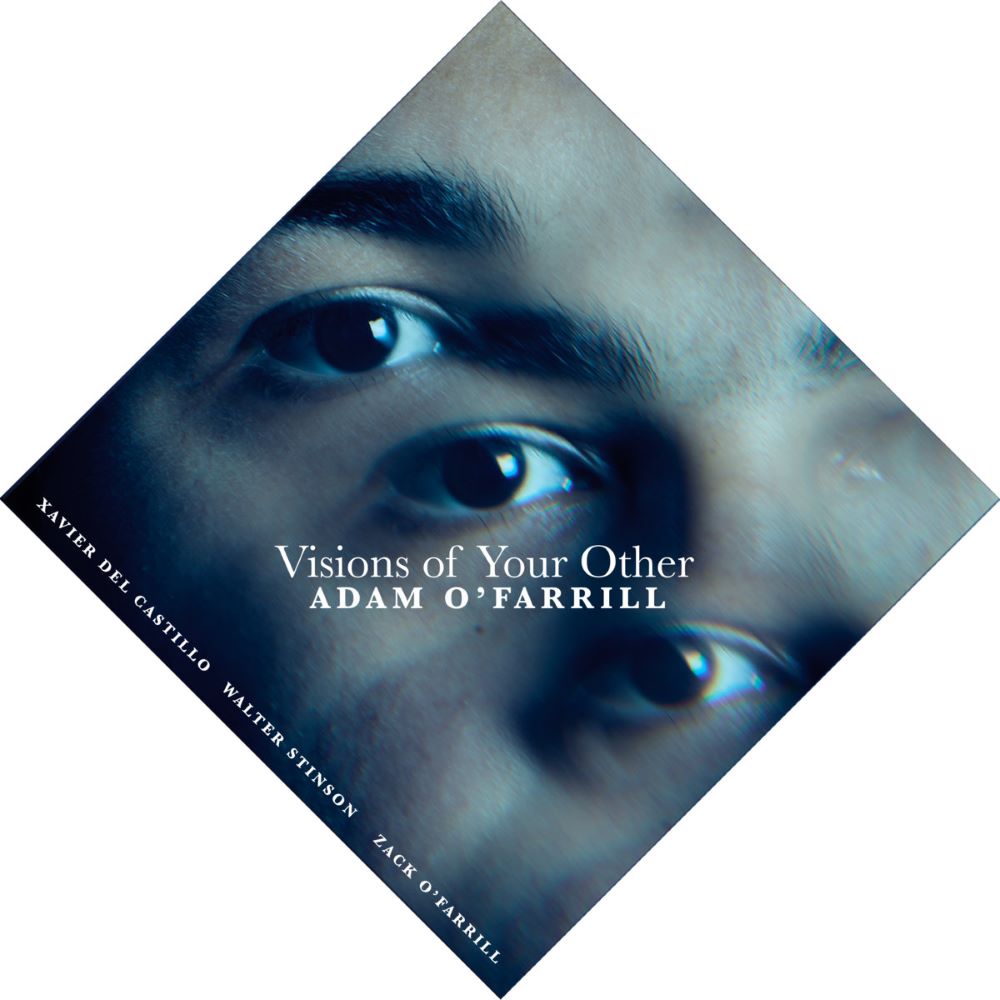
"Visions Of Your Other" is the third album by Adam O'Farrill's Stranger Days, one that takes the band back to its roots in original compositions after their Mexican folk music-inspired release, El Maquech. Adam and two of his bandmates, Walter Stinson on bass and Zack O'Farrill on drums, return along with the arrival of Xavier Del Castillo on tenor saxophone.
The album takes its title from a scene in Paul Thomas Anderson's post-WWII psychological portrait, "The Master", in which the main character, a veteran suffering PTSD, is interrogated about supposed visions he had of his mother.
In the vein of this theme of dueling realities, the album functions a study of conflict and contrast. The opening track, "stakra", takes Ryuichi Sakamoto's chromatic fantasy of the same name and extracts just a fragment of it, allowing the band to enter a deeper sonic meditation. Walter Stinson's "Kurosawa at Berghain" finds the meeting place between the rigidity of electronic house music and the spontaneity of acoustic, chord-less quartet. Adam wrote both "Inner War" and "Ducks" while staying and working at Morning Glory Farm in Bethel, ME in the summer of 2017, the former of which is a reflection of inner turmoil he felt when bringing chickens to be slaughtered. "Hopeful Heart" is a pseudo-lullaby inspired by the story of two lovers torn apart by circumstance, yet their uncertainty is lightly tinged with optimism. And the closing track, "Blackening Skies", was written from a climate change-induced anxiety, having experienced a scorching heatwave in NY within days of a summer monsoon in LA.
Trumpeter Adam O’Farrill pivots away from his family’s musical legacy toward dazzling postbop sounds
Trumpeter Adam O’Farrill is just 23, but there’s already plenty of weight attached to his name. His father is the acclaimed, innovative Latin jazz bandleader and pianist Arturo O’Farrill, and his grandfather was the great Afro-Cuban bandleader Chico. He began to forge his own path early on in his career, making waves playing alongside saxophonist Rudresh Mahanthappa on the latter’s 2015 album Bird Calls (ACT) and establishing himself as an improviser of protean strength and melodic clarity.
On his debut as a bandleader, 2016’s Stranger Days (Sunnyside), Adam eschews any connection to the lineage carved out by his forebears, pursuing a limber but sharply articulated strain of free bop that sparkles with erudition, soul, and precision. Leading a quartet with tenor saxophonist Chad Lefkowitz-Brown, bassist Walter Stinson, and his older brother Zach O’Farrill on drums, Adam proffers a vanguard postbop sound with rhythmic, elastic structures and harmonic thickets that support his sneaky, snaking melodies. A year ago I saw the group play a fiery but measured set in New York, and that performance, along with the group’s forthcoming second full-length, El Maquech (due in June from Biophilia), has completely convinced me that his band is the real deal. The album, which was recorded in the midst of a tour, captures the band playing with serious heat and interactive brio. This time out Adam explicitly draws upon nonjazz sources, opening with a thrilling adaptation of a northern Mexican folk tune called “Siiva Moiiva” and ending with a smoldering rendition of “Pour Maman,” an electro-soul song by New York singer-songwriter Gabriel Gárzon-Montano. While it’s early in 2018, I haven’t heard a better jazz record yet this year. By Peter Margasak / www.chicagoreader.com
Though he has only been at it for a short time, Adam O'Farrill has displayed maturity in his music beyond his 21 years. The young trumpeter/composer was introduced to the music world early on and quickly ascertained the importance of history, hard work and collaboration to realize his voice as an artist. On his debut recording as a leader, Stranger Days, O'Farrill introduces his fantastic and highly interactive quartet of the same name, showcasing distinctive and subtly programmatic original pieces.
The Brooklyn born and raised O'Farrill comes from a celebrated musical lineage: his grandfather, the Cuban composer/arranger Chico O'Farrill; his father, pianist and composer Arturo O'Farrill; and his mother Alison Deane, a classical pianist. Growing up in a musically rich environment, his parents showing him everything from Oscar Peterson to Steely Dan to Olivier Messiaen, it was only natural that he fell into it, first with piano lessons and then to the trumpet when he was 8 years old.
It was the influence of many, including his father and his bandmates, that led O'Farrill to appreciate the aspects of community within music, but it was the influence of his older brother and drummer Zack that really helped him deepen his studying and listening. Together they shared their love of jazz, traded recordings and played together on a daily basis. To this day, they have a deep musical connection that is apparent when they are on the bandstand.
O'Farrill's evolution has been a fast one and much of that is due to the teachers he has had. His first trumpet teacher was the great Jim Seeley, followed by studies with the likes of Nathan Warner, Thomas Smith, Cecil Bridgewater, and Laurie Frink. The latter he briefly studied with at Manhattan School of Music, where he is in his final semester and where he met his first composition instructor, Reiko Füting, who had a profound impact on O'Farrill's approach to composition.
It wasn't long before listeners began to take note of O'Farrill's talent. He has performed extensively with his father, most often in his sextet, Boss Level, and in the Afro Latin Jazz Orchestra, including on the Grammy nominated Cuba: The Conversation Continues. It is O'Farrill's recent association with saxophonist Rudresh Mahanthappa that has garnered him the most attention, as he has placed himself alongside one of the most important musical conceptualists of the past decade, on the highly lauded Bird Calls. Other creative artists that Adam has worked with include Gabriel Zucker, Stephan Crump, JIL, Sister Helen, Fred Ho, Onyx Collective, and Samora Pinderhughes.
Stranger Days was originally assembled in February 2014 as a quick addition to a triple bill. O'Farrill naturally chose his coconspirator and brother for the drum chair and then a couple of his longtime musical friends (he sees them as older brothers) to join the mix, tenor saxophonist Chad Lefkowitz-Brown and bassist Walter Stinson.
Along with music, O'Farrill loves films. His appreciation of cinema has strengthened his view of narrative and character within his music. His intention in his music is to permit a balance between the individual identities of the musicians and the direction of the music, in many cases to tell a story, carried by the overall band sound. Therefore, he needed musicians who he could trust to bring authenticity to the compositions, along with their distinctive personalities (and humor). O'Farrill has that in his friends, the crew of Stranger Days.
The recording begins with “A&R Italian Eatery,” a laid back introductory waltz that allows a playful dialogue between the band members. The piece depicts 'those old New York Italian restaurants where all the regulars are sitting around shooting the shit' (as Adam says). Named after the Camus novel, “The Stranger” is a Mingus inspired study of the story's main character's psychological murkiness, the solo trumpet intro interpreting the waves of an Algerian beach. “Survival Instincts” is a real challenge, as this ensemble piece presents a variety of difficult sequences that the musicians have to survive, like bosses that must be defeated before moving on to the next level of a video game.
A Lefkowitz-Brown sax 'monologue' introduces Stinson's “Why She Loves,” an enigmatic, yet moving piece that truly showcases everyone's musical character. “Alligator Got The Blues” is swampy and lurking, a slightly elegiac piece that picks up pace under a striking sax solo. Stinson also penned “Forget Everything You've Learned At School,” a tough piece that wittily represents a teacher and a poor student throwing all they learned out the window.
“The Cows and Their Farmer Walt” was written with the imagination of Stinson as a disgruntled farmer. This piece was deeply inspired by the classic Mickey Mouse cartoon, The Band Concert (1935), but in this case the tornado is Zack's thunderous drums, which inspired Adam to dub him 'Brother Nature.’ Following this tremendous drum solo, “The Courtroom” continues the story as a judge (bass), a politician (sax), and an environmental scientist (trumpet) try to come to terms with what happened after this natural disaster, not to mention what happened to the cows and their farmer.
The grooving and pointillistic “Building the Metamorphosen Bridge” utilizes a system of improvising where certain bass positions signal certain harmonic intervals that the horns can solo on. This is the final piece in a trilogy of sorts that began with “The Cows,” as the building of the bridge is a sign towards progress and development. Closing in a more traditional vein, “Lower Brooklyn Botanical Union” is a contrafact of Billy Strayhorn's “U.M.M.G.” and also contains a hip salute to O'Farrill's grandfather, utilizing a piece of the flute melody from his masterwork, The Second Afro Cuban Jazz Suite. The piece concludes the album in a way that shows how modernist the ensemble is, but also has a deep respect and understanding of what came before.
The mightily talented Adam O'Farrill has assembled a singular group in Stranger Days. Together, they have created a quiet, intense, at times humorous, and at all times entertaining debut album.
01. A & R Italian Eatery 03:29
02. The Stranger 10:17
03. Survival Instincts 06:50
04. Why She Loves 08:52
05. Alligator Got The Blues 05:51
06. Forget Everything You've Learned At School 05:44