Showing posts with label Rudresh Mahanthappa. Show all posts

Friday, February 4, 2022

Rudresh Mahanthappa Hero Trio - Animal Crossing EP (February 4, 2022 Whirlwind Recordings)

Acclaimed alto saxophonist Rudresh Mahanthappa reconvenes his Hero Trio with Rudy Royston and François Moutin for new 4-song EP

Animal Crossing, due out digitally February 4, 2022 via Whirlwind Recordings, tackles eclectic repertoire including the theme from the wildly popular video game and songs by Pat Metheny, Chuck Mangione and George Michael

“Its central achievement is bridging the gap between supposed high and lowbrow, as Mahanthappa’s trio convincingly puts a distinctive stamp on the eclectic source material, with sparkling cocktails of grooves, hooks and solos…”
– Kevin LeGendre, Jazzwise

" [Mahanthappa is] making truly some of the most original jazz out there at the moment."
– Brian Zimmerman, Jazziz

Listen! Up on all digital streaming services! It’s a Bird… It’s a Trane…No, it’s Rudresh Mahanthappa’s Hero Trio! The Caped Composer and his intrepid trio with bassist François Moutin and drummer Rudy Royston first assembled when the world needed them most, at the height of the pandemic. But the mid-2020 release of their self-titled debut also meant that most audiences were deprived of seeing them in person – great for maintaining secret identities, less ideal for celebrating live music.
 
But like any great superhero, Mahanthappa and the Hero Trio are back with a much-anticipated sequel. Animal Crossing, due out February 4, 2022 via Whirlwind Recordings, is a digital-only EP featuring four new songs, each an unlikely addition to the canon of jazz standards. “The idea behind Hero Trio was to turn the idea of playing a set of standards on its ear and freshen up the idea,” the saxophonist explains.
 
And yes, that includes the title tune – the theme song for the wildly popular video game that became ubiquitous during lockdown. While the choice may reflect the fact that Mahanthappa has two young children at home, allowing the lilting theme to worm its way into his brain and take hold, the game – much like the Hero Trio itself – fulfills a vital need just below its playful surface. For those who somehow managed to avoid the craze, Animal Crossing players take on adorable animal avatars, which can interact with other players within the game’s virtual world.
 
“Animal Crossing ended up being a kind of savior for a lot of people in lockdown,” Mahanthappa says. “It provided an injection of calm and positivity for lots of folks and became a way for isolated people to connect. You could play with your friends online – there were even stories of people having their birthday parties in Animal Crossing. It was amazing to me that this video game had that kind of presence and power.”
All four of the songs on the new EP, along with the entire Hero Trio repertoire, have such personal meaning for Mahanthappa, in one form of another. For much of the innovative altoist’s career, he focused intently on his own original music. He first joined forces with Royston and Moutin in 2015 for Bird Calls, a quintet album that paid unconventional tribute to Charlie Parker with new pieces reconfiguring material from Bird’s iconic compositions. Hero Trio grew out of that project, with Mahanthappa turning his arranger’s vision on material from a variety of eclectic sources.
 
“Partly I think it was spurred by my teaching,” says Mahanthappa, who was named Director of Jazz at Princeton University since 2016. “I find myself playing standards with my students and realizing that I really enjoy that.”
 
The reference in the title of Pat Metheny’s “Missouri Uncompromised” to one of the darkest moments in American history and a direct antecedent to the Civil War certainly has ominous echoes with our current divisive political moment. The tune itself is also simply a longtime favorite, a rarely reprised piece from the guitarist’s 1976 debut album, Bright Size Life. “That’s my favorite Metheny album, and ‘Missouri Uncompromised’ is my favorite tune on the album,” Mahanthappa says. “I never get tired of it, and I always thought that it would be a real challenge to record as a horn player.”
 
The name Chuck Mangione, on the other hand, doesn’t exactly scream “challenging” – the flugelhornist’s 1977 megahit “Feels So Good” instantly became the soundtrack of choice for breezy, carefree good times. That reputation obscures Mangione’s serious jazz chops (he’s an alumni of Art Blakey’s Jazz Messengers, for one) but Mahanthappa chose “Give It All You Got” for reasons much closer to home.
 
“My older brother was a huge Chuck Mangione fan when he was in late high school or early college,” he recalls. “He had a Chuck Mangione t-shirt! A lot of the music that I was exposed to when I was a kid came through my brother. Whatever he was into became what I was into by default. So I wanted to record ‘Give It All You Got’ because the music that you hear when you're really young had an impact, regardless of what you think of it later in life.”
 
In the trio’s transformative hands the original’s loping funk slows to a dirge-like lurch, turning an anthem of upbeat optimism into a dark ballad of determination in the face of overwhelming odds, a perfect reflection of the difficulties we’ve all been living through over the past few years.
Moutin’s vigorous pulse ushers in the album’s final track, which after a full-throttle intro coheres into a spirited take on George Michael’s “Faith.” With Mahanthappa essaying the familiar message with fierce declamation over Royston’s tumultuous rhythm, the song ends the EP on a particularly invigorating note. “George Michael had a special charisma about him,” Mahanthappa says, “and that song has a groove that is just killing. There are all these ways you can kind of manipulate it just by moving an eighth note here or there, but it always remains infectious.” Case in point – the trio’s second pass through the melody of “Faith” is superimposed on the chord changes of John Coltrane’s “Giant Steps.”
 
While Mahanthappa was excited to reconvene the Hero Trio to record these new songs, he’s even more eagerly anticipating playing for actual audiences in 2022. “We released this album in June and proceeded to do no gigs,” he laments. “We weren't even able to wear any of our superhero costumes in public! We at least want to get out there and wear the capes.”
Photos: David Crow

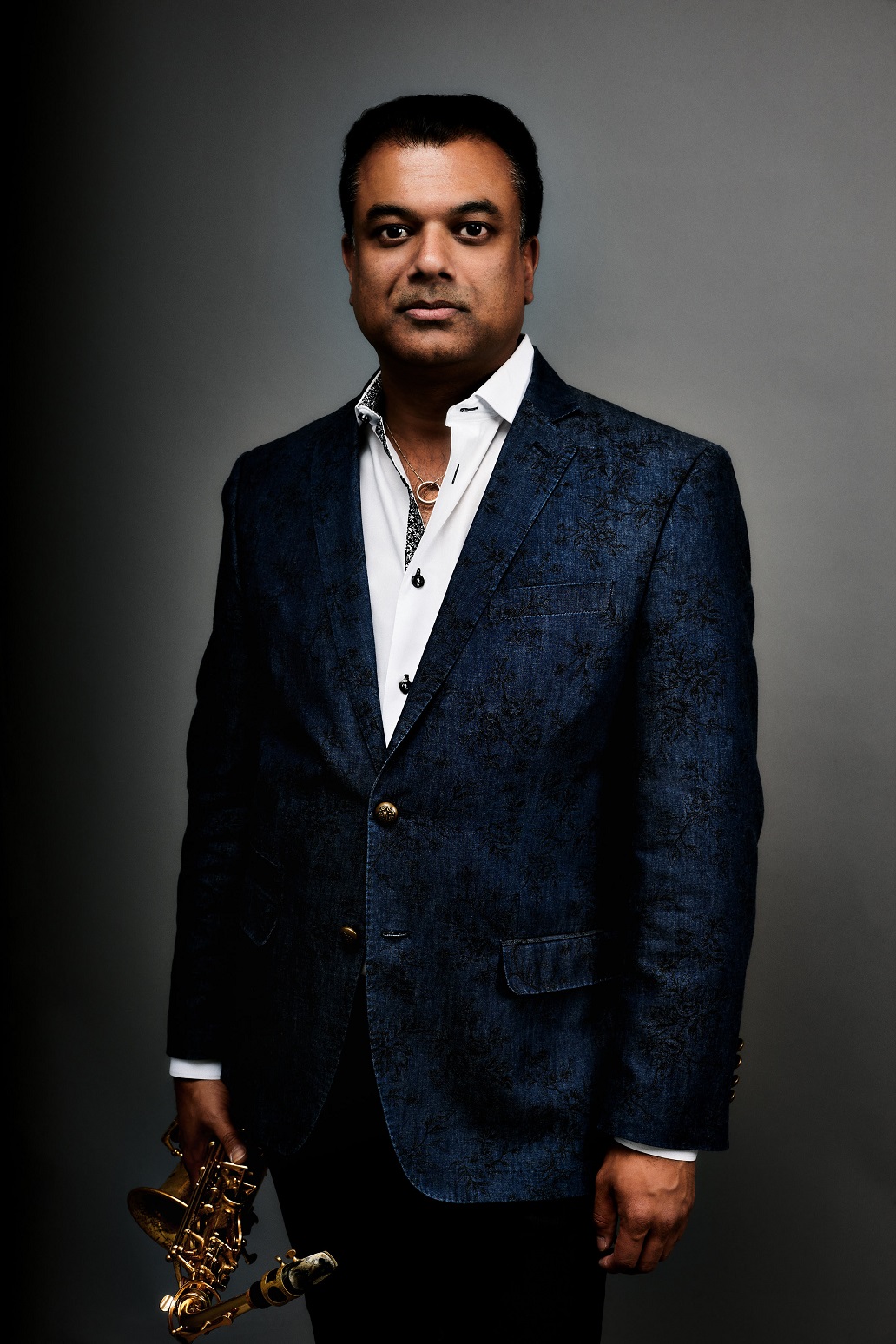
Rudresh Mahanthappa
Hailed by Pitchfork as “jaw-dropping… one of the finest saxophonists going,” alto saxophonist, composer and educator Rudresh Mahanthappa is widely known as one of the premier voices in jazz of the 21st century. He has over a dozen albums to his credit, including the acclaimed Bird Calls, which topped many critics’ best-of-year lists for 2015, and the eclectic self-titled 2020 debut of his Hero Trio with Rudy Royston and François Moutin. Mahanthappa has been named alto saxophonist of the year for nine of eleven years running in Downbeat Magazine’s International Critics’ Polls, and for five consecutive years by the Jazz Journalists’ Association (2009-2013) and again in 2016. He’s also won alto saxophonist of the year multiple times in the JazzTimes Magazine and Jazz Journalists Association Critics’ Polls and was named the Village Voice’s "Best Jazz Artist" in 2015.  He has also received the Guggenheim Fellowship and the Doris Duke Performing Artist Award, among other honors, and is currently the Anthony H. P. Lee ’79 Director of Jazz at Princeton University.

Tracks

Animal Crossing: New Horizons Theme (Kazumi Totaka) 6:08
Missouri Uncompromised (Pat Metheny) 6:42
Give It All You Got (Chuck Mangione) 5:20
Faith (George Michael) 4:29

Rudresh Mahanthappa Alto Saxophone
François Moutin Acoustic Bass
Rudy Royston Drums

Recording Date: November 22, 2021

Studio 
Sound On Sound, Montclair, NJ. 
David Amlen, Engineer

Mixed by Liberty Ellman

Mastered by Liberty Ellman

Producer Rudresh Mahanthappa

Friday, November 5, 2021

Sat. Nov. 6 – Jazz at Princeton University presents Rudresh Mahanthappa’s Hero Trio

Jazz at Princeton University presents Rudresh Mahanthappa’s internationally acclaimed Hero Trio in concert
with Princeton’s Small Group I on Saturday, November 6, 2021

Other events for the fall season include performances by student groups led by Jazz at Princeton faculty members Mahanthappa, Trineice Robinson-Martin, Matthew Parrish and Darcy James Argue
 
“Mahanthappa is “making truly some of the most original jazz out there at the moment."
– Brian Zimmerman, Jazziz
 
“The riveting cry of his alto saxophone is one of the most recognizable sounds in jazz.” 
– Thomas Conrad, Stereophile

Jazz at Princeton University, helmed by trailblazing saxophonist/composer Rudresh Mahanthappa, returns to live performances on Saturday, November 6 with a concert featuring Mahanthappa’s internationally renowned Hero Trio performing with Princeton’s Small Group I. Other concerts this season include performances by student groups led by faculty members Mahanthappa, Trineice Robinson-Martin, Matthew Parrish and Darcy James Argue. The concerts are free and open to the vaccinated public. For information, go to https://music.princeton.edu/calendar.
 
“Interfacing with the community via concerts by our renowned faculty and accomplished students has always been an important aspect of Jazz at Princeton,” says Mahanthappa. “I’m excited that we are able to bring it back and offer audiences the joy of attending live performances for the first time since the beginning of the pandemic.”
 
Fall performances include:
 
Saturday, November 6, 2021 – Jazz Small Group I and Rudresh Mahanthappa’s Hero Trio 
8 pm, Richardson Auditorium, Alexander Hall.  Free and open to the public. For tickets and information, call 609-258-9220 or log on to https://music.princeton.edu/events/jazz-small-group-i-rudresh-mahanthappa‘s-hero-trio-concert

One of the top ensembles in jazz, Mahanthappa’s Hero Trio features the saxophone icon with bassist François Moutin and drummer Rudy Royston. Their album Hero Trio, released in 2020 at the height of the pandemic, earned wide acclaim including top spots as one of the best albums of the year in outlets and publications including NPR, Paste, DownBeat, JazzTimes, Jazziz, Chicago Tribune, Boston Globe, and Denver Post. Robert Baird of Qobuz calls the album “a near perfect mix of buoyancy and mastery, a welcome revelation.” John Murph of DownBeat writes: “These tributes burst with so much interpretive ingenuity, sparkling friction and caffeinated improvisational interplay that they demand considerable replay.” Jason Bivins wrote in Dusted that Hero Trio offers “a genuinely expansive, and often thrilling, ride through songs from Mahanthappa’s personal pantheon.…In a year of precious little joy, this is quite simply a jewel of a jazz record.”  

Wednesday, December 1 – Jazz Small Group I led by Rudresh Mahanthappa
7:30 pm, Taplin Auditorium, Fine Hall. Free and open to the public. For information, call 609-258-9220 or log on to https://music.princeton.edu/events/jazz-small-group-i-concert
 
Mahanthappa leads Princeton’s premiere small jazz ensemble in an energizing and beautiful evening of music.

Thursday, December 2 – Jazz Vocal Collective led by Trineice Robinson-Martin
7:30 pm, Taplin Auditorium, Fine Hall. Free and open to the public. For information, call 609-258-9220 or log on to https://music.princeton.edu/events/jazz-vocal-collective-3
 
Jazz at Princeton University’s Jazz Vocal Collective (JVC), Princeton University's elite small jazz ensemble that features solo voice, will join director Dr. Trineice Robinson-Martin and showcase their original arrangements of classic and contemporary jazz compositions. 
 
Internationally recognized as one of the leading educators in gospel and soul voice training, Dr. Trineice Robinson-Martin specializes in vocal pedagogy and performance practices for contemporary music styles (jazz, pop, gospel, R&B, country, rock, music theater). As the creator of Soul Ingredients®, a methodology for nurturing vocal freedom and authentic musical interpretation and expression, Dr. Robinson-Martin regularly travels nationally and internationally teaching voice, lecturing and giving workshops. She also performs internationally and recently released All Or Nothing, her highly acclaimed debut album as a leader.
 
Saturday, December 4 – Small Groups X & Z led by Matthew Parrish
7:30 pm, Taplin Auditorium, Fine Hall. Free and open to the public. For information, call 609-258-9220 or log on to https://music.princeton.edu/events/jazz-small-groups-x-z
 
The Princeton University Jazz Ensembles X & Z perform under the direction of master bassist Matthew Parrish. Group X evokes the small group tradition of the Art Blakey groups of the 50’s and 60's where improvisation and inspiring interaction are key. The group performs as a septet with several featured trio performances. Group Z is new this year, created in response to the expanding number of excellent student musicians participating in Princeton’s jazz program.   
 
Matthew Parrish is a sought-after performer, arranger, composer, producer, and instructor. Matthew’s warmth in his playing and loyalty to delivering heartfelt, passionate works is apparent in every note, every tune, and every interaction with his fellow musicians. Born in central California, Matthew has performed and recorded with top names in jazz including Regina Carter, Wynton Marsalis, Dee Dee Bridgewater, Paquito D’Rivera, Clark Terry, Etta Jones, Orrin Evans, Clark Terry, Dr. Jonnie Smith, Savion Glover, Bill Charlap, Houston Person, and many others. He has recorded over sixty works, including his debut CD Circles (2000) and his most recent recordings with Karine Aguiar.  
 
Monday, December 6 – Small Group A led by Rudresh Mahanthappa
7:30 pm, Taplin Auditorium, Fine Hall. Free and open to the public. For information, call 609-258-9220 or log on to https://music.princeton.edu/events/jazz-small-group
 
Jazz at Princeton University's Small Group A, directed by Rudresh Mahanthappa, presents an evening of jazz at its most intimate in a showcase of improvisation and inspiring interaction. 
 
Friday, December 10 – Creative Large Ensemble – Led by Darcy James Argue
8 pm, Richardson Auditorium, Alexander Hall.  Free and open to the public. For tickets and information, call 609-258-9220 or log on to https://music.princeton.edu/events/jazz-creative-large-ensemble-fall-concert
 
Hear Jazz at Princeton University’s Creative Large Ensemble led by Darcy James Argue in their first live performance since the start of the pandemic. The ensemble continues to redefine the big band in an innovative program encompassing classic and contemporary repertoire.
 
Vancouver-born, Brooklyn-based composer and bandleader Darcy James Argue has toured nationally and internationally with his 18-piece ensemble, Secret Society. Argue made his mark with his critically acclaimed 2009 debut Infernal Machines. 2013 saw the release of Brooklyn Babylon, which, like Infernal Machines before it, earned the group nominations for both GRAMMY and JUNO Awards. His most recent recording, Real Enemies, released in the fall of 2016, earned a third consecutive GRAMMY nomination. Secret Society maintains a busy touring schedule, with European, Canadian, and South American tours and four appearances at the Newport Jazz Festival. Argue has also toured Australia and New Zealand leading the Jazzgroove Mothership Orchestra. He has led performances of his music by the WDR Big Band, the Danish Radio Big Band, the Frankfurt Radio Big Band, the Cologne Contemporary Jazz Orchestra, the Big Band Palácio das Artes, and the West Point Jazz Knights. Argue has composed works for chamber duo and string quartet, art songs for Newspeak, and created arrangements for the Atlanta Symphony. In 2015, Argue was awarded a Guggenheim Fellowship in Music Composition and a Doris Duke Artist Award. He has received commissions from the Fromm Music Foundation, the Jazz Gallery, the Manhattan New Music Project, the Jerome Foundation, and BAM, as well as ensembles including the Danish Radio Big Band, the Hard Rubber Orchestra, the West Point Jazz Knights, and the Orquestra Jazz de Matosinhos. He is the recipient of grants and fellowships from the New York Foundation for the Arts, New Music USA, the Aaron Copland Fund for Music, Composers Now, the Mid Atlantic Arts Foundation, the Canada Council for the Arts, and the MacDowell Colony.
 
Jazz at Princeton University under the direction of Rudresh Mahanthappa serves to promote this uniquely American music as a contemporary and relevant art form. Our goals are to convey the vast musical and social history of jazz, establish a strong theoretical and stylistic foundation with regard to improvisation and composition, and emphasize the development of individual expression and creativity. Offerings of this program include academic course work, performing ensembles, master classes, private study, and independent projects. Students also have the opportunity to participate in academic courses from the music department curriculum that encourage the study of the historical, social, theoretical, stylistic, and creative issues that pertain to the jazz idiom.
Hailed by Pitchfork as “jaw-dropping… one of the finest saxophonists going,” alto saxophonist, composer and educator Rudresh Mahanthappa is widely known as one of the premier voices in jazz of the 21st century. He has over a dozen albums to his credit, including the acclaimed Bird Calls, which topped many critics’ best-of-year lists for 2015 and was hailed by PopMatters as “complex, rhythmically vital, free in spirit while still criss-crossed with mutating structures.” His most recent release, Hero Trio, was considered to be one of the best jazz albums of 2020 by critics and fans alike.  Rudresh has been named alto saxophonist of the year for nine of the last eleven years running in Downbeat Magazine’s International Critics’ Polls (2011-2013, 2015-2018, 2020-1), and for five consecutive years by the Jazz Journalists’ Association (2009-2013) and again in 2016. He won alto saxophonist of the year in the 2015-2018 & 2020 JazzTimes Magazine Critics’ Polls and was named the Village Voice’s "Best Jazz Artist" in 2015.  He has also received the Guggenheim Fellowship and the Doris Duke Performing Artist Award, among other honors, and is currently the Anthony H. P. Lee ’79 Director of Jazz at Princeton University.
 
Born in Trieste, Italy to Indian émigrés in 1971, Mahanthappa was brought up in Boulder, Colorado and gained proficiency playing everything from current pop to Dixieland. He went on to studies at North Texas, Berklee and DePaul University (as well as the Stanford Jazz Workshop) and came to settle in Chicago. Soon after moving to New York in 1997 he formed his own quartet featuring pianist Vijay Iyer. The band recorded an enduring sequence of albums, Black Water, Mother Tongue and Codebook, each highlighting Mahanthappa’s inventive methodologies and deeply personal approach to composition. He and Iyer also formed the duo Raw Materials.
 
Coming deeper into contact with the Carnatic music of his parents’ native southern India, Mahanthappa partnered in 2008 with fellow altoist Kadri Gopalnath and the Dakshina Ensemble for Kinsmen, garnering wide acclaim. Apti, the first outing by Mahanthappa’s Indo-Pak Coalition (with Pakistani-born Rez Abbasi on guitar and Dan Weiss on tabla), saw release the same year; Agrima followed nine years later and considerably expanded the trio’s sonic ambitions.  In 2020, Rudresh released Hero Trio, an album of “covers” paying tribute to his musical heroes.  He also co-led a project celebrating the centenary of Charlie Parker with the blessing of the Parker estate. 
 
Mahanthappa has also worked with Jack DeJohnette, Mark Dresser, Danilo Pérez, Arturo O’Farrill’s Afro-Latin Jazz Orchestra, the collaborative trios MSG and Mauger, the co-led quintet Dual Identity with fellow altoist Steve Lehman, and another co-led quintet with fellow altoist and Chicago stalwart Bunky Green (Apex). His exploratory guitar-driven quartets on Samdhi and Gamak featured David Gilmore and Dave “Fuze” Fiuczynski, respectively. In 2015 he was commissioned by Ragamala Dance to create Song of the Jasmine for dancers and a hybrid jazz/South Indian ensemble. He was also commissioned by the PRISM Saxophone Quartet to compose a chamber piece, “I Will Not Apologize for My Tone Tonight,” which can be heard on the quartet’s 2015 double-disc release Heritage/Evolution, Volume 1.
 
Mahanthappa is a Yamaha artist and uses Vandoren reeds exclusively.

Saturday, February 13, 2021

Rudresh Mahanthappa - Hero Trio (Whirlwind Recordings)

Over the course of an illustrious twenty-five-year career Rudresh Mahanthappa’s music making has constantly pushed at the artistic boundaries to encompass such diverse influences as classic bebop, the flash and fury of electric fusion, and the complexities of Carnatic music, while always maintaining a clear sense of his own fiercely intelligent, uncompromising musical personality.

On 'Hero Trio', his sixteenth release as a leader/co-leader, he has moved the focus away from his own compositions to pay tribute to his greatest influences with an album of interpretations. All of the material is presented in Mahanthappa’s characteristically original arrangements, and to approach them with the greatest degree of freedom and spontaneity he chose to record in trio format, enlisting the talents of long-time associates François Moutin on bass and Rudy Royston on drums.

Their effortless collective virtuosity, and the perfect attunement of their musical thinking honed over two decades of playing together, makes this album an outstanding addition to the genre. “Playing chordless trio, you’re very exposed but you also have a degree of freedom that’s very special. There’s also a great history of piano trios that have a beautiful way of functioning like a single organism, and I wanted to capture that energy. I wrote the arrangements, and when we came together to rehearse I didn’t have to reorganise a thing. I felt like within ten minutes we were ready to make an album.”
His role as Director of Jazz at Princeton stimulated Mahanthappa to conduct a deep exploration of the standard repertoire, and this in turn led him to focus in on the diverse individual tunes that have helped shape his own career. Charlie Parker’s ‘Red Cross’ was one of the first Parker tunes Mahanthappa ever learnt, and appealed to him for its humour, an often overlooked component of Parker’s genius. The trio give it a thorough reworking. “It’s been interesting for me to take things apart - we play the melody divided into three different sections that are really three different moods, but it felt really natural at the same time.” ‘Overjoyed’ is an arrangement of the Stevie Wonder classic by Danilo Perez, with whom Mahanthappa has played in duo format - “Just an awesome tune in any way shape or form. Danilo’s arrangement goes through different meters and complex harmony but still flows beautifully: Francois has the ability to suggest all kinds of harmony even without a piano being present and I took full advantage of that.”

Mahanthappa wanted to acknowledge that his path would not have been possible without both Charlie Parker and John Coltrane, and he boldly combines their compositions in ‘Barbados/26-2’, emphasising the unifying strength of the melodies and the ingenuity of his arranger’s touch. By contrast, in live performance the trio have developed a strategy where the three of them create a spontaneously improvised groove for Mahanthappa to take in any direction he chooses - 'I Can’t Get Started' replicates that approach to powerful effect, showcasing how his sophisticated rhythmic conception can accommodate his love for Sonny Rollins and Benny Carter without compromise. ‘The Windup’ is from Keith Jarret’s ‘Belonging’, one of Mahanthappa’s favourite ever albums – “A ridiculously awesome album. I also liked the challenge of recording Jarrett with a pianoless group - if you can do that, then you can do anything.”

June Carter Cash wrote ‘Ring of Fire’ for her husband Johnny, and the tune connects Mahanthappa with his Colorado childhood. "Like Dolly Parton, when you take a closer look at what they did compositionally you realise that it has a conversational flow, with odd length phrases and extra bars here and there, and I wanted to capture that freedom." Reinvigorated jam session favourite ‘I’ll Remember April’ is inspired in part by the majestic version on Lee Konitz’s ‘Motion’ album, but Mahanthappa and the trio stamp their own idiosyncratic personalities onto this stunningly original performance. ‘Sadness’ explores the legacy of Ornette Coleman’s mid-sixties trio with David Izenzon and Charles Moffett - “The sonic landscape the three musicians created is pretty amazing - we wanted to explore those textures.” Mahanthappa wanted to include some lesser known Parker tunes and ‘Dewey Square’ was a last-minute spontaneous addition in the studio that provided a perfect bookend for the album.

Hero Trio is both a striking statement of Mahanthappa's own unique vision, and a tribute to his musical inspirations. “I have always wanted to record in the powerful yet intimate trio format. It would be an incomplete venture without somehow celebrating the quintessential saxophone trio work of Sonny Rollins, Lee Konitz, and Ornette Coleman. Outside of the jazz world, I first saw both Johnny Cash and Stevie Wonder on Sesame Street as a child and have always found their work to be beautiful, humorous, pensive, and utterly joyful. They have played such a strong role in helping me to look beyond the illusory boundaries of genre towards seeing music as a magical force that binds humanity. With this album, we seek to endorse and spread that message widely.”

1. Red Cross 06:29
2. Overjoyed 06:42
3. Barbados - 26/2 06:40
4. I Can't Get Started 05:30
5. The Windup 04:42
6. Ring Of Fire 03:56 video
7. I'll Remember April 05:45
8. Sadness 03:07
9. Dewey Square 02:42

Rudresh Mahanthappa - alto saxophone
François Moutin - acoustic bass
Rudy Royston - drums

Tuesday, February 13, 2018

Rudresh Mahanthappa named Best Alto Saxophonist in JazzTimes' 2017 Expanded Critics' Poll


Rudresh Mahanthappa named “Best Alto Saxophonist” in JazzTimes’ 2017 Expanded Critics’ Poll

Upcoming concerts:

• Friday, March 16 at McCarter Theatre Center, Princeton, NJ

• Sunday, March 18 at the ICA, Boston

Mahanthappa’s 2017 Indo-Pak Coalition recording Agrima earned acclaim as one of the best albums of 2017 from Rolling Stone, JazzTimes, The New York Times, NPR Music Jazz Critics Poll,
Paste Magazine and more 

Saxophonist and composer Rudresh Mahanthappa has been named “Best Alto Saxophonist” in the JazzTimes 2017 Expanded Critics Poll, published in the March 2018 issue.  For the poll, critics were asked to focus on artists’ achievements in 2017.  Mahanthappa also came in third in the “Electric/Jazz-Rock/Contemporary Group/Artist” category.

The voting came on the heels of Mahanthappa’s October 2017 recording Agrima with the Indo-Pak Coalition featuring Rez Abbasi on guitar and Dan Weiss on tabla. The recording earned numerous 4-star reviews and wide acclaim as one of the best albums of 2017 from Rolling Stone, The New York Times, NPR Music Jazz Critics Poll, Paste Magazine, JazzTimes and many others. The recording was released as a $2.50 download as well as a limited edition deluxe double LP via rudreshm.com.

“It is both humbling and rewarding to have my music recognized by some of the top jazz journalists in the world,” says Mahanthappa who in addition to performing and recording widely with his own bands, is the Director of Jazz at Princeton University.


Mahanthappa and the Indo-Pak Coalition will present two performances in March

609.258.2787

617.478.3103


Agrima is the long-awaited follow-up to the Indo-Pak Coalition’s 2008 recording Apti, which won praise from The Guardian for its “irresistible urgency.” The recording finds Mahanthappa and the group expanding aesthetic horizons: adding a modified drum set, incorporating effects and electronics, and working with a broader audio canvas overall.  The core of the band’s sound, the vibrant presence of Indian rhythmic and melodic elements in a charged, modern improvisational framework born of the New York jazz scene, remains firmly in place.

"Agrima is a knockout. The Indo-Pak Coalition stack harmonies, textures, dynamics, and peerless rhythmic maneuvering throughout in dazzling combinations. They extend the rich history of Indo-jazz fusion beyond its historical conversational and dialogic boundaries to create a new meta-musical language of their own design.” AllMusic, Thom Jurek 

“Influenced by both Indian folk and American rock, this blazing jazz trio creates an interplay that's immediate with a texture that's unique: Mahanthappa on sax, Rez Abassi on guitar and Dan Weiss splitting his time between tabla and drum kit, burning through glistening melodies. Mahanthappa plays in starts and stops, slow winds and bursts of tricky flurries, but he'll also provide a harmonium-like drone when it's time for Abassi to solo. With its hard-driving feel and a bit of distortion, the group's latest record is just as quick to feel like indie-rock moodmakers Morphine ("Showcase") or punk guitar heroes Television ("Agrima").” Rolling Stone, Christopher R. Weingarten

“Mr. Mahanthappa writes along the divide between contemporary jazz and South Asian classical, always with a sense of acute direction and well-hewn architecture. But it’s his trio’s synergy that gives Agrima what it needs: possibility, irony, tenderness.” NY Times, Giovanni Russonello

“The excitement here is large and wildly contagious.” The Buffalo News, Jeff Simon

“I’m going to spare you the comparisons to other jazz sax players and just flat-out say that Rudresh Mahanthappa is one of the best players today in terms of creativity and having a distinctive voice… Over the last 50 years, many artists have combined Indian music with jazz and rock, but nobody has done it quite like this. No matter what section of the store you file it in, Agrima is an outstanding release.” Expose, Jon Davis

“Mahanthappa uses his knife-like alto saxophone in many different contexts, but on this project he returns to that of an immigrant’s son trying to integrate his South Asian heritage into his beloved American jazz and rock. Working with guitarist Rez Abbasi and percussionist Dan Weiss, Mahanthappa employs his Charlie Parker-like speed, a tasteful dose of electronica and chameleonic themes that could thrive on either continent to fashion a triumphant fusion.” JazzTimes, Geoffrey Himes

“Mahanthappa achieves a remarkably orchestral palette with this session, featuring Rez Abbasi’s guitar and the drum/ table multiplicity of Dan Weiss. Certainly one of the most consistently exciting discs to emerge in the past year.” The World According to Rob, Robert Bush

“Indian music and NYC jazz isn’t a typical match of influences, and yet with his 2017 release Agrima, it’s as if the saxophonist has achieved a certain normalcy of presentation, to the point where an unconventional sound is as embraceable as taking your next breath. The core of Agrima is Indian music, sometimes as a melodic influence and other times imposing its will upon a piece rhythmically. But the house of the album is built with the raw materials of an indie-rock edge and contemporary grooves and electronic effects, and it’s why Agrima sits plumb with previous Mahanthappa recordings while also representing something new…Everything about this album is wonderful. And what it says about Mahanthappa’s willingness to refuse to sit still is promising as hell.” Bird is the Worm, Dave Sumner

“The core of the band's sound, the vibrant presence of Indian rhythmic and melodic elements in a charged, modern improvisational framework born of the New York jazz scene, remains firmly in place, but Mahanthappa's alto is transformed in places by software-driven effects to create strange processed timbres, echoes, decays and soundscapes.” Nextbop.com, Sébastien Hélary


“The alto saxophonist’s wind-tunnel control and technique are as breathtaking as always. The themes are more distinctly Indian, and darker, and more ambitious. Guitarist Rez Abbasi takes his tunefulness to new levels. And let’s not stop with the music: let’s say the hell with imperialist historical smog and unite India with Pakistan.” New York Music Daily. Alan Young

“There isn’t another band quite like this…These are three distinct talents, unfettered in pursuit of the brutish beauty of their collective vision, like the Indo-jazz version of Cream. Nearly a decade between albums, but worth the wait.” JazzTimes, Britt Robson

“There is individual virtuosity, at almost every turn. But the larger point of this album is the transformation of materials in a process of real-time exchange—a meeting of minds and methods that takes no possibilities for granted.” NPR Music, Nate Chinen

“…The second recording by alto saxophonist Rudresh Mahanthappa and his Indo-Pak Coalition goes beyond South-Asian/Jazz fusion, incorporating drums, electronics, and a greater sense of power and adventure… As a result, the group reunites with a fresh attack and broader range of tools, not recreating the excellent debut but creating something wider and, to my ears, richer… Agrima is a remarkable step in Mahanthappa's music because it takes his Indo-Pak Coalition and its music and makes us hear it and feel it as much more than an experiment in cross-cultural fusion. It is a pleasure to listen to these tracks and forget about the source of the melodies or the intelligence behind the musical melding of cultures. It impacts you more elementally than that: as great music that gives individual expression to three compelling personalities. And that's what great jazz does every time out.” Pop Matters, Will Layman

“With Agrima, Mahanthappa continues his penchant for creating sounds that are forward-leaning yet highly accessible, all while honoring various traditions.” Jazziz, John Frederick Moore

“The music is often fierce, sometimes hypnotic. Mahanthappa's searing saxophone careens over Weiss' rock solid rhythm and Abbasi's mesmeric guitar on "Rasikapriya."  "Alap," the brief opener, begins with Abbasi's electro-sacred tone. Weiss' tabla bubbles in, a luminescent sparkle of electronics paints a bright backdrop, and Mahanthappa's saxophone offers up a tranquil prayer. Then it's off into an insistent, cutting-edge, twenty-first century foray into the sounds of southern Asia—the deep roots—blended with the newer, growing roots of American jazz improvisation.” Allaboutjazz, Don McClenaghan

“Under the banner the Indo-Pak Coalition, the group intensely communicates joy and multi-textured sophistication. This is arresting music that takes plenty of chances yet feels entirely accessible, particularly for fans of jazz-rock fusion seeking something extraordinary.” The Denver Post, Bret Saunders

“If you’re a jazz fan who embraces music which has few boundaries, Mahanthappa, Weiss and Abbasi have created something you should hear.” Audiophile Audition, Doug Simpson

“This excellent album is like an elegant railway system linking jazz, folk, Hindustani, Pakistani Qawwali, Middle Eastern music and the chamber music style of the post-serialist and the avant-garde, 21st century conservatoire. If this sounds like quite a mouthful listeners will be delighted that despite the matrix of sound, the music is quite the distillation of it all in the singular voice of this Indo-Pak Coalition. Still, to describe it as such gives the impression of overcooking when in fact the whole project is a masterpiece of subtlety… Agrima is definitely worth its weight in gold.” JazzdaGama, Raul da Gama


Few musicians share the ability of alto saxophonist/composer Rudresh Mahanthappa to embody the expansive possibilities of his music with his culture. What has materialized is a sound that hybridizes progressive jazz and South Indian classical music in a fluid and forward-looking form that reflects Mahanthappa’s own experience growing up a second-generation Indian-American. 

Hailed by the New York Times as possessing “a roving intellect and a bladelike articulation,” Mahanthappa has been awarded a Guggenheim Fellowship, a New York Foundation for the Arts Fellowship, and commissions from the Rockefeller Foundation MAP Fund, Chamber Music America and the American Composers Forum. He has been named alto saxophonist of the year for six of seven years running in DownBeat Magazine’s International Critics’ Polls (2011-2013, 2015-2017), and for five consecutive years by the Jazz Journalists’ Association (2009-2013) and again in 2016. He won alto saxophonist of the year in the 2016 and 2017 JazzTimes Magazine Critics’ Poll. In April 2013, he received a Doris Duke Performing Artist Award, one of the most prominent arts awards in the world. In 2015, he was named a United States Artists Fellow. In 2016, he was named the Director of Jazz and the Associate Director of the Program in Musical Performance at Princeton University. 

Mahanthappa is a Yamaha artist and uses Vandoren reeds exclusively.


Wednesday, October 18, 2017

Rudresh Mahanthappa's Agrima with Indo-Pak Coalition (October 17, 2017)


WITH AGRIMA, ALTO SAXOPHONIST AND COMPOSER RUDRESH MAHANTHAPPA REUNITES THE INDO-PAK COALITION FEATURING GUITARIST REZ ABBASI, DRUMMER/PERCUSSIONIST DAN WEISS

Trio breaks new sonic and conceptual ground with first release since Apti (2008)

Independently released, Agrima is available October 17, 2017 via digital and vinyl only
(download $2, limited edition deluxe double LP), exclusively at rudreshm.com

Album Release Concert at BRIC JazzFest 2017 in Brooklyn on October 21, 2017

"The band, playing at the Litchfield Jazz Festival, "...lit a fire under the audience....Drawing on their album Agrima, they deployed a potent mix of fresh tunes and a new, expansive electronic sound."
– Phillip Lutz, DownBeat cover story

"...there is individual virory– Phtuosity, at almost every turn. But the larger point of this album is the transformation of materials in a process of real-time exchange — a meeting of minds and methods that takes no possibilities for granted."
– Nate Chinen, NPR

"These are three distinct talents, unfettered in pursuit of the brutish beauty of their collective vision.... Nearly a decade between albums, but worth the wait." – Britt Robson, JazzTimes

"...Rudresh Mahanthappa is one of the best players today.... Over the last 50 years, many artists have combined Indian music with jazz and rock, but nobody has done it quite like this....Agrima is an outstanding release." – Jon Davis, Exposé Online

"This is arresting music that takes plenty of chances yet feels entirely accessible, particularly for fans of jazz-rock fusion seeking something extraordinary." – Bret Saunders, Denver Post

"On Agrima, Abbasi’s guitar sounds as rugged as it ever has and Weiss now possesses the flexibility to go back and forth between tabla and drums to the extent that it sounds of one instrument. For his part, Mahanthappa never seems to run out of original ways to push his alto sax (and now, occasional effects) right into the great, unknown musical expanse he and his cohorts have created." – S. Victor Aaron, Something Else!

"★★★★★" – Angelo Leonardi, All About Jazz Italia

"The music on the album takes its sound from the Indian sub-continent with the intricacy of modern jazz and a boost of rock energy to make for a unique and compelling sound." - Tim Niland, Music and More

"★★★★" – Jazz Magazine (France)

"★★★★" With Agrima Mahanthappa continues to challenge himself and the listener with the difficult task of bringing the single-note and drone elements of Indian music together with jazz. Abbasi's penchant for blistering rock guitar interludes adds an almost incalculable test to the composing process. The complex methodology works, even more so than on Apti, due to the expanded reach of the better equipped Weiss. His ability move the process along and shift the environment without seismic repercussions, is just one of the wonders of Agrima. – Karl Ackermann, All About Jazz

Rudresh Mahanthappa's Indo-Pak Coalition has been hailed by The New York Times as "a trio equally grounded in folk tradition and jazz improvisation, propos[ing] a social pact as well as a musical ideal."  The ensemble's three formidable talents – Mahanthappa on alto saxophone, Rez Abbasi on guitar, and Dan Weiss on tabla – first documented their group conception in 2008 with Apti, which won praise from The Guardian for its "irresistible urgency."

Agrima, the long-awaited follow-up, finds Mahanthappa and the group expanding aesthetic horizons: adding a modified drumset, incorporating effects and electronics, and working with a broader audio canvas overall. The core of the band's sound, the vibrant presence of Indian rhythmic and melodic elements in a charged, modern improvisational framework born of the New York jazz scene, remains firmly in place.

According to Mahanthappa, "Agrima" in Sanskrit simply means "next" or "following." It comes at a propitious time for all three members: Mahanthappa has enjoyed great success with his Bird Calls quintet and recently became Director of Jazz Studies at Princeton University. Abbasi, born in Karachi, Pakistan and raised in California, has revealed a rare mastery of guitar in a range of settings including his own RAAQ acoustic quartet and his heavily electric project, Junction. Weiss, a voraciously eclectic drummer with interests ranging from classical tabla performance to metal, has garnered acclaim for his work ranging from solo drums to trio to large ensemble.


"I wanted everyone to think about Agrima as if we were making a rock album," Mahanthappa declares. "Apti is almost 10 years old and I think the way that the three of us conceive of non-Western or Indian music sonically and technically has really evolved. So I didn't want us to be concerned with having an overt Indian sound. I wanted to highlight our interactions, which we've developed since 2005 when the band premiered at New York City's Joe's Pub."

From all three instruments we hear a heightening of expressive nuance and possibility. Mahanthappa's alto is transformed in places by software-driven effects to create strange processed timbres, echoes, decays and soundscapes. "Working with electronics is like learning a new instrument," Mahanthappa says. "It takes a bit of thought to figure out how to have a voice in that realm. I ended up doing some work with Neil Leonard [from the Berklee College of Music's program in Electronic Production and Design]. He's also an alto player. He wrote a piece for the two of us, just two altos and our laptops, and he made all these patches for me, allowing me to use them however I wanted. I was always interested in electronics but my initial foray was not until Samdhi, (2011). That was really kind of a more instinctive approach but in the end it turned out really cool and I got what I wanted. Electronics was something I always wanted to get back to."

Abbasi's guitar, clean-toned and fluid (at times even acoustic) on Apti, becomes something bigger and more foreboding on Agrima: there's an edge and growl to the tone, a looming presence and sustain in the low notes, and more atmosphere thanks to an array of pedal effects that complement Mahanthappa's electronics at every turn. But perhaps the most pronounced shift from the previous record is Weiss's hybrid setup, melding tabla with drum set. "A while back we had a gig coming up in Montreal," Mahanthappa recalls, "and Dan asked what I thought about having him still be seated playing tabla but also with pieces of the drum set around him. We didn't even rehearse it, we just got to that sound check a half-hour early and Dan threw this thing together that ended up being amazing. That's how we've played ever since. On some tunes Dan only plays drum set, in fact. It all stems from our shared experience and our relationship to Indian music and jazz, which transcends the instrumentation."


In January 2017 the Indo-Pak Coalition premiered the new set of music that would become Agrima at globalFEST in New York. The energy of that encounter carried forward into the studio, from the eerie rubato incantation of "Alap" to the spiky lines and bracing tempo of "Snap," from the looping synthesized patterns, fractured beats and sunny temperament of "Agrima" to the simpler, moodier medium groove of "Showcase." The band is in peak form, executing tough thematic material, attending to fine dynamic contrasts, shifting tempos with spellbinding ease, and of course improvising with depth and ferocity.

There are riveting musical stories to be heard within "Rasikapriya" and "Revati," ambitious works with ever-shifting rhythmic foundations, gamboling between hyper-precision and pure abstraction. Between the slow and measured legato of "Can-Did" and the agitated esprit of "Take-Turns" we hear the play of extremes, of the unexpected, a many-sided adventurousness that is the Indo-Pak Coalition's reason for being. Inimitably rendered by three of the most mature and compelling players of our time, Agrima is an album likely to resonate through the years.


Friday, September 8, 2017

Rez Abbasi - Unfiltered Universe (WHIRLWIND RECORDINGS October 6, 2017)


Guitarist/Composer Rez Abbasi Melds Jazz and South Indian Music with a Bold, Original Vision on Unfiltered Universe, due out October 6

The third part of a trilogy with Abbasi's South Asian-inspired supergroup Invocation, the album features Rudresh Mahanthappa, Vijay Iyer, Johannes Weidenmueller, Dan Weiss and guest cellist Elizabeth Mikhael

"Producing so vivid a music that it can almost be tasted, Abbasi sounds like no one who has gone before him. His compositions are sheer genius." - Raul D'Gama Rose, All About Jazz

"Abbasi creates a sinuous, sometimes haunting and always evocative blend of contemporary jazz and Asia influences." - Time Out NY

Pre-order Unfiltered Universe and receive ‘Thin-King’ as instant download
(click the player below to listen)


It seems natural to refer to the music of Rez Abbasi as a hybrid, given the guitarist/composer's penchant for combining the traditions of South Asian music with his own modern jazz voice. That description ceases to fit as soon as one hears the music, however. In Abbasi's singular approach, this merging of influences feels less like a chimera, a patchwork of distinctive yet still identifiable parts; it is instead an evolution, a wholly new creature that bears distinctive traces of its antecedents yet has a form and beauty all its own.

Such is the case with Abbasi's 12th album, Unfiltered Universe (due out October 6, 2017 on Whirlwind Recordings), the third album in a trilogy exploring different South Asian musics with his stellar quintet Invocation. The band brings together five leading voices in forward-looking jazz, all of whom have extensively studied diverse South Asian traditions, often in collaboration with one another: Abbasi, saxophonist Rudresh Mahanthappa, pianist Vijay Iyer, bassist Johannes Weidenmueller, and drummer Dan Weiss.

Where Invocation's 2008 debut Things To Come highlighted the influences of North Indian Hindustani music with guest vocalist Kiran Ahluwalia, and their 2011 follow-up Suno Suno, the Qawwali music of Abbasi's native Pakistan, Unfiltered Universe takes as its point of departure the Carnatic music of South India. Abbasi's experience with Carnatic music can be traced back at least to Mahanthappa's 2008 release Kinsmen, a collaboration with South Indian saxophonist Kadri Gopalnath that merged jazz and Carnatic musicians, and continued through a 2015 project with the Indian-American Ragamala Dance Company. His studies and listening have persisted throughout the intervening years, allowing him to absorb its influence and create new music under its sway that is far from a literal interpretation of its surface qualities.

The title Unfiltered Universe refers to the way in which a lifetime of globe-spanning influences were allowed to emerge directly from Abbasi's subconscious into his music. "The idea was to operate from my intuition first while creating these compositions and then later use the thought process to manipulate the music, he says. "It's unprocessed and unfiltered, shining a light on the universe within me. It really brought the fruits of my experiences to the forefront."

Such an intuitive approach to composition was a fresh experience for the guitarist, who likens the approach to Jackson Pollock's action painting. "I wanted to let the influences hit the empty canvas and allow that to speak to me as opposed to having a foundational idea of what I was going to create," Abbasi explains. "I didn't want to impose preconceived rhythms or ideas; I wanted to get the essence and energy of what I've taken away from playing with Carnatic musicians and dancers, and to tie that in with everything I've done previously."

To realize the music Abbasi reconvened his quintet Invocation, a supergroup of innovative jazz artists who have explored similar territory in disparate ways in their own work. Both American-born musicians of Indian descent, Mahanthappa and Iyer have both delved into South Asian traditions with highly acclaimed results. Weiss has brought intensive tabla studies to his inventive approach to the drum kit, while Weidenmueller has co-authored books on metric modulation via his studies in Carnatic percussion.


It's a rare group of musicians whose experiences and collaborations have made them uniquely prepared to seize on every nuance of Abbasi's compositions. "I chose these individuals because I knew that whatever I bring to the table, it's going to be supplemented by the wide-ranging history that each carries. With this group, that history contains a fortified education in Indian music and so we don't need to discuss anything Indian, per se - it's already there. For instance, if Dan plays a particular rhythmic idea from his tabla studies, all of us will be able to grab onto it intuitively. That's one reason why the communication is so stimulating within the ensemble."

Throughout Unfiltered Universe, the music surges with a uniquely propulsive groove, with sinuous melodies that follow surprising, exotic contours. The title track morphs from meditative to frenetic, while opener "Propensity" bristles with a darting, angular energy. "Thin-King" earns its play on words by managing to juggle the cerebral and the playful, while the 12-minute "Turn of Events" gathers from the abstract to the urgent and disintegrates back again, "Disagree to Agree" captures the tenor of discourse in our current moment in its teeth-gritting tension, and "Dance Number" closes the album with a buoyantly erratic groove that both tempts and challenges the listener to move.

The end result of these converging lifetimes of experience, creation, collaboration and study, (un)filtered through the lens of Abbasi's intuitive writing approach, is a strikingly individual voice that never explicitly references its influences but instead evokes the atmospheres and feelings inherent to them. "As a jazz listener you may not necessarily hear the Carnatic influence," Abbasi says, "but you'll definitely hear something different, and ultimately that's what counts."


Abbasi has received multiple composition grants in recent years. Unfiltered Universe was supported in part by a New Jazz Works grant from Chamber Music America and the Doris Duke Foundation. It is the 2nd CMA grant he has received for his group Invocation. Most recently he was commissioned by the NY Guitar Festival to compose and perform a live score to the 1929 Indian silent film, A Throw of Dice. The premiere took place in NYC in May with a reprise performance scheduled for September 16th at the Ellnora Guitar Festival in Urbana, IL.


Guitarist and composer Rez Abbasi is an artist who continually pushes new boundaries. Born in Karachi, Pakistan, and raised in Southern California, he studied at the USC and the Manhattan School of Music in jazz and classical music, supplemented by a pilgrimage in India under the tutelage of master percussionist Ustad Alla Rakha. Abbasi's music is a vivid synthesis of all the above stated influences and genres. Voted #1 "Rising-Star Guitarist" in 2013's DownBeat Critics Poll and placed in the "Top-Ten Guitarists" in 2015 & 2016, guitarist and composer Rez Abbasi has become one of the most significant musicians on the current scene. Making New York home for the past 25 years, Abbasi has created a unique sound that is stimulated by his jazz pedigree and Indian-Pakistani upbringing. With twelve albums, multiple awards and composition commissions, Rez Abbasi continues to find creative ways to enrich diverse audiences with his musical projects.


Tuesday, February 14, 2017

Jazz at Princeton University Presents Diverse and Compelling Spring 2017 Season


Jazz at Princeton University Presents Diverse and Compelling Spring 2017 Season


Guest artists include Walter Smith III, Steve Lehman’s Sélébéyone, Darmon Meader and Billy Childs premiering a new work commissioned by Jazz at Princeton University


Jazz at Princeton University, helmed by acclaimed saxophonist/composer Rudresh Mahanthappa, presents a diverse and compelling series spring 2017 season, March 5 – May 13, 2017. Highlights include the world premiere of a Princeton-commissioned work by pianist/composer Billy Childs, and appearances by saxophonist Walter Smith III, saxophonist Steve Lehman’s global hip hop project Sélébéyone, and vocalist, arranger and saxophonist Darmon Meader.

“Jazz at Princeton University has a very exciting spring season that embraces this music in its many styles and forms,” says Mahanthappa. “Some of the top jazz artists of our day will be performing and working with out students.  From saxophonist Walter Smith III performing with our top small jazz group to esteemed composer and alto saxophonist Steve Lehman’s global hip-hop project Sélébéyone to a newly commissioned work by the amazing pianist Billy Childs, this will truly be a season to remember.”


Spring 2017 Schedule

Sunday, March 5 – Small Group I with special guest saxophonist Walter Smith III 
8 p.m. – Richardson Auditorium in Alexander Hall
Tickets are $15; $5 for students, available at 609-258-9220, or online at tickets.princeton.edu.

The Los Angeles Times simply states the future of Jazz is bright with rising saxophonist Walter Smith III. Although it may appear Smith is a young gun on the scene at age 33, he is widely recognized as an adept performer, accomplished composer, and inspired educator. Small Group I will be performing music from his most recent album Still Casual.

Tuesday, March 28 – Steve Lehman’s Sélébéyone
7:30 p.m. – Taplin Auditorium in Fine Hall
Free and open to the public.

Formed in 2015 by award-winning saxophonist Steve Lehman, HPrizm, Maciek Lasserre, and Bamar Ndoye, Sélébéyone is a collaborative project that draws from Senegalese rap, French spectral music, modern jazz, underground Hip Hop, interactive electronics, and beyond.  The band’s first full-length album was called one of the “Top 10 CDs of 2016 by NPR Music, The NY Times Popcast, The Denver Post, The LA Times and The Chicago Reader, among many others.
   
Wednesday, April 12 – Small Group 1 and Small Group A
7:30 pm – Taplin Auditorium in Fine Hall
Free and open to the public.

Sunday, April 23 - Small Group A 
2 p.m. at Princeton Public Library
Free and open to the public.

Come celebrate Jazz Appreciation Month in a special concert of jazz standards from Princeton’s Small Group A.  

Thursday, April 27 – Jazz Vocal Collective I and II with special guest Darmon Meader
7:30 pm – Taplin Auditorium in Fine Hall
Free and open to the public.

Recognized in both the jazz vocal and instrumental worlds, Darmon Meader is a highly respected vocalist, arranger and saxophonist. Meader has achieved international recognition as the founder, musical director, chief arranger, composer, producer, saxophonist, and vocalist with New York Voices. As a member of New York Voices, he has released numerous recordings on the GRP, RCA/Victor, Concord and MCGJazz labels.

Saturday, May 13 – Creative Large Ensemble with special guest pianist/composer Billy Childs 
8 pm – Richardson Auditorium in Alexander Hall
Tickets are $15; $5 for students, available at 609-258-9220, or online at tickets.princeton.edu.


Creative Large Ensemble with special guest pianist and composer Billy Childs, one of the foremost American composers of his era working in jazz, classical, and rock.  CLE will be premiering a new work of Mr. Childs commissioned by Jazz at Princeton University as well as performing his previous work in arrangements by Grammy Award Nominee Darcy James Argue.

Jazz at Princeton University serves to promote this uniquely American music as a contemporary and relevant art form.  Our goals are to convey the vast musical and social history of jazz, establish a strong theoretical and stylistic foundation with regard to improvisation and composition, and

emphasize the development of individual expression and creativity. Offerings of this program include academic course work, performing ensembles, master classes, private study, and independent projects.