
Showing posts with label Rogerio Boccato. Show all posts

Friday, January 7, 2022

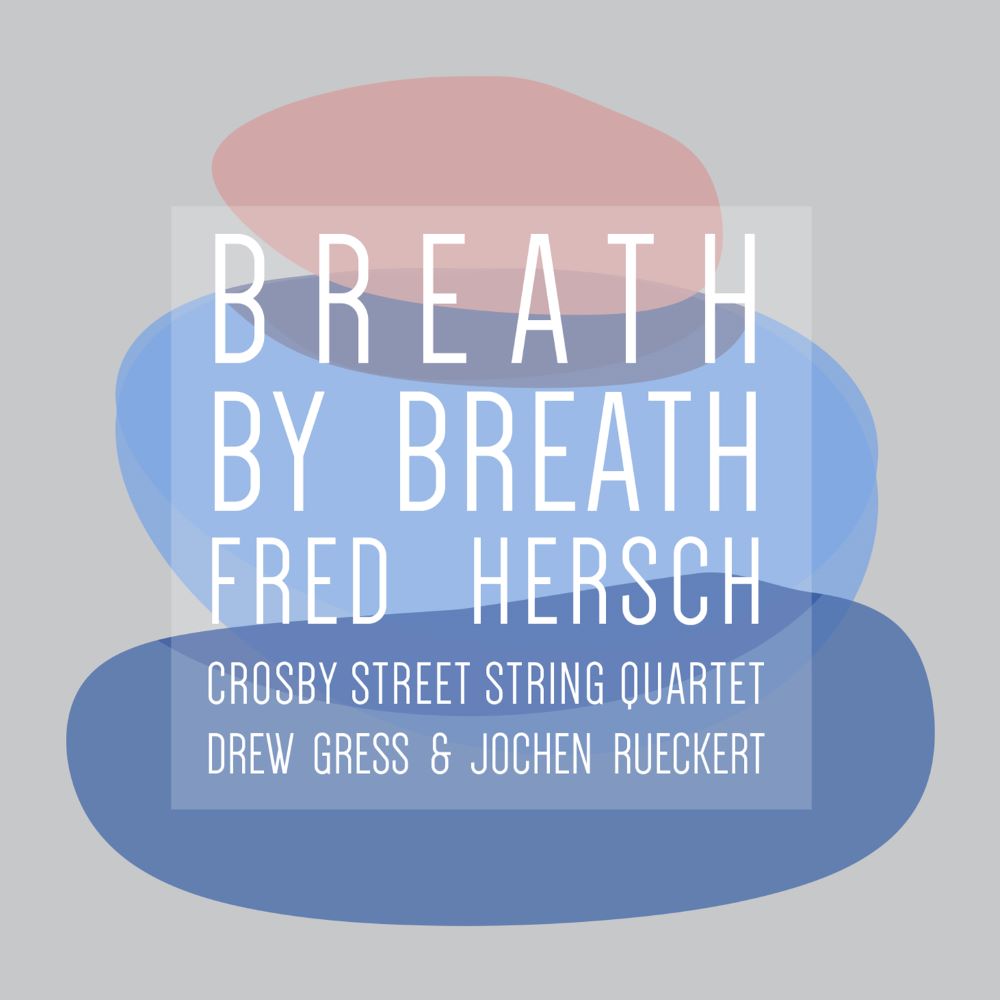
Fred Hersch's Breath by Breath out Jan. 7, 2022 via Palmetto

Pianist/Composer Fred Hersch reemerges from pandemic isolation with an ambitious new album pairing jazz piano trio with string quartet
 
Breath By Breath, due out January 7, 2022 via Palmetto Records, features a stunning new suite inspired by Hersch’s meditation practice performed by Hersch with Drew Gress, Jochen Rueckert, Rogerio Boccato, and the Crosby Street String Quartet

"[Fred Hersch is] a pianist, composer and conceptualist of rare imaginative power.” 
– Nate Chinen, The New York Times

“Hersch’s work has developed an intensity of intelligence and emotional directness unparalleled among his peers.”
– Steve Futterman, The New Yorker 

Album release concert January 9 at Village Vanguard, NYC 
Pianist Igor Levit premieres new Hersch work January 13 at Carnegie Hall 

Iconic pianist/composer Fred Hersch was an early adopter of new technologies and new ways forward when the pandemic hit in early 2020. But he’s also been among the most eager to return to live performance and collaboration now that life has begun to resume some semblance of normality. In August he returned to the studio to record one of his most ambitious projects to date: Breath By Breath, his first album ever pairing jazz rhythm section with string quartet.
 
“I’ve put all my streaming gear away,” declares Hersch, whose lockdown months started off with daily performances on Facebook and culminated in last year’s solo release Live From Home. “It was great while that was what it was, and now I'm in this place where it's live or nothing.”
 
Due out January 7, 2022 via Palmetto Records, Breath By Breath draws inspiration from the pianist’s longtime practice of mindfulness meditation, centered on the new eight-movement “Sati Suite.” But while the album is certainly contemplative and lustrous, it’s far from being merely an ambient backdrop for blissful relaxation – the music on Breath By Breath is as fully engaged and emotionally rich as any that Hersch has made over the course of his remarkable career.

In part that’s due to the musicians Hersch has enlisted for the album. Bassist Drew Gress was a member of the pianist’s first trio and has been an inspiring bandstand partner for more than three decades. Jochen Rueckert is one of the most in-demand drummers on the modern scene, having played with such greats as Kurt Rosenwinkel, Mark Turner, Melissa Aldana and Pat Metheny. The Crosby Street String Quartet, named for the NYC address where they first rehearsed with Hersch, combines four of the city’s busiest freelance string players: violinists Joyce Hammann and Laura Seaton, violist Lois Martin, and cellist Jody Redhage Ferber. 

“String quartets have been some of my favorite music to listen to my whole life,” Hersch explains. As he writes in the album’s liner notes, “I grew up listening to string quartets as a very young musician in Cincinnati. My piano teacher was the wife of the cellist in the famous LaSalle Quartet. I used to lie on the rug in their living room as an elementary school student while they rehearsed, quietly following along, hearing how the viola part meshed with the first violin, or the second violin and the cello. And ever since I started studying composition at age eight, almost all of my music has always focused on four melodic parts - so string quartets are a natural musical configuration for me.” 

The string writing on Breath By Breath spotlights the broad scope of Hersch’s compositional imagination. With each piece the quartet seems to take on a new role in relation to the piano trio: a lush background on one tune, an equal partner in dialogue on the next, an abstract instigator on yet another. “It was important to me that we record live with the strings so I could interact with what they were playing,” Hersch says. “I didn't want to lay down the music and then have them come in later and overdub. I felt like the fun of the project was to do it live.”

“Sati” is a Pali word meaning “mindfulness” or “awareness,” an idea that is central to Hersch’s meditation practice – which itself took on an even more profound importance during the pandemic. “It basically saved me,” he says with no hint of exaggeration. “Meditation is not about not emptying your mind; it's about observation. The phrase I like to use is, ‘relax, allow and observe.’ When I meditate it’s about recognizing sensations or thoughts as they come in and out, observing them and realizing that they're just phenomena. The brain thinks, and there's nothing wrong with that.”
The first movement, “Begin Again” references the cycle of renewal that begins fresh with each moment. Other pieces touch on different aspects of the process. “Know That You Are,” the composition that initiated the suite, refers to the foundational instruction, “When you sit, know that you are sitting and when you breath, know that you are breathing.” The often frantic activity of a mind struggling to be at rest is the subject of “Monkey Mind,” while “Mara,” which features a guest appearance by percussionist Rogerio Boccato, is the name of the god who tempted Buddha with wine, women and wealth.

Bringing meditation to the forefront of his music brings Hersch full circle in a sense, as he recognized when he began the practice decades ago. “When I started, I realized that in a way I've been meditating my whole life – but on a piano bench. I close my eyes when I play and I go into in that world. Occasionally I get distracted, but I don't get wrapped up in it. Instead of my breath being an anchor, the anchor is the sound that I get, the tactile feeling of my fingers on the keys, hearing the space around the music, and leaving that space for other musicians to contribute.”

Breath By Breath, then, is a recognition that meditation has been a way for Hersch to align his daily existence with the enlightened state he reaches while playing the piano. With the release of this captivating new recording, the rest of us are fortunate enough to glimpse that place and to feel its life-affirming impact on our own hearts and souls.

Fred Hersch
A select member of jazz’s piano pantheon, Fred Hersch is an influential creative force who has shaped the music’s course over more than three decades. A fifteen-time Grammy nominee, Hersch has long set the standard for expressive interpretation and inventive creativity. A revered improviser, composer, educator, bandleader, collaborator and recording artist, Hersch has been proclaimed “the most arrestingly innovative pianist in jazz over the last decade” by Vanity Fair, “an elegant force of musical invention” by The L.A. Times, and “a living legend” by The New Yorker. For decades Hersch has been firmly entrenched as one of the most acclaimed and captivating pianists in modern jazz, whether through his exquisite solo performances, as the leader of one of jazz’s era-defining trios, or in eloquent dialogue with his deeply attuned duo partners. His brilliant 2017 memoir, Good Things Happen Slowly, was named one of 2017’s Five Best Memoirs by the Washington Post and The New York Times.

The Sati Suite

1. Begin Again 6:52
2. Awakened Heart 4:13
3. Breath by Breath 6:22
4. Monkey Mind 4:01
5. Rising, Falling 5:03
6. Mara* 4:38
7. Know That You Are 3:41
8. Worldly Winds 5:26

Fred Hersch, piano

Crosby Street String Quartet
Joyce Hammann & Laura Seaton, violins
Lois Martin, viola
Jody Redhage Ferber, ‘cello

Drew Gress, bass
Jochen Rueckert, drums
*Rogerio Boccato, percussion

Fred Hersch – Breath By Breath
Palmetto Records – PM2198 – Recorded Aug. 24-25, 2021
Release date January 7, 2022

Wednesday, October 20, 2021

Fred Hersch to release major new album Jan. 7, 2022

Pianist/Composer Fred Hersch reemerges from pandemic isolation with an ambitious new album pairing jazz piano trio with string quartet
 
Breath By Breath, due out January 7, 2022 via Palmetto Records, features a stunning new suite inspired by Hersch’s meditation practice performed by Hersch with Drew Gress, Jochen Rueckert, Rogerio Boccato, and the Crosby Street String Quartet

"[Fred Hersch is] a pianist, composer and conceptualist of rare imaginative power.” 
– Nate Chinen, The New York Times

“Hersch’s work has developed an intensity of intelligence and emotional directness unparalleled among his peers.”
– Steve Futterman, The New Yorker 

Album release concerts January 4 – 9 at Village Vanguard, NYC 
Pianist Igor Levit premieres new Hersch work January 13 at Carnegie Hall

Iconic pianist/composer Fred Hersch was an early adopter of new technologies and new ways forward when the pandemic hit in early 2020. But he’s also been among the most eager to return to live performance and collaboration now that life has begun to resume some semblance of normality. In August he returned to the studio to record one of his most ambitious projects to date: Breath By Breath, his first album ever pairing jazz rhythm section with string quartet.
 
“I’ve put all my streaming gear away,” declares Hersch, whose lockdown months started off with daily performances on Facebook and culminated in last year’s solo release Live From Home. “It was great while that was what it was, and now I'm in this place where it's live or nothing.”
 
Due out January 7, 2022 via Palmetto Records, Breath By Breath draws inspiration from the pianist’s longtime practice of mindfulness meditation, centered on the new eight-movement “Sati Suite.” But while the album is certainly contemplative and lustrous, it’s far from being merely an ambient backdrop for blissful relaxation – the music on Breath By Breath is as fully engaged and emotionally rich as any that Hersch has made over the course of his remarkable career.

In part that’s due to the musicians Hersch has enlisted for the album. Bassist Drew Gress was a member of the pianist’s first trio and has been an inspiring bandstand partner for more than three decades. Jochen Rueckert is one of the most in-demand drummers on the modern scene, having played with such greats as Kurt Rosenwinkel, Mark Turner, Melissa Aldana and Pat Metheny. The Crosby Street String Quartet, named for the NYC address where they first rehearsed with Hersch, combines four of the city’s busiest freelance string players: violinists Joyce Hammann and Laura Seaton, violist Lois Martin, and cellist Jody Redhage Ferber. 

“String quartets have been some of my favorite music to listen to my whole life,” Hersch explains. As he writes in the album’s liner notes, “I grew up listening to string quartets as a very young musician in Cincinnati. My piano teacher was the wife of the cellist in the famous LaSalle Quartet. I used to lie on the rug in their living room as an elementary school student while they rehearsed, quietly following along, hearing how the viola part meshed with the first violin, or the second violin and the cello. And ever since I started studying composition at age eight, almost all of my music has always focused on four melodic parts - so string quartets are a natural musical configuration for me.” 
The string writing on Breath By Breath spotlights the broad scope of Hersch’s compositional imagination. With each piece the quartet seems to take on a new role in relation to the piano trio: a lush background on one tune, an equal partner in dialogue on the next, an abstract instigator on yet another. “It was important to me that we record live with the strings so I could interact with what they were playing,” Hersch says. “I didn't want to lay down the music and then have them come in later and overdub. I felt like the fun of the project was to do it live.”

“Sati” is a Pali word meaning “mindfulness” or “awareness,” an idea that is central to Hersch’s meditation practice – which itself took on an even more profound importance during the pandemic. “It basically saved me,” he says with no hint of exaggeration. “Meditation is not about not emptying your mind; it's about observation. The phrase I like to use is, ‘relax, allow and observe.’ When I meditate it’s about recognizing sensations or thoughts as they come in and out, observing them and realizing that they're just phenomena. The brain thinks, and there's nothing wrong with that.”

The first movement, “Begin Again” references the cycle of renewal that begins fresh with each moment. Other pieces touch on different aspects of the process. “Know That You Are,” the composition that initiated the suite, refers to the foundational instruction, “When you sit, know that you are sitting and when you breath, know that you are breathing.” The often frantic activity of a mind struggling to be at rest is the subject of “Monkey Mind,” while “Mara,” which features a guest appearance by percussionist Rogerio Boccato, is the name of the god who tempted Buddha with wine, women and wealth.

Bringing meditation to the forefront of his music brings Hersch full circle in a sense, as he recognized when he began the practice decades ago. “When I started, I realized that in a way I've been meditating my whole life – but on a piano bench. I close my eyes when I play and I go into in that world. Occasionally I get distracted, but I don't get wrapped up in it. Instead of my breath being an anchor, the anchor is the sound that I get, the tactile feeling of my fingers on the keys, hearing the space around the music, and leaving that space for other musicians to contribute.”

Breath By Breath, then, is a recognition that meditation has been a way for Hersch to align his daily existence with the enlightened state he reaches while playing the piano. With the release of this captivating new recording, the rest of us are fortunate enough to glimpse that place and to feel its life-affirming impact on our own hearts and souls.

Friday, September 24, 2021

Earl MacDonald - Consecrated (September 24th 2021 by Outside in Music)

“…a major force in the world of jazz composition”
Dan Bilawsky - All About Jazz

Outside in Music proudly announces the release of Consecrated, the seventh studio album from acclaimed jazz pianist, arranger and educator, Earl MacDonald.

Consecrated is an album of traditional hymns, brimming with poetic elegance. Unlike any of MacDonald’s previous award-winning recordings, vocals stand front-and-center, with Canadian up-and-comer Karly Epp introduced as an important, new collaborator. Her stirring vocal interpretations mixed with MacDonald’s thoughtfullycrafted instrumental underpinnings convey a wide spectrum of sentiments, ranging from reverence and gratitude to petition, pleading and lament.

Consecrated is a deeply spiritual, personal album for MacDonald, and therefore, a deeply refreshing one for the jazz listener. In both his musical artistry and in life, MacDonald clearly searches for beauty and a connection to the Divine, while comfortably exploring dissonance – both cognitive and musical.
1. Be Still, My Soul 5:32
2. O God of Love, Grant Us Your Peace 6:12
3. Sweet Hour of Prayer 6:04
4. Holy, Holy, Holy 4:03
5. By Our Love 9:08
6. Be Still 3:49
7. Take My Life, and Let It Be Consecrated 5:03
8. The Love of God 4:42
9. Be Thou My Vision 4:19
10. In His Holy Temple 2:43

Karly Epp - Voice
David Smith - Trumpet
Kris Allen - Saxophones
Alex Gertner - French Horn (5)
Sean Nelson - Trombone (5, 8)
Earl MacDonald - Piano
Karl Kohut - Bass
Rogerio Boccato - Percussion

Friday, September 3, 2021

Renee Rosnes | "Kinds of Love" | Available September 3 via Smoke Sessions Records


On Her Upcoming Album, Kinds of Love,
Pianist and Composer Renee Rosnes
Honors and Celebrates Love Through
Nine Brilliant New Compositions

The Recording Features a Stunning All-Star Band
with Some of Her Favorite Collaborators,
Chris Potter, Christian McBride, Carl Allen and Rogério Boccato

Kinds of Love is Set for Release September 3
on Smoke Sessions Records

This strange last year has been a time of reflection and contemplation for many of us, cut off from the people and the things that we love. Pianist and composer Renee Rosnes has emerged with a reinvigorated appreciation for the many different shapes that love can take. Her breathtaking new recording, Kinds of Love, is both a celebration of and a meditation on the myriad forms it’s taken in her own life – romantic love, love of family, of nature, of the arts and of close relationships she’s forged with many of her fellow musicians (including the critically acclaimed ARTEMIS, the international all-star group of which Rosnes serves as musical director).

Due out September 3 via Smoke Sessions Records, Kinds of Love is in itself a manifestation of a few of those ideas. The staggering all-star quintet that Rosnes assembled for the occasion – saxophonist Chris Potter, bassist Christian McBride, drummer Carl Allen, and percussionist Rogério Boccato – represent a deep web of friendships and collaborations stretching back decades in some cases. And for many of them, the recording date marked one of their first times back in a studio after the long dry spell of 2020. Rosnes seized the opportunity to craft a full album’s worth of new compositions, conceived with these particular voices, and their singular combination, in mind.

“I’ve tried to look at the pandemic as a gift of time, and the knowledge that I would soon be recording with my friends inspired much of the music,” Rosnes says. “It was thrilling to experience the humanity of making music again in the moment. Each of these musicians are profound, humble virtuosos and, on a human level, enlightened spirits.”

For Rosnes, Potter and McBride, Kinds of Love is a reunion of sorts; the three last recorded together on Rosnes’ acclaimed 1997 Blue Note release As We Are Now. The new album marks Potter’s fifth recording with Rosnes, including 1995’s Ancestors, Life on Earth (2002), and the 2018 Smoke Sessions release Beloved of the Sky. While she’s performed with Allen many times over the years, she was thrilled to have him join her on this project. Boccato is the pianist’s most recent acquaintance, a meeting facilitated by their shared experience with the tenor saxophonist Jimmy Greene.

“We are longtime friends who share a lot of history and camaraderie,” Rosnes says. “Having an unusual amount of quietude to work kept me creatively motivated during the past year. As I composed, I thought about each musician’s essence, and was truly inspired by all the possibilities.”

The love of family and the finer things are showcased on the album’s vibrant cover photo. Rosnes is seated on a raffia-upholstered club chair created by her nephew Aaron Aujla, the celebrated designer and co- founder of Green River Project. She’s also wearing a one-of-a-kind garment made from antique textiles, created by the award-winning Menswear designer and founder of BODE, Emily Adams Bode, who is Aaron’s fiancée.
The respect and love that these five musicians feel for one another and for the act of making music together is abundantly, joyously clear throughout Kinds of Love; just witness the boisterous groove laid down by McBride, Allen and Boccato on the fervid opener, “Silk,” or the playful back-and-forth between Rosnes and Potter on “The Golden Triangle.” The latter was named in honor of the Village Vanguard, whose iconic stage has seen its fair share of such vivid interplay.

“Silk” is a dedication to the pianist and composer Donald Brown, with whom Allen worked for a number of years. Rosnes’ longstanding fondness for Brown’s work is evident in the fact that she recorded his piece “Playground for the Birds” on her 1990 self-titled leader debut. “Donald’s music is extremely lyrical and harmonically complex but at the heart of it is always the dance of the drums,” Rosnes points out. “Carl, Christian and Rogério’s hookup drove the band from beginning to end.”

But fittingly given the album’s title, that infectious exuberance is far from the only mood explored on this rich album. The past year has also brought troubling aspects of modern life into stark relief, and Rosnes has spent her fair share of time pondering those unresolved issues. The fact that many of them are deeply rooted in people’s inability to recognize, honor or respect other kinds of love influenced her as well.

The title track aches with a fragile beauty illuminated by Allen’s cloud-like brushes and Boccato’s shimmering percussive touches; “Evermore,” which began as an improvisation on a Bach Sarabande, is an elegiac, graceful ballad as intimate as a silent prayer.

Passionately introduced by Boccato’s deft percussion, “Life Does Not Wait (A Vida Não Espera)” ponders the fleeting nature of life with an elegant pas de deux between Rosnes’ piano and Potter’s flute. And “Blessings in a Year of Exile” tenderly expresses the gratitude for what we have in light of the things so many have lost.

Love of nature has been a key element in much of Rosnes’ music, and the pandemic afforded her the opportunity to reaffirm her reverence for the flora and fauna surrounding her home. “In Time Like Air” is one result, inspired by the song of a persistent yet stubbornly unidentifiable bird that became a frequent visitor to her backyard. The Brazilian-hued piece also marks the first time that Rosnes has recorded on Fender Rhodes and on vocals, as she intones the wordless melody with Boccato.

“Passing Jupiter” moves from the earthbound to the cosmic, launching off from a phrase that Lester Young played on his 1957 Newport Jazz Festival performance of “Polka Dots and Moonbeams.” The celebratory mood returns on “Swoop,” with musical ideas bandied back and forth between the players like a bouncing ball. “It was a great feeling to be able to make music in the moment again,” describes Rosnes. “I think this recording reflects an explosion of creativity. You can feel the energy of our connectedness, and I think maybe there was an extra spark of love in the music too.” 

"Kinds of Love" was produced by Paul Stache and recorded live in
New York at Sear Sound's Studio C on a Sear-Avalon custom console
at 96KHz/24bit and mixed to ½" analog tape.
Available in audiophile HD format.

Renee Rosnes · Kinds of Love
Smoke Sessions Records · Release Date: September 3, 2021

For more information on other Smoke Sessions Records releases, please visit:

Thursday, April 8, 2021

NEW Live Concerts | Exclusive Release from Irma Thomas

New Album and Concert Series

Irma Thomas – Love Is The Foundation

While supplies last, get an individual copy of this timeless release from the beloved Soul Queen of New Orleans – her first studio recording in over a decade.

"Thomas sounds like a precious jewel placed in an exquisite setting." – John Swenson, OffBeat

(limited availability)
Support Live Music This April

Coming this Friday April 9th at 8pm ET: John Patitucci, Yotam Silberstein, and Rogério Boccato!

With live performances all but eliminated due to the pandemic, we created Newvelle Live for fans who want to support artists and institutions who are continuing the legacy of improvised music for a new generation. Anyone can join. All we ask is that you consider making a contribution to support the musicians performing every Friday in April. Contributions will be divided equally among the 12 artists performing throughout the series.

This series is designed as a radical experiment: one that explores the relationship between musician and fan, and an attempt to strengthen our communities and support musicians at this critical time.

Wednesday, February 17, 2021

Kristiana Roemer - House of Mirrors (Sunnyside Records)

Every individual has the opportunity to forge her own path through life making decisions based on internal and external factors. One’s intuitions, lessons learned, relationships and experiences inform the path one takes. Once the course has been taken, there is always reflection on the choices made and on what other choices may have yielded, and what they both may tell about one’s self.

Vocalist/composer Kristiana Roemer likens these wide-ranging deliberations to a disorienting, ever-changing array of looking glasses, thus, the title of her new recording, House of Mirrors. Roemer’s recording debut finds the vocalist at an exciting time in her promising career, navigating her unique path, where she is ready to introduce her fabulously broad musical approach and singular experience to the world.

Born to an American mother and a German father, Roemer grew up in a bi-lingual household in Frankfurt, Germany. Her mother instilled the importance of integrating her American with her German culture, namely through attending their English-speaking church and making long summer visits to North Dakota. Music was an important part of Roemer’s life from early on. She began piano lessons at six and then began singing in church and with a traveling choir; her first efforts at songwriting took place by the age of nine.

Roemer was taking classical voice lessons as a teenager when she met a professional pianist who invited her to sing popular tunes and standards with him at a local lounge, and soon they were performing together regularly. Choosing to continue her music education, Roemer received a scholarship to attend Concordia College in Minnesota for a year before she returned to Germany to care for her mother, who had fallen ill and passed away soon thereafter. During this time, Roemer had enrolled for her bachelor of science at Frankfurt University but soon impulse led her to move to Paris, where she spent three years performing regularly at cabarets and clubs and hosting a jam session, along with studying vocal jazz at the Paris Conservatory and completing her bachelor’s degree from abroad. In Paris, she formed a quartet and began performing her original compositions.

On a summer trip to New York, she fell in love with the City. Though Paris had been instrumental in solidifying her love and pursuit of jazz, the openness of New York’s scene made Roemer feel free to truly spread her musical wings and provided the nurturing ground that allowed her to define her musical voice. While writing music had become second nature to her, she felt that to truly express herself in her storytelling she had to broaden her approach, including her introduction of German lyrics along with English.

Roemer moved to New York soon thereafter and dove directly into the jazz scene there, performing regularly at Rockwood Music Hall, Jazz at Kitano Hotel and Cornelia St. Café, and completing her Master of Music in jazz studies at Queens College. Roemer was anxious to record as soon as she arrived. One of the many musicians she met was bassist Alex Claffy, whose enthusiasm for collaboration motivated Roemer to push through the production of House of Mirrors. Roemer set up recording dates and they brought on pianist Addison Frei and drummer Adam Arruda.

The original pieces on her stylistically diverse and explorative recording were selected with the intention of taking the listener on a journey and telling the story in a direct and honest way. These are compositions that Roemer felt needed to come out so that she could continue her growth and explore new pathways. The pieces span from her time in Paris to her time in New York, many having been written with her ensemble and special guest artists in mind. Many of the lyrics, hers and otherwise, began as poetry.

The story is introduced by the title track, a meditative piece exploring decisions made and paths taken, that’s mood is amplified by guest Gilad Hekselman’s sensitive but spacious guitar. The haunting “Beauty Is a Wound” is a tribute to Roemer’s mother, the music going straight to the heart with stripped-down, minimalist but emotionally charged accompaniment by percussionist Rogerio Boccato. The intrepidly upbeat “Virgin Soil” is an benison given to a sister to go out and find one’s own way; gorgeous solos from Dayna Stephens and Frei emphasize Roemer’s message.

Roemer intentionally includes German language in her music, as there has not been much use of the language in contemporary jazz, which she delivers in a natural, relatable way. In seeking German poetry, she discovered Felice Schragenheim’s “Deine Hände,” an uplifting love poem, written by a courageous woman who knew misfortune and died young at the hands of the Nazis, that Roemer arranged exquisitely for the quartet. The intensely persistent “Dark Night of the Soul” utilizes St. John of the Cross’s poem for content but really shines with Roemer’s brazen recitation of her own writing accompanied by Ben Monder’s guitar exploration. Hermann Hesse’s “Manchmal” is a blue-tinged appeal for humans to see our reflection in nature and mend our relationship with it.

Monder’s shimmering guitar tones provide a gorgeous, enveloping soundscape for Roemer’s “Lullaby for N.,” a thoughtful piece echoing the parting of a friend. Roemer adapted Stanley Turrentine’s “Sugar” into a metrically intriguing arrangement, the paramour’s message of love heightened by Stephens’s brilliant tenor, Frei’s rhapsodic piano and Claffy’s expressive bass. The recording concludes with Charles Mingus’s “Duke Ellington’s Sound of Love,” a tremendous song about the love of music that brings us back to the journey’s true essence and its ultimate goal, the music.

The music of Kristiana Roemer comes from an honest place, a place of appraisals of actions and embracing all potential paths, whether taken or not. Her House of Mirrors is a diverse and brilliantly devised program of music that illustrates where Roemer has been and where she will go in her bright future.

1. House of Mirrors 03:02
2. Beauty Is A Wound 04:14
3. Virgin Soil 04:46
4. Deine Hände 02:01
5. Dark Night of The Soul 04:57
6. Manchmal 03:03
7. Lullaby for N. 03:56
8. Sugar 05:54
9. Duke Ellington's Sound of Love 04:53

Kristiana Roemer - vocals
Addison Frei - piano
Alex Claffy - bass
Adam Arruda - drums
Gilar Hekselman - guitar (1)
Ben Monder - guitar (5, 6, 7)
Dayna Stephens - saxophone (3, 8)
Rogerio Boccato - percussion (2)

Sunday, August 26, 2018

Renee Rosnes & David Hajdu - Ice on the Hudson (October 12, SMK Jazz)


Pianist/Composer Renee Rosnes and

Author/Lyricist David Hajdu to Release

First Album of Songwriting Collaborations

Ice on the Hudson, Available October 12 via SMK Jazz

Ice on the Hudson features vocalists René Marie, Janis Siegel, Darius de Haas and Karen Oberlin and an all-star ensemble interpreting diverse songs about the emotional complexities of adult life in today’s world.

There’s a special chemistry that’s found only in the rarest of songwriting partnerships, forever linking the names of composer and lyricist in the minds of listeners. The names Renee Rosnes and David Hajdu are already well known to music lovers: Rosnes as one of her generation’s most acclaimed jazz composers and pianists, Hajdu as an award-winning author and critic. With Ice on the Hudson, their first collaborative album of songs, the pair reveals a breathtaking synergy, crafting a collection of deeply felt and genre-defying songs that join words and music with alchemical results.

Ice on the Hudson, due out October 12 via SMK Jazz (a newly launched imprint curated by Smoke Sessions Records), brings together four magnificent vocalists: revered, GRAMMY® Award-nominated jazz singer René Marie; Manhattan Transfer co-founder and nine-time GRAMMY® winner Janis Siegel, celebrated musical-theater actor and art-song interpreter Darius de Haas; and acclaimed jazz/pop performer Karen Oberlin. Their voices are matched by a stunning ensemble, featuring Rosnes at the piano along with cellist Erik Friedlander, saxophonists Steve Wilson and Seamus Blake, clarinetist Ken Peplowski, bassist Sean Smith, drummer Carl Allen, and percussionist Rogerio Boccato.

While both Rosnes and Hajdu can boast considerable accomplishments in their respective fields, songwriting was a fairly new endeavor for both. Rosnes had had a handful of her instrumental compositions set to lyrics, and Hajdu had collaborated on a few songs with Fred Hersch and others. When Rosnes and Hajdu decided to try writing together, five years ago, “Everything clicked,” in Hajdu’s words.


“Renee is one of the most gifted, most sophisticated and most creative composers alive,” Hajdu says. “I consider myself the luckiest boy in the music world for getting to write with this flat-out genius. We both enjoy the exhilarating thrill of doing something that we care about, that draws on our professional and life experiences, but that provides a whole new set of challenges for us.”

For Rosnes, who has long drawn inspiration for her own music from sources as diverse as the natural world and the visual arts, the partnership has given her rich depths of emotion and narrative to plumb. “David is a powerful and compelling storyteller,” she says, “and each of his lyrics has many layers and great substance. It’s been a fulfilling experience to take his words and search for melodies that truly allow the story to shine through.”

Given the tantalizing complexity of Hajdu’s words, Rosnes found herself exploring a wide range of sensibilities, never concerned with genre. Ultimately, while some pieces fit comfortably into the jazz songwriting tradition of Jon Hendricks or Bob Dorough, others evoke the world of musical theater or such respected singer-songwriters as Joni Mitchell or Randy Newman. “When I embarked on this project with David, I put the idea of genre out of my mind,” she explains. “I was most interested in allowing the lyrics to inspire and move me in whatever direction that musically translated to.”

“A Tiny Seed” opens the album with a parable both timeless and timely, about a wall-building king and the seemingly small detail that grows to topple his kingdom. Marie’s wry, soulful vocal offers inspiration to those hoping to turn such fairy tales into reality. Her serpentine lines bring an exotic mystery to “Little Pearl,” a reinterpretation of Rosnes’ instrumental “The Quiet Earth.”

Siegel’s voice seems to float into a whimsical daydream on “I Used to Like to Draw,” a tender reminiscence of the childhood days when we all gave vent to our imaginations, before the supposed reality of adult life quashed such fancies. Siegel also sings “The Passage,” which takes the natural splendor that inspired Rosnes’ instrumental piece “Gabriola Passage” into the realm of transcendence. On the title track, “Ice on the Hudson,” she takes the bizarre fact that the Hudson River flows both upstream and downstream as a metaphor for the often contradictory aspects of grown-up reality – one of several instances of complex ideas that stem from the collaboration between two artists with a wealth of life experience.


Oberlin offers a bit of culinary respite from the world’s divisiveness on the playful “I Like Pie” and a bit of romantic perspective on “I Still Feel the Same.” The moving “All But You” builds from scraps of both songwriters’ biographies to paint a picture of living with a missing someone. Rosnes suggested a song based on her experience as an adopted child wondering about her birth parents, which Hajdu countered with his own background. “Renee said it felt strange growing up not knowing who her biological parents were, but my father sat at the dinner table with me every night my whole life, and I don’t know who my father was either. We share that feeling of a hole in your life, that there are people who could have been there who were not.”

Hajdu based “To Meet My Brother” on the tragic loss of his sister and the feeling of wanting to be reunited, whatever the cost. Darius de Haas brings tender yearning to that piece and an urgent sensuality to “Confound Me.” His knack for theatrical drama illuminates “Trotsky in Mexico,” a Sondheim-like musing on the Russian revolutionary’s fling with Frida Kahlo.

A five-time winner of the JUNO award, Renee Rosnes is one of the premier jazz composers and pianists of her generation. Upon moving to New York City from Vancouver, Canada, she quickly established her enduring reputation as a creative original and versatile collaborator, touring and recording with such masters as Wayne Shorter, Joe Henderson, BobbyHutcherson, J.J. Johnson, James Moody, and Ron Carter. With 16 recordings as a leader, Rosnes has grown ever more ambitious musically, as her most recent album, Beloved of the Sky (Smoke Sessions Records), attests. 

David Hajdu is an award-winning author, critic, and songwriter. A three-time winner of the ASCAP Deems Taylor/Virgil Thompson Award for Music Writing as well as a three-time finalist for the National Book Critics Circle Award, Hajdu is the author of five books, including Lush Life: A Biography of Billy Strayhorn, Positively 4th Street, and Love for Sale: Pop Music in America.


Tuesday, May 1, 2018

Matt Penman - Good Question (SUNNYSIDE RECORDS June 8, 2018)


"The music on this recording is a series of musical questions I posed to my bandmates over two days, that I might get their input on a range of subjects that interest me. Much like having prescribed topics for conversation, I wrote these tunes in the hope of starting a dialogue that could provoke reactions, new angles and corollaries that were unforeseen, yet welcome. In fact all of the musicians on this album have their own points of view and a strong opinion, as well as a natural inclination to collaborate, and these are the reasons why I wanted to record with them. This is also why the musical discussion proved to be so rich and wide-ranging." – Matt Penman 


Bassist/composer Matt Penman has spent much of the past decade developing and presenting music for the illustrious SFJazz Collective and the fantastic James Farm collective. That had left a gap between solo recordings that he felt it was time to abate. The result of his efforts are presented here on Good Question, a poignant recording of pieces meant to challenge, engage and entertain both its listeners and the musicians involved in its creation. 

Originally from New Zealand, Penman, since his arrival in 1995, has been an essential voice in the musical landscape of New York. His experience in the States has provided him with both inspiration and exasperation. He has chosen to address his feelings as a part of his new music: 

"There are a variety of musical moods and spaces, some written with these exact musicians in mind, some not; some written as a response to the cultural and political climate in the country I have chosen to make my home, and some as purely musical excavations. Overall, you could say that the album represents a general delight, bemusement, indictment and celebration of the American experiment through the eyes of a foreigner who has now lived more than half his life in the States." 

The ensemble that Penman assembled features not only the top musicians in jazz but also his regular collaborators and friends, including saxophonist Mark Turner, pianist Aaron Parks and drummer Obed Calvaire. There are also guest appearances by guitarist Nir Felder, saxophonist Will Vinson and percussionist Rogerio Boccato. 

Penman’s compositions are meant to stimulate the ensemble into reactions and conversations within their framework. The pieces either present musical puzzles or are think pieces for reflection on topics, mainly natural or political. The ensemble handled the task with aplomb over three days of recording at Brooklyn Recording during the spring and summer of 2017. 

The recording begins with the shimmering “Mr. Right,” which poses questions of how much freedom is too much and do the boundaries of a closed song form encourage creativity? The challenge behind the deceptively difficult yet beautiful “Small Famous” is to make the tune’s complex harmonic form sound easily formulated. The quietly insistent “Fifths and Bayou” presents the players with defined phrase lengths and a set form with the hopes that they would transcend them, as does the soaring soprano saxophone of Will Vinson. A moving excursion on “Blues and the Alternative Truth” explores the many possibilities of the open space allowed by paring down the ensemble to a trio of piano, bass and drums. The exploratory “Cave Life” is about portraying a scene and creating a story about it, in this case spelunking. 

“Ride the Paper Tiger” is an adventurous piece that provides ample opportunity to highlight the talents of the ensemble, including guest guitar slinger Nir Felder. On “Copeland,” Penman asks the ensemble to create an aural safe haven from the traumas of modern life, “a place for political refugees, PTSD sufferers, ex-White House staffers and anyone undergoing a tax audit.” The impressively wrought “Meats” is through composed with a little solo wriggle room given to drummer Calvaire. The concluding piece, “Big Tent, Little Tent,” is a grooving, easygoing composition that frees the ensemble as it closes out the set. 

After posing his questions and framing his scenarios to his open-minded ensemble, Matt Penman has been awarded with a fascinating and moving recording in Good Question, knowing all along that there might not be any answers to his queries at all. 

"'Good question' becomes a response when we don’t actually know the answer, but are willing to ponder further."

1. Mr. Right
2. Small Famous
3. Fifths and Bayou
4. Blues and The Alternative Truth
5. Cave Life
6. Ride the Paper Tiger
7. Copeland
8. Meats
9. Big Tent, Little Tent

Mark Turner - tenor sax (1, 2, 5, 7-9)
Aaron Parks - piano, Rhodes, organ, vibraphone
Oded Calvaire - drums
Nir Felder - guitar (6 & 9)
Will Vinson - soprano sax (3)
Rogerio Boccato - percussion (3)

Sunday, March 4, 2018

Caroline Davis - Heart Tonic (SUNNYSIDE RECORDS March 23, 2018)


Born in Singapore to a Swedish mother and British father, Davis grew up in the United States from the age of six, settling first in Atlanta, then Texas and ending up in Chicago, where she attended Northwestern University and received a Ph.D in Music Cognition. It was in Chicago that Davis became engrained within the local jazz and improvisatory music community, one that is tight knit, diverse and particularly open to each player’s musical inclinations. 

Davis’s Chicago experience was instrumental in her development as a player. Regularly hearing local greats, like saxophonist Von Freeman, guitarist Bobby Broom, and pianist Ron Perrillo, playing in wide ranging musical contexts and interdisciplinary collaborations helped to shape her into a well balanced and genre defying artist. Davis was also privy to a range of artists, including one of her biggest influences, the iconoclastic composer/conceptualist Steve Coleman. 

Upon her move to New York City in 2013, Davis found herself as an outsider looking in. It was difficult to come from a place where she was established to an entirely different community, especially one as fractious as New York’s. Though, Davis soon showed that she was equal to its demands.


The roller coaster lifestyle of working as a professional musician in New York was challenging. Davis quickly saw that her days would have some career highpoints alongside humbling lows of everyday musician life. Friends like drummer Jay Sawyer helped her overcome her blues by coming along to sessions and gigs, thus helping establishing herself in the scene. Soon, Davis began to play more regularly with a diverse group of musicians, including Matt Mitchell, Greg Saunier, Billy Kaye, and Curt Sydnor. 

It was about this time that Davis found out that her father had heart arrhythmia. The news prompted her to do detailed research on the physical aspects of the human heart. 

It was with all of this in mind that Davis decided to compose this music, using the heart for its emotional connotation or utilizing ventricular rhythms as metrical devices. Composing helped not only in her emotional transition but also focused her study on biological aspects of the body. Heart Tonic finds Davis employing more standard jazz elements than in the music of her previous work, including formal harmonic changes and shifting meters. 


To assist in the recording, Davis employed a brilliant ensemble of young musicians, more aligned to swinging, straight ahead jazz, but who could also handle the challenges the composer posed for them in her idiosyncratic music. Pianist and keyboard player Julian Shore and percussionist Rogerrio Buccato had been friends with Davis since her time at Litchfield Jazz Camp nearly a decade ago. Trumpeter Marquis Hill is a Chicago contemporary and a perfect foil for Davis’s lithe alto. Originally from Israel, Tamir Shmerling is unwavering on acoustic and electric bass, while longtime friend and drummer Jay Sawyer always insures the music is remarkably propulsive. 


The recording begins with the churning “Footloose and Fancy Free,” a piece that relies on a cyclical bassline echoing the cycle of the heart’s superior and inferior vena cava leading to the brain and back but with an unconstrained melody singing above that anchor. The plaintive “Loss” is an introspective and emotional piece that was written quickly after a truncated musical connection in Chicago after Davis’s move, featuring Rogerrio Boccato on percussion. The swinging “Constructs” is a suite concerned with the insistency to make up words for the intangible, like using “heart” as a metaphor for honesty, bravery or sympathy. The waltzing “Fortune” is a thankful tribute to the new people and projects Davis has been involved with since relocating. It also features Benjamin Hoffmann on organ. “…TuneFor” is a drum feature for Sawyer stemming from “Fortune.” 

Wayne Shorter’s “Penelope” lent itself to the project as its heart beat like pulse is reminiscent of the rhythms her father’s arrhythmia was making in his own heart. Originally written for another album, Davis rewrote “Dionysian” in New York with a new mindset eschewing the filters of frustration that had limited her on her arrival; it provides an emphatic proclamation of place. The haunting “Air” floats on a bassline in 7 while the rest of the instruments play in 4, thus generating an ambiguous but stable cycle and bedrock for Shore’s lovely piano solo. The stirring “Ocean Motion” closes the recording with a piece in 9/4 in three sections, which leaves the listener with a healing final melody and incendiary drum solo. 

Caroline Davis’s new Heart Tonic is a moving and pulse livening journey through Davis’s emotional relocation from Chicago to New York and her investigation of the biology of the heart.

1. Footloose and Fancy Free
2. Loss
3. Constructs
4. Fortune
5. ...TuneFor
6. Penelope
7. Dionysian
8. Air
9. Ocean Motion

Releases March 23, 2018 

Caroline Davis - alto saxophone
Marquis Hill - trumpet
Julian Shore - piano, Fender Rhodes, Yamaha DX7, Roland JD-Xi
Tamar Shmerling - acoustic & electric bass
Jay Sawyer - drums
Rogerio Boccato (percussion 2, 9)
Benjamin Hoffman - organ (4, 5)

Friday, April 28, 2017

Jimmy Greene: Flowers – Beautiful Life, Vol. 2 (MACK AVENUE RECORDS 2017)


Every musician, I assume, has a prime source for inspiration. For saxophonist and composer Jimmy Greene, that’s been his daughter Ana, who had given him that inspiration during her life and in the aftermath of her shocking, tragic death that made international news. More than four years after the Sandy Hook massacre that cut short Ana Greene’s life, Ana continues to be a muse for her father. Flowers – Beautiful Life, Volume 2 (April 28, 2017, Mack Avenue Records) finds Jimmy Greene in a better spot in his life, because he chose to turn misery and grief into music that’s a celebration of the spirit of Ana and the forces of good.

Thusly, Flowers isn’t a low key affair that A Beautiful Life was at times, but jazz through the cheerful, carefree lens of a six year old. Greene, rest assured, is still making the same polished, attenuated music that endeared himself to us back in ’09. The difference now is that he makes the music a little more playful and lighter on its feet, music that someone at both six and sixty could dance or at least bob their head to.

You can hear him having a good time recording the 6/8 Brazilian samba festival tune “Stanky Leg” or the Nola-inspired second line “Stink Thumb” (apparently putting forth a notion that if it smells bad, it must sound good). On the former, pianist Renee Rosnes spins a tastefully flowing piano solo and the latter is livened up by Ben Williams’ pocket aware bass and Otis Brown III’s jumpin’ snare drum. On both, Greene delivers a happy, prancing soprano sax.


Other songs are inspired by Ana’s own words: “Big Guy” is what she called her 6’6″ father and the song of that name swings in a unique, dynamic way. “Fun Circuits” (“Don’t let them suck your fun circuits dry, Mom!”) has complex rhythms and Mike Moreno’s guitar with Rosnes’ Fender Rhodes give it a rock-jazz flair but also characterizes childlike exhilaration and unpredictability.

“December” is a song with a multidimensional complexion to portray the range of emotions that occur at the Greene household during this month every year (holiday season without Ana, anniversary of the Newtown massacre). But even here Greene is pushing forward; the song works through the mixed emotions with vigor and Brown’s drums make sure of that.

Sometimes words are needed to fully explain the feeling, and accordingly, a couple of vocal turns are included. Sheena Rattai takes on the task on the titular “Flowers” with words inspired by Ana’s book of flower drawings intended as an expression of love to her father. Greene offers what he calls “some humble advice to parents” as conveyed by Jean Baylor on the sweet ballad “Someday” while Greene’s cool, assuring tenor sax flutters around.

The only song Greene didn’t compose came instead from Level 42. Greene had revealed to us before that there was “something about Ana” so you might say he turned this 1986 hit “Something About You” into a message about her. Greene gets really creative with the middle of it, practically making up a whole new section where he again drops down chops from his soprano sax.

There’s talent galore on this album: besides Rosnes, Moreno, Williams and Brown, there are also appearances by Jeff ‘Tain’ Watts, John Patitucci, Rogerio Boccato and Kevin Hays. They all do their part to help make Flowers – Beautiful Life, Volume 2 a worthy successor to Greene’s gorgeous tribute Beautiful Life. But Jimmy Greene’s biggest help comes from within. Inside his heart, where Ana Grace Greene lives and thrives.

1. Big Guy
2. Stanky Leg
3. Flowers
4. Second Breakfast
5. Fun Circuits
6. Stink Thumb
7. Someday
8. December
9. Amantes
10.Something About You
11.Thirty-Two


Renee Rosnes
Mike Moreno
Ben Williams
Otis Brown III
Jeff ‘Tain’ Watts
John Patitucci
Rogerio Boccato
Kevin Hays


Friday, March 3, 2017

Newvelle Records' First Album of Season Two is Shipping Now!

Newvelle Records is excited to be sharing the first record of their Second Season with members now.  Irmãos de Fé featuring John Patitucci, Yotam Silberstein and Rogério Boccato is a truly beautiful and unique recording of all Brazillian music

Rogério Boccato, John Patitucci and Yotam Silberstein © Jordan Kleinman
What if it's about the song?

There is a paradox in the regional specificity of these songs and their overwhelming universal truth. Music that speaks not just across languages but through a deeper medium. These songs are not conveyances for improvisational flights of fancy. John, Yotam and Rogerio bring their considerable gifts and unique voices to express the song, and the song alone, and perhaps that is the higher calling. 

– excerpted from the liner notes by Elan Mehler


The second release of Season Two features Lionel Loueke and Kevin Hays showing some super-human telepathy on an album of all original material.  Check out a sample on the In The Studio page.

Our third release of Season Two is a band led by Jon Cowherd, featuring Brian Blade, Tony Scherr and Steve Cardenas.  Check out a sample on the In The Studio page.


John Patitucci Trio Featuring Yotam Silberstein and Rogerio Boccato

Kevin Hays and Lionel Loueke Duo

Jon Cowherd Quartet featuring Steve Cardenas, Tony Scherr and Brian Blade

Chris Tordini Trio featuring Becca Stevens and Greg Ruggerio

Aruán Ortiz revisiting the music of the great Cuban classical composers

Rufus Reid Trio with Steve Allee and Duduka Da Fonseca and featuring the Sirius Quartet

 All of Newvelle's covert and interior photographs for Season Two come from the French Collective Tendance Floue.
Newvelle's Recording Engineer on all six records is the multi-Grammy winning Marc Urselli.
Mastering engineer is by Alex Deturk.  
Jim Hoppin and Sarah Enid Hagey shot video at these sessions.  
All video editing is by the award-winning Ben Chace.  
Jordan Kleinman shoots all studio photos.
The web team is run by Aymeric Auberger.
Social Media management by Jessye Mehler.
Newvelle is run by:  Elan Mehler and Jean-Christophe Morisseau.