Showing posts with label RATTLE RECORDS. Show all posts

Monday, March 19, 2018

Gillian Whitehead - Shadows Crossing Water (RATTLE RECORDS 2018)


This project began with a concert of my music in Prague in 2012, curated by American-born Prague-based pianist Patricia Goodson and featuring some of Prague's most respected musicians, including the Stamic Quartet, oboist Vilém Veverka, and Patricia on piano.

Subsequently, with funding from Creative New Zealand, my sextet for string quartet, oboe and piano, Shadows cross the water, was commissioned and premiered in the EuroArts Festival in Prague in 2014. With the prospect of two further performances in Berlin in 2016, one in the Czech Embassy and another in the Matthäus- Kirche, we decided to capitalize on the opportunity and record the pieces in Prague. The music was recorded in late 2016 and early 2017 by one of the best Czech audio engineers, Ondřej Urban.

This is an important album for me, containing several substantial pieces that are very close to my heart. The programme consists of eight pieces that span my compositional career, from Three improvisations for solo oboe (1963) to Shadows cross the water (2016). The recording features six outstanding musicians, artists who are sympathetic to my music and perform it brilliantly with authority and understanding.

Gillian Whitehead

01 Clouds over Mata-au
for string quartet (7:55)

In 2010 I was fortunate to hold a residency run by the Henderson Arts Trust and to live for a while in the house designed by Austrian architect Ernst Plischke, which is built high above the powerful Mata-au (Clutha) river in Central Otago. The first of two string quartets on this album, Clouds over Mata-au was the last piece I wrote in that evocative landscape. It was premiered in Prague by the Stamic Quartet.

02 Three Improvisations for solo oboe
(9:07)

I wrote these pieces in 1963 as an undergraduate at Victoria University of Wellington. They are not really improvisations (I wasn't very good at naming pieces back then), but I'm still happy with them all these years later.

03 Arapātiki
for solo piano (5:32)

Commissioned by pianist Stephen De Pledge for his Landscape Preludes project, Arapātiki translates from the Māori language as 'the path of the flounder'. It refers to the sand flats in front of my house on the Otago peninsula, and the two main ideas in the piece are based on the inexorable ebb and flow of the tide and the call of the korimako (bellbird).

04 Tom's serenade for Ann Morris
for oboe, violin, viola and cello (13:45)

While I was composer-in-residence with the Auckland Philharmonia in 2001, Tom Morris (a great supporter of the orchestra) bought a piece of mine at a fund-raising auction for the orchestra. He named the piece for his wife, Ann, and requested it for the specific orchestral players he had sponsored.

05 Tūmanako: Journey through an unknown landscape
for solo piano (6:37)

This piano piece was also the result of a fund-raising auction, this time for SOUNZ. Dedicated to the grandchildren of the successful bidder, Helen Kominik, Tūmanako translates (which translates as ‘hope’) was the name of Helen’s childhood home. Written shortly after I returned from Yunnan, a province in southwest China, the piece evokes a journey through a landscape where you know nothing beyond what you actually see, and also a journey through a musical score.

06 No stars, not even clouds
for string quartet (9:45)

This is a single movement piece commissioned by Chamber Music New Zealand in 2012 for the New York-based Enso quartet.

07 Tōrua
for violin and piano (4:45)

Commissioned by Hilary Hahn for her 27 Encores project, I began writing this piece for violin and piano in February 2011 just as the second devastating Christchurch earthquake shook the country, and something of this event affected the work. The Māori title embodies ideas of duet, pattern weaving, and a change of wind or current. I've used a different song of the korimako here.

08 Shadows cross the water
for oboe, piano, and string quartet (17:25)

2014 marked the seventieth anniversary of the arrival of New Zealand’s first refugees, more than 700 Polish children who were cared for at a specially prepared camp at Pahīatua, which led me to consider the terrible and dislocating movement of children in times of war. As I wrote this piece, two significant and dear friends – Peter Maxwell Davies and Jack Body – were terminally ill, so there are many interpretations of the title (which was taken from a Greg O'Brien poem).

All compositions © Gillian Whitehead


Stamic Quartet
Jindřich Pazdera (violin)
Vilém Veverka (oboe)
Patricia Goodson (piano)

Produced by Markéta Janáčková 
Recorded by Ondřej Urban at Sound Studio HAMU, Prague
Design by UnkleFranc
Printing by Studio Q

Eve de Castro-Robinson - The Gristle of Knuckles (RATTLE RECORDS 2018)


This album is a sideways manoeuvre for me. My previous recordings are faithful renditions of meticulously scored works, but this one is an entirely different beast. Sitting at my 60th birthday concert listening to Callum Passells’s coruscating take on Countercurrents and Ashley Brown’s thrillingly reworking of Tumbling Strains, I immediately felt a collaborative album of reimagined versions of my music coming on. The title for the album leapt out from a page of jazz poetry, the gristle of knuckles by Kyle Dargan, and soon after Steve Garden and I got to work.

Eve de Castro-Robinson


01 Doggerel
Nathan Haines (alto flute, C flute, bansuri)

02 ConunDRUMs 
Ron Samsom (drum kit, cymbals, percussion)
Kingsley Melhuish (hue puruhau, pumoano, tuba)

03 The long dream of waking
Don McGlashan (voice, guitars, horns, keyborads, percussion)  

04 Trouble, trouble mind
Delaney Davidson (voice, guitars, and various other instruments) 

05 Hau
Mere Boynton (voice, glass)

06 small blue 
Ron Samsom (cajon)
Kevin Field (piano)

07 Passion Flower
Kevin Field (piano) 

08 Countercurrents
Callum Passells (saxophone) 

09 Stumbling trains
Ashley Brown (cello, treatments)

10 Key rings 
Eve de Castro-Robinson (toy piano, kalimba, chiming toy, music box)
Steve Garden (chiming toy, arrangement)

All compositions © Eve de Castro-Robinson 2017, except Stumbling Trains by Eve de Castro-Robinson and Ashley Brown © 2017, and Key rings by Eve de Castro-Robinson and Steve Garden © 2017

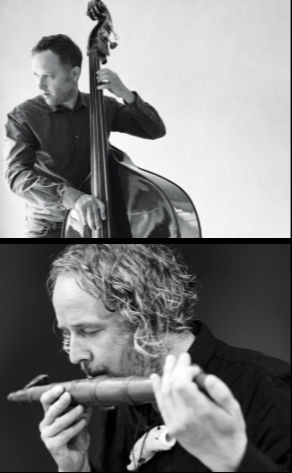
Al Fraser & Phil Boniface - Ponguru (RATTLE RECORDS 2018)


Phil and Al began performing together in 1998 while studying jazz performance at Massey University Conservatorium of Music, now the New Zealand School of Music. Al’s journey with ngā taonga pūoro began in 1999 and he is now one of the leading performers of Māori musical instruments. Phil’s journey as a jazz bassist and composer led him to Canada for more than a decade where he played with some of the finest jazz musicians on the West Coast. With Ponguru, Phil and Al bring together the low voice of the double bass and the many voices of taonga pūoro in an exploration of timbre, space, melody, and our shared musical language.

01 Form (2:37)
02 Matter (3:17)
03 Space (3:28)
04 Kõrorohua (3:22
05 Kõrerorero (3:34)
06 Snare (1:52)
07 Time (3:15)
08 Rēkohu (2:31)
09 Conveyance (2:35)
10 Pūrerehua (2:57)
11 Pūtõrino Suite (7:32)
First Light (1:32)
Crossing (1:48)
Waiting (2:26)
Wayfaring (1:46)
12 Ponguru (3:13)

All compositions © Al Fraser and Phil Boniface, except Ponguru by Al Fraser, Phil Boniface, and Steve Garden


Al Fraser (ngā taonga pūoro)
Phil Boniface (acoustic bass)

Produced by Al Fraser and Phil Boniface
Recorded by Lee Prebble at The Surgery, Wellington, Sept 2017 and Feb 2018
Mixed and mastered by Steve Garden at Garden Shed Music Studio, Feb 2018
Design by UnkleFranc
Printing by Studio Q


Space by Phil Boniface and Al Fraser from Al Fraser on Vimeo.

Tony Chen Lin - Disgressions (RATTLE RECORDS 2018)


Life seems to be an endless stream of unforeseen digressions; it is often difficult to distinguish them — when they occur, what they depart from, where they lead to. Seen in this light, the realisation of a debut album has certainly been a happy and fortuitous “digression” in my life, and I am thrilled to present it here on Rattle.

The programme consists of three seemingly unrelated works presented in an order that exploits their contrasts to the fullest, suggesting a “narrative” in which each work digresses from a “main subject” to which we may or may not return. In lieu of the token classical sonata that often opens a concert, I jump in with Bartók’s utterly unapologetic Piano Sonata, a unique work deeply rooted in Baroque and Classical traditions — yes, as dissonant as it may sound! I conclude the recital with Schumann’s mercurial Humoreske, a work that exemplifies his polyphonic tendencies in forming ideas. In this respect, both works point to Bach (as great music often does) who occupies centre stage in the programme.

Squeezed in among these giants is my composition, which is partly inspired by the digressive nature of Schumann’s piano music, and partly from digressive — or rather, distracted — moments while studying the Humoreske. Thus, motifs from Schumann’s work surreptitiously find their way in. In concert I often serve it as an hors d’oeuvre of sorts to segue into the tender opening of the Humoreske, cheekily bypassing the difficulty of beginning a work that seemingly does not begin ... but I digress.


My thanks first and foremost go to Prof. Jack C. Richards, without whose generosity and support this project would only have remained a dream. I would also like to thank producer Kenneth Young for his sharp, discerning ear and for pushing me to perform at my best, and engineer Steve Garden, with all the magical powers he seems to possess. I am forever indebted to my wonderful mentors who have been an endless source of inspiration over the years: Rosemary Stott, Edith Fischer, Jorge Pepi-Alos, Balázs Szokolay, Andreas Immer and Neville Baird.

I dedicate this album to my parents, who support me in every way yet beckon me back whenever I digress too far, and to my friends, but above all to my audience. My heartfelt thanks goes to you all for your unwavering support, and for continuing to remind me at crucial moments that what I do actually matters.

Tony Chen Lin, February 2018

DIGRESSIONS

Béla Bartók
Piano Sonata BB 88 (Sz. 80)

01 i. Allegro moderato (4:44)

02 ii. Sostenuto e pesante (4:51)

03 iii. Allegro molto (3:41)

Johann Sebastian Bach
French Suite No.5 in G Major, BWV 816

04 i. Allemande (2:45)

05 ii. Courante (1:37)

06 iii. Sarabande (4:33)

07 iv. Gavotte (1:12)

08 v. Bourrée (1:12)

09 vi. Loure (2:21`)

10 vii. Gigue (3:19)

Tony Chen Lin
11 Digression (Meditation on R.S.) (5:15)

Robert Schumann
Humoreske Op. 20

12 Einfach; Sehr rasch und leicht; Noch rascher; Erstes Tempo, Wie im Anfang (5:45)

13 Hastig; Nach und nach immer lebhafter und stärker; Wie vorher, Adagio (5:18)

14 Einfach und zart; Intermezzo, Adagio (5:11)

15 Innig; Schneller (3:05)

16 Sehr lebhaft; Immer lebhafter, Stretta; Mit einigem Pomp (3:57)

17 Zum Beschluss (6:52)


TONY CHEN LIN: Digression from SOUNZ on Vimeo.

Steve Barry - Hatch (RATTLE RECORDS 2018)


It’s not hard to be daunted by the vast repertoire of music for solo piano. Propelled by my background in improvisation and jazz performance, my fascination with harmony and melody led me deeper into modernist classical music during my doctoral studies, across the gamut from Schoenberg to Ligeti, Boulez, Feldman, Cage, Stockhausen, Tristan Murail, Elliot Carter & Michael Finnissy, et al — a veritable baptism by fire. After a few initial years of research, it was oddly enough a five-week trip around India that catalysed the two-year consolidation of the insights gleaned from these masters with my existing practice as an improviser - the products of which are partly represented by this selection of original compositions for solo piano. Varying in construction from intricately notated to freely improvised, this collection reflects in various ways the milieu of influences that have occupied my ears for the past few years. 

Microcosm and Codify short sketch-like platforms for improvisation inspired by the cellular melodies wide-ranging improvisations characteristic of the new school of experimental & free improvisers – the likes of pianists Matt Mitchell, Kris Davis and drummer Tyshawn Sorey. Avian Bagatelle grew out of an extended period of listening to Ligeti’s Piano Etudes, while A Dance? owes at least some of its genesis to the work of Milton Babbitt. The pieces spawned by the latter — Tag! and Canon — divulge a love of counterpoint, marrying the linearity of Bach with free atonality of Hindemith’s harmonically wandering Ludus Tonalis. 

Mice echoes Debussy’s early 20th century character pieces, with its quirky melody and bi-tonal tendencies. Roundabouts (one of the bonus tracks available online) echoes the rich, harmonically dense chord structures of Messiaen’s piano music, using 8-note units as a platform for improvisation.


Dreamreader adopts the spaciousness and stemless notation characteristic of Morton Feldman’s piano music, while also — for the most part counter to Feldman’s aesthetic — calling upon the performer to use the piece’s inherent structures for their own personal improvisatory ends. Plink takes this concept to its nth degree, consisting of an open, time-space style array of notes with minimal performance instructions, limiting each realisation only to the imagination of the performer. 

Finally, interludes such as Meander owe much to the incredible pianism and improvised counterpoint of pianist Fred Hersch. 

I’m also grateful to the many Australasian pianists for their inspiration and encouragement: Mike Nock, Barney McAll, Paul Grabowsky, Tim Stevens, Matt McMahon, Tom O’Halloran, Marc Hannaford, Kevin Field, Mike Walker, Mark Isaacs and particularly Judy Bailey, with whom I’ve had the great pleasure to periodically collaborate with over two pianos since my undergraduate study with her in 2011. 

The list could go on, but I’ll let the music do the rest of the talking. Happy listening!