Saxophonist and composer Quinsin Nachoff’s career to date has delivered a boundary-crossing body of work that’s consistently unpredictable, fearlessly innovative, breathtakingly accomplished, and full of creative passion, constantly increasing its scope to encompass ever greater horizons. His new album Pivotal Arc presents his most ambitious project yet: bringing together virtuoso violin soloist Nathalie Bonin with a jazz-inflected unit comprising two established giants of the NY scene, bassist Mark Helias and drummer Satoshi Takeishi, and the stunning young vibraphone player Michael Davidson, and adding a wind and string ensemble conducted by JC Sanford for a concerto that boldly mixes written and improvised sections. A contemporary string quartet performed by the renowned Molinari String Quartet and the extended title piece round out the album.
The result is three diverse long-form works that flow naturally together, demonstrating Nachoff’s equally heartfelt facility with the free-flowing language of jazz improvisation, the depth and rigour of classical composition and the direct melodicism of folk forms.
The three-part violin concerto is built around Nachoff’s long-standing creative partnership with Nathalie Bonin and showcases her extraordinary range and versatility. “Nathalie’s drive is very intense, her musical interests are really diverse, and she dives into whatever challenge and works at it until she masters it!”
The first movement is an imaginary deconstructed and reconstructed Tango that sets the tone, intensity and sound palette for the entire work. After the improvised violin solo, the orchestra ferociously returns with nearly a concerto for orchestra section that gradually winds down to a dream-like cadenza, setting up the second movement. “I love Astor Piazolla and I’d heard Nathalie improvise brilliantly in that setting - Stravinsky also looms large and Weill and Ligeti were very inspiring as well, but the tango was the main focus, twisted and deconstructed in different ways”
The second movement is a haunting ballad that sweeps through several tonal landscapes “Where Berg meets Ellington!”.
A gorgeous improvised violin solo leads into both a written and improvised cadenza that connects to the final movement. It is Balkan-infused and showcases the violinist's virtuosic range and rhythmic strength.
The String Quartet represents some of Nachoff’s most intricate writing to date, allowing him to explore his deep attachment to the tradition and his engagement with contemporary iterations. “I like to keep up with what’s happening now in quartet writing and this gave me the opportunity to explore some of those ideas – pitch axis, using quarter tones, etc., but still keeping a jazz influence because that’s a large part of my background”
Each of the four movements is a miniature concerto for each member of the quartet. The first movement features Violin II, the probing second movement showcases the Viola, the vacillating third movement is for the Cello and the intense final movement is for Violin I. “It felt like it was improvised, it had this really alive, vibrant feeling to it that is a testament to the Molinari’s exceptional work as an ensemble”
The final, titular piece, ‘Pivotal Arc’ is Nachoff’s extended reflection on the critical position we currently find ourselves regarding climate change. It features opening and closing solos from bassist Mark Helias, inspired contributions throughout from Michael Davidson, a call and response solo section between the orchestra and drummer Satoshi Takeishi and an improvisation section moving through a variety of moods for Nachoff’s tenor saxophone. “Mark is so accomplished and so individual, always able to add an element of surprise in any setting! Satoshi is similarly unique: he adds so much energy and always sees the big picture. Michael was phenomenal on both the improvisations and the written sections and JC Sanford was essential to realize the project and get the blend right"
With a sonic palette that ranges across the spectrum from Strayhorn and Mancini to Bartok and Berg, this is a stunningly original set of pieces that will cement Nachoff's reputation as a major cross-genre musical force.
Saxophonist/Composer Quinsin Nachoff Discovers New Approaches to Melding Exploratory Jazz and Classical Music with his Ethereal Trio
The adventurous trio's self-titled debut, out May 19 from Whirlwind Recordings, features bassist Mark Helias and drummer Dan Weiss
"There's a push and pull between the visceral and cerebral, between jazz and modern classical... intensity and modernity, a brashness and in-your-face confidence of delivery."- Dan McClenaghan, All About Jazz
"Rather than lazily hewing to tradition, saxophonist/composer Quinsin Nachoff and his fellow provocateurs push against boundaries and expectations using every tool in their kit. The results are as stimulating as they are sagacious."- Michael Roberts, Jazziz
Saxophonist/composer Quinsin Nachoff has become renowned for his unique and ingenious mergers of modern jazz and contemporary classic music. His music daringly ventures to the farthest edges of both idioms while dancing elegantly along the often uneasy borderline between them. While it shares the same roots, Nachoff's new Ethereal Trio takes a somewhat different approach - as the name implies, there's something looser, more elusive and free-ranging, about this trio as opposed to the more rigorous hybridization of some of Nachoff's other ensembles (Flux, the Horizons Ensemble, Magic Numbers). In part, that's due to the musicians involved. The Ethereal Trio - whose self-titled debut will be released May 19, 2017 via Whirlwind Recordings - teams Nachoff with two of modern music's most forward-thinking artists: bassist Mark Helias and drummer Dan Weiss. Both are inveterate explorers well-versed in absorbing a variety of complex musical vocabularies and expressing them in personal and compelling fashion. But the singularly, well, ethereal feeling of this music can also be credited to Nachoff's astute compositions, which blend methodically composed material with free improvisation in a way that leaves enticing, inspirational space for all three to roam. "As a contrast to some of my other recent projects,"Nachoff says,"this ensemble allows me to explore as a saxophonist, visiting different pillars and languages within the jazz tradition but striving for a personal sound and narrative." The Ethereal Trio was birthed directly from the composer's interest in merging jazz and classical influences. Nachoff was commissioned by the Penderecki String Quartet to compose "Stars and Constellations: Scorpio," a piece for string quartet and saxophone trio, which prompted the New York-based, Canadian-born saxophonist to further the idea of establishing a chordless trio as a distinct project away from his larger ensemble successes. A stand-alone concert with seasoned Helias and Weiss created the conceptual spark, and following the writing of new material early in 2016, a series of concerts in New York, Toronto and Montreal neatly led to this recording.
"I enjoy writing this way as it gives me two distinct voices that I can really work with,"Nachoff says."As a bassist, Mark Helias is such an experienced musician - I can compose harmonically or contrapuntally and he always expands it to such an extent that we're never missing harmony; if we play in more of an open setting, it leaves us more freedom. Dan Weiss is a master of dealing with anything rhythmically -so he can be very free within even something very structured. All three of us love to investigate different colors and extended techniques, so many different directions are possible. Once we've understood what the direction is for each composition, that's when the magic starts to happen." Each piece on the album has its own plot and internal logic, yet the trio's predominant vibe is searching and otherworldly - hence the "ethereal" tag, which should not be understood as implying something delicate or dreamlike. This is fiery, passionate, relentlessly venturesome music that boldly seeks new discoveries in the far reaches of Nachoff's structures. The titles seem to juggle left and right brain notions in provocative ways, suggesting a mixture of art and science that finds equal stimulation in both the speculative and the cerebral. "Clairvoyant Jest" opens the album with Nachoff's saxophone dancing across rhythmically twisted swing, characterized by double-stopped, open-stringed bass and harmonics which highlight the harmonic motion. "Gravitas" follows, focusing on freer response and reflection as its questioning saxophone motifs are interpreted by arco bass. Suggesting a change in our imaginative picture of the world, "Imagination Reconstruction" pairs sax and Helias' bass harmonics magnificently, and the ten-minute progression of "Portrait in Sepia Tones" ramps up into a superbly percussive maelstrom. "Push-Pull Topology" possesses an underlying walking bass thread, stretching and pulling different rhythms - fives over fours over threes - while the bristling landscapes of "Subliminal Circularity" summon the leader's equally raw and rippling saxophonic tones. Quinsin Nachoff relishes the freedom and the opportunities this trio offers: "I'm regularly involved in projects which include a lot of composing, arranging and organizational effort to make them happen. This Ethereal Trio album became much more about simply playing the saxophone, which was extremely fun and rewarding - and these musicians are such a pleasure to play with. That's the world I like to live in."
“[Nachoff’s writing is] bold, diverse and filled with compelling
counterpoint.” – James Hale, DownBeat
Saxophonist/composer Quinsin Nachoff brilliantly captures the sound of evolution on his latest release, Flux, due out September 16 from Mythology Records. Exploring the elusive terrain between modern jazz and contemporary classical, between the cerebral and the organic, Nachoff reveals a fervently original sound that evokes bold, incisive playing from a singularly innovative quartet. Nachoff’s vision asserts that the state of flux can represent shape-shifting invention rather than uncertainty – though he’s certainly not afraid to venture into the untested unknown.
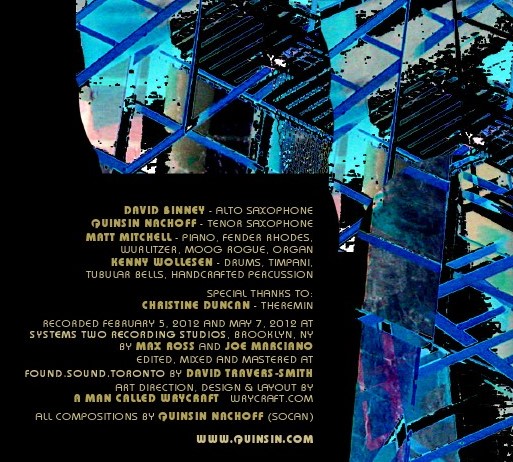
The bass-less quartet of Flux is entirely composed of leaders in their own right, each known for their groundbreaking adventurousness. Alto saxophonist David Binney, whose Mythology label is releasing the album, is a prolific and forward-thinking player and composer as well as being an influential producer whose collaborators have included Donny McCaslin, Uri Caine and Chris Potter. Pianist/keyboardist Matt Mitchell has seized a place at the leading edge of the music through his jaw-dropping work with the likes of Dave Douglas, Tim Berne and Rudresh Mahanthappa. And drummer Kenny Wollesen is a founding member of the New Klezmer Trio and Sex Mob whose diverse resumé includes work with Bill Frisell, Norah Jones, Tom Waits and John Zorn.
These four come together to breathe vivid life into Nachoff’s wide-ranging compositions, which continue to develop his longtime interest in fusing together eclectic influences from jazz and classical music. Don’t mistake this for a “Third Stream” or “chamber-jazz” project, however; this is radically creative music that forges its own path.
“The kind of music that I’m interested in making isn’t straightahead in either genre,” says Nachoff, who has composed for string and brass ensembles as well as jazz big bands. “I like mixing and matching things. I try to find commonalities between them to put people into different landscapes to improvise in.”
Flux was born out of a time when Nachoff’s life was in a state of flux itself. The Toronto native was in the process of moving to New York City and finding a new niche for himself in the jazz mecca’s ultra-competitive scene. “It’s quite a transition going from working a lot and teaching at well-respected schools to starting again from scratch,” he says.
Nachoff discovered kinships with the members of the Flux quartet in different ways: Binney on shared gigs with bassist Michael Herring, Mitchell during an Australian tour under Nachoff’s leadership, Wollesen simply through hearing the drummer play with bassist Eivind Opsvik’s Overseas ensemble. “I was blown away by his incredible feel,” Nachoff says of his first experience hearing Wollesen live. “I was infatuated with his hi-hat the whole night - which was only playing quarter notes!”
At the core of the sound of Flux is two pairings – the twin saxophone frontline, and the alchemical, opposites-attract meeting of Mitchell and Wollesen. “The concept was to put more heady material that Matt can deal with on top of this really organic feel that Kenny does and have it work as a band sound.”
The compositions that Nachoff brings to the quartet fully explore that tension between the band’s virtuosity and passion, which fuel each other in thrilling ways. With the two saxophones, Mitchell playing a variety of keyboards including Fender Rhodes, organ, Wurlitzer, and Moog, and Wollesen incorporating a variety of handmade percussion instruments, the palette that Nachoff had to work with, in his often surprising orchestrations, was vast.
Several of the pieces on Flux began life as commissions for classical ensembles, reinvented for and by the quartet. Aptly-named opener “Tightrope” is Nachoff’s response to the Toca Loca ensemble’s request for a “pop” influenced piece – allowing for as abstract an interpretation of that proviso as desired. The piece follows a loose verse-chorus structure with an underlying rock feel to the rhythm – and Mitchell interpreting two keyboard parts into one intricate whole.
“Complementary Opposites” is derived from a suite penned for trumpeter Peter Knight’s 5+2 Brass Ensemble and is built on surprising juxtapositions of style and rhythm – as when a reggae groove suddenly takes over the piece somewhere in the middle. The two-part “Mind’s Ear” comes from a suite written for the Greg Runions Jazz Orchestra that featured Nachoff and trumpeter Tim Hagans (who gave the piece its name) as guest soloists. The pieces are marked by unconventional harmonic motion and jarring tonal shifts.
The evocative title of “Astral Echo Poem” is an anagram for the name of its primary influence – Brazliian composer Hermeto Pascoal. Finally, “Tilted,” which erupts with nervous energy, is an apt bookend with “Tightrope,” drawing once again on hard rock inspirations for its driving beat, complicated by the fleet, snarling melodies.
A graduate of the University of Toronto, Nachoff has been colliding genres since his 2006 debut, Magic Numbers, which melded a jazz trio with a string quartet. He’s since composed music for a variety of ensembles in both worlds, including the Penderecki String Quartet, the Toronto Jazz Orchestra, and the Cecilia String Quartet, as well as his own Horizons Ensemble, Quiescence Quartet, and FoMo quartet. He also leads the Pyramid Project, which brings together saxophone, brass quintet and drums and features Ralph Alessi, Jonathan Finlayson, John Clark, Ryan Keberle, Marcus Rojas and Jim Black. As a sideman he’s performed and/or recorded with Kenny Werner, Howard Johnson, Tim Hagans, Kenny Wheeler and Don Thompson among others. He has coached at the Banff Centre for the Arts and taught at the University of Toronto and Humber College, as well as serving as artist-in-residence at the Queensland Conservatorium in Brisbane, Australia.