Thursday, March 1, 2018

Sebastiano Dessanay / Alessandro Di Liberto / Pierpaolo Frailis - Alternative Songbook EP (April 16, 2018)


Three outtakes from the recording session of Songbook Volume Two, two of which (Alternatively Nora and Sos Alternative Meres) remixed and remastered by Matthew O'Malley in 2017.

1. Alternatively Nora 02:46
2. Alternate Intermission 03:03
3. Sos Alternative Meres 05:39

Sebastiano Dessanay, double bass and all compositions, except Alternate Intermission by Dessanay, Di Liberto, Frailis
Alessandro Di Liberto, piano
Pierpaolo Frailis, drums

Recorded at Studio 1, Birmingham Conservatoire on the 15/16/17/18 of June 2011
Mixed and Produced by Matthew O'Malley
Assistant Engineer Emma Chilton
Mastering by Matthew O'Malley

Cover artwork by Seb Camilleri

follow me

Dunmall / Schubert / Dessanay / Bashford - Sign of the Times (2018)


Master UK saxist, Paul Dunmall, has been working with other saxists through the years (like Evan Parker & Dave Liebman) and obviously chooses them well. This is the third recording that Mr. Dunmall and Mr. Schubert have done together, working with Alex Von Sclippenbach and Willi Kellers in the past. Both Italian bassist, Sebastiano Dessanay and UK drummer, Jim Bashford, have recorded with Mr. Dunmall in the past as well. From the gitgo, there is a fire burning from within, with Mr. Bashford’s strong mallet work and Mr. Dessanay’s probing bass creating an uplifting undertow. Both saxes, first alto and then tenor, start spinning one at a time, the spirits slowly rising higher as they build, the energy and intensity edging upwards as the go. The interplay between all four members of this quintet is extraordinary, waves upon waves, spiraling higher and higher as they go. Both saxists, although different and distinctive in tone, toss their lines tightly back and forth, sometimes at furious pace, sometimes sailing down to a more restrained simmer. When they later switch to soprano, the stream is more contained yet no less focused. The ’Sign of the Times’ must be the setting free of those cosmic spirits since this is what we have here. - Bruce Lee Gallanter, Downtown Music Gallery

1. Sign Of The Times 31:49
2. Talbot 21:07
3. Blues Is The Colour Of My Beloved 08:19

Paul Dunmall, soprano, alto, tenor saxophones
Frank Schubert, soprano, alto saxophones
James Bashford, drums

Recorded at the Lamp Tavern, Birmingham, on 10/10/2017
Recorded and mixed by Matthew O'Malley
Wood engraving by Paul Dunmall
Produced for FMR by Trevor Taylor
follow me

Sebastiano Dessanay UK Quartet - Restless Dreams (2018)


Restless Dreams is the latest album by Sebastiano Dessanay, which features his UK Quartet with Fulvio Sigurtà on trumpet, Bruno Heinen on piano and James Bashford on drums. 

The album took a long time to be conceived and realised, and it includes all original compositions by Sebastiano, some of which are rearranged tunes from his chamber opera The Cry of the Double Bass (www.thecryofthedoublebass.co.uk). 

Restless Dreams was beautifully recorded in Cagliari at janeStudios by American sound engineer Marti Jane Robertson. The cover photos are by Francesca Ardau and the stunning cover artwork by Giampaolo Gerra.


1. Prologue 00:45
2. Guarujá 04:57
3. Father and Son 04:28
4. Mother 08:45
5. Two Riffs 07:26
6. Restless Dreams 06:45
7. Norma 04:36
8. Oh My Soul 06:01
9. Epilogue 01:47

All compositions by Sebastiano Dessanay

Fulvio Sigurtà, trumpet and flugelhorn
Bruno Heinen, piano
James Bashford, drums

Recorded on 13 and 14 of April 2017 at janeStudio, Cagliari
Sound Engineers: Marti Jane Robertson and Michele Rovelli
Assistant Engineer: Marzia Bulli
Mix and Mastering: Marti Jane Roberston
Produced by Sebastiano Dessanay
Artwork by Giampaolo Gerra

Other Animal - Other Animal (TRAUMTON RECORDS 2018)


A new formation with old friends, a particular sound with familiar vignettes: Other Animal plays “alternative prog-jazz”. The newest project of Bernhard and Peter Meyer, who take the key roles as composers and producers in this quartet, unites players from Berlin and New York who harmonize perfectly together and inspire each other. The Meyer brothers are best known for their highly acclaimed Melt Trio. With their distinct music and sophisticated stylistics on semi-acoustic bass and electric guitar, they have been contributing to the Berlin-specific jazz sound for years.

Beside the already beaten paths of the genre, they fuse elements of improvised and new music, independent-rock and ambient sounds and show how jazz can sound in the present and the future. “Also on their third album, the Melt Trio again plays in a league of its own,” Jazzpodium summarizes and places Peter Meyer among the international ranks of the generation Marc Ribot, Jacob Bro and Marc Ducret.


The magazine Rondo labels the trio as “one of the most stunning of the current jazz scene.” As a trio they have always enthralled listeners with their CDs and countless concerts and in addition, they explored other constellations - sometimes together, sometimes separately. For instance with the Norwegian electronica artist and live-remixer Jan Bang, the drum charismatics John Hollenbeck and Nasheet Waits, the exceptional singer Theo Bleckmann and the Portuguese double-bass original Carlos Bica. The Meyer brothers had also worked with Jim Black in the past.

Born in 1967 in Seattle, Black studied at Berklee College, then moved to New York and ever since, has been enhancing many projects with his distinctive playing. On the one hand in his own formations, such as the post-rock jazz quartet AlasNoAxis with Chris Speed, the Balkan-oriented Band Pachora, as well as Human Feel, with Speed, Kurt Rosenwinkel and Andrew D’Angelo. Furthermore, Black recorded a handful of albums alongside Dave Douglas and Uri Caine, also for the BBC with Tim Berne and Nels Cline, with Dave Liebman, Steve Coleman, Laurie Anderson and many more. During the same time as these sessions with Jim Black, the Meyers had initiated collaboration with Wanja Slavin.

The saxophonist, born 1982 in Freiburg and based in Berlin since 2005, received a Jazz-Echo award in 2014 for the album Starlight, which he recorded with Petter Eldh and Christian Lillinger. Most recently Slavin attracted attention in the quartet Amok Amor (Eldh, Lillinger, Peter Evans), for instance at the Moers Festival 2016, London Jazz Festival and Jazzdor Straßburg. Moreover, he has played with Kenny Wheeler, Médéric Collignon, John Schröder, Joachim Kühn, Alexander von Schlippenbach and others.

It was only a matter of time, until these award-winning individualists would unite to form a quartet. In November 2016 the band went to the legendary Funkhaus-Studio in the east of Berlin. The takes were so successful that thoughts about cutting and editing never came up. Merely a few overdubs were added, like guitar layers and electronic effects from Peter Meyer and flute and synthesizer from Wanja Slavin, to give the sound more depth here and there. With only one exception, Bernhard and Peter Meyer wrote all pieces on Other Animal specifically for this quartet.

“We wanted to give the musicians something where they could fully unfold their magic. Jim masters an enormous variety of grooves, so of course we also worked with that.” Consequentially the tempos of the pieces are very diverse and reach from almost Nordic seeming calmness all the way to crescendos with metropolitan verve. Black’s intuitive, free and yet very pointed playing with dynamic and forceful entrances also exhibits a pronounced sense for sound, which again harmonizes perfectly with the Meyer brothers’ sound awareness, their arcs of suspense and their energy made up of both transparent-airy and powerful dense passages. Wanja Slavin brings a sometimes fragile, sometimes rough beauty into the band. Inspired by the revolutionary expressiveness of John Coltrane and Ornette Coleman, Slavin can captivate with sensitive as well as forcefully gripping sounds; some facets of his playing are reminiscent of new music and electronic music.


Thanks to Slavin, Peter Meyer’s role in this quartet is a little different than usual. “With the Melt Trio I’m always the soloist, kind of like the singer of the band. In Other Animal I can concentrate on creating specific tonal colors from time to time. Just like guitarist Meyer, Slavin evidently also thinks in structures and textures. Both focus on atmospheric, sharply detailed soundscapes instead of the traditional “faster, higher, further”-competition. Thus they interlock like zippers’ teeth - not only in parallel passages. Or they seem like a tree, whose shoots sprout into different directions.

A constant quality of Other Animal, is the compositional modernity of both Meyers, which is guided by their own listening habits. The two early thirtysomethings are not only influenced by the sound of certain jazz greats like Bill Frisell, Keith Jarrett (especially the quartets with Haden, Motian, Redman or Garbarek), Marc Ribot and Terje Rypdal, but also by rock experimenters like Radiohead, James Blake and the Notwist. Exemplarily they mention their piece Nongeniality; a melody that could come from Charlie Parker, but is turned and twisted through the indie-rock filter. To the Meyer brothers the form of the songs is at least as important, as melodic themes and solos.

By that, they mean the sequence of parts, arcs of suspense and instrumentation. In these aspects McCoy Tyner and Brad Mehldau are just as much inspirational sources as Weather Report and Grizzly Bear. Above all else is the band’s motto formulating what is best for the music: playing consciously and intuitively, leaving out the irrelevant and standing above vanity and self-display.

The title Other Animal represents the unknown and the new, Bernhard and Peter Meyer explain. A band is an organism, which breathes and pulsates. It needs to communicate and be kept alive to amaze with different motions, timbres and developments again and again. In this sense, Other Animal is a very special, charismatic species.


1. Drown Dreams 03:43
2. Name of Cold Country 05:38
3. Mr Manga 02:49
4. Stroy 05:03
5. Downbear 04:47
6. Nongeniality 03:11
7. Cloudline 04:13
8. E Dance 06:03
9. No Fruit 04:14
10. Spectral 05:55
11. Qubits 04:15
12. Blim 05:24

Peter Meyer - guitar
Wanja Slavin - sax
Bernhard Meyer - bass
Jim Black - drums


Bernhard Meyer - Murmuration (TRAUMTON RECORDS 2018)


“I have had this formation in mind for some time now,” Bernhard Meyer says about his quintet, which unites an unusual combination of instruments and charismatic musicians. “The specific sound came together over time in my imagination,” Meyer continues, “inspired by collaboration with these musicians individually, in smaller formations.” Of course the ingenious unity with his brother Peter is present again, well known through three highly acclaimed albums and countless concerts of the Melt Trio. Moreover, Bernhard Meyer’s particular, melodiously rich playing of his semi-acoustic bass has impressed listeners in co-operations with Norway’s live-remixer and electronica-grandmaster Jan Bang (with the Melt Trio), John Hollenbeck, Jim Black, Kurt Rosenwinkel, Nasheet Waits, Eric Schaefer and many more.

Besides the Melt Trio, the Meyer brothers have been exploring similarities with another outstanding drummer of the German scene for a while now, namely Andi Haberl. The Bavarian Berliner-by-choice made a name for himself with distinctive appearances with the Andromeda Mega Express Orchestra and has been fascinating audiences with Europe’s most progressive indie-rock band The Notwist for years. In addition, Bernhard Meyer played several concerts in a chamber musical jazz trio with the clarinet virtuoso and electronic tinkerer Claudio Puntin and Julius Heise, who shone as a fine jazz vibraphonist, with the Brand Brauer Frick Ensemble among others.

Some time ago Bernhard Meyer united the different personalities into a new quintet. On Murmuration the stylists now reach tremendous depth and wonderful richness of detail. At times their playing is extremely filigree, like a ballerina they perform surprising twists on tiptoes. At the same time there is a force inherent in their interaction, which blazes the way dynamically and can boost and intensify contrasts. The expression spans from acoustic nuances all the way to contemporary electronica vignettes and futuristic facets.

Bernhard Meyer’s individual bass playing goes far beyond just setting the basis and carries melodies and rhythms. On top of that, the internal allocation of responsibilities shifts. Sometimes Peter Meyer and Julius Heise create harmonic chords and transparent sound layers, then the guitarist changes to join Claudio Puntin, to merge melodies and electronic sounds. Just a little later the Meyer brothers and Andi Haberl act as a rhythm section, trenchantly pressing the groove forward. Bernhard Meyer’s compositions and arrangements unroll a wide panorama. It is so rich in variety that you always want to keep going, curious to find out what happens beyond the next bend.

Melodies and themes flash up, fade again into the background and come back unexpectedly from a different direction. Every piece has its own character. “Plain Air” is reminiscent of Steve Reich’s pathbreaking minimalism, “Unchild” conveys almost sacral atmosphere, “Wooden” captivates with its open and in a broader sense free approach. At times one deems to perceive distant allusions to John Hollenbeck’s Claudia Quintet, Bill Frisell, colorfully shimmering arrangements of Sufjan Stevens or Kurt Rosenwinkel’s Heartcore.

A scale by Olivier Messiaen provides the basis for a three-part unison in “Corus”. New perspectives surprise again and again, even within certain tracks Meyer skillfully plays with alleged contrasts. Like in “Growl”, where weightless, warm sounding vibraphone and cool monolithic synthesizers encounter each other get along remarkably well. In “Plain Air” the Classical minimalism makes way after a while for a passage, in which the spirit of Charles Mingus comes alive; then towards the end the piece comes closer to the indie progressive rockers Grizzly Bear. Throughout the album, grooves interchange with odd meters and freely devised rhythms.

Some ingenuity might remain concealed to the listener, which doesn’t disrupt the enjoyment though, nor does it bother Bernhard Meyer. He sees the conceptual deliberations for his pieces primarily as a toolbox for producing new ideas. As an example for details with deeper background, he mentions his bass improvisation on “Aphir”, which isn’t performed as a traditional solo, but is abstracted in a live-remix by Peter Meyer and Claudio Puntin.

Bernhard Meyer has meticulously polished many aspects of his compositions. As head of the quintet, most impulses and ideas do indeed come from him - at the same it is important to him, that his partners have room to bring in their personal talents. Thus drummer Andi Haberl and the Classically trained and New Music versed Julius Heise can also exhibit their sense for orchestration. A master of this discipline is Claudio Puntin, when he’s not playing as a soloist.


Born 1965 in the Central Swiss town Zug, the multiply award-winning clarinetist wrote music, besides for his own productions, also for film, theatre, audio dramas, and exhibitions. His list of collaboration partners is long and stretches from Steve Reich, Carla Bley, Fred Frith, Hermeto Pascoal and Sidsel Endresen to the Ensemble Modern and the Philharmonic Orchestras of Cologne, Munich and Zurich. Most recently Puntin worked in the Trio Ambiq with producers and DJs Max Loderbauer and Ricardo Villalobos, to create bridges between free improvisation and electronic music.

Clever and smart ideas run through Murmuration like a golden thread and the intuitive playing attitude of the band makes the album lively. A dazzling band sound is the motivation and objective for Bernhard Meyer. Innovation and form are the important parameters thereby. The album title references the spectacular flights of starlings, where the complex interconnectedness and densification fascinates all people and still poses riddles to science.

“I’ve had the pictures of these swarms in mind for quite some time, as a synonym for a band that can fluently and unpredictably vary delicate structures and textures,” Bernhard Meyer says. His band may not reach the volume of a swarm in numbers, but their diversity of sound surpasses the expectations a quintet usually generates. Meyer’s Murmuration mesmerizes the listener just like the swarms of starlings its observers.

1. Just Like John 08:19
2. Radiance 05:38
3. Dark Flow 06:50
4. Growl 07:09
5. Aphir 03:36
6. Plain Air 06:18
7. Unchild 05:20
8. Wooden 05:50
9. Corus 06:14
10. Shields 05:23

Shake Stew - Rise And Rise Again (LAUB RECORDS April 6, 2018)


SHAKE STEW is Austria‘s jazz band of the hour. After playing more than 25 gigs during the first months since premiering at Jazzfestival Saalfelden 2016 and selling out their first record „The Golden Fang“ within half a year, the unique septet is conquering the music world with a hypnotic mixture of afrobeat and jazz grooves shaken up by the intense and mysterious soundscapes created with a combination of two drummers and two double bass players! With „Rise And Rise Again“ Shake Stew are releasing their highly anticipated second album in May 2018, which also features Shabaka Hutchings on 2 of the tracks. Everywhere they went so far, the press has been more than enthusiastic, often trying to create new terms and genre-labels to put their live experiences into words and this new release will only further establish their status as one of Europe's most upcoming Jazzbands.

Shake Stew brings together seven unconventional musicians, all of them interesting characters of the young Austrian and German jazz scene. They are united with bandleader Kranzelbinder (1988) by the pursuit of new, enhanced sound possibilities and by concepts beyond boundaries of genre, which are by now already considered a guarantee with Kranzelbinder. His own distinct combination of virtuosity, entertainment and uncompromising energy comes out in many of his projects and has meanwhile become a kind of trademark of the hard working musician, composer, and arranger.

As the youngest musician so far in the history of the prestigious Jazzfestival Saalfelden, he was chosen to put together a new project for the festivals opening concert in 2016, which is also connected with a 4 day residency. He put together a septet and prepared the festival show for a whole year, before not only recording the debut album “The Golden Fang” within a day of the residency but also playing a concert to remember: Der Standard from Vienna describes the septet’s performance as a „magical opening hour“, to the Kurier Shake Stew sounds „like an intergalactic road movie for the ears.“ The Süddeutsche Zeitung calls the bassist and composer Kranzelbinder a whizz kid and the OÖN added: „The 28-year-old writes fantastic pieces, which optimally feature the exciting instrumentation with its three-part horn section and two basses and drummers“.

From this point on Shake Stew was on a unique journey. In their 6 month residency as a Stage Band they managed to sell out Viennas biggest jazz club Porgy & Bess for every show, developing and presenting a new program at each of their performances. When Kranzelbinder invited Shabaka Hutchings for one of the evenings, the musical and spiritual connection between Shake Stew and the Tenor Wizard was felt almost immediately. Right after a 4 day tour they went into the studio and recorded an album that reflects the many musical souls that lie within this group of musicians.

During the course of 6 tracks “Rise And Rise Again” reveals as many different energies as musical influences, always taking the listener by surprise with the vast possibilities of instrumentation that this young group offers between its members. “Everytime I was playing a live show with Shake Stew, I felt that this band has the power to send out a very strong musical energy to the audience.


So I wanted to create an album that people can put on to get six different kind of tracks, each with a unique energy, lifting them to different levels so that they can rise with the music as well as fall down and land softly with it – only to rise again and drift away to a different place once again. Basically you can choose the kind of track that fits to your current mood or the mood you want to be taken too. For me, only the power of music can do that.” Behind this idea stands a band that works on the highest level of musical skills. Driven and relentless beats set off this record, with “Dancing in the Cage of a Soul” slowly introducing each instrument but soon developing into a jubilant anthem that sets off a spirited tenor saxophone solo by Johannes Schleiermacher rising above the shivery rhythm section. “How We See Things” fully utilizes the spectrum of acoustic possibilities by using Shabaka Hutchings as a guest and therefore having three tenor saxophones playing a theme above a tranquilizing and addictive pattern played by both double basses that reflects the strong influence of african music in the composers cosmos.

At the time trumpet player Mario Rom starts to take the listener under his spell with a beautifully ruminant solo, any kind of resistance is already futile. Featuring his soloists with lengthy and excessive spots to fully express themselves is a notable trademark of Kranzelbinders compositions and with “Goodbye Johnny Staccato” he wrote a theme tailor-made for tenor saxophonist Schleiermacher. Referring to a TV show about a detective/jazz musician in the late 60ies this piece of music unravels all kinds of musical layers during its twelve minute tour de force, including reminiscences of old soundtracks and Italian restaurants. The 2 parts of “Fall Down Seven Times, Get Up Eight” then reflect the dynamic journey that Shake Stew is capable of, with two double basses setting up a vast space for the trumpet to develop a captivating solospot. As soon as the rhythm section gets going with intelligent use of the three available bassdrums in “Get Up Eight” and the horns start another praising, nearly gospel-like chorus you can feel the presence of Shakaba Hutchings growing with each bar.

His solo starts on top of two basses laying down a virtuosic carpet of interlocking sixteen notes and from there on you already guess the highly energetic climax this journey is bound to. With the most stand out song of this album being at the end, “No Sleep My King” feels like an epilogue that – once you lost yourself in its vibe – fully lets you drift away on the repetitive bassline, the moroccan field recordings or the remarkable alto solo by Clemens Salesny.


1. Dancing in the Cage of a Soul
2. How We See Things (feat. Shabaka Hutchings)
3. Goodbye Johnny Staccato
4. Fall Down Seven Times...
5. Get Up Eight (feat. Shabaka Hutchings)
6. No Sleep My King?


Special Guest: 
Shabaka Hutchings - Tenor Saxophone (Track 2 & 5)

All compositions written by Lukas Kranzelbinder
All tracks recorded on April 23 + 24 at 4tune audio production by Werner Angerer
Mixing by Werner Angerer
Mastering by Martin Siewert
Photography by Andreas Waldschuetz
Shirt Artwork by Luna Ghisetti
Graphic Design by die Kaz


Wednesday, February 28, 2018

Karen Sharp - The Sun, The Moon and You (TRIO RECORDS March 1, 2018)


Karen Sharp returns with a long awaited second album on Trio Records featuring her now well established quartet of Dave Green, Niki Iles, and Steve Brown - a stella line-up indeed.

Following the same format as the critically aclaimed debut, the album featueres some Cole Porter as well as some more contemporay themes by Tom Harrel, Danny Zeitlin as well as originals by Karen and Nikki. The album also features a great version of Monk's Pannonica as well as the little heard, deceptively simple tune by bassist Ron Carter, Little Waltz.

Far from being a horn with accompanying trio, Karen's Quartet features each voice to its fullest without ever undermining the integrity of the group, with fine contributions by all.


1 - get out of town - cole porter 6.36
2 - the sun, the moon and you - tom harrell 6.04
3 - pannonica - thelonious monk 8.28
4 - the ford - karen sharp 6.40
5 - little waltz - ron carter 8.03
6 - all of you - cole porter 6.31
7 - iris - nikki iles 5.04
8 - quiet now - danny zeitlin 5.51
9 - night and day - cole porter 6.41
10 - terminus - karen sharp 5.08

Karen Sharp on saxes
Nikki Iles on piano
Dave Green on bass
Steve Brown on drums

Mark Cherrie Quartet - Joining The Dots (TRIO RECORDS 2018)


'Joining the Dots' is the debut album by the Mark Cherrie Quartet. What makes this a little unusual is that the album is led by Mark Cherrie, a steel pan player. The quartet also features the great pianist John Donaldson, superlative Mick Hutton on bass and, Eric Ford on drums.

The quartet is also joined by special guests including guitarist Nigel Price, vocalist Sumudu and saxophonist Dave O'Higgins.

The titles on it are a very mixed bag including jazz classics by Herbie Hancock and Wayne Shorter, to more modern jazz standards by Pat Metheny, to jazz takes on contemporary tunes by Nirvana and The Police.

This is a really enjoyable album featuring the steel pan which is rarely heard in jazz but which easily holds its own in the company of the more usual instruments. This eclectic collection of tunes lasting well over an hour is great to listen to and all the more interesting because it includes tunes that were written specifically for the steel pan as well as others of different genres that were not - a rare gem not to be missed.

Howard Lawes

In Mark's own words:

I decided to record a jazz album with musicians that are well known on the UK jazz circuit, where the music was deliberately not at all Caribbean. All the band tracks were recorded all together in the studio live room in one day, in fact between 12 noon and 6pm. The second day was reserved for overdubs, i.e. sax, acoustic and electric guitars and voice. I mixed the album myself, in my own studio and then it was professionally mastered. I believe that there is no other album out there that attempts to cover the musical area that I have done with this one. Hopefully, there will be some people out there that will want to hear it, ha ha!.

1. Morse Code
2. Maiden Voyage
3. Little Wing
4. Footprints
5. October's Child
6. Just Like Lovers Do
7. Scarborough Fair
8. When We Were Free
9. Sippin' At Bells
10. Smells Like Teen Spirit
11. Starless And Bible Black
12. Walking On The Moon
13. Last Summer
14. Just Like Lovers Do

Mark Cherrie - steel pan
John Donaldson - piano
Mick Hutton - double bass
Eric Ford - drums

Special guests:
guitarists Nigel Price and Dominic Grant
vocalist Sumudu and saxophonist Dave O'Higgins

Blameful Isles - Pleroma (URBAN WAVES RECORDS March 12, 2018)


Blameful Isles new LP "Pleroma" is a fantastic journey starting out in the mystic land of the Tanzanian capital Dodoma. In our spiritual quest for enlightenment we visited an old shaman that opened the door to the spiritual plane for us. Where we've met with spirits that told us stories about their ancestral deeds. While listening we were yet again transposed to a further astral plane in which words weren't spoken anymore. Everything came together and made sense as a whole, harmonious sounds were omnipresent we could not only hear it but see it as well. We realized that what we were experiencing was music! Upon waking up from our astral dream the sense of home and family was overwhelming. It all made sense more than ever, we had purpose yet again.

This album is an ode to the realization that music is the universal language of love and compassion. 

~A warm and loving thank you to everyone who participated in the making of this album: Madeleine, Christopher, John, Alex, Uwe, Christian and Hüey.

Notes on the vinyl edition : 
The vinyl edition will be strictly limited as usual, it comes in a deluxe gatefolder cover with 2 vinyls. The sound mastering is absolutely lovely, it feels like being the same room as Blameful Isles. It plays for about an hour. It's an absolute gorgeous piece of art, a must have!

1. Prelude (The Lord Is Calling Us)
2. Infinite Being (Sagittarius)
3. Light of Idun (Áries)
4. Witchdoctor (feat. John Millstream)
5. Ramnasjön (Aquarius)
6. Sci-Fi Intermission
7. Orange sun tea (Gemini)
8. The Hyperflare Nine
9. Lumos (Pisces)
10. Interlude - Soft Celosia
11. Snowflake Nebula
12. Farewell Voyage to Crystal Meadow (Capricorn)
13. Jahlia (feat. Hüey Stone)

Various Artists: J​-​Jazz - Deep Modern Jazz from Japan 1969​-​1984 (BBE MUSIC 2018)


In the years following the World War Two, Japan developed one of the most insatiable, dynamic and diverse markets for jazz. For a crucial period of little over a decade - from the late 1960s to the early 1980s - Japanese jazz culture progressed at an astonishing rate, producing an extraordinary array of artists, recordings and record labels that created some of the most forward thinking and impressive jazz to be committed to tape. This amazing journey is explored on ‘J Jazz’. 

This compilation from BBE uncovers some of the most sought after and rare material from this period and pulls together key artists who shaped the postwar modern jazz scene in Japan. ‘J Jazz' includes obscure and sought after rarities like the bass-driven power jazz of Koichi Matsukaze’s ‘Earth Mother’, the holy grail rarity of Aizawa Tohru Quartet’s ‘Dead Letter’ and the loping majesty of Takeo Moriyama’s ‘North Wind’. 

This collection takes the listener into deep spiritual jazz, post-modal impressionism and fierce dance-floor fusion with material from artists and composers whose names are generally only known to committed collectors of Japanese jazz. Fumio Karashima, Mitsuaki Katayama, Takeo Moriyama and Kiyoshi Sugimoto are among the names featured on an album aiming to shed a little light on the shadowy world of Japanese jazz clubs, tucked away in the neon backstreets. This music demands a wider audience and BBE are excited to deliver a landmark compilation, lifting the veil on this wonderful and mysterious area of the global jazz catalogue. None of the tracks featured on ‘J Jazz’ have ever received an official release outside Japan before. 

The albums the tracks are taken from are extremely hard to find and often fetch huge sums on the collector’s circuit. Originally pressed in small numbers on independent and private labels such as Union, Johnny’s Disk, Whynot, ALM and VAP, these tracks are now available for everyone to enjoy. Compiled by Tony Higgins and Mike Peden, both long-time collectors of Japanese jazz, ’J Jazz’ brings together the very best in modern jazz from Japan, recorded during a critical period of musical and cultural transition that saw composers and musicians not only assert a new artistic identity but also create a lasting musical legacy.

1. Koichi Matsukaze Trio - Earth Mother 11:22
2. Tohru Aizawa Quartet - Dead Letter 10:11
3. Eiji Nakayama - Aya's Samba 06:33
4. Takao Uematsu - White Fire 07:48
5. Shintaro Quintet - A Blind Man 10:55
6. Mitsuaki Katayama - Unknown Point 06:33
7. Takeo Moriyama - Kaze 05:09
8. Terumasa Hino - Ode to Workman 15:19
9. Fumio Karashima - Little Island 09:04
10. Kiyoshi Sugimoto - Long Neal 08:26

Tracklist 3LP Vinyl Album:

Side A
Koichi Matsukaze Trio - Earth Mother
Takeo Moriyama Quartet with Shigeharu
Mukai - North Wind*

Side B
Tohru Aizawa Quartet - Dead Letter
Eiji Nakayama - Aya’s Samba

Side C
Takao Uematsu - White Fire
George Otsuka Quintet - Sea Breeze*

Side D
Shintaro Quintet - A Blind Man
Mitsuaki Katayama - Unknown Point

Side E
Fumio Karashima - Little Island
Kiyoshi Sugimoto - Long Neal

Side F
Takeo Moriyama - Kaze
Terumasa Hino Meets Reggie Workman - Ode to Workman*

*This tracks are vinyl only, not on CD.

PRE-ORDER ITEM : The vinyl LP is currently being repressed and will be available on or about June 10th. If you wish to secure yourself a copy, order now to avoid disappointment. Please note any orders containing pre-order items won’t be shipped until all items are available, so please order this separately to avoid delays.

In the years following World War Two, Japan developed one of the most insatiable, dynamic and diverse markets for jazz. For a crucial period of little over a decade – from the late 1960s to the early 1980s – Japanese jazz culture progressed at an astonishing rate, producing an extraordinary array of artists, recordings and record labels that created some of the most forward thinking and impressive jazz to be committed to tape. This amazing journey is explored on ‘J Jazz’.
This compilation from BBE uncovers some of the most sought after and rare material from this period and pulls together key artists who shaped the post-war modern jazz scene in Japan.

‘J Jazz’ includes obscure and sought after rarities like the bass-driven power jazz of Koichi Matsukaze’s ‘Earth Mother’, the holy grail rarity of Aizawa Tohru Quartet’s ‘Dead Letter’ and the loping majesty of Takeo Moriyama’s ‘North Wind’. This collection takes the listener into deep spiritual jazz, post-modal impressionism and fierce dance-floor fusion with material from artists and composers whose names are generally only known to committed collectors of Japanese jazz. Fumio Karashima, Mitsuaki Katayama, Takeo Moriyama and Kiyoshi Sugimoto are among the names featured on an album aiming to shed a little light on the shadowy world of Japanese jazz clubs, tucked away in the neon backstreets. This music demands a wider audience and BBE are excited to deliver a landmark compilation, lifting the veil on this wonderful and mysterious area of the global jazz catalogue.

None of the tracks featured on ‘J Jazz’ have ever received an official release outside Japan before. The albums the tracks are taken from are extremely hard to find and often fetch huge sums on the collector’s circuit. Originally pressed in small numbers on independent and private labels such as Union, Johnny’s Disk, Whynot, ALM and VAP, these tracks are now available for everyone to enjoy.

Compiled by Tony Higgins and Mike Peden, both long-time collectors of Japanese jazz, ’J Jazz’ brings together the very best in modern jazz from Japan, recorded during a critical period of musical and cultural transition that saw composers and musicians not only assert a new artistic identity but also create a lasting musical legacy.

Click HERE to search for the album on other stores and formats.

Quoan - Fine Dining (feat. Brian Walsh, Daniel Rosenboom, Sam Minaie & Mark Ferber) ORENDA RECORDS 2018


Brimming with cheeky humor and fearless creativity, Quoan tips its hat to the historic lineage of the modern, chord-less jazz quartet with an album that feels classic yet new, biting yet sweet, and that overflows with virtuosity and character.

Two prominent Los Angeles's wind/brass improvisers join forces with a formidable New York rhythm section to deliver Fine Dining under the band name Quoan. Though clarinetist Brian Walsh and trumpeter Daniel Rosenboom have collaborated in numerous bands and projects for more than a decade, this is their first co-led ensemble, and the results are as nuanced and engaging as such a union would suggest. Bassist Sam Minaie and drummer Mark Ferber ground and drive the group with a remarkably nimble approach, ranging from elegant to burly, as the bi-coastal group navigates the timbral landscapes of the modern chord-less quartet. With a fearless approach to composition and improvisation, Quoan steps into the lineage of this classic avant-garde jazz format with grace, creativity, and a cheeky sense of humor that is downright infectious.


Brian Walsh and Daniel Rosenboom are two of the most sought after voices in the Los Angeles creative music scene and have appeared on dozens of recordings in jazz, pop, classical, experimental and other genres. Walsh is a member of the contemporary classical groups wild Up and gnarwhallaby and has previously worked alongside figures as diverse as Gavin Bryars, Meredith Monk and Nels Cline. In addition to leading his own bands Burning Ghosts and the Daniel Rosenboom Quintet, Rosenboom has worked in the groups of Vinny Golia, Josh Groban and Anthony Wilson and works frequently in the storied Hollywood film-scoring community for such notable titles as the recent Star Wars films. Sam Minaie has worked with many of today's leading jazz musicians, including Tigran Hamasyan, Donny McCaslin, and Ravi Coltrane, and Mark Ferber has performs regularly with such notable artists as Gary Peacock, Ralph Alessi, and Brad Shepik. 

This wealth of performance experience is on full display in the expansive stylistic ground covered throughout the duration of Quoan's Fine Dining. Beginning with the brooding groove of “The Last,” Walsh and Rosenboom carve out their own distinct sonic spaces while exploring the shifting colors of microtonal improvisation. This group has moments of unabashed jazz as well, such as the hard-swinging “Capitol Absurdity” and slippery groove that anchors “Demicolon.” The group plays cleverly with structure, as in the rhythmic palindrome of "216" or the aleatoric “Fist," and plays with ironic sound painting in "Legislation" and the title track "Fine Dining." Several miniatures pepper the record, where the group breaks into factions of duos and trios (“Gnomish”, “Shunyata” and “Witch's Butter”), as well as a couple moments of profound lyrical respite in the waltz “Moon Cage” and the elegiac closer “Braids and Brooms.” 

History is not lost on these musicians. Recorded live, all together in the same room at 64 Sound in Highland Park, CA, using a total of 9 microphones, the group embraces an old-school sound that places the listener in the room with palpable energetic interplay between band mates. This marriage of history and innovation extends even to Eron Rauch's cover art, which presents a wonderfully "kill-your-idols" style homage to Andy Warhol and the Velvet Underground. With Fine Dining Quoan presents an album that feels classic yet new, biting yet sweet, and overflowing with light-hearted virtuosity.

1. The Last 07:44
2. Shunyata 01:34
3. Demicolon 06:25
4. Fine Dining 03:20
5. Moon Cage 07:26
6. Gnomish 01:26
7. Fist 02:14
8. 216 09:51
9. Witch's Butter 01:17
10. Legislation 00:22
11. Capitol Absurdity 06:06
12. Braids and Brooms 08:42

Tracks 1, 5, 7, 12 composed by Brian Walsh (ASCAP)
Published by Walsh Set Music (ASCAP)

Tracks 3, 8, 11 composed by Daniel Rosenboom (ASCAP)
Published by Daniel Rosenboom Music (ASCAP)

Tracks 2, 4, 6, 9, 10 improvised by Quoan

Brian Walsh - Clarinet, Bass Clarinet, Contrabass Clarinet
Daniel Rosenboom - Trumpet, Piccolo Trumpet, Flugelhorn
Sam Minaie - Bass
Mark Ferber - Drums

Recorded October 19, 2017
64 Sound, Highland Park, CA

Sound Engineered by Theo Karon

Mixed by Daniel Rosenboom
Orenda Sound, Los Angeles, CA

Mastered by Sam Minaie
Bird Food Studio, New York, NY

Art and Design by Eron Rauch

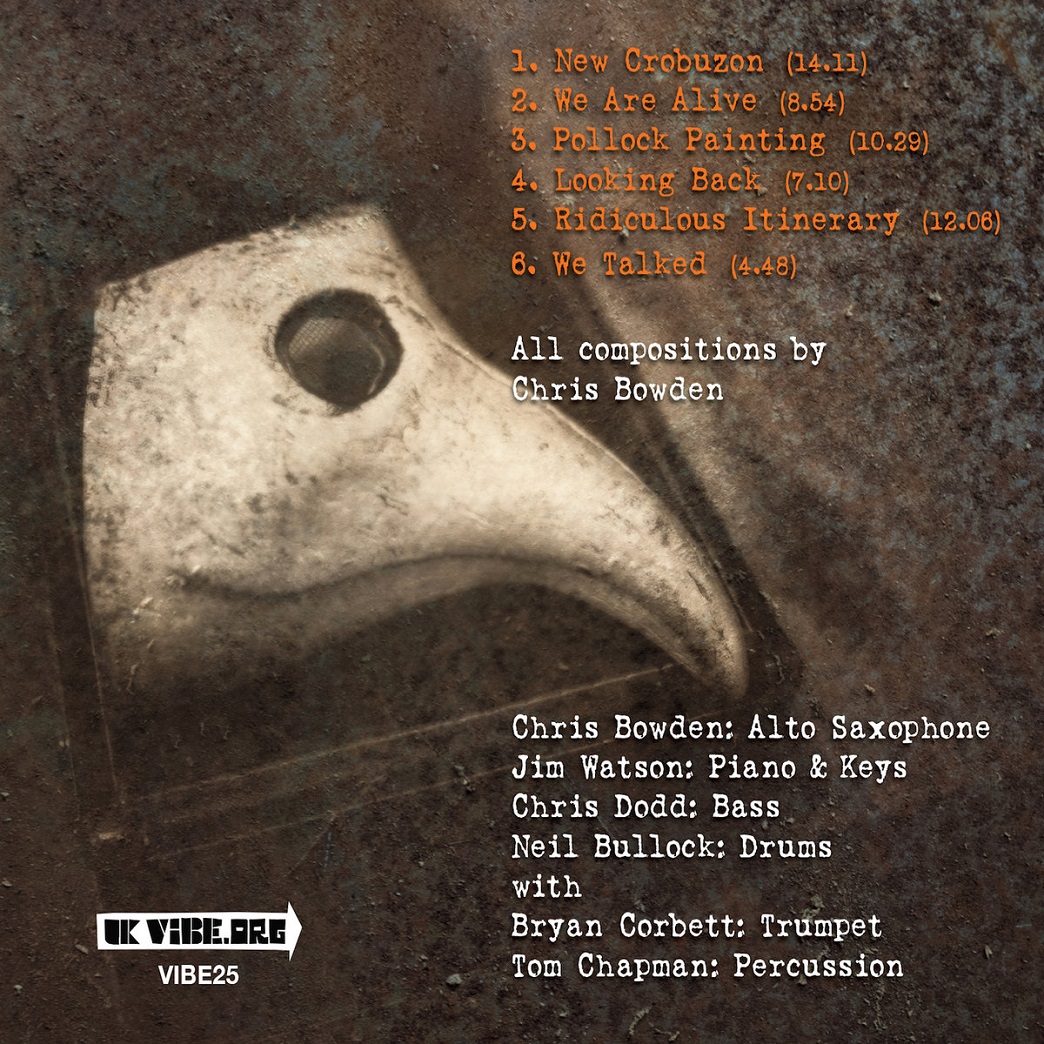
Chris Bowden - Unlikely Being (UK VIBE RECORDS February 28, 2018)


Formed in late 2017, Unlikely Being is the uber-exciting new project led by saxophonist/composer/arranger Chris Bowden. This stand-out quartet features Jim Watson on piano and keys, Chris Dodd on bass and Neil Bullock on drums. Trumpet player Bryan Corbett adds a 5th dimension on the band’s inaugural release. Bowden takes the listener on an innovative roller-coaster ride of a journey depicting his eventful life experiences through his music. 

‘Unlikely Being’ draws on Bowden’s multi-faceted material from the cult, classic albums “Time Capsule” (Soul Jazz Records) and “Slightly Askew” (Ninja Tune), along with music from the infamous (yet unreleased) “The Incredible Death of Cash Bodean”. Hints of Bowden’s work with “The Herbaliser”, “4Hero” and “The Heritage Orchestra” are evident throughout, yet it is a timeless, optimistic, jazz-fuelled quality in the saxophonist’s new compositions that really sing out loud.

Ryan Meagher - Lost Days (FRESH SOUND NEW TALENT RECORDS 2018)


Ryan Meagher (pronounced Marr) is a jazz guitarist and composer who grew up in San Jose, California. His teenage years were split between taking ground balls and hitting soft-toss on ball fields with stomping on distortion pedals and kicking over mic stands in garage band rehearsals. He launched his international reputation in New York City in 2003 after completing his bachelor of music degree at San Diego State University. During his years in New York, he released his debut jazz album "Sun Resounding," followed by his second album entitled "Atroefy" on Fresh Sound New Talent Records (FSNT). His third album "Tone," also on FSNT, was created while he was splitting time between graduate studies at the University of Nevada, Reno (UNR) and New York City.

Not soon after relocating to Portland, Meagher teamed up with the Portland Jazz Composers Ensemble, the local non-profit organization (of which he would later become an important leader), and recorded a live album that would be released on their budding record label, PJCE Records. “Tango in the City of Roses," was recorded live in concert at Ivories jazz club in 2014 alongside his mentor from UNR, Peter Epstein (alto and soprano sax), George Colligan (piano), Chris Higgins (bass), and Matt Mayhall (drums). The album is a confluence of regionality in that Meagher, Epstein, and Mayhall all shared Reno as a home base for some time; Colligan, Higgins, Epstein, and Meagher resided in Portland at one time or another; and Epstein, Colligan, Higgins, and Meagher all called New York City home for a period.

Read more...

01. Bayou Brasileira
02. Absurdly Delinquent
03. Lost Days
04. Brook’s Little Blues
05. Introduction to Heart-Whole
06. Heart-Whole
07. South Slope
08. Deep Ocean Hall
09. Meagher
10. Bayou Brasileira (Surf Reprise)

All tracks written by Ryan Meaghe

Ryan Meagher (guitar, Irish bouzouki & glockenspiel)
Bill McHenry (tenor sax)
George Colligan (piano, Hammond organ, Wurlitzer electric piano & Fender Rhodes)
Chris Higgins (bass)
Mark Ferber (drums)

Recorded at Map Room Studios, in Portland, Oregon, April 13 & 14, 2017