Corpo de Dentro é o álbum de estréia do compositor, arranjador e guitarrista Lourenço Rebetez. Produzido por Arto Lindsay (Caetano Veloso, Ryuichi Sakamoto, David Byrne, Marisa Monte), o disco conta com uma formação instrumental ambiciosa: 8 sopros (trompetes, saxofones, trombones); 3 percussionistas (atabaques, timbaus, surdos virados, caxixis); piano, baixo acústico e bateria. São dez composições inéditas que, se por um lado têm o jazz evidente na maneira de tocar e nas ricas texturas harmônicas dos arranjos, têm firmes raízes no universo percussivo afro-brasileiro. Nesse sentido, a presença dos percussionistas baianos Gabi Guedes, Iuri Passos e Ícaro Sá é marcante no disco. A percussão aqui não tem uma função meramente decorativa. Pelo contrário, os naipes de atabaques, timbaus, surdos virados, combinados em arranjos inspirados, fazem deste um disco de apreensão “corporal”, feito pra se ouvir com o quadril tanto quanto com os ouvidos.
Mas, para além do uso intenso dos instrumentos de percussão nos arranjos, há ainda um sentido mais profundo, pois é das claves dos toques de candomblé e das levadas dos blocos afro-baianos que vem a matriz composicional desses dez temas instrumentais, o que faz deste um álbum de jazz profundamente brasileiro. São ritmos como opanijé, aguerê, ijexá, samba-reggae, samba afro, vassi e bravum, que se somam à cozinha potente de Henrique Gomide, Bruno Migotto e Vitor Cabral para formar os grooves enérgicos de O Corpo de Dentro. Diz Zuza Homem de Mello: “Eis Lourenço Rebetez, um jovem de 30 anos que aflora com seu corpo de dentro. Junta a riqueza rítmica da música brasileira com sopros do jazz. Com sua turma, ele provoca quem sabe ouvir música”.
01. Abertura (O Avesso das Coisas)
02. Ozu
03. O Mais Profundo é a Pele
04. Interludio 1 (Opanijé)
05. Imã
06. Pontieva
07. Birjand
08. Interludio 2 (Supernova)
09. Punjab
10. Sombrero
Lourenço Rebetez é músico de São Paulo, Brasil. Trabalha com composições e arranjos de linguagem jazzística e em colaboração com artistas de dança contemporânea, cinema e teatro. Estudou guitarra com Chico Pinheiro, composição popular e ritmos afro-brasileiros com Letieres Leite (Orquestra Rumpilezz),composição erudita no ciclo avançado da EMESP, além de piano e percussão brasileira. É formado pela Berklee College of Music em guitarra e jazz composition.
Enjoying a career which includes key roles with prominent UK symphony orchestras and big bands, plus recording/touring projects with Aretha Franklin, Quincy Jones, Tom Jones and Randy Brecker (to name but a few), trumpeter and composer/arranger Ryan Quigley now unveils his ten-track album What Doesn’t Kill You – a quintet release with Paul Booth (tenor sax, flutes), Steve Hamilton (piano, Fender Rhodes), Michael Janisch (double bass) and Clarence Penn (drums).
Having worked for a number of years with Scottish band Brass Jaw, as well as releasing his own album Laphroaig-ian Slip, Quigley’s experience shines through in this new set of originals which suggests the passion of early ‘60s hard-bop and early ‘70s fusion, yet is up to date in forward-thinking appeal. Here is music born out of strong compositional melody which, in turn, sparks honest improvisational freedom; and while it features the leader’s assured, incisive trumpet, the sense of group coequality remains blissfully evident throughout this near-hour-long session.
The swinging ‘Doctor Stage’ couldn’t be more infectious, Paul Booth’s effervescent tenor imaginings leaping off one of Quigley’s memorable, Freddie Hubbard-style unison riffs ahead of the trumpeter’s own, soaring improvisations. Slowly shifting ‘Fire Eyes’ shimmers broadly to Steve Hamilton’s piano and Clarence Penn’s soft-malleted percussion – a towering landscape of romantic horn textures embellished by distant, stadium-fanfare trumpet.
Characterized by Janisch’s simple, leaping figures and Clarence Penn’s softly pulsing rhythms, the lazy heat of ‘Green Light’ spotlights Hamilton’s eloquent piano, punctuated by gentle trumpet and sax phrasing; and an underlying poignancy in ‘Hymn To Their Homeland’ is affirmed by the creative openness of its solo bass introduction and the elegant mystery of Paul Booth’s low, swooning flute – an episode which is both affecting and majestic.
The deep groove of title track ‘What Doesn’t Kill You’ offers still greater freedom as Quigley’s blistering, stratospheric technique combines with Penn’s tumultuous drumming; and supported by Michael Janisch’s agile bass resonances, while Hamilton’s Fender Rhodes extemporisations are especially sweet. ‘Say What You See’ possesses that contemporary jazz-fusion edge, its rattling propulsion encouraging fiery soloing amidst the brightest ensemble colors (Penn matching both Quigley and Booth for voltaic energy); and the wide swing of ‘The Long Journey Home’ pulls out all the stops – a full-on vibe with the melodic framework to prompt powerful, often raucous individual expressions.
This release – bookended by lyrical, echoic solo trumpet – finds Ryan Quigley delighting in the opportunity of working with good friends who share his innate desire for musical integrity, and whom he also counts amongst his musical heroes: “My hope is that this recording captures something of that ambition, and that listeners can feel its warmth, depth of feeling… and friendship.”
“Live Jazz Playing at its best.”★★★★ The Guardian (live review)
"Full of sparkle and dynamics... Hugely enjoyable."London Jazz
"A fine band of like minded musicians... Classy."★★★★ Jazzwise Magazine
"An exhilarating evening of jazz... Steeped in the traditions of the idiom, but in no way restricted by those traditions."Seen & Heard International (live review)
"Strong melodic themes are a constant throughout and the playing from a stellar cast is terrific... Bright, inventive and vivacious."★★★★ The Jazz Mann
"Ryan Quigley proves with his latest recording that he can write swinging and engaging tunes as well as he plays them. A very satisfying set indeed demanding frequent replays."★★★★ All About Jazz
"Strong melodies, a cohesive, collective sound, and the assured improvisational flights one would associate with Quigley and his band mates."Bebop Spoken Here
"It’s a great set of tunes, firmly grounded in the tradition as codified in the hard-swinging 1970's, with everyone playing their hearts out and a real feeling of warmth and friendship between the participants."Jazz Views - Album of the week
"An absorbing album which shows how a contemporary sensibility can be applied to past jazz genres to create something new and original."Sandy Brown Jazz
It is commonplace to describe many of today's jazz musicians as "sharp-eared," "having lightning reflexes," or "uncanny musical ESP" and this is many times true even for one-off gigs.
As new generations of performers and composers mature in front of our eyes and ears, the level of musicianship continues to rise to astounding levels. New recordings constantly surprise with modes of expression that feel completely natural while being fresh and new.
Despite so much good music appearing almost daily, the trio that is Stream -pianist Yago Vazquez, bassist Scott Lee and drummer Jeff Hirshfield- must be placed in the highest echelon of such groups.
Their music combines the qualities of depth with lyricism, intensity with calm assurance and an elastic, yet sure handed rhythmic sense. Stream's hallmark sound is one of graceful chamber jazz, which nevertheless, has a taught core.
The qualities that each player brings to whatever group in which they find themselves are perfectly balanced when brought together in Stream. Lee and Hirshfield, having played together for a long time, have now almost become one. As Hirshfield's delicate, yet insistent cymbals fill the sound space, Lee's bass lines simultaneously provide the bottom and counterpoint to Vazquez's piano. This supple and responsive "rhythm section" gives the younger Vazquez not only the freedom to lead, knowing Lee and Hirshfield will follow, but also the room to step back and provide accompaniment.
The music presented in Second Stream has many intertwining levels, and can be listened to in a number of ways; the most appropriate being with one's full attention, letting this master session weave its spell. -Budd Kopman
“the most expansive, expressive and exciting new jazz orchestral sound to have emerged in this country since the late-lamented Loose Tubes”– John Fordham, The Guardian “A force to be reckoned with on the British scene … his approach to the interplay of the historical and the contemporary is as open-minded as it is creative…”– Jazz Journal “an incredible achievement from Hans Koller, and has to be rated as one of the most important and musically rewarding releases in 2016.”– UK Vibe
Dustin Laurenzi's Natural Language is a band of four like-minded improvising musicians. The quartet weaves its way through original compositions that bring to mind the idiosyncratic melodicism of drummer/composer Paul Motian as well as the melancholy folk songs of Nick Drake. Each member brings his own distinct voice as an improviser, but no single member outshines the group. Melodies are passed between the musicians, creating contrapuntal textures with simmering intensity.
"Laurenzi has already achieved one of the toughest things to do in jazz without overdoing it: a genuine presence." - Peter Margasak, Chicago Reader
"...a compelling portrait of an agile quartet." - Izzy Yellen, DownBeat Magazine
"This superb album is another milestone in [Laurenzi's] brilliant career." - Hrayr Attarian, All About Jazz
Chicago saxophonist Dustin Laurenzi has developed a distinctly personal approach to improvisation and composition that has garnered the attention of the city's creative music community. Recognized for his "offbeat approach to articulating harmonies and constructing melodies" (NextBop), Dustin's music is inspired and informed by jazz, folk, improvised music, and contemporary classical music. His wide range of influences and inventive improvisational sensibilities have made him a sought-after musician in many circles of Chicago's rich music scene.
Dustin has been a leader/co-leader of his own projects, Twin Talk, Snaarj, and Natural Language, and a member of the Marquis Hill Blacktet, the Quentin Coaxum Quintet, and Katie Ernst's Little Words, among others. He has released several albums featuring his original compositions, including Twin Talk’s eponymous release, praised by Chicago Jazz Magazine as “a cohesive and original album that brims with a vibrant fluidity and a poetic sense.”
Dustin earned a Bachelor of Music in Jazz Studies and a Performer's Certificate from Indiana University's Jacobs School of Music in 2011. He has performed or recorded with Jeff Parker, Matt Ulery, Russ Johnson, Jeff Hirshfield, Corey Christiansen, Lil BUB's Big Show, the Dave Lisik Jazz Orchestra featuring Tim Hagans, and has recently been featured at the Chicago Jazz Festival, the Hyde Park Jazz Festival, and the Kennedy Center. Dustin’s debut album as a leader, Natural Language, will be released in September 2016 on ears&eyes Records.
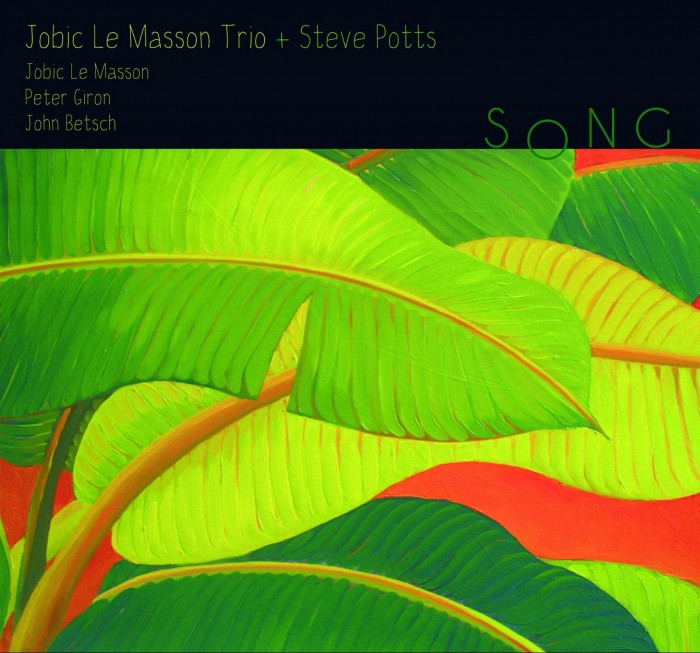
djamlarevue Le plus odieux dans la formule journalistique est moins son implacable débilité, que le constat que de temps à autre, bien plus rarement qu'on ne l'utilise, elle convient. Elle idoine même. Elle sied. Donc oui, Jobic Le Masson est bien « le secret le mieux caché » du jazz parisien, depuis trop longtemps pour trouver cela normal. Mais je m'arrêterai là, dans le cadre de ma thérapie contre la quérulence chronique de ces chroniques. Revenons au pianiste : deuxième album de ce trio après Hill en 2008, mais cette fois avec Steve Potts aux saxophones en plus de Peter Giron et John Betsch (basse et batterie). Soit un line up très marqué par Steve Lacy, parfaitement. Deuxième album en leader pour ce pianiste bientôt cinquantenaire qui a pourtant joué avec beaucoup de monde, notamment les camarades de la scène parisienne de sa génération et notamment ceux passés par le free. Or, Jobic ne joue pas là du free, quoique les incursions plus out aient plus qu'un droit de cité dans l'album (voir le solo de Steve Potts sur « Double Dutch Treat », composé par John Betsch). Song est une caravelle gonflée d'universelle musicalité navigant dans la mer des Sargasses d'une histoire du jazz idéale, sans recherche de concept ni de référence que ceux qui viennent sous les doigts. Sous les heures et les années d'improvisation à quatre, sous la complicité et l'entente qui ont pris leur temps. Song est peut-être une chanson, filée par un propos très narratif dont les solistes fournissent une trame captivante et soubresauté de mille plateaux : ballade langoureuse à la pulsation bancroche (« Idania »), marche antimilitaire à la solennité fantasque et créatrice (« Tangle »), up tempo dont l'évidence masque la précision de l'arrangement et de l'interprétation (« Cervione »), etc. Song est peut-être la somme des influences de son leader, revendiquées ici à travers Waldron et Monk (j'aime ce type,!), suggérées dans le jeu de chacun des solistes. Song est peut-être sa diversité musagète, peut-être plus que la somme de quatre individualités fortes dont chaque solo touche juste, c'est-à-dire au cœur de tout ce qui fait que nous écoutons de la musique, dans la simplicité d'une tonalité comme dans la touffeur ésotérique de vocabulaires plus complexes. Song est peut-être tout cela, et plus encore tout ce qu'on ne peut écrire ni dire, parce que Song est. Ça suffit bien à préserver cette vie de toute attaque journalistique, dont le plus odieux reste de réifier les êtres vivants. Alors faisons silence, devant la chanson de ce quartet précieux.
"The interesting thing is that he's using avant-garde techniques, but in a traditional framework." Will Friedwald, NY Sun
Guitarist/composer Chris Jentsch - "Ša composer who can convey his ideas on a grand scale, swings with the grace of Duke Ellington and rocks with the nuance of Frank Zappa," (Mark F. Turner, All About Jazz) - releases Fractured Pop, a double album length studio recording accompanied by extras including a DVD of a short live set. The recording, Jentsch's fourth, will be out January 13, 2017 on the Fleur de Son label. Fractured Pop features Jentsch Group Quartet with longtime compatriots Jim Whitney (double bass) and John Mettam (drums), and multi-instrumentalist Matt Renzi. It's accompanied by a DVD of a short live set recorded at Context Studios in Greenpoint, Brooklyn, and chock full of extras like alternate takes, slide show music videos, a high-resolution FLAC file of the audio CD, PDF lead sheets of the tunes, and four of the composer's own remix/mash ups. As Bill Milkowski writes in the album's liner notes, in Fractured Pop "Jentsch re-examines some of the same tunes that appeared on his large ensemble outings with a lean quartetŠ The title track, for instance, has a whole web of guitars, from acoustic strumming on the intro to clean electric lines played in unison with Renzi's sax on the intricate head to Jentsch's distortion-laced guitar solo. The moody and atmospheric 'Radio Silence' also makes use of crafty guitar overdubs throughoutŠ'Are You Bye?' Jentsch's clever contrafact of 'Bye Bye Blackbird,' is underscored by Mettam's supple brushwork and culminates in some fiery call-and-response between sax and guitar at the tagŠ. 'Route 666,' a hard-hitting groover with angular lines, is fueled by bassist Whitney and sparked by a twisted distorto solo from JentschŠ. Tenor sax and distorted guitar lines weave together near the end of 'Meeting at Surratt's', building to an ecstatic crescendo."
Chris Jentsch is a Brooklyn-based composer, bandleader, and guitarist working primarily in jazz and contemporary improvisational forms. Based in NYC since 1999, his main ensemble is Jentsch Group in its various configurations. As a composer, he has been the recipient of grants, commissions, or fellowships from American Composers Forum (3), New Music USA, Meet the Composer, New York State Council on the Arts (3), Ucross Foundation (2), and most recently, Chamber Music America/Doris Duke New Jazz Works, which commissioned his new work Topics in American History.
The work will have its world premiere on Friday, December 2 at ShapeShifter Lab in Brooklyn, NY. The piece will also be performed on Sunday, January 8 at iBeam, 168 7th St., Brooklyn. Performing is Jentsch Group No Net, a nine-piece chamber jazz ensemble conducted by JC Sanford with Jentsch on guitar, Michel Gentile on flute, Mike McGinnis on clarinet, Jason Rigby on saxophone, David Smith on trumpet, Brian Drye on trombone, Jacob Sacks on piano, Jim Whitney on bass, and Eric Halvorson on percussion.
As a bandleader and sideman Jentsch has performed in clubs and concert halls throughout the East Coast, and has worked with such diverse musical personalities as George Russell, John Cage, Maria Schneider, and Chris Wood. He appears as a guitarist on the CD John Cage, Volume 11 (Mode Records 41). He is also featured in Scott Yanow's book The Great Jazz Guitarists (2013 Hal Leonard). Jentsch has released four CDs as a leader. Jentsch attended Berklee College of Music and has liberal arts and jazz guitar degrees from Gettysburg College, New England Conservatory, and the Eastman School of Music. He earned the Doctor of Musical Arts degree in Jazz Composition from the University of Miami in 1999 and is published by the University of Northern Colorado Press, Advance Music, and Fleur de Son Records.
2017 Chris Jentsch Events
January 8, 2017 - Jentsch Group No Net at iBeam, Brooklyn NY - follow up performance of Topics in American History.
January 13, 2017 - Fractured Pop CD/DVD release, Jentsch Group Quartet.
Ongoing This fall was the debut of Jentsch's new YouTube channel https://www.youtube.com/user/JentschChris. Six hours of content including an entire 2012 set from Jentsch Group No Net (HQ), selections from a 2015 trio date, two jazz orchestra records, modified aleatoric music for two mixed chamber quartets, and more.
Topics in American History by Christopher Jentsch and Jentsch Group No Net has been made possible with support from Chamber Music America's 2015 New Jazz Works Program funded through the generosity of the Doris Duke Charitable Foundation.
An award-winning composer, arranger, and trombonist, Finzer is bringing the joy and power of Jazz to both traditional fans and the most modern 21st century audiences. He’s on a mission to be a passionate voice defining the sound of Jazz in this age while also bringing street cred to the trombone with a bold, tight sound.
Born into the musical world (Mom Sherry Finzer is an international flutist), Finzer developed a fascination for the music of Duke Ellington and found himself, in high school, performing at the annual Essentially Ellington competition of Jazz at Lincoln Center. It was then that he decided to pursue a life in music himself. His budding talent was recognized by Wycliffe Gordon who began a life-long mentorship by writing four pieces for the young Finzer while he attended the Eastman School of Music. Nick went on to get his masters at Juilliard’s prestigious Jazz program where he was mentored by the trombone legend Steve Turre.
In 2011 Nick was the winner of the Eastern Trombone Workshop’s National Jazz Trombone Competition and was a finalist in the 2010 International Trombone Association’s Carl Fontana Jazz Trombone Competition.
In January of 2013 Nick released his recording debut as a bandleader and composer with “Exposition” (Outside In Music). Two tracks appearing on the album garnered Finzer a pair of accolades: The prestigious American Society of Composers and Performers (ASCAP)’s Herb Alpert Award for young composers (2013 & 2015)
In 2014, Nick composed a new album-length work, “The Chase.” Nick's sophomore album debuted in July of 2015 on Origin Records to rave reviews, a feature article in Downbeat Magazine, and peaked at #6 on the JazzWeek Charts.
Famed trombonist and mentor Wycliffe Gordon called Finzer “a new voice [in] the pantheon of upcoming trombone greats in the making” and added “Nick's CD is a glowing example of things to come.”
When away from NYC, Finzer can be found touring the globe not only with his own projects, but as part of YouTube sensation, Scott Bradlee’s Postmodern Jukebox. Finzer has joined the group on television, in viral videos with millions of views, and on tours across North America, Australia, New Zealand and Europe.
Finzer has performed at top Jazz clubs and concert halls with Wynton Marsalis’ Jazz at Lincoln Center Orchestra, Lucas Pino’s No Net Nonet, Ryan Truesdell's Gil Evans Project, Bob Stewart’s Double Quartet, Frank Wess, Terrell Stafford, Lewis Nash, the Tommy Dorsey Orchestra, Walt Weiskopf, Slide Hampton, Frank Kimbrough, Carl Allen, Steve Turre and many more.