Akira Sakata impresses as a skilled saxophonist, a marine biologist and with his vocals from a far away time and place...
Since the late 60s, Sakata has been a constant figure in jazz and creative music scenes as an adventurous multi-instrumentalist, and member of Yamashita Yosuke Trio and many under his own lead. He played and recorded with Bill Laswell, Hijokaidan and is active with Jim O'Rourke.
1. Archezoa
2. Mitochondria
3. Hachi
4. Tsui-oku (reminiscence)
5. Satsuki
6. Ghosts
7. Chiasma
8. Dance
9. Wann kann ich sie wiedersehen
Recorded at Kashiwa Church Chiba Pref., Japan on 24 May 1986 by Yukio Tezuka on stereo cassette recorder
“Unstructured Time” for jazz septet is an original work about finding introspective peace in a loud world. I started writing it in 2019 and after quite a few delays, including pandemic delays, finished it in 2020 and premiered it April 29th, 2021 at the Fulton Street Collective in Chicago. The album features Alexandra Olsavsky, voice; Amos Gillespie, alto sax; Andy Schlinder, tenor sax; Gustavo Cortinas, drums; Paul Bedal, piano; Casey Nielsen, guitar and Dan Thatcher, bass.
1. Shades of Red 10:45
2. Deconstructed 04:34
3. Like a Blossom 05:00
4. Nothing Changes 06:16
5. Tangerine Road 04:50
6. Sleepless 04:06
7. Fewer Words 02:57
8. Silence is Your Own 03:16
9. Juiced 04:11
All tracks are written and arranged by Amos Gillespie @2021
Recorded, mixed and mastered by Tyler Rice at Transient Studios in Chicago. Cover photo, by Amos Gillespie, features "Connect Origins to Destinations (2009)," From the Mile of Murals project curated by Rogers Park business alliance.
The music of Brazilian guitarist and composer Baden Powell has enchanted listeners for decades. His ability to combine elements of jazz, classical, and Brazilian folkloric music into his own singular genre that was spoken only on his nylon string, acoustic guitar has maintained his quiet legend status throughout the world.
Born in France, but raised in Brazil, bassist/composer Gui Duvignau was drawn to the music of Baden Powell through his Brazilian guitarist friends, who all considered Powell a fundamental figure in the worlds of Brazilian music and acoustic guitar. During his own guitar study, Duvignau asked friends for pointers and they continually referred him to Powell’s techniques. Further exploration of Powell’s repertoire led the bassist to the revelations provided by the fantastic music of the guitarist.
Years of studying and performing the music of Baden Powell led Duvignau to the idea of developing a recording celebrating the great guitarist. Duvignau’s new recording, Baden, uses Powell’s beloved songs as a foundation for explorative interpretations and improvisations from Duvignau’s fantastic ensemble, along with two highly esteemed guests, Ron Carter and Bill Frisell.
As a well-studied musician, Duvignau was astounded by Powell’s classical-honed technique and ability to communicate across genres. The guitarist’s music was a breath of fresh air and there was a sense of the spiritual in everything that Powell played, including the many interpretations he made of religious music of Brazil’s African-derived religions, like Candomblé and Umbanda. The guitarist was unique as he looked more toward the influences of samba rather than the bossa nova style that was popular at the time.
Duvignau felt that the best way to pay tribute to Powell was to play his music as openly as possible; not try to make a recording that was a Brazilian jazz record. Thus, Duvignau pointed this out to the musicians that he wanted to play with as he knew they could take the music anywhere. He welcomed back two mentors and friends who had appeared on his previous recording, 3, 5, 8, woodwind master Billy Drewes and drummer Jeff Hirshfield. Duvignau also recruited fellow Berklee alum, pianist Lawrence Fields, a great bandmate and consummate professional.
To make the project even more special, Duvignau invited his mentor Ron Carter to participate on a track. The bassist also recruited the great guitarist Bill Frisell to add his brilliant tones to a number of the pieces.
The recording begins with Powell and Vinícius de Moraes’s “Canto de Ossanha,” perhaps Powell’s most well-known piece and one that Duvignau felt necessary to include. Here the tune’s mysterious then upbeat nature is carried by Frisell’s guitar and Drewes’s lithe soprano sax. Another Powell and de Moraes collaboration from their Os Afro Sambas record, “Canto de Xangô” is a waltzing piece inspired by Candomblé ritual music that was passed down from West Africa. Fields’s piano solo is especially inspiring here. Duvignau scaled the band down to a trio with Frisell and Hirshfield for “Tristeza e Solidão,” his resonant bass work blending beautifully with Frisell’s unmistakable guitar.
Duvignau wrote “Ao Baden” when he first discovered Powell’s music and is loosely based on the chord changes of “O Astronauta.” Luiz Gonzaga and Humberto Teixeira’s “Asa Branca” is a bluesy piece that Powell recorded frequently. Duvignau wrote the blues piece “Bluesa Preta” to introduce it and be performed with Mr. Carter in a moving duo. The impressionistic “Canto de Iemanjá” is another piece from Os Afro Sambas and provides a magical setting for Drewes over Fields’s Wurlitzer playing. Powell and Paulo César Pinheiro’s “Refém da Solidão” is a simple but beautiful ballad, while Powell and de Moraes’s “O Astronauta” has a natural, standard-like feel orbiting in the hands of this jazz quartet.
Duvignau’s subdued “Mata Adentro” (meaning “Into the Forest”) is open and minimal, providing ample space for Drewes, Frisell, Hirshfield, and the leader to explore texturally. The bassist challenged himself and took on Powell and de Moraes’s “Berimbau” and “Consolação” as a solo piece for bass, channeling the mystical sounds perfectly. Powell and Pinheiro’s “Lapinha” is a song about a capoeira master from Bahia and the ensemble performs it in a bright and folkloric manner. The recording concludes with Duvignau’s tribute to Powell and Frisell, “For Bill & Baden,” finishing the record with a blues as Duvignau does most performances.
The music of Baden Powell has been a revelation for Gui Duvignau since he discovered the guitarist a number of years ago. The bassist has assembled a fantastic ensemble and program to pay tribute to the Brazilian great on Baden.
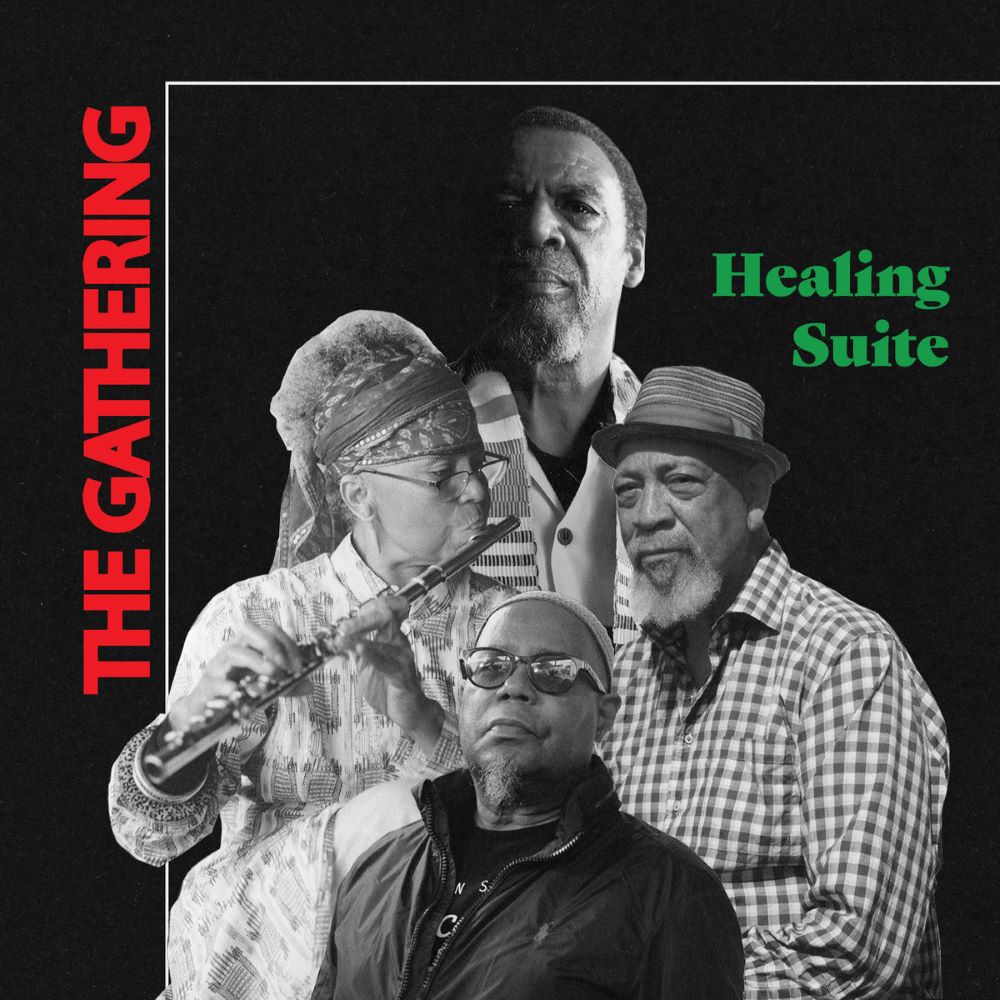
On November 8, 2015 Jesse Sharps, one of the great composers to emerge out of the Los Angeles progressive jazz scene and an early bandleader in Horace Tapscott’s Pan Afrikan Peoples Akrestra, brought together a select group of musicians at the Mayme Clayton Library and Museum in Culver City, California for special concert to celebrate The Gathering, a historic recording summit that had occurred a decade earlier at Cal Arts in Valencia. This album is a select representation from that concert in 2015, and features several of the musicians present at the original summit from 2005. This release includes a bonus, full-length version of "Freedom's Sweet" and extended liner notes by Matthew Duersten.
Early in the program Dwight Trible brought forth a disarming version of Strange Fruit in a stunning duo with Theo Saunders on piano. Kamau Daáood performed Healing Suite, a transcendent incantation of poetry accompanied by cello, bass, piano, percussion, and drums. And with what was the pinnacle and closing piece in the concert that day, Freedom’s Sweet, conducted by bandleader Jesse Sharps, featured a powerful intro by Kamau Daáood, vocals by Maia, solos by Roberto Miranda, Phil Ranelin, Fritz Wise, and Mercedes Smith in an epic and moving masterpiece put together by Horace Tapscott.
Mother, sung by Dwight Trible, with music by Nate Morgan and lyrics by Kamau Daáood, was performed earlier in the program but serves as both an emotional and musical coda for the journey this album represents. A journey that reaches back “400 years” as Maia sings it in Freedom’s Sweet. And in Healing Suite, Kamau’s chants of “Come healers, come warriors to this place of chaos,” get their response in the next tune with Maia singing “Marcus, Medgar, Malcolm, Martin” and calling out ”Black Lives Matter” as she “scats new landscapes.” Here we have our own healers and warriors, straight from this deep community of artists and musicians. Amos Delone, Danny Cortez, Derf Reklaw, Dwight Trible, Fritz Wise, Fundi Legohn, Greg Ramsey, Jesse Sharps, Kamau Daáood, Maia, Mercedes Smith, Nick Rosen, Phil Ranelin, Roberto Miranda, and Theo Saunders all digging into this rich history. A Healing Suite for your hearts, minds, and ears!
1. Strange Fruit
2. Healing Suite
3. Freedom's Sweet Part 1
4. Freedom's Sweet Part 2
5. Freedom's Sweet Part 3
6. Mother
Jesse Sharps - Bandleader/Woodwinds
Dwight Trible - Vocals
Maia - Vocals/Flute
Kamau Daáood - Poetry
Mercedes Smith - Alto Saxophone
Amos Delone - Baritone Saxophone
Fundi Legohn - French Horn
Danny Cortez - Trumpet
Phil Ranelin - Trombone
Greg Ramsey - Tuba
Nick Rosen - Cello/Bass on "Mother"
Roberto Miranda - Bass
Theo Saunders - Piano
Derf Reklaw - Congas/Percussion
Fritz Wise - Drums
Recorded live by Wayne Peet November 8th, 2015 in Culver City, CA at the Mayme Clayton Library and Museum
Mixed and Mastered by Wayne Peet at New Zone Studios in Los Angeles, CA
With a fat, warm tone threading through the jazz cymbal groove with poetic patience, guitarist Nathan Borton celebrates his Midwest musical inspirations - particularly Grant Green & Wes Montgomery - with blues-drenched lines & rhythms on this, his debut recording. Along with jazz masters Xavier Davis on piano, bassist Rodney Whitaker, drummer Keith Hall, and the front line of saxophonist Diego Rivera & bass trombonist Chris Glassman, we don't just hear a tribute to evergreen jazz guitar purism, but rather a complete, satisfying journey through the rich tradition of straight-ahead jazz. From the hard swinging "Milestones," or Tin Pan Alley classics such as "Just One of Those Things," through five originals from Borton and his mentor/producer Randy Napoleon, we discover a young talent with a deep wellspring of ideas and a penchant for surprising musical moments.
1 Each Step (Nathan Borton) 5:48
2 Just One of Those Things (Cole Porter) 5:34
3 The More I See You (Harry Warren and Mack Gordon) 5:24
4 Milestones (Miles Davis) 4:37
5 What Now? (Nathan Borton) 4:37
6 These Are the Things We Throw Away (Randy Napoleon) 5:10
Composer, sound artist, and flutist Rachel Beetz presents Unofficial, her first full-length album of improvisations exploring the electro-acoustic flute with texture, and noise.
“The sound of the acoustic flute was never satisfying enough for me. I would always push to the extremes of acceptability in both contemporary and bel canto playing. My performances are intensified by living on the edge - overblown louds and softs that you could barely hear. I was always wanting more out of my instrument and have had trouble ‘playing nice.’ This album is me exploring my instrumental voice by transforming it into synthesizers and layering those with noise and effects.”
Beetz’s flute playing has been described as “evoking the roar of prehistoric animals” by the San Diego Union Tribune and “soulfully elegant” by the Washington Post.
To create Unofficial, Rachel improvised with custom synthesizers made from samples of her acoustic flute playing (Tracks 1, 4, 5, 6, 7, and 8) and also on the acoustic flute with effects pedals (Tracks 2 and 3). All of the tracks capture in-the-moment creations with some production in post. Other than the desire to transform the flute into the entire range of musical frequencies, there were no rules or systems employed in creating these tracks. Performed in the privacy of her home studio, these improvisations are an attempt at revealing the inner subconscious.
“Improvisation is also a challenging area for me. My desires for long, sustained lines and polyphony are difficult to explore on the flute. Even with a mastery of the instrument, the sounds I want to make require me to sustain the limits of my physicality. This often brings an undesired element of physical virtuosity into the work. No longer limited by my physical body with the flute synthesizers, I was able to be more in the moment. Listening back, I was surprised to hear such intense emotion. Hearing my true feelings reflected back at me, I was more able to process the world around me.”
As a composer and sound artist, Beetz’s works recreate physical atmospheres based on her deep listening adventures in the wild, exploring hidden worlds of nature and machines. Combining experimental field recordings and electronically modified flutes, her works examine community, environmentalism, and women’s work through sound, video, textiles, and lighting. Her projects have been featured in concert halls and galleries in Australia, Iceland, India, the United Kingdom, and the United States. As a flutist, she is dedicated to performing works by living composers, as well as pushing the boundaries of the instruments traditional roles and techniques.
“There has always been some cognitive dissonance for me in my identity as a musician who plays the flute, a somewhat gentle instrument. I’ve trained for decades to be able to play with that beautiful, resonant singing tone and can do it, but it is a challenge for me. I’ve come to enjoy adding some dirt and grit into my sound and have been exploring that in contemporary music for years. The first time I truly heard myself in my sound was in the creation of my tracks on Script – Rescript. Those were a reaction to drawings made by artist Nichole Speciale. I made them with strict rules, measuring every line and defining every color. Unofficial takes the opposite approach, leaving the door completely open to a moment in time. I am surprised that the outcome feels even more like my sound. It is very freeing as an artist to hear something you’ve been trying to make for decades come true and invigorating to find it through a completely different working approach.”
“This release needed a special place where it felt safe to be open and vulnerable. I am proud to have Unofficial on Orenda Records, a label that accepts and encourages sound makers of all kinds. To me, Unofficial is science fiction, representing a utopia where we are self-aware enough to know when to express our feelings and when to protect them. It is where we are free to be officially unofficial.”
A true music lover typically has dreams that their favorite musicians, who do not normally work one with another, will meet and perform together. I had a dream many years ago that the two Giants of contemporary improvised music, Joëlle Léandre and Barry Guy play a double bass duo together. And my dream became true at the 2017 Ad Libitum in Warsaw in Festival, and was released by Fundacja Słuchaj! on a phenomenal 3 CDs box “Blue Horizon ● Barry Guy@70”. Here is another dream realized by Fundacja Słuchaj! – on “String Fables” Barry Guy encounters Jordina Millà.
Barry has a long experience working in piano trios and piano bass duos: from Howard Riley Trio in the 1960s, through Ithaca Trio with Marilyn Crispell and Paul Lytton, to Aurora Trio with Agustí Fernández and Ramón López, or more recent trio with the phenomenal Japanese pianist, Izumi Kimura and Gerry Hemingway, also on Fundacja Słuchaj!.
The most impressive piano-bass duo of recent years are with Agustí Fernández, who is, in a sense, a mentor of Jordina. They both play improvised piano, they both played prepared piano, they both oscillate between abstraction and lyricism – yet the music of Jordina is completely different, completely original and absolutely not comparable to anything else. When I first listened to her debut album “Males herbes” (Sirulita), I wrote on the Facebook: "I experienced today a birth of a star, better to say a supernova.” Indeed, Jordina grew up to become a legendary figure of Catalan scene immediately. Her way of tuning abstraction to sound lyrical is absolutely unique and uncompromising. In this sense she is an ideal partner to Barry, whose approach to the lyrical side of life is similar. Both of them can be extremely lyrical, sad and melancholic without any simplicity and any loss of abstract complexity.
String Fables is a masterpiece presentation of the joint concept of this music: lyrical abstraction/abstract lyricism. For me, this is one of the most beautiful piano-bass records of the century!" Maciej Lewenstein
1. String Fables 9,14
2. Nuc 4,01
3. Duna 6,07
4. Decodification 10,00
5. Agora 7, 49
6. Quart creixent 2,45
7. Plithorikós 7,05
8. Essential Sonances 12,41
Total Time: 59,41
Jordina Millà - piano
Barry Guy - bass
Recorded July 16th 2021 Studio Rosazul, Barcelona
Mixing & Mastering by Ferran Conangla at FCM Studio, Barcelona
Photos: Barry Guy by Francesca Pfeffer, Jordina Millà by Aina Lesan
I became acquainted to Joe Fonda’s musical creativity in 1998, precisely on November 6th at a concert of the Fonda/Stevens Group at Bunker Ulmenwall in Bielefeld, Germany. Along with some friends, I was curating the club‘s jazz program since 1996 at that time. After the enthralling show in 1998 Joe was a frequent artist at our club as his music was immensely inspiring - full of enthusiasm and playfulness. On November 8th 2003 there was Satoko Fujii Quartet playing a show in Bielefeld. On this evening an enduring friendship with Satoko Fujii and Natsuki Tamura began to develop. I go to know two wonderful artists as well as human beings and – what I did not know at that time – two of the most thrilling and versatile musicians in the jazz scene.
Both Satoko and Joe, have been touring Europe separately in many different group selections over and over again. ...And while attending a duo-concert of Joe Fonda with guzheng playing musician Xu Feng Xia, I got the idea of also bringing Satoko and Joe together – at least for one musical (live) encounter. It worked out and since then they both have played together not only as a duo but in numerous projects with changing players. They also began recording together or taping live shows. Focussing on their duo output, their first duo-record „Duet“ was released in 2015. Natsuki Tamura was joining on some compositions as well as on the „Mizu“ album in 2017. The aptly named „Four“ was released in 2019.
Now it is 2021, and The Thread of Light was recorded during the Corona-pandemic separately in their distant homes in Kobe and New York and put together for release. It is featuring fantastic music full of inspiration and optimism for a time after the pandemic. Musical pieces full of power and emotions reflecting anger, anxiety and sorrow as well as a way out of it with their inherent musical energy. One can literally sense the leaves falling quietly down the tree before they got whirled up magically. Ease and Restlessness. Sunshine, Rain and Storm take it in turns. Yes, that’s the „Fallen-leaves-dance“. All ends up in broad confidence.
Extraordinary music for an extraordinary time. Wolfgang Gross , July 12, 2021
1. Kochi 4:35
2. Fallen Leaves Dance 4:09
3. Reflection 9.00
4. Anticipating 5.44
5. My Song 3.18
6. Sekirei 2.52
7. Wind Sound 6.07
8. Winter Sunshine 2.17
9. Haru 4.29
10. Between Blue Sky and Cold Water 9.04
Satoko Fujii – piano
Joe Fonda – bass, cello, flute
All composed by Joe Fonda (GEMA) and Satoko Fujii, Koro Music (BMI) except #5 My Song by Joe Fonda and #8 Winter Sunshine by Satoko Fujii.
Satoko Fujii’s tracks were recorded by Fujii at her home in Kobe, Japan in January and February 2021.
Nothing says more than listing names of artists! Great bass virtuoso Michael Bisio and legendary piano wizard Matthew Shipp second time together. Let listen what is the flow of everything!
1. Flow 9.25
2. Bow For Everyone 6.18
3. Everything 2.35
4. Of Now 7.49
5. Of Everything 11.59
6. Go-Flow 5.25
7. Flow Of Everything 6.33
8. Pockets 7.05
9. Panel 5.56
Michael Bisio - bass
Matthew Shipp - piano
Engineer: Jim Clouse
Recorded, mixed and mastered April 5, 2021 at Park West Studios in Brooklyn, NY
All compositions Matthew Shipp (Matt Shipp Music ASCAP) and Michael Bisio (AMB Music ASCAP)
Trees have a fascinating memory. They have lived here with us for hundreds of years, and if they could talk, they would teach us many things. We were inspired by them and created a story that trees could tell. Dream yourself with our music and listen to the Memory Of The Trees.
1. Memory Of The Trees / Pamäť stromov 03:32
2. Wind / Vietor 04:10
3. Road From Snowy Mountain / Cesta zo zasnežených hôr 05:30
4. Fire On The Midnight Side / Oheň na polnočnej strane 03:25
This album features original compositions by jazz guitarist Duane Allen. The group features Josh Nelson on piano and keyboards, Karl McComas-Reichl on bass, and Dan Schnelle on drums.
Enzo Favata / Pasquale Mirra / Rosa Brunello / Marco Frattini
A new album recorded after several shows in the summer of 2020. Enzo Favata The Crossing is a quartet with a progressive and contemporary attitude, mixing complex layers and themes, a travel in space and time, jazz, urban atmospheres, African and Mediterranean roots, electronica, krautrock and many other different styles. Enzo Favata, a maverick musican, producer, one of the most respected artists in the Italian jazz scene, has joined forces with Pasquale Mirra (vibraphone and midi marimba), Marco Frattini (drums) and Rosa Brunello (electric bass and double bass).
There is a special care and research in sound and production a balance between jazz interplay and dynamics, live recordings and studio sessions. “The Crossing is the band I was looking for since a long time” tells Enzo Favata “And I needed jazz players that had a new feeling and approach to compositions. Concert after concert the quartet reached a new dimension and tightness, a real band in all its aspects and the main goal was to transfer this energy into an album. I achieved this through a mix of live recordings and additional production, overdubs of keyboards and analogue synths of the 70s and other guests that provided an orchestral feeling, like the strings from Salvatore Maiore and Maria Vicentini, the cinematic vocals of Ilaria Pilar Patassini, Marcello Peghin's electric guitar and the Chinese master of guzheng, Zhan Qian.
In the studio session in February 2021 we recorded two tracks, “For Turiya” written by Charlie Haden for Alice Coltrane and a new electronic hi-energy song, “Black Lives Matter” with sampled vocals from Malcolm X, Fela Kuti and Steve Biko, a strong stand against racism, a long time problem still actual, and dedicated to the struggle of black people. The album opens with “Roots” by Ian Carr's Nucleus, legend of British jazz rock and Canterburysound, that leads to an original composition, “Turn”, featuring soprano sax, electronic instruments, vintage keyboards and organ, theremin and synths. “Salt Way” is an exploration of “fourth world music” as theorized by Jon Hassell and Brian Eno, without losing the key elements of jazz.
“Oasis” is the final track, where in 12 minutes there is a summary of many elements of the album, the love for African music through the Ethiopian scales played with bass clarinet. The recording was mixed and mastered by senior sound engineer Alberto Erre, with his deep knowledge of analogue gear, filters and compressors and the result is a warm wall of sound that can hardly be obtained with contemporary digital plug ins.
1. Roots 09:19
2. All Names 09:33
3. Turn 08:32
4. Salt Way 11:49
5. For Turiya 05:45
6. Black Lives Matter 03:08
7. Oasis 12:14
Enzo Favata soprano sax, indian flute , live electronics , synth
Pasquale Mirra vibraphone, marimba midi, live electronics , samplers
Rosa Brunello electric bass, live e electronics
Marco Frattini drums , samples
Turn, Oasis and Salt Way were recorded live in the Summer of 2020 by Attilio Lombardo
Roots was recorded live in the Summer of 2020 by Giacomo Jakkeddu Sanna
Black Lives Matter – For Turiya
Recorded in a session in February 2021 at Carrabbuffas Studio
Sound engineer Alberto Erre
All additional instruments and keyboards recorded in February 2021
Mixing
February 2021
RockHouse Studio
Sound Engineer Alberto Erre on a Trident 1990 desk
This work on the compositional process informs the creator's musical universe. Over the years she has worked continuously to consolidate her own uninhibited voice, which in turn has considerably enriched the current musical panorama.
The album strikes a balance between improvisation and composition; featuring the musical voices of Albert Cirera, Iván Gonzalez, and Joan Moll who contribute their own personal traits to the whole; resulting in a unified abstract vision that is captivating for the listener.
Clara Lai's music becomes a mirror in which one recognizes one's own emotions, and where contemporary forms reveal new unsuspected horizons..
1. Introducción A 02:30
2. Introducción B 01:54
3. Nueva 11:43
4. Creciente 10:24
5. Llena 04:39
6. Menguante 02:19
7. Epílogo 10:17
Clara Lai - Piano & Composition
Albert Cirera - Tenor Sax
Iván González - Trumpet
Joan Moll - Drums
All music composeed by Clara Lai
Tracks 1,2,6 Composed by Clara Lai & Albert Cirera
Recorded live at Teatre de l'Aurora, Igualada, by Adrià Serrano & Sergi Felipe on 21 june 2021
“Nostalgia” is the name of drummer Maximilian Hering’s debut album with his “Maximilian Hering Group”, featuring the Barcelona based Félix Rossy, Edu Cabello and David Muñoz. The extraordinary line up -two horns, bass and drums- proved to be a format in which all four players would have the freedom of unfolding their personality and creating a vivid musical interplay between each other. The album contains seven original pieces, all composed by the bandleader. “Nostalgia”, also referring to the title track, is related to a melancholic flashback to the period when Maximilian was a resident in Catalonia. On two songs Andalusian flautist Fernando Brox joins the quartet and enlarges the harmonic and melodic possibilities of the band’s instrumentation.
1. Too Bad for You 06:25
2. P.F.E.M. 05:20
3. Frust 04:00
4. Elegy (On Being Left Behind) 05:12
5. Una per al Verdi cent set 06:05
6. Nostalgia 07:05
7. Like 4 Likes 05:47
Félix Rossy - Trumpet
Edu Cabello - Alto saxophone
David Muñoz - Double bass
Fernando Brox (track 5 & 6) - Flute
Maximilian Hering - Drums
All music composed by Maximilian Hering
Recorded at Sol de Sants Studios Barcelona on May 2nd and July 19th 2021
Recording engineer: Alberto Pérez
Assistants: Matteo Olivero, Paula Ruiz, Manuel Sánchez Ortiz
Mixed by Bernhard Hering at Klangraum Mainz
Stem mastering: Tom Krüger at ¿ no sé ? Studio Stuttgart
Good Time Music began when a promoter from Portugal asked Bernstein if Butler and the Hot 9 would like to play there. Butler couldn't make the show but Bernstein suggested this great singer he'd worked with at the Barn, Catherine Russell, who had cut the Harry Nilsson tune "Poli High" with Sexmob back in 2009. Bernstein built a book of arrangements around her, they played the show and it was a hit. The Community sessions with Russell were originally intended as a calling card for getting more shows, but after hearing Andy Taub's mixes, it was obvious that Good Time Music was a bona fide album.
The title comes from Lou Reed, who had just seen Levon Helm's triumphant 2007 show at New York's Beacon Theatre. Bernstein was in the band and recalls that "the audience went crazy." But Reed's summation was a bit more laconic. "Oh, you know," he told his friend Hal Willner, "it was good time music.”
"When Hal told me that story, I thought it was a put-down," says Bernstein. "But later I learned that Lou loved good time music — the kind where you just tap your foot and nod your head with a smile on your face — because he knew how important that is in the world. And with Levon, I learned how beautiful it was to play that kind of music. I always thought it would be great to make a record of good time music. So here it is.”
And once again, there's that sense of music as healing. "Absolutely," Bernstein agrees. "It's _always_ healing to play good time music — even if you haven't experienced loss. Playing good time music feels good: the band feels good, the audience feels good, everything feels good." Of course, Bernstein and the MTO had no way of knowing how much the world would soon need music such as this.
All these tunes were Bernstein arrangements that got played once or even not at all. And most of them happen to be written by residents of New Orleans: Percy Mayfield ("River's Invitation"), Earl King ("Come On"), Allen Toussaint ("Yes We Can") and Professor Longhair ("Baby Let Me Hold Your Hand"). New Orleans music runs deep in Bernstein's bones: he's worked extensively not just with Henry Butler but with Allen Toussaint and Dr. John; he was originally taught trumpet in the style of Louis Armstrong, and, like Satchmo, he funnels his charisma and genial sense of humor into a compelling stage presence.
Louis Armstrong is just one connection to Cat Russell: her father Luis Russell was Louis Armstrong's musical director in the '30s and early '40s; he also played with another New Orleans jazz originator, King Oliver. (Russell's mother Carline Ray, a Juilliard grad, played with the famed International Sweethearts of Rhythm.) In their roles as "go to musicians" Cat and Bernstein have also collaborated on recordings with Levon Helm and Little Feat.
Russell sang backup with Steely Dan and David Bowie for years, as well as other blue chip artists such as Paul Simon, Madonna and Al Green. Later in her career, she became an acclaimed solo artist, with seven albums and two Grammy nominations to her credit. "She's just the best," Bernstein marvels. "She's got a perfect mixture of science [technique] and intuition. She's an excellent musician: listen to her rhythm, every note she sings, it's perfect. There is no one else like her."