Friday, June 4, 2021

Vocalist Judy Wexler's "BACK TO THE GARDEN," jazz treatments of iconic songs from the 1960s

JUDY WEXLER REIMAGINES 1960s SONGS OF LOVE, HOPE & CHANGE
BACK TO THE GARDEN
Coming June 4th on Jewel City Jazz

Vocalist JUDY WEXLER is known for her soulful, heartfelt vocals and her ability to find under-exposed gems and imbue them with warmth and wit. On BACK TO THE GARDEN (June 4, 2021, Jewel City Jazz), she departs from her usual jazz fare to recast iconic songs of the 1960s as jazz/pop anthems relevant for today’s social and political ethos.

BACK TO THE GARDEN is Wexler’s sixth album. It follows Crowded Heart (2019), What I See (2013), Under a Painted Sky (2011), Dreams & Shadows (2008), and Easy on the Heart (2005). Each album received wide critical acclaim and made it to the top of the national JazzWeek radio charts.

Wexler is a mainstay on the California jazz scene. A Los Angeles native and current resident, she performs regularly around the state, from San Diego to San Francisco to Mendocino. She also headlines major venues across the country, appearing at Birdland and The Blue Note in New York City, Jazz Alley in Seattle, Blues Alley in Washington, DC, among many others. She has sung in clubs and at festivals overseas, including the Montreal Jazz Festival, the Tel Aviv Jazz Festival and the Dubai Jazz Festival. She has appeared on NPR Weekend Edition twice with Susan Stamberg who said, “Based on the evidence, Judy Wexler can sing almost anything.”
Wexler has a sumptuous voice and approaches a song like an actress inhabiting a script. Eschewing vocal pyrotechnics, she focuses on lucid storytelling. She wields her formidable vocals chops, like her spot-on phrasing and sophisticated approach to melody, with great subtlety to capture the emotional essence of a song. In All About Jazz, Nicholas Mondello wrote, “She is balletic light on her vocal feet, dead-on with her pitch, and lyrically smooth. She probes emotional depth and returns gems without melodrama.” UK’s Jazz Journal writes, “An always engaging demonstration of contemporary jazz singing at its best.”

BACK TO THE GARDEN is a departure from Wexler’s previous albums, which featured modern jazz songs and selections from the Great American Songbook with just a smattering of reimagined pop tunes. On this new recording, Wexler points her gaze to interpreting iconic, well-known pop/rock songs from the 1960s with reimagined arrangements.

Wexler says, “Music is truly a reflection of the times, and the music of the 1960s reflected the turbulence engendered by war, political protests, and the rise of important social movements like feminism and racial justice. Fifty years later, we’re still struggling with those issues and more. Although the arrangements of these iconic songs are new, I find their message of hope, love, and change as timely as ever.”

Wexler has been fascinated with the music of the era since 2010, when she created a show in Los Angeles she called “Back to the Garden.” She revised and updated the show in 2016 and was scheduled to do yet another one on her birthday in mid-April 2020 when the pandemic hit and all the music venues closed. Since live gigs were canceled for the foreseeable future, she decided to record an album instead.
Wexler brought on board her longtime pianist and arranger JEFF COLELLA, a consummate accompanist and improviser. Among his many accomplishments are 16 years touring as musical director with the legendary Lou Rawls. He also toured the world with the Jazz Tap Ensemble for seven years, was the Musical Director for Jack Jones, and has worked with a host of top names like Gregory Hines, Savion Glover, Sheila Jordan, Kenny Washington, and others. Colella plays piano, wrote most of the arrangements for BACK TO THE GARDEN and co-produced the album with Wexler. Pianist and composer JOSH NELSON also contributed two arrangements.

Wexler and Colella brought in several top musical artists from Southern California and beyond, including guitarist LARRY KOONSE, bass player GABE DAVIS, and drummer STEVE HASS, old friends with whom Wexler has performed and recorded before and who formed the core of the rhythm section. Colella’s arrangements are richly textured and multi-layered, and other players who added their distinctive voices are BOB THIELE, JR. on electric and baritone guitars, DANNY JANKLOW on alto sax, JAY JENNINGS (from the Grammy-winning Snarky Puppy) on trumpet, and NYC-based harmonica master HENDRIK MEURKENS. Grammy-nominated violinist SARA CASWELL is featured on one song, and a string section comprising violinists JOEL PARGMAN and CARRIE KENNEDY, viola player RODNEY WIRTZ, and cellist STEFANIE FIFE perform in various configurations on three tracks. Vocalist ERIN BENTLAGE arranged and contributed layered background vocals on four tracks. Bentlage is a member of the vocal group säje, which snagged a Grammy nomination in 2021 for arranging.
The ten songs on BACK TO THE GARDEN are reflective of the tumultuous era of the 1960s. Wexler includes two songs by Bob Dylan, “The Times They Are A-Changin',” one of the most famous protest songs of all times, and the sweetly hopeful “Forever Young.” “American Tune,” by Paul Simon, paints a picture of the struggles and weariness of the American experience that stands in stark contrast to the can-do attitude so often portrayed in the media. Stephen Stills was inspired to write “For What It's Worth” after the Hollywood curfew riots in November 1966. The riots were part of a series of counterculture-era clashes that took place between police and young people.

Joni Mitchel’s “Big Yellow Taxi” is about destroying the natural world for the sake of commerce, while “Get Together,” made famous by The Youngbloods, is an appeal for peace and brotherhood. “Everybody’s Talkin’,” sung by Harry Nilsson in the film “Midnight Cowboy,” was written by Fred Neil and deals with the alienation of big city life and the desire to get away. “Up on the Roof,” by Gerry Goffin & Carole King, is another song about the need to escape the pressures of urban life. “Since You've Asked,” with its tender lyric, is the first song Judy Collins wrote. Wexler closes the album with “Who Knows Where the Time Goes,” Sandy Denny’s meditation on the passage of time and ephemeral nature of life.

With Wexler’s fine-grained voice and heartfelt interpretations, the updated, modern arrangements, and superb musicianship, the music on BACK TO THE GARDEN is as relevant today as it was over 50 years ago.

1. Get Together (Chet Powers)  6:00
2. Up on the Roof (Gerry Goffin & Carole King)  4:41
3. American Tune (Paul Simon)  4:03
4. Big Yellow Taxi (Joni Mitchell)  3:24
5. The Times They Are A Changin' (Bob Dylan)  4:45
6. Since You've Asked (Judy Collins)  3:27
7. For What It's Worth (Stephen Stills)  3:53
8. Everybody's Talkin' (Fred Neil)  3:32
9. Forever Young (Bob Dylan)  6:10
10. Who Knows Where the Time Goes (Sandy Denny)  5:15

Jeff Colella piano, melodica (5), background vocals (1)
Larry Koonse nylon string & electric guitar
Gabe Davis bass
Steve Hass drums
Bob Thiele, Jr., electric guitar, baritone guitar (1,7,8,9)
Erin Bentlage background vocals (1,4,7,9)
Danny Janklow alto sax (4)
Jay Jennings trumpet (10)
Hendrik Meurkens harmonica (8)
Sara Caswell violin (9)
Joel Pargman violin (3,6)
Carrie Kennedy violin (6)
Rodney Wirtz viola (3,6)
Stefanie Fife cello (3,5,6)
Talley Sherwood background vocals (1)

Produced by Judy Wexler and Jeff Colella
Arrangements by Jeff Colella (1,2, 4-9) and Josh Nelson (3,10)
String arrangements by Jeff Colella
Trumpet arranged by Jeff Colella 
Background vocal arrangements by Erin Bentlage (1,7,9)
Background vocal arrangement by Jeff Colella & Erin Bentlage (4)

BACK TO THE GARDEN will be available on June 4, 2021 in stores and online everywhere. Distribution by A Train Entertainment.

Dahveed Behroozi - Echos (June 4, 2021 Sunnyside Records)

Trained in both jazz and classical music, West Coast-based pianist Davheed Behroozi is the uncommon musician to earn endorsements from icons in both disciplines. Ursula Oppens, a renowned virtuoso of contemporary classical music, has praised Behroozi’s “creativity, curiosity and integrity,” adding that “his performances are stunning, his interpretations astonishing.” Likewise, jazz piano star Fred Hersch has described Behroozi’s music-making as “intense and immersive,” with the pianist’s evolution as an improviser revealing “deep musical knowledge and devotion.” The best presentation yet of Behroozi’s artistry as a jazz musician now comes with his sophomore album, Echos, to be released digitally and on CD via Sunnyside Records on June 4, 2021. 

Showcasing Behroozi’s richly atmospheric, even hypnotic compositions, the new disc – his first studio recording – features Behroozi in league with two of New York’s finest: bassist Thomas Morgan and drummer Billy Mintz, both master improvisers known for their subtle, individual sounds. They are an ideal complement to Behroozi’s rhapsodic, wide-screen pianism, which is as inspired by such jazz masters as Keith Jarrett, Herbie Hancock and Gonzalo Rubalcaba as it is classical exemplars Maurizio Pollini, Martha Argerich and Glenn Gould.

Echos – its title referring to the Greek for “reflected sound” – starts with the Paul Bley-evoking “Imagery,” an ideal album opener given its darkly enveloping lyricism and ravishing trio resonance. “This music, and the trio itself, is centered on sound rather than structure,” Behroozi explains. “Sound and vibe have become increasingly important to me as a player. Both Thomas and Billy have amazingly personal sounds on their instruments, and I’m especially drawn toward a less-is-more aesthetic, focusing on sheer character of sound.

There is real dynamism in the music of Echos – particularly with a track like ‘Sendoff’ – but I really do love that hypnotic vibe, something you can hear in the tune ‘TDB.’ What’s beautiful about Thomas and Billy is that they can explore just one note for what seems like days and make you realize there can be a world of music in that single note.”

Born in 1981 and raised in San José, California, Behroozi met Morgan while they were nascent jazzers in Bay Area high schools. They re-connected in New York City when the pianist and bassist were both studying at the Manhattan School of Music in the early 2000s. Morgan has since become a veteran of dozens of high-profile recording sessions by the likes Paul Motian, Bill Frisell, Tomasz Stanko, Jakob Bro, Ron Miles, Dan Weiss, Dan Tepfer, Steve Coleman and Jim Black. The bassist introduced Behroozi to Mintz, who – in addition to working as a bandleader – has played with such diverse figures as Tony Malaby, Alan Broadbent, Sylvie Courvoisier & Mark Feldman, and David Bowie pianist Mike Garson. 

After graduating from the Manhattan School, Behroozi pursued his advanced studies at Brooklyn College, and he continued to play private sessions with Morgan and Mintz for years as well as performing in New York clubs, the trio honing its sense of exploratory, emotionally acute interplay.
“My first album, Games, came out in 2012 – it was a live trio album made in California that also included Thomas, along with Tim Bulkley on drums,” Behroozi says. “Besides the fact that the new record is a studio recording, there has been a lot of evolution from that album to Echos, in both the writing and the playing. The new album is looser, freer. I’m concentrating on my most direct impulses, whether it’s in the choice of notes or how they flow. Playing with Thomas and Billy is perfect for this – reacting in the moment is what they do. I have such trust in them. Thomas is a player of real intimacy, not only with his beautiful sound but with his note choices – and the emotional weight he can invest in each one, drawing you in.

He also has a linear, storytelling dimension to his improvisations that I love. With Billy, he’s able to produce sounds on his kit – especially with cymbals – that I’ve never heard before. He’s a painter on the drums, as beautiful to watch as to hear. There’s a vintage glamour to what he does.”

Behroozi and company recorded Echos in 2019 with engineer Ryan Streber at the high-end Oktaven Audio in Mount Vernon, New York, with the pianist manning a gorgeous Steinway instrument. The trio arrayed together on the studio floor with no isolation, allowing keener interaction. The pianist’s favorite tune on the album is “TDB” (titled after the band member’s first initials), for its sense of spaciousness and patience. “Thomas and Billy aren’t afraid of letting there be real space in the music – and that takes a combination of courage and confidence,” Behroozi says. “I aspire to their level.”

There were no rehearsals for Echos, with Behroozi bringing only sketches for the tunes into the studio – sketches unseen by Morgan and Mintz before that day. “The compositions came out of me improvising at home, so I wanted to keep that free-flowing feel of discovery in the studio,” Behroozi explains. “This is a dream trio for that approach – we captured the masters in just a couple of takes. For one tune, ‘Chimes,’ we included both of the takes, because it’s a dynamic piece and each performance was so different.” Kindred to the above-mentioned “Imagery,” album highlight “Gilroy” is a dark-hued, melodious gem, named for the laidback town in California where Behroozi teaches at Gavilan College.

The ruminative yet swinging “Tricks” is one of the album’s more upbeat numbers, while “Royal Star” is another slow-rolling, tune-rich beauty, its title referring to a variety of Magnolia bloom – with gardening having become a new pastime for Behroozi during the pandemic.

Behroozi strives to create “a multi-sensory landscape” with his music, impressionistically. “I’d like to evoke other senses with only sound,” he says. “Something akin to synaesthesia, so you can ‘hear’ the swing and sway of trees, for instance, or visualize colors. Most of all, I hope that Echos – like my favorite records do for me – creates emotional impressions for listeners, a resonance that stays with them.” 

1. Imagery
2. Chimes
3. Gilroy
4. Alliteration
5. Sendoff
6. Royal Star
7. Chimes (Variation)
8. Tricks
9. TDB

Dahveed Behroozi - piano
Thomas Morgan - bass
Billy Mintz - drums

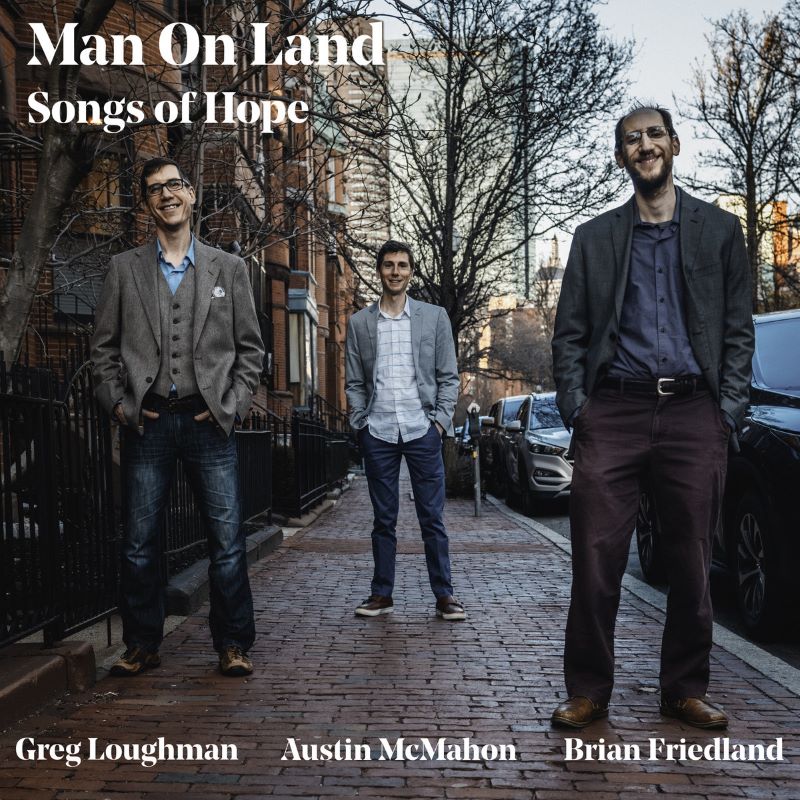
Man On Land - Songs Of Hope (June 4, 2021)

Man On Land is a collectively led trio between pianist Brian Friedland, bassist Greg Loughman, and drummer Austin McMahon.  The band name is formed from the end each band member’s names, driving home the point that this group is a true collaboration. Each member brings their full creativity to the music, and all contribute compositions and arrangements to create a whole greater than the sum of its parts.

Man On Land first performed in 2009 at the Taylor House in Jamaica Plain, playing original music by all three members. The sympathetic connection between them was obvious, and inspired them to keep performing and composing specifically for the group. Through a decade of performing each other’s music, that connection has deepened and is clearly manifested in this debut recording. Their original music places a great emphasis on melody, narrative, atmosphere, and interaction, blending together their distinct compositional voices. The versatility and imagination of their live performances have created a loyal following in the Boston area.​

1. Hope Suite Mvt. I Prelude (Leaving Room)
2. Hope Suite Mvt. II- The Hill We Climb
3. Hope Suite Mvt. III- The Loss We Carry
4. Hope Suite Mvt. IV- The Bridges We've Made
5. Hope Suite Mvt. V- The New Dawn Blooms
6. Oh My, What a Splendid Day!
7. Stride of Pride

"João Donato JID007" | Joao Donato, Adrian Younge & Ali Shaheed Muhammad | June 4 via Jazz Is Dead

Jazz Is Dead’s Adrian Younge and Ali Shaheed Muhammad Collaborate with João Donato: An Innovator of Brazilian Bossa Nova, Jazz Fusion and Funk from the Golden Era

João Donato JID007,

Where’s João Donato? It’s a frequently asked question, referring simultaneously to the physical location and the musical moment he inhabits. A sampling of some of his more descriptive song titles suggests Donato’s comfort with musical hybrids: “Bluchanga,” “Sambolero,” and “Sambongo,” to name just a few. Lacking a formal genre for his style of music, Donato’s is a distinct sound, immediately recognizable from the first few bars of any of his compositions. He was funky back when “funk” was a bad word (listen to either of his 1960s Brazilian LPs, Sambou, Sambou and The New Sound if Brasil, for proof). His compositions are deceptively simple, while his arrangements are harmonically complex, revealing their intricate details upon repeat listening.

Today, Donato brings this flavor, now near synonymous with his name, to a new album in the Jazz Is Dead series with Adrian Younge and Ali Shaheed Muhammad: Joāo Donato JID007. “Donato is one of the greatest Brazilian composers from that golden era. His signature style, simple melodies combined with colorful chordal progressions, establishes a new lane for Jazz Is Dead,” explains Younge. “João is one of the most innovative Brazilian jazz composers of the last century. Creating with and learning from this maestro was one of the greatest experiences of my career.”

On the first day of recording, João Donato was so flattered that to learn Younge and Muhammad had crafted some tunes for him to grace that on the second day, the maestro showed up to the studio with a composition in honor of his new musical partners: “Adrian, Ali and Gregory.” Gregory (aka Greg Paul) delivers an effortlessly buoyant rhythm to support Donato’s whimsical and wistful Fender Rhodes. Younge and Muhammad added the flute melody after the sessions, a perfect tribute and compliment to this master arranger, sweet and melancholic at the same time. 

Building off a sinister interlocking drum and bass pattern, Donato, Younge, Muhammad, Paul and vocalist Loren Oden, assemble a swaying and swirling tune with a romantic mantra, “Nāo Negue Seu Coraçāo,” which translates to “Don’t Deny Your Heart.” Aspirational saxophones dance among cascading monophonic synths, a churning Hammond B3 and cutting fuzz guitar while Donato’s subtle and slinky Fender Rhodes leads the way through the musical maelstrom. Delivered in Portuguese, Oden sings the song’s emotional energy into existence.
If Jon Lucien made a fusion album, it would have sounded something like “Forever More.” Oden’s vocals capture the longing and romanticism of the title, while the rhythm section harkens back to the last album Donato recorded in Los Angeles in 1970, a jazz fusion fore-runner full of pulsing polyrhythms and urgent melodies. “You guys made me like L.A. again,” Donato told Younge and Mohammad towards the end of his 2019 trip to record this album and perform at the Jazz Esta Morto series. 

João Donato deserves a place among the legends of Brazilian music, alongside Antonio Carlos Jobim, João Gilberto, Dorival Caymmi, Ary Barroso, and select few others. Ironically, his constant experimentation with different genres – the very essence of his greatness – make him a challenge to classify and perhaps held him back from becoming the household name some of his peers became. Asked how he would describe his own work, he says, “It’s my style of music, the way I think about [music]. I don’t even think about it, it’s just the way I do things. I don’t know if it even has a name.”

Donato has finally received long overdue accolades for his contributions to date. An archetypal “musician’s musician,” Donato’s stepped out of the shadows more recently, recording at an unprecedented rate and collaborating with a variety of musicians, from Brazil and beyond, old and young. Still going strong at over eighty years old, the late praise and recognition is finally coming for the artist who Claus Ogerman offered to arrange an album, who Antonio Carlos Jobim called a genius, and who no other than João Gilberto claims invented the bossa nova beat.

“Has the day unfolded without a smile landing on you? Then follow the road to a João Donato song, you are sure to find one there,” says Muhammad. “João, one of the founding fathers of bossa nova has opened his magical melodious spirit to us here at Jazz Is Dead. Together we found beleza na música.”

Mark Shippy & Alex Cunningham - Ghost Note (June 4, 2021 Personal Archives)

Ghost Note is an inspired duo exchange between guitarist Mark Shippy and violinist Alex Cunningham. Their first recorded collaboration, Ghost Note is alternately dense and spacious, a free improv gut punch from two artists from different generations, steeped in DIY tradition and established in New Music circles.

Shippy is best known for his work with deconstructionist underground legends U.S. Maple. His idiosyncratic approach to the instrument has influenced a generation of avant-rock musicians. Mark began his career in noise rock groups Snailboy and Shorty, which evolved into U.S. Maple. He was a member of Invisible Things and Miracle Condition, and played in Marnie Stern’s touring band. Recent endeavors include trio recordings with Ben Billington (Tiger Hatchery, Quicksails) and guitarist Daniel Wyche, as well as myriad other collaborative ensembles.

Cunningham has quickly risen to prominence among the free improv cognoscenti. Combining academic acumen with a DIY ethos, his virtuosity is augmented by emotion and intensity. Alex collaborated with Claire Rousay for a release on esteemed label Astral Spirits, and was a member of Vernacular String Trio. He is also one-half of Apathist!, with Chris Trull (Grand Ulena, Yowie), and has recorded with Lisa Cameron & Damon Smith.

1. Please Stand Here
2. One Way Stairs
3. Avoid Closet
4. Clear Walkway

Mark Shippy - guitar
Alex Cunningham - violin

Recorded and mastered by Ryan Wasoba
Artwork by Jeremy Kannapell
Layout by Josh Levi

سم [ISM] - Japanese Flower (June 4, 2021 Umlaut Records)

To follow up on their first album Nature in its inscrutability strikes back (Umlaut Records 2015), the unclassifiable European trio سم [ISM] is releasing two new recordings captured during a studio session in Tokyo in November 2018. The first part titled Metaphor was released on CD in the spring of 2019 while the second installment - the LP Japanese Flower - will be available in June 2021.

In this dense and adventurous diptych, the rhythm section of the group أحمد [Ahmed] exposes and propels music populated by sound fictions that pulverise the listening habits of the jazz trio format. Sometimes polyphonic, meditative, pulsed and repetitive, abstract or hypnotic, the music of سم [ISM] is crude, direct, labyrinthine, always rooted in an immediate sound mattere — as consisting of abrupt breaks and renewed continuities. Like the floral compositions of the Ikebana artist Junichi Kakizaki, this music can be listened to « like a flower » and step by step unveils a secret unity where the work of improvisation intensifies each of its moments.

[ISM] is a name written in ink. A dash through European creative music. A round trip, Berlin – Oxford, via Paris. اسم [ISM] is Pat, Joel and Antonin in a dotted silence without name. Acoustically, the trio creates abstract forms close of written contemporary music with sounds reminding us of ancient traditional jazz trios. The groove wich appears in this music is dense, extreme but always quiet. Music in a continuous flow of high voltage charges. In Arabic, اسم [ISM] is a way to connect between different cultural and imaginary worlds. اسم [ISM] is an Arabic word, which means The Name.

1. Dahlia
2. Tomato
3. Tomato EXCERPT

all music by Pat Thomas, Joel Grip and Antonin Gerbal
recorded 23 november 2018 at Knuttel House Tokyo by Taku Unami
remixed and mastered by Taku Unami
floral art on cover and liner notes by Junichi Kakizaki
photo by Joji Okamoto
design by Takashi Nagata
produced by Antonin Gerbal and Joel Grip

Dexter Gordon Quartet - Swiss Radio Days (June 4 , 2021 Challenge Records)

In Willisau in 1978, Dexter is in a very happy period. Columbia signs the prodigal tenor resulting in the significant successes “Sophisticated Giant” and “Manhattan Symphony”, together with a rhythm section that Dexter then tours on club stages across the country. From this rich and sustained collaboration is born an incomparable musical osmosis, which makes the saxophonist's quartet of that time an authentic musical ark. It’s consequently this group, exquisitely road tight and brimming with desire to play, which arrives in Willisau in 1978, a year which sees Dexter awarded “Musician of the Year” by Down Beat magazine, and two years before being inducted into the renowned “Jazz Hall of Fame”. And since Dexter is not the type to let the flow of music unfold without fueling it with endless proposals for his partners, he knows he can rely on and lean luxuriously on the Cables – Reid – Gladden triplets, a trio synonymous with 24-karat! And if we had a mini-doubt concerning the pleasure that Dexter takes playing that night, we only have to let ourselves be carried away by his muscular and intoxicating dialogue, which is particularly riddled with famous quotes, as enjoyable as they are occasionally unexpected. Like the boppers, Dexter has always adored the nod granted by a well-placed melodic quote, which he uses either in relation to a neighboring harmonic sequence which lends itself to it, or in a textual relation with the lyrics of the song he quotes! For the repertoire of the day’s concert, our favorite tenor takes no prisoners! It's meat from start to finish, with themes that are practically tattooed on the soul of this exceptional performer. 

1. On Green Dolphin Street 15:32
2. The Jumpin' Blues 09:35
3. Hi-Fly 14:06
4. Old Folks 16:29
5. Strollin' 15:07

Recorded live at Hotel Mohren, Willisau, March 4, 1978
Recording engineer: Walter Troxler
Digital editing & mastering: Blaise Favre

Thursday, June 3, 2021

Tomaga & Pierre Bastien - Live Ateliers Claus (June 2021 Les Albums Claus)

Live recording from the performance of Tomaga & Pierre Bastien, on 24th January 2020. 'Bandiera Di Carta’ is the collaboration between instrument builder and composer Pierre Bastien and the London based duo Valentina Magaletti and Tom Relleen who release music under the name Tomaga.

We're glad to be able to share this unique and historic audio recording.

1. Movement 1 22:39
2. Movement 2 06:35
3. Movement 3 11:24
4. Movement 4 10:45
5. Movement 5 07:36

All music performed live by
Valentina Magaletti
Tom Relleen
Pierre Bastien

Alchemy Sound Project - Afrika Love (Artists Recording Collective)

Afrika Love, the breathtaking third album by Alchemy Sound Project,
traverses boundaries of genre and geography

An ode to the grandeur of nature, reflections on relationships, and a pair of musical tributes comprise
five eclectic, aurally compelling original works


★ ★ ★ ★ “…a mesmerizing combination of chamber jazz, symphonic music, modern jazz and big band. You
might even hear strains of Charles Mingus in this aurally delicious mix.” – Bob Protzman, DownBeat Magazine

Alchemy is defined as “a seemingly magical process of transformation, creation, or combination” (Oxford English Dictionary). It’s hard to imagine a word that more aptly suits Alchemy Sound Project, a collective in which five esteemed composers and bandleaders — pianist Sumi Tonooka, woodwind players Salim Washington and Erica Lindsay, trumpeter Samantha Boshnack, and bassist David Arend — form a potent ensemble greater than the sum of its parts. A synergy that seems almost supernatural, especially given the farflung home bases from which these artists converge, is evident throughout Afrika Love, the band’s third album, due May 14, 2021 via Artists Recording Collective.

Alchemy Sound Project formed in 2014, two years after the group’s members met in Los Angeles at the Jazz Composers Orchestra Institute, where, over the course of a week, they learned to utilize Western classical music concepts and orchestration techniques. “We were five friends and colleagues who had all these similar connections,” Tonooka recalls, “and I wanted us to be able to extend what we do together musically, instead of leaning on other projects or other commissions — to set up our own small chamber group to play and record.” What resulted is a diverse, eclectic group that makes powerful, original music meant to blur the boundaries between notated composition and improvisation.

Sessions for Afrika Love took place in January 2018 in Conshohocken, PA. But the album’s title, borrowed from the composition that Washington contributed to the album, reflects the band’s keen awareness that this recording arrives in the wake of one of the most tumultuous years in recent U.S. history — a pivotal period in which race relations and social justice protests have taken center stage.

According to Tonooka, the band found the title “appropriate in terms of what’s happened with the Black Lives Matter movement, and with what the country still has to deal with in terms of conversations about racism and the aftermath of slavery, and the fact that we still haven’t gotten it together to really heal, because no one seems to talk about it in a way that is healing.” Seen in that light, the multi-gendered, multi-racial makeup of Alchemy Sound Project in itself offers an understated, buoyantly positive example of cooperation and mutual regard.

Given that each Alchemy member is so distinguished individually, it’s no surprise that their collective effort shines. Tonooka, who presently makes her home in Philadelphia, was a 2020 Painted Bride Composer Grant recipient, a 2019 Chamber Music America New Jazz Works Grant winner, and a 2018 Philadelphia Jazz Legacy awardee, among other accolades. Seattle resident Boshnack issued a debut album with her band, Seismic Belt, in 2019, and led the group in appearances at Winter Jazzfest, the Festival of New Trumpet Music, and Seattle’s Earshot Jazz Festival.

Arend settled in Los Angeles in 2018, just in time to see local screenings of Changyou’s Journey, a short film for which he served as composer and co-producer. After making his debut as acting principal bassist of the Los Angeles Chamber Orchestra, he completed his first major orchestral score. Lindsay, based in upstate New York, is an artist-in-residence at Bard College, teaching jazz composition and arranging as well as leading a contemporary-music ensemble, and in 2019 she was an artist-in-residence at Philadelphia’s Kimmel Center. Washington, based in Durban, South Africa, leads a busy performance career with several respected groups — the newest, a quartet he leads jointly with piano prodigy Afrika Mkhize, in whose honor Washington penned the album’s title track.
Completing the lineup on Afrika Love are two versatile colleagues, trombonist Michael Ventoso a student of Lindsay’s who plays in both classical and jazz settings, and drummer Chad Taylor, a dynamic solo artist and bandleader, and cofounder of the renowned Chicago Underground Duo. The group elected Arend, a seasoned studio hand, to produce the album, which showcases one original composition by each member.

“The title says it all,” Arend says of “The Fountain,” which opens the album. “I was inspired to depict in music the imagery of a huge fountain of water, both the larger scale of gushing energies as well as the smaller scale of individual water droplets. Tightly organized at the beginning and end, the piece contains a central section that is pure free improvisation.” On this track, the musicians’ cohesive free play is bookended by curve-hugging tightness at the start and finish.

Tonooka says that in writing “Dark Blue Residue,” she was thinking about the aftermath of any experience that brings people together. “A relationship, it could be a group, it could be any social type of situation — the quality of what’s left behind is a sort of residue. People move on, people move forward, but there’s a residue that’s left. And dark blue has to do with the bittersweetness of that, when you’re left to reflect on what you have, and what you’ve done.” Throughout the piece, Arend slips seamlessly from classical arco playing with and among the winds and horns to a woody pizzicato throb beneath, lending nuance and dimension.

“Afrika Love” is Washington’s tribute to his South African compatriot, pianist Afrika Mkhize, son of renowned pianist-composer Themba Mkhize. “One day he called me up out of the blue, simply to say, ‘I love you,’” Washington relates. During their conversation, Mkhize talked about a distinctive pitch system native to Zulu musical tradition. “I began experimenting with this system, and decided to write a composition with it,” Washington says. An unaccompanied horn establishes the tone dramatically from the start, and the composer’s oboe soliloquy is a highlight of this rich, original conception.

“The Cadillac of Mountains” is about feeling awestruck in the face of nature’s grandeur, says Boshnack. “As a hiking enthusiast living in the dramatic environs of the Pacific Northwest, this composition conveys the inspiration I feel when enjoying the overwhelming beauty in the outside world.” The composer’s sky-scraping trumpet lines evoke heavenly expanses, which Washington’s plummy bass clarinet counters with elemental earthiness. Lindsay’s tenor sax solo conveys the composer’s passionate vision, while a contrasting section anchored by Tonooka and Arend evokes nature’s tendency toward unpredictable shifts. And not to be overlooked is Chad Taylor’s subtle and varied accompaniment.

A different sort of marvel animates “Kesii,” Lindsay’s sly, earthy closer. “I named this piece after a friend of mine who passed away this year at the age of 107,” she says. “The journey of life and the path it takes us on holds so much wonder and unexpected gifts.” The piece, she explains, is meant to evoke all the twists and turns a life can hold with a constantly changing series of moods, tones, and colors. “I took a 5/4 repeating clarinet phrase as a starting point, and let the music tell its own story,” Lindsay notes.

Each of these five compositions tells a story worth hearing. Together, they serve to remind the listener that, for all of its unanimity of spirit and intent, Alchemy Sound Project showcases five compelling individuals, each with their own powerful creative vision. The genuine magic in the band’s work is that artists so individually strong and distinctive can fold themselves into one another’s visions so completely and sympathetically. The result is alchemy at its finest.

Wednesday, June 2, 2021

KODIAN TRIO on tour 2022!

KODIAN TRIO
ANDREW LISLE: drums / DIRK SERRIES: electric guitar / COLIN WEBSTER: alto sax

Improvising power unit KODIAN TRIO rose from the ashes of a scorching concert at London’s Café Oto in 2015. Three albums and multiple live appearances later, the trio are swiftly becoming major contenders on the fertile and outward-looking European scene. The uniquely voiced trio is formed of saxophonist Colin Webster using aggressive techniques and unusual approaches to his horn, electric guitarist Dirk Serries throwing spiky lines in forceful and unorthodox dialog, and in-demand UK drummer Andrew Lisle providing underpinning and punctuation.

In 2020 KODIAN TRIO only managed to play one date of their proposed 5th anniversary tour, before global events brought everything to a halt. Luckily the concert was recorded and released by OEM records, and Kodian Trio will be back on the road in 2022.

"II , more than the trio previous releases, defines Kodian Trio as an outfit that operates in the lines of a classic free jazz unit, opting for an intense, uncompromising interplay, with some degrees of playfulness. Webster, Lisle and Serries form tough and dense dynamics, never lose their restless momentum." Freejazz blog

“4 out of 5. Europe’s free jazz scene continues to race forward, to the delight of its small but ardent fan base. The self-described “improvising power unit” Kodian Trio is doing its part to keep things hopping. " Free Form Free Jazz 

AVAILABLE : one-offs, fly-ins, festivals and on tour throughout Europe 2022.

GET IN TOUCH : newwaveofjazz@gmail.com / colinwebster@gmail.com

Discography :
I (CD/LP, A New Wave Of Jazz 2015)
Live At Paradox (CD, Raw Tonk Records 2016)
Volt/Pletterij (TAPE, Raw Tonk Records 2017)
II (LP, Trost Records 2017)
III (CD, Trost Records 2019)
Live in Leeds (CD, Raw Tonk Records 2020)
Live at BRAKfest (CD, OEM Records 2021)

Kodian Trio Live at BRÅKFEST (2021 oem records)

1. Live at BRÅKFEST 00:00 / 24:20

Colin Webster saxophone
Dirk Serries guitar
Andrew Lisle drums

Recorded at BRÅK Festival of Improvised Music, Hundred Years Gallery, 29 February 2020.

Produced by Martin Clarke

Marco Scarassatti and Abdul Moimême - Zero Out (2021 oem records)

"This might be the first post-Bolsonaro symphony, the values of a wild, threatened by industrial detritus, which has turned that ruined landscape into the material of a personal and collective triumph, an improvisation so focussed that it includes extended introspective listening, dialogue and achieved form."
Stuart Broomer, Ezz-thetics

1. Desolation 20:29
2. Silence 02:28
3. Breathe 16:20

Marco Scarassatti viola do cocho, tromp Kirk Roland
Abdul Moimême two electric guitars (played simultaneously) & objects

Joaquim Monte recording
Mixed and mastered by Abdul Moimême
Photo by Nuno Martins
Design by Carlos Santos

Alan Wilkinson & Dirk Serries - One in the Eye (2021 A New Wave of Jazz)

Journalist Guy Peters imagines the free-improvised meeting of British reeds master Alan Wilkinson and Belgian guitarist Dirk Serries to action painting, «an arena in which to act – rather than as a space in which to reproduce, redesign, analyze or ‘express’ an object, actual or imagined». Likewise, according to Peters’ liner notes for «One in the Eye», the sound is abstract, so why not embrace it, and focus on the range of sounds, extended techniques, density, dynamics and the here and now. «One in the Eye» is a double album. The first disc was recorded at the Sunny Side Inc. Studio in Anderlecht in Belgium in November 2019. The second disc was recorded live two months later during A New Wave Of Jazz festival at the Hundred Years Gallery in London in January 2020.

Serries plays on both discs on acoustic guitars and this choice of instrument forced Wilkinson to adapt his sonic palette-  on the bass clarinet, baritone and alto saxes, to the sonic spectrum of the guitar. The pieces in the studio recording are urgent and dense, explore an array of extended techniques and different modes of energy and intensity, sometimes quite playful («In The Long Run») and at other times even abrasive, but all flow naturally and stress the immediate affinity between Wilkinson and Serries. «In The Here and Now» surprises with its lyrical melody and its quiet contemplative spirit and «The Stings Of The Flesh» relies totally on Wilisnson and Serries extended techniques and on «Pull The Other One» Wilkinson employs his voice (alongside the baritone sax) as an exotic and passionate instrument, matches beautifully by Serries’ rhythmic guitar playing.

All these pieces are remarkably cohesive. The two live improvisations are, as expected, are longer. Despite the time that has passed since the studio recording, these improvisations still highlight the immediate, organically flowing interplay. «HYG 1» is quite playful and rhythmic even in its most abstract and tense segments. «HYG 2» introduces first a mysterious vein when Serries explores Far-Eastern sonorities while Wilkinson suggests gentle, meditative lines, but soon Serries and Wilkinson settle again on loose and inventive rhythmic games. Adventurous, insightful but highly engaging.” Salt Peanuts – Denmark/Norway

1. Upshot 05:45
2. One In The Eye 02:03
3. In The Here And Now 08:09
4. Hobson's Choice 03:29
5. The Stings Of The Flesh 09:58
6. In The Long Run 11:30
7. Hand Over Fist 08:55
8. Pull The Other One 08:48
9. HYG 1 19:32
10. HYG 2 13:17

Alan Wilkinson : bass clarinet, baritone and also saxophones, voice
Dirk Serries : acoustic guitars

Disc 1 : performed, recorded, mixed and mastered at the Sunny Side Inc. Studio, Anderlecht (Belgium) on November 29th 2019.
Disc 2 : live in concert at A New Wave Of Jazz festival, Hundred Years Gallery (London, UK) on January 22nd 2020, recorded and mixed by Martin Clarke. Mastered at the Sunny Side Inc. Studio, Anderlecht (Belgium)

Pierre Gerard - Pieces of Apparatus (2021 A New Wave of Jazz)

My first encounter with the music of Pierre Gerard wasn’t something I enjoyed very much (see Vital Weekly 1243), as I have very little interest in the super silent approach to music (Lopez’ early work, Bernard Günther et al), so I was a little reluctant to play his latest work. I am not sure, but this might be the first time that a release by this label doesn’t mention any instruments. The previous one used “guitar, electronics, object, abstract voice with _ into environment”, so who knows, maybe here too? There are five pieces here, of which four are over eleven minutes and the longest fifteen, with in the middle a brief piece of three and a half minute.

The role of silence on this release is a lot smaller than on the first one I heard (Gerard has more releases, but mostly in very small editions). Also, I would think he just plays acoustic guitar here. Gerard plays what I would call ‘small music’. Up close to the microphone, he plays the strings individually, most of the time and very occasionally there is a small strum. This is music that is akin to that of Taku Sugimoto, but, oddly enough, with less silence (!) between the notes and fits what could be perceived as Wandelweiser music.

Small, individual sounds, seemingly randomly played on the guitar, without any hurry, without much drama, and very minimal, without being repetitive. I have no idea if Gerard plays his music with some Zen-like notion, even when the silent approach of before seemed to hint at such a thing, this release too is best be enjoyed with the mind being as empty as possible, sit back and let it all just happen, not in the ambient sense, full-immersive drone sound, but as quiet events taking place and enjoy this with a general sense of quietness.” Vital Weekly – The Netherlands

1. Formé Sur Un Bois De Rose Pâle 15:33
2. Spécimen Dans Les Tons Proches 11:38
3. Miniature En Poudre Pratique 03:26
4. En Plein Rose D'un Bois Lisse 11:08
5. Emprunté A La Transparence D'une Forêt Sans Rose 11:04

Improvised & recorded in January 2019 by Pierre Gerard. Mastered at the Sunny Side Inc. Studio, Anderlecht (Belgium)

Arvind Ganga & Riccardo Marogna - Ballads from the Wrecked Ship (2021 A New Wave of Jazz)

Keeping things small this time, with only three new releases by A New Wave Of Jazz from Belgium and on the first one, there is electric guitar player Arvind Ganga, of whom I heard before and Riccardo Marogna, on tenor saxophone, bass clarinet and electronics. He is one half of Sho Shin Duo (Vital Weekly 1019), but I didn’t review that one. I do vaguely remember being present at an event where Ganga and Marogna were also playing, but did I see that? I honestly don’t remember. They are from the city of The Hague and have been active in the city’s improvised music scene with some occasional release.

They have seven tracks here, recorded in The Hague in 2018, use T.S. Eliot’s ‘The Waste Land’ as a “touchstone”, whatever that may constitute, and the interaction between both players is great. While the music is all improvised, and there is no escaping that fact, there is an interaction between them that results, at times, in some mysterious music. In ‘Oed’ und leer das Meer’ (“a phrase borrowed by Eliot from Wagner’s ‘Tristan Und Isolde'”) there are a few of these moments, and that’s just opening tracks.

The electronics used doesn’t take the sound of the instruments into something entirely different, but add another layer of sound to the existing sound. Both players aren’t afraid to employ a more traditional tune, chord or melody in their work together and, right next to uses metallic brushes upon snares and pieces of tin foil rattling against the wind instruments. It is that mixture of what we know and the venture into the unknown that makes this a very fine release.” Vital Weekly – The Netherlands

1. Oed' und lees das Meer 08:51
2. Chozodia 03:41
3. The Limp Leaves Waited For Rain, While The Black Clouds Gathered far distant, over Himavant 08:43
4. Phantoon 05:54
5. Zeelas 04:57
6. Kzans 06:14
7. These Fragments I Have Shored Against My Ruins 02:59

Arvind Ganga : Electric guitar, objects
Riccardo Marogna : Tenor saxophone, bass clarinet, electronics

Recorded at Helicopter, The Hague (NL) on November 9th - 10th 2018. Mastered at the Sunny Side Inc. Studio, Anderlecht (Belgium)

Gonçalo Almeida - Monólogos a Dois (2021 A New Wave of Jazz)

I am not sure if with the double bass there are various types, like with the guitar, but none is mentioned on the cover or the fact if this is a mono recording. The latter probably not. It was recorded in the spacious surrounding of the old church in Oud-Charlois, which is a part of Rotterdam and home to a few great concerts, some of these involving the church organ housed there. Goncalo Almeida stuck to his bass. We know him for his one-off collaboration with Rutger Zuydervelt (see Vital Weekly 1000) and various releases with the Spinifex Quartet. The liner notes inform me of a whole world I probably knew existed, but someone I don’t know much about.

The world of free jazz, solo bass players and so on. It makes an interesting read, as it was done with Guy Peters, but after I was done with it, I didn’t return to it any more and decided to play the record again, no longer disturbed by historical information. I found the music quite refreshing. Almeida uses various techniques, the bow, plucking the strings, maybe a bit of the body of the instrument, but in all twelve of these pieces, the double bass remains a recognizable constant presence. It is within these pieces that he shows a great variety of approaches, from melodic, to abstract, from melancholically inclined to a menacing drone. 

From a very big sound (and I don’t mean spacious in the sense that the church plays a role in that; just a massive sound by itself, not too difficult one could think with this low humming instrument) to very small and delicate. It is never aggressive or noisy, Almeida remains a respectful player, with a fine ear for the smaller things happening between the notes, yet not overplaying the whole of silence. Far from it, actually. Like the Serries record, one of delicate beauty; a different kind of delicacy, however. Vital Weekly – The Netherlands

1. Monólogos a Dois I 08:30
2. Monólogos a Dois II 02:21
3. Monólogos a Dois III 01:35
4. Monólogos a Dois IV 03:06
5. Monólogos a Dois V 03:08
6. Monólogos a Dois VI 03:24
7. Monólogos a Dois VII 05:20
8. Monólogos a Dois VIII 02:22
9. Monólogos a Dois IX 03:21
10. Monólogos a Dois X 03:16
11. Monólogos a Dois XI 05:41
12. Monólogos a Dois XII 01:59

Gonçalo Almeida - Double bass

Performed & recorded at the Old Church in Oud-Charlois, Rotterdam (The Netherlands) on 11th July 2020

All music by Gonçalo Almeida
Recorded & mixed by Gonçalo Almeida
Mastered at the Sunny Side Inc. Studio, Anderlecht (Belgium)

Dirk Serries - Solo Acoustic Guitar Improvisations I (2021 A New Wave of Jazz)

Following some forty CD releases on his imprint New Wave Of Jazz, Dirk Serries thinks the time is right to expand to the world of vinyl with these two LPs, of which the first one contains music by the man himself. He plays a 1957 Hoffner archtop guitar, and recorded with a single microphone, some 50 centimetres from the guitar and there has been no other audio processing.

The liner notes, as always by Guy Peters, are on the front cover, and he uses the extra space the format allows him, to talk some more on the history of free jazz and connects that to punk and self-taught musicians, of which Serries is one. His direct approach to both the guitar and the recording (mono! Phil Spector would have been proud if still alive) makes that you sit up close to the music. It is almost as if Serries is in your living room, playing his guitar. As we know from his recent playing within the field of free improvisation, Serries is a skilful and varied player, not just within the context of playing with others, but also solo.

The guitar is all ten of these improvisations easily recognized and yet nowhere it sounds like some conventional. Maybe it sounds to the uninitiated as if somebody plays it without any knowledge as to how to play the damn thing, but to the trained ear (and, hold on, I am not saying I am an expert in this field; not when it comes to guitar playing, nor when it comes to knowing something freely improvised music) of unusual music, I’d say, he knows what he is doing. He plays odd little motifs, but seemingly hitting just strings or notes, but sometimes he repeats them and makes little differences within these and here’s when you recognize someone clueless and someone who sure knows what has to be done. No bowing, no drones, no lengthy spacious journeys, all of his trademarks from his long career, but immediate, direct music. Vital Weekly – The Netherlands

This is a mono recording, using the AEA R44 Anniversary Edition ribbon microphone placed 50cm away from the body of the guitar. One band eq and variable-mu compression was subtly applied across the spectrum to smooth out dynamics. No other audio processing was used.

1. Axis 02:11
2. Grid 05:23
3. Cluster 02:53
4. Overlap 04:45
5. Kinetic 02:53
6. Factor 05:07
7. Rhetoric 01:46
8. Sketch 06:04
9. Exertion 02:33
10. Areal 03:46

Dirk Serries played a 1957 Höfner archtop guitar

Performed, recorded, mixed and mastered at the Sunny Side Inc. Studio, Anderlecht (Belgium) on July 31st 2020

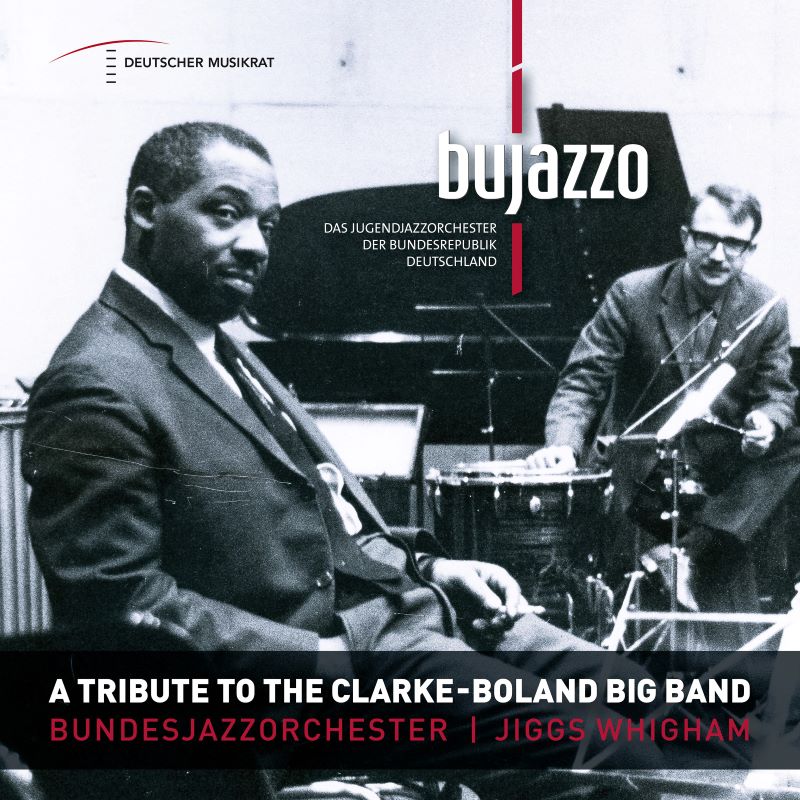
BuJazzO / A Tribute To The Clarke - Boland Big Band (2021 Challenge Records)

The Federal Jazz Orchestra, abbreviated and affectionately named BuJazzO by many, pays tribute to the legendary Clarke-Boland Big Band on its new CD. The legendary international ensemble existed from 1961 to 1972 in Cologne and was led by American drummer Kenny Clarke and Belgian pianist, composer and arranger Francy Boland.

The Clarke-Boland Big Band was formed on the initiative of Pierluigi “Gigi” Campi, who was born in Italy and lived in Cologne as well as promoted and produced the band. Campi's estate contained several boxes full of original notes from the Clarke-Boland Big Band, which Campi's family bequeathed to the Federal Jazz Orchestra. Two years ago, the orchestra devoted itself to this treasure. Trombonist Jiggs Whigham, who led the Federal Jazz Orchestra from 2011 to 2020 together with saxophonist Niels Klein, chose the repertoire. After an intensive rehearsal phase, the Federal Jazz Orchestra gave twelve concerts in Germany, from whose recordings the CD is composed.

“The Clarke-Boland Big Band was an international jazz orchestra at its best,” Jiggs Whigham said who is still enthusiastic about the orchestra. He lived in Cologne at the time and played with the band several times. “The mood in the band was always full of optimism, which was also due to the fact that most of the musicians were friends. There was a party atmosphere in this band every day.”

Providing a testimonial to this ensemble makes sense, because the Clarke-Boland Big Band was not only a gathering of exquisite soloists, but also thrived thanks to its leaders. American drummer Kenny Clarke, who was a founding member of the Modern Jazz Quartet and had played in various bands of Miles Davis, had lived in France since 1956. With his characteristic drumming, for which a penetrating beat on a large cymbal was indispensable, he relentlessly drove the band forward. Belgian pianist Francy Boland, who worked as an arranger in Paris and wrote for Count Basie and Benny Goodman in New York, was responsible for the Clarke-Boland Big Band's repertoire. He tended to compose songs extremely carefully, and consequently his style shaped the sound of the band.

Since the members of the Federal Jazz Orchestra are constantly changing, despite it already existing for more than 30 years, the band can be attested a kind of eternal youth. It is fascinating to hear how this ensemble of young musicians, who are between 17 and 24 years old, appropriates the musical cosmos of the Clarke-Boland Big Band and skillfully brings this music, which is now almost 60 years old, into the present. The multi-award-winning ensemble sets a vital and pulsating monument to the Clarke-Boland Big Band.

1. You Stepped Out Of a Dream 02:57
2. Lieben Sie Jazz? 00:59
3. Lullaby Of the Leaves 03:51
4. Das Kleine Örtchen Köln 00:45
5. Love For Sale 02:53
6. BuJazzo-Voices 00:35
7. The Song Is You 05:49
8. Ein Pariser Briefkasten 00:37
9. Box 703 08:33
10. Einfach Nur Applaus 00:24
11. Smoke Gets in Your Eyes 04:44
12. Nach Der Ruhe Kommt Der Sturm 00:49
13. Dancing In The Dark 04:17
14. We Need some Beat 00:25
15. Griff's Groove 06:25
16. Ein Feature Für Alto 00:29
17. November Girl 04:53
18. Because It's Swinging 01:16
19. The Jamfs Are Coming 08:30
20. Wunderbar, Aber Schrecklich 00:42
21. African Seeds 05:08
22. I Love The Music Too 01:02
23. Johnny One Note 02:46
24. Vielen Dank 01:26
25. Sax No End 07:28

Michel Meis 4Tet - Kaboom (2021 Challenge Records)

“Kaboom” Behind this picturesque title lies the explosive mixture created by the 4tet of the Luxembourg drummer Michel Meis on his second album. This time the band has a guest on some of the songs: the French violinist Théo Ceccaldi. “Théo Ceccaldi was brought to my attention by our pianist Cédric Hanriot,” Meis said. “His music and attitude really appealed to me. There is a lot of space between the violin and the trombone in terms of sound, which was a very experimental approach. Musically, it fit very well, because both are very flexible.”

Alisa Klein on the trombone merges as casually as unpredictably with the violin tone of Ceccaldi, and band leader Meis knows very well how much she is worth for the band. “Alisa Klein is the soul of the band,” a fact of which he is very aware. “Her sound is very warm and emotional and has a lot of space, but it still sounds very intimate. Such a deep-sounding wind instrument sound totally appeals to me.”

The well-structured pieces of the band leader have exactly the right mix of eclectic modern jazz and improvisational desire for experimenting. Meis can rely on his 4tet, which has grown into an unbeatable unity since the debut album “Lost in Translation”, which received excellent reviews. “No member of the band can be replaced and it would significantly affect the sound if one were missing,” Michel Meis stated. Stephan Goldbach is on the bass, and he also plays in the Trio Village Zone of pianist Georg Ruby, for example. “Stephan also plays a lot of experimental music,” Meis knows. “For me, he's the punk attitude in the band. He is the base of the band. But he brings a lot of physical strength to the band and plays in a very solo-like manner.”

The 4tet is held together by the French pianist Cédric Hanriot. “Cédric Hanriot is a pianist the kind of which I haven’t heard many times in my life,” Meis said. “He has his Cédric moments, during which I recognize him immediately, but his solos are always surprising because he doesn't hesitate to leave his comfort zone. He always takes substantial risks, and we adapt to them.” Between the longer pieces, Meis has included small miniatures on “Kaboom” where two musicians usually ester into conversation. However, the album is opened by the impetuous “Full Pedal Jacket”, which explores the abundance of possibilities in just under nine minutes that the 4tet and its guest have at their disposal. “’Full Pedal Jacket’ tends to go in the pop direction,” Meis believes. “It’s based on a riff that I experimented with.”
The whole band joined together to play “State of Uncertainty” which shifts between edgy rhythms and small melodic treats. “I wrote the piece during the first lockdown,” Meis recounted. “The beat is repeatedly broken up, whereby the piece is intended to describe the prevailing uncertainty.”

The white cat on the cover also has some significance, because it illustrates what is also the hallmark of the Michel Meis 4tet: “Cats do what they want and have a mind of their own,” Meis knows.

1. Full Pedal Jacket 08:44
2. [hanriot] 01:15
3. State of Uncertainty 08:20
4. [ceccaldi / goldbach] 01:01
5. Kaboom 06:53
6. Coming Together 02:00
7. She 07:09
8. [goldbach / hanriot] 01:04
9. Red Desert Air 04:34
10. [klein / meis] 00:56
11. Re:Build 08:25