Thursday, November 30, 2017

Miguel Zenón Earns Grammy Nomination for "Best Latin Jazz Album"


Internationally Renowned Saxophonist/Composer Miguel Zenón
Earns 2018 Grammy Nomination for “Best Latin Jazz Album” 
Zenón’s album Típico celebrates his longstanding quartet

"One of the great jazz discs of the year…."  – Jeff Simon, Buffalo News

4-stars. "Zenón's appreciation for intricacy always creates sparks, but it's his buoyancy that keeps things intriguing. That balance is everywhere on one of his most engaging adventures... insightful, passionate, and don't sound quite like anyone else in Latin, jazz, or their hyphenate." 
— Jim Macnie, DownBeat

4-stars. “Zenón himself has one of the most instantly distinctive sounds in jazz today, as has his band...An enthralling recording by a great group." — Tony Hall, Jazzwise Magazine

"Típico is a portrait of a band lost in thought with smiles on their faces as they reach that elusive moment when it all comes together and they are thinking, and playing, as one." – Felix Contreras, NPR

Internationally acclaimed saxophonist/composer Miguel Zenón has earned a Grammy nomination in the category of “Best Latin Jazz Album” for his recording Típico (Miel Music).  The album is a celebration of his longstanding quartet featuring pianist Luis Perdomo and bassist Hans Glawischnig who have been with Zenón since the turn of the millennium, and drummer Henry Cole who joined the band in 2005. This is Zenón’s fifth Grammy nomination.

"I am extremely excited and honored to receive this nomination along with such a distinguished group of musicians,” says Zenón. “I look forward to attending the ceremony in January.”

A multiple Grammy nominee and Guggenheim and MacArthur Fellow, Zenón is one of a select group of musicians who have masterfully balanced and blended the often-contradictory poles of innovation and tradition. Widely considered one of the most groundbreaking and influential saxophonists of his generation, Zenón has also developed a unique voice as a composer and as a conceptualist, concentrating his efforts on perfecting a fine mix between Latin American folkloric music and jazz. Born and raised in San Juan, Puerto Rico, Zenón has recorded and toured with a wide variety of musicians including Charlie Haden, Fred Hersch, Kenny Werner, Bobby Hutcherson and Steve Coleman and is a founding member of the SFJAZZ Collective. 

Zenón’s past several releases have generally fleshed out his quartet with additional instrumentalists as Zenón has looked outward to explore various aspects of his Puerto Rican heritage. Típico is more intimate. Its focus stays closer to home, with nods to Zenón’s own personal and professional life as it zeroes in on what makes his band unique.

“I was thinking about what this band and the guys in the band mean to me as I was writing the music,” he explains. “I kept going back to this idea of us developing this common language that identifies us as a band.”


Their language is thoroughly fluent modern jazz, with all the instrumental prowess and rhythmic and harmonic complexity that that implies. But the dialect they’ve created together through the years is distinctive.

“‘Típico’ refers to something that’s customary to a region or a group of people,” Zenón says. “Or something that can be related to a specific group of people. And when I was writing the music, I was thinking about music that identified us and this band.”

Each of the album’s final three tracks, Zenón notes, was composed around a solo or signature rhythmic line that one of the band members had played before. “My approach was more systematic on those three compositions specifically. But the whole record essentially is about representing the sound of the band. The sound of our band.”


Típico has received extensive critical acclaim:

Editor’s Pick: “Típico is a welcome showcase for Miguel Zenón’s longstanding, yeoman quartet.... shorn of any sidemen or abiding thematic adornment, the distinctive character, energy and joy of their interaction—their sheer jazz—is spectacular.... Típico eschews grand themes for ensemble intimacy, but Zenón’s latest triumph is no less resonant.” – Britt Robson, JazzTimes

“Típico, Zenón’s new album, is a dedicatory project that celebrates the unity and invention of the alto saxophonist’s longtime quartet, now approaching its second decade as a fierce modernist ensemble. The leader’s lapel-grabbing playing may remain the focus, but his bandmates the pianist Luis Perdomo, the bassist Hans Glawischnig, and the drummer Henry Cole having thoroughly absorbed Zenón’s integration of Latin musical sources and jazz, are invaluable contributors, each worthy of his obvious pride. – Steve Futterman, The New Yorker

“...one of the standout jazz albums of 2017.... Their decade together has given them a rare degree of sensitivity and understanding that greatly enhances their work. And their shared sense of purpose results in a keen musical focus that illuminates their aural excursions.” – George Varga, San Diego Tribune

Editor’s Pick: “On Típico high points arrive as sure as the sun on each of the eight tracks on the album.... [Zenón’s] melodic and extended improvisational lines contain qualities allied to a personality of exceptional purity, muscularity and creative intelligence.” – Raul da Gama, Jazz Global Media

“After using his last few albums to elaborate on the musical folklore of his native Puerto Rico, Zenon designed Típico without a conceptual framework, instead opting to simply show off what it means when a band locks in and fires on all cylinders.... All eight pieces are tricky in their own way, but in the end Zenon proves his point: his technical dexterity and virtuosic flash never undermine the fiery group interplay.” – Peter Margasak, Chicago Reader

“...at the core Zenon's ensemble is defined by the translucency of its tone, the alacrity of its approach to rhythm and the intimacy of Zenon's solos on alto saxophone.” – Howard Reich, Chicago Tribune

 “…this is exactly how a quartet should sound. It’s inventive, exciting, powerful, intriguing and thoughtful in turns. The band seem to employ their own unique musical language, creating a distinctive feel and sound through the obvious kinship and music they are performing...this recording can be easily summed as this; thoroughly fluent, mouth-watering modern jazz.”  Mike Gates, UK Vibe

"Alto saxophonist Miguel Zenón has maintained one of jazz' steadiest working units for well over a decade...While the quartet is back down to its core, it has never sounded so huge. The music rushes forth in a near-blizzard of rhythmic detail and yet conveys looseness and breath-in a word, alma (soul)...galloping rhythmic twists; gorgeous modern harmony; and relentlessly difficult ensemble writing that somehow always sounds unruffled." - David Adler, NYC Jazz Record

4 stars: “The pure-toned alto saxophonist continues to explore his Puerto Rican heritage through the prism of jazz with this beautifully crafted set of originals.... Each track bursts to the seams with intimate dialogue and finessed technique, and with Zenon in peak form and pianist Luis Perdomo a match, the blend of Latin music and jazz is unusually complete.” – Mike Hobart, Financial Times

“...one of [Zenón’s] most sophisticated collections yet of kinetic, genre-bending post-bop.” – Matt Collar, Allmusic.com

Winners will be announced at the Grammy Awards ceremony on Sunday, January 28, 2018 at Madison Square Garden in New York City.


Fred Hersch earns 2 Grammy Nominations for Open Book


INTERNATIONALLY RENOWNED JAZZ PIANIST/COMPOSER FRED HERSCH NOMINATED FOR TWO 2018 GRAMMY AWARDS FOR RECENT PALMETTO CD 

OPEN BOOK

“Best Jazz Instrumental Album” and “Best Improvised Jazz Solo”


Internationally acclaimed jazz pianist and composer Fred Hersch has received two 2018 Grammy nominations for his recent solo recording Open Book on Palmetto Records. Hersch has been nominated in the categories of Best Jazz Instrumental Album and Best Improvised Jazz Solo (Benny Golson’s “Whisper Not”). The Grammy Awards ceremony will take place at Madison Square Garden in New York City on Sunday, January 28, 2018.

Hersch has earned a total of twelve Grammy nominations since 1993 in the categories of Best Jazz Instrumental Performance, Best Instrumental Composition and Best Improvised Jazz Solo. Nine of his nominations have come since his recovery from a 2-month coma in 2008.

A select member of jazz’s piano pantheon, Fred Hersch is a pervasively influential creative force who has shaped the music’s course over more than three decades as an improviser, composer, educator, bandleader, collaborator and recording artist. A twelve-time Grammy Award nominee, he continues to earn jazz’s most prestigious awards, including recent distinctions as a 2016 Doris Duke Artist, 2016 Jazz Pianist of the Year from the Jazz Journalists Association and the 2017 Prix in Honorem Jazz for the entirety of his career from l'Académie Charles Cros in France.


Hersch has long defined jazz’s creative edge in a wide variety of settings, from his breathtaking solo recitals and exploratory duos to his extraordinary trios and innovative chamber settings. With some three dozen albums to his credit as a leader or co-leader, he consistently wins an international array of awards and lavish critical praise for his albums. The 2015 Palmetto album Fred Hersch SOLO , his tenth solo disc won the French Grand Prix de Disque de L’Académie de Jazz. His 2016 release, Sunday Night at the Vanguard (Palmetto), is a definitive statement by his long-running trio with bassist John Hébert and drummer Eric McPherson; it earned Hersch two Grammy nominations. His eleventh solo CD Open Book also earned two Grammy nominations as well as the 2017 Coup de cœur jazz from l'Académie Charles Cros.

Hersch has earned similar distinction with his writing, garnering a 2003 Guggenheim Fellowship in Composition. He’s collaborated with an astonishing range of artists throughout the worlds of jazz (Joe Henderson, Charlie Haden, Art Farmer, Stan Getz, Bill Frisell); classical (Renée Fleming, Dawn Upshaw, Christopher O'Riley); and Broadway (Audra McDonald). Long admired for his sympathetic work with singers, Hersch has joined with such notable jazz vocalists as Nancy King, Janis Siegel, Cecile McLorin Salvant, Norma Winstone and Kurt Elling.

The feature documentary The Ballad of Fred Hersch premiered at the prestigious Full Frame Film Festival in March 2016 to a sold-out house and rave reviews and is now streaming on Vimeo. His autobiography Good Things Happen Slowly (Crown Books/Random House), was named one of the Five Best Memoirs of 2017 by The Washington Post.


Open Book has earned wide critical acclaim

“But Mr. Hersch’s music of the last half-dozen years is at the pinnacle of the jazz idiom. In my opinion, jazz piano doesn’t get any better than this.” – Ted Gioia, The Wall Street Journal

“After Keith Jarrett, Fred Hersch is our leading exponent of solo jazz piano. The secret to Hersch’s work is that he does not fundamentally alter his engagement with the instrument. Understanding that the piano’s essence is to sing, he remains quintessentially, lyrically pianistic. Hersch’s touch with melody is extraordinary.” – Thomas Conrad, Stereophile

★★★★★ “This is a recording that makes it seem as though Fred Hersch is the finest jazz pianist in the world. That’s an impossible assertion, of course. There are a dozen, maybe more pianists who have achieved this level of artistry. But for now, with ‘Open Book’, he can wear that title.” – Dan McClenaghan, All About Jazz

"At 61, he stands among jazz's first rank of pianists and composers, possessing rare and wide-ranging gifts yet promoting no particular style.  He plays it his way, always shaping a personal sound.” – Larry Blumenfeld, Village Voice

“Pianist Fred Hersch personalizes everything he plays, investing deep emotion into his inventive interpretations of standards, pop tunes or whatever he turns his hand to, displaying a jaunty virtuosity that simultaneously delights and inspires awe.” – Bob Weinberg, Jazziz

"...a tour de force of solo piano playing." – Pierre Giroux, Audiophile Audition 

“Seemingly contrapuntal and contrary exchanges of left and right hand, tenderly emerging climaxes and the feeling that he is always whispering in your ear are a few of the major attractions of this captivating set…a pianist at the height of his powers.” – Selwyn Harris, Jazzwise (UK)

“’Open Book’ shows an artist at the height of his creative power without a sign of slacking off.  It’s one of those albums that sounds good any time of day, early in the morning with the birds singing outside your window or late at night as you relax after a long day. No matter when you listen, this is quite a good ‘book.’” – Richard Kamins, Steptempest

“Most everything in Fred Hersch’s oeuvre has always miraculously existed as slow read and page-turner all at once.  The many phrases, songs and albums from the mind of this highly expressive pianist-composer have been something to really take time with, to be savored and appreciated for their beauty and depth of creative thought.  “Open Book’ serves as a fine companion piece to go with Hersch’s memoir, but it’s a work that also stands alone, apart and aloft without issue. This is another five-star find from one of jazz’s greatest treasures.” – Dan Bilawsky, All About Jazz

“The centerpiece of the album is an almost 20-minute stream-of-consciousness improvisation, ‘Through The Forest,’ made completely compelling by Fred’s intelligent weaving of multiple musical strands and techniques into a narrative that holds the piece together into a cohesive whole.  It is comparable to Keith Jarrett’s famous solo piano concerts, but Fred seems more focused than even Keith was, as dramatic passages alternated with knuckled clusters in a constantly unfolding panorama.” – George Kanzler, Hot House


“It would be interesting to know how many truly great jazz pianists are alive at any given time. But I’ll say this: you could tighten the criteria until you have excluded all but ten, and Fred Hersch would still be among them. In fact, I’d suggest that he’s possibly one of the top five. His latest album is a solo excursion, perhaps the most deeply personal and introspective of any he has made yet. All of it is exquisite.” – Rick Anderson, CD Hotlist


"This is the work of a real artist examining his art and laying himself bare in the musical process. Solo piano music that forces you to lean in, put this up there with genre classics." – Chris Spector, Midwest Record 

“There’s no such thing as a casual listen to a Fred Hersch recording. Diving into the American pianist/composer’s work is no cold shower, though, but a trip into an enchanting world of teeming melodies, rich colours and criss-crossing stories. Like Keith Jarrett and Brad Mehldau, Hersch is a brilliant solo artist, and Open Book is a mix of originals and covers built around Through the Forest, a remarkable total-improv performance from a 2016 concert in Seoul. It is a typical Hersch set: understated, cliche-free, and sublime in its craft and musicality.” – John Fordham, The Guardian (UK)

"Profoundly expressive and technically astounding..." – Mel Minter, Musically Speaking 

★★★★★ “Hersch is the musician’s musician, a deep and thoughtful artist who strikes that elusive balance between soul and skill every time he touches the keyboard. This magnificent solo recording is aptly named, a revelatory experience, almost indecent in its emotional truth, and proof - if it were needed - that music, particularly in the hands of a poet like Hersch, can express what words cannot even approach.” – Cormac Larkin, The Irish Times 

★★★★★ “An album so free in emotions, from lyrical to strong and dissonant, that you as a listener are emotionally completely blown away. With his fabulous technique as a base, Hersch, on Open Book, knows how to create a musical world that's so intense and emotional that he'll let you forget the messy world outside.” – Dick Hovenga, Written In Music (Belgium)

"’Through the Forest’ is an almost 20 minute spontaneous improvisation, played at a point where he was unusually exhausted, and allowed himself to totally give in to the moment, and let the ideas flow as they came. It is the centerpiece of an exceptional album, one that definitively demonstrates the singular genius possessed by Fred Hersch.” – Joe Lang, Jersey Jazz

“Open Book gives Hersch fans both the familiar pleasures they’ve come to expect and a novel and daring performance that shows just how unbounded the great pianist’s talents can be.” Peter Hum, The Ottawa Citizen

“The closing track is Billy Joel’s tender ballad, ‘And So It Goes’, and while I’ve heard many renditions of this song, I don’t recall one that touched me as much as this one.  The passion Hersch injects into this powerful song shows why he is one of jazz’s most treasured performers.” – Thomas Cunniffe, Jazz History Online

“Fred Hersch is a modern piano master. The closer, a stately, hymnal take on Billy Joel’s And So It Goes that hews close to the theme, is one of the most gorgeous pieces of piano playing you’re ever likely to hear.”  – John Turney, London Jazz News

“In the sometimes seemingly overcrowded world of the contemporary jazz pianist, it must be difficult to make a lasting impression. I often think of Hersch as something of an unsung piano hero. If you are a fan of contemporary jazz piano of the highest order you will need this in your collection.” – Alan Musson, UK VIbe

“Built around a long, wholly-improvised concert perfromance, this solo piano recital from Fred Hersch is stunning evidence that he is one of the few great solo jazz pianists alive.” – Will Layman, Pop Matters


Wednesday, November 29, 2017

BOOK: Fred Hersch / Good Things Happen Slowly (A Life In and Out of Jazz)

MEMOIR
Notes

Jazz could not contain Fred Hersch. His meteoric rise as a in-demand sideman–one who played with the giants of the 20th century in the autumn of their careers, including Art Farmer, Joe Henderson, and more– blossomed further in the nineties and beyond into a compositional genius that defied the boundaries of bop, sweeping in elements of pop, classical, and folk to create a wholly new music.

Good Things Happen Slowly is a memoir, but it is also more than that. It’s the story of the first openly gay, HIV-positive jazz player, and a deep look into the cloistered, largely African-American jazz culture that made such a status both transgressive and groundbreaking. It is a remarkable, at times lyrical evocation of New York in the twilight days of post-Stonewall hedonism, and a powerfully brave narrative of the illness that led to Hersch’s two-month-long medically induced coma in 2007, from which he would emerge to create some of the finest, most direct and emotionally compelling music of his career.


Jane Ira Bloom: Early Americans BEST SURROUND SOUND ALBUM


Best Surround Sound Album

Jim Anderson, surround mix engineer; Darcy Proper, surround mastering engineer; Jim Anderson & Jane Ira Bloom, surround producers (Jane Ira Bloom). Label: Sono Luminus


Media Contacts
Jim Eigo Jazz Promo Services
Ph: 845-986-1677 / jim@jazzpromoservices.com
"Specializing in Media Campaigns for the music community, artists, labels, venues and events.”

Gianni Mimmo - Prossime Trascendenze (AMIRANI RECORDS 2017)


Forms, shapes, their dislocation in space, their own dynamics, functions, their contagious outputs and expressive inner logic.

Constellations, definitely.

Composing was to look at them as parts of a complex system, keeping transparency in mind as the final goal […] 


Pivotal work in Mimmo’s discography this “Prossime Trascendenze” explores the intriguing relationships between composed and improvised forms, “tight corners” and collective interplay.

A seamless orchestration toward a higher level of articulation that leads the listener through a textural pulsing structure where enlightened details deliver a splendid intelligibility.

In his liner Massimo Ricci states: […] Across the contrapuntal tableau and the solipsistic fragments we can walk slowly, inhale deeply and observe the small particles against the light rays […]

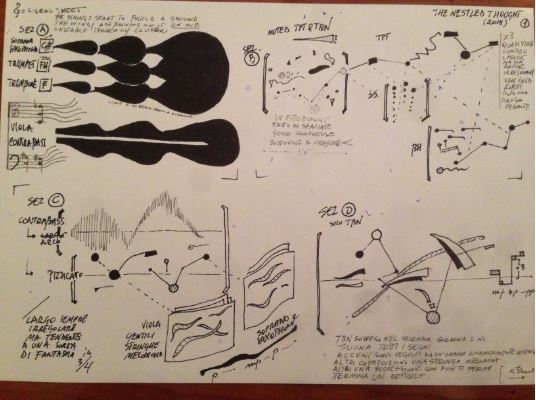
“Prossime Trascendenze” is a body of compositions Gianni Mimmo wrote between 2014 and 2015, consisting of graphic scores intended as formal structures and improvisational strategy for Quintet and Sextet ensembles.

The scores are quite detailed (duration, height, dynamics, etc.), as the idea is to develop a kind of strategy by moving across the given form. According to Mimmo’s definition these scores provoke a “Navigation through form”: “I consider these scores as maps traced on a puddle. A single touch can transform the whole reflection, delivering rippled skies, deviating the calm transit of generous clouds” […]


Due Sestetti (2015)
1 Daphne
2 The Nestled Thought

Cinque Multipli (2014)
3 Ivy and Birds
4 Five Facet
5 Esercizio della Distanza
6 Dress Code
7 Aspera

Basset Horn – Michele Marelli (tracks: 1,2)
Composed By, Producer, Soprano Saxophone – Gianni Mimmo
Double Bass – Fabio Sacconi (tracks: 1,2)
Edited By, Mixed By – Fabio Sacconi
English Horn – Mario Arcari (tracks: 3,4,5,6,7)
French Horn – Martin Mayes (tracks: 3,4,5,6,7)
Graphics – Mirko Spino
Liner Notes – Massimo Ricci
Mastered By – Maurizio Giannotti
Percussion – Marco Clivati (tracks: 3,4,5,6,7)
Recorded By – Alberto Callegari
Trombone – Angelo Contini (tracks: 1,2)
Trumpet – Mario Mariotti (tracks: 1,2)
Viola – Benedict Taylor (tracks: 1,2)
Violin – Alison Blunt (tracks: 3,4,5,6,7)

All music composed by Gianni Mimmo
Recorded at Elfo Studio on November 26, 2014 and on May, 15, 2015.
Sound Engineer: Alberto Callegari
Editing and mixing: Fabio Sacconi
Mastering: Maurizio Giannotti, New Mastering studio, Milano, Italy
Liner notes: Massimo Ricci
Graphics: Mirko Spino
Produced by Gianni Mimmo for Amirani Records

Lisa Mezzacappa - Glorious Ravage (NEW WORLD RECORDS 2017)


"I am doing what a woman can hardly ever do . . . , " wrote British world traveler Isabella Bird in an 1872 letter from Hawaii. "And I can fall, I can fall into anything." San Francisco Bay Area composer, acoustic bassist, and bandleader, Lisa Mezzacappa used those lines - and more from the writings of Bird and other women adventurers of the 19th and early 20th centuries - to fashion lyrics for her ten-part "panoramic song cycle for improvisers." Sung by the extraordinary vocalist Fay Victor, those two lines might also be taken to reflect Mezzacappa's place in the world of progressive and avant-garde jazz.

With Victor's voice at the core, and musical ideas percolating up from the texts, Mezzacappa tailored the open-ended structure of Glorious Ravage to the gifts, sensibilities, and personalities of the individual musicians. That required her to develop a bigger compositional framework than she had ever built before, and one that could both reflect and refract the multifaceted stories and personas of the women she met in her research and meet the challenge of keeping the composition, in her words, "open to the kind of collective wisdom that emerges from any given musical community."


Mezzacappa has written that initial inspiration for her work "comes from a messy, unfocused, overwhelming, brilliant, seductive, and terrifying pool of sensations, ideas, gut reactions, intellectual concerns, moral ambiguities." From that pool has bubbled up something that retains many of those qualities, but that also manifests focus, chemistry, communication, and an emergent sense of both order and transcendence. 

Glorious Ravage is a musical exploration of what is possible. Soaring with it can trigger an experience of the sublime, similar to the altitude sickness that Isabella Bird, Ida Pfeiffer, and Annie Smith Peck fell into during their lofty adventures, an ecstatic mind state South Americans called  veta  or  soroche. When Bird wrote in her letter from Hawaii, "This is the height of the last and most glorious ravage," she could not have foreseen that Lisa Mezzacappa would bring us another of equal magnificence.

1. I. Veta  4:06
2. II. Make No Plans  6:16
3. III. Heat & Hurry  7:15
4. IV. Taxonomical  4:59
5. V. Great Green Gloom  8:03
6. VI. Soroche  4:42
7. VII. For the Dusky Mourner  13:26
8. VIII. Marianne  5:03
9. IX. Shut Out the Sun  7:29
10. X. City of Wonders  8:18


Fay Victor voice
Nicole Mitchell  flute
Kyle Bruckmann  oboe
Vinny Golia  woodwinds
Cory Wright  woodwinds
Darren Johnston  trumpet
Michael Dessen  trombone
Dina Maccabee  viola
John Finkbeiner  electric guitar
Myra Melford  piano, harmonium
Kjell Nordeson vibraphone, percussion
Mark Dresser acoustic bass
Tim Perkis  electronics
Jordan Glenn drum set, percussion

Ran Blake / Kresten Osgood - The Dorothy Wallace Suite (ILK MUSIC 2017)


This is the much awaited duo album of Danish drum innovator Kresten Osgood and American piano genius Ran Blake. more than 40 years of age divide them, but they meet in a contemporary expression. The Dorothy Wallace Suite is a suite composed especially for this project by Ran Blake and is a heartfelt tribute to the great Dorothy Wallace who was a patron of the arts in Boston and played a vital part in Ran Blake´s art. This is only the second time in the entire Ran Blake discography where he plays duo with drums. The suite is recorded in Brookline on a piano of Ran Blake´s choice.

1 Symphony in Green  04:44
2 Vera Fuller  01:59
3 Ricky Ford at Logan  02:04
4 Bruni  01:49
5 The Carriage house  02:04
6 Brick in the Driveway  01:31
7 Ricks Room  03:10
8 The Demise of Rick Wallace  02:15
9 Ran´s Account  01:44
10 Eileen´s Account  02:05
11 The Door To The Forbidden Room  00:54
12 The Library at Midnight  01:16
13 Pannonica  02:26
14 Mood Indigo  04:32
15 Who  03:00
16 Dancing in the Dark  02:17
17 Never Can Say Goodbye 02:03


VA - Hendrix in the Spirit of Jazz (ACT MUSIC 2017)


Luca Segala Libertrio - La Rete Di Indra (AMIRANI RECORDS 2017)


Libertrio is the newest project of Luca Segala: another interesting investigation on post-jazz language through a very personal saxophone voice, here interplaying with drums and double bass, delivering luminous frames and complexity of the lines, dense trialogues and classical clarity. Intriguing, assertive, evocative and really good.

1 Tony's Hungry 7:52
2 My Sweet Home 6:16
3 Little Suite 5:42
4 The Charm of the Dance 4:55
5 Acqua 8:12
6 L'occhio di Nina 6:45
7 A Prayer 5:43
8 Prendi i soldi e scappa 3:35

Gianluca Alberti: double bass
Tony Boselli: drums


Polymorphic Orkestra - Confluence (2017)


In an age of half-chewed soundbites and the relentless chatter of tiny tweets – of ever-decreasing attention and even shorter digestion – it is always gratifying, on a number of levels, to see art made that demands as much of your time as it needs.

Trumpeter Lee McIver‘s Polymorphic Orkestra makes music that demands that time – and rewards one for it, in spades. Together with vibraphone player Ed Goyer and drummer Ed Rodrigues, this three-man orchestra expands on the sounds of their instruments by adding digital elements to the acoustic, often combining the two into remarkable alloys.

Both McIver and Rodrigues use laptop samples and FX to grow the possibilities of their own instruments, as well as adding external colours to the music – an intriguing use of the murmur of indistinct human voices, like a dream radio, or the sudden startling sting and snap of a plucked string.


Their latest album, Confluence, is made up of two long improvisations – the 40-minute ‘Stream’ and the 24- minute ‘Flow’. The titles are fitting, as this music has much in common with the nature of both water and of electricity: rushing between banks, bubbling over rapids, coming to rest calm and lake-serene, sparking, ever moving to a point of resolution or rest.

‘Stream’ is the more free-form of the two – moments of purely acoustic playing, then moments of digital crackle and sheen, with often beautifully balanced hybrids of the two. The empathy is almost telepathic between McIver and the two Eds – rarely does one soloist rise above the others, and if so only fleetingly as if to point the way to a new path. ‘Stream’s 40 minutes goes by like seconds.

‘Flow’ appears more structured, yet retains the same ecstatic feeling of discovery that guides its longer twin. Beginning with a melody that is almost like a lost jazz standard, it moves into an ostinato bass pattern, and then off into points unknown (to us and to the players, both).

This is unique and rewarding music. The trumpet colours call to mind obviously Miles Davis‘ more expansive fusion sides, as well as the electric watercolours of Jon Hassell, yet the Polymorphic Orkestra has its own voice and vision, and it is perfectly realised here.

Give them an hour and they will give you a world.

1 Stream 40:51
2 Flow 23:15


℗ 2017 Polymorphic Orkestra