
Saturday, November 5, 2016

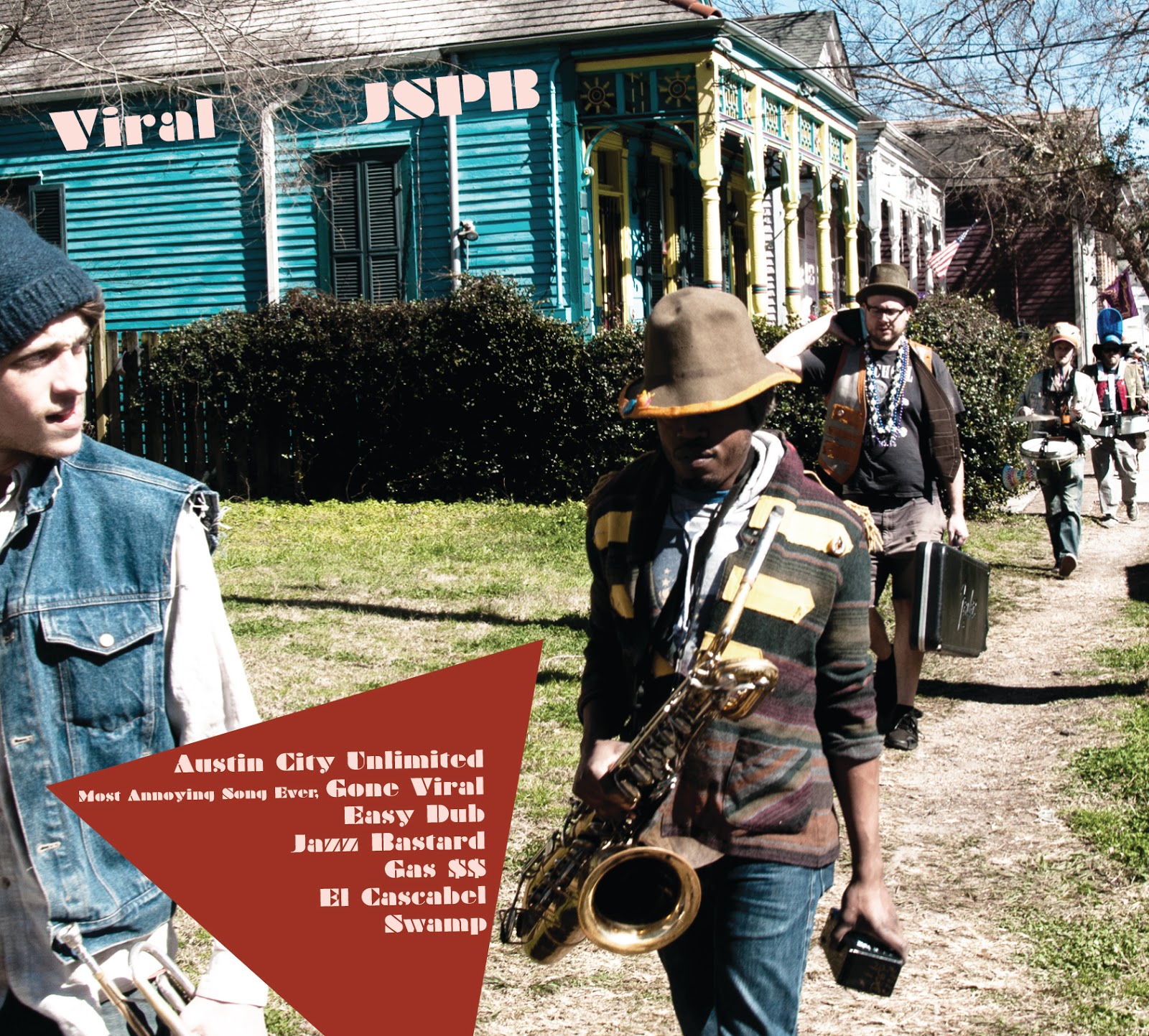
Jefferson Street Parade Band - Viral (Releases November 4, 2016)


Jefferson St. Parade Band Brings Bombastic Beats and Brass to the People on New Album

Weaving together many international influences, Jefferson St. Parade Band brings bombastic beats & brass to the people. A fully mobile party band, JSPB features an innovative drum line and a rich horn section. And their guitarist and bassist play through custom made Ghostbusters-style portable backpack amps.

JSPB walks a rare line: This brass band is at home playing jazz, world, and jam band festivals, tailgates, punk shows, schools, microbreweries, weddings, funerals, art museums, flea markets, groceries, and convention centers… Their unique combination of virtuosic horn solos, polyrhythm, and face-melting bass and guitar work has the ability to get rockers, toddlers, and seniors up and dancing.

Fall, 2016 finds JSPB putting the final touches on their third independent album: Viral is set for local release in Fountain Square, Indianapolis on Friday November 4th, with a national release on November 18th. They’re sharing the bill with Indianapolis’ Highlife heroes Sweet Poison Victim. Doors at 7, music at 8, all ages.

The new album is co-produced by JSPB’s director Ben Fowler, and Blockhouse media wizard Andrew Beargie.  Says Beargie, “Viral is one of the most natural and vibrant recording projects I’ve worked on to date.” JSPB’s previous album feature covers of Guinean heavyweight Famoudou Konaté’s Kadan and Konkoba II, and Brazilian composer Baden Powell’s Canto De Xangô. 

Their new disc focuses on originals by several composers within the band, along with a standout covers of Mexican traditional El Cascabel, and Easy Dub, by Jamaican electronics/sound pioneer King Tubby.


They have enjoyed success performing at Groove Fest (CO), Crash Detroit, HONK!TX, TEDxIndianapolis, Lotus World Music and Arts Festival (IN), Custer Fair (IL), The Wedge Brewery (NC), and The Blue Nile in New Orleans, where they’re slated to play their third annual Mardi Gras set this coming February 2017. Jefferson St. Parade Band has shared the bill with nationally-recognized acts The Soul Rebels, Karl Denson’s Tiny Universe, Moon Hooch, and My Brightest Diamond. They’ve collaborated on recordings with Asthmatic Kitty recording artist DM Stith, and former tUnE-yArDs vocalist Moira Smiley.

“A kinetic explosion of intoxicating global beats and brass. The Jefferson St. Parade Band is a riotously fun experience.”
-DJ Kyle Long/NUVO

 “[JSPB’s second album] Consultation with Tubby showcases the talent of the Jefferson St. Parade Band, merging many genres together while creating a unique and cohesive sound that is undeniably their own.”

-Anna Polovick/Black Grooves


1. Austin City Unlimited
2. Most Annoying Song Ever, Gone Viral
3. Easy Dub
4. Jazz Bastard
5. Gas $$
6. El Cascabel
7. Swamp

About


Ben Fowler/Drums, Alto Sax, Director Fowler’s drumming inspirations are Elvin Jones (with John Coltrane), Mitch Mitchell (With Jimi Hendrix), and Famoudou Konate (Djembe master from Guinea, West Africa). His first love was the drum set; he traded it for the marching snare in an effort to take his music out of the stale bar scene and into the streets. He lights up the snare. As a songwriter/saxophonist he veers toward angular, unusual harmonies and arrangements (see Fowler Kilter, Swamp, Gas $$).

Fowler graduated from the IU Jacobs' School of Music in 2008, with a bachelors' in Jazz Studies/Percussion. At IU he studied with LA studio stalwart Steve Houghton. He has had lessons with New Orleans veteran drummer John Vidacovich, and studied regularly with Indianapolis jazz/gospel great Charleston ‘Deno’ Sanders. In years past, he toured Europe with DM Stith (Asthmatic Kitty), and toured the eastern and southern USA with The Delicious (Joyful Noise) and Kentucky Nightmare (Standard Recordings). Now he focuses the bulk of his musical energy on Jefferson St. Parade Band.

Aaron Comforty/TPT and composer. Aaron is an excellent multi-instrumentalist (Trumpet, pennywhistle, banjo, guitar, keys, drums, vocals). His wily compositions are a breath of fresh air in the JSPB repertoire (see Chalk, Most Annoying Song Ever Gone Viral). Aaron recently received a Bachelor’s from IU in Ethnomusicology with a focus in Music Education. Comforty has the surprising ability, simply through melodic ornamentation, to bring his listeners back to turn-of-the-20th-Century Bulgaria.

Alex Arnold/TPT and composer. Alex earned his BA in Music Composition at Earlham College. Alex is a multi-instrumentalist, producer, and active member in multiple other projects (!mindparade, Ladycop, Black Acid Arkestra). His trumpet playing is fiery and his solos are unpredictable. His love of Roma/Balkan music informs his compositions within the band (Koze Glavata, from JSPB's first album, Juntos).

Alex Akers/TPT. Akers brings crisp tone and clarity on the trumpet. A Graduate of Indiana State University in music education, he is an active performer, composer, band director, guitar instructor, producer, and clinician. His versatile musicianship has led him to tour nationally and internationally. Some past performances include iCandy Rock n’ Roll at Indiana Live Casino, Rhapsody in Swing (China tour), and several US tours with JSPB. Akers produces for the innovative hip-hop label TeamGreenWhatUp, and plays in Chicago based groups The Rave, and Caught on Cline.


Evan King/TPT. Evan was the principal of the Denver Philharmonic for their first international tour (China, summer 2016) and was the former principal of the columbus, Indiana philharmonic. King received his undergrad from IU in Trumpet Performance. He brings his precision and brilliant sound to JSPB any time that he can get away from graduate school and gigging in Denver, CO.


Matt Setzler/Alto Sax. Settler received his undergraduate degree at the University of Michigan in Jazz Studies. He is now pursuing his masters in Cognitive Science at IU. He has performed with Lee Konitz, Buster Williams, Christian McBride, and John Hollenbeck. While living in Ann Arbor, he was a regular participant in the Free Jazz Church at Canterbury House. His playing is steeped in the Free Jazz and Bebop traditions.

Peter Hanson/Alto Sax. Peter, aka Daddy, grew up in Bloomington, and has spent much of the last 13 years in and around NYC. He received a jazz degree from SUNY Purchase College, and has since taught and gigged in and around Brooklyn. His tastes center on improvised, genre-defying music. He has toured with JSPB, and Jason Ajemian and The High Life (and with their new incarnation, Folklords). Folklords will be appearing in Continental Europe for several dates this fall.

Dylan Maloney/Tenor Sax. Dylan has traveled extensively in Latin America. He has paid several visits to Xalapa, the capitol city of Veracruz. There he focuses on learning a south-western Mexican folk music called Son Jarocho. This past year he arranged one of their classics, El Cascabel, for the Jefferson St. Parade Band. Dylan also studies luthiery in Xalapa. In recent years he has made several regional stringed instruments (the Leona and the Jarana), and two guitars. In the fashion of his teacher there, he builds stringed instruments almost entirely by hand!

Eric Arnold/Tenor Sax. Eric’s solos have a playfulness and a rhythmic edge that competes with the band’s finest drummers. Eric spends his time away from JSPB rebuilding an old Airstream trailer, writing code for apps, and producing trill beats.

Durand Jones/ Bari Sax. Through the bari sax, Durand can sing and cry, shout and scream. His years of classical training (Southeastern Louisiana University Bachelor’s, and an IU Jacobs Masters’ in Music Performance/Saxophone) have given him an effortlessness on his instrument (hear his solo on Gas $$). But his voice is uniquely powerful as a sax player and as a singer. His singing can be heard on his self titled 2016 release, Durand Jones & the Indications.

Zach Frasier/Guitar. Zach comes from a jam band background (nearly a decade with Elephant Quiz). He lights up the electric guitar like no other (Hear his solo on Party time excellent, and Most Annoying Song Ever Gone Viral). Zach is still scheming about mounting a pedal board to his belt.

Matt Romy/Bassist, composer, arranger. Romy studied Jazz Piano at IU Jacobs School of Music. He is JSPB’s Mingus, an excellent bassist with a hand in the overall harmonic landscape of the band. Romy's compositions lean toward driving funk (Austin City Unlimited, B.F.'s BFFs), with a harmonic depth that rewards continued listening. Romy is right at home playing punk/rock guitar (Community Currency), jazz piano, and heavy metal drumset (Marine Corpse). 


Ben Handel/Snare, Toms. Handel is a tireless drumline and drumset player. He has toured extensively with Blast!, throughout Japan and South Korea (Blast! is the 2001 winner of the Tony Award for "Best Special Theatrical Event," and the 2001 Emmy Award for "Best Choreography”). This summer he was involved in the arranging, rehearsing, and Japanese debut of the Blast! Disney Show. Locally, he works with IU's Marching Hundred, Bloomington North's Drumline, and the Owen Valley Drumline. Handel recorded and mixed JSPB’s second album, Consultation w/Tubby. 


Josh Olivo/Snare. Josh keeps things light and tight on his snare/tambourine rig. A consummate musician with two decades of drumming under his belt, he has an instinct for the phrase and an ear to the big picture. When he solos, Olivo prefers to explore the microscopic, expertly subdividing the flow of time. Goodhands Team is the outlet for his electronic work. Josh is a practitioner of Tibetan meditation, and slays on the basketball court.

Chuck Roldan/Toms, Bass Drum. Chuck is perhaps the most expressive drummer in the band. He can whisper on his bass drum/tom rig, moments before sending it to the repair shop! He brings together precision and raw energy like no one else. By day he works as a mild mannered math tutor.

Jack Stewart/Bass Drum. With a strong grasp of jazz, rock and funk, Jack has long been the foundational pulse of the band. He played jazz in school in Ithaca, NY, and has nearly completed a Masters in Information Science at IU. Jack wiles away his days inputting data into complex computer systems, waiting for the next chance to get.

Kevin Weinberg/Bass Drum. Kevin gets inside the unusual beats of JSPB, and always finds a way to give them his own twist. He works around town as a sound man, and an audio and video engineer. He studied jazz drumming, and received his bachelor’s degree at IU in the Recording Arts.

Matt Andert/Bass Drum and Engineer. ‘Dirty’ sawed his marching bass drum in half, and filled the open half with a cowbell and snare drum he made out of a cooking pot. He built an amplifier into the body of a busted acoustic guitar, gave it backpack straps, and played a keyboard through it. he built a PA system onto an adult tricycle and entered the Bloomington 4th of July Parade with a pickup band playing the Star Wars Imperial March.

Peia - Beauty Thunders (Releases November 16, 2016)


Peia - Beauty Thunders and the Ties That Bind

The seeker’s life becomes a quest. It’s a search that never seems to end, one that takes them far from home, a quest for the truth on the horizon. Each discovery along the way becomes a gem, a joy to be added and celebrated. For Peia, each treasure is a song, a link to her past and to her future, and she documents them on her third album Beauty Thunders (released November 16, 2016).

“I’ve been finding my own roots through songlines,” Peia explains. “My bloodline is mostly Scots and Irish, and before that, we believe, Basque – travelers who migrated north as the Celts receded from the mainland of Europe.”

That movement explains the choice of material on Beauty Thunders. It opens with “Szerelem,” with Peia’s voice rising over a shifting soundscape of melody for an otherworldly introduction to the disc, before exploring the Basque and Gaelic traditions, while including her own songs that tie the knot between history and now.

Throughout, the theme is movement. “Bánchnoic Éirann Óigh,” for instance, is an Irish leaving song, a lament of one forced abroad through poverty and famine.


“It’s such a beautiful, moving piece,” Peia says. “His fate is to go far away and never return. That really spoke to me as an American with our lost culture. The song came to me from a family of song keepers in Ireland, people who also hold fast to the Gaelic tradition and help it stay alive.”

Peia’s ears truly opened to the sounds of the world when she was a student at the New England Conservatory of Music. She was already a hugely talented singer, whose teacher had pointed her toward many kinds of music, from opera to the swing music of the ‘40s, but a full scholarship to the Conservatory pressed her into the Western classical tradition.

“Within a year I knew opera wasn’t for me,” Peia recalls. “But there were classes in so many other things – klezmer, Turkish music, Indian – and I devoured them. I did the minimum I needed to satisfy my opera professors and immersed myself in everything extracurricular.”

With those seeds planted, she moved to Portland, Oregon after graduation and heard Sufi Qawwali music for the first time. Its deep spirituality resonated with her and she found a teacher to start her on the path before she left for India to dig deep into its music.

The seeds were starting to grow and they began to blossom on The Dance of Devotion, her first album. But it was with 2013’s Four Great Winds that she truly found what she needed in music, tracing the present back along with winding paths of the past, while still making each piece very much her own. She’d made her voice into a powerful instrument to carry the listener into the song, and it’s still growing, the remarkable centerpiece of the new album.


The arrangements for Beauty Thunders developed over time, building into the vision of each song that was alive in her head. Each piece keeps faith with the root of the music but builds on that foundation to create something deliciously amorphous, a sound that’s intensely personal but still immediately accessible, always topped by her clear, soaring voice.


“I like to keep the songs alive in old ways and honor the traditions from which they came,” Peia agrees, “with the chords and the melody line. But each one touches me and it changes as I keep performing it. That’s what I want to record.”

That’s very apparent in a deeply mystical song like “Que Mi Medicina,” which originates in Peru.

“I’ve been singing and tracing the roots of this song for many years,” Peia says. “I’ve tracked it deep into the jungles of Peru, but the exact tribe or region is still unknown. The song speaks of healing and seeing the unity in all things."

The healing that music can offer is a vital part of Peia’s life; the four original songs on Beauty Thunders make that obvious.

“That reconnection with nature is something we desperately need,” Peia says. “After all, it’s the elemental forces that give us life. The song “Beauty Thunders” is about the beauty all around us in this world and also the delicate times in which we live, while “The Old Ways Restored” talks about the need to respect nature, to return and remember.”


The ties that bind all the people on the planet, no matter how far back in time they stretch – those connections across history and geography are the things that are important to Peia, the way from the present to the past. Humanity, history, the way forward, they’re all there on Beauty Thunders.


1. Szerelem
2. Beauty Thunders
3. Ciamar a ní mi’n dannsa díreach
4. Dance in the Storm
5. Que mi Medicina
6. Txoria Txori
7. Bánchnoic Éireann Óigh
8. The Old Ways Restored
9. We will Rise Again


About


Peia is poised to release her third studio album, Beauty Thunders, a collection of traditional and original songs tracing the movement of humanity and her own ancestors throughout the ages. This new album is produced by engineer and Grammy Award Nominee Kamal Engles and includes an array of phenomenal musicians from the world music community. 

Born in Connecticut, Peia trained in Boston at the New England Conservatory of Music, followed by an immersion in Indian classical singing. Her recording debut was in 2009 with Renaissance lutist and Grammy nominee Ronn McFarlane. 2012 saw her first solo album, The Dance of Devotion, followed by Four Great Winds in 2013, which was signed by Sounds True for global release. These stunning recordings have sparked acclaimed tours across Europe, Australia and the USA, as well as collaborations with Rumi scholar Coleman Barks, mythologist Michael Meade and Iranian tar master Ali Ghamsari.

As an archival songstress, Peia has gathered songs from ancient traditions that span across the globe. She carries melodies wrinkled and wise with time, laboring faithfully to revive their language, stories and original essence. Praised for her crystalline tone and high soaring soprano voice, Peia’s music pierces the heart with bell-like clarity.

Accompanying herself with charangon, harmonium and guitar, her eclectic ensemble offers enchanting renditions of timeless songs.

Friday, November 4, 2016

Erskine, Oles & Colombo (feat. Bob Mintzer, Kathleen Grace & Michel Stever) - We All Love Burt Bacharach (ORACLE RECORDS LTD 2016)


Venerdì 4 novembre esce We All Love Burt Bacharach, una raccolta dei più noti brani del compositore statunitense Burt Bacharach (sotto etichetta PLAY in collaborazione con Oracle Records Ltd).

Burt Bacharach, nato a Kansas City nel 1928, è un compositore di grande successo nonchè vincitore di numerosi premi. Nel 1967 Bacharach ha composto la colonna sonora del noto film Casino Royale, con The Look of Love, cantata da Dusty Springfield. Ha scalato le classifiche americane e britanniche posizionandosi con oltre 50 brani nella top40 dei due paesi.

Il disco, già disponibile in preorder, è un tributo al successo di questo grande artista e contiene 13 tracce di cui 8 cantatate e 5 strumentali.

We All Love Burt Bacharach è stato concepito e prodotto da Giampaolo Pasquile e Michele Garruti per l’etichetta italiana PLAY fondata dallo stesso Giampaolo.

“Non vergognarti mai di scrivere una musica che la gente ricorderà facilmente”. E’ una delle massime sostenute da Burt Bacharach, un concetto che nella sua semplicità racchiude tutto il suo genio. Ciò ha  fatto si che melodie pop siano diventate anche colonne sonore di molti film. Essendo sin da bambino un amante del pop, – dichiara Giampaolo - e in particolare di Bacharach, sognavo l’idea di riproporre la sua musica in una chiave “jazzata” come ancora non avevo sentito ma che era sempre stata nella mia mente!”

Un album dal respiro geneticamente internazionale che coinvolge grandi artisti del mondo del jazz e non solo, a partire da Peter Erskine celebre batterista degli incredibili Weather Report, di Diana Krall, Joni Mitchell e tanti altri, Bob Mintzer sassofonista e clarinettista, leader degli Yellowjackets ed ex membro della leggendaria Buddy Rich Big Band che vanta collaborazioni molto prestigiose tra cui Jaco Pastorius Bill Cobham. Alla tromba c’è Michael Stever, considerato il nuovo “white cat” della tromba jazz, ha collaborato con Al Jarreau, Dave Brubeck, Ramsey Lewis, Steve Miller. Al contrabbasso Darek Olesziekiewicz, conosciuto con lo pseudonimo di Oles che ha collaborato, tra gli altri,  con Pat Metheny.

Al disco ha partecipato anche Massimo Colombo noto pianista jazz italiano, che ha curato gli arrangiamenti di We All Love Burt Bacharach, mentre è lo stesso Giampaolo Pasquile ad averne realizzato il missaggio e il mastering.

La voce invece è di Kathleen Grace, raffinata folksinger della west coast.

La scelta di una voce folk anziché jazz è stata proprio dettata dall’esigenza di realizzare un disco in cui il jazz è solo uno degli elementi stilistici.

Il disco, realizzato a Los Angeles, ricrea un ambiente jazz, contaminato da sonorità che spaziano dal latin allo swing, dal funky al cool jazz, al be-bop fino ad arrivare alla ballad. Un mix particolare e raffinato che non lascia spazio a compromessi sulla qualità, rendendolo accessibile non solo agli amanti del jazz ma al grande pubblico.


Amina Claudine Myers - SAMA ROU (Songs From My Soul) 2016


There are very few musicians who make the blood scorch the heart and the pulse roar quite like Amina Claudine Myers. She does that with infallible regularity, performance after performance, recording after recording. What a splendid recording Amina Claudine Myers Salutes Bessie Smith was, the same year she recorded Song For Mother E with Pheeroan akLaff. Thirty-six years after those iconic recordings, Myers has continued to advance her illustrious career with Sama Rou – Songs From My Soul. Here, it pays to raise a famous ghost; that of the great Ludwig van Beethoven who once encouraged the living artist of his day with the following words: ‘Don’t only practice your art. But force your way into its secrets, for it and knowledge can raise men to the Divine’. Amina Claudine Myers is the very quintessence of that exhortation. And Sama Rou is that record that makes it so.

It is no coincidence also that Amina Claudine Myers channels the spirits of the ancestors who dwell in the rarefied realm. In her music Paul Robeson and Marion nestle cheek-by-jowl with Igor Stravinsky; even Anton Webern. But Myers is a singular artist and her work who – certainly in Jazz – has created dramatic pianistic innovation in the schematic organization of pitch, rhythm, register, timbre, dynamics, articulation, and melodic contour, further enhancing the sonic splendour of her music with the depth of her glorious contralto. Myers’ setting for the ‘Songs From My Soul’ emphasises her sense of wonderment, humility and devotion. The highly derivative idiom (The Great Negro Spiritual that is) is thoroughly tonal, the tone luxurious and the work cast at a predominantly prayerful slow pace.


The opening medley, ‘Steal Away/Athan (Call to Prayer)/Fatiha (Sura Prayer)’ is especially haunting, with its unhurried and repetitive, whispered echoes of ‘Steal Away’ melting into the adhan called out as if by a muezzin from a minaret. The somber introverted orchestration of Christian and Muslim tradition, far from being contrasting, enters somberly into a lovely, hushed unified spiritual. There is a magnificent glow to every Negro Spiritual in this repertoire and one can only gasp in wonder at the spacious dedication with which Myers brings them to life. Their flashes of drama carry over from one spiritual into the other as she adorns each with a lyrical radiance. ‘My Soul’s Been Anchored In The Lord’ and ‘Sometimes I Feel Like A Motherless Child’ are followed by ‘Go Down Moses’, a seraphically rendered Spiritual that crowns the sequence of truly great music.


I would be remiss if I did not pay homage to the three compositions on this disc by Amina Claudine Myers. Each is an example of majestic melody and dissonant harmony with strong plagal cadence. ‘Crossings’, and ‘Ain’t Nobody Ever Gonna Hear Us?’ are classics of their kind: anthemic pieces fulfilling their declared brief to be an aspiration towards recognition and happiness. ‘Thank You’ to the Lord speaks to the magisterial beauty of another vivid performance by an artist not only emboldened by the Association for the Advancement of Creative Musicians (AACM) – New York chapter, but by a singular genius of Black Music.


01. Steal Away / Athan (Call to Prayer) / Fatiha [Sura Prayer] 7:55
02. Down on Me 3:50
03. Intro (Crossings, Pt. I II & III) 19:34
04. Ain't Nobody Ever Gonna Hear Us? 5:51
05. Nobody Knows The Trouble I See 5:21
06. My Soul's Been Anchored by the Lord 3:56
07. Sometimes I Feel Like a Motherless Child 5:05
08. Go Down Moses 5:59
09. Thank You 3:59

Rene McLean: recitation


Mats Gustafsson & Hamid Drake - For Don Cherry (OKKA DISK 2016)


Rhythmic virtuoso Hamid Drake and reeds innovator Mats Gustafsson deliver a jaw-dropping and all-too-brief set recorded in Chicago on Oct. 19, 1995, the day of Don Cherry’s death. 

One of the few live records to make this listener earnestly wish she’d been in attendance, Drake and Gustafsson’s meeting is a perfect example of the phenomenal synergy possible between two musicians. The two in question are an ideal match; both temper the muscularity of their playing with sensitivity and musical sophistication. Neither artist allows the other the option of sitting on his heels at any point; this recording is challenging, intense, and enjoyable from start to finish.

Plus, it seems like they’re having fun; have a listen to the frenetic, playful second piece, wherein Gustafsson presumably forgoes his saxophones for a bit to yelp and whoop in response to Drake’s inspired djembe playing. Gustafsson, frequently touted as a "rising star" of European jazz, is in my opinion rarely matched among powerhouse reedsmen in creativity. Meanwhile, the tireless and infallible Drake delievers one of the more visceral and thrilling percussion solos to make it to records. This is improvisation, and it rocks, to boot; my favorite live record of the year. Only 600 copies entered the world, so you know what that means.

- Susie Jae, ON AIR magazine, WKCR 89.9 FM (New York)


01. 1 04:53
02. 2 06:27
03. 3 17:30
04. 4 11:09


Record Label: Okka Disk 
Recorded at Urbis Orbis, Chicago, IL, October 19, 1995

Produced by: Bruno Johnson 
Recorded by: Jim O’Rourke 
Engineered by: John McCortney/Airwave 

Cover art: William Mohline


Hamid Drake — percussion 
Mats Gustafsson — reeds

Tickets now on sale for Lake Street Dive at NEC Feb. 16, 2017


NEC alumni Lake Street Dive return to alma mater to
 kick off NEC’s 150th birthday celebration

Thursday, February 16, 7:30 p.m. at Jordan Hall

Lake Street Dive will perform two sets, one with the band alone
and another with large student ensembles including the NEC Philharmonia, NEC Jazz Orchestra, and NEC Gospel Ensemble

 “We hope it’s hard for people to stay seated; we hope it’s exultant!” 
– Mike Calabrese, Lake Street Dive, about this concert

“Having an orchestra, and big band, great faculty, arrangers and conductors – that will be very special for us,” – Bridget Kearney of Lake Street Dive

Lake Street Drive © Danny Clinch

NEC alumni Lake Street Dive return to their alma mater on Thursday, February 16 to kick off NEC’s 150th birthday celebration. The performance will include a rare opportunity to hear Lake Street Dive in concert with larger ensembles, as well as a set by the band alone.

The concert takes place at 7:30 p.m. at NEC’s Jordan Hall, 290 Huntington Avenue, Boston.  Tickets go on sale on November 1. Tickets $30, $40. There are also a limited number of VIP seats at $150. The VIP package includes a pre-concert reception, post-concert meet-and-greet with Lake Street Dive, and tickets to NEC's A Feast of Music after-party on February 25.


or in person and by phone at the NEC box office (617-585-1260)  

For more information (click)

Lake Street Dive will perform two sets, one with the band alone and with large student ensembles including the NEC Philharmonia, NEC Jazz Orchestra, and NEC Gospel Ensemble.


“Having an orchestra, and big band, great faculty, arrangers and conductors – that will be very special for us,” says Bridget Kearney of Lake Street Dive.  Mike Olson of the band continues: “We’ve seen our heroes doing this, so it’s very cool to get a chance to do it ourselves.”

NEC Jazz Studies Chair Ken Schaphorst, who also directs the NEC Jazz Orchestra, notes: “It seems only fitting that Lake Street Dive celebrates NEC’s 150th Anniversary with a program combining elements of jazz, classical and popular music.

Throughout its history, NEC has been dedicated to the development of creative music making, fostering a respect for the varied traditions of our contemporary musical world. I’m looking forward to collaborating with Lake Street Dive in the performance of their music with our students, along with “Angel Eyes” arranged by Gunther Schuller and “God Bless the Child” arranged by Jaki Byard."


Lake Street Dive band members feel strongly about the importance of their NEC education. “It’s so important to really know technique and theory – these are such a gift for existing in a world of pop and rock and roll.  These allow us to compose and improvise…we’re so lucky to have had this from NEC,” says band member Bridget Kearney. 

Mike Olson continues, “We’ve taken our NEC jazz education, tucked it under our arm, and are running as fast as we can… We work really fast and efficiently – we have this framework in which we can work.  We all speak the same language at a very high degree, and that comes from NEC.”


On February 18, 1867, Eben Tourjée opened the doors to New England Conservatory, then located in Boston's Music Hall–the building now known as the Orpheum Theatre. The school and its musicians have since played a major role in the musical life of Boston, the nation, and the world. For some fast facts about NEC, log on to necmusic.edu/fast-facts.

This concert is the first of many events celebrating the anniversary, most of which will take place during the 2017-2018 season.


After meeting while students at NEC in the early 2000s, Lake Street Dive has catapulted to stardom. The foursome—vocalist Rachael Price '07, trumpet/guitar player Mike Olson '05, stand-up bassist Bridget Kearney '08 Tufts/NEC, and drummer Mike Calabrese '07—have filled major concert venues all over the country, and have been seen and heard on NPR, The Late Show with Stephen Colbert, A Prairie Home Companion, and everywhere music is heard.


NEC's Jazz Studies Department was the first fully accredited jazz studies program at a music conservatory. The brainchild of Gunther Schuller, who moved quickly to incorporate jazz into the curriculum when he became president of the Conservatory in 1967, the Jazz Studies faculty has included six MacArthur "genius" grant recipients (three currently teaching) and four NEA Jazz Masters. The program has spawned numerous Grammy winning composers and performers and has an alumni list that reads like a who's who of jazz. 

As Mike West writes in JazzTimes: “NEC's jazz studies department is among the most acclaimed and successful in the world; so says the roster of visionary artists that have comprised both its faculty and alumni.” 

The program currently has 105 students; 55 undergraduate and 50 graduate students from 16 countries.

RAM: Bringing the Haitian Streets to Miami - RAM Live at Little Haiti Cultural Center Nov. 5th


11/05/2016 - Little Haiti Cultural Center, Miami, FL at 9:00 PM

The new album from Haitian misik rasin group RAM is a lengthy jaunt that crosses and encompasses many moods and styles, but maintains a consistency rooted in vodou rhythms, memorable melodies, and tasteful instrumental accompaniment.

The album starts with an aggressive rara track, “Papa Loko (Se Van)” which comes straight at you like an overnight express train driven by an outlaw: Rolling snares, haunting ostinatos of vaksin trumpets and a bevy of percussion announce the return of one of Haiti’s most locally and internationally acclaimed groups.

By the second song, the group relaxes into a comfortable konpa, “Jije’m Byen” led by the velvet voice of Lunise, backed by the characteristic chorus-drenched guitars and busy bass, pocket drums and percussion, with rara horns never far away.

The group, founded in 1990 in Port-au-Prince by Haitian-American musician Richard A. Morse and his wife Lunise, blends ceremonial vodou spiritual music with rock, a genre locally known as misik rasin (“roots music”). RAM caught their big international break in 1993, when “Ibo Lele (Dreams Come True)” was featured in the Hollywood movie Philadelphia, but they made a name for themselves in Haiti with a series of carnival hits and political songs criticizing Haitian dictator Raoul Cédras, and later Jean-Bertrand Aristide and his party Fanmil Lavalas.

Ironically, Morse is a cousin of the ex-president of Haiti, Michel Martelly, whom he initially supported.


The music on RAM 6: Manman m se Ginen is as firmly rooted in Haitian vodou spiritual music as ever (Morse himself is a houngan, a vodou priest, as are other members of the group) and yet the new album also has influences from West and Central African popular music styles.

There is a very literal connection between Haitian vodou music and West African traditional spiritual music, especially from the Benin/Togo/Ghana region, and yet RAM is doing a different sort of fusion: On the tracks “Ipokrit (Manje Bliye),” “Odan Bonswa” and “Koulou Koulou,” RAM blends Haitian konpa and rara rhythms with upbeat highlife and Congolese soukous, which blends seamlessly with konpa guitar and keyboard styles. Halfway through “Koulou Koulou,” the energy is lifted by an exciting call and response between rara horns and the male chorus vocals that harkens to a song or style that is so familiar, yet just beyond this reviewer’s conscious mind.

At the end of “Ipokrit” a half-time keyboard breakdown leads right back into an uptempo dance party.

There’s also a softer side of this album, from “Tout Pitit,” a deliciously melancholic konpa, to the opening of “Ogou O,” a gorgeous ballad to the loa of iron and war, Ogou, which transforms into a feature of traditional songs, driving percussion with drum set accents. Similarly, the soft guitars of “Kolibri Ankò” leads intro the hard-driving “Kolibri Mèt Bwa,” a vodou rock romp with heavy percussion and guitars, with lyrics about the ‘hummingbird of the forest.

With “Mon Konpè Gede,” RAM takes us to the cemetery, celebrating Gede, the top-hatted guardian spirit of death, with a relentless groove. But the penultimate track, “M’pral Dòmi Nan Simityè,” is by far the most exciting on the album: It opens with sounds of cheering crowds, and then a sudden assault of rara vaksins and punk-rock guitars and drums launch a raging rara rhythm with thumping bass drum, glittering metal bells, and hocketing  horns.


RAM 6: Manman m se Ginen is a tour de force. Every track is a unique and tasteful mixture of sacred, secular, local, international and creative music. Bravo, RAM, and may the next 20 years be as fruitful as the last.

59th Annual Grammy Awards – Delfeayo Marsalis & the Uptown Jazz Orchestra


59th Annual Grammy Awards

Delfeayo Marsalis & the Uptown Jazz Orchestra
"Make America Great Again!"

Large Ensemble Album
Best Engineered Album Non-Classical Music
Song of the Year


" Delfeayo is, in many ways, the most fun of the Marsalises. He's the family trombonist. And record producer. And he seems to be the family wise guy too." — Jeff Simon, The Buffalo News

Delfeayo Marsalis © Keith Major

Under the direction of NEA Jazz Master Delfeayo Marsalis, the Uptown Jazz Orchestra adds some home-cooked seasoning to original material and jazz classics that pay homage to America’s great cultural traditions—blues, swing, groove and good old-fashioned Southern hospitality. Founded in 2008, UJO performs weekly in New Orleans and is known to play mostly by ear in addition to creating original songs spontaneously! One such composition, Make America Great Again! is the title of UJO's first cd. Marsalis and his rollicking big band take back that tarnished slogan and run it up the flagpole of great American music, tracing its sounds from its African roots through the streets of New Orleans to the country as a whole.


Despite the serious themes, Make America Great Again! is anything but heavy, offering a wonderfully upbeat and spirited collection of songs determined to make listeners move even as it asks them to think. As Marsalis says, “People have told me, ‘You play feel-good music,’ and I say, ‘Why would we play anything else?’ Don’t come check out the Uptown Jazz Orchestra if you feel like being depressed. We’re all about having a spiritual connection and understanding that we’re here to make the world a better place.”

Thursday, November 3, 2016

The Eric Ineke Jazz Xpress - Dexternity (The Music of Dexter Gordon) CHALLENGE RECORDS 2016


Jazz Xpress takes us right back to the sparkling sound of Long Tall Dexter

By Robin Arends / JazzTimes

When Dutch drummer Eric Ineke started to play under his own name in 2006 he decided to call his quintet the Eric Ineke JazzXPress. The ultimate sideman (the label his long time companion Dave Liebman gave him) who accompanied legendary soloists like Jimmy Griffin, Dizzy Gillespie, George Coleman and Hank Mobley linked his name to a dreamteam. The quintet recorded five wellreceived albums and last month they released another album.

This album, called Dexternity, is dedicated to legendary tenor saxophonist Dexter Gordon. Ineke regularly played with Long Tall Dexter between 1972 and 1977. One of these concerts was recorded on a double album, called All Souls' (recording: The Rob Agerbeek Trio, featuring Dexter Gordon, The Hague, november 2, 1972). None of the songs on this album appears on this Gordon- homage. However, this disc contains a collection of Dexter's finest compositions. Eight of them are respectful edited by Marius Beets, Rob van Bavel and Sjoerd Dijkhuizen. The album features songs like "Fried Bananas," "Mrs. Minniver" "Cheesecake" and Johnny Green composition "Body and Soul."

The CD kicks of with Fried Bananas, wich introduces the sound of the master, packed in a beautiful interplay between Rik Mol and Sjoerd Dijkhuizen. Ineke and Beets play their steady parts, each in their supporting role. This pattern is continued in Dexters swinging ode to the Black Panthers, called The Panther. Van Bavel makes his point and proofs he is one of Europe's best jazzpianists. The quintet continues with the rarely performed Tivoli, the title track of a pornographic film. A silent tribute to a forgotten era.

Besides the dominant brassparts we can enjoy Rob van Bavels distinguished piano. The arrangements of Fried Bananas, Boston Bernie and Mrs. Minniver are his. A true craftsman who moves effortlessly between the roles of accompanist to soloist and back again. Van Bavel was ten years old when Gordon toured the Netherlands, but Dexter Gordon would have been really happy with a sideman of this level.

Dexter Gordon. Eric Ineke played many times with him in the seventies. And he has been through a lot with this legend. Ineke talked about it with Dave Liebman. The interviews are included in "The Ultimate Sideman" (2012, Pincio Uitgeverij, Zoetermeer): 'He was slow. If we said: "Dexter we have to go..." he said: "Oh, relax, relax...just take it easy." Frequently he arrived one and a half hour later. Just to get him into the car and say: "Come on Dex, let's go", it costs a lot of energy. But he always got away with it... Dexter just played one and a half hour longer. I always came home late in the morning. He really played what people wanted him to play. They paid their money for it and they got what they wanted.'

Bernie Boston, Sony Califa and Cheese Cake obviously bring us the sound of the JazzXpress: timeless bop in a contemporary sauce. Gordon performed the songs represented on this album without trumpeter. The Jazz Xpress arrangers had to adapt the compositions for quintet with a trumpet. They have been tremendously successful. Ineke still is the ultimate sideman in his own band. Both on CD and hopefully also in concert halls!


Eric Ineke Jazz Xpress takes us right back to the sparkling sound of Dexter in the idiom of contemporary jazz. Dexternity proofs to be an inimitable tribute to this tenor giant by one of his finest companions.

01. Dexter Gordon - Announcement  00:16
02. Fried Bananas  05:27
03. The Panther  05:04
04. Tivoli  05:36
05. Boston Bernie  06:12
06. Sticky Wicket  05:16
07. Body And Soul  05:31
08. Soy Califa  03:09
09. Mrs. Minniver  05:54
10. Cheese Cake  05:22

Eric Ineke - drums 
Rik Mol - trumpet 
Sjoerd Dijkhuizen - tenor and soprano saxophone 
Rob van Bavel - piano 
Marius Beets - double bass


Enrico Pieranunzi / André Ceccarelli / Diego Imbert - Ménage à Trois (BONSAÏ MUSIC/SONY 2016)


Enrico, André et Diego en Ménage à Trois le temps d’un album, voici ce que le petit label qui monte, Bonsaï Music, nous propose en ce mois d’octobre 2016.

La terminologie de ce début de millénaire propose comme synonyme de ménage à trois : « trouple » ou « triade ». Oui, le ternaire est bien la base du langage jazz, par qui les trois musiciens de cet album se sont rencontrés : nul besoin de Meetic! D'ailleurs, les trois protagonistes de cet album sont déjà presque mythiques sur la scène jazz hexagonale ; inutile de les présenter ! Il serait sans doute plus facile de trouver les musiciens avec lesquels ils n’ont pas joués...

La seule question qui vient est, pourquoi s’unir à trois le temps d’une chanson, comme Serge Gainsbourg dans « La Javanaise »? Pour le goût et le plaisir des mélodies, en reprenant la « 1ère gymnopédie » d’Erik Satie, mais aussi la plupart des succès romantiques de Maurice Schumann, à  Franz Liszt en passant par Edith Piaf sans oublier Darius Milhaud. Vous comprenez qu’il fallait bien partager le même logement pour réussir ce tour de force, et nous ne sommes pas au Brésil qui depuis 2012 reconnait le ménage à trois officiellement.


Comment font-ils ? Les trois compères se suivent se répondent et confirment leurs dévouements aux mélodies, définies par Enrico Pieranunzi « …les mélodies qui t’emportent sont faites de peu de choses. C’est comme si tu rencontres une belle femme et que tu la regardes, il se passe quelque chose, mais personne ne parle. Cela est beaucoup plus fort que les mots à mon avis... »

Le résultat est rare, car respectueux des pièces originales. L’équipe contrebasse/batterie est implacable et offre un travail subtil. Mais la pierre philosophale de cet album est l’œuvre de l’alchimiste Enrico, qui ne transforme pas le plomb en or comme le veut la tradition, mais nous dévoile sa double vie classique­/jazz. Qui est l’officielle et la maîtresse ? Chacun, à l’écoute de Ménage à Trois, y trouvera sa réponse.


01. Mr. Gollywogg (D'après Gollywogg's Cake-Walk de Claude Debussy)
02. 1ère gymnopédie
03. Sicilyan Dream (D'après Siciliano, BWV. 1031 de Johann Sebastian Bach)
04. La plus lente que lente / La moins que lente
05. Improvisation No. 15 in C minor, FP 176 "Hommage à Edith Piaf"
06. Le crépuscule
07. Mein Lieber Schumann I (D'après Davidsbündlertänze No. 2, Op. 6 de Robert Schumann)
08. Romance / Hommage à Milhaud
09. Mein Lieber Schumann II (D'après Carnaval de Vienne, Op. 26: I. Allegro de Robert Schumann)
10. Hommage à Fauré (D'après Improvisation, Huit pièces brèves, Op. 84: V. Improvisation de Gabriel Fauré)
11. Liebestraum pour tous (D'après Liebestraum, S. 541: II. Seliger Tod in E-Flat Major de Franz Liszt)

Enrico Pieranunzi : piano
André Ceccarelli : batterie
Diego Imbert contrebasse