Tuesday, January 19, 2016

Fahir Atakoglu - Live at Umbria Jazz (2016)


Label: Far & Here LLC
Source: Cdbaby 


The Teatro Morlacchi, in the Italian hill town of Perugia, has the stature and complexion of a dowager queen: classically proportioned, resplendent in red and gold, with four tiers of opera boxes hugging the curved walls – still regal, only slightly faded. That’s understandable. Although it has received several facelifts and one extensive remodeling, it opened in the summer of 1781 – making it nearly 230 years old when Fahir Atakoğlu brought his trio to perform there, as part of the 2010 Umbria Jazz Festival.

Contradictions abound. The Morlacchi, which stands on the site of an ancient convent, was built to host Baroque music and 19th-century opera; Atakoğlu’s music belongs firmly to the modern age, revitalizing the energetic fusion jazz of the 1970s – originally the province of electric keyboards – via the pianoforte. The Morlacchi witnessed the full flowering of European polyphony; the Turkish-born Atakoğlu comes from a musical tradition rooted in monophony (the unadorned melodic line). And while Italy remains in many ways a cosseted culture, protectively guarding its homegrown arts, Atakoğlu has worked to blend his own native music with sounds from the wider world, incorporating Cuban rhythms, Middle Eastern melodies, and improvisation as perfected by American jazz artists.

“I grew up in a country where people are born into monophony,” Atakoğlu explains. “But we as Turks combine it with the polyphony used throughout the world. And I always wanted to play with musicians from different countries, to hear their approach.” In fact, the success of Atakoğlu’s music stems largely from this generosity of spirit. “A lot of my compositions have Turkish origins and tempos; it just comes naturally. But I always want the people I play with to come up with their own ideas, their own interpretations; I don’t want them to play these songs like Turkish musicians would. In this way, we can meet each other musically.

“So for instance, when my songs are delivered by ‘El Negro’ [Horacio Hernandez], with his Cuban background, they come out different, because he puts something else into them.” Hernandez, the drummer who has played regularly with Atakoğlu since 2005, straddles the borders between Cuban, American, acoustic, and electric music; he has transformed dozens of recordings, mainstream jazz as well as fusion, by adding subtle elements of Afro-Caribbean rhythm. In a similar vein, when the French Canadian bass virtuoso Alain Caron solos, he adds the cantabile quality of French chanson, as well as the experience of co-founding UZEB, Canada’s first major fusion band, in the mid-70s. Read more...


1. Beyoglu
2. Sync-Op
3. Aheste
4. Faces
5. Gypsy in Me
6. Connection
7. Black Sea
8. Ess
9. Trapped
10. Saturday


Fahir Atakoglu - piano
Alain Caron - electric bass
Horacio "El Negro"Hernandez - drums


BUY THIS ALBUM


Charles Lloyd and the Marvels - I Long to See You (2016)


Source & Label: Blue Note


In 2015, iconic saxophonist Charles Lloyd continued his innovative trajectory into the upper spheres of jazz and the spiritual realms of wonder and beauty. He basked in a banner year that included receiving the National Endowment for the Arts Jazz Masters honor and marking a triumphant return to Blue Note Records with his remarkable live album Wild Man Dance. While talking about his “call of the wild” at the time, Lloyd said, “I am still searching to find the sound. It is my path. I call myself a ‘sound seeker.’ The deeper I dive into the ocean of sound, I find there is still deeper and further to go.”
The creative dive progresses on Lloyd’s superlative Blue Note follow-up, I Long to See You, a recording of pristine beauty, refined elegance, passionate emotion and spiritual sensitivity. It features a marvelous new lineup of voices who deliver a sumptuous collection of ten songs that range from traditional hymns to anti-war folk protests to re-envisioned originals that appeared on his earlier recordings. Lloyd has enlisted the rhythmic core of his stalwart New Quartet ensemble—bassist Reuben Rogers and drummer Eric Harland—and invited top-tier collaborators including guitarist extraordinaire Bill Frisell and stellar pedal steel guitarist Greg Leisz. Appropriately Lloyd has dubbed the quintet The Marvels. In addition, I Long to See You spotlights two guest vocalists: Willie Nelson and Norah Jones because as Lloyd says, ‘I love the voice.’” As for the meaning of the title, Lloyd succinctly explains: “In the reservoir of my heart, there has always been this deep longing.”
The seed for the new project was planted in 2013 when Lloyd invited Frisell to perform with him at UCLA’s Royce Hall. They had met earlier that year when they shared a stage, and Lloyd says, “We made a connection. I knew that we were moving toward the sound. Bill is a great sensitive and very intuitive. When he was a kid in Denver, he told me he was influenced by my first band with Jack DeJohnette and Keith Jarrett. He said that music opened his imagination to a wide spectrum of new possibilities. We don't need to say much when we get together—it’s all expressed in the music, in the sound, the feeling.”  Read more...


01 Masters Of War
02 Of Course, Of Course
03 La Llorona
04 Shenandoah
05 Sombrero Sam
06 All My Trials
07 Last Night I Had The Strangest Dream [feat. Willie Nelson]
08 Abide With Me
09 You Are So Beautiful [feat. Norah Jones]
10 Barche Lamsel

Charles Lloyd
Bill Frisell
Greg Leisz
Reuben Rogers
Eric Harland
Norah Jones #9
Willie Nelson #7


BUY THIS ALBUM


Hristo Vitchev Quartet - In Search of Wonders (2016)


Label: First Orbit Sounds Music
Source: Cdbaby 


The highly anticipated double album by the impressionistic Hristo Vitchev Quartet marks the 7th release as a leader for the internationally acclaimed guitarist.
The new compositions and sonic textures explored here, catalog the evolution of this award winning group over the last decade, and present a sound and style that is completely unique and truly identifiable with the quartet. For the recording of this project the group decided to first take the music on the road all around the world, and let each piece evolve night after night, letting it settle naturally and effortlessly into its final shape and place, which you can now experience on this marvelous release.

"Beautiful. Complex. Aerial. Solid. Listening to guitarist Hristo Vitchev is like waiting for blessings, and watch them as they come rushing in to the soul, making it brighter." - Esther Berlanga-Ryan (Jazz Journalist)

“In Search of Wonders is more than one-hundred minutes of diverse, accessible and engaging music. As he has long been, Vitchev is beyond proficient in his array of techniques while remaining an overall impressionist; both being characteristics he shares with Singh. At their improvisational best, Vitchev and Singh are like two streams of thought at a confluence; each bringing their own charisma and exquisite style to a place that enhances both players and conveys—as the title suggests—a sense of wonder to the listener.” – Karl Ackermann (All About Jazz)

"For those who have discovered the compositions and artistry of Bulgarian American Hristo Vitchev, congratulations! This new recording is a gift to you. For those who have yet to experience the manner in which this gifted guitarist and composer brings a new vitality and globally significant response to jazz, this is as fine an aperitif as any of his six CDs. IN SEARCH OF WONDERS may reference the music Vitchev has been exploring for the past years, but it is also quite a step forward in sophistication, as if these songs/melodies/ideas have been gestating or brewing long enough to come into full bloom here. And as usual the music is packaged in a quality case that features the lushly evocative artwork of Vitchev.
The Hristo Vitchev Quartet continues with the guitar artistry of Vitchev, the superb piano of Jasnam Daya Singh (Weber Iago), the solid support (musically and emotionally) of Dan Robbins on bass and the impressive contribution of Mike Shannon on drums. The sound we hear here is a mysterious mixture of classical line, jazz technique in approach, new age, and experimental/spiritual - blended in a manner that is immediately recognizable as the sound of Hristo Vitchev – Impressionism . Each of the fifteen compositions on the two discs here are by Vitchev and his magnanimous spirit is evident in the manner in which he distributes the solo lines equally among the quartet members. Vitchev may supply the mood and the musical line for each song but it is the manner in which each member of this fine ensemble explores the possibilities of expression of that initial line that makes this music such a sold success.
This listener considers this his finest recording to date.
Splendid compositions, first rate performances, and an invitation to a spiritual place – it is all here, generously shared by the inimitable Hristo Vitchev. Highly Recommended." - Grady Harp (Amazon.com) Read more...


Disc 1:
The Transitory Nature
It May Backfire
Post Nubes
Fuchsia Brown Eyes
In Search of Wonders
Almost Home (Intro)
Almost Home

Disc 2:
Falling in Orange
Old Theme
It Is Here, Somewhere
Stay (Prelude)
Stay
Without Words, As the Full Moon Shines
The Invisible Stairway
We Search for Wonders

Hristo Vitchev: guitar
Dan Robbins: bass
Jasnam Dava Singh (Weber Iago): piano
Mike Shannon: drums 


BUY THIS ALBUM


Paquito D'Rivera - Plays The Music Of Armando Manzanero (2016)


Source & Label: Sunnyside Records


Jazz has a long history of interpreting music from the American songbook. Latin America has just as lofty a collection, many compositions stemming from the tremendous Mexican composer Armando Manzanero. On his latest recording, Paquito & Manzanero, the great woodwind master Paquito D’Rivera illuminates the incredible work of Manzanero in Paquito’s favored idiom, Latin jazz. Along with his fantastic ensemble, featuring members like trumpeter Diego Urcola, drummer Antonio Sanchez and the Manzanero himself, on vocals, D’Rivera shows why Manzanero has been celebrated across the globe, by artists as diverse as Elvis Presley and Tony Bennett. 


 01. Amanecer
02. Esta Tarde Vi Llover
03. Voy A Apagar La Luz
04. Llevatela
05. Contigo Aprendi
06. Somos Novios
07. Por Debajo de la Mesa
08. Mia
09. Te Extrano
10. Parece Que Fue Ayer


Paquito D'Rivera - alto & soprano sax, clarinet and tarogato
Diego Urcola - trumpet, flugelhorn, valve trombone
Alex Brown - piano
Carlos Henriquez - double bass
Antonio Sanchez - drums
Ariel Lud - bandoneon
Armando Manzanero - vocals 


BUY THIS ALBUM 


Aruán Ortiz Trio - Hidden Voices (2016)


Label: Intakt Records


The jazz piano trio comes in a wide spectrum of approaches, from the traditional—Red Garland, Tommy Flanagan—to the way out there avant-garde, like Cecil Taylor. When the subject of "Cuban pianists" comes up, some of the first names that come to mind are probably those who work in a traditional vein: Chucho Valdes, perhaps, or maybe Gonzalo Rubalcaba, both of whom work the percolating beauty of Latin rhythms to the hilt.

Aruan Ortiz—Cuban-born and now New York-based (after a stint in Madrid) pianist—leans away from the traditional end of the spectrum, in both classic jazz terms and the Latin approach. On Hidden Voices he teams up with bassist Eric Revis and drummer Gerald Cleaver, who are well versed in the avant-garde. The resulting music says that Ortiz has found two excellent compadres.
There's no doubt that these are improvisation heavy workouts. Latin grooves bubble covertly, and Ornette Coleman ("Open & Close/The Sphinx") and Thelonious Monk ("Skippy") are brilliantly covered—though the brilliance is of a dark and brooding hue. Oritz penned seven of the ten tunes. Tracing a finger along the piano trio spectrum, you'd slide past the traditionalists, beyond the edgy-but-still traditional guys and into Andrew Hill territory. Hill, with a series of brilliant Blue Note Records releases in the sixties, earned a reputation as an uncompromising individualist, rooted in tradition, but with branches that reached out into the deep blue sky where few of his contemporaries followed.

Not that Ortiz and company sound like Hill. They break their own ground, constructing loose musical architectures that stop short of the sometimes chaotic ramblings of Cecil Taylor, even simulating something akin to holy church bells on the trio's collective composition, "Joyful Noises," before the trio flays into Monk's "Skippy" with a Thelonious-onian elasticity and zest.


Track Listing: Fractal Sketches; Open & Close/The Sphinx; Caribbean Vortex/Hidden Voices; Analytical Symmetry; Arabesques of a Geometrical Rose (Spring); Arabesques of a Geometrical Rose (Summer); 17 Moments of Liam's Moments; Joyful Noises; Skippy; Uno, Dos y Tres Que Paso Mas Chevere. 


1. Fractal Sketches 06:28
2. Open & Close / The Sphinx 06:31
3. Caribbean Vortex / Hidden Voices 06:09
4. Analytical Symmetry 08:38
5. Arabesques of a Geometrical Rose (Spring) 03:15
6. Arabesques of a Geometrical Rose (Summer) 05:04   
7. 17 Moments of Liam’s Moments (or 18) 01:42
8. Joyful Noises 03:18
9. Skippy 05:03
10.Uno, dos y tres, que paso más chévere 02:42
    

Aruán Ortiz: Piano, Composition
Eric Revis: Bass
Gerald Cleaver: Drums
Arturo Stable and Enildo Rasúa: Claves (On “Caribbean Vortex/Hidden Voices”) 


BUY THIS ALBUM 


Peter Erskine - Dr. Um (2016)


Label: Fuzzy Music


As an educator in addition to long being one of the most advanced musicians in and out of jazz, Peter Erskine’s proficiency on drums is inarguably at the doctorate level. Belatedly taking up a quarter-century old suggestion from an old friend, Erskine created a ‘new’ persona of himself as the PhD-accredited linchpin for his newest album Dr. Um, out January 15, 2016 through Erskine’s own Fuzzy Music imprint.
This new persona is really the old Peter Erskine that fusion fans were attracted to from his days in Weather Report and Steps Ahead, two of the genre’s most advanced outfits. But since then, Erskine’s exploits have been predominantly on the straight ahead and egghead side of jazz (he had become a regular on ECM both as a leader and a sideman) while continuing to participate in high-profile studio dates with the likes of Barbra Streisand, Kate Bush and Michael Bublé. With Dr. Um returns to his RnB and rock-jazz drumming that dominated his mindset for much of the 70s and 80s.
From 1978 to 1982, Erskine was in Weather Report, alongside bass legend Jaco Pastorius and of course the mainstays Joe Zawinul and Wayne Shorter, the most celebrated configuration of this constantly evolving group. About half of the tracks on Dr. Um consciously conjure up the spirit of that band at that time, in a way only someone on the inside could do it. Much as original WR bassist Miroslav Vitous demonstrated what Version One of the band was about with remembering Weather Report , Erskine does his own remembering from a different phase, one where gurgling Wurlitzers, dense Third World rhythms and funky bass lines peacefully co-existed with the exuberant swing of classic jazz.
Indeed, “Hawaii Bathing Suit” is a lesson on how to making electric jazz swing like its 1949. Saxophonist Bob Sheppard and keyboard player (and co-producer with Erskine) John Beasley turn in strong solos amid Erskine’s boss pulse, especially during Sheppard’s Michael Brecker influenced tenor sax break. Sheppard leaves behind Shorter-like quips for “Lost Page” over a very smooth and slinky groove.
A Weather Report cover comes from the 1982 self-titled album, the last one featuring Erskine: “Speechless” is one of Zawinul’s sensitive ballads, and bassist Janek Gwizdala projects the soulfully melancholy of Pastorius’ original lead part. Stripped of Zawinul’s lush synth harmonics, the band (with Beasley on piano and organ instead) exposes the beauty at the kernel of the song. “Bourges Buenos Aires” is a Zawinul song that gestated during Erskine’s time with him; a well-written melody with a vocal-like synth line as the lead voice and comped with an oscillating electric piano, it’s got a dead-on 1978 vibe.
But Erskine dives into other areas of fun jazz, like the intimate Hammond B3 organ trio excursion with Beasley and Sheppard for the soul-jazz delight “Okraphilia,” or the Crusader’s hard type of soul found on “Sage Hands” featuring tasty guitar handiwork from Jeff Parker. Larry Koonse is the guitarist on hand for the West Coast adaptation of Vince Mendoza’s “Sprite,” and Koonse works well in tandem with Beasley’s lissome piano.
Erskine himself is mostly content to lead from behind, but makes his rare spotlights memorable, especially during “Northern Cross,” where he adds discriminating accents to his shuffle, choosing the veteran’s path of being gently commanding instead of overly dominant.
And as of that guy who came up with the “Dr. Um” concept all those years ago: Jack Fletcher is a theater director who has worked with Erskine on film scores, and he lends his voice to a few short spoken word pieces sprinkled throughout the album. More importantly, he helped Peter Erskine realize that the drummer who is capable of taking on any role he wants behind his drum set makes his best music when he takes on the role of simply being himself.   Victor Aaron


1  You're Next
2  Lost Page
3  Hawaii Bathing Suit
4  Bourges Buenos Aires
5  Little Fun K
6  Mahler
7  Sage Hands
8  Okraphilia
9  Speechless
10 Sprite
11 Northern Cross
12 You Awake

Peter Erskine
John Beasley
Janek Gwizdala
Larry Koonse
Bob Sheppard
Jeff Parker
Aaron Sefarty


BUY THIS ALBUM 


Daniel Zamir - Forth and Back (2015)


Source & Label: Jazzhaus Records


One must quickly admit that our knowledge of the rich Jazz scene in Israel is still in the beginning stages. Names like Avishai Cohen or Gilad Atzmon have been instilled in the minds of listeners for years in this country, yet behind these internationally celebrated artists lurk new discoveries. Just how many is not known at the moment. The 35-year-old saxophonist and composer, Daniel Zamir, has left behind this realm of the unknown. Over the past decade, he has become one of the most important virtuosos in Israel. With his 11th CD release, yet his first with a German label, comes the opportunity to get to know the man from Petah Tikva, one of the most amazing representatives of Jewish Jazz.
After completing his studies at the prestigious Thelma Yellin-School of Arts, Daniel Zamir headed off to New York for his coming-of-age years. While there he graduated from the New School in 2002. In this foreign land, he developed an increased interest for Jewish Hasidic traditions and the sounds from the Balkans. Here he is discovered by John Zorn, the “enfant terrible” of the New Yorker Jewish scene, and records with his band 3-studio and 1-live CD (2000-2007) for his label Tzadik. The most outstanding amongst these released works, is Children of Israel, arrangements about Israeli traditions in Jazz vocabulary, and on which not only Zorn cooperated, but also prominent guests such as Ned Rothenburg, Greg Cohen and Uri Caine.
In 2004 Daniel Zamir decided to return to Israel. It is here that he begins to collaborate with luminaries such as the bassist Omer Avital, drummer Daniel Friedman and pianist Omri Mor. The prelude to this new phase of his career, characterized by Jewish-Orthodox spirituality, is the 2006 production of Amen. This album advanced to the best-selling Jazz album of all time in Israel. His alliances crossed the boundaries of Jazz: Zamir’s stage and studio partners are also from the Rock and Pop sector. His collaboration with the Reggae star Matisyahu, who was also his guide on his spiritual journey, counts as one of his most prominent links, along with his participation in Sting’s Israel tour in 2006. Zamir, whose name appropriately means “song-maker”, continues to take an unusual path: and so in 2010 he records Israel’s National Anthem, Hatikva. In 2010 he is presented with the Prime Minister Award.  Never before has an artist of his age won this renowned prize. At the end of 2014 he goes on stage in Jerusalem and Tel Aviv, with the greats from Israel’s Pop scene like Eviatar Banai and Berri Sakharoff, to record his second live album. Today Daniel Zamir is the director and founder of the Mizmor Music School. It is the first academy on Israeli soil since 2000, with its main focus strictly towards Jewish music.
Being well versed from trios to large big-band collaborations, Daniel Zamir decided for his album, Forth and Back, to focus on making music in the form of a quartett. With his long-time companion Omri Mor on piano and colleagues Daniel Dor (dr) and Gilad Abro (b) the saxophonist is able to reach an intense level of abstraction, that centers on the music without any programmatic contributions getting in the way. As a consequence, the songs simply have different numbers as titles. One might suspect behind this, hides a mystical numerology, but his explanation is quite simple: “Music has a dimension that is greater and deeper than words. To give a song a name would mean to limit the associations that arise in the listener. In order to not steal this freedom from him, I have only given the pieces numbers according to their chronological creation or the beat style.”
Therefore one can be “primitively” immersed in the new works and give rise to a unique visual language. Zamir’s style plays on the singable folk elements and intertwines with orientalism, but never swivels into pure Jazz and is even lesser so on the natural Klezmer terrain. From this excitement the ensemble draws the nuanced coloration of the pieces – as can be shown in just a few examples: In the rhythmic, retroserrate, Uptempo-intro “36” emerges a fluent dialogue between alto sax and piano, an overflowing of solos, that towards the end drift into the open. All the while a persistent ostinato survives all adventurous rhythm changes. “4” delves heartily into the American tradition of Bebop, while in “11” the quartet winks with a downright exuberant breath towards Reggae. In “2” Zamir furthermore proves with an equally melancholy as airy melody, that he also harbors a soulful voice.
Daniel Zamir and his quartet are bringing, with their new work, Middle Eastern playfulness and wily virtuosity under one roof. They are proving, once more, that one should not underestimate Israel as a land of Jazz.


1 Thirty Six    
2 Thirty Five B
3 Seven B    
4 Thirty    
5 Two    
6 Forty Six
7 Yes Eleven
8 ExplicitFour
9 Fifty Six         


Daniel Zamir (Saxophon)
Daniel Dor (Schlagzeug)
Gilad Abro (Bass)
Omri Mor (Piano)


BUY THIS ALBUM


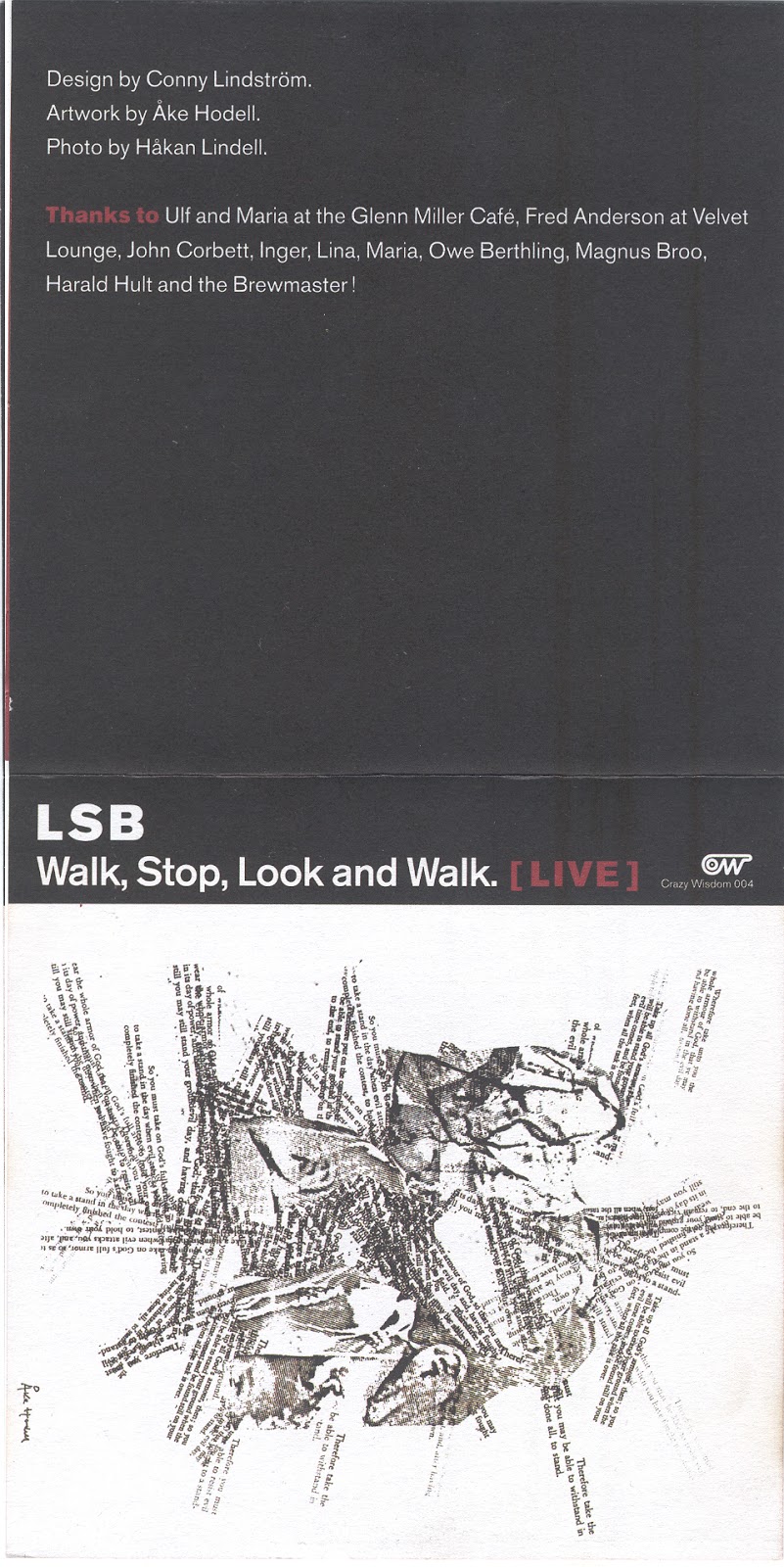
LSB (Ljungkvist·Strid·Berthling) - Walk, Stop, Look and Walk (Live) 2000


Originally formed in the late 1990s and composed of Fredrik Ljungkvist (saxophone and clarinet), Johan Berthling (bass) and Raymond Strid (drums), LSB is one of the longest lasting and most creative Swedish jazz bands. The third album of this much sought-after super group is set for release in 2015, promising more of their highly pleasing formula: melodic and swinging free jazz, full of intensity, excess, virtuoso musicianship and a huge dose of irreverence. This is not a nostalgic form of music; instead, it is contemporary and open to other influences, markedly European and always innovative.


LSB

Fredrik Ljungkvist (tenor & baritone sax, clarinet)
Johan Berthling (bass)
Raymond Strid (drums)

1. Ebony Swing
2. Walk, Stop, Look And Walk
3. Kurt
4. Kyrkitten
5. Leather Soul Walk
6. Different Directions
7. Natti-natti

BUY THIS ALBUM!!!

Courtesy of PEPE (Many Thanks)

Francesca Han & Alex Sipiagin - Dream Episodes (Live) 2016 Edition


Recorded February 14, 2014 at Olympus Hall, Seoul / February 15, 2014 at Audioguy Studio, Seoul

Mix and mastered at Audioguy Studio in Seoul


Francesca Han : Piano
Alex Sipiagin : Trumpet

Microphones
AEA R44C (for Trumpet)
Scheops MK4 (pair for Piano)

Recording System : Merging Horus (DXD format)
Monitoring System : KISO ACOUSTICS HB-X1

1. Orbit (Unless It's You)
2. Stepping Zone
3. Luiza
4. Videlles
5. I Can't Get Started (With You)
6. Tenor Madness
7. My Funny Valentine


Domi

Monday, January 18, 2016

Living Coltrane - Writing 4 Trane (2015)


Questo e` il terzo album della saga di Living Coltrane, un gruppo nato per testimoniare la passione dei suoi membri per il mondo musicale di John Coltrane, e se i primi due Cd erano interamente dedicati a brani del repertorio del grande maestro afroamericano, senza alcuna volonta` di realizzare un progetto iper concettual ene´, tantomeno, un tributo, ma con il semplice desiderio di suonare quella musica con tutta la freschezza, l’entusiasmo e la bravura possibili, quest’ultima produzione segna una svolta significativa. Il quartetto propone infatti soltanto composizioni originali di Cantini e Maccianti, scritte certamente pensando a Coltrane e a un momento particolare della sua complessa vicenda artistica, ma senza perdere di vista le peculiarita` del modo di comporre dei due autori. Qui si scrive “per” Coltrane, non “come” Coltrane, anche se la fonte di ispirazione dei brani e` certo legata al suo universo espressivo e alla sua lezione sul modo di “comporre per la performance”. 

Cosi`, pur nell’originalita` del tratto, possono emergere relazioni con il dedicatario svelate da qualche frammento di tema, oppure nel climax stesso di una musica dove troviamo la memoria di Coltrane vivificata da un quartetto di grande esperienza e affiatamento. Naturalmente un’operazione di questo tipo richiedeva di affrontare il momento poetico di Coltrane piu` vicino alla sensibilita` dei musicisti di questo quartetto e l’impressione e` che, per sposare il senso melodico e la sottile tensione espressiva che pervade il gruppo, la scelta sia caduta sul Coltrane dell’ultima fase del sodalizio con Tyner, Garrison e Jones, in particolare su quelle opere, riflessive e spirituali, che il Maestro ha inciso verso la fine del 1964, come la troppo poco considerata Crescent e la celeberrima A Love Supreme. Cosi`, l’ascolto di Mr.Kay Double You sembra riferirsi a Resolution, secondo movimento di A Love Supreme, con una cellula tematica che funge da incipit per il luminoso crescendo delle improvvisazioni, laddove il pedale che sorregge il ritmo afrolatino di Rush rimanda proprio all’apertura dello stesso album.


Del resto, in Cantini troviamo forse una piu` diretta aderenza alla poetica coltraniana e riferimenti meno impliciti alle sue composizioni e interpretazioni, a partire dal ricordo dell’improvvisazione di My Favorite Things nelle sinuose e ipnotiche spirali del sax soprano in Aria di mare, dalla melodia di carattere mediterraneo cosi` tipica del tratto compositivo del suo autore, che ritroviamo in un altro brano dal tempo lento come Julius Reubke (pianista e compositore tedesco morto a 24 anni e allievo, tra i prediletti, di Liszt), la cui insinuante melodia comunica una profonda serenita` spirituale. E, ancora,

nel tema meloritimico di Uscita a est, che riprende una pratica del Coltrane compositore, cioe` la capacita` di costruire temi molto caratterizzati e dalla funzione eminentemente ritmica. Simile, ma con significative differenze, lo stile di scrittura di Francesco Maccianti, che da pianista non ha sperimentato concretamente l’approccio sassofonistico al mondo coltraniano affrontato da Cantini, sottraendosi anche a un influsso troppo diretto con quello di Tyner, anzi assimilandone la lezione all’interno di una intereressante simbiosi tra tonalismo e modalismo. Cio` nonostante, anche i suoi brani assorbono comunque la poetica riflessiva del Coltrane immediatamente precedente alla fase allucinata e mistica che verra` inaugurata con Ascension. Per questo il clima e la struttura blues (o, meglio, bluesy) di Seeds, riflette una chiarezza narrativa priva di qualsiasi tensione, laddove Batch-Hombres propone una rilassata dimensione collettiva nella distribuzione dei ruoli, con l’ambiguita` poliritmica che fa circolare la musica tra i vari strumenti, mentre Sunset presenta una melodia penetrante e di non facile decifrazione, ma sempre legata a una situazione espressiva fortemente rilassata e meditativa. Se il pianista e il sassofonista sono l’anima del progetto, che stavolta si trasforma in un vero e proprio concept album, il quartetto e` pero` un organismo unitario, che respira all’unisono e condivide globalmente lo spirito della musica.

La batteria di Piero Borri presenta la danzante e poliritmica elaborazione del beat, sempre implicitato, mai direttamente espresso, che fa parte del lascito di Elvin Jones, a cui si aggiunge una concezione melodica nel trattamento del ritmo che ce lo fa avvertire piu` vicino alla nostra sensibilita` odierna. Il contrabbasso dal suono definito quanto profondo di Ares Tavolazzi evita di fare unicamente da ancora, da piedistallo granitico delle strutture, per addentrarsi sin nelle trame piu` interne della musica, che poi e` l’essenza stessa dell’interplay, pur senza mancare di fornire quel sostegno che in meccanismi di questo tipo, legati a un incessante work-in-progress, si rivela imprescindibile. Cosi`, lo sguardo a Coltrane, quindi a un preciso periodo storico del jazz, e` qui tanto piu` efficace quanto meno si dimostra legato alle prassi e, molto di piu`, alle conseguenze possibili di quella esperienza, che viene trasformata dalla sensibilita` e dalle nuove linee espressive dei jazzisti del nostro tempo. Maurizio Franco

Stefano Cocco Cantini: sax
Francesco Maccianti: piano
Ares Tavolazzi: double bass
Piero Borri: drums

1,4,5,6,7 composed by Stefano Cantini 2,3,8 composed by Francesco Maccianti

1 Rush
2 Sunset
3 Batch-Hombres
4 Julius Reubke
5 Mr Kay double you
6 Aria di mare
7 Uscita ad est
8 Seeds


Domi

Dmitry Baevsky - Somethin' Special (2016)


The only child of a writer and a translater, Dmitry was born in St Petersburg, Russia. Baevsky started piano lessons at the age of six and discovered his passion and seriousness for music as a teenager when he picked up an alto saxophone. Although he was not surrounded by professional musicians, his family was closely connected to music. His great grand-father, Moisei Beregovsky, was one of the most famous and respected Jewish ethnomusicologists who spent his life gathering melodies and words of Yiddish folk songs, as well as Eastern European Jewish dance melodies (klezmer music).

In 1991, he entered the Mussorgsky College of Music in St-Petersburg where he studied with the brilliant Russian jazz saxophonist Gennady Goldstein for four years. Throughout the nineties, he appeared in many jazz venues and international festivals throughout Russia.

 Upon his arrival in New York at age 19, he was accepted into the Jazz Department at the New School University on a full scholarship. After finishing college, Baevsky remained busy working within the New York jazz community and has performed and/or recorded with musicians such as Benny Green, Peter Washington, Willie Jones III, David Hazeltine, “Killer” Ray Appleton, Peter Bernstein, Cedar Walton, Dennis Irwin, Jeremy Pelt, Steve Williams, Joe Magnarelli, Ryan Kisor…

In 2005, he released his first CD as a leader “Introducing Dmitry Baevsky” (Lineage Records). The album features such masters as Cedar Walton and Jimmy Cobb, along with Ilya Lushtak on guitar and John Webber on bass.

In 2009, Dmitry recorded “Some Other Spring” (Rideau Rouge / Harmonia Mundi) while on tour in Europe with the guitarist Joe Cohn.

In September 2010, the label Sharp Nine Records released “Down With It”, an album featuring trumpet player Jeremy Pelt as well as Jeb Patton (p), David Wong (b) and Jason Brown (dr). The recording stayed more than four months in the Jazzweek charts (a weekly report of the top fifty Jazz recordings played on radio stations across the United States and Canada).

Baevsky's second release on Sharp Nine Records, called “The Composers”, came out in 2012 and features David Hazeltine on piano, John Webber on bass, Jason Brown on drums and the great guitarist Peter Bernstein on three tracks.

2015 marks his debut on Jazz Family label with “Over and Out”, a trio album recorded with bassist David Wong and drummer Joe Strasser.

Dmitry Baevsky (as)
Fabio Miano (p)
Ignasi González (b)
Joe Strasser (ds)

1. Somethin' Special (feat. Fabio Miano, Ignasi González & Joe Strasser)  
2. Fools Rush In (feat. Fabio Miano, Ignasi González & Joe Strasser)  
3. Cheesecake (feat. Fabio Miano, Ignasi González & Joe Strasser)  
4. Lament (feat. Fabio Miano, Ignasi González & Joe Strasser)  
5. Eclypso (feat. Fabio Miano, Ignasi González & Joe Strasser)  
6. The End of a Love Affair (feat. Fabio Miano, Ignasi González & Joe Strasser)  
7. I Thought About You (feat. Fabio Miano, Ignasi González & Joe Strasser)


Domi

Dmitry Baevsky - Over and Out (2015)


You can hear it loud and clear in his music: Dmitry Baevsky is here!  The Russian born alto saxophonist has made quite a name for himself since immigrating to New York from his St. Petersburg birthplace nearly twenty years ago.  Now a charter member of the world jazz community, Baevsky has proven himself to be a formidable force to be reckoned with, confirming his prodigious abilities in countless appearances with some of the music’s greatest artists. From his very first recording with NEA Jazz Masters Cedar Walton and Jimmy Cobb the altoist has shown himself to be an important new voice on his instrument.  Possessing a robust sound, acute harmonic mind and keen sense of rhythm, the young horn man puts it all together in a manner that is appealing in its lyricism, yet intriguing in its originality.

On his four previous efforts as a leader Baevsky has appeared in the traditional jazz quartet/quintet configuration.  On this fifth outing he has chosen to expose his talent to the greater scrutiny of the trio format.  He explains, “A trio setting is just different. It makes me go places rhythmically, harmonically and melodically, that I might not go otherwise … it boosts creativity, and at its best the outcome can be rewarding to both the musicians and the listeners. The sound is so much more open, airy and even fragile. In a way it’s a dangerous place to be in; it puts more light on everyone, but if the musicians are good it’s a great way of showcasing their abilities that otherwise might be overlooked.” 

The impressive skills of both bassist David Wong and drummer Joe Strasser are indeed on full display here.  Baevsky notes, “I am very fortunate to know, play with and even be friends with these two guys. Their credentials speak for themselves, but I would like to add that they provide me with exactly what I need – real, super strong “New York” energy and sound, uncompromising swing and the willingness to support the soloist at the maximum capacity without sacrificing their identity. They’re real pros on the highest level possible, who also happen to be wonderful human beings that I can trust completely -- which is uber important. It’s like climbing a mountain – you have to have the complete trust and support of your team.”


The music Baevsky has chosen to spotlight the cohesive talents of the trio clearly reveals the depth of his broad knowledge of the jazz canon.  He notes, “The repertoire is really important to me. I don’t choose songs because of some specific “significance” or “meaning” they have for me. I simply look for the best possible vehicles to improvise on; songs that have interesting harmonic, rhythmic and melodic things going on. Ones that will sound great, that will be appealing to both the audience and the band. And last but not least, that will inspire me.” Somewhat ironically, the songs the saxophonist has chosen to perform on this pianoless excursion are for the most part composed by or associated with some of jazz’s greatest masters of the keyboard.

The towering evergreen “Poinciana” that begins the date was of course popularized in jazz circles by pianist Ahmad Jamal’s classic rendition recorded Live at the Pershing. Ray Bryant’s soulful “Reflection” is best known for Phineas Newborn’s interpretation on the Roy Haynes album We Three.  Monk and Duke are represented by the former’s “Brilliant Corners” and the latter’s “The Feeling Of Jazz” and “Tonight I Shall Sleep (With A Smile On My Face).”  “Turquoise” is by the recently departed Cedar Walton (with whom Baevsky recorded and shared the bandstand for a week at Chicago’s Jazz Showcase). Walton’s spirit is also present on “Circus,” which was first widely heard on the Impulse album Art Blakey and the Jazz Messengers! that featured the great pianist.

Baevsky even dedicates one of his three originals on the date to a pianist.  He says, “ ‘Silver Screen’ is sort of a tribute to Horace Silver, thus the title. I just wanted to write something in that tempo - in between slow and medium - and Horace always wrote great things for this tempo. Sort of like his ‘Strollin’.” Dmitry describes his own “In the Know” as “a slightly different type of a tune.” He explains, “It has a lot of changes going by, which is something that I like to deal with and it has a rather unusual bridge, harmonically speaking.” Of the date’s title track the saxophonist declares, “I wanted to have something fast, but not too crazy fast, to play. I was looking for the right material, but nothing was quite clicking. At some point I came up with a simple melody that stuck with me and after a while I wrote a slightly more involved bridge. The song is rather standard in its nature and makes it a fun number to blow on.” 

The disc closes with the standard “Stranger In Paradise.”  Baevsky confesses, “The melody is inspired by Russian composer Borodin’s piece - so in a way it is a semi-hidden nod towards the place I come from….”  When he first came to New York, Dmitry Baevsky (like most musicians from another part of the world) probably felt like a “stranger in paradise.”  Today he’s no longer a stranger, but an integral part of the jazz capital of the world’s inspiring scene.  You can hear why here.  His message is clear.  Over and out.


DMITRY BAEVSKY – alto sax
DAVID WONG – bass
JOE STRASSER – drums

01. Poinciana (Nat Simon)
02. Reflection (Ray Bryant)
03. Over and Out (Dmitry Baevsky)
04. Chega de Saudade (Antonio Carlos Jobim)
05. Brilliant Corners (Thelonious Monk)
06. The Feeling of Jazz (Duke Ellington)
07. In the Know (Dmitry Baevsky)
08. Turquoise (Cedar Walton)
09. Tonight I Shall Sleep (With a Smile on My Face) (Duke Ellington)
10. Circus (Louis Alter)
11. Silver Screen (Dmitry Baevsky)
12. Stranger in Paradise (R. Wright & G. Forrest)


Domi

Danilo Pérez / John Patitucci / Brian Blade - Children of the Light (2015)


Danilo Pérez, John Patitucci and Brian Blade have been three quarters of the extraordinary Wayne Shorter Quartet for more than a decade. Since, they’ve also continued their individual careers as leaders of their own projects and groups. Now, on Children of the Light, they step forward as a trio for the first time with an imagination and fearlessness in their approach that defies the roles and ways of a trio in both obvious and subtle ways. “When I gave Wayne a copy of the recording I told him: ‘this is for you, Doctor. This is our gift. This is our show of love, care and gratitude for all the lessons’,” says Pérez. “The compositions on this recording represent the idea of ’going beyond the music.’ That’s what he has taught us: to not think about music just in musical terms but as a tool for the betterment of society. It’s about creating music that brings people together.” Daring and luminous, often an improbable mix of pointed, questioning turns and childlike joy, the music unfolds with mischievous unpredictability.

The 11 tracks include original compositions by all three members of the trio and a fresh take on “Dolores,” an old Shorter classic. Pérez, who typically plays acoustic piano, plays a Yamaha CP4 Stage electric piano on his West African-rooted piece “Lumen.” Patitucci, who plays here acoustic, five and six-string electric bass, contributes three pieces, including “Ballad for a Noble Man,” which features cellist Sachi Patitucci. Drummer and percussionist Blade contributes the soulful “Within Everything,” perhaps the closest to a standard song in the program. It’s a remarkable balancing act but even as they put their considerable talents to the service of the trio, each of the members maintains his distinct personality. “We can ‘comprovise’ (spontaneous composition) with dense harmonic and melodic forms, but we can also explore the beauty of a simple harmony,” says Pérez. “And you can see the care each one of us put into the songs we brought in.” The pieces themselves don’t follow conventional song forms but rather suggest cinematic structures. Narratives do not always unfold linearly. Solos play out more like close-ups in the telling of the story than individual features.”For us, it was like writing the soundtracks of our own lives,” offers the pianist. “It was about using music to paint a scene, using the sounds to tell a story.” 

Children and light are two recurrent themes throughout the recording. The references to kids are not only explicit (such as the voices in Patitucci’s “Milky Way”) but also suggested by some of the themes, perhaps most evident in the playfulness of the motifs in the title track and “Sunburn and Mosquito” (dedicated to Carolina, one of Pérez’s daughters). “Wayne has taught us the magic of having a simple idea,” says Pérez. “Like in his ‘Over Shadow Hill Way’ (he sings the theme). In a way, I’m using my children as good judges for melodies. If they can sing it, if something sticks with them, I feel I’m on the right track.” As for the idea of light, it is most obviously present in the song titles (“Moonlight on Congo Square,” “Lumen,” “Looking for Light” and “Light Echo/Dolores” to name a few) but it is also evident in the approach and the choices of open, translucent textures the trio favors. “’Light Echo’ is just an introduction I put together and it’s named after a phenomenon in astronomy,” explains Pérez.


The light echo is analogous to an echo of sound. “It is the echo of a burst of light, like at the creation of a star, and it can go on for a long time. For us, it has to do with Wayne’s light echo and our hope of passing it on. We want to explore the galaxies together, but we also want to remain human and explore the earth.” As for the playing, it doesn’t take long to realize that this is not a conventional piano trio. Pérez, Patitucci and Blade first came together during the recording sessions for the Pérez’s Motherland in 2000, and their work with Shorter since has fostered not only their audacity and cohesion as a trio but also a distinct, shared language. “As a trio, we have found a way to orchestrate things differently, we overlap in a certain way that makes it feel like there are other instruments in there,” says Pérez. “One of the things I feel is so strong is how we function without Wayne, and yet he is there in spirit. As a group, we have a language we play and his notes are felt even when he’s not playing.” The pianist further comments, “We didn’t get together just to do a record. We’ve been writing music since we met, and Wayne has encouraged, supported, and guided us along the way.” Pérez elaborates, “John, Brian and I have a long history, and this is not just a record for us but a commitment to continue the Shorter school. 

We have developed a language we call ‘zero gravity,’ a way of interacting, of orchestrating the music that we want to continue exploring and developing. While we were putting this record together there was no pretension, no grandiose ideas. This was simply three brothers who just wanted to keep the family together.” The very name of the recording is a play on Shorter’s “Children of the Night,” a piece that first appeared on Art Blakey & The Jazz Messengers’ Mosaic in 1961. Years ago, while they were touring, “It was John who said ‘we should call it Children of the Light and bring a little light to the world’,” recalls Pérez. “You say ‘thank you’ to a great man like Wayne not by imitating what he does but by playing off the language he created —finding a new language in the process. Like Wayne says: ‘This is the new sound of the trio. You guys are touching another dimension’.”

Danilo Pérez, piano
John Patitucci, bass
Brian Blade, drums

01. Children of the Light
02. Sunburn and Mosquito
03. Moonlight on Congo Square
04. Lumen
05. Within Everything
06. Milky Way
07. Light Echo/Dolores
08. Ballad for a Noble Man (In Memory of Doug Sommer)
09. Looking for Light
10. Luz del Alma
11. African Wave


Domi

Quintorigo & Roberto Gatto - Around Zappa (2015)


A sincere, philological and experimental thanksgiving to Frank Zappa. Not merely a tribute concert or live-concept. A monographic work, accurate in its theatrical and scenographic details, an entertaining opportunity for everybody to know and rediscover Zappa’s universe.

It’s impossible to sum up briefly the countless influences in Zappa’s music, just as so many are the musicians who adopted (sometimes unconsciously) something precious from him. Among these are Quintorigo.


Critics had already found in Quintorigo’s music an evident Zappianic code almost as a priori and obsessive forma mentis. The show is also an emotional and instinctive performance, an exquisite and tasty selection from Zappa’s works which will lead us to gorge on his discography, stodgy dishes included.

Working on Zappa’s music has always been a project in embryo. Thanks to Roberto Gatto all this came true. Gatto, outstanding star of Italian and international jazz with renowned career, since forever harboring an unrestrained passion for Zappa, invited Quintorigo to bring about this beautiful idea together. Thankful and eager the band accepted. Coming out soon the album “Around Zappa”.


The cd playlist begins with instrumentals such as Uncle Meat and Peaches En Regalia. Moris Pradella joins the band singing Cosmik Debris, Don’t Eat The Yellow Snow, Lucille Has Messed My Mind Up, King Kong, Big Swifty, Igor’s Boogie, Village Of The Sun. The beautiful Uncle Remus is introduced by the violin of Andrea Costa while Gionata Costa at the cello leads the melanchonic Black Napkins, making good use of effects to convey the charisma of an electric guitar enriched by the expressiveness of the cello. And an end with a bang, playing Echidna’s Arf (Of You) e Zomby Woof.

Quintorigo and Roberto Gatto approach Zappa with refined arrangements still respecting the essence of the original songs, reread with personal sounds, exquisite textures and unrestrained experimental trend, mark of Quintorigo since their beginning. With Roberto Gatto, Quintorigo prove once again themselves distinguished musicians, gaining without reserve the passionate audience’s approval. “Around Zappa” is not to be missed by Zappa’s fans and recommended for everyone.

Valentino Bianchi: saxophones
Andrea Costa: violin
Stefano Ricci: double bass
Gionata Costa: cello
Roberto Gatto: drums
Moris Pradella: vocals

1. Uncle Meat
2. Peaches en Regalia
3. Cosmik Debris
4. Montana
5. Lucille Has Messed My Mind Up
6. King Kong
7. Don’t Eat the Yellow Snow
8. Uncle Remus
9. Big Swifty
10. Igor’s Boogie
11. Black Napkins
12. Village of the Sun
13. Echidna’s Arf (Of You)
14. Zomby Woof

Arrangements:
Stefano Ricci: 1, 10
Quintorigo & Roberto Gatto: 2, 3, 5, 7, 9, 11, 12, 14
Roberto Gatto: 4, 13
Valentino Bianchi: 6, 8


Domi