Wednesday, March 15, 2017

Ensemble Art Sonic - Le Bal perdu (2017)


Le p’tit bal perdu : qui ne la connaît, cette valse douce-amère chantée par Bourvil.
C'est parti pour une heure de valses musettes fort bien ar­rangées pour quintet à vent et accordéon.
Une ambiance de place de village, un air de féte ! 

Non je ne me souviens plus
du nom du bal perdu.
Ce dont je me souviens
c'est qu'ils étaient heureux
Les yeux au fond des yeux.
Et c'était bien...


Le Bal perdu

On sait compter les temps d’une valse, Jacques Brel le faisait très bien. En général, on s’arrête à trois. Mais sans pour autant bâcler le travail, ni le faire en deux temps – trois mouvements, l’Ensemble Art Sonic propose à six, les dix-huit titres que voici. Trois temps, six musiciens, dix-huit titres. Le compte est bon !

Qu’on soit de Paname, de Nogent ou d’ailleurs, ces valses musettes-là, on les connaît sur le bout des pieds.

Après un premier album « Cinque Terre », composé de musique originale, picturale parfois et minimaliste dans l’ensemble, puis « L’Orchestre éphémère », nomenclature unique au monde (Art Sonic augmenté d’un clavecin, d’un célesta, d’une harpe, d’un Cristal Baschet et de percussions métalliques et aquatiques), les cinq soufflants du quintette revisitent avec humour et déhanché la nostalgie d’un temps qu’ils n’ont pas connu à travers un répertoire de valses et de ritournelles que toute personne vivant en France a entendu, connu et reconnu. 

Et ce n’est pas parce que Art Sonic est un quintette à vent contemporain qu’il ne peut pas faire tourner les têtes et flamber les montalbanaises. Ce n’est pas parce que Didier Ithursarry, invité sur cet album, déplie son accordéon dans des contextes plus aventureux, qu’il ne peut pas prétendre ici assumer l’héritage de Gus Viseur, Jo Privat et de tous les pianistes à bretelles de l’hexagone.

D’ailleurs, que trouve-t-on vraiment dans ce disque ? Outre ces grands compositeurs de musique populaire que sont Privat, Viseur, Louis Ferrari ou Emile Carrara, on peut tout aussi bien pointer les compositions de Serge Gainsbourg, Django Reinhardt, Marc Perrone, Aldo Romano, Bourvil ou Boris Vian. La figure centrale de Jo Privat a été le déclencheur du projet pour le flûtiste Joce Mienniel. Il s’est penché sur ses valses, ses javas en proposant des arrangements suffisamment solides pour être interprétés au basson, au cor ou au hautbois. Le clarinettiste Sylvain Rifflet et le corniste Baptiste Germser ont également proposé quelques arrangements de leur plume. De tout ce travail, découle la création d’un nouveau matériau musical qui, de par l’orchestration choisie, donne ses lettres de noblesse à cette musique de bal populaire.

Que ces chansons éternelles servent de trame au répertoire du nouveau disque d’Art Sonic ne choquera personne, comme écouter la finesse des arrangements aériens – ici, tous les instruments respirent - ou apprécier la tension décontractée qui tient l’édifice. Et c’est aussi rendre justice à ces compositeurs d’antan que de magnifier leurs chansons.

La valse qui constituent l’essence même de la musique « française » aux yeux du reste du monde, est construite dans la musette généralement en trois parties : un thème (comptez 32 mesures en moyenne), un pont (mettez-y 16 mesures) et un trio (souvent majeur et lumineux). Le thème, c’est ce que tout le monde chante. Le pont, c’est quand l’accordéoniste joue vite et d’une manière acrobatique. Et le trio, c’est le moment de l’enchantement sur la piste de danse. Alors, ces chansons, Joce Mienniel et Sylvain Rifflet, les ont choisis pour toutes ces raisons. Lentes ou rapides, gaies ou tristes, mais toujours belles et nostalgiques.

François Billard et Didier Roussin disait des valses de Jo Privat qu’elles étaient « d’une grande richesse harmonique et nées d’un métissage des accords traditionnels de la valse musette et de la musique tzigane, science transmise par les guitaristes rabouins de l’époque. Exigeant une grande technique, elles présentent pourtant un caractère de totale évidence aux oreilles d’un non-initié. Leur complexité ne nuit en rien à la danse, pas davantage à l’expression mélodique. Ce sont les valses les plus poétiques du genre. » Et c’est vrai que chez Jo Privat, l’inspiration est grande. Il n’y a qu’à écouter ses formes-Trios pour y déceler une élégance rare.

Il n’est pas perdu pour tout le monde, ce petit Bal.

01. Ouverture 0:29
02. La Javanaise 2:27
03. C'était bien... au petit bal perdu 3:57
04. Java des bombes atomiques 2:27
05. De dame et d'homme 4:07
06. Montagne Sainte-Geneviève 3:44
07. Papillons noirs 3:12
08. Quatre cents coups 4:29
09. Allez, glissez / Allez ! Roulez 4:55
10. Ballade irlandaise 3:51
11. Les bluets 0:28
12. Avalanche 3:06
13. Flambée montalbanaise 3:16
14. Coup de fil 2:50
15. Reine de musette 1:49
16. Il camino 3:38
17. Valsajo 3:06
18. Volubilis 3:33


I Just Came From The Moon - Hoax (JAEGER COMMUNITY MUSIC 2017)


I Just Came From The Moon has homogeneous and highly personal expression. The music ranges from the very intimate and fragile, to the all-embracing and challenging where the strong solo performances and compositions invite the listener to an organic and lyrical universe.

Hoax is the result of an intensive six months where the band has played concerts in most Denmarñ and achieved a unique sound that embraces and extends bassits Frederik Hagner's compositions.

The music is an expression of a collective musical flow that covers everything from country ballads to ostinato-based improvisation.

The album is released digitally and on 12" vinyl and enclosed by Kasper Knudsen's intense painting.

1. Med Rumraket til Rundhøj 8:59
2. Wonderful Ryan 6:19
3. Munken 4:41
4. Goodnight Kerberos 3:52
5. Ugler I Mosen 8:12
6. Februar 5:32
7. Weeping Hedgehog 1:43

Jonas Scheffer, trumpet
Nis Hellerøe Myrtue, tenor sax
Nikolaj Bugge, guitar
Frederik Hagner, bass
Tobias Andreasen, drums


Krokofant - Krokofant III (RUNE GRAMMOFON 2017)


Krokofant typify a new and invigorating movement currently sweeping across the Nordic region: hard boiled improvisation and strong instrumental personalities bolted onto rock beats and driving rhythms. Equally powerful on record and on stage, Krokofant pull no punches, sounding off like some unholy three-way marriage of early 70s jazz rock (Mahavishnu Orchestra, Terje Rypdal), the sprawling progressive odysseys of King Crimson and Van Der Graaf Generator, and the fierce heat of John Zorn or Peter Brötzmann’s harsh free jazz ensembles. If their 2014 debut album was a fresh breath of youthful energy, the follow-up showed a trio more confident of their abilities after extended live work. Their third album in just three years follows in this tradition, with Mathisen´s fat syntheziser tones adding a new colour to the soundscape. They still ally a strong discipline with wide, exploratory arcs, Tom’s agile guitar and Jørgen’s snaking sax fighting to break out, just held in check by Axel’s tough, rhythmic tumble. Only 23 years old, the young drummer is something of a sensation, combining pure energy with superior technical skills. This is a trio where you can hear the individuals pushing each other to new hights while keeping the solid group foundation intact.

1. Tommy Synth (8:23)
2. Clazz (6:55)
3. Juice (6:44)
4. Double Dad (7:02)
5. Wrong Turn (10:19)

Tom Hasslan / guitars
Jørgen Mathisen / saxophone, synths
Axel Skalstad / drums


Formula Bruta - Masse Molecolari (ANGAPP MUSIC 2017)

L’idea musicale dell’EP, e del progetto in generale, è quella di creare un “bilanciamento stechiometrico” fra scrittura e improvvisazione, fra tradizione e innovazione, dando particolare attenzione ai colori, ai timbri e quindi ovviamente all’orchestrazione dei brani, il tutto contenuto nell’involucro del jazz, nelle sue varie forme o non-forme. L’idea strutturale dell’EP è quella di considerare ogni pezzo come un “pianeta” o una “molecola” a parte (idea simile a quella di Holst nei Planets) ognuno con il suo mood, i suoi suoni, il suo ritmo, e così via. In particolare, il primo brano è ispirato dallo sport e dall’agonismo (dalle corse automobilistiche ecc..), il secondo è un blues dal carattere solenne e marziale, il terzo è una sorta di danza macabra la cui struttura si rifà ad un bolero, il quarto è una simil-suite ispirato alla tradizione bandistica, sia le bande funebri che quelle festive, il quinto è un valzer etereo e seducente, il sesto è una ellingtoniana giungla di suoni.

Il sestetto “Formula Bruta” nasce dalla collaborazione di sei musicisti pugliesi che ricercano nella diversità culturale ed intellettuale una formula per creare nuove alchimie sonore. La formula bruta di una molecola è quella che fornisce informazioni esclusivamente sul numero e sul tipo di atomi che la costituiscono senza mostrare il modo in cui gli elementi sono legati tra loro. Allo stesso modo il sestetto Formula Bruta combina tra loro i vari elementi musicali in maniera imprevedibile creando i materiali sonori più disparati: dai groove inquietanti alle atmosfere più estatiche, dalle melodie swing dal sapore psichedelico alle astrazioni bop più trascinanti. Ogni singolo componente dei Formula Bruta attinge a diversi substrati sonori come quelli del jazz, del rock e dell’elettronica e, attraverso la manipolazione della materia musicale e l’interazione con gli altri, genera una nuova sostanza musicale del tutto originale. Il progetto nasce sul tramontare del 2015 e concretizza nei primi mesi del 2016 le idee che daranno vita al primo lavoro ufficiale.

The "Formula Bruta" Sextet was born in 2015, in the rooms of the "Nino Rota" Conservatory, in Monopoli (Bari), from the collaboration of six Apulian musicians, who believe in cultural and intellectual heterogenity as a "formula" to create new sound alchemy. In chemistry "formula bruta" (raw formula) is the one that gives informations only about the number and the type of atoms that made the molecule, without showing the way elements are interrelated among themselves.

In the same way the "Formula Bruta" Sextet combines musical elements, often in an unpredictable way, creating an extensive assortment of musical material: from disturbing grooves to more extatic atmospheres, from swingy-psychedelic melodies to bop abstractions and so on. Every single member takes inspiration from a vast background of musical ideas, like the sounds of Jazz, Rock, Electronic music, and with the manipulation of the musical matter and with the interaction with the others, a new original musical substance is synthesized.

1. Falsa partenza 2:56
2. Sirenomelia 8:29
3. Can't Remember 7:51
4. Mister FM 11:56
5. Revolving Dream 5:20
6. Swinging Monkeys 7:30


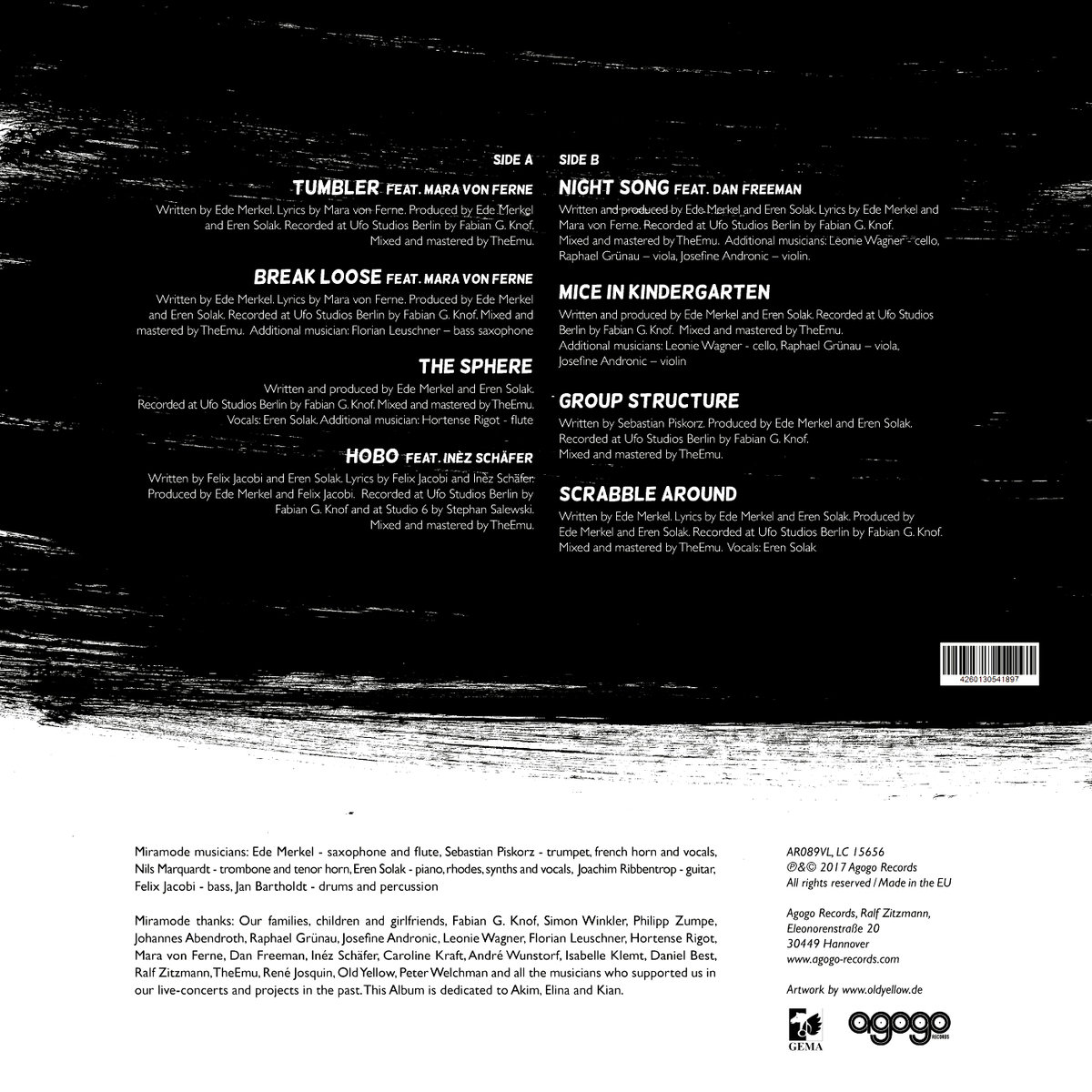
Miramode Orchestra - Tumbler (AGOGO RECORDS 2017)


A good concert is like a journey. When it starts you might not know what episodes await you, but in your heart you can feel which direction it will take you in. The Miramode Orchestra offers just this type of enriching, exhilarating experience. Although they meander between coordinates including jazz, electronica and groove, the seven musicians can never be tied down to a single musical location.

The sound created by a four-man rhythm section and three horn players is always flavoured by a certain ambition, but never fails to let souls fly and get bodies sweating!

Their debut album “Restless City” announced the band as fans of both exploration and experimentation. Why break down barriers when you can simply soar over them – after all, they only exist in the mind.


It is therefore no surprise that collaborations have already included not only a range of artists more at home in genres such as hip hop, soul and modern club culture, but also a string ensemble.

The latter returned to the studio for the band’s forthcoming album “Tumbler”, which is set for release in early 2017 on Agogo Records. There is a noticeable shift towards more song-like structures: The vocals of Inèz Schäfer, Dan Freeman, Mara von Ferne and the band’s keyboard player Eren Solak are taking Tumbler to another level.

At times it is difficult not to hear a touch of Bon Iver, 4hero or Cinematic Orchestra. Yet just as listeners are ready to slot a song into a pigeonhole, the Miramode Orchestra whisks them away to a new, unexpected stop on their journey.


LABtrio - Nature City (OUTHERE MUSIC 2017)

LABtrio talking about its new project: ‘For our latest album we explored the world of chamber music, with a lot of elaborated compositions and extensive improvisations. This time, we are fi guring out who we have become after ten years of LABtrio. Over the years, we have built a varied repertoire and a uniqueness we want to stress with our new album. The challenge is to expand and dig in our identity and our story as a trio, as well as to breathe new life into it.’


To accomplish this, Lander, Anneleen and Bram look for lyricism and drive, melodies and beats, that project LABtrio. Inspired by different musical genres, ranging from classical music to pop and electronics, they selected their favourite ‘non-guilty pleasures’.

When all these ingredients come together, one can expect a third album that will be a range of new collectively composed works and older never-heard compositions, recycled and refreshed by the band members, combined with some covers, on which the musicians wanted to leave their own mark.


Playlist for Tom Ossana – The Thin Edge – March 15, 2017 MST 7:00 to 9:00p.m.


http://www.kzmu.org/listen.m3u ~ Use this link to access the show online.