Showing posts with label Amir ElSaffar. Show all posts

Monday, September 13, 2021

Amir ElSaffar - Rivers of Sound: The Other Shore (September 2021)

Amir ElSaffar – who leads five ensembles and has released seven albums over the past 16 years – has earned acclaim for being, in the words of All About Jazz, “a virtuoso on the horn, but also an imaginative bandleader, expanding the vocabulary of the trumpet and, at the same time, the modern jazz ensemble.” The Wire has described ElSaffar as “uniquely poised to reconcile jazz and Arabic music… with eloquence.” The Chicago Tribune hailed the way his “melismatic trumpet lines convey tremendous lyric beauty,” adding that his transcultural innovations place him “among the most promising figures in jazz today.” ElSaffar – a 43-year-old Chicago native of Iraqi-American heritage – now presents The Other Shore, his eighth album and the second by his 17-piece Rivers of Sound orchestra. This moving, sonically kaleidoscopic album features an all-star lineup of players on instruments from East and West, with the performers improvising on the leader’s piquant, serpentine compositions: from the evocative curtain-raiser “Dhuha” (Dawn) to the ravishing “Medmi” (Epilogue). Belgium’s Outnote Records/Outhere Music releases The Other Shore, digitally and on CD, on September 10, 2021.

In the liner notes to The Other Shore, ElSaffar explains the concept for his large ensemble: “I formed the Rivers of Sound orchestra in 2015 as a musical, cultural and social experiment. The idea was to discover new ways of organizing sound without the hierarchical notions found in Western European art music (composer > conductor > players) and without the burden of precedence found in non-Western folk or traditional forms (relying on the past), but still maintaining a sense of structure and cohesion. I was interested in blurring spaces between improvisation and composition, between composer and players. The process relies on spontaneous group interaction, where each musician has agency as part of the creative process… Rivers of Sound is one of the most joyful musical experiences I have ever been a part of.”

Along with his fluid trumpet playing, ElSaffar sings vocalese in the Arabic maqam idiom and plays the santur, the Iraqi hammered dulcimer (including a beautiful extended solo in “Concentric”). The other members of Rivers of Sound are “family and friends who are like family.” These include his sister, Dena ElSaffar, on violin, viola and joza (the Iraqi spike-fiddle), and her husband, Tim Moore, on Arabic percussion. JD Parran, who plays bass saxophone and clarinet, performed alongside ElSaffar in Cecil Taylor’s large ensemble. Mohamed Saleh, who plays oboe and English horn, worked with him in Daniel Barenboim’s East-West Divan Orchestra. ElSaffar played in high school and college with vibraphonist Jason Adasiewicz, and alto saxophonist Fabrizio Cassol took ElSaffar on his first tour of Europe. Then there are the top jazz improvisers whom ElSaffar met through “serendipitous connections” on the New York scene: guitarist Miles Okazaki, drummer Nasheet Waits, saxophonist Ole Mathisen, pianist John Escreet, bassist Carlo DeRosa. The ensemble also includes Naseem Alatrash on cello, Rajna Swaminathan on the Indian mridangam, George Ziadeh and Zafer Tawil on the Arabic oud, and Tareq Abboushi on buzuq.
“I’m less interested in the surface intermingling of cultures and more fascinated by the new sonic possibilities in this unique combination of instruments from around the world,” ElSaffar says. “What happens when you combine the vibraphone, the santur and the English horn? The rich overtones mix to create fresh textures and sonorities, a new sound whether it’s scintillating or deep and resonant. But it’s not just the instruments but also the way these particular musicians play those instruments. What makes all the musicians in Rivers of Sound special is their versatility and openness to listening to each other, not being bound to any one style but rather bending with the music. We made our first album, Not Two, amazingly quickly, but after that experience and tours of the Middle East, Europe and the U.S., Rivers of Sound has evolved. Our chemistry has deepened, something you can hear in the fluent polyphony and play of microtonal harmonies on the new album, which I think is more ambitious than the first. The eight pieces are partially scored and partially improvised – so I rely on the players to help shape the music in the moment, bringing their own sounds and sensibilities to the compositions. They are what truly makes the alchemy of this music.”

In the liner notes, ElSaffar expands on both the technical and philosophical basis for Rivers of Sound: “The tonal basis of The Other Shore is the maqam – a system of microtonal heptatonic modes found in the Middle East, North Africa, Eastern and Southern Europe, and Central Asia. By using microtonal intervals, as opposed to the fixed pitches of the 12-tone equal temperament, the rigidness of forms melts away, allowing something new to emerge. The ensemble includes musicians from a broad spectrum of musical backgrounds and from different parts of the world. My desire is to expand beyond ideas of culture, in the sense of one style of music ‘belonging’ to a particular group of people or a society. Rivers of Sound proposes an alternative musical model by embracing a multitude of musical expressions, by focusing on the interactions between individual musicians. When we begin with an inherent sense of unity and interconnectedness, and think of musicians as individuals, not as representatives of a culture, there is no longer a need to ‘build bridges’.” 
Amir ElSaffar, photo by Hannah Devereux

1. Dhuha 12:50
2. Transformations 09:54
3. Reaching Upward 16:29
4. Ashaa 15:24
5. Concentric 05:11
6. Lightning Flash 08:53
7. March 06:00
8. Medmi 04:15

Jason Adasiewicz vibraphone
Tareq Abboushi, buzuq
Naseem Alatrash, cello
Fabrizio Cassol, alto saxophone
Carlo De Rosa, acoustic bass
Amir ElSaffar, trumpet, santur, vocal
Dena El Saffar, violin/joza
John Escreet, piano
Ole Mathisen, tenor saxophone, soprano saxophone
Tim Moore, dumbek, naqqarat, frame drums
Miles Okazaki, guitar
JD Parran, bass saxophone, clarinet
Mohamed Saleh, oboe, English horn
Rajna Swaminathan, mridangam
Zafer Tawil, oud, nay
Nasheet Waits, drums
George Ziadeh, oud

All compositions by Amir ElSaffar, ElSaffar Music (BMI)

Saturday, April 14, 2018

the Jamie Baum Septet + / Bridges (SUNNYSIDE RECORDS May 18, 2018)

Hailed by Downbeat for her “remarkable artistic facility” and by The New York Times for her “remarkable balance of fluidity and restless creativity,” New York-based flutist/composer and 2014 Guggenheim Fellow Jamie Baum is proud to announce the release of her sixth CD as a leader, Bridges, featuring The Jamie Baum Septet+. The highly anticipated follow-up to her 2013 recording In This Life, Bridges offers yet another recording of incredible depth, beauty, spirituality, undiluted zeal and is the culmination of Baum’s search for common links between some of the world’s great religious music traditions. While conducting research for her Guggenheim Fellowship Award, Baum explains, “I found there to be very deep connections going back centuries, between certain types of Jewish music (my earliest musical influences), and Muslim/Arabic and Hindu/South Asian music.” Exploring these musical connections, and composing new music inspired by her findings, became the focus of Bridges. 

Baum’s advanced harmonic sensibility and sonic imagination, beautifully brought to life by the stellar members of her long-running ensemble, proves yet again the capacity of modern jazz to absorb and transform music of diverse traditions, without sacrificing the improvisatory element at the core of jazz’s identity. In her album notes Baum cites Wikipedia’s definition of the word “bridge,” one that seems to sum up her artistic mission here: “a structure built to span physical obstacles without closing the way underneath.” At the same time, Baum’s musical wanderings highlight something even deeper: our shared humanity, and the common threads that run throughout our history. 


With great respect for these varied traditions and their vast languages, Baum’s goal was not to play or compose exactly in these styles, but to have her travels and playing experiences inspire new ways of writing and improvising. The diverse musicians who make up the Jamie Baum Septet+ are all first-call artists on the jazz scene, many of them accomplished leaders in their own right. Their presence gives Baum limitless compositional freedom and inspiration: “Having specific players to write for is a bandleader/composer’s dream and offers an incredible opportunity for experimentation and growth,” she says. We hear this borne out in the lyrical melodies, intricate contrapuntal passages and complex rhythmic ideas at the heart of Bridges, and in the textural warmth and surprise of Sam Sadigursky’s alto sax and bass clarinet, Brad Shepik’s guitar, Amir ElSaffar’s trumpet and voice, John Escreet’s dazzlingly virtuosic piano and of course Baum’s compelling improvisations on flute and alto flute throughout the album. 

Baum’s fascination with world sacred music traditions stemmed from her love of South Asian music and in particular for Nusrat Fateh Ali Khan, Pakistan’s late Qawwali vocal master. Her previous album In This Life was inspired by Khan’s legacy, because she “found in him what I have found in those musicians who have touched me, like Coltrane, Miles and Pavarotti…a truly gifted, deeply spiritual and soulful artist,” Baum writes in her album notes. Expanding her focus from Qawwali outward to other forms of religious music, Baum arrived at the focus of Bridges. 

Khan’s influence is also felt on “Joyful Lament,” derived from a melody of Khan’s called “Lament,” Baum explains. This piece was arranged with Shepik’s guitar in mind, and “his solo certainly exceeds anything I could have imagined,” Baum enthuses. 

In addition to her study of Khan, Baum’s travels to India and especially Jazzmandu, the Kathmandu Jazz Festival, in 2003 and again in 2009, widened her musical horizons immeasurably. The three-movement “Honoring Nepal: The Shiva Suite,” a centerpiece of Bridges, represents Baum’s wish to give back to a community that has given her so much. The piece was commissioned by the Rubin Museum of Himalayan Art in New York. “It was difficult to watch the pain and destruction the 2015 earthquake caused to the beautiful people and historic sites in Nepal, including musicians I knew and places I’d been,” Baum writes. “I knew I wanted to highlight and pay tribute in some way to this event and found inspiration in a painting of Shiva … a pan-Hindu deity revered widely by Hindus in India, Nepal and Sri Lanka. Shiva is the ‘destroyer of evil and the transformer’ within the Trimurti, the Hindu trinity that includes Brahma and Vishnu. Shiva is the Supreme Being who creates, protects and transforms the universe. Completely contradictory aspects of life have been built into the personality of Shiva…. A particular ‘thank you’ to my rhythm section [Escreet, bassist Zack Lober and drummer Jeff Hirshfield] for their drive, sensitivity and expertise in navigating and highlighting the changing colors, dynamics and intensity, giving so much meaning to the arc and intent of this suite!” 


The Nepali influence emerges again on “Mantra,” arranged by Baum with Nepali musician Navin Chettri, who plays tanpura and sings on the track. The tune is based on Mahamrityunjaya Mantra “meant for healing, rejuvenation and nurturance,” Baum writes. “According to Shiva Purana when you have fear of any unknown event this chant helps you to overcome the fear. The Shiva Purana is the highest science of elevating human nature to the very peak of consciousness, expressed in the form of very beautiful stories.” 

“From the Well” opens the album with the sound of a scale “common to Maqam, Jewish and South Asian music,” writes Baum. “Song Without Words,” a tribute to Baum’s late father, highlights the composer’s Jewish influence — in particular the Kol Nidre prayer so central to the holiday of Yom Kippur. “There Are No Words,” with its relaxed straight-eighth feel and beautiful chamber-like interplay within the ensemble, revisits the theme of loss as well. And the closing track, “Ucross Me,” was written during Baum’s residency at the UCross Artist Colony in Clearmont, Wyoming in March 2015. It’s a piece “about crossing boundaries and connecting influences,” Baum writes, encapsulating the theme of Bridges as a whole. 

In addition to her Guggenheim Fellowship (an honor she shared the same year with Steve Coleman and Elliott Sharp), Baum was awarded the 2017 New Music USA Project Grant and selected as a 2014-15 Norman Stevens Fellow during her MacDowell Colony residency. Baum’s exemplary career has been built on superlative performances in the studio and on stages around the world, alongside a long list of renowned jazz artists including Randy Brecker, Mick Goodrick, Tom Harrell, Dave Douglas, Fred Hersch, Uri Caine, Ralph Alessi, David Binney, Anthony Braxton, Wadada Leo Smith and many others.


She has placed in the DownBeat Critics’ Polls annually since 1998 and has been nominated by the Jazz Journalists Association as “Flutist of the Year” eight times; the Jamie Baum Septet+ was nominated in 2014 as “Best Midsize Ensemble of the Year” in the same category as the Wayne Shorter Quartet and Steve Coleman’s Five Elements. She has received support from the National Endowment for the Arts, International Jazz Composers Alliance, Meet the Composer, Chamber Music America and the American Music Center. Her playing credits include tours as a State Dept./Kennedy Center Jazz Ambassador, in 1999 to South America and in 2002 to India, Sri Lanka, Maldives, Thailand and Bangladesh. Baum has served on the faculty of the jazz department at Manhattan School of Music since 2007 and on the adjunct faculty roster at the New School University since 2004. Altus Flutes/KHS America has sponsored her innovative clinic “A Fear-Free Approach to Improvisation for the Classically Trained Musician”™ at colleges, conservatories, festivals, flute clubs and “music and art” schools worldwide since 1993.

1. From The Well
2. Song Without Words (for S. James Baum)
3. There Are No Words 05:59
4. Honoring Nepal: The Shiva Suite Part 1 - The Earthquake
5. Honoring Nepal: The Shiva Suite Part 2 - Renewal
6. Honoring Nepal: The Shiva Suite Part 3 - Contemplation
7. Joyful Lament
8. Mantra
9. UCross Me

Amir ElSaffar - trumpet, vocals
Sam Sadigursky - alto sax, bass clarinet
Chris Komer - French horn
Brad Shepik -guitar
John Escreet - piano
Zack Lober - bass, singing bowl
Jeff Hirschfeld - drums
Jamey Haddad - percussion (Bridges)
Navin Chettri - percussion, vocals (Bridges)

Thursday, March 22, 2018

nusica.org: March Festival & Tour


March 2018
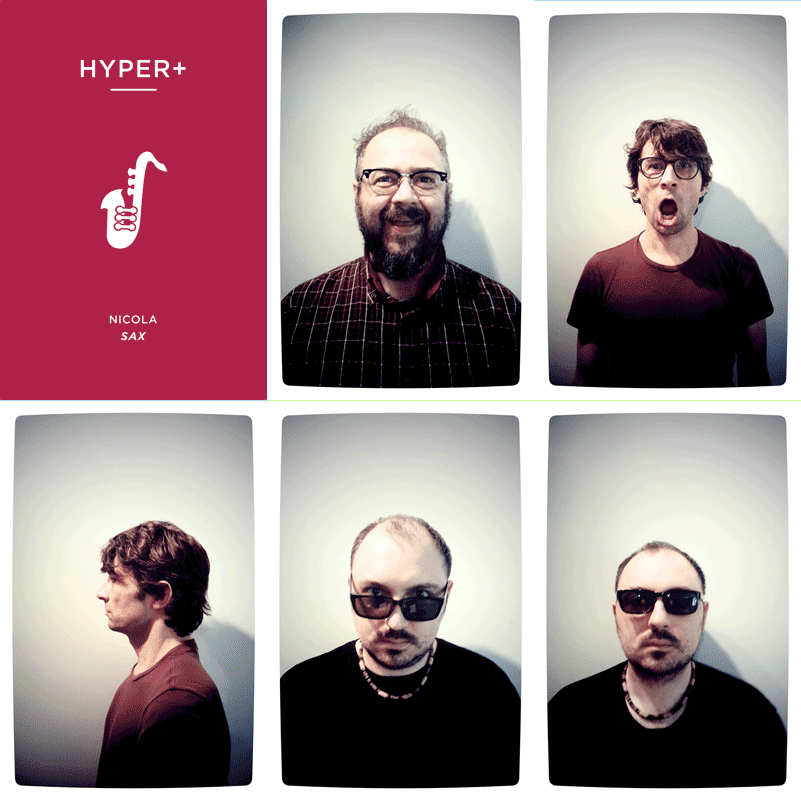
Hyper+ Amir ElSaffar
Amir ElSaffar (trumpet)
Nicola Fazzini (alto sax)
Alessandro Fedrigo (electric bass)
Luca Colussi (drums)

A virtuous melting pot made of different musicians, with some fundamental common lines: they all like free improvisation and contamination of styles and rhythms.

Contemporary language and free jazz are mixed with old arabian roots by the ElSaffar's attitude to "maqaam" and to the ancient musical patterns form his birth place, Iraq.

24 March 2018 h 21.00

25 March 2018 h 14.00

26 March 2018 h 21.00


Jazz Area Metropolitana, 2nd edition
March - May 2018

Jazz Area Metropolitana is growing to the second edition, starting on 23th March in the area cross the Riviera Miranese. A nice and original way to enjoy this part of Veneto's territory, through art, music, city life and staying together as a community.

The first concert is about Tango mixed with jazz texture (Paolo Giaro TangJazz, 23 March), the other ones are more orientated to "without border" music: free jazz and charming contamination between jazz and electronics (Helga Plankensteiner "Plankton", 24 and 25 March) and improvisation melting with ancient traditional arabian music (Hyper+ Amir ElSaffar, 25 March)

Friday, July 7, 2017

Amir ElSaffar / Rivers of Sound - Not Two (NEW AMSTERDAM RECORDS 2017)


Iraqi-American trumpeter, santur player, vocalist, and composer Amir ElSaffar has mastered disparate musical styles and created a singular approach to combining aspects of Middle Eastern music with American jazz, extending the boundaries of each tradition. ElSaffar’s Rivers of Sound Orchestra presents 17 musicians from a broad spectrum of traditions; together, the group creates an entirely new musical language that transcends established notions of style and convention. In performing Not Two, a composition by ElSaffar, each musician in the Rivers of Sound orchestra interacts with the group to create a new approach to transcultural music through the combination of improvisation and composition, the merging of musical languages, maqam and polyphony, and the novelty of the sound. 

Not Two will be released as a double LP with a digital download on June 16, 2017.

Using resonance as its governing principle, Not Two incorporates elements of maqam modal music of the Middle East with jazz and other contemporary musical practices to create a unique microtonal musical environment that moves beyond the notions of style and tradition into a realm of uninhibited musical communication. 

The highest ideal in maqam music is to reach a state of tarab, or “musical ecstasy,” which results from the melting away of borders between a notion of self and other, as performers and audience revel together in the music. As pitches and rhythms become fluid, so do cultural boundaries: elements that traditionally divide musicians and genre-specific modes are re-contextualized in a fresh transcultural soundscape.

This ideal is central to the music on Not Two.

The work sees microtonal maqam melodies traverse a richly-textured bed of sound created by oud, buzuk, and santur, in combination with cello, violin, saxophones, English horn and trumpet. Also at play are multi-layered, rhythmic patterns and harmonies performed by re-tuned vibraphone, piano and guitar. The drum set, mridangam, dumbek, frame drums and double-bass provide the rhythmic foundation and subdivisions of the multiple currents. 

ElSaffar also wrote the music with each musician’s sensibilities in mind, and encouraged everyone in the orchestra to consider the written scores as points of reference, beginnings from which they may improvise, vary, re-write, create their own music. This way, the music could be alive, unique to each performance, yet of a certain essence. The players bring their individual experience and understanding into the orchestra, their collective uniqueness combining to form a cohesive whole, allowing Not Two to approach something universal. As pitches and rhythms become fluid, so do cultural boundaries: elements that traditionally divide musicians and genre-specific modes are re-contextualized in a fresh transcultural soundscape.

ElSaffar has previously forged his novel approach to combining musical languages through his six-piece ensemble Two Rivers. Over the past eight years, the group has released three CD's on Pi Recordings. Not Two is a continuation of the Two Rivers concept, but projected onto a wider canvas unprecedented in scope and imagination.


Amir ElSaffar explains:

“Rivers of Sound is not concerned with “bridging” divergent cultures. In each composition, one can hear elements of maqam, polyphony, polyrhythmic structures, melisma, and groove. But these do not exist as separate entities “belonging” to any people or place.

After spending much of my life playing and composing in diverse musical worlds, I question the idea of culture. My interest is in finding sonic realms that can embrace the phenomena found in the myriad musical languages, drawing upon sensibilities and materials of various idioms, but without the limitations of a particular genre. The idea is about fluidity: sounds flow into one another, overtones interact, as we come closer to a universal human sound.

Years ago, I had the good fortune to study with Kongo Langlois Roshi, a Zen Buddhist teacher in Chicago. One day, when I shared my inner state of confusion, he replied, “When the mind becomes muddled in dualistic thinking, think ‘not two,’ and all will become clear.”

ElSaffar believes that the nature of this sound cannot be captured digitally and  committed to all analog recording, with Not Two being released as a double LP. The limited possibility of making edits when recording analog brought an intense focus to the players' performance in the studio, which is as close as possible to reproducing the feel of a live performance.

ElSaffar received funding from the MAP Fund and Arab Fund for Arts and Culture to create Rivers of Sound. In 2015, the 17 members came to New York City from as far away as Qatar, Palestine, and Brussels in April for three days of rehearsal, the premiere of Not Two at the Lincoln Center, and an epic 14-hour day at Avatar Studios, where they recorded the 80-minute suite directly to tape. The album was produced by ElSaffar, engineered by Sascha Van Oertzen, mixed by John Davis at Bunker Studios, and mastered by Scott Hull at Masterdisk. All compositions on Not Two were written by ElSaffar, whose work is published by BMI.

1. Iftitah 11:14
2. Jourjina Over Three 07:13
3. Penny Explosion 12:45
4. Ya Ibni, Ya Ibni (My son, my son) 12:25
5. Layl (Night) 10:40
6. Hijaz 21/8 09:39
7. Shards of Memory/B Half Flat Fantasy 16:14
8. Bayat Declamation 06:14


Sunday, February 5, 2017

HYPER+ AMIR ELSAFFAR - SAADIF (2016) [NUSICA.ORG]


HYPER+ AMIR ELSAFFAR NEW CD "SAADIF" IS OUT NOW!

SAADIF means in arabic "meeting" and is the result of the collaboration between Amir ElSaffar, New York multiethnic scene’s rising star, and the Italian trio HYPER+.

An original album between tradition and innovation, where the "beyond-jazz" of Hyper+ is mixed with Iraqi maqam music.


Amir ElSaffar, trumpet & vocals
Nicola Fazzini, alto & soprano sax
Alessandro Fedrigo, acoustic bass guitar
Luca Colussi, drums


In these last years, physical and cultural borders sadly seems to be stronger than ever and cultural barriers keep on standing. Musical projects built upon the idea of make identity meet offer different ways of relationships and artistically innovative narratives in integration. 

In this perspective the collaboration between trumpeter Amir ElSaffar (New York multiethnic scene’s rising star) and the platform HYPER+, that allows to Nicola Fazzini, Alessandro Fedrigo and Luca Colussi trio to work with different guests, is a stunning, expressive, meeting. 

In this quartet, the original method of ElSaffar (musician who has collaborated with artists like Vijay Iyer, Don Byron, Cecil Taylor or Marc Ribot), using the microtones found in Iraqi maqam music to create an innovative approach to harmony and melody, stimulates fellow musicians (who work together in the renamed XY Quartet) to explore new acoustic and electric paths, between tradition and innovation. 

Born in Chicago to an American mother and an Iraqi father, Amir ElSaffar plays the trumpet, the santur and sings traditional Iraqi music. After undergoing classical training the focus of his work has been on jazz, collaborating with great names of contemporary jazz. 

After an italian tour in November 2015, the quartet has recorded (for nusica.org label) “Saadif” (“meeting”) at Casa della Musica in Trieste. Published in April 2016, the record contains original tunes, mostly composed by ElSaffar. “Saadif” carries the listener on an evocative journey, cunningly structured, rich of shades and colorful, a music where urban tensions and multicultural relationships are able to light sparkles of future sounds.


nusica.org is free, eco-friendly, digital, conceptual


Wednesday, July 6, 2016

Hyper+ Amir ElSaffar Summer Tour 2016: 9/10/12 of July


After many positive reviews for the album "SAADIF", HYPER+ AMIR ELSAFFAR will perform in Italy during 3 unmissable events.

SAVE THE DATES!

Sunday 9 July, 2016, h 9.30PM
Hyper+ Amir ElSaffar @Argini e Margini - Pisa
Free entry

Sunday 10 July 2016, h 9PM
Hyper + Amir ElSaffar @ JA'M Fontanelle - Treviso
Entry + dinner 10€ from 7PM

Tuesday 12 July 2016, h 10PM
Hyper+ Amir ElSaffar @ Castelfranco Jazz - Treviso
Free entry


Amir ElSaffar, trumpet & vocals
Nicola Fazzini, alto & soprano sax
Alessandro Fedrigo, acoustic bass guitar
Luca Colussi, drums

Listen to "Saadif":


Thursday, May 5, 2016

Hyper+ Amir ElSaffar at Vicenza Jazz: PRESENTATION OF THE CD SAADIF (SUNDAY 8th of MAY) NUSICA.ORG


Hyper+ Amir ElSaffar at

(click here)


We are proud to announce that SAADIF, last production of nusica.org label, will be presented at Vicenza Jazz Festival, Italy!


- Gallerie di Palazzo Leoni Montanari, Vicenza, h 5 PM

- Bar Borsa Jazz Café Trivellato, Vicenza, h 10 PM

Complete program here!


Amir ElSaffar, trumpet & vocals
Nicola Fazzini, alto & soprano sax
Alessandro Fedrigo, acoustic bass guitar
Luca Colussi, drums

nusica.org Website