
Showing posts with label Kenton Loewen. Show all posts

Monday, January 31, 2022

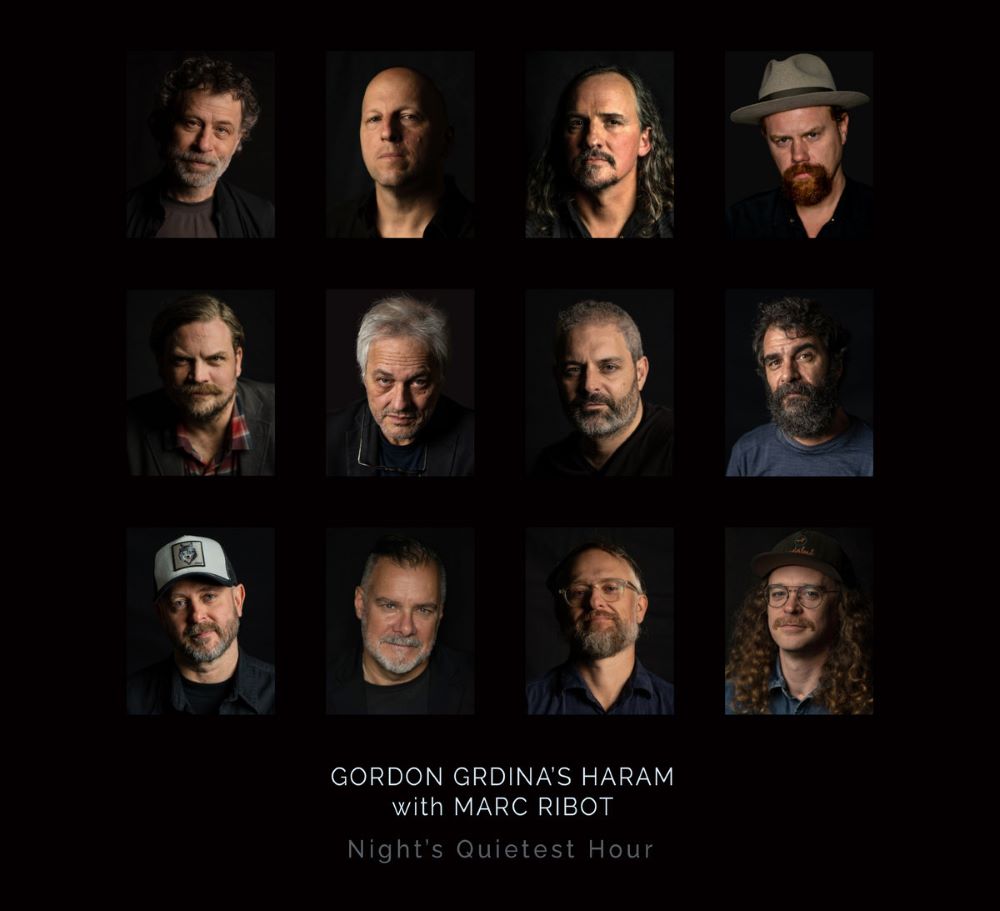
Gordon Grdina's Haram with Marc Ribot - Night's Quietest Hour (February 18, 2022 AttaBoyGirl Records)

Just before the Pandemic hit Marc joined our ensemble for two concerts in Vancouver Feb 28 and Seattle on March 1st, with a recording session on the leap year Feb 29th. This was an incredible experience and Marc blended into the ensemble from the beginning. He played almost our entire repertoire with us and these tracks are the previously unreleased pieces. This album reflects our continued exploration of the Classic Arabic repertoire and new exploration of Sudanese music from the 60's and 70's. An already incredibly dynamic group Marc's presence pushed the group's delicacy, intensity and explosive nature to new heights. The process of creating this album has reliagned the trajectory of the ensemble.

Gordon Grdina's Haram

Juno Award winner Gordon Grdina formed Haram in 2008 as a large ensemble vehicle to interpret classic Arabic repertoire. The group started with Iraqi folk music and the great era of Egyptian radio music in which Oum Khalsoum and Farid Al Atrash reigned. It has since expanded to incorporate the classic Sudanese and Persian repertoire. These pieces are lovingly reinterpreted with an ensemble half studied in the tradition and half in avant-garde improvisation. This blend of traditions is what gives Haram its unique sound.

Through improvisation and arrangement, the band keeps alive the spirit and Tarab inherent within the compositions. These time-tested pieces are blown wide open by the ensemble mixing elements of noise, electronic soundscape, and free improvisation. The music has developed to the state of effortless cohesion mixed with wild abandon conjuring up a sense of respect and homage while being explosively self-expressive. Haram is a powerhouse ensemble playing a repertoire that has been revered by millions. 

1. Longa Nahawand 8:58
2. Sala Min Shaaraha A-Thahab (Gold Streamed Down from Her Hair) 10:48
3. Dulab Bayati 9:39
4. Lamma Bada Yatathanna (When She Begins to Sway) 10:18
5. Hawj Erreeh. (Violent Wind) 8:14

Total time: 48:00

Recorded and mixed in 32 bits / 96kHz

Compositions by 1, Kevser Hanim, 2, Salah Ben Al Badiya, 3, Traditional - attr. Muhammad 'Abd al-Rahim al-Maslub 4, Traditional, 5, Ahmad Al Jaberi

Arranged by: Gordon Grdina

Gordon Grdina's Haram with Marc Ribot
-Night's Quietest Hour

Gordon Grdina -Oud
Marc Ribot -Guitar
Emad Armoush -Vocals, Ney
Tim Gerwing -Darbuka
Liam MacDonal -Riq
Tommy Babin -Bass
Kenton Loewen -Drums
Francois Houle -Clarinet
Christopher Kelly -Sax
Jp Carter -Trumpet
Josh Zubot -Violin
Jesse Zubot -Violin

Recorded, Mixed by John Raham at Afterlife Studios, Vancouver, BC
Mastered by Alex DeTurk at The Bunker Studio, New York, NY
Produced by: Gordon Grdina
All Photography by: Genevieve Monro. @genmonrophotography
Design by: Chelsey Maher

AttaBoyGirl Records
Made in Canada

A & P 2022 AttaBoyGirl Records

Friday, June 18, 2021

Kenton Loewen & JP Carter - It Becomes Us (June 18, 2021 The Infidels A Record Label)

It Becomes Us was recorded in the fall of 2020 by Kenton Loewen (Dan Mangan, Peregrine Falls, The Crackling) and JP Carter (Destroyer, Haram, the Inhabitants), two musicians who have performed and recorded together hundreds of times.

Half of the album was improvised in the studio, and shows their dedication to the "now" at the heart of all improvised music.

The other half features music written by Sonny Sharrock, Ornette Coleman, Roscoe Mitchell, Wayne Shorter, and Jaki Byard, and shows a deep love for the history and cultural traditions inherent in jazz, as well as a willingness to explore and create new sounds using those traditions as a launching pad.

The first single is As We Used To Sing, originally written and recorded by Sonny Sharrock for his seminal 1991 album, Ask The Ages.

1. As We Used To Sing (Sharrock)
2. What Is That (Loewen/Carter)
3. From Beyond The Ridge (Loewen/Carter)
4. I Don't Think We're Alone (Loewen/Carter)
5. It Bellows Through The Night (Loewen/Carter)
6. It Becomes Us (Loewen/Carter)
7. Peace (Coleman)
8. Orbits (Shorter)
9. Mrs. Parker of KC (Bird's Mother) (Byard)
10. Odwalla (Mitchell)

Kenton Loewen Drums
JP Carter Trumpet

David Sikula at Demitone Studios Engineering, Mixing, Mastering
Simon Roy Cover Art
Ben Frith Design
Chris Preston Photography

Producer Tim Reinert

Thursday, May 18, 2017

Gordon Grdina / François Houle / Kenton Loewen / Benoît Delbecq - Ghost Lights (SONGLINES 2017)


Album Introduces New Quartet, Expanding Grdina-Houle-Loewen Trio with the Addition of Benoit Delbecq


Gordon Grdina, guitar, electronics
François Houle, clarinet, electronics, loopers
Kenton Loewen, drums & percussion
Benoît Delbecq, piano & bass station


“The threesome navigated through a wider landscape of sound with meandering lyrical passages, encircling eerie plateaus and sudden about-turns into wild abysses triggering raucous rides and accumulation of sound that went hazy and eventually dissolved…” – Henning Bolte, AllAboutJazz, (reviewing a performance of Grdina/Houle/Loewen at Jazztopad 2016)

But when they added Benoît Delbecq the music became something else again.

François Houle explains: “As Benoît and I were looking at opportunities for the duo [established in 1996], Ken Pickering [Vancouver jazz festival artistic director] suggested we merge this with the trio collective [formed in 2014, though its members have been performing in different Grdina groups since around 2004]. Knowing how Benoît’s playing fits into so many different configurations, I thought this would work nicely. I suggested he bring his bass station to augment the lower end of the quartet.” Two performances at the 2015 festival led to a return engagement in 2016 followed by a day in the studio. “The whole session unfolded quite spontaneously, with hardly any discussion between takes. Gord suggested we play my piece ‘Soro’ as he knew Benoît’s affinity for African rhythms in his piano approach. Benoît brought out “Broken World”, written shortly after the terrorist attack at the Bataclan in Paris. We tried it and found it to be a beautiful, haunting piece. The rest was completely improvised, and took us into the most unexpected musical spaces, with generous room for all to participate in the music making.” The longest take (not on the record) went on for 31 minutes!

So this is music that takes its time, as Benoît notes: “It’s music with slow motion, with nothing spectacular or demonstrative. But delicate…We let the flow of improvisation be at play and it held us in a creative mode…I think the strength comes from the collective aspect of the craft. This is why I play music – to share some states of grace with my peers; it’s an incredible feeling to experience a common way to conceive sound fabrics collectively.” François agrees: “It speaks to the really broad scope of experiences by this collective. We can move from one musical state to the next with seemingly little effort, while trusting that the others will not only anticipate the next move, but also pave the way for this to happen at any given moment.”

In music like this, texture is as important as structure, and electronics play their role in Gord’s playing, which features rich-sounding octave-doubling. François uses loopers to similar effect: “I'm interested in opening up the vertical range of the clarinet and treating it as a chordal instrument rather than a monophonic one. I consider my work with loops a sort of extension of my playing with two clarinets simultaneously.” Benoît doesn’t employ his looping software here, but his bass station has its own sensuous sine waves and filters: “It’s just a basic (two oscillators) analog synth made by Novation in the early 90s. I mostly use it in the lower register and I love the feel of it. I’ve always liked the mixture of electronics and ‘bio’ sounds such as prepared piano or regular piano…What I like in how the guys play is that we all sound like we’re processed even when we might not be using electronics, because our concern for sound production is very advanced.”

“Waraba” is dedicated to the late bassist (and kora and sanza player) Jean-Jacques Avenel, whose 2004 west African jazz release on Songlines, Waraba, Benoît produced. Benoît started working with JJ in 1998, and JJ was a member of the trio Delbecq 3 The Sixth Jump from 2008 until his death. “Anyone who played with Jean-Jacques and shared his love for African music has been deeply imprinted by JJ’s joy, expertise, and world-class musicianship…I still feel his presence when I play, and when I vamp layers on the prepared piano I could keep going forever, like Manding musicians who have another idea of time and duration in music…All of us in this band are strongly related with traditional music from all continents, and the momentum of the music we played found itself naturally.”

“Waraba” ends the record on a hopeful and almost joyous or at least somewhat peaceful note, but the music has moved though many other spaces to get there. The aesthetic is liminal: music that’s on the verge of becoming something else, crossing boundaries that are undefined and intuitive. This applies to the subtle way instruments and instrumental lines merge and separate, the range of harmony/atonality, rhythmic and energetic aspects (from near-stasis to turbulence), different emotional resonances – and finally the way the music engages the listener’s attention in a play of foreground/background, active listening and trance-like immersion.

More information on Grdina-Houle-Lowen can be found here.   Benoit Delbecq's website is delbecq.net. Read an interview with Houle and Delbecq about Ghost Lights on Songlines website.