With a stunning mixture of grace and power, tenor saxophonist Diego Rivera transcends cultural boundaries to deliver an emphatic message of intelligence and inclusivity on his 2022 release "Mestizo." Critical listeners may appreciate these performances as a series of engaged discussions employing the repartee of context and contrast between the leading voices of the horns and the affectionate support and retort from their immaculate rhythm section of pianist Art Hirahara, bassist Boris Kozlov, and drummer Rudy Royston.
This assemblage of bright moments is also admirably enhanced by the presence of trumpet phenomenon Alex Sipiagin, who joins Rivera as his front line aide-de-cam, providing musical offerings of incisive intensity that steadily serve to escalate the entire proceeding unto another level. Nonetheless, if we overly focus on the interplay of elements, then we risk missing out on the point of the dialogue and mistake the medium for the message. Rivera's unmistakable talent as a songwriter is the real story, as he deftly transforms this dynamic quintet into a unified instrument and unleashes a powerful combination of swinging blasts juxtaposed with forays into the emotional parlance of subtle conversation.
From the opening salvo to the last hurrah, the melodic message of "Mestizo" moves effortlessly straightforward and affirms that Rivera is a shining star of unlimited brilliance to keep an eye on for many years to come.
1. Battle Fatigue
2. Rasquache
3. Teru
4. Bracero
5. Escapade
6. Canción De Cuna
7. Most From The Least
8. The Rose Window
9. La Raza Cósmica
10. Mestizo
Diego Rivera - tenor saxophone
Alex Sipiagin - trumpet, flugelhorn 6, 9
Art Hirahara - piano
Boris Kozlov - bass
Rudy Royston - drums, percussion 2, 4, 8
produced by Marc Free
engineered by Nick O'Toole
recorded September 16-17, 2021 & Teru on June 6, 2021, at Acoustic Recording, Brooklyn, NY
mixed & mastered at Woodland Studio, Lake Oswego, OR
Misha Tsiganov, who lived in Leningrad in the former Soviet Union until he emigrated to the U.S. in 1991, at 25, has never shied away from a challenge. That’s apparent from the levels of complexity that Tsiganov embeds in the 18 arrangements and 9 originals on his three prior Criss Cross albums – The Artistry of the Standard (Criss 1367), Spring Feelings (Criss 1384), and Playing With The Wind (Criss 1401).
As written in the liner notes for Spring Feelings, Tsiganov has established “a signature blend of mixed meters, shifting tempos, changing keys and reharmonization that he deploys in order to insure ‘that something is happening always, so the listener doesn’t fall asleep.’”
Tsiganov’s latest, Misha’s Wishes, doesn’t eschew technical complexity. But the feel of this sophisticated, emotionally nuanced program – performed by old friends trumpeter Alex Sipiagin, tenor saxophonist Seamus Blake, bassist Boris Kozlov and drummer Donald Edwards, themselves leaders of multiple Criss Cross dates, with whom Misha Tsiganov feels such simpatico that he once postponed a recording session until all were available – is different than its predecessors.
1. Fire Horse (Misha Tsiganov) 7:14
2. Strike Up The Band (George Gershwin) 8:32
3. Misha's Wishes (Misha Tsiganov) 5:35
4. There Was A Birch Tree In The Field, So What (Russian Folk Song) 6:10
5. Lost In Her Eyes (Misha Tsiganov) 2:18
6. Just A Scale (Misha Tsiganov) 6:08
7. Give Me Five (Misha Tsiganov) 8:21
8. Hope And Despair (Misha Tsiganov) 7:15
9. Comrade Conrad (Bill Evans) 7:21
10. Are You With Me (Misha Tsiganov) 7:51
Total Time: 66:47
Recorded September 9, 2021 in Astoria, NY, USA by Mike Marciano
Trumpet sensation Alex Sipiagin conducts his attention and intention "Upstream" directing the energetic empathy of his music towards engaging the hearts and minds of jazz fans on his first release for Posi-Tone. Exuding confidence with effortless virtuosity, Sipiagin performs with a compelling and emotional voice on his instrument that clearly elevates and distinguishes him from his able contemporaries. Joining Sipiagin on this musical journey is Posi-Tone's steadily serviceable and reliably inventive rhythm section of pianist Art Hirahara, bassist Boris Kozlov and drummer Rudy Royston.
With elegant lyricism, Sipiagin leads the group steadily straight forward to explore harmonic wonderlands that clearly reflect his modern melodic non-diatonic jazz sensibility. With a thoughtful program of original compositions and arrangements, Alex Sipiagin clearly attenuates his focus "Upstream" and successfully provides jazz fans everywhere with an astonishing array of captivating currents and bright moments to cherish and enjoy.
1. Call 05:22
2. Echo Canyon 05:30
3. Sight 05:21
4. SipaTham 06:20
5. Magic Square 05:44
6. Rain 07:10
7. Shura 06:46
8. Miyako 05:00
9. Upstream 07:37
Alex Sipiagin - trumpet, flugelhorn
Art Hirahara - piano
Boris Kozlov - bass
Rudy Royston - drums & percussion
Marc Free - producer
Nick O’Toole - mixing & mastering engineer
Michael Brorby - recording engineer
recorded October 24-25, 2020 at Acoustic Recording, Brooklyn, NY
mixed & mastered at Woodland Studio, Lake Oswego, OR
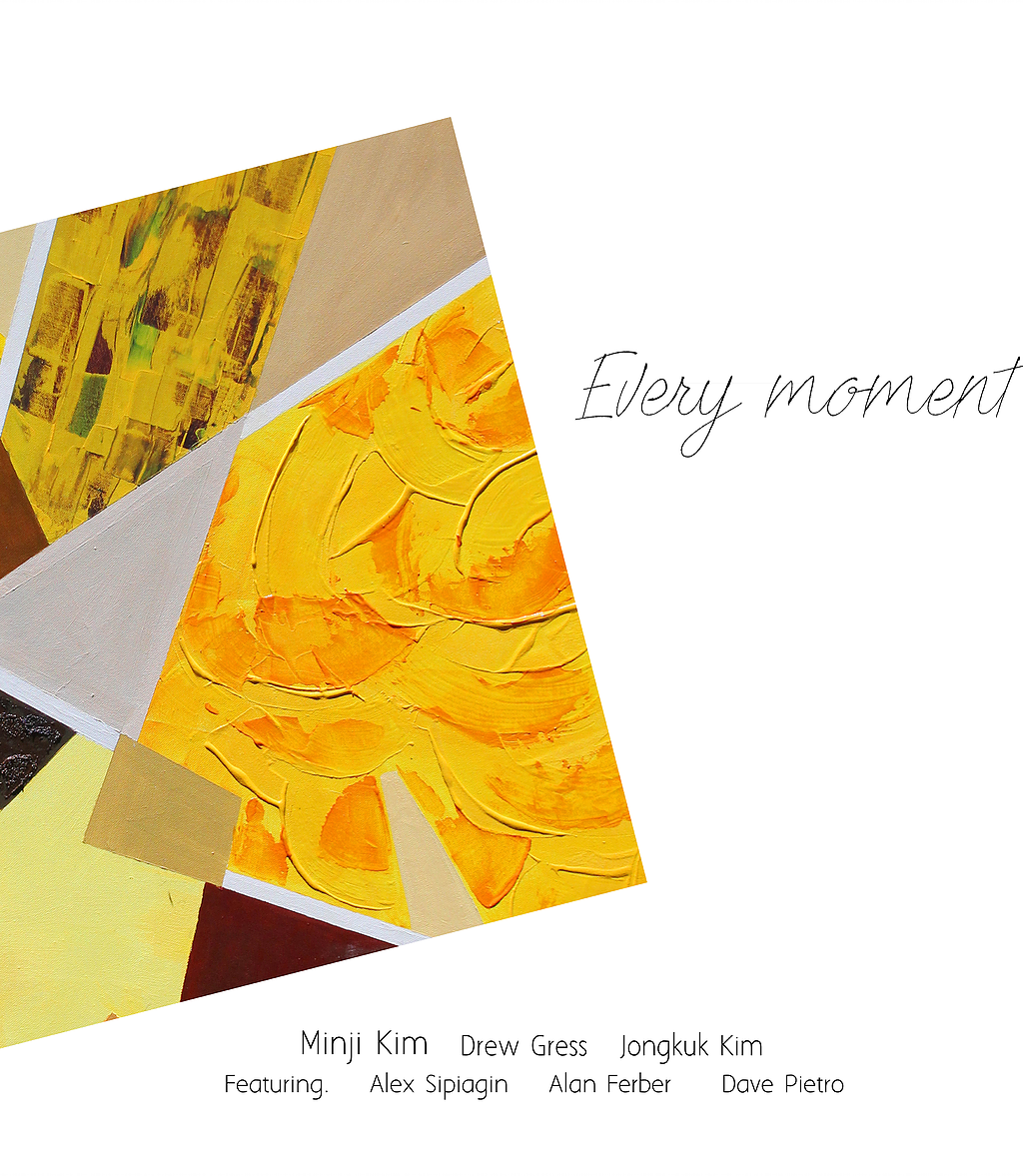
Minji is a pianist, composer, and an instructor who was born in South Korea. She pursued bachelor’s degree at Berklee College of Music with a Jazz Performance Award, Berklee Achievement Scholarship, and Berklee International Grant. She studied with many brilliant professors including Joanne Brackeen, Alain Mallet, and Ed Tomassi. Minji is currently pursuing her Master’s degree in Jazz Performance at New York University while working as an adjunct instructor at NYU. She has recorded/performed with many recognizable musicians including Drew Gress, Alan Ferber, Alex Sipiagin, David Pietro (will perform with Lenny Pickett on April 27th and Brad Shepik in July). She has released her first debut album, “Every Moment”, on February 2018 under her own recording label with Drew Gress on bass and Jongkuk Kim on drums (featured by Alex Sipiagin on trumpet, Dave Pietro on alto sax, and Alan Ferber on trombone). Minji currently is performing at various places and building her musical experiences with many musicians, such as Blue Note, Club Bonafide, ShapeShifter Lab,Tomi Jazz, Loewe Theatre, and James Dolan Studio. She will have her first abroad tour in Costa Rica (“Costa Rica Tour & Clinic) in July 2018 with NYU Group (featured by Brad Shepik).
1. A Big Tree (feat. Alan Ferber) Minji Kim, Drew Gress & Jongkuk Kim 6:04
2. Light River (feat. Alex Sipiagin & Dave Pietro) Minji Kim, Drew Gress & Jongkuk Kim 7:09
3. Db Minji Kim, Drew Gress & Jongkuk Kim 4:53
4. April 29th (feat. Alex Sipiagin, Dave Pietro, Alan Ferber & Songyi Jeon) Minji Kim, Drew Gress & Jongkuk Kim 6:25
5. Na-Bi Minji Kim & Jongkuk Kim 5:18
6. The Moment (feat. Alex Sipiagin) Minji Kim, Drew Gress & Jongkuk Kim 5:24
“For my taste, Sasha is definitively the best drummer in Russia. Every time I go to Russia to do a Russian project, I ask him to play drums.”
— Alexander Sipiagin
“When I lived in St. Petersburg, Sasha to me was the main drummer—the most creative, most contemporary, most looking-forward, everything else. When he moved to Moscow, I actually left, too, and one reason was because playing with him regularly wasn’t possible any more.”
— Zhenya Strigalev
One Russian equivalent of “outside the box” (вне коробки [vne korobki]), as 41-year-old Moscow-based drummer Alexander “Sasha” Mashin titles his debut leader recording, is the phrase мыслить нетрадиционно (myslit' netraditsionno-“think unconventionally”). Both the literal and metaphorical usages apply to Mashin’s intentions on this kinetic date, on which he and his pianist and bassist of choice propel the flow for separate sets of original music by two of Russia’s most distinguished jazz exports — New York-based trumpeter Alexander Sipiagin and London-based alto saxophonist Evegeny “Zhenya” Strigalev. Call it global jazz with a Russian attitude. Mashin’s path began in St. Petersburg, where he trained early on as a classical percussionist. He taught himself to play the drumset, studying and internalizing the languages of Buddy Rich, Max Roach, Tony Williams and Elvin Jones in the samizdat manner, from multiple-generation cassettes of their recordings. He was already much-employed on several St. Petersburg scenes by 1995, when Igor Butman — himself a St. Petersburg native — returned to Russia from an eight-year stay in Boston and New York, and hired him for his quartet. In 1997, when Butman opened his first club in Moscow, Mashin followed, and remained, becoming an integral figure in upper echelon Russian jazz-modernism, and developing an international reputation in the collective MosGorTrio with pianist Yakov Okun and bassists Anton Revnuk or Makar Novikov, with whom, for more than a decade, he brought his big beat and exemplary musicality and taste to numerous bandstands with a diverse cohort of main-stem jazz heroes as Johnny Griffin, Benny Golson, James Spaulding, Kenny Barron, Eddie Henderson, Lew Tabackin, Donny McCaslin and Mark Turner. Later in the ’00s and into the ’10s, Mashin began to push the envelope further on intra-Russia tours on which the trio heard on Outside The Box (Novikov and keyboardist Alexey Ivannikov), and other configurations that included pianists Ivan Farmakovsky, Alexey Bekker and Vladimir Nesterenko (who plays flute on this album), played consequential engagements with, among others, J.D. Walter, Josh Evans, and Sipiagin. Although Sipiagin first met Mashin in 1995, five years after the gold-toned trumpeter left the chaos of post-Gorbachev Russia for New York City, their musical relationship began around 2005, when Sipiagin resumed frequent trips to his homeland. By then, he’d already recorded about a dozen albums documenting his contrapuntal, gracefully voiced, metrically modulated, sweetly melancholic compositions with New York avatars Chris Potter, David Binney, Seamus Blake, David Kikoski, Adam Rogers, Scott Colley, Jeff Watts, and Antonio Sanchez. As Mashin navigated these odd-metered structures on repeated engagements, he found himself increasingly captivated by Sipiagin’s argot, as we hear from his fluent contribution to Sipiagin’s 2014 CD, New Path, with Dutch vocalist-lyricist Hiske Oosterwijk (who contributes three new lyrics to Out of the Box) and New York-based Russian expats Misha Tsiganov on keyboards and Boris Kozlov on bass. “Learning Alex’s music was a turning point,” Mashin says. “It changed my style towards more modern playing.” Mashin reinforced these stirrings on consequential tours with a quartet led by veteran Tunisian oudist-vocalist Dhafer Youssef that includes Azerbaijani pianist Isfar Sarabski. Youssef praises Mashin’s ability to “feel my music and propose his own vision for it.” Sarabski, whose performance in trio with Mashin at the 2012 Montreux Jazz Festival attracted international attention, echoes the sentiment, citing the elder musician’s incessant “creative development.” “Sasha plays with amazing quality,” Sipiagin says. “He thinks close to the way I think. He’s open-minded, and he likes to work hard and prepare—I send him my charts, and he memorizes them. He doesn’t have an ego. He always follows advice. It’s very comfortable to play with him.” During Mashin’s St. Petersburg years, he played frequently with Strigalev, who moved to London in 2002 to matriculate at the Royal Academy of Music. He has subsequently made his mark on that city’s jazz community by dint of the virtuoso technique and formal command that he applies to his unfettered improvisations, and also as a scene-maker who booked cutting edge bands like Horacio “El Negro” Hernandez with Iftaluba, Mark Giuliana’s Beat Music, and the Chris Dave Trio. On a series of recordings since 2010 that document his rhythmically percolating, expertly off-kilter compositions, Strigalev assembled bands featuring such free thinkers as Harland, Ambrose Akinmusire, Taylor Eigsti, Tim Lefebvre, Larry Grenadier and Linley Marthe.
About four years ago, after a long hiatus, Strigalev resumed visits to Russia, creating ample opportunities for he and Mashin to pick up where they left off. “Sasha always had a nice sound and feel, and a searching, creative fire,” Strigalev says. “He was flexible, and I liked to play with him because he was up for trying new things. He played bebop when it was necessary to play bebop; he played Dixieland when it was necessary to play Dixieland; he played swing when it was necessary to play swing. We tried to play something between all of those. Over the years, his creativity has ripened and has more meaning. That’s why I like to play with him now, too, and I’m looking forward to doing it more.”
While Sipiagin and Strigalev nurtured their individualism within the vivid transcultural mix of their adopted cities, Moscow-based Mashin has faced a more solitary struggle to establish his voice in what he describes as a culture of conformity, represented by the CD cover illustration that depicts him looking through a cage. About a year ago, while in Spain, Mashin had a box tattooed on his arm as a visual analog to his determination never again to be circumscribed in matters of artistic production.
“When people try to do things differently, other people are full of sarcasm and try to push you,” Mashin says. “They say, ‘Hey, do like everybody is doing; don’t try to be different.’ Some people weren’t happy about my decision to play music other than bebop, and called me less often. But I am trying not to value so much the opinions of other musicians. Each year I have many more opportunities to play music I like to play. I no longer need to go to a gig where I don’t like the music.”
Both halves of Outside The Box resoundingly demonstrate the truth of that assertion. The album-opening “Sipiagin’s Mood” is a Mashin “mash-up” of Sipiagin’s “38-58” (named for the alcohol level of two different versions of Taiwan’s equivalent to vodka), which titles a 2015 Criss Cross CD, and “Mood-2,” which Sipiagin debuted on the 2003 Criss Cross album Equilibrium. On this track, as on Sipiagin’s “7=5” and “Paint,” Italian alto saxophone master Rosario Giuliani — another of Mashin’s recently discovered musical soulmates, who offers a shout-out to Mashin’s “own way of playing contemporary styles with great sound and technique while being completely rooted in the tradition”— solos with characteristically inflamed spirit and panache. So does Oosterwijk, who has found a wellspring of inspiration for poetic lyric-writing in Sipiagin’s complex lines, which she renders with impeccable phrasing and intonation. The solo order is Sipiagin, keyboardist Alexey Ivannikov, Giuliani, bassist Makar Novikov, and Mashin.
Of Novikov, who composed “Jazzmashin” for the date, Mashin says: “Makar has solid time, which is rare for Russian culture; his quarter notes connect perfectly to mine.” The composer — himself an avid fan of Elvin Jones' Jazz Machine units of the 1970s, 80s and 90s — opens with a forceful vamp over which Nesterenko states the refrain on flute;
Oosterwijk declaims her eloquent paean to artistic freedom and self-determination. Sipiagin’s pensively funky solo reaches for the stars and finds them.
Sipiagin composed “7=5” and “Paint” specifically for the album. The former tune is based on a rhythmic cycle in which a 7/4 pattern overlays a 5/4 pattern, a gnarly conundrum that Mashin resolves with elegance. Giuliani dances through a forceful statement; Sipiagin plays as though Freddie Hubbard’s spirit was riding him; guitarist Evgeny Pobozhiy (from Igor Butman’s orchestra) sustains the energy with rhythmically varied, across-the-bar lines that unfailingly land in the right place. Sipiagin’s well-wrought brass arrangements punctuate the trajectory of the solos:
Oosterwijk returns with another bespoke lyric for “Paint” (“In the eyes the truth is near / Think outside the box when you are in fear / Silence is so powerful / No words needed if you have peace in mind.”). Mashin’s uncorks a surging straight-8th groove; Giuliani solos over the opening melody; there follows a polyphonic, gorgeously voiced collective improvisation by Sipiagin, Oosterwijk, soprano saxophonist Andrey Krasilnikov, and trombonist Odei Al-Magut (the latter two are young up-and-comers from Moscow); and then well-wrought solos by Sipiagin, Krasilnikov and Al-Magut.
The first of Strigalev’s four pieces that follow is “Some Thomas,” which debuted on his 2016 CD Never Group. The composer offers his tone parallel to Sonny Rollins, a personal hero. Mashin drives a stentorian Strigalev solo and a probing statement by up-and-coming American trumpeter Josh Evans, who has been spending time in Moscow during recent months. Also from Never Group is the drum-and-bass oriented “Strange Party,” a six-note refrain on which electric bassist Anton Davidants, who currently resides in Shanghai, follows Strigalev’s turbulent, wailing, thematically unified solo with a well-wrought declamation of his own. “Sharp Night”—which Strigalev debuted in 2015 on Robin Goodie—is a tour de force. The saxophonist’s deep study of the dialects of Charlie Parker, Rollins and Ornette Coleman comes through on an information-packed two-minute navigation through the blues-based form. Mashin applies the finishing touch with an erudite, thematically cohesive concluding statement. Also from Robin Goodie is “Kuku,” dedicated, Mashin says, “to the cuckoo bird, which, in Russian folkloric tradition, can tell you how long you’ll live on the planet.” Strigalev’s commanding solo proceeds over Mashin’s “funk with a limp” beat; Ivannikov goes deep into the swamp. The proceedings conclude with “Omulu Dance,” an Afro-Brazilian inspired composition by world-class, 20-something bassist Daria Chernakova, who plays (right channel) alongside Novikov. After an impressionistically fragmented opening section chock-a-block with instrumental color, Chernakova launches a mighty vamp, locking in with Mashin and Cuban conguero Fidel Alejandro to provoke Strigalev’s ascendent, inflamed solo. Ivannikov plays huge, dramatic chords in his unaccompanied turn, setting up an effervescent Chernakova-Novikov bass duet that invokes the spirit of the title. At the end, we hear Mashin’s delighted, sardonic laugh. “This laughing means that I am outside the cage, outside the box, outside the prison,” Mashin says. “I’ve been a sideman all these years, and I never wrote music, which is why I didn’t make records. Then I realized that Art Blakey didn’t write, and yet he was a great bandleader and he had many amazing bands. So just try to get together people you like to play with, and see what happens. You have to start with something.” Ted Panken
Composer/arranger, Dave Lisik can always be relied upon to put together colorful, unpredictable and creative jazz projects. The music on Machaut Man and a Superman Hat is no exception, featuring a world-class quintet interpreting seven of his originals along with an unusual version of “Georgia On My Mind.” A little background is in order for those who might not be familiar with Dave’s history. Born in Canada, he earned a Master of Music degree in Jazz Pedagogy from the University of Northern Iowa in 1998. After working as Director of Bands at Murdoch MacKay Collegiate in Winnipeg, Canada during 1998-2003 (which included recording three CDs and collecting quite a few awards), he earned his Doctor of Musical Arts degree in Composition with a Jazz Emphasis at the University of Memphis, where he taught and directed jazz ensembles. He worked as Assistant Professor of Music and Director of Jazz Studies at LeMoyne-Owen College in Memphis, where he created the LeMoyne-Owen Records label and the African Drumming Ensemble. Lisik now lives in New Zealand, where he works at the New Zealand School of Music in Wellington (teaching jazz composition, arranging, theory and pedagogy), co-directs the New Zealand Youth Jazz Orchestra, founded and produces the NZSM Jazz Festival, and is a trustee of the New Zealand Jazz Foundation. In addition, he has worked as a trumpeter (playing with big bands, his own quintet, and symphony orchestras) and he has written over 400 works. It has made for quite a busy life, which fortunately includes a regular series of recordings. For Machaut Man and a Superman Hat, Lisik was able to utilize trumpeter Alex Sipiagin’s quintet. “When players of this caliber are willing to share their amazing musicality, it is quite a remarkable experience,” says Lisik. “Alex Sipiagin came to the first New Zealand School of Music Jazz Festival as a guest artist in 2011 and we have worked together numerous times since then.” A superb trumpeter, Sipiagin has recorded with Lisik on his jazz orchestra suite Walkabout – A Place For Visions and on two other projects that will be released in the near future: an electroacoustic album with Seamus Blake (Students In Exile) and a set with a jazz orchestra (Origin Of Species). “Donny McCaslin was a featured soloist on my first jazz orchestra recording project, Coming Through Slaughter - The Bolden Legend. He is one of my absolute favorite musicians, and is beautiful to listen to. Dave Kikoski, Boris Kozlov and Donald Edwards are all regular players in the rhythm section of the Mingus Big Band, and in Alex's quintet with Seamus Blake, Opus 5. These are some of the best jazz musicians anywhere. They know each other very well, play together all of the time, and have a real group thing happening.” Although Lisik’s music is consistently challenging, the five musicians sound relaxed and effortless throughout this set, coming up with interpretations that clearly pleased the composer. The music is as colorful and offbeat as the song titles. “Steal Bryan’s Laptop” serves as an excellent introduction to the quintet with lengthy and passionate solos by Sipiagin, McCaslin and Kikoski, and tight work by the rhythm section that often seems to think as one. Its unusual title refers to hypothetical pranks that Lisik and members of his college faculty fantasized about playing on the representative from Bryan College. “When a particular Memphis college was facing imminent bankruptcy, other colleges and universities were invited to participate in a recruiting fair of sorts to give students other study options once their dying college was closed. I was with a few colleagues representing my school, and we were set up directly across from the lone, male representative of the small religious, Bryan College. It seemed logical to us that Bryan himself was likely manning the recruiting table. Over the course of a long day, in order to pass the time, we came up with jokes to play on “Bryan” including sabotaging his chair in various ways, having him continuously paged to the central office, slipping something into his beverage and … stealing his computer.” “Hooptie on the 405” has a melody that recalls early Ornette Coleman. This performance, one of the strongest on the CD, includes a fine solo by Kikoski, a hard-swinging improvisation from Sipiagin, and some raging tenor by McCaslin. “Au Chien Qui Fume,” named after a Paris restaurant, is a sensitive ballad with a melody in two different keys. McCaslin’s soprano playing, which displays his original voice, is lyrical and beautiful. “The Disgruntled Plagiarist” has a funky feel reminiscent of Herbie Hancock in the 1960s, warm statements from flugelhorn, tenor and piano, and a prominent role for drummer Donald Edwards. As for its title, Lisik says, “it is either about the moment when a college student realizes that the internet contains a vast amount of information that can easily be copied and pasted into a research document, when a deadline is looming, or the moment, after the paper has been handed in, that the student realizes that finding the plagiarized content is even easier for the person grading the paper than it was to copy and paste it in the first place.” The up and down scalar piece (and Rolling Stones tribute) “Wet Chihuahua” is catchy, features some powerful trumpet and heated tenor, and has exciting interplay by the two horns at its conclusion. The menacing strut “Machaut Man and a Superman Hat” has some fairly free ensemble playing, a tempo that accelerates gradually a la Charles Mingus, and plenty of dramatic moments. “Guillaume de Machaut was a French poet and composer of the 1300s who was the subject of one of the hits of the disco era Village People.” Hoagy Carmichael’s “Georgia On My Mind” was drastically re-harmonized for this version, and the results sound like a brand new song. The final track of this continually fascinating program is “Katafuzees”, a Lisik original based on John Coltrane’s “Giant Steps.” The two horns battle it out for a time before the rhythm section eventually joins in. The piano, bass and drums solos are outstanding, bringing this set to a fiery end. Dave Lisik may be a significant educator in New Zealand but, as this and his previous CDs show, he is obviously a major composer with an original style and conception of his own. All of his recordings are well worth exploring and savoring. Scott Yanow is the author of 11 books including The Great Jazz Guitarists, The Jazz Singers, Jazz On Film and Jazz On Record 1917-76.
Bonnie And Clyde, a set of original music inspired by ten unique pairs of characters, is the latest accomplishment in the very productive and creative career of arranger-composer-trumpeter Dave Lisik. A Canadian who taught high school in Winnipeg, Canada and college in Memphis, Tennessee, Lisik has been a resident of Wellington, New Zealand since 2010 where he teaches at the New Zealand School of Music and has been a very active part of the jazz and creative music scene. While Lisik has written for many larger ensembles, symphony orchestras and his own quintet in his career (with over 450 compositions), Bonnie and Clyde features the duo of trumpeter Alex Sipiagin and pianist Dave Kikoski interpreting his music. Sipiagin, along with Bob Sheppard, had been the principal soloist on Lisik’s 2011 jazz orchestra record Walkabout – A Place For Visions. In 2014, Lisik’s quintet recording Machaut Man and a Superman Hat featured Sipiagin and tenor-saxophonist Donny McCaslin along with the rhythm section of the Mingus Big Band which included Dave Kikoski. “Alex and Dave are both incredible players, technical masters and artists on a really high level,” says Dave Lisik. “As a trumpet player I have a particular appreciation for Alex's ability on the instrument but his inventiveness really stands out for me, even when compared to some of the other top trumpeters playing today. Music just flows out of both of these guys. Alex was in New Zealand for the national jazz workshops in January 2016 and he was already planning some duo gigs with Dave Kikoski. Rather than just writing random tunes for them, it seemed more interesting, given the two-player format, to create a collection of new tunes based on famous pairs from history.” The adventurous music on Bonnie and Clyde was a challenge for the two players but they quickly came up with fresh and inventive ideas that perfectly fit the pieces. “A few of the tunes start with chord progressions like standards, others are more modern harmonically, and a few are based on ostinatos with melodies and no harmonic progression. It is easy to worry about there not being enough variety with only two instruments but then, as always happens with players at this level, they took the music to places that I had not imagined. The improvisations and interplay are so interesting that it is fun for me to hear what they did with my pieces.” Bonnie and Clyde begins with “Kourke ‘N Spock,” named after Captain James T. Kirk and Mr. Spock from Star Trek. “The odd spelling of Kourke is a nod to the way that Alex, with his Russian accent, pronounces Kirk. It’s identical to how the Russian Star Trek character Pavel Chekov said it, which I found humorous.” The wide intervals played by Sipiagin somehow sounds effortless and relaxed, giving this piece a futuristic feel. “Samneric,” the twin boys Sam and Eric from Lord Of The Flies who were so close that they melded into one character. This dramatic performance has Alex Sipiagin and Dave Kikoski engaging in dramatic interplay as they play off of each other’s ideas throughout the piece. “Antony and Cleopatra,” historic figures who were immortalized by Shakespeare, are musically portrayed by Sipiagin (who hints at the melancholy of Miles Davis on this piece even during his faster runs) and Kikoski, who takes an extended solo filled with twists and turns. “Porgy and Bess,” the lead characters in George Gershwin’s famed folk opera, are saluted in a thoughtful piece that is a bit nostalgic. “Henson and Oz” celebrates the creative partnership of Jim Henson and Frank Oz who together created Kermit the Frog and Miss Piggy and Ernie and Bert. This high energy romp has Sipiagin and Kikoski engaging in playful moments and fiery stretches that jump around with the energy of a children’s television show. About this track Lisik says, “Jim Henson and Frank Oz were one of the most important modern comedy duos. Henson passed unexpectedly in 1990 and Frank Oz eulogizing Jim Henson at his memorial service is one of the most touching moments I’ve seen and a wonderful tribute to the relationship between these two men. “Bonnie and Clyde” is for the Depression era criminals Bonnie Parker and Clyde Barrow who were depicted in a colorful movie of the same name. Lisik’s music is worthy of a memorable chase scene. “Arwen and Aragorn” is dedicated to two characters from the Lord Of The Rings, a saga that is particularly popular in New Zealand where the films were shot. The particularly lovely chord progression of this romantic jazz waltz is borrowed from “Fairy Tale” by Bob Washut, Lisik’s former teacher at the University of Northern Iowa. The cat and mouse interplay throughout “Holmes and Watson” is perfect for a tribute to Sherlock Holmes and Dr. Watson. The whimsical yet mysterious piece conjures up the image of a Sherlock Holmes tale. “Rosencrantz and Guildenstern” are Shakespearean characters from Hamlet. On this performance and briefly elsewhere, Dave Kikoski is heard on Fender Rhodes, sometimes playing electric and acoustic pianos together with one hand on each. The unisons and general theme on this original are quirky, witty and difficult to predict. Bonnie and Clyde concludes with “Fred And Ginger,” a warm ballad dedicated to Fred Astaire and Ginger Rogers. Too much praise cannot be given to the two musicians who interact spontaneously throughout the ten pieces with the same confidence and relaxed creativity that they would have displayed if they had been stretching out on much more familiar standards. Dave Lisik became involved in music early in his life. After playing organ for five years, he switched to trumpet in sixth grade, performing regularly in his school bands. “Both of my junior high and high school band directors were trumpet players so I'm sure that helped me.” Lisik developed quickly and, while still in high school, he performed for two years in the big band at the University of Manitoba. Always interested in writing, he experimented with electroacoustic music while in high school and mostly wrote classical music while in college, but gained experience writing jazz before and during his doctoral study at the University of Memphis. “I wrote for the guest artists who came to the school including Marvin Stamm, Bill Mays, Luis Bonilla, Paul Hanson, Carl Allen, and Kirk Whalum. Once my dissertation was finished, Luis was particularly encouraging and helpful in getting players to record my first big band CD.” Among those jazz composers and arrangers whose music inspired him early on were Bob Brookmeyer, Jim McNeely, Maria Schneider and Thad Jones. In addition to teaching at the New Zealand School of Music in Wellington, Lisik co-directs the New Zealand Youth Jazz Orchestra, founded and produces the NZSM Jazz Festival, and is a trustee of the New Zealand Jazz Foundation. During the past year he has co-written with Eric Allen the book 50 Years at the Village Vanguard: Thad Jones, Mel Lewis and the Vanguard Jazz Orchestra. He has also recorded many inventive CDs of his music with several new projects scheduled to be coming out in the near future. For the future, Dave Lisik says, “I hope to keep writing music for inspiring performers, both in classical music and jazz. I want there always to be some urgency to evolve and keep getting better rather than having my projects be too similar.” Bonnie and Clyde, which is unlike any of Dave Lisik’s previous recordings, succeeds at being fresh, new and full of inventive music. Scott Yanow, jazz author/historian and author of 11 books including Trumpet Kings and Jazz On Record 1917-76.
Andy LaVerne continues to explore the path he set out with his previous critically acclaimed release “Genesis” (SCCD 31818), this time with an added voice in trumpet/flugelhorn by Alex Sipiagin as well as Mike Richmond’s overdubbed cello over his bass-line. As in the previous album all titles are new originals by LaVerne, who, to quote Neil Tesser, Grammy Award winning American journalist, isa committed melodist, with truly individualistic tone. “… Intelligent Design lives up to its name as one of LaVerne’s best efforts thus far and one of the finest jazz releases of the year.” (C. Andrew Hovan – AAJ)
New York City, such as Birdland, Sweet Rhythm, and with renowned musicians like legendary jazz drummer Albert "Tootie" Heath, Alex Sipiagin, Michael Philip Mossman, Antonio Hart, Giuseppe Bassi, Gegè Telesforo, and the complete violinist Benjamin Schmid. For this album she is joined with Alex Sipiagin, Donny McCaslin, Donald Edwards and Boris Kozlov. Her debut album “Untitled” won two Golden Indie Music Awards, which is Taiwan’s version of the Grammy, for “Best Jazz Album” and “Best Jazz Single” in 2011. Two years later, her second album "sentimotional", which featured trumpet virtuoso Alex Sipiagin on three songs, again garnered two Golden Indie Music Awards for "Best Musician" and "Best Jazz Single”. YuYing has a Master of Music degree from Purchase College, State University of New York, and studied with piano masters such as Gerard D'Angelo, Hal Galper, Arturo O'Farrill, Charles Blenzig, and Sam Yahel. Her thesis focused on jazz piano legend Keith Jarrett and his style of improvision in piano trio and solo in the late 1960s and 1970s. Since YuYing relocated back to Taiwan in 2010, she has performed in major music festivals such as Shanghai Jazz Festival, Taichung Jazz Festival, and Summer Jazz Party held by the National Theater Concert Hall. She has also held her own concerts, workshops, and performed at various jazz venues around Taiwan. An avid listener of jazz music, YuYing seeks to fuse improvisation with her own life experience. She takes inspirations, thoughts of her travels, her love of artists such as Francis Bacon and Yayoi Kusama, and turns them into musical notes that bounce off the pages, as heard in her original, award-winning pieces “Twisted One” and “Anything Can Happen on a Sunny Afternoon.” Through her music, YuYing hopes to share her emotions, passions, and love of life with jazz aficionados around the world, one performance at a time.
Moments Captured is trumpeter Alex Sipiagin's third Criss Cross date to feature a three-horn lineup, after Equilibrium (Criss 1257) in 2004 and Destinations Unknown (Criss 1336) in 2011. While the earlier discs featured David Binney on alto, here it is the fiery Will Vinson displaying his prodigious talents alongside the leader and master tenorist Chris Potter. Rounding out the lineup on this exploratory all-original session are the players from Sipiagin's 2015 album Balance 38-58 (Criss 1378): John Escreet on piano and keyboards, Matt Brewer on bass, and Eric Harland on drums. The intricate, polyphonic aspect of Sipiagin's writing continues to flower and grow, but it is Escreet's extensive use of the Prophet 6 synthesizer that marks this album's biggest departure. Wringing a seemingly limitless array of tonal colors from the instrument, Escreet gives Sipiagin's music a refreshing and wholly unpredictable edge.
1. Evija Bridge (Alex Sipiagin) 11:09
2. Moments From The Past (Alex Sipiagin / Alina Engibaryan) 10:02
3. Unexpected Reversal (Alex Sipiagin) 10:07
4. Blues For Mike (Alex Sipiagin) 11:00
5. Breeze (Alex Sipiagin) 5:16
6. Bergen Road (Alex Sipiagin) 8:39
7. Dream (Alex Sipiagin) 9:22
Total Time: 65:40
Recorded September 21, 2016 in Brooklyn, NY, USA by Michael Marciano
E' per me un grande piacere presentare questo ultimo lavoro. L'intero Cd è costituito da mie composizioni scritte in questi ultimi tempi, frutto di una ricerca sul contrappunto, sul ritmo e sull'armonia, con un interesse costantemente rivolto ad un senso melodico che attraversa e accomuna tutti i brani. L'idea è quella di raccontare una storia che, pur divisa in "capitoli" diversi, si snoda dal primo all'ultimo brano come un romanzo. Un paesaggio interiore che trova modo di materializzarsi ed apparire nella sua più reale e chiara evidenza, attraverso i temi, le improvvisazioni e i colori degli strumenti. Fondamentale in questo lavoro è la presenza del grande Alex Sipiagin, un musicista straordinario con cui collaboro dal 2002 in vari progetti e dischi (Tankio Band USA Special Edition, N.Y. Pocket Orchestra, Quartet, Duo, e nei cd Fassi- Sipiagin Double Plunge, Riccardo Fassi N.Y. Pocket Orchestra Sitting In A Song, Analog Trio Guest Alex Sipiagin). Il suono di Alex e il suo grandissimo talento di improvvisatore sono una fonte di ispirazione costante per me. Alcuni brani sono stati concepiti pensando al suono di Alex. Essenziale è stato anche l'apporto dei miei bravissimi collaboratori: Steve Cantarano, Pietro Iodice e Marco Valeri, che interpretano e sviluppano in modo eccellente le mie composizioni, aggiungendo grandi idee e stimoli con le loro creative improvvisazioni. Nei brani vi sono alcuni omaggi a grandi musicisti con cui ho suonato e che mi hanno ispirato: Dave Binney (Three Chords For D. B.) e Kenny Wheeler ( For Kenny). Inoltre vi è una ballad dedicata a Bill Evans, che prende spunto da una sua composizione dodecafonica, e sviluppa dei bassi che diventano la struttura di una nuova melodia (Same Bass From Bill). Un brano, Resolved By Me, è dedicato al mio amico Enrico Bracco, grande chitarrista. La struttura armonica della sua composizione Unresolved mi ha ispirato una nuova melodia. Riccardo Fassi
Riccardo Fassi è decisamente uno dei miei musicisti-compositori preferiti. Il suo stile è molto originale e ha un bellissimo approccio melodico-armonico. Una volta che hai ascoltato o suonato uno dei suoi pezzi, resterà con te per sempre ! Sono realmente felice di far parte di questa registrazione. Alex Sipiagin It gives me great pleasure to present this latest creation: a CD which consists entirely of my own compositions, all of them written quite recently. They are the result of a research into counterpoint, rhythm and harmony, with a constant emphasis on creating a melodic sense that runs through all of the tracks and effectively unites them. The idea was to tell a story that unwinds like a novel from the first to the last track, divided into a succession of different "chapters". The inner landscape finds a way to be materialized and to appear in a real and clear form, by means of themes, improvisations and the colours of the instruments. In this work the presence of the great Alex Sipiagin is fundamental, as he is an extraordinary musician with whom I have worked since 2002 on various projects (Tankio Band USA Special Edition, N.Y. Pocket Orchestra, Quartet, and Duo) and CDs (Double Plunge by the Riccardo Fassi Quartet with Alex Sipiagin, Sitting In A Song by the Riccardo Fassi N.Y. Pocket Orchestra, and Synthi Mental Moog by Analog Trio with Alex Sipiagin as special guest).
The sound of Alex and his great talent as an improviser are a constant source of inspiration for me. Some tracks were in fact specifically conceived with the sound of Alex in mind. But also the contribution of my talented collaborators Steve Cantarano, Pietro Iodice and Marco Valeri was essential, as they interpret and develop my compositions excellently, adding some great ideas and new stimuli thanks to their creative improvisations. These tracks contain tributes to some great musicians I have played with and who have inspired me: Dave Binney (Three Chords For D. B.) and Kenny Wheeler (For Kenny). There is also a ballad dedicated to Bill Evans, inspired by a twelve-tone composition of his, which develops some bass-lines that become the structure of a new melody (Same Bass From Bill). Another piece, Resolved By Me, is dedicated to my friend the great guitarist Enrico Bracco, as the harmonic structure of his composition Unresolved inspired me to compose a new melody. Riccardo Fassi
Born in Caracas, Venezuela, Olegario Diaz moved to USA at age 17 to study jazz at the Berklee College of Music and then furthered his studies at New York’s Manhattan School of Music where he earned the master’s degree. Currently in Venezuela, Diaz leads an active life as performer and renowned author of several instructional books. He travels frequently to New York to record and perform. “Diaz wrote seven of the tunes here and that seems logical as he appears to be one of the best jazz composers today…. He is more than a fresh breath of air in the classical post-bebop tradition.” (Ole Nimand – Jazz Special on SCCD31774 Basquiat By Night/Day)