
Showing posts with label OddSong. Show all posts

Sunday, November 28, 2021

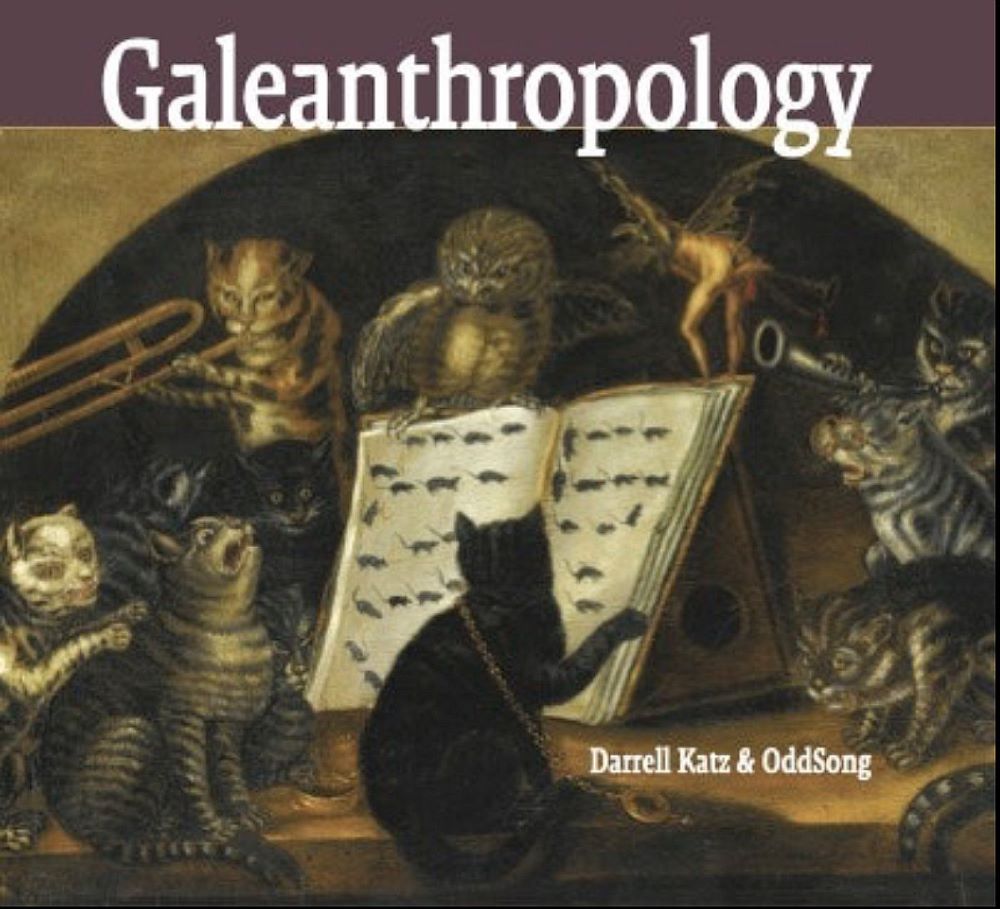
Darrell Katz & Oddsong - Galeanthropology (November 2021 JCA Recordings)

Composer-arranger Darrell Katz’s New OddSong CD Features Original Songs, Pop Classics, and Jazz Standards

Unique ensemble features four saxophones, violin, marimba, and voice 

“a progressive and creative orchestrator of new music in a way that few can claim.”
— Michael G. Nastos, All Music Guide 
 
“Darrell Katz is the heir to the great George Russell–composer, arranger, innovator par excellence. Just as Russell invented the Lydian Chromatic Concept of Tonal Organization... Darrell Katz has redesigned and integrated song form into the ‘jazz’ orchestration and attracted major soloists to his visioning of the art.”
— Steve Day, Sandy Brown Jazz 

The artistic vision of jazz composer Darrell Katz recognizes no boundaries and Galeanthropology (JCA, November 19, 2021) is a varied showcase of his genre-spanning interest in American music from Jimi Hendrix’s “Belly Button Window” to original jazz-art song settings of the poetry of Paula Tatarunis. Working with the drummerless ensemble OddSong, which gracefully blends composition and improvisation into seamless performances, the album ranges from gritty blues to sublime meditations on the vagaries of life. 

Settings of poems by Katz’s late wife, Paula Tatarunis, are among the highlights of the album. Few modern composers, in any genre, are as good as Katz at composing music for voice that reinforces the meaning of words. Sung with luminous transparency by vocalist Rebecca Shrimpton, “Guiding Narrative” is a poignant poem about the inevitability of misfortune in life. It features a melody seamlessly linked to the cadence of the words, while rhythmic phrases from the marimba and saxophones provide jazzy propulsion, and the instrumental scoring shades and deepens the meaning. Violinist Helen Sherrah Davies’ rhapsodic, melancholy solo beautifully encapsulates the poem’s rueful irony and sadness. The final line of the poem was originally scored for voice and violin, but Katz ended up scoring for a trio of voices. Written while Katz was recovering from knee replacement surgery, the poem is the source of the band’s name. “I was in the hospital, having a difficult time with my recovery from surgery,” Katz says. “And so it’s about me—I was lost in the forest of the night. Not only did it give me the name of the group, but it was a name that Paula called me.” 

A little studio manipulation helped create the moving “Women Talking.” When the group performed it live, women members of the band talked among themselves at the opening of the song. But Katz didn’t feel it had the comforting quality he wanted, so he gave lines that Tatarunis had written to female members of the band, then created a collage of voices in the studio. The music shadows the words sometimes echoing them (the droplets of marimba notes when Shrimpton sings “rain whispering”) and sometimes amplifying the beautiful melancholy of the poem. Phil Scarff interweaves a lovely soprano sax solo into the ensemble and a collective improvisation is perfectly integrated into the flow of the score. 

Vocalist Shrimpton (whose virtuosic solo rendition of Mingus’ “Duke Ellington’s Sound of Love” is an album highlight) recites “Outta Horn,” the story of a discouraged poet inspired seeing John Coltrane in a club, told in what Katz describes as Tatarunis’ “detective novel/film noir” voice. The accompanying music offers a commentary on the story that balances composition and improvisation. “There are scored passages, but also section that include only directions as to what person is playing and when, when everybody stops or what approach they should take; it's mapped out,” Katz explains. “So, each performance has some kind of similarity to the others, but there are important differences.” 
The title track, a witty and loving tribute to Tatarunis written by Katz, is playfully humorous (much like Tatarunis’ poetry often is) with a tender emotional twist at the end. The title derives from a mental condition in which patients believe they are a cat. The music is playful with the words—for instance, there’s a quote of Charlie Parker’s “Ornithology” in response to the question “Wouldn’t you really rather be a bird?” Alto saxophonists Rick Stone and Lihi Haruvi, in another nod to Parker, are the soloists. 

Arrangements of “Sweet Baby James” and the Standell’s garage band anthem “Dirty Water” have their origin in Jazz Along the Charles, a 2018 outdoor concert in Boston during which jazz groups played their interpretations of Boston-related songs. Instead of the original spoken introduction to “Dirty Water,” Katz substitutes “Microtonal.” The tough guy persona of the poem’s voice fits with the song’s outlaw sensibility, but Katz’s abstract setting contrasts with the song’s famous rhythmic hook. Baritone saxophonist Melanie Howell Brooks uses that hook to propel her flowing, blues-inflected solo. Musically related, are settings of the folk song, “I Am a Poor Wayfaring Stranger,” Jimi Hendrix’s “Belly Button Window,” and Katz’s bruising ballad original, “The Red Blues,” an homage to Julius Hemphill. Katz translates them into the sound world of OddSong with his own riffs and rhythmic figures, tart and often surprising harmonies, and opens them to the band’s superb soloists. 

OddSong handles the many demands of the music with graceful flair. Comprised of a saxophone quartet with violin, marimba, and voice, OddSong walks a fine line between classical chamber ensemble and big band sax section. Their passionate engagement with music, from the unclassifiable fusion of jazz and classical elements in “Guiding Narrative” and “Women Talking” to the jazzy harmonies and funky swagger of “Dirty Water” and “Belly Button Window,” indicate a band perfectly in tune with its leader’s vision. The instrumentation gives Katz plenty of opportunity to work with unusual textures and timbres and the group displays a fine-tuned balance that allows all the colors to shine through. 

Musician-composer-bandleader-educator Darrell Katz is a composer of uncommon range and broad vision, able to weave influences from every musical sphere into his own unique voice. The Boston Phoenix called him, "one of Boston's most ambitious and provocative jazz composers." As director of the Jazz Composers Alliance (JCA), an organization he helped found in 1985, Katz has documented his large ensemble work on 10 previous CDs with the Jazz Composers Alliance Orchestra. His JCA Orchestra album Wheelworks was named one of DownBeat’s best CDs of 2015. He debuted his smaller OddSong ensemble in 2016 with Jailhouse Doc with Holes in Her Socks. Lynn René Bayley, writing in Art Music Lounge, called it “one of the most fascinating jazz albums of 2016, possibly one of the finest albums I’ve heard regardless of genre.” Jerome Wilson, of All About Jazz says “Listening to Darrell Katz's music, it boggles the mind that he is not celebrated as one of the best jazz composers/arrangers around. He has been creating ambitious and accessible works full of humor, social conscience and creativity for decades...” 

Saturday, September 3, 2016

Jailhouse Doc With Holes In Her Socks Darrell Katz and OddSong (2016)


JAZZ COMPOSER DARRELL KATZ DEBUTS UNIQUE NEW ENSEMBLE, ODDSONG 

Jailhouse Doc with Holes in Her Socks available September 30, 2016 on JCA Records 


Featuring the poetry of the late Paula Tatarunis set to Katz’s music and performed by OddSong with vocalist Rebecca Shrimpton; saxophonists Phil Scarff, Melanie Howell Brooks, Jim Hobbs and Rick Stone; marimba player Vessela Stoyanova; violinist Helen Sherrah-Davies; JCA Winds, and the JCA Orchestra with special guest Oliver Lake

 “Katz has synthesized a wide range of influences including modern classical, folk/blues traditions, and the entire jazz legacy into a mature and personal compositional style.” ⎯ Boston Phoenix

CD Release Concert Sunday, October 2 at the Lily Pad, Cambridge, MA

With Jailhouse Doc with Holes in Her Socks, jazz composer Darrell Katz introduces his latest ensemble, OddSong, an unusual and perfectly balanced group featuring four saxophones, violin, vibraphone/marimba, and voice. Listeners familiar with Katz’s work with the Jazz Composers Alliance Orchestra (JCA Orchestra) will recognize many of the compositions. But Katz, who has consistently striven to push himself as a composer, has reimagined them for the more intimate setting of OddSong. Katz, a strikingly original compositional voice for more than 30 years, once again finds new orchestral colors, new moments of beauty, and new ways to inspire the improvisers in his band to great heights. 

Many of the album’s new arrangements, as well as five new compositions, are settings of the poetry of the late poet Paula Tatarunis, whose words have inspired some of Katz’s best work, and her spirit permeates the album. She provided the name of the ensemble in a poem in which she addressed Katz, her husband, as “Oddsong.” And she was very much on the mind of everyone in the studio as the album was recorded while she was in critical condition in the hospital. “This album was not originally conceived as an homage to Paula; I just wanted to present the new group,” Katz says. “But it became an unintended tribute to her when she tragically died four months later. She will always be part of my life, and in my heart forever.”

From the beginning of the project, Katz was primarily interested in exploring the sonic potential of his new ensemble. “One of the challenges of a group like this is to find a way to keep the momentum going without drums and bass,” Katz says. “Since I’ve composed for and recorded with the JCA Sax Quartet (I’m Me and You’re Not, 1998), I already had some ideas. The additional instruments gave me more voices, colors, and textures to work with. And I knew they would blend really well.”

Indeed, Katz consistently finds new ways to drive the music. There’s Melanie Howell Brooks’s thundering baritone sax line that both anchors and drives the title track. The steady pulse of Vessela Stoyanova’s marimba provides a smoothly rolling base for the lurching, zig-zag saxophones on “Tell Time,” pitting regular and irregular rhythms against each other. And on “Red Blue” Katz’s riffs and supporting motifs generate swinging forward motion.

Without drums, Katz is also free to explore subtle timbres and dynamics and he often breaks the ensemble down into smaller subgroupings to keep the sound varied. The result is a shifting sonic tapestry on “Lemmings” as duo and trio combinations of instruments take turns accompanying Shrimpton. On “Squirrel” and “Gone Now,” instrumental commentary combining classical, jazz, and blues inflections can be dark and dense or bright and airy, comical or serious. 

Katz excels at composing music that mirrors the tone of the words and in wedding poetic cadences to musical ones. The near indivisibility of words and music on “Like a Wind,” from the novel, Winesburg, Ohio, by Sherwood Anderson, and Tatarunis’s darkly humorous “Lemmings” are good examples. Once again, as she has on many previous JCA Orchestra albums, vocalist Rebecca Shrimpton brings the words to glorious life with her crystalline voice and sensitive attention to each poem’s meaning. 


Katz is also a composer dedicated to unleashing improvisers to do their thing. “Nothing pleases me more then to let creative musicians loose on a pathway that I’ve been able to open for them,” he says. Highlights include a scorching solo by Jim Hobbs and a beautiful alto duet between Phil Scarff and Rick Stone on “Jailhouse Doc with Holes in her Socks,” Scarff’s elegant soprano solo on Sherrah-Davies’s arrangement of Astor Piazzolla’s “LLAP Libertango,” and a rollicking solo by special guest Oliver Lake on a live performance of “The Red Blues/Red Blue” with the JCA Orchestra. Violinist Helen Sherrah-Davies projects great sadness and dignity during her solo on “Libertango.” There are several passages of collective improvisation throughout the album, most notably the completely improvised “Prayer,” which opens the disc. 

The Boston Phoenix called musician-composer-bandleader-educator Darrell Katz "one of Boston's most ambitious and provocative jazz composers." The paper could just as easily have said one of the entire jazz world’s most ambitious and provocative composers. His work with the JCA Orchestra, as documented on 10 previous CDs, shows a composer of uncommon range and broad vision, able to weave influences from every musical sphere into his own unique voice. His 2015 release, Why Do You Ride?, includes “Wheelworks,” a setting of quotations that Albert Einstein may or may not have said. In a 4-star DownBeat review, Ken Micallef called it, “rich, swinging and often surprising … Why Do You Ride? balances modern music with timeless intellectual pursuits (and humor).” Jazz de Gama described it as “pure and mad … Borges-like and sublime … a breathtaking eight-part invention that delights as much as it mystifies and dazzles at the same time.”

As director of the Jazz Composers Alliance (JCA), an organization he helped found in 1985, Katz has been a strong proponent of artist self-empowerment, providing a vehicle for forward-thinking composers to hear their works realized by some of Boston’s best musician-improvisers. The artist-run Julius Hemphill Composition Awards (1991-2001), which in its final year received 240 compositions from 28 countries, provided a means of international community building and a way for peers to acknowledge the work of their fellow composers. He has received a Massachusetts Artist Fellowship in composition, three Massachusetts Artist Fellowship finalist awards, a Jazz Fellowship Grant from the NEA, and grants from Meet the Composer, The Aaron Copland Fund, The New England Foundation For The Arts, the Artists Foundation, the National Association of Jazz Educators and three Readers Digest/ Margaret Jory copying grants, as well as a Faculty Fellowship from Berklee College of Music, where he currently teaches. 

Jailhouse Doc with Holes in Her Socks is another milestone in the three-decade journey of growth and discovery in the music of composer Darrell Katz. 


Jailhouse Doc with Holes in Her Socks available September 30, 2016 on JCA Records