
Showing posts with label INFREQUENT SEAMS. Show all posts

Friday, March 18, 2022

Kyle Motl - Hydra Nightingale (March 18, 2022 Infrequent Seams)

Hydra Nightingale features premiere recordings of recent works for solo contrabass by Caroline Louise Miller, Jessie Cox, Anqi Liu, and Asher Tobin Chodos, performed with vivid clarity by Kyle Motl. Miller’s Hydra Nightingale weaves melodic threads, rattly string noise, and multiphonic noise as a living organism. Liu’s Light Beams Through Dusts, Through a Mist of Moistures views the bass through a post-spectral lens where hazy clouds of barely audible harmonics give way to grinding multiphonic textures. Cox’ Nachklang employs multiphonics and pressure techniques on prepared strings, bringing the bass to speak with a fragile whisper that resonates with glistening tones. Motl’s own Phosphene conjures a hallucinatory polyphony of light by way of oscillating harmonics. The only work with electronic media, Chodos’ Trickle Town brings loopy rhythms in dialogue with Ronald Reagan speeches. Together, these works present a multitudinous yet cohesive view into the possibilities of solo bass.

We speak of sound in terms of high and low, and in doing so we carry some of that metaphor’s cruelty into discussions of music. As the bass has emerged as a solo instrument, some of that cruelty has lost its purchase. But some survives, and by surviving gives this album a delightful plaything.

Hear a low tone. Take a pause. Now hear a chord three octaves up. Is there not some primordial instinct to measure each of the sounding tones against the remembered bass note? The dialogue between the two registers is not innocent of such vestigial hierarchies. Or, at least, from such habituated ways of listening. These habits are exactly what this album toys with, inverting them and working them into beautiful new shapes.
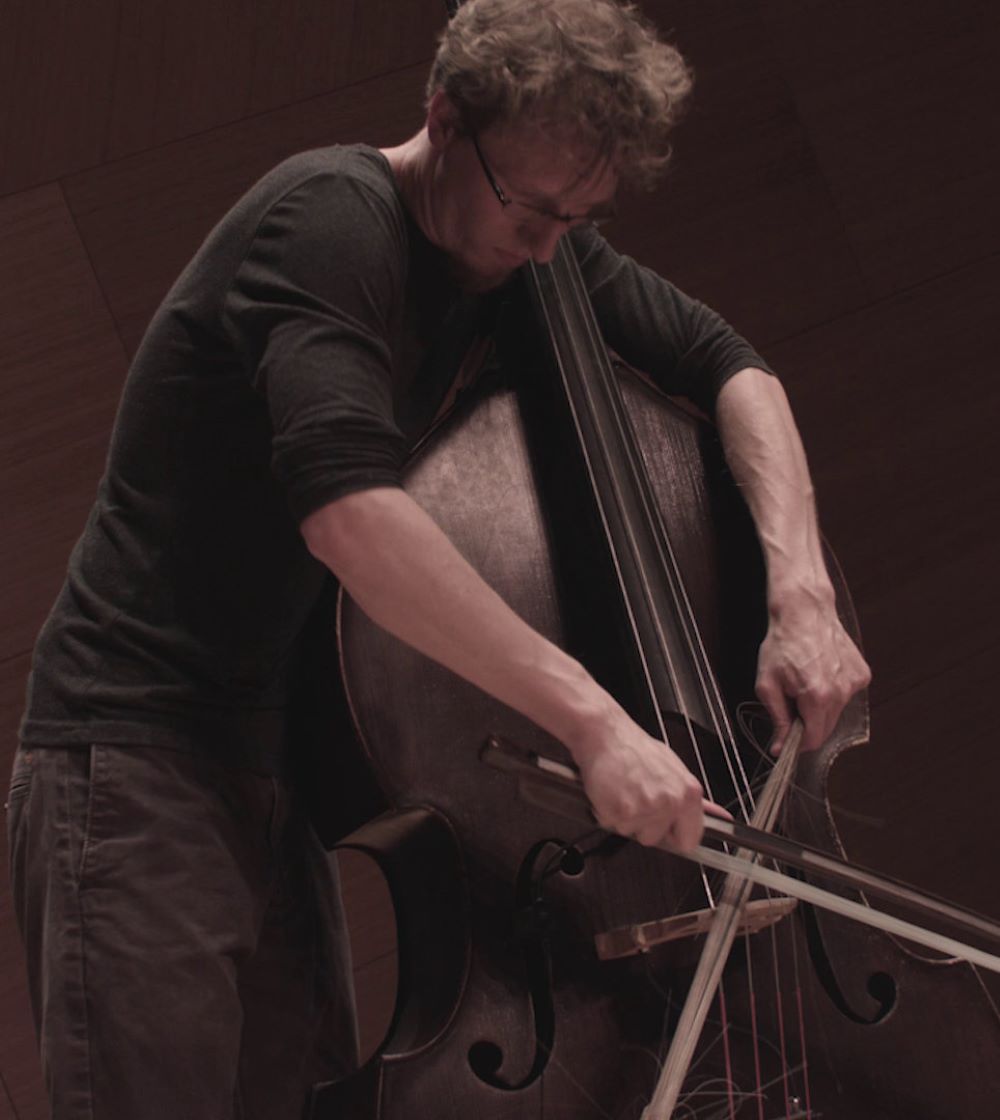
How long, this album asks, and through what disorienting spectral straits, will you continue to cling to a fundamental before you relinquish it as the foundation for everything else? What is the muddiness threshold beyond which a musical figuration is no longer acceptable as a motif? Why is there such a thing as basso buffo, and is the bass even a low instrument to begin with? The works on this album do not castigate these ancient music-theoretical conceits, but instead stand as benign witnesses to their partial decomposition. This music in part eases their passage, but it also seems to tease them on their deathbeds and play with their cadavers.

Each of these pieces, in other words, works by defamiliarizing the lower half of the audible spectrum. If the history of bass notes is a landscape of distantly perceived but rhetorically decisive stratification, these pieces are a quiet and ambiguous form of subterfuge. Instead of proclaiming loudly that the emperor’s clothes don’t exist, they steal them from his bedroom, put them on backwards, and dance in the center of town. 

1. Caroline Louise Miller - Hydra Nightingale (2017)
2. Anqi Liu - Light Beams Through Dusts, Through a Mist of Moistures (2019)
3. Kyle Motl - Phosphene (2016/2018)
4. Jessie Cox - Nachklang (2018)
5. Asher Tobin Chodos - Trickle Town (2016)

Kyle Motl - contrabass

Hydra Nightingale, Light Beams…, and Nachklang recorded by Matt Baltrucki - March 27, 2021 in Boca Raton, FL

Phosphene recorded by Kyle Motl - September 8, 2021 at Earthdance, Plainfield, MA

Trickle Town recorded by Alexandria Smith - April 26, 2019 at UC San Diego, Warren Studio A

Mixing & mastering by Matt Baltrucki (except for Trickle Town, mixed by Alexandria Smith)

Design and layouts by Dustin Krcatovich (Golden Feelings)
Cover painting by Leah Asher (2021)
Executive producer: James Ilgenfritz

Friday, October 29, 2021

Kyle Bruckmann - Mesmerics​​ / Hindsight B (October 29, 2021 Infrequent Seams)

Restless new music chameleon Kyle Bruckmann (best known as an improvising oboist mining the intersection of free jazz, noise rock and contemporary classical) offers his first fully electronic solo release.

Sourced primarily from vintage analog synthesis, this double-album diptych anachronistically evokes, from a sardonic post-techno vantage point, both late 60s and late 70s experimentation. Attempted minimalisms chafe at their own restraints, bursting at the seams to comprise “a suite of weighted blankets for an intracranial dancefloor.” By turns hypnotic, immersive and bludgeoning, "Mesmerics/Hindsight" charts an unlikely Venn diagram linking the Day-Glo legacy of the San Francisco Tape Music Center with proto-Industrial’s bleak, gray throb.

While the influences of those two seminal electronic music eras map roughly onto the two albums respectively, echoes of each reverberate throughout. "Mesmerics/Hindsight A," on balance, prioritizes space; "Mesmerics/Hindsight B," periodicity. The limited-edition 90-minute cassette contains both albums; purchases of the physical edition include digital downloads of both.

Throughout the quarantined conditions of 2020-21, Bruckmann sought a stop-gap for his preferred creative modes of highly collaborative, real-time interactivity by indulging in a hermetic practice of solo electronic explorations. Between his home studio and the electronic music labs of two colleges where he teaches, he exploited access to an instrumentation featuring classic Buchla, Moog and E-mu gear alongside more contemporary Eurorack modules.
"The physically and psychosocially distanced circumstances of 2020-21 have found me driven further into my own head and deeper into solo work and circuitry. Offered here are selected research findings from that at times harrowing journey: a suite of weighted blankets for an intracranial dancefloor.

A parallel dimension of hindsight: as I hurtle through middle age and devote an ever larger portion of my career to teaching, I’m confronted with the inevitability of my aesthetics growing ever more ossified, anachronistic, irrelevant. To my students and younger colleagues, I suspect I have become the equivalent (vis-à-vis Ohio in the mid-70s, the Lower East Side in the early 80s, Chicago in the late 90s, etc. etc.) of the boomer who won’t shut up about Woodstock.

One possible response? Double down, as they say; make that central to the creative exercise. This is, in part, an interleaved love letter to two volatile junctures (both especially salient in the history of the synthesizer) on which I’ve remained perennially fixated: the heady intersection of 'art music' experimentalism with 'popular' psychedelia as the 60s skidded through the Altamont Pass into the 70s, and the gag reflex of post-punk and industrial as the 70s gave way to the Anglo-American neocon hellscape of the 80s.

I particularly acknowledge indebtedness to a West Coast electronic music legacy with roots in the San Francisco Tape Music Center, but that also encompasses the likes of the League of Automatic Music Composers, the Residents, Screamers, and the ongoing Brutal Sound FX empire. (Rest in power, Mills College CCM.)" 


1. Blindside 03:32
2. Used To Dance 04:12
3. Mind Blight 03:53
4. Mesmeric (sedimentary) 05:38
5. Large Gatherings 03:57
6. Mesmerics (metaphoric) 04:29
7. Use for Dance 03:18
8. Fight | Flight 02:55
9. Mesmeric (igneous) 05:07
10. Keinzeit 04:31

Kyle Bruckmann, electronics

Mastered by Myles Boisen, Headless Buddha Mastering Labs, Oakland, June 2021
Cover image & Layouts: Dustin Krcatovich / Golden Feelings

Kyle Bruckmann - Mesmerics​ / ​Hindsight A (October 12, 2021 Infrequent Seams)

Restless new music chameleon Kyle Bruckmann (best known as an improvising oboist mining the intersection of free jazz, noise rock and contemporary classical) offers his first fully electronic solo release.

Sourced primarily from vintage analog synthesis, this double-album diptych anachronistically evokes, from a sardonic post-techno vantage point, both late 60s and late 70s experimentation. Attempted minimalisms chafe at their own restraints, bursting at the seams to comprise “a suite of weighted blankets for an intracranial dancefloor.” By turns hypnotic, immersive and bludgeoning, "Mesmerics/Hindsight" charts an unlikely Venn diagram linking the Day-Glo legacy of the San Francisco Tape Music Center with proto-Industrial’s bleak, gray throb.

While the influences of those two seminal electronic music eras map roughly onto the two albums respectively, echoes of each reverberate throughout. "Mesmerics/Hindsight A," on balance, prioritizes space; "Mesmerics/Hindsight B," periodicity. The limited-edition 90-minute cassette contains both albums; purchases of the physical edition include digital downloads of both.

Throughout the quarantined conditions of 2020-21, Bruckmann sought a stop-gap for his preferred creative modes of highly collaborative, real-time interactivity by indulging in a hermetic practice of solo electronic explorations. Between his home studio and the electronic music labs of two colleges where he teaches, he exploited access to an instrumentation featuring classic Buchla, Moog and E-mu gear alongside more contemporary Eurorack modules.

"The physically and psychosocially distanced circumstances of 2020-21 have found me driven further into my own head and deeper into solo work and circuitry. Offered here are selected research findings from that at times harrowing journey: a suite of weighted blankets for an intracranial dancefloor.
A parallel dimension of hindsight: as I hurtle through middle age and devote an ever larger portion of my career to teaching, I’m confronted with the inevitability of my aesthetics growing ever more ossified, anachronistic, irrelevant. To my students and younger colleagues, I suspect I have become the equivalent (vis-à-vis Ohio in the mid-70s, the Lower East Side in the early 80s, Chicago in the late 90s, etc. etc.) of the boomer who won’t shut up about Woodstock.

One possible response? Double down, as they say; make that central to the creative exercise. This is, in part, an interleaved love letter to two volatile junctures (both especially salient in the history of the synthesizer) on which I’ve remained perennially fixated: the heady intersection of 'art music' experimentalism with 'popular' psychedelia as the 60s skidded through the Altamont Pass into the 70s, and the gag reflex of post-punk and industrial as the 70s gave way to the Anglo-American neocon hellscape of the 80s.

I particularly acknowledge indebtedness to a West Coast electronic music legacy with roots in the San Francisco Tape Music Center, but that also encompasses the likes of the League of Automatic Music Composers, the Residents, Screamers, and the ongoing Brutal Sound FX empire. (Rest in power, Mills College CCM.)

Track-specific notes are due only to A Perforated Kakemono for Henri Michaux, the earliest completed of these pieces (premiered in February 2020 at SF’s Center for New Music in 8-channel diffusion, thanks to Chris Brown’s curation). It is a souvenir from a New Year’s ritual with loved ones – an auspicious transition into what became a most inauspicious year. In tethering it to literary baggage, I must thank Matt Shears, who leant me Thousand Times Broken: Three Books, translated from the French by Gillian Conoley (City Lights, 2014). From Michaux’s introduction to Peace in the Breaking (1959):

“This vibratile carpet, which had something in common with electrical discharges with ramified sparks, as well as with magnetic spectra, a certain something that trembled, that burned, that tingled, like spasms turned into nerves, this tree with fine branches, that could also be lateral bursts, that tempestuous fluid, contractile, shaken, effervescent, but elastically held and kept from overflowing through some sort of surface tension, that nervous projection screen, even more enigmatic than the visions that arose on it, I don’t know, I will never know how to talk about it properly.” (p. 43) 

1. Hindsight I: Epigraph 04:15
2. Hindsight II: Occam’s Blunderbuss 17:02
3. Hindsight III: October 2020 (Fallen Leaf Lake) 06:11
4. Hindsight IV: A Perforated Kakemono for Henri Michaux 16:50

No double reeds were harmed in the making of this music.

Mastered by Myles Boisen at Headless Buddha Mastering Labs, Oakland, June 2021

Friday, June 25, 2021

Matthew Goodheart & Broken Ghost Consort - Presences: mixed suite for five performers and nine instruments (June 25, 2021 Infrequent Seams)

Presences: mixed suite for five performers and nine instruments is a multimovement collaborative composition by composer, improviser, and sound installation artist Matthew Goodheart. Working with his Broken Ghost Consort (featuring Georg Wissel on clarinet and George Cremaschi on bass), the group is expanded by noted trombonist Matthias Muche and veteran tubist Melyvn Poore. Goodheart, known for his “reembodied sound” technique of activating musical instruments using surface transducers, brings this technique to the ensemble as a whole, harnessing the player’s instruments with transducers so that they produce electronic sounds as the performers play. The group of musicians is additionally surrounded by four transducer-activated metal percussion instruments, creating an expensive hybrid ensemble that blends performance and sound installation.

The collaborative nature of the work emerges from the compositional design. While Goodheart provided an overall framework, each musician recorded a set of instrumental sounds of their own choice. These sounds were then and manipulated according to the compositional parameters, generating the electronic components to be played back in concert through the attached transducers. The ensemble essentially performs alongside a “ghost” of themselves and the autonomously sounding metal percussion.

Over the course of four movements, this process becomes a multi-leveled platform to explore complex timbres, spatialized sound, instrumental acoustics, interaction, and the nature of time and materiality in sonic creation. 
1. Prelude in Disintegrations
2. Interlude
3. Impulse Response Variations
4. Closing Forms

Composer: Matthew Goodheart
Broken Ghost Consort:
Georg Wissel – clarinet
Matthias Muche – trombone
Melvyn Poore – tuba
Matthew Goodheart - piano
George Cremaschi – bass

Produced by Georg Wissel

Recorded June 13, 2019, The Loft, Köln
Recording Engineer: Stefan Deistler
Mixed by - Matthew Goodheart
Mastered by - Jonah Rosenberg at Blooming Lightways

Thursday, November 9, 2017

Miya Masaoka / Zeena Parkins / Myra Melford - MZM (INFREQUENT SEAMS 2017)


Ten improvised pieces from three of the most innovative instrumentalists at work today, blending harp, piano, and koto with electronic sounds. The new trio of Myra Melford, Zeena Parkins, and Miya Masaoka is called MZM. Each made an indelible mark in the last three or four decades of experimental music, and their improvisations blend together all of the various histories that evolved from their disparate activities. From sound-art to noise rock to modern jazz, are each known both for their extensive output as leaders and their their work with a who's who of adventurous music: Bjork, Nels Cline, Steve Coleman, Dave Douglas, Mark Dresser, Fred Frith, Joseph Jarman, George Lewis, Pauline Oliveros, Yoko Ono, Tin Hat, Christian Wolff, and many others.

1. Red Spider 03:28
2. Bug 04:44
3. Saturn 04:55
4. Eight-burst 06:37
5. Retina 03:33
6. Taurus 03:57
7. Southern Owl 05:43
8. Spiral 06:03
9. Ant 08:28
10. Rosette 06:10

Miya Masaoka – 21-string Koto
Zeena Parkins – Electric Harp, Electronics
Myra Melford – Acoustic and Prepared Piano

All music composed & performed by:
Myra Melford, (GEMA), Sun on the Sound Publishing (BMI)
Zeena Parkins, eyeofnight (ASCAP)
Miya Masaoka (ASCAP)

Recorded by Jay Cloidt, Hertz Hall, Mar 9, 2014 and Center for New Music and Audio Technologies (CNMAT), Jan 22, 2016, University of California, Berkeley

Mixed by Tom Hamilton, Aug 20, 2016, New York City

Design: Miya Masaoka
Layouts: Yuri Zupancic
Group Photo by Heike Liss

Special Thanks:  Edmund Campion, Jeremy Wagner and Richard Andrews at CNMAT

In memory of David Wessel, our dear friend and colleague who will never be forgotten.


In improvised music we encounter a space of freedom, which is specific to this music. It speaks to us, wants to be exhausted, forded and explored. The potential of this freedom at hand seems to be borderless and signifying for this form of music. "We search for sounds. We look for the meanings that become attached to sounds. And we have to decide – on the basis of observable responses – on the musical, cultural and social values that reside in whatever configurations emerge. The search is surely for self-invention and social-invention. This is an opportunity to make our world" (Edwin Prévost). It seems to be natural in improvised music, that we are addressed as beings that do not only learn sounds, explore and constellate them, but also define their self- and world- relations. In the conversation of this music, we are not merely preservers of a tradition and members of a self-iterating community, or actors in a fixed play of society, limited to one specific form of life. Rather, as one could say with Hegel, the musician could be seen as an agent of a self-accomplishing skepsis. 

But skepsis and change are inscribed into our post-Nietzschean society in a prominent way, which is why we have to ask what else is signifying for improvised music. It seems to be neither the search for new sounds (on its own), which is also a standard modus-operandi of many other forms of music, nor the constitution of a value system and a world picture, which is always the case. If we ask, "who is searching for the sounds, where and how are they shared, how is the search being conducted," it seems that we see a clearer picture. For improvised music it is signifying, that these unique agents, the searching and sounding individuals, are presenting their sounds (and therefore themselves) to a society of the like-minded, after they have asked / while they are asking their instruments about sonic potentials. It is a society of poets who speak with an "idiosyncratic vocabulary" (Richard Rorty), which meets on the basis of their own languages, in a forum of egalitarian discussion. This discussion shows a specific form of openness and acceptance for the contingency of the individual proposals and has an increased degree of acceptance for skepsis. In relation to society, improvised music has to be understood as a utopian project that hints to a horizontally organized, non-hierarchical discourse. It is the courage / the need for skepsis and the discursive play of the individual actors, that distinguishes improvised music. Improvised music is the realm of a hyperbolic constructive skepsis, which, in the words of Immanuel Kant, is asking: "sapere aude.” 

If, in the light of this theoretical lens, we take a look at the music of Miya Masaoka, Zeena Parkins and Myra Melford, the courage of their discussion is striking. All three artists have done groundbreaking work in their field and have been important voices in the development of creative music in the last few decades. Every one of them has, as both performer and composer, developed a unique body of work, which contains their individual sonic utopias. Miya Masaoka has found international recognition as a Koto-player, composer, performance-and sound artist. Zeena Parkins is an internationally known multi-instrumentalist, harp-player, composer and improviser. Myra Melford has been internationally successful as a piano player and composer as well. All three have received diverse awards and prizes for their work and have been/are serving as teachers at different highly recognized universities. 

It is in the autonomy of the individual projects and the idiosyncrasy of the languages, where they musically debate with each other. In the unfolding discussion, the willingness for parallelism and the heterogeneity of material and ideas, which rest upon a deep mutual understanding and trust, play an important role. The music becomes a forum of exchange between strong individual voices and natural forces, which is resting upon the mutual challenge that the participants are posing to each other. They are addressing the question “Why do we improvise?” in a highly adventurous way. Following a concept of German philosopher Hans-Georg Gadamer, we can understand the musical exchange as a transformative conversation, which is resting upon a constructive reception of the productive skepsis, inherent to improvised music, and is opening the view for a form of life: 

“You must have chaos within you to give birth to a dancing star” (Friedrich Nietzsche) 

Liner Notes by Nicola L. Hein, 2017