Showing posts with label Joanna Mattrey. Show all posts

Friday, September 24, 2021

NEW RELEASE: Gabriel Zucker's LEFTOVER BEATS FROM THE EDGES OF TIME is due out September 24, 2021 via ESP-Disk’

Gabriel Zucker presents Leftover Beats From The Edges Of Time, a new album with The Delegation, out September 24, 2021

“Zucker creates a compelling, mysterious world that is as beautiful as it is elusive…” 
— All About Jazz

Leftover Beats From The Edges Of Time, the latest release from polymath and musical maximalist Gabriel Zucker, is a sprawling and ambitious achievement. Five years in the making, the 90-minute record defies categorization or synopsis, featuring complex mixed-meter jazz, virtuosic chamber music, electronic soundscapes, and indie art rock — performed with emotion and urgency by Zucker’s virtuoso large ensemble The Delegation. Leftover Beats From The Edges Of Time will be available on September 24, 2021 on ESP-Disk’. An album release show will take place at Roulette, located at 509 Atlantic Avenue in Brooklyn, on Tuesday, October 5th at 8:00 PM.

Despite its stylistic variety, Leftover Beats musically coheres as a single, carefully crafted composition, portions of which were premiered at Carnegie Hall and Roulette in 2017 and 2019. Written primarily between 2015 and 2018, during several stints Zucker spent living and performing in England and throughout Europe, the record reckons with time, and with the competing impulses of a backwards-looking nostalgia and a forwards-looking futurist belief in progress. “It’s something Americans have been talking about for generations, but the age and gravity of the so-called Old World is always so striking and so palpable,” says Zucker. “As a New Yorker, you find yourself among these ancient buildings in the old capitals of Europe, struck by their beauty, and yet always missing New York’s dynamism.”
“Zucker’s advanced compositional work is knotty, unpredictable, and utterly satisfying.” 
— JazzTrail

Zucker’s classical training shines as he effortlessly recycles six primary leitmotifs in seemingly endless permutations. Just moments after we first hear the titular ‘Leftover Beats’ melody in the first movement, “Requiem I: Leftover Beats,” it shows up again as a fragmented, perpetual-motion texture in the horns in “Such Closer I” — a sign of the iterations to come. Each movement is a collage of half-familiar characters, in ceaseless organic development.

The work is split into four sections of three movements each. The section names — “Past,” “Autumn 2016,” “Present,” “Future” — tell us we are moving forward in time, but the eclectic journey is anything but linear or predictable. The “Past” is manic and alive, culminating in the contrapuntal chamber-music romanticism of “How To Keep, Forever.” “Autumn 2016” opens with “Someone to Watch You,” which reaches its grand climax in a cycle of irrational meters that the band renders warm and sweet. But the section focuses mainly on November. “This notion that progress isn’t linear and forwards motion can be illusory played out so blatantly and painfully on November 8 — right as I was in the middle of composing,” Zucker says. The night of the election is grotesquely illustrated at the end of the record’s sixth track, “Confidence White.”

The “Present” that comes next feels subdued and chastened in its aftermath, with the James-Blake-inflected synth pop of “Songbird” and the hyper-produced prog jazz stylings of “Shallow Times.” And the “Future” is a dreamscape of synthesizer and sound collage nightmares punctuated by a Mahler-esque climax in “Requiem III,” before we close on Zucker’s solo piano in “How to Know, Forever,” drifting off into the sands of time.

Part of the structural conflict of Leftover Beats is built on a dialogue between two different ensembles: Several movements are performed by a chamber ensemble of Zucker, Mariel Roberts (cello), Joanna Mattrey (viola), Kate Gentile (drums), Yuma Uesaka (clarinet), and Nolan Tsang (trumpet), while the rest feature a larger ensemble of horns, rhythm section, and voices. More firmly rooted in jazz, this latter ensemble prominently features the playing of Adam O’Farrill on trumpet and Anna Webber on tenor saxophone.
Photo of Gabriel Zucker by Michael Yu

“Piano firebrand.” 
— Brooklyn Rail

The live bands were tracked in 2017 and 2019, but Zucker didn’t fully return to the recordings until the pandemic year, which he spent living nomadically in the desert of New Mexico. Far from other musicians and from the city, he turned to the tools at hand, weaving a dizzying array of synthesizers, samples, field recordings, and effects over the raw performances — disorienting waves of sound that constantly threaten to and sometimes entirely overwhelm the instrumentalists and singers. Many artists have Zucker’s skill and creativity as composers, performers, or producers — but few have such simultaneous ambition in all three.

Yet through all of the grandiose themes and overwhelming sounds, Leftover Beats is intensely personal and vulnerable — a record of confessional songs. Zucker’s rich and nuanced lyrics range from the esoteric to the direct, circling around short, emotional, aphoristic appeals repeated like mantras. The record’s first half features the effortless and beautiful vocals of Artemisz Polonyi and Lorena Del Mar, but as the album progresses the lyrics are increasingly sung by Zucker himself, in an intimate baritone over the chaos.

Leftover Beats is the second studio album with The Delegation, and Zucker’s fifth overall. It follows 2016’s Evergreen (Canceled World) with the same ensemble, which received 4.5 stars in Downbeat; 2018’s Weighting with a riveting quartet featuring Tyshawn Sorey, which won Best Debut in the New York City Jazz Record and 4.5 stars in All About Jazz; and two records with indie art rock band underorder, in 2017 and 2020.

Friday, August 27, 2021

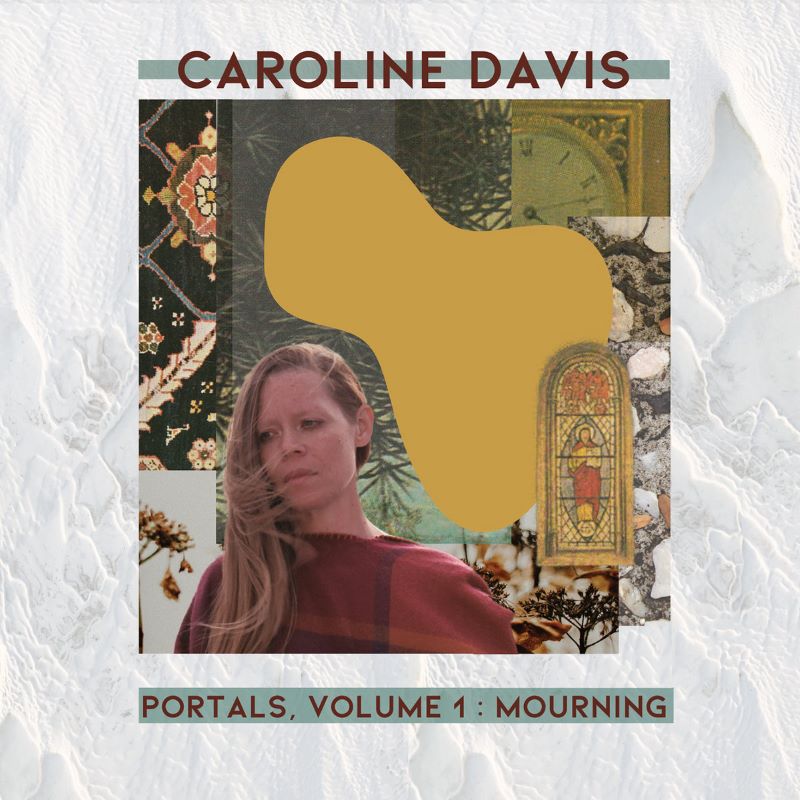
Caroline Davis - Portals, Volume 1: Mourning (August 27, 2021 Sunnyside Records)

One challenge of this frustrating time has been finding methods to handle grief. The loss of loved ones, enforced isolation, and abounding uncertainty have only heightened anxiety and its painful effects. Learning how to cope with grief and work through it is imperative for one’s mental health.

Saxophonist and composer Caroline Davis has done much to try to allay her own emotions after the harsh period she dealt with in 2019. Davis lost her father early in the year and was trying to cope with this devastating event when the pandemic descended. She turned to research and creation to work herself out again. Her new recording, Portals, Volume 1: Mourning, is a culmination of a year of suffering, accepting, and channeling her mourning through a unique process to find equilibrium through composition and reflection.

Davis has always found ways to deepen her musical work by allowing her current preoccupations drive the generation of her art. When her father suddenly passed, Davis was stunned and needed to find a way to express her feelings. She read about grief and trauma, studying the work of Bessel van der Kolk, Mary Oliver, Resmaa Menakem, and Margaret Stroebe. Kübler-Ross’s five stages of grief did not occur in a similar sequence for Davis, so she looked toward the self-help and mystical teachings her father expressed interest in, even up until his passing.

Looking back on her time with her father, Davis began to realize that she must deal not only with the immediate results of his passing but with the legacy of residual pain that he inflicted, intentionally or not. Living at a distance from one another, and his workaholic lifestyle, made things difficult in their relationship. Davis was still wrestling with this.

A welcome aid to Davis’s recovery and work was a residency at the McDowell Artists’ Colony in New Hampshire. At McDowell, she was able to begin sculpting what would become the pieces on Portals, Volume 1. A grant from the Jerome Foundation made it possible for her to complete the remainder of the compositions and recording in 2020.

Portals, Volume 1 is a collection of pieces that Davis wrote for her current quintet along with a string quartet, her first time orchestrating for this instrumentation. The quintet has been her regular group since 2019 and features trumpeter Marquis Hill, pianist Julian Shore, bassist Chris Tordini, and drummer Allan Mednard. For the string quartet, Davis knew that she desired string players who placed improvisation at the center of their practice. Having had the good fortune to work previously with a number of multi-talented players, she was able to recruit violinists Mazz Swift and Josh Henderson along with violist Joanna Mattrey and cellist Mariel Roberts.
The recording was made at Oktaven Audio in Mt. Vernon, New York during December 2020. The studio was a perfect environment for the musicians, and each had COVID tests prior to the dates. Engineer Ryan Streber offered advantageous assistance, helping with pacing and following the musical scores, insuring that every nuance was captured.

The music that Davis composed followed three distinct themes, all tied to recovering from the effects of trauma. The first refers to the intellectual thinking brain and how grief can reorganize one’s memories. The other two focus on the emotional and somatic impacts of grief, one relating to the experience of love and the other associated with bodily and chemical reactions to traumatic events. The experience of trauma is remembering, and reflecting on the past helps to consolidate, as feelings can be complicated and change over time. Examining her bodily reactions and re-drawing physical elements like heart rate, breathing, and eye movements, became a central part of Davis’s practice. These strategies recognized the full scope of using her body as a portal in the process of healing.

The recording begins with “Yesterday’s Seven Thousand Years,” a dynamic piece for the quintet that builds from the rhythm of a quatrain from The Rubaiyat of Omar Khayyám, a poem that Davis discovered when looking back at her father’s photo, accompanied by a quote from this poem as the caption, in his high school yearbook. The next two pieces, “Hop On Hop Off” and “Highlighter Hearts,” are paired, and reflect on specific memories of Davis’s father, fond memories that are also tied to discontent. The first mirrors a hop on, hop off bus tour, the rhythm is the bus slowing down and speeding up, skipping and extending through the piece before halting for a cello feature from Roberts. The swirling “Highlighter Hearts” refers to loving but rushed letters that her father used to send, written in highlighter as it was at hand in the quick, as he was always working.

Davis meditated on nature frequently during her process, especially on textures that could be transferred to human experience. Though her approach to texture in rhythm and harmony can be heard on every piece, “On Stone” is the most representative of this grief as tactile manifestation, as Davis asked the string players to express this hard nature in their improvisations. Continuing that thought, “How to Stop a Drop of Water from Evaporating” takes the rhythm and rationale of one of her father’s riddles (the answer is to throw the water into the sea) and construct a groove-based tune. This piece and “Acephalous Placebo” channel Davis’s father’s interest in energy and faith-based healing, the latter utilizing the ratio of 5:6 to inform the harmonic and rhythmic directions of the composition.

The quiet “Respite” is just that and a thematic foreshadowing of the recording’s conclusion. The tense “Left” deals with the apprehension of being abandoned as a child and the anxiety of not knowing what to do, a violin feature building into an intense ensemble explosion. The subtle “Faced” is entirely improvised and leads to “The Inflated Chariot Awaits Defeat,” a moving meditation on pride and its senselessness with Davis’s poetry and saxophone driving into a dramatic ensemble workout. The recording concludes with the haunting “Worldliness and Non-Duality,” which honors Davis’s father’s last words to her, about his attempts to accept non-duality.

Caroline Davis’s Portals, Volume 1: Mourning is simultaneously melancholy and bright. This is entirely appropriate as the best way to conquer grief is to face the trauma and mindfully engage in its bodily affectations, a message to reflect on as the world begins to blossom again.

1. Yesterday's Seven Thousand Years
2. Hop On Hop Off
3. Highlighter Hearts
4. On Stone
5. How To Stop a Drop of Water From Evaporating
6. Acephalous Placebo
7. Respite
8. Left
9. Faced
10. The Inflated Chariot Awaits Defeat
11. Worldliness and Non-Duality

Caroline Davis - alto saxophone
Marquis Hill - trumpet
Julian Shore - piano
Chris Tordini - bass
Allan Mednard - drums
Mazz Swift - violin
Josh Henderson - violin
Joanna Mattrey - viola
Mariel Roberts - cello

Recorded by Ryan Streber at Oktaven Audio (December 2020)
Mixed & Mastered by Dave Darlington
Original Artwork by Alexa Lima
35mm Photography by Attis Clopton