Showing posts with label Esbjörn Svensson. Show all posts

Friday, November 26, 2021

Nils Landgren / Esbjörn Svensson - Layers Of Light (2 Vinyl LP) November 26, 2021 ACT Music

All music has its roots in folklore. In some playing styles this is easy to recognize. In others hundreds of years of cultural development and change have effectively sublimated those roots. Stripped of ornamentation and structural artifice, however, the foundation remains the same. The melodies and structures that affect and influence people in their day to day lives remain the basis of musical knowledge and experience. They are the blueprints of the collective consciousness and a challenge to the creative spirit. Individuality along with innovation in its surprising, unconventional workings emerge as a contrast to those folk origins. So is the secret art by which the balance between memory and fantasy, between folklore, tradition, and improvisation is weighed.

Nils Landgren was born in 1956 and grew up with the music of his father, a jazz cornetist, and the church music of his grandfather, a pastor. He never lost his strong affinity for his own musical heritage.

Esbjörn Svensson, born in 1964, didn’t want to play folk music at first. At home with the music of Chopin, Ellington, or disco-pop groups such as The Sweet, the pianist had first found his place in the competitive music scene in Sweden. His trio was a success, and in his homeland he was voted jazz musician of the year in 1995 and 1996. The first sprinkling of jobs became a steady flow. Svensson proved himself in the bands of his friend Nils Landgren. The music was about funk  and soul, occasionally pop, and in the main, classic jazz. But not folklore.

It was through the influence of Landgren and Svensson’s former teacher Bengt-Arne Wallin, who recorded the landmark album "Old Folklore In Swedish Modern" back in 1962 (ACT 9254-2), that Svensson and Landgren were inspired to make a duo album centered around folk songs. In August 1997 both went into the studio and with only trombone and piano recorded Swedish Folk Modern (ACT 9257-2). Their improvised treatments of the classic songs of the folk culture not only impressed the public; it brought praise from the press. Svensson and Landgren had created more than just a few impressions in duo. Discarding any sort of large conceptual superstructure, they had continued what Jan Johansson’s Jazz på Svenska and Bengt-Arne Wallin had begun in the early sixties and what has since become a major force within the inner workings of European jazz.

The time after Swedish Folk Modern was hectic and exciting. Nils Landgren’s Funk Unit advanced to the position of a celebrated festival act. Svensson’s own trio, EST expanded beyond Scandinavia’s borders, where the band’s fortunes skyrocketed. Inundated with jobs, the musicians finally found the time to once again get together in December 1999 in Oslo’s Rainbow Studio. It would be a meeting full of exceptional jazz energy. Even more than the first time, they would rely on the force of reduction. Moods would be suggested, left open. Melodies worked out in simple clarity.  Delicate variations supplemented and amplified both the original and traditional motifs of the central musical im- pressions. Layers of Light is an affair of the hearts of two artists who went back to their roots. That makes their music truthful, direct, and authentic in a wondrous way. 

1 Song From The Valley (traditional) 03:33
2 Calling The Goats (traditional) 03:37
3 Kauk (traditional) 04:07
4 Kristallen (traditional) 04:25
5 Mattmar (traditional) 02:59
6 Lakk (traditional) 04:32
7 Höpsi (traditional) 02:53
8 Calling The Cows (traditional) 04:16
9 Lullaby (traditional) 03:21
10 Simple Song (traditional) 03:03
11 Layers Of Light (Svensson, Esbjörn) 05:04
12 Lonely At The Lakeside (traditional) 03:38
13 Norwegian Fox Trot (traditional) 04:21
14 Nils Walksong (traditional) 03:57
15 The Farewell (Wallin, Bengt-Arne) 03:34

Nils Landgren - trombone
Esbjörn Svensson - piano

Recorded at Rainbow Studios, Oslo - Norway on
December 2 - 3, 1999
Engineered and mastered by Jan-Erik Kongshaug,
24 bit digital supermapping
Produced by Siegfried Loch

Format: Vinyl (also available as CD)

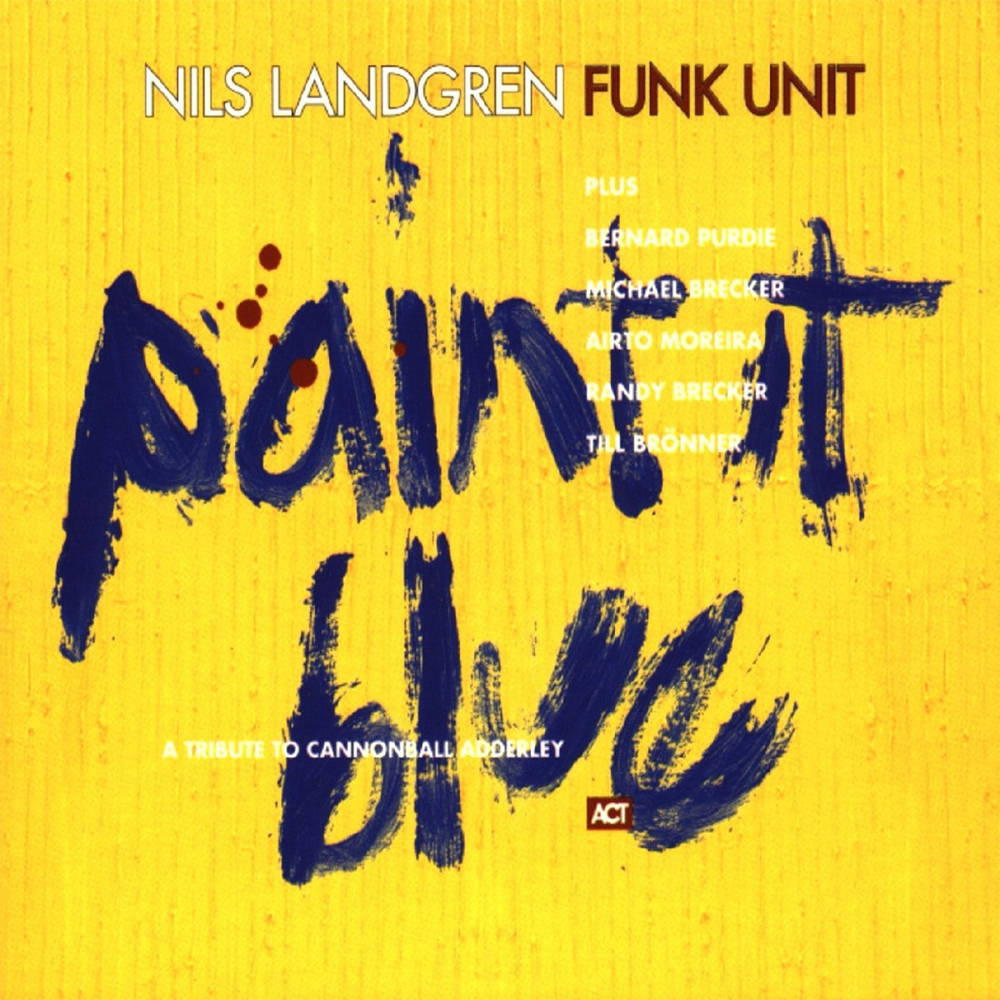
Nils Landgren Funk Unit - Paint It Blue (2 Vinyl LP) November 26, 2021 ACT Music

A TRIBUTE TO CANNONBALL ADDERLEY.

What is Funk? Funk is Soul with the resources of Jazz: the fluid boundaries between religious service and a party.

The record PAINT IT BLUE is dedicated to the man who for many still today embodies the central figure at the genre’s source: Julian Edwin "Cannonball" Adderley (1928 - 1975). Maybe he didn’t invent Funk. Together with his co-musicians in his 60s quintet, Cannonball’s alto sax style, his attitude, humor great musicality, and his love for his audience allowed him to become a synonym for FUNK.

NILS LANDGREN, born in 1956, grew up between the music of his father, a Jazz cornet-player, and the music of his grandfather, a pastor on the island Gotland. He first heard Cannonball Adderley on Kind Of Blue. In this Miles Davis Sextet of the late 50’s, they were all together: "Miles, the master of beauty. Coltrane, the master of sound. And Cannonball Adderley, the master of funk," Nils Landgren writes in the liner-notes to Paint It Blue. From that point on he procured everything of Cannonball’s that he could lay his hands on. Landgren never experienced the revered master live. "Without the soul of Cannonball it would have been impossible to form my group Funk Unit many years later," he writes. Is it a coincidence that  this band had its greatest success to date with the guest alto saxophonist, Maceo Parker (on ACT 9223-2)?

The enormous liveliness and freshness of Cannonball Adderley’s music becomes apparent to anyone listening to his recordings today. Someone like him does not need a museum and that is why Paint It Blue, Nils Landgren’s second Funk Unit production for ACT, is more of a declaration of love to the spirit of Funk à la Cannonball than a musical show of reverence to a deceased idol. Nils Landgren has developed, deliberated and played Cannonball further. Seven of the twelve tracks are Nils own compositions and, more importantly, every bar of the famous Adderley-numbers like Walk Tall or Mercy, Mercy, Mercy, with all love for the originals, sound like here and now. Seamlessly, Nils Landgren inserts Rap elements of the 27 year old MAGNUM COLTRANE PRICE. The autodidact sings everything from Hip Hop to Rhythm ‘n’ Blues that’s good and also plays numerous instruments. With one exception, the remaining lyric contributions are from Adderley himself. Landgren edited Cannonball’s live concert announcements into his own arrangements, so that the time jump between the original and the nouveau arrangement appears non-existent. An effective device that literally brings this revered musician into the fold of Nils Landgren’s Funk Unit.

Whoever speaks of Cannonball Adderley, must also speak equally of his brother Nat Adderley. It was an obvious thought to invite the most important brothers in Jazz after the Adderleys to guest on Paint It Blue; with the high energy Funk-Jazzrock of the late 70s, the Brecker brothers have proven worthy heirs to the Adderleys. Both of them solo on Landgren’s track You Dig.

The equally noble and forcible groove is delivered by the sideman to countless Soul greats, BERNARD PURDIE. Bernard’s own stylistically related production with the Brecker Brothers, Nils Landgren, amongst others is now strongly in the public consciousness on SOUL TO JAZZ, ACT 9242-2. Much like Cannonball Adderley, AIRTO MOREIRA owes important impulses to his time with Miles Davis.

NILS LANDGREN, the man with the red trombone and the blue-painted overalls, the initiator and one paying homage, combines the variety of his possibilities of expression here. His eventful musical curriculum vitae gives a hint of these. As a six year old he already played the drums - not the worst start for a career as a Funk musician. Seven years later, Landgren changed over to trombone and after a music degree he moved to Stockholm, aged 23. Years of apprenticeship with Jazz and Rock bands as well as in the theatre followed, until in 1981 he became first trombonist in Thad Jones’ Bigband. He formed his first Unit in 1983 and a year later his debut record under his own name, Planet Rock, appeared. Since 1991, Nils Landgren has been a regular guest at the Baltic Sea jazz-festival, Jazz Baltica; he is the only musician to have been a member of all the Jazz Baltica-Ensembles, which have changed in line-up from year to year. Internationally he has played with artists as diverse as Marcus Miller and Kenny Wheeler, Abba and Herbie Hancock, The Crusaders and David Murray - to name a few.

Paint It Blue is possibly Nils Landgren’s most lavish record to date and with some certainty also his best. Landgren’s playing is cool and smooth, with warmth, temperament and thought. Here his sound combines organically with everything he surrounds himself with. The album sounds as if the recordings for it were a pure joy for all participants. Nils Landgren has the prerequisite for serious fun, the gift of intelligent serenity.

The Funk Unit:
Nils Landgren - tb
Per Ruskträsk Johansson - sax
Henrik Janson - git
Esbjörn Svensson - keyboards
Magnum Coltrane Price - vocals, synth
Lars DK Danielsson - fender bass

plus:
Bernard Purdie - dr / Michael Brecker - ts
Randy Brecker - tp /Airto Moreira - perc
Till Brönner - tp / Marcio Doctor - perc
Steffen Schorn - bcl

Recorded in May 1996 Peer Studios, Hamburg/Germany by Geoffrey Peacey
Produced by: Anselm Kluge and Nils Landgren. Executive Producer: Siegfried Loch

Format:Vinyl (also available as CD)

Esbjörn Svensson Trio e.s.t. / e.s.t. Live ‘95 - 2 Vinyl LP (November 2021 ACT Music)

They have been lauded as the "New sound in the Old World", and as "high voltage out of Sweden"; the group has been called "possibly the best jazz trio in the world". The Esbjörn Svensson Trio’s - known as EST - rise to the heights has been almost frightening. After their first major success in Sweden, their international breakthrough came in 1999 during the ACT World Jazz Night at the Montreux Jazz Festival. In the following years EST was a sensation throughout Europe, and they are now on the path to continuing their success story in the USA. It’s no wonder that, especially when playing "live", EST lets loose an almost unbelievable energy - and this energy appears to grow from tour to tour - a rising star that shines ever brighter.

Stars sometimes shine much longer than one would think. And here are recordings that demonstrate this is true for EST. The band, which was first formed in 1993, quickly found their very special sound. However, at first, no one outside EST’s homeland was aware of them. Six years ago, in 1995, when Esbjörn Svensson still had long hair, and wore a headband, a record titled "Mr. And Mrs. Handkerchief", which consisted of live air shots from various towns in Sweden, was released. A year later, EST recorded the album "Esbjörn Svensson Trio Plays Monk" (recently re-released as ACT.). It reached the undreamed of sales of 10,000 CD’s nationwide. Those who have heard how the trio played back then can attest that it was breathtaking music (for a quick listen: track 5).

Much of what characterizes EST’s play today was already well-defined in 1995: the unity and riveting strength of the inter-play, the compelling themes - themes that immediately jump out at the listener, and yet are never burdened with cliches. Then there are the musical influences of the likes of Thelonious Monk and Kieth Jarrett, which are fused into a unique style that is again and again infected by the forward-thrust of rock. Magic moments are preserved for posterity in these live takes. In tracks three and seven, Svensson plays on an upright piano that doesn’t even come close to the brilliance and clarity of a concert grand - and yet, these recordings are pearls. The trio had by this time mastered the ability to react spontaneously to the inspiration of the moment.

Absolutely no difference from today? On their latest tours EST sounded tighter, less raw, with the impetuosity of wilder times more under control. Comparison with the masterpiece "Dodge the Dodo" from the 1999 Montreux concert (bonus CD) shows that the trio’s development has not been by leaps and bounds, but has been a continual process. Esbjörn Svensson himself has stated most clearly how much the music from past periods influences the band; "Obviously we develop all the time, both as individuals and as a group. But development isn’t only about blind process. So instead of just going forward, in places we’ve chosen to refer back to our earlier sound, to what we had on our first two albums." That’s already reason enough to pay new attention to "EST LIVE ‘95".

1 Say Hello To Mr. D (To Mr. S.) ( Svensson, Esbjörn) 09:12
2 The Rube Thing ( Svensson, Esbjörn) 05:28
3 Happy Heads And Crazy Feds ( Svensson, Esbjörn) 05:20
4 The Day After (leaving) ( Svensson, Esbjörn) 04:39
5 Like Wash It Or Something ( Svensson, Esbjörn) 08:57
6 Breadbasket ( Svensson, Esbjörn) 05:06
7 What Did You Buy Today ( Svensson, Esbjörn) 03:10
8 Hymn Of The River Brown ( Svensson, Esbjörn) 05:13
9 Same As Before ( Svensson, Esbjörn) 06:25
10 Mr. & Mrs. Handkerchief ( Svensson, Esbjörn) 07:19
11 Dodge The Dodo "live in Montreux" ( Svensson, Esbjörn / Berglund, Dan / Öström, Magnus) 10:02

Esbjörn Svensson - piano
Dan Berglund - bass
Magnus Öström - drums

Recorded by Åke Linton in March 1995, except # 11 recorded by Manu Guiot at Montreux Jazz Festival July 16, 1999, # 5 by Per Åke Hermansson, Radio Dalama and # 6 by Verner Kjersgaag, DR Östjüllands Radio
Mixed by Åke Linton at Bohus Studio
Produced by e.s.t.

Format:Vinyl (also available as CD )

Tuesday, November 13, 2018

Esbjörn Svensson Trio - e.s.t. songbook Volume 2 (ACT MUSIC 2018)


21 leadsheets for piano - content: dating picnic the chapel good morning susie soho did they ever tell cousteau? what though the way may be long carcrash letter from the leviathan reminiscence of a soul the well-wisher a picture of doris travelling with boris serenade for the renegade definition of a dog strange place for snow o.d.r.i.p. spunky sprawl in my garage somewhere else before brewery of beggars sipping on the solid groundwhere we used to live

Recording Information
e.s.t. Songbook
Volume II

96 pages
21 e.s.t. works

1 Serenade For The Renegade ( Svensson, Esbjörn / Berglund, Dan / Öström, Magnus) 04:26
2 Strange Place For Snow ( Svensson, Esbjörn / Berglund, Dan / Öström, Magnus) 06:46
3 Spunky Sprawl ( Svensson, Esbjörn / Berglund, Dan / Öström, Magnus) 06:23
4 Carcrash ( Svensson, Esbjörn / Berglund, Dan / Öström, Magnus) 05:05
5 Somewhere Else Before ( Svensson, Esbjörn / Berglund, Dan / Öström, Magnus) 05:36
6 Good Morning Susie Soho ( Svensson, Esbjörn / Berglund, Dan / Öström, Magnus) 05:53
7 Dating ( Svensson, Esbjörn / Berglund, Dan / Öström, Magnus) 05:32
8 Picnic ( Svensson, Esbjörn / Berglund, Dan / Öström, Magnus) 05:01
9 The Chapel ( Svensson, Esbjörn / Berglund, Dan / Öström, Magnus) 04:11
10 Definition of a Dog ( Svensson, Esbjörn / Berglund, Dan / Öström, Magnus) 06:04
11 In My Garage ( Svensson, Esbjörn / Berglund, Dan / Öström, Magnus) 04:16
12 O.D.R.I.P ( Svensson, Esbjörn / Berglund, Dan / Öström, Magnus) 08:19
13 sipping on the solid ground ( Svensson, Esbjörn / Berglund, Dan / Öström, Magnus) 04:32
14 where we used to live ( Svensson, Esbjörn / Berglund, Dan / Öström, Magnus) 04:25
15 brewery of beggars ( Svensson, Esbjörn / Berglund, Dan / Öström, Magnus) 08:22
16 Letter From The Leviathan ( Svensson, Esbjörn / Berglund, Dan / Öström, Magnus) 06:56
17 A Picture Of Doris Travelling With Boris ( Svensson, Esbjörn / Berglund, Dan / Öström, Magnus) 05:40
18 Did They Ever Tell Cousteau? ( Svensson, Esbjörn / Berglund, Dan / Öström, Magnus) 06:02
19 The Well-wisher ( Svensson, Esbjörn / Berglund, Dan / Öström, Magnus) 03:47
20 What Though The Way May Be Long ( Svensson, Esbjörn / Berglund, Dan / Öström, Magnus) 06:20
21 Reminiscence Of A Soul ( Svensson, Esbjörn / Berglund, Dan / Öström, Magnus) 05:45

Saturday, May 5, 2018

Esbjörn Svensson Trio e.s.t. - e.s.t. live in London (ACT Music May 11, 2018)

The release of this album marks a poignant moment: the tenth anniversary of the tragic and premature death of Esbjorn Svensson on 14 June 2008.

During the last ten years after the end of e.s.t. there have been constant reminders of the indelible mark which the band has left on the international jazz scene. Indeed it is hard to imagine a whole generation of currently highly successful young bands all over the world, often attracting an audience of same age, without the deep and lasting influence of the sound and the aesthetic of e.s.t. It might sound like a cliché but it is evident that through his music, Esbjörn Svensson will stay with us forever.

The trio really was a phenomenon. Its scale, recognition and impact grew progressively and internationally during the seventeen years of its existence. British audiences, for example, took e.s.t to their hearts, and in a special way. Things began quietly when they first performed one night in the tiny Pizza Express Jazz Club in Dean Street in the late 1990’s, and their footprint in the UK just kept growing steadily from there, until they were packing out concert halls. It is part of a similar story in many European countries. They were not just met with massive success in Germany and France, they truly went Europe-wide. And they also reached out further: they were the first European band ever to appear on the cover of Downbeat in May 2006, the magazine’s seventy-third year. In 2006, one year after „Live in London“ was recorded, they played over 100 concerts in 24 countries and were heard by 200,000 people.

That unforgettable experience of e.s.t. playing live has been caught before on CD, notably in "Live in Hamburg", which was named the “Jazz album of the decade 2000–2010” by The Times, whose critic wrote: “In a decade when Scandinavia staked a claim as the home of progressive jazz, no one had more success than this piano trio.” Jamie Cullum described the appeal of their live concerts: „e.s.t. are a jazz trio, only I can take my non-jazz friends along to see them.”

This new release was recorded at a completely sold-out Barbican Centre in 2005, during a hugely successful and highly popular UK tour. It is e.s.t. at the peak of their creativity touring after the release of their to-date best selling album “Viaticum”. The organic and natural way in which the set evolves is remarkable, and there is plentiful evidence of what Canadian critic John Kelman has called their “unique simpatico.” For people who know and remember the band well, the absolute gem here is a serene, deliciously poised account of “Believe, Beleft, Below.”


The Independent’s critic Stuart Nicholson was clearly moved by the concert. Here we reproduce his thoughtful and vivid review:

The Esbjorn Svensson Trio, or EST as they like to be known these days, do to the jazz piano trio what James Joyce did to coming-of-age tales by cutting up the form and starting afresh. This acclaimed Swedish group have been a hit on the European scene for a while now. In 2000, the German news weekly Der Spiegel hailed Svensson as "the future of the jazz piano", and since then his trio have consolidated their position as one of the top bands on the circuit. They are currently more popular than most big American jazz names.

Attracting the kind of following EST enjoy prompts accusations - often well founded - of dumbing down. But Svensson is one of those rare musicians who dispenses the common touch without compromising his art. He avoids the usual jazz musician's stock-in-trade of cramming as many notes as he can into the square inch, instead favouring innovative silences and a darkly intense lyricism that allows his emotional honesty to show through.

Although he once dabbled among the magical spells of the pianist Keith Jarrett's Belonging period, the new spirit Svensson has come up with is shorn of Jarrett's angst and the feeling that a good thing has been taken to wearying extremes. Featured were several tunes from EST's current album, Viaticum (which went gold in France and platinum in Germany), including "Tide of Trepidation", "Eighty-eight Days In My Veins" and the title track.


The suave use of lighting underlined the shifting moods of EST's music while their careful use of dynamics, unusual in jazz, which usually opts for fast-equals-loud, slow-equals-soft, made Svensson's lyrical intensity stand out in sharp relief. Yet the non-conformist Dan Berglund likes Jimi Hendrix and Richie Blackmore (of Deep Purple) and is not afraid to use a wah-wah pedal or feedback with his acoustic bass ("Mingle In the Mincing Machine"), while the drummer Magnus Östrom dances around formal regularity with a variety of techniques, such as using his fingers on his snare to emulate pop's rhythm samples.

EST renew the notion that the cutting edge of jazz need not involve volatile experimentation. At the head of a sense-sharpening breeze of change currently blowing through European jazz, Svensson [..] gave further evidence that the best European jazz is no longer a pale imitation of what is happening in the United States. Indeed, here was evidence that Europe is now moving ahead in creativity and originality.