Showing posts with label Ralph Alessi. Show all posts

Friday, March 4, 2022

Tomas Fujiwara’s Triple Double album March 4, via Firehouse 12

Drummer/composer Tomas Fujiwara reconvenes his unique sextet Triple Double for a collection of exhilarating new music inspired by dance and protest

March, due out March 4, 2022 via Firehouse 12 Records, features drummers Fujiwara and Gerald Cleaver, guitarists Mary Halvorson and Brandon Seabrook, and trumpet/cornet players Ralph Alessi and Taylor Ho Bynum

"Deliberately seeing double in the cause of exploratory jazz, Fujiwara brings together instrumentalists primed to rub each other in all the right and creatively wrong ways."
– The New Yorker

"[The six musicians’] collective talent and Fujiwara’s innovative leadership make for a tonic of unpredictability… A triple scoop of great music."
– Britt Robson, JazzTimes

Tomas Fujiwara’s Triple Double celebrates album Friday, March 4 at The Stone, NYC
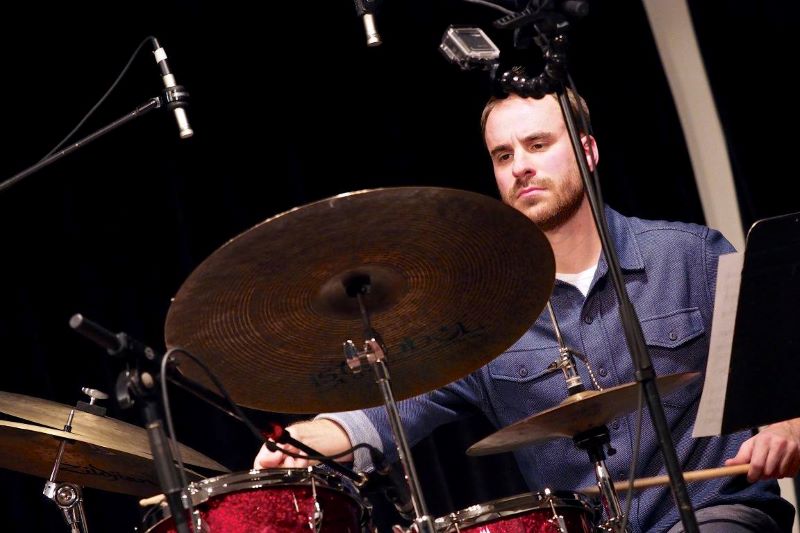
Tomas Fujiwara, photo by Brian Cohen

Parsing out the various combinations possible within Tomas Fujiwara’s Triple Double feels something like wandering through a hall of mirrors. Look at it one way and you might see two horn/guitar/drum trios; turn slightly and suddenly it becomes three paired artists taking their shared instruments in radically different directions. Despite the unusual instrumentation of the ensemble, however, Triple Double is at its core a group of six distinctive individuals, each among the most innovative and singular voices in contemporary creative music – drummers Tomas Fujiwara and Gerald Cleaver, guitarists Mary Halvorson and Brandon Seabrook, and trumpeter Ralph Alessi and cornet player Taylor Ho Bynum

On the sextet’s second album, March (due out March 4, 2022 via Firehouse 12 Records), Triple Double has also become a band in the most thrilling sense, sharing a scintillating chemistry and a sense of musical mission that remains evident no matter how far apart the various pairings and triplings stretch the music in far-flung directions.
Tomas Fujiwara's Triple Double, photo by Nicki Chavoya

“On the first album [2017’s Triple Double], the band was still relatively new,” Fujiwara explains. “There were a few people in the group that had never played together before. Since then we’ve spent a lot more time touring and playing together, so I feel like those connections and the rapport within the group have really deepened. That influenced my writing for this album because now I had a reference point for different places the band had gone, and I was also conscious of where else I wanted to push us as a group.”

The formation of Triple Double did bring together some new pairings – Alessi and Bynum had never crossed paths, and the drummers had never had the opportunity to share the stage despite Fujiwara’s longheld admiration for Cleaver. At the same time, the grouping also reconvened some well-established hook-ups (to borrow the name of another Fujiwara ensemble). Bynum and Halvorson are both among Fujiwara’s most frequent collaborators, in each other’s ensembles as well as (in Fujiwara and Halvorson’s case) in the collective trio Thumbscrew. Triple Double grew out of a trio that the drummer formed with Alessi and Seabrook.

“When I first put the band together I made a pretty exhaustive list of all the different combinations of the six of us,” Fujiwara says. “On this album I really wanted to hone in on the subtle shifts that can happen with the addition and subtraction of different musicians in the ensemble. It feels like there are endless possibilities, which is really exciting.”

Opener “Pack Up, Coming For You” offers perhaps the most explicit example. The tune begins with the trio of Fujiwara, Bynum and Halvorson. After they trade improvisations their counterparts emerge and the second trio takes over for a time. Finally all six combine and the full scope of the group dynamic is revealed. Like its predecessor, March includes an improvised duet by Fujiwara and Cleaver in tribute to the bandleader’s childhood teacher, Alan Dawson.

The unique combination of instruments is in some ways a challenge, offering little guidance for a composer. At the same time, Fujiwara found the lack of precedent refreshing. “Not having a blueprint can be challenging,” he explains, “but at the same time it can be quite liberating and inspiring. If you’re leading a guitar trio and want to do something personal with it, it can be difficult to get out from under the shadow of all the great guitar trios that came before. With this there isn't that history, so it takes away expectations. That challenge is fun for me.”
Tomas Fujiwara's Triple Double, photo by Nicki Chavoya

Fujiwara took on several disparate challenges in the crafting of March. His vibraphone playing is given a much more prominent role, while the floating, airy “Life Only Gets More” was instigated by the fact that drummers are so rarely asked to solo over ballads. The album was also recorded fairly quickly and spontaneously, despite the challenging material – an approach prompted by Fujiwara’s love of classic Blue Note Records.

“On many of the sessions they would just call in a group of musicians, they’d show up, the bandleader would have some charts on the music stand, they’d run through them and just record them. And yet they're now eternal classics that we love. I wanted to capture some of that magic.”

Like the name of the ensemble, the new album’s title also folds multiple meanings into a deceptively simple word. At its most basic, March is the month of the album release – but of course it’s a loaded date, falling exactly two years after much of the world went into pandemic lockdown and ensembles like Triple Double were suddenly indefinitely separated. The gulf has proved a long one for this band in particular, having recorded the album in late 2019.

But March also implies movement, as suggested by the felt assemblages that grace the album’s colorful artwork. The multi-hued group embracing on the cover could be dancers stepping in rhythm or protesters parading for a cause. All of those meanings danced in Fujiwara’s head as he penned the music for March, especially as he titled the tunes in the midst of the tense protests that erupted throughout 2020.

“There's something about marching that is very evocative to me,” the drummer explains. “It's a coordinated activity that always has a group intent behind it – which could be peaceful, violent, revolutionary, stifling or joyful. Marching can take on so many different forms, but it's always a group activity for a group cause that represents those intentions or feelings by a show of numbers together in one direction. Oftentimes it's not about getting from point A to point B, it's simply the act of marching and of being together that expresses the point.”


Tomas Fujiwara
Described as “a ubiquitous presence in the New York scene…an artist whose urbane writing is equal to his impressively nuanced drumming,” Brooklyn-based Tomas Fujiwara is an active player in some of the most exciting music of the current generation. He leads the bands Triple Double (with Gerald Cleaver, Mary Halvorson, Brandon Seabrook, Ralph Alessi, and Taylor Ho Bynum), 7 Poets Trio (with Patricia Brennan and Tomeka Reid), and Tomas Fujiwara & The Hook Up (with Jonathan Finlayson, Brian Settles, Halvorson, and Michael Formanek); has a collaborative duo with Bynum; is a member of the collective trio Thumbscrew (with Halvorson and Formanek); and engages in a diversity of creative work with Anthony Braxton, John Zorn, Halvorson, Matana Roberts, Joe Morris, Bynum, Nicole Mitchell, Ben Goldberg, Reid, Amir ElSaffar, Benoit Delbecq, and many others. In 2021, he won the DownBeat Critics Poll for Rising Star Drummer, and premiered two suites of new music as part of his Roulette Residency: “You Don’t Have to Try” (with Meshell Ndegeocello) and “Shizuko” (with Bynum, Reid, Rafiq Bhatia, and Davi Vieira). “Drummer Tomas Fujiwara works with rhythm as a pliable substance, solid but ever shifting. His style is forward-driving but rarely blunt or aggressive, and never random. He has a way of spreading out the center of a pulse while setting up a rigorous scaffolding of restraint…A conception of the drum set as a full-canvas instrument, almost orchestral in its scope.” 

Saturday, June 5, 2021

Devin Gray - Melt All the Guns (feat. Ralph Alessi & Angelica Sanchez) June 2021 Rataplan Records

Melt All the Guns.

Dear friends and music supporters, I hope this note finds you well.

I am very happy to share this project with you. The music on this recording was composed during the fall of 2019 after several gun violence incidents took place. The increase of gun violence over the years and particularly in the United States has upset me so much that I need to speak out. Simply put, we need to expand awareness and work for a future free from gun violence. Today, June 4th is the 7th National Gun Violence Awareness Day. In the link below there are local events and resources including the Wear Orange Campaign that I recommend your involvement.

This trio recording features the incredible Ralph Alessi and Angelica Sanchez, which was luckily captured after we played some concerts in Canada and the States, and uniquely explores expressions of my feelings around those infuriating times albeit pre-pandemic. I hope you can support not only the impact of the song titles, but also all artists you know and love during these challenging times.

Lastly, as the reopening continues, please mark your calendars now as we will be celebrating the release of this music on July 9th in Brooklyn at the wonderful SoapBox Gallery with limited in person audience and live stream concert!

I truly hope to see you all soon!

My Best,

Devin Gray
1. Think About It 03:26
2. Jet Lag Party 03:35
3. Micro Waves 04:30
4. Melt All the Guns 04:31
5. Protect Our Environment 03:25

Ralph Alessi - Trumpet
Angelica Sanchez - Piano
Devin Gray - Drums & Compositions

Thursday, May 6, 2021

Tony Malaby - Cellar Notes (2021)

I never had the opportunity to document this quartet, so I am happy that I can now share these live sets from Cornelia St. Cafe. At the time of these recordings, I was leading the groups Tamarindo, Apparitions, and Paloma Recio, as well as many sideman projects, several of which featured Ralph Alessi and John Hébert . The three of us were yearning for an outlet to stretch out in a casual, relaxed setting with no predetermined solo order, solo length or complicated road maps. When I was offered a weekend at Cornelia Street, I jumped at the chance and called Billy Drummond.

I put together four books of tunes that were laying around the pad, mostly by peers such as Chris Lightcap, Angelica Sanchez, Dave Scott, Michael Attias, Eivind Opsvik, and Billy Mintz. We filled out the book with Ralph and John’s tunes, along with some Ornette, Frisell, Motian, and Sidney Bechet. At the time I called it “The Reading Band.” Drew Gress often subbed for Hébert . This group never played to an empty room. Please follow us here at Bandcamp and enjoy Cellar Notes.

1. Ralph and the Red Head (Dave Scott), Blind Pig (John Hébert), Flight (Billy Mintz) 29:31
2. Mirror Me (Angelica Sanchez), Humpty Dumpty (Ornette Coleman), Endless(Paul Motian) 21:17
3. Cajun Christmas (John Hébert) 10:59

Tony Malaby - Tenor Saxophone
Ralph Alessi - Trumpet
John Hébert - Bass
Billy Drummond - Drums

Recorded by Scott Friedlander
Mastered by Eivind Opsvik
Cover Art by Tim Berne
Recorded Live at Cornelia St. Cafe on March 13, 2009

Wednesday, March 31, 2021

Tom Rainey Obbligato with Ingrid Laubrock, Ralph Alessi, Jacob Sacks and Drew Gress - Untucked in Hannover (April 16, 2021 Intakt Records)

With Untucked in Hannover, Tom Rainey's top-notch quintet Obbligato presents a third album of a collection of jazz standards – with Jacob Sacks on piano replacing regular pianist Kris Davis for this live recording. Wonderful jazz tunes like Stella by Starlight or I Fall in Love Too Easily are interpreted in an open dialogue with stunning joy of playing and improvisation. And though standards are the modus operandi of Obbligato, their approach is intended to be less conventional, less reverential and certainly less solo-centric than many other bands that tackles with Standards. Obbligato sometimes plays with the essences of famous jazz standards in an implied way, sometimes in a teasing and mysterious way, but always in a tantalizing way.

"Close your eyes, imagine sitting in the front row of your favorite jazz club, sit back and enjoy Obbligato playing pieces from the Great American Songbook in a way you've never heard them before: and by one of the most inventive and inspiring live bands of the last decade," writes Laurence Donohue-Greene in the liner notes.
1. If I should Lose You
2. Stella by Starlight
3. What's New – There is No Greater Love
4. I Fall in Love to Easily
5. Just in Time – In Your Own Sweet Way
6. Long Ago and Far Away

Ralph Alessi: Trumpet
Ingrid Laubrock: Saxophones
Jacob Sacks: Piano
Drew Gress: Bass
Tom Rainey: drums

Recorded October 15th, 2018 by NDR, Jens Kunze, at Jazz Club Hannover. Live sound engineer, Raphael Becker-Foss. Recording producer NDR, Felix Behrendt. Recording executive producers NDR, Axel Dürr, Stefan Gerdes. Mastered October 2020 by Michael Brändli, Hardstudios, Winterthur. Cover art: Christine Reifenberger, Graphic design: Jonas Schoder. Liner notes: Laurence donohue-Greene, Photo: Jan-Gerrit Schäfer, Jazzclub Hannover. Produced by Tom Rainey, NDR and Intakt Records.

Thursday, November 15, 2018

Florian Weber / Ralph Alessi / Linda May Han Oh / Nasheet Waits - Lucent Waters (ECM November 2018)


In his second ECM appearance (following a critically-acclaimed duo recording with Markus Stockhausen) pianist Florian Weber leads a strong cast through a programme of his compositions and sketches.  Whether paying tribute to mentor Lee Konitz on “Honestlee”, impressionistically conveying the glittering “Melody of a Waterfall” or generating impactful drama out of fragments of sound on “Butterfly Effect”, Weber continually draws fresh responses from his players.  “I wanted this project to be as open as possible”, he says. “It’s the idea of exploration that is important here, and the differences between the players.” The strong, grounded bass of Linda May Han Oh contrasts strikingly with Nasheet Waits’s fleet, fluid drumming, setting up new contexts for Ralph Alessi’s elegantly inventive trumpet and the leader’s highly creative piano playing.  Lucent Waters was recorded at Studios La Buissonne in the South of France in September 2017, and produced by Manfred Eicher.

Florian Weber   Piano
Ralph Alessi   Trumpet
Linda May Han Oh   Double Bass
Nasheet Waits   Drums

1 BRILLIANT WATERS (Florian Weber) 02:07
2 MELODY OF A WATERFALL (Florian Weber) 03:02
3 FROM COUSTEAU'S POINT OF VIEW (Florian Weber) 05:37
4 HONESTLEE (Florian Weber) 07:30
5 BUTTERFLY EFFECT (Florian Weber) 07:49
6 TIME HORIZON (Florian Weber) 04:01
7 FRAGILE COCOON (Florian Weber) 06:11
8 SCHIMMELREITER (Florian Weber) 06:01

Saturday, April 14, 2018

Román Filiú - Quarteria (SUNNYSIDE RECORDS May 11, 2018)

Six buildings in close proximity with families living one on top of another within a constant melee of sound, including music of all sorts. This is the public housing of Santiago de Cuba, known locally as cuartería. These apartments and their confederation of people and sounds serve as the inspiration to saxophonist and composer Román Filiú’s new musical suite and subsequent recording, Quarteria. 

Growing up in the far eastern province of Cuba, Filiú was aware of music all around him. His father was a music theory teacher who encouraged his son to explore classical music scores. Filiú’s own musical studies began with classical piano before he focused on the saxophone. While visiting his friends who lived in the local cuartería, the budding musician was exposed to a wide variety of sounds of Cuban extraction, including liturgical music for Bembé, conga oriental, tumba francesa, classical, jazz, and popular music, the cuartería was Filiú’s own musical Tower of Babel. 

Filiú left Santiago de Cuba some time ago. He continued his studies in Camagüey and at the Instituto Superior de Arte in Havana. He lived and played locally in Havana, including a stint in jazz super group Irakere, before he moved to Madrid, where he lived for seven years. Filiú has been in New York since 2011 and has made his mark on the jazz scene as a bandleader, composer, instrumentalist and collaborator of note, playing alongside well-known musicians like Henry Threadgill, Steve Coleman and Dafnis Prieto. 

Upon receiving a commissioning and residency grant from The Jazz Gallery of New York City, Filiú was able to compose his Quarteria. His goal was to create a suite of music that involved an eclectic range of musical styles performed by a diverse group of musicians. In composing, Filiú utilized a number of methods, including writing by transcribing piano improvisations, playing his saxophone, singing the melody or even without the influence of an instrument, putting his thoughts straight to paper. Through the entire process, Filiú made sure that the pieces served improvisation. 

The ensemble grew out of Filiú’s intention to have as full a sound as possible with as compact an assemblage as he could muster. The ensemble ended up as a septet with an additional horn on two pieces, all members being brilliant stylists and improvisers well-versed in a variety of musical traditions.


Trumpeter Ralph Alessi has been a frequent collaborator with Filiú in Dafnis Prieto’s band, the two having originally met while the trumpeter traveled with Steve Coleman to Havana. Dayna Stephens’ s sonorous tenor saxophone is a perfect foil for Filiú’s alto. Also from Santiago de Cuba, pianist David Virelles has been a long time collaborator and is responsible here for widening the ensemble’s panoramic sound. Bassist Matt Brewer was a must for his steady rhythm and expert time, while drummer Craig Weinrib is equally adept in support and widely steeped in rhythmic traditions from all over the world. 

The suite begins with the staggering “Fulcanelli,” the piece inspired by its namesake’s study of the sacred geometry of cathedrals and which utilizes symmetry within its compositional makeup. Olivier Messiaen’s compositional style informed “Grass,” which was written away from the piano and utilizes expanded voicings between the three horns and the piano. The title of “Harina Con Arena” refers to the period of Russian withdrawal from Cuba in the 1990s and the food crisis that followed where there developed a common practice of adding sand to the cornmeal sold to the population. The piece is meant to have the jilting feeling of biting into that unexpected texture. 

Utilizing hints from his choir director brother, Filiú wrote the beautiful “Choral” with formal voice leading, lending to the shifting harmonies within the instruments. On his week long Jazz Gallery residency at the Pocantico Center in Tarrytown, New York, Filiú composed three danzas at the piano: the improvised “Danza #5,” the Messiaen influenced “Danza #1,” and “Danza #3,” which was inspired by the rhythms of his childhood neighborhood comparsa ensemble, San Pedrito. The wonderfully disjointed “Glass” uses one melody, which is delayed a half beat between the parts, creating a unique counterpoint. 

The stately “Imperator” mirrors the walk of an old Haitian refugee who lived near Filiú’s childhood home and who used to help the young saxophonist carry his horn home from school. Saxophonist Maria Grand appears on “For Horns and Bells,” which is a chorale and an experiment in conduction and voice leading. The final two pieces came from an idea to create crazy names and then write music for them. “Tursten” is a mysteriously laconic piece, while “Kaijufrem” is aggressive and utilizes a compositional system devised by Filiú in which he assigns a note to each letter of the name but then allows the structure to mutate from there. 

The metaphor of a large edifice with people from of all walks of life comingling with the soundtrack of the music of Cuba is fitting for Roman Filiú’s Quarteria, which is an exceptional example of a lifetime’s exposure and dedication to the study of music in all its forms, coalescing into a moving musical experience. 

1. Fulcanelli
2. Grass
3. Harina Con Arena
4. Choral
5. Danza 5
6. Danza 1
7. Glass
8. Danza 3
9. Imperator
10. For Horns and Bells
11. Tursten
12. Kaijufrem


Ralph Alessi - trumpet
Dayna Stephens - tenor saxophone
Maria Grand - tenor saxophone (10 & 11)
David Virelles - piano
Matt Brewer - bass
Craig Weinrib - drums
Yusnier Sanchez - percussion

Saturday, April 7, 2018

David Ake - Humanities (POSI-TONE RECORDS 2018)

Pianist, composer, and educator David Ake is a native of New Haven, CT, but spent his formative years in Chicago. He did his  undergraduate at the University of Miami before heading to the West Coast to do post-grad work at the California Institute of the Arts and UCLA.

Ake’s fifth album on Posi-Tone is titled “Humanities” and features the powerful musical voices of his fellow CalArts colleague Ralph Alessi (trumpet), Ben Monder (guitars), Drew Gress (bass), and Mark Ferber (drums).  If you have heard any of Ake’s earlier group albums, you’ll know he’s a powerful and thoughtful pianist while his music often has a powerful forward motion.

There are moments on the new album where the music leans towards Americana, not surprisingly on the quintet’s reading of The Grateful Dead’s “Ripple” (the only “cover” tune on the CD) – they don’t mess with the gentle bluesy quality of Jerry Garcia’s sweet melody. Alessi’s muted trumpet brings the sound of Ron Miles to mind and the piece would not be out of place on a Bill Frisell album (but note the alternate chords at various times throughout the piece). The piano introduction to “Drinking Song” has the feel of a Randy Newman ballad but there is a spare quality to the melody. The trumpet and guitar play the melody and counterpoint while the rhythm section tosses and turns beneath them, not disrupting the flow as much as creating dynamic differences.

What stands out throughout the program is how distinctive all five voices are.  On songs such as “The North“, one can hear the power of the guitar, the rich melodic sense of the trumpet, the “heavy” chords from  the piano, the counterpoint and melodies from the bass, and the driving force of the drums. Ferber is truly in the driver’s seat; listen to his strength on “Rabble Rouser“, how Gress helps him push the music forward, and then how the soloists are inspired by the rhythm section.  And, they can swing! “Hoofer” starts out with the drummer’s brush work creating his own sweet soft-shoe.  Ake picks up on that and dances right through his sly Monk-like solo.  The bassist leads the group through the beginning of “Stream” – much of the fun of the piece is how the dynamics change on the fly.  After the opening, the band moves into a harder-edged melody but drops back for the piano solo.  Ake build the tension as the trumpet and guitar play a unison counterpoint to his solo. A similar interaction takes place beneath Alessi’s solo, this time the pianist and guitarist playing chordal patterns as Ferber builds the tension with a fiery drum spotlight.

The program closes with “Walter Cronkite“: that’s the newsman’s voice you hear near the beginning saying “...it’s the ultimate question that being a democracy we the people are responsible for the actions of our leaders“.  Alessi’s keening, questioning, trumpet moves atop the rumbling piano, droning bass, quiet guitar fill, and active drums, giving the rubato piece the feel of an elegy, at times, a prayer.  There is a short section where the trumpet and piano sounds like a telegraph signaling an urgent question across the great divide before the music fades.

To do justice to the music on “Humanities” is truly to tell you to listen and listen deeply. David Ake composes music that asks questions, that plumbs the depth of the human spirit, and looks for the soul within the songs. And the musicians know how to transmit those questions and searches to an eager audience.  Give some time to this music; it will make you think and, perhaps, even move you to action in these often tense times.


Saturday, March 24, 2018

Magnus Thuelund - Angel From the South (March 25, 2018)


Magnus Thuelund is a Danish saxophone player/composer and teacher currently, living in Copenhagen Denmark. He is a Rhythmic Music Conservatory (RMC) graduate from (2003-2008).  (2005-2006) At the New School of Music in New York. And later (2010-2012) where he did the highly esteemed 2 year programme “Advanced Post Degree Diploma” in composition with composer/keyboardist Django Bates.

Magnus Thuelund has studied and played with prominent Danish and international musicians such as: Thomas Franck, Lars Møller, Ole Kock Hansen, Peter Jensen,  Nikolaj Hess, Butch Lacy and the Danish Radio Big Band.  And Marc Mommaas, Reggie Workman, George Garzone, Dave Glasser,  Mark Turner, Jamire Williams and Armen Donelian.

“Magnus Thuelund is a talented young and hard-working alto saxophonist and composer. He has a strong sound, a good ear, is an excellent reader and loves a challenge.” Marc Mommaas tenor saxophonist/composer.

Thuelund has played in Carnegie Hall and all over Europe with own bands and bigbands i.e.  as part of a European/Canadian tour with “Swinging Europe” European Youth Jazz Orchestra among others.


1. Slower 09:41
2. Argentum 07:35
3. Reach 09:40
4. Angel from the south 07:21
5. Autumn in April 05:09
6. Illuminate 07:46
7. Aurum 10:24
8. Miss Lisa 05:11

Ralph Alessi trumpet
Marc Mommaas tenor saxophone
Nikolaj Hess piano
Graig Earle bass
Nasheet Waits drums

Thursday, November 2, 2017

Tomas Fujiwara - Triple Double (FIREHOUSE 12 RECORDS 2017)


Bandleader, composer, and drummer Tomas Fujiwara possesses a musical dexterity that could go unnoticed if not for its ripple effect. He has brought his rhythmic and compositional imprint to a wide variety of settings – as a member of the collective trio Thumbscrew (with Mary Halvorson and Michael Formanek), in a long-standing duo with Taylor Ho Bynum, and as a supporting member in groups led by Bynum, Halvorson, Matana Roberts, Tomeka Reid, Amir ElSaffar, and Nicole Mitchell. While these collaborative efforts could define and sustain him, a more ambitious musical intelligence emerges on closer inspection.

1. Diving For Quarters 11:00
2. Blueberry Eyes 05:58
3. Hurry Home B/G 03:32
4. Pocket Pass 02:46
5. For Alan 08:00
6. Love And Protest 07:43
7. Decisive Shadow 05:52
8. Hurry Home M/T 03:21
9. Toasting The Mart 04:02
10. To Hours 06:20


Tomas Fujiwara – drums
Gerald Cleaver - drums
Mary Halvorson – guitar
Brandon Seabrook - guitar
Taylor Ho Bynum – cornet
Ralph Alessi - trumpet


Friday, September 15, 2017

Tom Rainey Obbligato - Float Upstream (with Ralph Alessi, Ingrid Laubrock, Kris Davis, Drew Gress) INTAKT RECORDS 2017


On this second CD with his band Obbligato Tom Rainey surprises with standards and beautiful love songs like «Stella by Starlight», «What Is This Thing Called Love» or «I Fall in Love too Easily».

Tom Rainey has played in bands with Tim Berne, Fred Hirsch and Craig Taborn, and his own trio with Ingrid Laubrock and Mary Halvorson.

For this ensemble he chose some of the finest players New York has to offer: Ingrid Laubrock, Ralph Alessi, Kris Davis and Drew Gress.

Christian Broecking writes (liner notes): «With Obbligato, Rainey brings two familiar acquaintances from Jazz history to the fore – collective playing and improvising on Standards – the actual material itself, the well-known melodies and chord progressions are not overly taken apart.

With Obbligato he wanted to find his own way of playing the milestones of Jazz history.


1. Stella by Starlight (Victor Young) 5:15
2. Beatrice (Sam Rivers) 6:21
3. What Is This Thing Called Love (Cole Porter) 4:02
4. What's New (Bob Haggart) 10:35
5. There is no Greater Love (Isham Jones) 6:48
6. Float Upstream (Obbligato) 5:23
7. I Fall in Love too Easily (Jule Styne) 4:53

Ralph Alessi Trumpet
Ingrid Laubrock Saxophones
Kris Davis Piano
Drew Gress Bass
Tom Rainey Drums

Recorded at Brooklyn Recording in NYC by Andy Taub on January 19th, 2017. 
Mixed by Andy Taub on January 26th, 2017. Mastered by Alan Silverman at Arf! Productions Inc. on May 3rd, 2017. 
Cover art: Christine Reifenberger. Graphic design: Jonas Schoder. Photo: Peter Gannushkin. 
Liner notes: Christian Broecking. Executive production by Anja Illmaier. 
Produced by Tom Rainey and Intakt Records, Patrik Landolt.

Friday, February 26, 2016

Ralph Alessi Baida Quartet - Quiver (2016)


Source & Label: ECM


There are magic moments when an artist can be said to have well and truly “arrived.” For Ralph Alessi, the release of Baida – his ECM debut as a bandleader – is just such a moment, despite his already extensive resume. Among those in the know, Alessi is renowned as a musician’s musician, a first-call New York trumpeter who can play virtually anything on sight and has excelled as an improviser in groups led by Steve Coleman, Uri Caine, Ravi Coltrane, Fred Hersch and Don Byron, as well as leading his own bands. But Alessi has created something breathtaking with Baida, an album sure to beguile a wider audience with its atmospheric depth and melodic allure. To voice his suite of compositions, the trumpeter has convened a powerhouse New York band with pianist Jason Moran, bassist Drew Gress and drummer Nasheet Waits. As a vessel for the album’s seemingly bottomless lyricism, this quartet of virtuosos plays with extraordinary finesse; but there is also a tensile strength emanating from the performances, a muscularity that one can feel. Then there is the silver of Alessi’s trumpet tone; as The New York Times has said, it has “a rounded luminescence, like the moon in full phase.”


1  Here Tomorrow
2  Window Goodbyes
3  Smooth Descent
4  Heist
5  Gone Today, Here Tomorrow
6  I To I
7  Scratch
8  Shush
9  Quiver
10 Do Over


Ralph Alessi: trumpet
Gary Versace: piano
Drew Gress: double-bass
Nasheet Waits: drums  


BUY THIS ALBUM


Tuesday, February 16, 2016

Angelika Niescier & Florian Weber - NYC Five (2016)


With their new album, alto player and bandleader Angelica Niescier and pianist and composer Florian Weber both from Cologne, Germany place themselves at the centre of the New York jazz scene. Their quintet NYC FIVE is completed by three jazz musicians in great demand in the “Big Apple”: trumpeter Ralph Alessi, bassplayer Christopher Tordini and drummer Tyshawn Sorey. The quintet plays highly contemporary jazz with original tunes, distinctive arrangments, complex rhythms and expressive improvisations. Laurence Donohue-Greene, editor at «The New York City Jazz Record» writes: "With this new dynamic quintet – Angelika, Florian, Ralph, Chris and Tyshawn present a unique aura of timelessness, as much influenced from decades past as about the present and future state of jazz, from New York and beyond." And: "Angelika’s distinctive tone shoots right through to the listener’s core."


Angelika Niescier: Saxophone 
Ralph Alessi: Trumpet 
Florian Weber: Piano 
Christopher Tordini: Bass 
Tyshawn Sorey: Drums

1. The Barn Thing 08:28
2. And Over 10:20
3. Invaded 06:39
4. The Liquid Stone 07:31
5. Parsifal 06:21
6. Für Krefeld 08:06


Domi

Thursday, February 11, 2016

Michael Rosen - Sweet 17 (2015)


Michael Rosen, tenor sax
Lage Lund, guitar
Ralph Alessi, trumpet
Domenico Sanna, piano
Matt Penman, double bass
Bill Stewart, drums

At 17, one’s dreams are alive and vivid and there’s always hope that one day these may come true, as they did for American saxophonist Michael Rosen. Rosen began studying the cello at the age of seven for two years before moving to the piano, and later at eleven he moved to the saxophone.

In the following years, he was first alto saxophone with the Middle School and High School Big Bands and received numerous state and local "best Soloist" awards. Initially, his interests lay more towards “progressive” groups such as Yes, Led Zeppelin, and Talking Heads, but when in 1985 Michael Rosen moved to Boston to study at the Berklee College of Music with renowned teachers such as Gary Burton and George Garzone, where he started to cultivate his soaring passion for the music of Charlie Parker, Joe Henderson, Miles Davis, Stan Getz and John Coltrane, and many other jazz artists who since then have been the main source of his inspiration.

Rosen has been living in Italy for almost 30 years and spends most of his time between Rome and London, highly active in the musical circles of both capital cities. Today, after 35 years of international success with 9 CDs as a leader, over 200 as a sideman, and having collaborated with leading artists of the day such as Bobby McFerrin, Sarah Jane Morris, Mike Stern, the Orchestra della Scala, and countless other American and European musicians, the seventeen-year-old boy with long and disheveled hair, now at the height of his artistic career, returns to New York, his hometown, to record his new music together with a stellar cast of jazz musicians. Sweet 17, as with all albums of the saxophonist / composer, leaves ample room for melodic beauty, fluidity and expressiveness, and introduces the more dynamic, modern and evolved compositions that Rosen has written so far, reflecting all the experience gained from the late 80s to date.

Accompanying him on this musical experience are highly-acclaimed musicians such as: Lage Lund (guitar), Ralph Alessi (trumpet), Domenico Sanna (piano), Matt Penman (double bass) and Bill Stewart (drums). It can be truly said that Michael Rosen’s dream, his "Sweet 17", came true and this album is the evidence.


01 Architextures (Michael Rosen)
02 Ebb Tide (Michael Rosen)
03 Sweet 17 (Michael Rosen)
04 Fair Weather Ahead (Michael Rosen)
05 Hopefully (Michael Rosen)
06 Safe As Houses (Michael Rosen)
07 39 Belgrave Square  (Michael Rosen)
08 Yellow Barn Road (Michael Rosen)
09 Jacoby’s Ladder (Michael Rosen)
10 The Way We Were (A. Bergman, M. Bergman, M. Hamlisch)


Domi