Jamie Fox's first CD, released in 2006, featuring a crew of stellar NYC based musicians. All compositions are originals by Jamie Fox, performed in various instrumental combinations.
Our second recorded work stands in continuity with the previous one, Sunday morning (released in 2016), although marking an evolution and introducing some innovations.
Almost all the compositions are our own. In addition, the recording features two arrangements of classical derivation: Gabriel Fauré’s Pavane and the theme from Sergej Rachmaninov’s Third Concerto for piano and orchestra. Classical nuances and references were already present in our previous work, but this time we tried to get in relation with two great composers in music history.
Another important novelty is the featuring of two guests, on two tracks: Bruno Martinetti on trumpet and Didier Yon on trombone.
A touch of funk, some classical nuances and most importantly the sensitivity, life and music experiences of each of us. Enjoy the music.
Dedicated to Chick Corea, one of the greatest musicians and composers of all time.
Recorded on June 6 and 7, 2016, at Ware House Sound, Omaha, Nebraska and originally released in 2017 on the 10 track album “It’s Been a Long Time” by Project Omaha
Cornetist/composer Bryan McCune's music draws from a wide stylistic palette, including jazz, blues, rock, folk, western, eastern, and beyond. He often incorporates an ever evolving effects rig as part of his sonic signature, while never completely abandoning the natural sound of the cornet (well, almost never).
Transformation is the constant that unfolds infinitely. Those moments when future becomes the past, and the past becomes the present. Cosmic Transitions navigates the challenges and changes of existence leading up to 2020 and beyond.
It is best for anyone who really seeks to take a journey to know that all the steps in between shape the arrival. Isaiah Collier and The Chosen Few etched together an occurrence in this recorded performance of a five-part Suite composed by Collier. To compress all the understanding, lessons, love, and humility into writing would surely be taking the breath from the poetic moment that occurred on September 23rd, 2020. These artists and more importantly, these souls took a journey with the intention of pushing beyond the limitations of the world, critics, and perhaps even their own expectations.
This performance takes place at Van Gelder Studio’s on John Coltrane’s birthday, in the very room where he and so many other compassionate artists pushed beyond what was known and created a new wave in sound. So many steps were taken to achieve this moment of boundless reaching. Music is the Universal Language. The unifying force that bends reality around its subjects, as it services as an instrument of unity. Beyond wherever it is that society is, it is music and love the saves the day.
Each musician on this recording takes hold of this composition and threads their own path to the purpose of this work of art. That purpose is like most forms of art left to an audience for interpretation to examine their place in life and hopefully feel a connection to something more than the here and now. Cosmic Transition begins in invocation with frequency’s resonating in the same room where so many had stood with hopes and intentions that their art and purpose service a greater understanding.
This Quartet performance finds each musician pushing and exploring the sonics of their individual instruments to expand as one wave, one journey. I implore anyone daring enough to take this journey, that you listen to this experience in its entirety.
Every dimension of the room both on the physical and spiritual plane made this moment possible. Do you hear those few seconds when John walked into the room? Beyond any space and time, beyond the common understanding of life and death, beyond a type of music or crowd, Cosmic Transitions is a doorway for all. For all those who came before and after gratitude for your ear and hopefully your heart. As’e! -Ausar Ra
1. Invocation/Part I. Forgiveness
2. Part II. Humility
3. Part III. Understanding/Part IV. Truth and Guidance
Joe Armon-Jones, keyboardist, composer and producer, is pushing the boundaries of his sound, blurring the lines between bass- heavy dub, contemporary club culture and his background as a pioneering force in the modern jazz scene.
Away from his solo project, he’s a member of Ezra Collective, regularly plays with Nubya Garcia, and has toured with Ata Kak and Pharoahe Monch.
Bassist, composer, and bandleader, Zac Carson has developed a modern playing style that draws from the jazz tradition, but incorporates influences from rock, classical, and folk.
Currently based in Queens, NY, Zac is known for his lyrical playing, innovative compositions, and intricate grooves.
Casco Records was initiated by bassist Raoul van der Weide in 2009 in order to document a spectre of musical co-operations with signature musicians that share the urge to create personal contributions in composed and improvised music.
1. Skin Sound 02:41
2. Manieres de la main 02:06
3. Tomkes 05:44
4. Before the beginning 04:34
5. Mimetisme 08:37
6. L'esprit des cordes 07:03
Raoul van der Weide contrabass, crackle box, percussion
Henk Zwerver guitar
Recorded September 9 2020 at Atleier 5 in Amsterdam
Recorded and mastered by Hayden Zappa Hook
Mixed by Hayden Zappa Hook, Raoul van der Weide, Henk Zwerver
Cover art by Henk Zwerver, graphic design by Hidde Dijkstra
20 years ago, British pianist Tommy Scott emerged onto the jazz scene as a teenage prodigy, championed by the likes of Joey Calderazzo and Danilo Perez and described as “astonishing” by Jazz Review.
Heavily influenced by the style and energy of Herbie Hancock, McCoy Tyner & Kenny Kirkland, he returns with a brand new trio project, featuring double bassist Yuri Goloubev and drummer Asaf Sirkis.
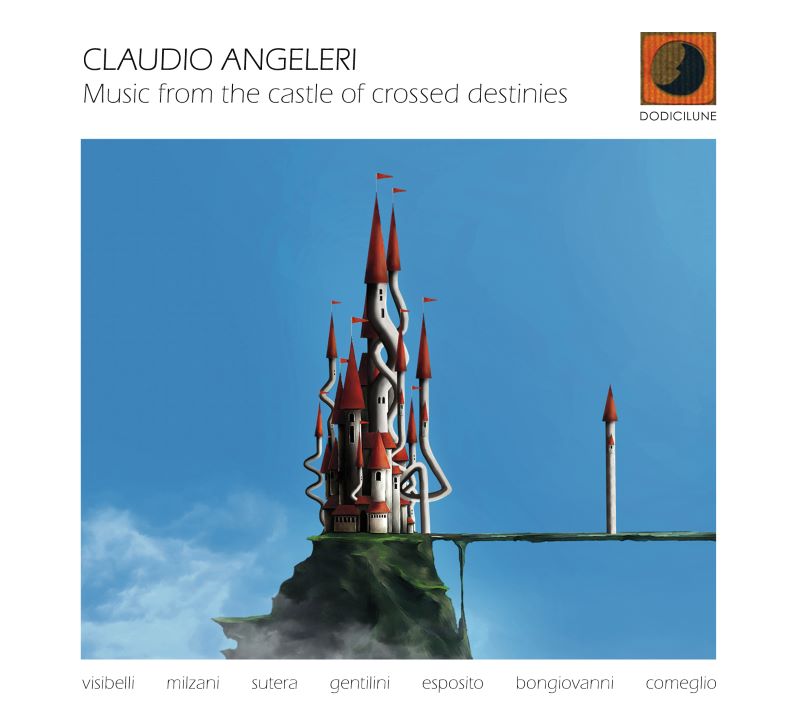
The idea of a new project around the literature of Italo Calvino originated from an invitation by Maestro Enrico Intra and Maurizio Franco to the MIT Jazz Festival at the Piccolo Teatro in Milan in November 2019. This is, however, not my first encounter with Calvino, as in 2004 I had already composed the music for a performance inspired by “Le città invisibili", one of the cult books of 20th century literature. Actually, my relationship with Calvino has much deeper and far-reaching roots, shared during the 70s with many 'young people' belonging to my generation. This was the period when the writer published “Il Castello dei destini incrociati” (The Castle of the Crossed Destinies), the book of short stories that inspired this new work of mine.
A period characterized by its many contradictions, but also an extremely creative, fertile and transformative one from a social, political and cultural point of view. In books and music, one can find immediate, multifarious, succinct and, at the same time, profound answers. In his stories, Calvino expresses a methodological and philosophical attitude that strips away the non-essential, leaving only its fundamental dimensions: mind, space and time. It is the literary transposition of the widely shared concepts of the 70s: in particular, Mies van der Rohe's "less is more" in architecture, and, in my opinion, the aesthetics of several jazz representatives, first and foremost Thelonious Monk and Duke.
Calvino is all this and so much more. He does it with lightness, irony, rigour and a somewhat “classical” mastery of writing. It is the period of combinatorial writing, a new way of “doing” literature, through technicalities that are openly stated and disclosed to readers, who become active players in the feat of literary composition. In “Il Castello dei destini incrociati”, Calvino's first work written entirely using this literary technique, the stories of the different characters who happen to meet in a castle after a series of ordeals, are constructed according to the combination of 15th-century miniature tarot cards (tarocchi). The cards are the same but the stories they tell are all different.
In this way, Calvino tells of Orlando, driven insane by love, or of Astolfo, who goes to the moon to regain Orlando's wits, and again of alchemists, lovers and ramshackle knights. Characters apparently connected by a common medieval-renaissance setting, and yet, on closer analysis, estranged from time and space and, for this reason, extremely contemporary.
Within this ambitious methodological research, I discovered a connection with the language of music. Music is, in fact, the art of combining sounds with silence. This combinatory practice is applied through written, oral or 'audio-tactile' norms and processes. The history and musicological studies of Western and non-Western music have introduced us to many of them: from modality to tonality, from seriality to polytonality, and so on, including techniques adopted by other continents.
"Jazz is not a what, jazz is a how”, as the great pianist Bill Evans used to say when asked to define jazz. Using just a few words, Evans sums up its essence, that is, the way in which this music is able to be pluralistic and unique at the same time, embracing a multiplicity of cultural influences and processing them through its own aesthetics. Composition is undoubtedly one of the distinctive traits of jazz, meant both in "slow" terms in which the composer can rethink, modify and rewrite the music, and in terms of "fast," real-time composition: in other words, improvisation. These reflections provided me with further common ground with Calvino's work and techniques. Moreover, in the concluding notes of “Il Castello dei destini incrociati”, the writer reveals the open-ended and evolving nature of the book, which remains, in some ways, poised and unfinished. In fact, the text was to contain a third contemporary part based on the same narrative structure.
The idea was therefore to take up the challenge of devising new stories through the language of sounds and to accomplish that unfinished third part through musical storytelling. The characters and places portrayed by Calvino are transformed here by the combination of the twelve sounds both in the written part as well as in the one improvised by the seven musicians involved - eight with Gabriele Comeglio featuring on one track. In addition to the sixteen stories that make up “Il Castello dei destini incrociati”, eight for each part, I composed another eight following an entirely subjective criterion, leaving space to the creative stimuli contained in the book. As Calvino states: "I concentrated primarily on observing the tarot cards attentively, with the eye of he who does not know what they are, and on drawing suggestions and associations from them, interpreting them according to an imaginary iconology".
I therefore composed a counterpoint, assigning it to the different instruments representing, for their sonorous features, specific characters: the violin, the flute, the (distorted) electric guitar, the voice, the piano, the (electric) bass, the percussion.
The specularity of the story is rendered instead by two twelve-tone series. I was however not completely satisfied with the outcome. It was too intellectual and not communicative enough. I therefore worked on the inner harmonisation of the voices to bring tensions and dissonances into yet another territory, halfway between the affirmation and the denial of the key. Was this again the duality suggested by Calvino?
There was then the rhythmic and timbral aspect that brought the music elsewhere, beyond the variables of improvisation and the action-reaction of the musicians with respect to the written stimuli. It was a pretty creative mishmash where creativity and intricacy were growing hand in hand. Enjoy listening. Claudio Angeleri
Watanabe Norio is a jazz guitarist based in Nagoya Japan. His high skill of playing music makes it more colorful and affect impress vibrate. He seldom play improvised music, but today we play quite beautiful improvised music together.
Recorded in 1996 at the week long residency at Sweet Basils celebrating the release of Marc Cary's Listen. Also celebrating the birthdays of Dion Parson and Dwayne Burno
Wieviel ist möglich mit nur drei Musikern? Wie wenig? Ruhe und Melodie gefolgt von Groove und Beats in Eigenkompositionen spielt das Trio „Bird´s Free Funk“, sodass in minimaler Besetzung sich eine neue Welt auftut. Intensiv und packend, mit der Suche nach Schönheit von Klängen, bei der jeder Musiker maximale Verantwortung trägt, spielt sich das Trio von Swing über Latin Jazz zu modernen Kompositionen. So versuchen die drei Musiker/innen aus Hannover und Berlin, dem Jazz eine eigene Note zu geben, weg von dem Zuviel hin zu dem Nötigsten, Musikalischsten, Schönstem.
Trumpet sensation Alex Sipiagin conducts his attention and intention "Upstream" directing the energetic empathy of his music towards engaging the hearts and minds of jazz fans on his first release for Posi-Tone. Exuding confidence with effortless virtuosity, Sipiagin performs with a compelling and emotional voice on his instrument that clearly elevates and distinguishes him from his able contemporaries. Joining Sipiagin on this musical journey is Posi-Tone's steadily serviceable and reliably inventive rhythm section of pianist Art Hirahara, bassist Boris Kozlov and drummer Rudy Royston.
With elegant lyricism, Sipiagin leads the group steadily straight forward to explore harmonic wonderlands that clearly reflect his modern melodic non-diatonic jazz sensibility. With a thoughtful program of original compositions and arrangements, Alex Sipiagin clearly attenuates his focus "Upstream" and successfully provides jazz fans everywhere with an astonishing array of captivating currents and bright moments to cherish and enjoy.
1. Call 05:22
2. Echo Canyon 05:30
3. Sight 05:21
4. SipaTham 06:20
5. Magic Square 05:44
6. Rain 07:10
7. Shura 06:46
8. Miyako 05:00
9. Upstream 07:37
Alex Sipiagin - trumpet, flugelhorn
Art Hirahara - piano
Boris Kozlov - bass
Rudy Royston - drums & percussion
Marc Free - producer
Nick O’Toole - mixing & mastering engineer
Michael Brorby - recording engineer
recorded October 24-25, 2020 at Acoustic Recording, Brooklyn, NY
mixed & mastered at Woodland Studio, Lake Oswego, OR