
Tuesday, April 12, 2016

Brian Bromberg - Full Circle (2016)


Label: Mack Avenue


World-renowned acoustic and electric bassist Brian Bromberg hasn’t released an album in the U.S. since 2012, a fact that might not have been cause for concern if you know that at one point he released three albums in one year. Every man deserves a break. However, once you realize that this chameleon with over 20 projects in his catalog recently had reason to believe that he might never play music again, you understand the gravity of his latest acoustic jazz project, Full Circle – one he says may well be “the most important record of my career.”
Like all of his work, Bromberg’s latest features a stellar cast that includes trumpeter Arturo Sandoval, saxophonists Bob Sheppard, Kirk Whalum and Doug Webb, pianists Randy Waldman, Mitch Forman and Otmaro Ruiz, and percussionist Alex Acuña. The project also finds ‘the man that refuses to sit still’ mixing styles from New Orleans funk and a legit jazz cover of Michael Jackson’s “Don’t Stop `Til You Get Enough” to Cubop – with a sizzling relentless swing throughout. But the aspects that make this project resonate deeper than anything Bromberg’s done prior boils down to a series of life changing events, career firsts and the magic of today’s technology meeting mediums of old.
A freak accident that Bromberg had at his home a couple years ago resulted in him breaking his back in two places with severe trauma. The fall nearly debilitated him requiring extensive rehabilitation to stand and walk, let alone cradle an upright bass properly or strap an electric bass on his back. Through sheer intestinal fortitude, exhaustive work, and the love and support of the woman in his life, Bromberg made an amazing recovery. When he did, a familial spirit guided him to make an album that returned him to his roots in acoustic jazz. That spirit is that of his father, Howard Bromberg, a once-busy drummer in Tucson, Arizona (where Bromberg was born) who inspired both his sons to play drums as well.
Full Circle opens and closes with the tunes “Jazz Me Blues” and “Washington & Lee Swing” that were originally recorded by the senior Bromberg with a band of friends onto a one off acetate. Spiritually moved by a desire to play with his late father – something he never got to do when he was alive due to a stroke he suffered just when Bromberg became proficient on bass – he copied the platter with a USB turntable, had the file cleaned up at Oasis Mastering then overdubbed himself in his home studio playing bass in his dad’s old quintet.
“A few really amazing things happened to me when I was recording those tracks with my father; those tracks originally were recorded before I was born, so it was such a trip playing with my Dad before I was even on this planet! When I was playing with him I realized at that moment where I got my time feel and swing from, it was effortless to play with him, mind blowing actually. I guess the experience that inspired the whole concept of this album was feeling his time feel and swing inspired me to start playing drums again, because it felt so good.”
That sentimental journey inspired Full Circle. Bromberg seamlessly laid down rhythm tracks for bass, drums and “guitar” (the latter facilitated by playing melodies and solos on the higher pitched piccolo bass) on every song. As a bassist, Bromberg playing the piccolo bass with his fingers affords him a unique sound (much like guitarist Stanley Jordan ) from the majority of guitarists that play using picks.
“That’s where the ‘Full Circle’ concept came around. I didn’t know if I was ready to do it but, spiritually, I felt that my father wanted me to do it and to do it now.”
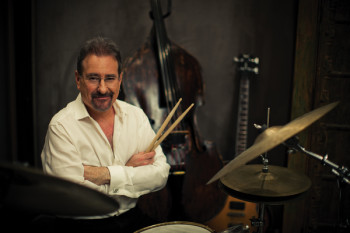
Brian Bromberg
Photo Credit: Raj Naik

Breaking down his methodology, Bromberg shares, “When I wrote the tunes, I made demos with swinging drum samples that I programmed just to hold down time, and then I played reference piccolo bass parts and regular bass parts to make a musical foundation. Then I had the piano players come over and I’d play drums live with them for interaction. The point is, by the time I played drums to it, I had good swinging bass parts to lock my drum parts to or vice versa. I added all my piccolo bass (and the horn players’ solos) last. I’m proud that I don’t sound like ‘a good drummer for a bass player.’ It doesn’t sound overdubbed and the feel of the pocket is righteous. Because I don’t have the facility of a drummer that’s played for 45 years, there’s more space than a normal drummer would leave which gives it a unique sound.”
“This album is just a swinging, in your face traditional jazz album with simple tunes that are easy to sing along with and remember, but have a foundation in hardcore “real” jazz.” Bromberg concludes. “I hope people enjoy this album for what it is and what it means to me vs. judging it for what it’s not.”


1  Jazz Me Blues
2  Full Circle    
3  Sneaky Pete    
4  Saturday Night in the Village
5  Boomerang    
6  Havana Nights (aka Havana Nagila)
7  Bernie's Bop    
8  Don't Stop 'Til You Get Enough
9  Naw'lins!
10 Susumu's Blues
11 Washington and Lee Swing

Brian Brombergg: acoustic & electric bass, piccolo bass, drums
Arturo Sandoval: trumpet
Bob Sheppard, Kirk Whalum and Doug Webb: saxophone
Randy Waldman, Mitch Forman and Otmaro Ruiz: piano
Alex Acuña: percussions


Ari Erev - Flow (2016)


Label: Self Released


In Flow, pianist-composer Ari Erev and his players pour fresh energies into the pool of sounds that nourish our world. They do so in accord with the hallmarks of personal expression, collaborative interplay and creative sophistication that characterizes jazz in all its glorious styles and forms.

This third album by the Tel Aviv-based Erev introduces a new set of original songs that expand on his taste for lyricism with a Hispanic accent. Inspired at first by virtuosic Cuban pianist Gonzalo Rubalcaba, who he heard on bassist Charlie Haden's bolero-tinged records Nocturno and Land of the Sun, Erev has made a study of keyboardists drawing upon Spanish, Caribbean, Mexican and South American musical legacies. He joins them in underscoring melodic themes with the rhythms of Africa adapted across the Atlantic Ocean as early as the 18th century, and 200 years later embraced all around the world.

This strategy requires skilled instrumentalists and in return spotlights their talents, so Erev has gathered accomplished compatriots to the task. Veteran bassist Eli Magen grounds the album's aura with his subtle yet substantive sound; drummer Ron Almog, best known for his prominent role in the Avi Lebovich Orchestra, and percussionist Gilad Dobrecky (on four tunes) deftly collude in support. Soprano saxophonist Yuval Cohen (of The Three Cohens, featuring his brother, trumpeter Avishai and sister, reedist Anat) richly enhances five tracks of Flow's tracks. The result of everyone's well-attuned efforts is more than an hour of music that soothes and stimulates in balanced measure.

"I prefer to leave these songs mostly unexplained," Erev says, "so that the listeners will come up with meanings and interpretations." But it will not hamper audiences' speculations to reveal that Flow's opener "Jump into the Water" was the last piece of this book written by the pianist. It came to him quickly one evening as a melody conveying the concept of taking a bold move "from which there is no way back. Once you jump, you can't regret it. . . "

"Flow" itself was the first song Erev penned for this project, a waltz that rises and dips during his piano solo as if buoyed by waves. On "Playful Moments" Cohen's voice-like horn floats upon a samba beat, a hint of "saudade," the Brazilian mood of nostalgic sadness, glistening through the song.

"July, Again" is Erev's tribute to his deceased friend and bassist Udi Kazmirski, who first gigged together on a July day; Kazmirski died in July 2012, hence the title. "Treasures in Havana" is Erev's allusion to spiritual, rather than material, assets, sparked by transcendent experiences, especially with music, he recalls from a family visit to Cuba.

Bassist Magen's line, says Erev, is the pivotal one of two meshing in "Inner Story." "What the Heart Sees" is Erev's evocation of the statement "What is essential is invisible to the eye," from Antoine de St.-Exupery's fable The Little Prince. Might what's essential be clearer to the ear? It seems so, as Erev, Cohen, Magen and Almog avoid mere embellishment while sketching soulfulness at a luxuriously moderate pace. And so Flow continues, with "Continuance" emphasizing the power of carrying on; the lyrical "Domingo," by Brazilian pianist-composer Debora Gurgel; the self-explanatory "Latin Currents," and American pianist-composer Fred Hersch's "Endless Stars."

It's true these tracks need little explanation. Your own attentions and reactions to the musicians' intimate interplay and sensitivity will tell you all you need to know. The music gives the impression that it's being created in the moment, just for us. As Ari Erev says, "Flow is the state of mind during which one is immersed in a continuous act of doing something, usually with great enjoyment and complete focus, without even noticing the passage of time. A listener can easily enter such a state. Simply sit down, relax and go with this Flow. – Howard Mandel


TEXT FROM THE ALBUM BOOKLETTE:

For me Flow has two meanings:

One is a stream of water that is directional and repetitive.
However, the repetitiveness is not even and comprises a wide variety of
large and small streams, colliding, converging and splitting again.
I see resemblance between Flow and Music. Similarly to a flow,
music consists of numerous different streams that have the same
general direction and – especially with improvisation
– never exactly repeat themselves.

Another meaning is a state of mind during which one is immersed in a
continuous act of doing something, such as learning or creating, usually with great
enjoyment and complete focus, without even noticing the passage of time.
It is as if the time becomes suspended and the perception of reality is blurred
by the unconscious. Some people may regard this as the embodiment of
Happiness itself...

I feel extremely fortunate to have experienced such emotions
while composing and arranging some of the tunes for this album.
. . . .

I hope you let my music flow into your hearts and minds.

Ari Erev
January 2016


 1. Jump Into the Water
2. Flow
3. Playful Moments
4. July, Again (For Udi Kazmirski)
5. Treasures in Havana
6. Inner Story
7. What the Heart Sees
8. Continuance
9. Domingo
10. Latin Currents
11. Gan Ha-Shikmim (The Sycamore Garden)
12. Endless Stars    


Ari Erev - piano
Eli Magen - bass
Ron Almog - drums
Gilad Dobrecky - percussions
Yuval Cohen - soprano sax


Leroy Jones - I'm Talkin' Bout New Orleans (2016)


New Orleans trumpeter Leroy Jones is recording his sixth independent album

The past few months have been busy for Leroy Jones; composing, arranging, and planning all take place long before the musicians step into the studio. His upcoming release, under the working title "I’m Talkin’ Bout New Orleans" will be recorded in January 2016 but planning for the album has been well under way for some time now. The final, welcomed push came from the Threadhead Cultural Foundation who supported the project in their fall grant cycle of 2014.

The total budget for the album is of course far greater than the Threadhead grant but the grant will cover a sizeable portion of the musicians' compensation. "Although I am producing the recording on my own, one of my priorities is to pay the musicians well for their time. This is what they do for a living, and you can't take favors and discounted rates to the bank," says Jones.

Consisting of original compositions, Jones' fans are surely waiting for the new album as it will be his first full length release since the 2009 "Sweeter Than A Summer Breeze." A single, "Go To The Mardi Gras" was recorded and released in 2012. The upcoming project "I’m Talkin’ Bout New Orleans" will feature 10 songs, performed by different ensembles ranging from quartet to a sextet with strings. The personnel will include some of New Orleans' most sought after musicians and the studio team will be Jones' trusted duo of Tim Stambaugh and David Farrell. Most of the songs have never been recorded and all arrangements are tailored for this release.

Excited to be heading back into the studio, Jones says that he is "delighted to be able to create a recording with only original compositions, thus adding to the New Orleans canon. It is wonderful that cultural foundations like the Threadheads are supporting artistic projects that perpetuate the true essence of New Orleans music."

Preproduction should be finished by December 2015 and if recording goes as scheduled, the fans will be able to purchase their copies of the brand new album in late March. As with Jones' previous projects, graphic design and photography will be done in-house, by Katja Toivola. This will allow the album's visual look to continue Jones' sophisticated trademark style.


I’m Talkin’ Bout New Orleans
The Aftermath Blues
Armstrong Parade
Time Is Always On Your Side
Rosey’s Theme
More Five Four
La Vella
Rendezvous
Carnival Is In The Air
Two Five One
Wonderful Christmas

All songs and lyrics written and arranged by Leroy Jones, except "Two Five One," with lyrics by Paul Sanchez and music by John Rankin and Leroy Jones.

Leroy Jones - trumpet/flugelhorn/vocals (tambourine/cowbell on track 9)
Alonzo Bowens - tenor sax
Wessell "Warm Daddy" Anderson - alto sax (track 7)
David Harris - trombone (tracks 1, 4, 9, 10)
Terrance Taplin - trombone (tracks 3, 5, 7)
Katja Toivola - trombone (track 2)
Helen Gillet - cello (track 5)
Todd Duke - guitar
Larry Sieberth - piano/Rhodes/organ
Jason Stewart - contra bass
Shannon Powell - drums (tambourine on track 8)

Recorded and mixed at Word of Mouth Studio by Tim Stambaugh, January 12th, 14th-16th & 20th, 2016
Mastered at Sonic Studio by David Farrell, January 28th, 2016

BUY THIS ALBUM

SONIA

Mikel Andueza 5 Segundoro - Cada 5 Segundos (2015)


Label: Errabal Jazz
Source: Tomajazz


El navarro Mikel Andueza es una garantía de calidad en cada proyecto que acomete. Su técnica depurada al saxo alto, sus buenas composiciones y su acierto en la elección de los músicos llenan de valor sus discos. Cada 5 segundos, su último trabajo, lo viene a confirmar una vez más.
El disco lo conforman nueve temas, ocho compuestos por el propio Andueza y otro popular navarro, interpretados por un sexteto de lujo en el que están Iñaki Salvador, Dani Pérez, Chris Kase, Gonzalo Tejada y Gonzalo del Val, todos magníficos en su participación.
El motivo del disco es el tiempo y la muerte de los niños en África. Una llamada de atención ante una de las masacres más silenciosas y olvidadas de este planeta. A esos niños está dedicado Cada 5 segundos.
El disco tiene un cierto carácter melódico en el comienzo de las piezas. Sus temas son reflexiones armónicas que se desarrollan a través de improvisaciones de Andueza con un estilo sencillo, pero impecable en cuanto a su ejecución. Escuchar este disco es plenamente reconfortante. La complicidad establecida entre los músicos desde que empieza con el tema que da título al disco hasta que acaba con “Jan Steps” da una sensación de historias muy bien contadas, con unos personajes-músicos que encajan a la perfección y unos ritmos dirigidos por Andueza, dignos de admiración. Buena culpa de ello la tiene la capacidad compositiva de este músico. Lo mismo encontramos temas intensos como “Underground”, que preciosos solos de Chris Kase a la trompeta y otro de Iñaki Salvador al piano en “Axuri Beltza”, o exposiciones de Mikel Andueza y Dani Pérez a la guitarra en “Ponle letra” o “Mr M.B.”. En realidad ningún tema tiene desperdicio.
El disco es jazz plenamente contemporáneo, con unos temas dotados de una fuerza que les hace siempre salir airosos, sin fisuras y con un desarrollo redondo. Un nuevo acierto de Mikel Andueza.
© Carlos Lara, 2016


Cada 5 Segundos
Zortziko para Mauro
Majito
Axuri Beltza
Underground
Mr M.B.
Kenny
Ponle Letra
 Jan Steps


Miguel Andueza (saxo alto)
Dani Pérez (guitarra)
Chris Kase (trompeta)
Iñaki Salvador (piano y órgano)
Gonzalo Tejada (contrabajo)
Gonzalo del Val (batería)


Victor Goines - A Dance At The Mardi Gras Ball (2016)


Source: offbeat

As the director of jazz studies for the Bienen School of Music at Northwestern University since 2008, New Orleans native Victor Goines has had the opportunity to hang in nearby Chicago. And it shows! The saxophonist and clarinetist, who is best recognized for his work with the Wynton Marsalis Septet and the Jazz at Lincoln Center Orchestra, grabs his tenor for some hard blowing on “Stoit,” the post-bop opener of A Dance at the Mardi Gras Ball. Known as a mild-mannered gentlemen, Goines really lets go and takes it out, enabled by a loaded rhythm section made up of excellent Chicago-based musicians. They include drummer Gregory Artry, Jr., pianist Ron Perrillo and bassist Dennis Carroll. The latter two are also fellow educators who teach at Chicago’s DePaul School of Music.

Naturally, Goines also reveals his romantic side, and for ballads such as “Her Eyes Smile,” the soprano sax is often his instrument of choice. It’s a quiet, lovely tune, the mood lightly accented by Perrillo’s fluttering piano notes and the occasional splash of cymbals.

The music starts swinging on the blues-laden “Mississippi Mud Shuffle,” on which Goines starts honkin’ in a rougher, more swaggering style than many would consider his norm. Think of him blowing in a small, old-school Chicago jazz and rhythm and blues club.

Victor Goines—who wrote all of these varied compositions—lives jazz, and his knowledge and ability to perform the music’s full spectrum are proven again on A Dance at the Mardi Gras Ball.


Stoit
A Dance at the Mardi Gras Ball
Soledad
Her Eyes Smile
Mississippi Mud Shuffle
The Princess and the Troll
The Swaggerer (Calypso Version)
Departure
Blues for the Cedarhurst
You and Me
The Swaggerer (Swinging Version)

Victor Goines – Soprano and Tenor Saxophone
Ron Perrillo – Piano
Dennis Carroll – Bass
Gregory Artry Jr – Drums

BUY THIS ALBUM

ROJ TEAM

Monday, April 11, 2016

Ralph Peterson - Triangular lll (2016)


Label: Self Released
Source: Cdbaby


To invert a Ducal dialectic, this music does mean a thing, and means it right from the start—and swing at this level of vigor and accomplishment means no less than the vitality of jazz at the present time. Swing rhythm has always represented an engagement with time—clock time, musical time, historical time: all the unavoidable times in which we live—with the power to liberate us from time’s constrictions and open a human, syncopated pathway to life more abundant. I’m glad it’s still with us, on this record and in clubs like New Haven’s Firehouse 12—“I like the intimacy of the room,” Ralph Peterson told me. “It’s a great place to play, the piano is fantastic and the tech stuff is always on the highest level.”—to light us up in this increasingly punchback, backbeat world.
The first tune is pianist-composer Walter Davis Jr.’s near-standard, “Uranus”, the first of three Davis compositions Peterson has chosen in tribute to a master musician who was an influence and mentor early on. “I was nineteen years old, studying at Rutgers, and Walter came to town with Philly Joe Jones’s Dameronia. At the time, I was trying to play as much like Philly Joe as I could, and I wasn’t cutting it, but for some reason Walter took an interest in me, and we started talking regularly. He’d mention a record, not tell me to check it out, just mention it, but then he’d call the tune on me without even counting off. That was the way back then, the masters would give you one chance to not know something, and if you weren’t paying attention, that would be the end of their interest in you. Walter gave me my first real gig in New York City, in a band that also included Wynton and Branford Marsalis, and we play three of Walter’s tunes on this CD.”
The fleetness of the trio-playing coming out of the gate on the first of these is a particular thrill: even listeners who take bassists for granted—and you know who you are—should perk up at Luques Curtis pushing his bass line into the forefront of the beat to fuse with the leader’s multiform sense of push and pocket. Peterson notes that although Luques Curtis is heir to the great tradition of Latin bass from Cachao to Andy Gonzalez, his walking bass is impeccable. “He was a student at Berklee and when I first heard him he was at a level above where I expected him to be, and now, fourteen years down the line, well, his development speaks for itself in the music.” Peterson similarly says of Zaccai Curtis that while most pianists anchored in Latin music don’t play jazz with equal authority, and vice versa, there is no such division in the pianist on this date, as his athletically longlined improvisation on “Uranus” makes clear. Also note his graceful variations on the catchy melody of Sam Rivers’ “Beatrice”, the first of two tunes associated with Joe Henderson—“He’s one of the main non-drum playing influences on what I do,” said Peterson, “and Luques and Zaccai’s arrangement of “Inner Urge” is a particularly brilliant take on the tune, combining clavé and odd meter ingeniously.”
And so on into the rest of this very live recording, through powerhouses like Peterson’s “The Art of War”—note the nod of homage to McCoy Tyner’s early composition, “Inception”—lyrical remissions via “Moments” and Hoagy Carmichael’s classic “Skylark”, and all sorts of variety lights and darks. “Backgammon”, “Manifest Destiny”, and “400 Years of War” demonstrate how much rhythmic variety a muscular, intelligent piano trio can bring to the conversation. Extraordinary throughout is the fullness that Peterson’s drumming achieves without overwhelming either busily or dynamically the necessary balance of the trio format.
“That kind of sonic balance comes from thirty years of experiemce. A lot of people with a lesser vocabulary tend to use the words loud or powerful, whereas the word dynamic, and the understanding of the word dynamic, escapes them. Dynamics isn’t playing soft all the time any more than it’s playing loud all the time. It’s the distance between the two and how you navigate it . . . Trio drumming, or any drumming, is not not so much about what to play or how much to play, but why, and where, and when. Understanding what the music calls for and placing it correctly enhances the dynamic impact of the music you’re trying to get acrosss.”
The session closes with the speedball “Blues for Cooch”, and if you lose track of the structure, as I did, it helps to be told, as I was, that it’s an eighteen-bar blues, shaped from three groups of six bars, with an extra harmonic nuance at the end of the chorus, and it’s full of rich three-way invention and the jazz language of our time spoken at peak eloquence, with a full measure of fire and wit and passion: a live event capped, appropriately, by Peterson acknowledging his bandmates, then including the audience: “And you, and you, and you!”
Your luck is running high: now you’re in on it too.


COMING NEXT ON REPUBLIC OF JAZZ


STAY TUNED...

YOUR FRIENDLY NEIGHBORHOOD

Greg Fishman - New Journey (2016)


Label: Self Produced
Source: Cdbaby


Greg Fishman has been a dynamic tenor-saxophonist on the jazz scene for the past twenty-five years. His bright and appealing tone, his ability to sound equally at home with up-tempo bop romps and Brazilian-oriented music, and his steady stream of creative ideas have made him a major force in both the Chicago and international jazz scenes. His collaborations with his wife, pianist-singer Judy Roberts, guitarist-singer Paulinho Garcia in their duo, known as Two For Brazil, the late pianist Eddie Higgins (on their duet album Indian Summer) and as the leader of his own quartets display his talents as a multifaceted improviser with melodic beauty in everything he plays.

Throughout his career he has focused on straight-ahead jazz and Brazilian music, performing everywhere from the NorthSea and Monterey Jazz Festivals to concerts and clubs in SE Asia. He can always be relied upon to uplift any bandstand with his enthusiastic playing and inventive ideas. Greg is also well-known for his work in jazz education as a teacher, and as owner of Greg Fishman Jazz Studios, which has published more than twenty highly acclaimed books focusing on jazz saxophone, music theory, and improvisation.

New Journey is arguably Greg Fishman’s finest recording to date, featuring performances of seven originals with a top-notch quartet. “Most of these tunes were written when I was on concert tours of Bangkok, Singapore and Japan. The music is mostly straight-ahead but with some unusual chord changes and twists.”

On New Journey, Fishman teams up with his regular Chicago rhythm section. He is rightfully enthusiastic about their abilities. “Dennis Luxion is a lyrical player with a sensitive touch, beautiful voicings and comping that is really interactive. Eric Hochberg sets the groove, and creates what I call a “long arc” on the bass-- melodic lines that frequently stretch over an entire phrase. Phil Gratteau is a fantastic drummer who is very knowledgeable in a lot of styles, always stretching the music and making it sound personal, always playing in the moment."

The program begins with a perfect opener, “Champagne Jane.” The uptempo swinger has a catchy and singable melody, some cooking tenor, a piano solo by Luxion that keeps the momentum flowing, and a brief trade of fours with drummer Gratteau. One could imagine Dexter Gordon or Richie Cole having fun on this tune, a song that could very well catch on as a standard in the future.

“Dahlia” is a hard bop piece with a Latin feel that would have fit in well on a Blue Note album of the mid-1960s. While there are hints of Joe Henderson and Stanley Turrentine in spots, Fishman plays throughout in his own distinctive style.

The atmospheric piece “Floating Down” has an unusual chord progression (major seventh chords descending in whole steps) and a melody that gives one the impression of a consistently downward motion. The tricky jazz waltz includes a counter-melody played by bassist Hochberg that answers the ideas of Fishman.

A downward harmonic pattern is also used as part of “New Journey,” although primarily as an introduction and transition between soloists. It also acts as an exciting coda to the tune. The medium tempo straight-ahead original finds Fishman’s tenor flying effortlessly over the complex harmonies.

“Boppertunity,” like Charlie Parker’s “Little Willie Leaps,” outfits the chord changes of “All God’s Children Got Rhythm” with a new and fresh melody. Greg Fishman takes a hot boppish solo and both Dennis Luxion and Phil Gratteau get to stretch out on this stimulating performance.

“The Ninth Degree,” a modern Brazilian-flavored tune, has Fishman nodding in Stan Getz’s direction but in his own distinctive voice, caressing the piece and playing with a great deal of warmth.

The final selection, “Constellations,” opens with shimmering bursts of cymbals, and with the saxophone exploring the harmony in a series of short cadenzas before launching into a straight-ahead swing tune with a harmonic approach worthy of John Coltrane during his Atlantic years (circa 1960).

With this album, Greg Fishman and his quartet have created a truly memorable recording, with each musician exploring and discovering musical treasures that will invite the listener to come along on this New Journey.

Scott Yanow, jazz journalist/historian and author of 11 books including Bop, The Jazz Singers and Jazz On Record 1917-76

 
1. Champagne Jane
2. Dahlia
3. Floating Down
4. New Journey
5. Boppertunity
6. The Ninth Degree
7. Constellations

Greg Fishman - Saxophone
Dennis Luxion - Piano
Eric Hochberg - Double Bass
Phil Gratteau - drums   


Live Out Loud Band - Organizing Chaos (2016)


UNKNOWN INFORMATION


HELP


Original Release Date: April 8, 2016
Release Date: April 8, 2016
Label: The Live Out Loud Enterprise
Copyright: 2016 The Live Out Loud Enterprise

1. Poke-Her-Dots I (feat. DJ Fire)
2. Cali Groove
3. Beautiful Eyes (feat. Teri Gina)
4. We Use to Be (feat. Charlie B.)
5. Poke-Her-Dots II (feat. DJ Fire)
6. S.L.T.S (feat. Philippe Edison)
7. Inductive Reasoning


BUY THIS ALBUM

VÍCTOR


Eco-Music Big Band - Colors of Resistance (2016)


ECO MUSIC BIG BAND

The Eco-Music Big Band is proud to present the Philadelphia premiere of its COLORS OF RESISTANCE program at the Painted Bride!  Equal parts radical big band music by living composers, theatrical performance art, and classical-turned-jazz, COLORS OF RESISTANCE features new works by up-and-coming composers Livio Almeida, Felix Del Tredici, Marie Incontrera, Albert Marques, Zack O’Farrill, and Stefan Zeniuk; celebrates the five-decade career of bass trombonist and composer David Taylor; and reimagines iconic works by the late Chinese-American composer and baritone saxophone virtuoso Fred Ho and late composer and activist Cal Massey.

COLORS OF RESISTANCE tells a joyful story of music that comes from the tradition of resistance to oppression: fusing virtuosic radical jazz with hip hop, heavy metal, Latin rhythms, and blues forms, the Eco-Music Big Band promises a one-of-a-kind experience that intends to propel the jazz idiom into the 21st century.  The title of the program was conceived during bandleader Marie Incontrera’s final conversation with band’s founder Fred Ho before his death, in which Ho said “all the colors of resistance… all the colors of life… hold them…”

The Eco-Music Big Band is a 16-piece, multigenerational and unique big band that includes some of the nation’s most acclaimed jazz musicians (such as bass trombonist David Taylor, drummer Zack O’Farrill, and trumpeter Adam O’Farrill).  Hailed as “…music and activism at its finest” (DooBeeDooBeeDoo), the Eco-Music Big Band regularly commissions works by younger and emerging composers, and performs music with a vision for a better world.  The band also performs the exclusive repertoire of the music of its late founder, Fred Ho, and the 1970s jazz composer and bandleader Cal Massey.  The Eco-Music Big Band has performed on respected stages throughout the New York area such as the Blue Note Jazz Club, Red Rooster’s Ginny’s Supper Club, Joe’s Pub at the Public Theater, Zinc Jazz club, BAMcafe, Roulette.


ABOUT MARIE INCONTRERA

Marie Incontrera is a composer, conductor, and band leader whose work spans queer opera, political big band, and music for the oppressed.

Marie has conducted as a bandleader as well as in classical and operatic settings at Brooklyn Academy of Music, WOW Cafe, Red Rooster Harlem, BarnArts Center for the Arts, and others. Marie conducted the Green Monster Big Band for Fred Ho’s final album, which has an international release date for later in 2014. Marie was Fred Ho’s last composition and conducting protege.

A fierce revolutionary warrior and Fred Ho’s last music student, Marie was tasked to take his music to the highest level of harmoniously merging music and ecology, or PONO — a Kanaka Maoli, indigenous Hawaiian concept, for elegant and exquisite equilibrium. Eco-Music strives for this equilibrium and beyond.


01. Action and Reaction (feat. Adam O'Farrill)
02. Rag House
03. Double Tier (feat. David Taylor)
04. Mission Accomplished
05. Foggy Conscience
06. Iron Man Meets the Black Dog Meets David Taylor (feat. David Taylor)
07. Seven Generations
08. The Channel (feat. Lauren Lee)
09. I.D.N (feat. Gabriel Globus-Hoenich)
10. Prayer

BUY THIS ALBUM

JAVI