"Inspired in the American jazz of the Sixties, but with a North European perspective of inquestionable modernity, Fredrik Nordström imposed himself already as one of the most powerful and intriguing saxophonists in the tenor variant coming from the Old Continent. His prestige as a performer is extensive to the compositional work he’s developing, such is the richness of ideas in terms of harmony and rhythm presented by his quintet.
Monday, March 1, 2021
Fredrik Nordström Quintet - Live in Coimbra (2021 Clean Feed Records)
Fredrik Nordström - Needs (2021 Clean Feed Records)
"In his new album, saxophonist and composer Fredrik Nordström deals with a format that reminds of a double quartet of the same type as Ornette Coleman recorded in the early 1960’s. For someone always interested in exploring different possibilities of group interaction, the decision isn’t really a surprise in itself: what surprises us are the results. Instead of acting as a double quartet, Nordström and his fellow Swedish musicians sometimes acts as an octet or as a trio, a quintet, or, you name it! The (double) rhythm section shows off some groovy and hard swinging parts as one unit, but the freedom to contribute individually in this collective of great improvisers is fundamental.
Nordström’s writing and conduction of the improvisational developments are, as always, subtle and meticulous, like hidden geometrical forms in an (apparently) abstract canvas. And if the double quartet matrix is generally connoted with the free jazz subgenre, in “Needs” something else is in equation, coming from the bop and hard bop traditions (Nordström’s tenor style owes something to Dexter Gordon) adding adventurous compositions with dazzling improvisations and giving expression to what the leader of this one day session calls «progressive jazz with unquestionable influence of contemporary classical and rock music». A must."
1. Needs 07:37
2. Fake Face 04:34
3. House of Tales 07:09
4. Hometown Prophet 05:51
5. Hope 07:29
6. Brand New Dollars 06:13
7. Morning Bliss 09:02
LEFT channel:
Fredrik Nordström - tenor & baritone saxophones
Mats Äleklint - trombone
Filip Augustson - double bass
Christopher Cantillo - drums
RIGHT channel:
Fredrik Ljungkvist - clarinet & tenor saxophone
Niklas Barnö - trumpet
Torbjörn Zetterberg - double bass
Fredrik Rundqvist - drums
All compositions by Fredrik Nordström
Recorded March 23, 2018 at BAS, Bandhagen Sweden by Mats Äleklint
Mixing and mastering at Bluenord Studio, Högdalen Sweden by Fredrik Nordström
Produced by Fredrik Nordström
Executive production by Pedro Costa for Trem Azul
Archie Shepp & Jason Moran - Let My People Go (2021)
"Words, sounds, speech, men, memory, thoughts, fears and emotions—time—all related…all made from one…all made in one." —John Coltrane, 1964
There comes a time when musical expression flows directly from the soul—unimpeded, unfiltered. Unmasked. A point when the modes of expression—the way a person plays and sings, the way he walks and talks and even wears his hat—are all on the same wavelength, all drawing from the same inner spirit. Their music reveals not just who the individual musician might be, but reflects who we all are. Message, music, and identity weave together into one.
Archie Shepp, more than sixty years into a career of supreme dedication, has devoted a lifetime to this idea of spiritual singularity. His vast discography is peppered with moments of deep connection: small ensembles and big bands. Significant studio projects and equally historic live performances, as sideman, leader, and very often, collaborator.
A special thread connects the saxophone/piano duets and makes them standout, Shepp’s meetings with such greats as Horace Parlan, Joachim Kühn, Mal Waldron, Jasper Van’t Hof, and Abdullah Ibrahim (back when he went as Dollar Brand.) Four hands, two instruments, one common statement. Shepp has found a way to consistently excel in this space, as a speaker and as a listener. Much of it has to do with the intensity of the interaction between the two voices, how that space allows the dialogue to stand out. Shepp, in all these instances, has elevated it further: developing these conversations with just the right amount of form and freedom.
Neither Shepp nor Jason Moran are old, and neither are they young—except in spirit and delight. Moran is the more recent arrival, and he’s no new kid on the block. They carry age and experience in their playing as much as a youthful fascination with the songs and forms that define this tradition we call jazz. Let My People Go is the timely title of this collection, but when has that message not been relevant? Now, sadly, as ever.
This is their first recording together, a gathering of duet performances from 2017 and 2018, chronicling a relationship that can sound like the intimate huddling of two old friends: whispered asides, excited exclamations, utterances coinciding with practiced harmony, followed by bursts of laughter. “Ain’t misbehavin’!” cries out one. “Waahhhh!!”, says the other. (That’s really Shepp speaking both parts—but you get the idea.)
Jason Moran - The Sound Will Tell You (2021)
The Sound Will Tell You, Moran's 3rd Solo piano recording, was made on January 4-6, 2021. Half of the works use an effect dubbed "DRIP", a filter to allow the sound cast a shadow. The Drip gives the note another gravity. These pieces are marked by "tear", "honey" and "shadow. Moran, from Houston, also recalls DJ Screw's ability to give a song a new sluggish gait. Drawing out the drawl and sinking the beat into the mud. The music moves in slower motion.
Many of the titles refer to Toni Morrison, the author Moran read most frequently during quarantine. She evokes sound often and speaks of the pitch black night as "it may as well be a rainbow." - Song of Solomon.
The Sound Will Tell You is being concurrently released with an exhibition of new works on paper at the Luhring Augustine Gallery in Tribeca, New York. Moran's practice of recording his hand motions on the piano manual creates a variation on the "recording". The attack of the finger on the key leaves a mark and accumulates residue.
A believer in "melody", much like his idols Thelonious Monk and Herbie Nichols, Moran writes pieces that retrace themselves. The songs step into their own footsteps, a choreography of repetition, occasionally disrupting their own dance. Body and Soul remains a piece Moran circles around, this time with a nod to Eddie Kendricks' Intimate Friends.
For Love was recently heard in the film version of Ta-Nehisi Coates' Between the World and Me, which Moran scored. His dedication to the melody is what pulls this record into another territory, aiming to eliminate the differences between melody and solo. The narrative drives these works.
How much more terrible was the Night highlights America's current state of pandemonium.
1. Follow the Light 02:38
2. Spoken in Two (Tear) 02:55
3. For Love 03:56
4. My Mother's Handful of Tea 03:35
5. Only the Shadow Knows (Honey) 04:56
6. Body & Soul with Intimate Friends (Shadow) 03:06
7. Dawns after the Dream 02:13
8. Bee Mantra (Honey) 03:22
9. How much more terrible was the Night 03:12
10. The only morning coming (Tear) 02:34
11. Hum then Sing then Speak 05:16
12. Toni Morrison said Black is a Rainbow (Shadow) 04:23
Jason Moran: piano solo
Cecil Taylor Quintet - Lifting The Bandstand (2021 Fundacja Słuchaj Records)
When the Cecil Taylor quintet was ready to play at the Tampere Jazz Happening on October 30, 1998, all the musical world knew the virulent compactness of Taylor's groups, especially after the American pianist had established an on-going link with Berlin and the European public. That day in Tampere, a superlative performance of free improvisation (Harri Sjöström on soprano sax, Tristan Honsinger on cello, Paul Lovens on drums and Teppo Hauta-aho on double bass) was able to represent Taylor's enormous creative potential. It is a concert discovered in the archives of Finnish Radio YLE, never documented on a recording medium, which allows us to enter that absolutely unique world of Taylor’s groups: art and sound density, expressive universes that leave you speechless even after their conclusion.
That day the sound power produced by the group was even able to impress Steve Lacy who, at the end of the concert, went to find the musicians backstage, saying:"...You guys really lifted the bandstand...", a statement that has been carved into the memory of that evening and also provides the title of this live recording. In Lifting the Bandstand the structure is typical: Cecil enters the stage, poetizes on his verses and enters into a free dance; then some deep clusters on the piano; the string musicians offer themselves in an abstract design and the development of a sort of propitiatory ritual outlined in all its excitement and fullness when the clusters start to become cutting and the musical set becomes explosive. In this concert Taylor and the four European musician-personalities continue their enthusiastically celebrated non-hierarchical style of play that they started from the very beginning of this constellation.
They sow the seeds for a free and choral relationship that favors the shattering, the physical prowess of the musicians and a phenomenology of music. The first half hour of Lifting the Bandstand is an uncontrolled expansion of the sound mass, with the instruments continuously expanding so that one cannot believe that musicians can play with that intensity for so long: an instinctive, chemical experiment consumes itself, in which all "music" is demolished and re-presented according to a project of apparent intangibility, not a sterile but a constructive fury, which upsets for the speed undertaken and the extended techniques; only after an hour the shockwave fades into a cubic phase, less thunderous, more oriented towards a melodic quality and a timbre line, where onomatopoeia intervenes; there are some attempts to replicate operatic singing and we find reminiscences of classicism camouflaged in areas of interaction.
Even when the music calms down in the end, there are still electric shocks of music, small refluxes of the instruments, which the musicians cannot completely dominate in this new situation of relaxation. When the ritual ends, the sensation is to have experienced the equivalent of a virtuous myth, a regenerating force that leaves the listener astonished, breathless and enriched not really knowing to where he had been taken. Ettore Garzia
1. Desperados A 28:25
2. Desperados B 47:08
Cecil Taylor, piano
Harri Sjöström, soprano sax
Tristan Honsinger, cello
Teppo Hauta-Aho, double bass
Paul Lovens, drumset, cymbals and gongs
Recorded October 30.1998 at Tampere Jazz Happening by the Finnish Broadcasting Company YLE at Tampere Jazz Happening. Originally produced for YLE by Veli- Pekka Heinonen
Final mix by Patrick Römer and Harri Sjöström + Paul Lovens
Mastering by Patrick Römer of Unisono Records
Marek Malinowski / Robert Rychlicki-Gąsowski / Wojciech Zadrużyński - Scratching Fork (2021 Fundacja Słuchaj Records)
A place between structure and fluctuation where planning and spontaneity intertwine, enriched by rational thinking or wild instinct. A connection between cold focus and wonderful oblivion. The art of compromise without compromising. It might be a place where the hardness of metal touches the softness of skin. Scratching Fork could be all of these. One thing is certain – it is a band, a talented trio playing jazz-like music in contemporary style. The story of this band started in 2015 and since then Scratching Fork has been growing without rush, but consistently and inevitably, just like the mountains of New Zealand. Developing, not seeking attention or caring about changing trends, simply focusing all its energy on its purpose, emotions and discovery.
Slowly cultivating its music, the band has grown stronger by firmly following its local Kuyavian roots. And what about these roots? What, or rather who creates Scratching Fork? The idea to create the group, just like the first song of Ilúvatar, seeded in the mind of Marek Malinowski. He then invited two musicians from Toruń to cooperate, Wojtek Zadrużyński (drums) and Robert Rychlicki (double bass), who had cooperated in rhythm sections for years. Both were fascinated by Marek’s music from the very first rehearsal and thus, adding a touch of their own sounds and emotions, became part of the band.
1. When She Sleeps 07:00
2. Mountains 10:05
3. Vertigo 03:06
4. Dancer In Galoshes 05:17
5. 7 O'Clock 04:18
6. Goodbye Poem 04:43
7. Fairytale Land 05:14
Marek Malinowski - guitar
Robert Rychlicki-Gąsowski - double bass, bass guitar
Wojciech Zadrużyński - drums
All compositions by Marek Malinowski
Frisque Concordance - Distinct Machinery (2021 Trost Records)
Disquiet - Disquiet (2021 Trost Records)
Shaymus Hanlin Quartet - Just Us, Just We (2021)
Shaymus Hanlin is a 19-year-old vocalist based out of Portland, Oregon. Growing up with the American Songbook in his heart, he fell in love with the music and began performing at age 13. For many years Shaymus had dreams of creating a jazz combo and, in late 2019, the Shaymus Hanlin Quartet was born. Their debut single “It’s All Right With Me” was released on November 28th, 2020. That release marked their very first sound out to the public. As the pandemic of 2020 crushed live entertainment around the world, the hopes for the band getting to play live anytime soon were fading fast. So... what did they do?
They recorded their very first album. With the help of many, lots of planning, hard work, and passion, SHQ is set to release their 10 track album in Feb. 2021 titled “Just Us, Just We.” Shaymus and the band can’t wait to share the music with everyone and hope you will follow along their journey. To learn more about Shaymus Hanlin Quartet, be sure to follow shaymus_hanlin on all major social media platforms, as well as shaymushanlin.com
1. Just You, Just Me 04:50
2. A Kiss to Build a Dream On 04:42
3. How High the Moon 03:38
4. The Lady Is a Tramp 07:49
5. It Had to Be You 02:58
6. 'S Wonderful 04:37
7. Too Marvelous for Words 03:16
8. I Fall in Love Too Easily 05:59
9. It's All Right With Me 04:33
10. Almost Like Being in Love 03:22
Vocal/Bandleader: Shaymus Hanlin
Piano: Wes Georgiev
Bass: Liam Hathaway
Drums: Michael Rodenkirch
Tommy Smith - Solow (2021)
These five short solo saxophone tracks are slightly different from anything you've heard before.
The idea behind this, especially Songs of the Martyrs, was directly inspired by experiencing and listening to Psalm singing live, on the Isle of Lewis, in the Scottish Hebrides; music, which is one of the branches of 'call and response'.
About Tommy Smith
Born in 1967, Edinburgh. In 1983 Chick Corea recommended Tommy Smith to Gary Burton; he joined his group. Recording over 30 solo albums for Blue Note, Linn, ECM, Spartacus Records, touring 50+ countries, performing with Arild Andersen, Edwin Morgan, John Scofield, Jaco Pastorius, Trilok Gurtu, Dizzy Gillespie. In 2019, he was awarded an OBE for services to jazz from HRH Queen Elizabeth II.
Sunday, February 28, 2021
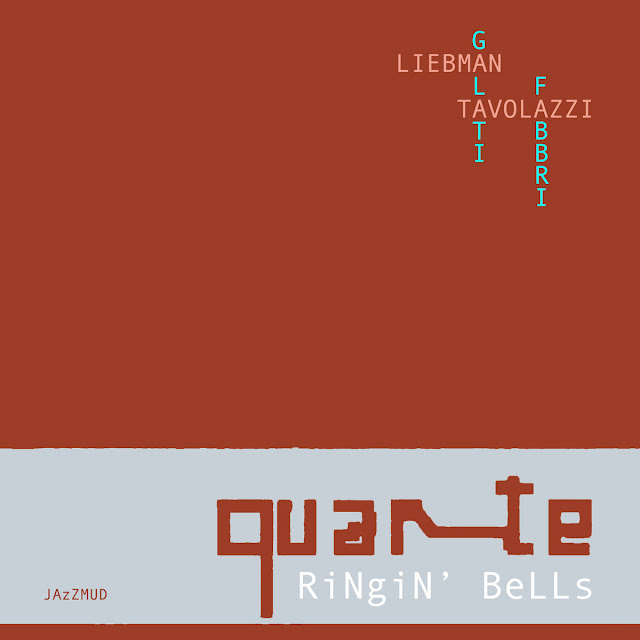
Quarte - Ringin' Bells (February 2021 JazZMUD Recs)
Makoto Kawashima - 2021.2.27 (February 28, 2021)
Butch Miles - Straight on Till Morning (February 2021 nagel heyer records)
Marco Grispo - Parques (February 2021)
"Two and a half years have passed since I arrived to New York from Argentina. Through this time, I have had the opportunity of meeting and playing with many heroes of mine, and also found inspiration in great people I met along the way. A lot happened very fast and like everyone, thanks to the quarantine I got the chance to stay still for a moment, reflect, and to write and work on this music.
It was also during quarantine that my bond with Arturo and Fernando got to a new level, both personally and musically. It is a great pleasure and a blessing to make music with people so close to me, and that share a same feeling.
Similarly, a week before we even learnt about lockdown, I moved together with my partner Siewli to our current apartment in Brooklyn. Her warmth and support are not only a key to the realization of this album, but a huge part of the compositions and sounds in it.
Also, I want to express my deep gratitude to Guillermo Klein. All of the compositions were based on concepts he shared with me in a series of virtual encounters we had through the lockdown. I treasure all the advices he gave me and I know they will be part of my process forever.
Finally, I give thanks to my family; specially to my parents for their love, my brother for his advice, and my grandma for her prayers.
I hope you enjoy this music, it is my way to share this love I mentioned. There is a lot more to come."
-Marco
1. Diabelita 03:49
2. Intro to Fort Greene 01:09
3. Fort Greene 06:06
4. Atardecer con Siewli 03:46
5. Para que no te vayas Nunca 03:33
6. Parques 04:58
7. Go Out and Get It 04:45
Marco Grispo | Guitar
Arturo Valdez | Upright Bass
Fernando Ferrarone | Trumpet
All compositions by Marco Grispo.
Recorded on December 15th, 2020 at Luis Bacqué's Studio in New Jersey by Luis Bacque. Mixed and Master by Luis Bacqué.
Nacho Moze Sexteto - Costanera (February 2021)
Kevin Kastning // Mark Wingfield: Rubicon I (March, 9 2021 Greydisc Records)
Saturday, February 27, 2021
Joachim Kühn - Touch the Light (February 2021 ACT Music)
Florian Willeitner - First Strings on Mars (February 2021 ACT Music)
“I don’t think I have ever known a musician with quite the level of openness to people, to emotions, to musical languages, and the capacity to make them his own as Florian Willeitner. He is a stun-ningly good violinist, and I discover something new every time I hear him.” Paul Zauner, Founder & Artistic Director, INNtöne Festival
In the past the violin in jazz could sometimes seem a bit exo-tic, even outlandish, but all that has changed. Classical music and jazz are no longer mutually exclusive worlds; these days they en-rich each other, and it is the norm for string instruments to take centre stage. The ACT label has played its part in this transforma-tion, with artists such as the Bartolomey/Bittmann duo, the ra-dio.string.quartet.vienna and the incomparable Adam Baldych among the pioneers who created the paradigm shift, and who continue to take their music in new directions.
And yet, as violinist/composer Florian Willeitner from Passau in Southern Germany sees it, there is still further to go: “The full potential of the violin, with its unique versatility and its kaleidoscopic possibilities of timbre and texture, is rarely to be heard in conventional jazz settings.”
And from this he has derived his credo as both composer and instrumentalist: “It is my firm belief that in order to write music which uses the violin’s great spectrum of possibilities, it is crucial not just to have an awareness of the classical tradition, but also of the many other cultures which feature string instruments prominently and in which unique approaches and techniques have been developed. To blend these different ingredients into a trans-cultural style which is respectful to each of these distinct traditions is what inspires me.”
Willeitner, who was the star student of top violinist Benjamin Schmid, has been travelling the world and studying a wide variety of different musical cultures since the age of 19. During his classical studies, completed in 2017, he experimented with new ways of writing for orchestra, notably in his Violin Concerto No. 1, which had its first performance in the Vienna Musikverein. With his “New Piano Trio” he has spent several years refining this cross-genre composition and performance. In 2018 he founded “Pool of Invention”, an international artists' collective. With this collective he has focused his efforts on highly efficient transcultural art. The collective is a creative partner of leading festivals such as Mozart Week in Salzburg, directed by Rolando Villazón.
Larry Coryell & Philip Catherine - Jazz at Berlin Philharmonic XI: The Last Call (February 2021 ACT Music)
The wheel has come full circle with the album “Last Call”, featuring the duo of Larry Coryell and Philip Catherine. This live recording from the Philharmonie in Berlin captures the culmination of an evening under the banner “Art of Duo” in Siggi Loch’s “Jazz at Berlin Philharmonic” series.
After four decades, it marks the two guitarists’ return to the scene of one of their very first major triumphs. In 1976 they appeared as part of the band 11th House at the Berliner Jazztage at the same venue, but it was the moment when just the two of them stepped forward and performed as a duo which the “Die Zeit”’s critic hailed as possibly the high point of the whole festival. It was a decisive step in what would become a highly successful collaboration.
Coryell and Catherine subsequently made two superb studio albums: “Twin House” (Atlantic, 1977), recorded in London, and the very fittingly named “Splendid” (Elektra, 78), recorded in Hamburg. Both of these LPs have definitely stood the test of time. Both also had the same producer, who credi-ted on the sleeve as “Siegfried E. Loch”. As he wrote to both the musicians in November 2016 on the 40th anniversary of the recording of “Twin House”: “I am pleased that we are going to be celebrating this music in the concert on 24 January 2017 in Berlin." On “Last Call” Coryell and Catherine play four num-bers, followed by first-time appearances of duos consisting of Philip Catherine and pianist Jan Lundgren and then of Larry Coryell with bassist Lars Danielsson, plus a valedictory jam on “Green Dolphin Street” with all four of these musicians plus trumpeter Paolo Fresu.
Coryell and Catherine, two “brilliant, mutually attuned musicians” as the liner note for “Twin House” describes them, were born less than six months apart during the Second World War. Texas-born Coryell and London-born Catherine have different musical heritages, but their affinity and above all their complementarity shone through every time they played together. When playing as part of larger units, there would always be at least 20 minutes when the pair would perform as a duo.
Diego Pinera - Odd Wisdom (2021 ACT Music)
Diego Pinera is a unique figure who is genuinely taking music in new directions by juxtaposing the po-lyrhythmic freedom of jazz with other metric systems. As he says, “I studied music in the places where it came from.” He started playing drums as a four-year old in Montevideo. His student years were spent in Havana, Boston (Berklee) and Leipzig.
Based in Berlin since 2003, he has continued to wi-den his musical horizons, immersing himself in the ‘odd’ meters of the title through extensive work with Berlin-based musicians from Greece and Bulgaria.
‘Wisdom’ here refers not just to Pinera’s accretion of wide knowledge and consummate skill, but also to mystery and alchemy: the track “Conversations With My-self” is a hushed, concentrated masterpiece. His ear for fresh colours and timbres is astonishing.