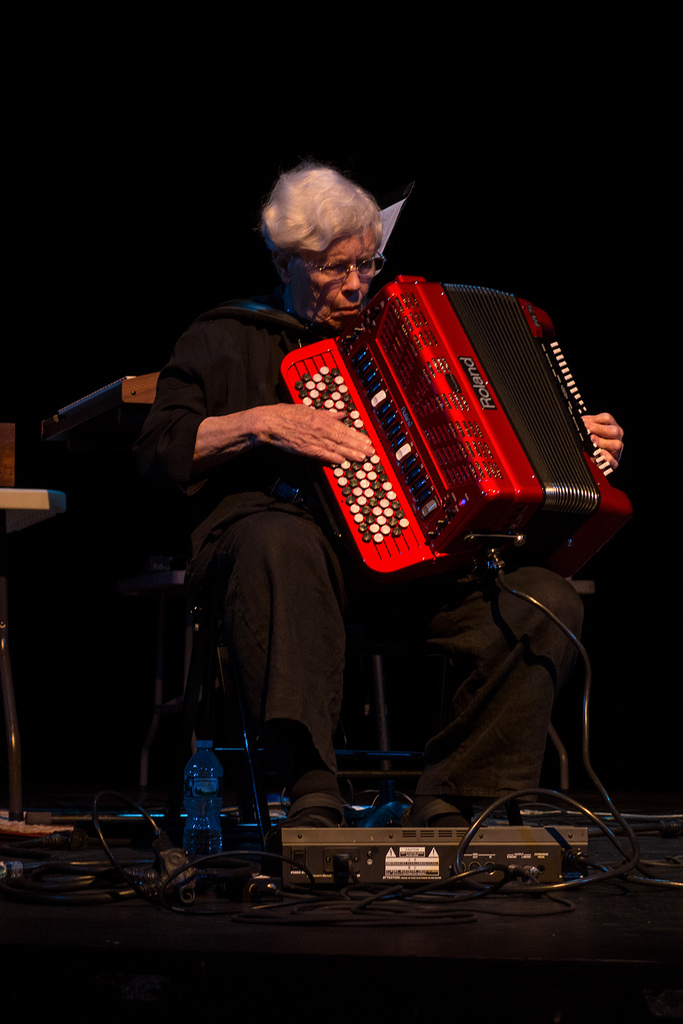
Thursday, May 20, 2021
Roscoe Mitchell / Sandy Ewen / Damon Smith / Weasel Walter - A Railroad Spike Forms The Voice (May 2021 Balance Point Acoustics)
Thursday, February 25, 2021
Roscoe Mitchell & Mike Reed - the Ritual and the Dance (February 2021 Astral Spirits)
The free jazz genre is graced by the dynamic duo of multireedist Roscoe Mitchell, an unapologetic nonconformist, and drummer Mike Reed, an artisan of the rhythm. The sophomore release of these AACM artists is called The Ritual and the Dance and was recorded live in 2015 during their European tour. It consists of a nearly 37-minute uninterrupted storytelling with no idle moments.
The high-pitched soprano laments delivered by Mitchell take the form of piercing indigenous chants blown vertiginously with circular breathing and patterned stimuli. The dry rat-a-tat of the snare drum makes a beautiful tonal contrast with the deep bass drum kicks, establishing an intense, sedulous workout routine that will put you in a state of bemused fascination.
The impressive versatility of Reed surfaces not only when he seats behind the drumset, but also when he operates electronics with subtle sensitivity. At some point, his adept pulses are transformed into droning backgrounds, whose dark tones allow the saxophone to reflect brightly. Reed then resumes the stomping cadence but keeps changing its colors.
The turbulent environment is refrained at the minute 20, when Mitchell switches to tenor, seeking folk melodies and exploring some long notes that oscillate in pitch. His beefy, occasionally raucous tone is unadorned, if slower, here, but he switches horns again for a stimulating final stretch.
Adventurous jazz listeners will be struck by the force of this music, certainly wishing that Mitchell and Reed can collaborate again soon.
1. the Ritual and the Dance 36:43
2. the Dance SAMPLE 16:08
Roscoe Mitchell: reeds
Mike Reed: drums, electronics
Recorded by Michael Huon at the Oorstof concert series
Zuiderpershuis, Antwerp, Belgium, October 22, 2015
Thursday, February 4, 2021
Roscoe Mitchell - Splatter (i dischi di angelica 2020)
Internationally renowned musician and composer Roscoe Mitchell, since his debut with Sound in 1966, has defined his style through an innovative approach towards composition in what is traditionally an improvised music genre, pre-empting the development of jazz and its relationship with contemporary music in the following decades.
Splatter, drawn from two concerts held at the AngelicA festival in Bologna in 2017, presents the most recent developments of this research, with two examples from his cycle Conversations for large orchestra. Started in 2016, it is based on the transcription and subsequent orchestration of what originated as his improvisations with the trio including Craig Taborn and Kikanju Baku, for the album Conversations I and II which was released in 2014.
Sunday, June 24, 2018
Roscoe Mitchell / Brus Trio - After Fallen Leaves (SILKHEART RECORDS 2018)
It's important that these are not simply the time-honored traveling-soloist-plus-pickup-accompaniment performances, but true quartet performances. "That was a good thing to have happen," Mitchell says. "I like people who can perform in several idioms, and deal with the reeds and stuff, and be up on a certain level technically for certain types of compositions – people who really want to be in full control of their concentrated power, to project what they're doing. These are interesting musicians – they study that kind of thing." In fact, Mitchell has not always had the advantage of such confident, accomplished players to perform his works, so Brus Trio's responsiveness is especially welcome.
The threesome's control, concentration, projection, and mastery of idioms has been earned through years of working and setting challenges together. Producer Keith Knox, who brought Mitchell and the trio together, offers biographical information about these artists. Gilbert Matthews (born 1943) was an established guitarist in his home city, Capetown, South Africa, when a clubowner asked him to take the place of an absent drummer; Matthews did, and a successful, wholly new career in music began. Like some others of that country's finest musicians before him, Matthews wearied of attempting to create music amidst apartheid's official harrassment, and left in 1974, settling in Sweden; Abdullah lbrahim, Chris McGregor, Archie Shepp, Sarah Vaughan and Ray Charles are among those with whom he's subsequently drummed.
Meanwhile, pianist Arne Forsen (born 1960, Umeå, Sweden) and bassist Ulf Åkerhielm (born 1962, Sundsvall, Sweden) were growing up with jazz, playing it in their youth – Åkerhielm was a tenor sax "boy wonder" at three Pori (Finland) Jazz Festivals – and they met when both were studying classical music at Kapellsburg music school in Härnösand, Sweden. By 1979 they were appearing as a duo, startling audiences with their "outside" jazz, and scuffling for engagements in Stockholm, Two years later, Matthews heard them in a club and played with them informally; the experience was so stimulating to all that they began Brus Trio.
Usually original compositions, most often Forsén's, provide the takeoff for the trio's free flights, though in two earlier recordings they joined with lyrical saxophonists John Tchicai and Charles Tyler. Clearly, Brus Trio's eight years' experience in freely improvising together has brought vigor and sensitivity to MitchelI's compositions. For instance, Mr. Freddie is in a perfect, medium-up tempo for swinging – what Von Freeman has called "the Chicago tempo" – and the tense, eager, ahead-of-the-beat bass of Åkerhielm provides irresistible propulsion. Forsén's superb development of ideas in his piano solo results in a hard-edged line moving with a radical sense of drama, before Matthews, who is truly a "listening" drummer, at last breaks loose, enthusiastic assertion balanced by strong formal instincts. All of this is extension and complement to Mitchell's happy theme and wonderful alto solo. As the great bassist Wilbur Ware used to say, "Let's play this music together."
The trio's dynamic and linear sensitivity to Mitchell's ideas is the subtle feature that makes this music flow, a sensitivity that's crucial to Sing. The music's constituent elements – color, harmony, rhythm, melody – are a step removed from conventional associations, as the work evolves to Mitchell's long-toned alto sax melody.
While Forsén's piano solo develops largely in rhythmic terms, to the complex, dancing accompaniment of Åkerhielm and Matthews, the composition's essential innocence is never violated. And in many ways Brus Trio's most impressive work on this disc is its freedom within the medium of free space as they interpret Mitchell's most unique works, presenting the interaction of sounds amid silence with uncommon clarity and responsiveness. The flowing quality of these performances, then, is their most pleasing feature.
Before meeting Brus Trio, Mitchell had heard them on record and knew they could meet his music's demands. The new kind of ensemble that he had brought to jazz in the 1960s, which eventually became the Art Ensemble of Chicago, thoroughly refreshed the art form by drawing on all of its resources, past, present, and future. Subsequently, he began isolating and investigating the fundamental elements of music, especially sound and its properties, and critic Larry Kart's comments on Mitchell's LRG/The Maze/S II Examples (Chief CD) could apply to much of Mitchell's 1970s works: "Harmony is nonexistent, as are melody and rhythm in the sense of variations from any norm outside the world of the piece. Instead, we hear timbre and the shape of phrases in space, with the space between each shape always clearly defined... he is discovering that when music is truly broken down into its component parts, a new order can emerge.
While Roscoe Mitchell continued to explore along these lines in the 1980s, his interests expanded in other directions also. The lyrical, melodic, swinging works that appear here are also typical of his present work, and a special advantage of the extended time available to compact discs is the opportunity to hear a wider variety of Mitchell musics than was hitherto possible in a single document. Apart from his works with his Sound, Space, and Chamber Ensembles, and his concert adventures with Cecil Taylor, Muhal Richard Abrams, and Steve Lacy, among others, his 1980s Quartet calls for special mention. The sad passing of his longtime associate, drummer Steve McCall, concluded the Quartet's efforts, but its explorations (note Mitchell's 1986 Black Saint album The Flow Of Things) were to blossom forth into the musics that the Mitchell-Brus Trio quartet presents here.
To look at the performances in order, then:
Sing first appeared in the 1981 Mitchell Sound Ensemble release Snurdy McGurdy and her Dancin' Shoes (Nessa LP); in this colorful, highly decorated new version, Mitchell appears first on flute, then on alto sax.
The 55th Street point of Lake Michigan, in the heart of Chicago, is a magnet for swimmers, sunbathers, picnickers, and others. "I thought of sitting there on a nice warm day, and usually the drummers were playing and a lot of people were throwing balls or sitting and watching the lake – a lot of gaiety," says Mitchell. The isolated tones of his soprano sax and the other, distant, instruments here, all played very softly, present a detached individual's mood, with the faintest hint of sly expectancy on A Lovely Day at the Point.
From such soft, spaced sounds to the wild freakout of The Reverend Frank Wright is a long step indeed. Mitchell recalls meeting Wright in 1968, when the bold tenor saxman was in Cecil Taylor's band, which shared a California concert with the Mitchell-Lester Bowie-Malachi Favors trio – "We were out there just barnstorming, the way we usually did."
Amid the dense ferocity here, note how Mitchell's low, blatted, repeated tenor sax figure is the cell motive for a thorny solo.
And Then There Was Peace is not exactly serene – the quartet's reflections include dark shadings. The work dates from 1962, when Mitchell led a pianoless quartet in Chicago. "Studying some of the stuff that we were doing back then is just a wealth of information."
Mitchell says that Everett Sloane is a fictional character but The Two Faces of Everett Sloane is not really a Dr Jekyll-Mr. Hyde shocker. Rather, one face is portrayed in near cubist fashion with broken sounds, and the other face is portrayed in an incredibly long, many noted, involved soprano sax phrase.
After Fallen Leaves is "improvised off certain theme lines," with the players creating in separate, independent parts that nevertheless share a pastoral mood; Mitchell is heard first on flute, then in a long-noted tenor sax melody.
And then, wham! A big, powerful alto sax tone over roiling accompaniment introduces Mr Freddie, which has no links to the early blues standard of that title by Freddie Shayne. Rather, this 1962 song honors Mitchell's trumpeter of those days, Fred Berry; Mitchell's wondrously melodic solo recalls his links to early Ornette Coleman, however, bathed in the chemicals of Mitchell's own intensity and cruel humor.
Come Gather Some Things and Play With The Whistler are improvised to a "formula" that uses space and many sounds: "It's supposed to sound like a composition. In improvisation on a high level, you're completely aware of every part, including yourself." It recalls his sound collages of LRG and The Maze, with a series of events from a few seconds to a couple of minutes long, which add a piano to the free motions of multi-wood-wind-string-percussion sounds in space. Forsén, who ranges from percussive to almost melodic in his brief not-phrases, often proves a humanizing element as he lends irregular degrees of harmony to the others' ever-changing sonorities: a sensitive, responsive improvising quartet indeed.
Since these recording sessions, Mitchell has continued to tour and record widely with the Art Ensemble of Chicago, including sessions with South African musicians, Cecil Taylor, and Lester Bowie's Brass Fantasy. He's also composed for pianist Joseph Kubera and for his own several groups, and is planning collaborations with Henry Threadgill and performances with Douglas Ewart's Clarinet Choir.
He continues to teach at the University of Wisconsin in Madison, his home city, where he plans to start a large repertory ensemble to perform music of "contemporary composers, like Ornette Coleman, Muhal Richards Abrams, Anthony Braxton, Leo Smith, Leroy Jenkins, Henry Threadgill, and on and on." Hopefully, there will be future collaborations with the Brus Trio, too, for the stimulating success of After Fallen Leaves, its vitality; flow, and abundantly shared feelings, surely call for more.
John Litweiler
Saturday, February 17, 2018
Roscoe Mitchell and Montreal-Toronto Art Orchestra - Ride The Wind (NESSA RECORDS 2018)
Steve Lacy once posited that the difference between an improviser and a composer is that the latter has abundant time to decide what to communicate musically with ten seconds whereas the former simply has ten seconds. It remains a pithy rejoinder to a strawman conundrum that’s dogged the intersection between the two idioms for decades. But what of the scenarios where improvisation actually serves as the basis for composition? Roscoe Mitchell explores that compelling overlap on Ride the Wind, a second document of investigations following last year’s at once similar and yet wholly separate Discussions on the Wide Hive label.
For the previous project Mitchell balanced orchestral transcriptions of earlier improvisations with new collective improvisations for the assembled large ensemble. The results revealed a captivating merger of the forms, although his own incendiary playing was limited to just several of the contexts leaving flautist Wilfrido Terrazas the welcome latitude to almost steal the show. Here, he exercises even more restraint on the playing end, appearing only in an extended, frenzied sopranino salvo on “They Rode for Them – Part Two” and leaving the disc’s remaining six pieces to the nineteen-piece Montreal-Toronto Art Orchestra. The deference is another indication of how seriously he takes the ensemble focus of the work.
Essayist Stuart Broomer drafts an edifying accounting of the session details in the accompanying notes and it’s immediately apparent that Mitchell’s canvas is different even though it pulls primarily from the same provenance as its predecessor, the series of recorded improvisations he engaged in with pianist Craig Taborn and percussionist Kikanju Baku from 2013 and later transcribed by a cadre of close colleagues. Mitchell handles the majority of orchestrations himself starting with swelling fugue-like waves of “They Rode for Them” that give way to an feathery improvisation by altoist Yves Charuest over shimmer color field conjured by the orchestra in sections.
“Splatter” builds from forceful collisions between percussion, strings, reeds and brass, which roil and swirl together in a textured centripetal spin. The title piece erupts with fanfare expansiveness before receding and dispersing into a succession of individual voices. Flimsy idiomatic descriptors like jazz, classical and the like are irrelevant to the proceedings, replaced by the umbrella adjectival phrase of organized and energized sound. The arboreal murmurings of “RUB” recall the Art Ensemble’s expeditions with “little instruments” while “Shards and Lemons” brings a delightful measure of dry humor in the timbre juxtaposition of disparate orchestral constituencies.
The disc caps with a quartet arrangement of the pivotal “Nonaah”, a piece Mitchell first performed nearly forty-five years ago. It’s one of the anchors of his oeuvre and the assembled team of three reedists and single bassist makes the rondo theme at the piece’s center both sing and shout before switching tacks to layered legato drones and icy overtones. As is the Nessa label hallmark, accompanying packaging and content is top-notch with copious session photos and the aforementioned deep dive annotations. Temporal considerations both immediate and indefinite converge to make this set another memorable entry in Mitchell’s copious catalog of momentous achievements.
Derek Taylor / Dusted Magazine
Friday, January 12, 2018
Roscoe Mitchell & Matthew Shipp - Accelerated Projection (ROGUEART 2018)
Roscoe Mitchell, member of AACM from its early stage and founding member of Art Ensemble of Chicago is a living legend, a national treasure, involved in whether it as a solo, a duet, an ensemble or a classical music situation. Matthew Shipp, definitely a legend in his own right as well, play in many configurations witnessing his impressively brilliant creative devolvement. The experience seeing these musicians play live is equivalent to seeing/hearing Bach, Beethoven and Chopin play live if such a thing were still possible.
Here we are holding the gift of a recording of them playing together in duet. And what a gift it is! -Yuko Otomo, excerpt from the liner notes.
Monday, May 22, 2017
Roscoe Mitchell - Bells for the South Side (2 CD) ECM 2017