Showing posts with label PALMETTO RECORDS. Show all posts

Monday, January 31, 2022

SINGLE "Canopy of Trees" from Brian Landrus' RED LIST

"Canopy of Trees” : a SINGLE from low woodwind master Brian Landrus’ upcoming album Red List: Music Dedicated to the Preservation of Our Endangered Species, via Palmetto Records
Brian Landrus © Nick Carter

Landrus’ impassioned manifesto dedicated to bringing awareness to the world’s most endangered species, Red List features Landrus with his all-star band: Ryan Keberle, Geoffrey Keezer, Nir Felder, Rudy Royston, Ron Blake, Jaleel Shaw, Lonnie Plaxico, John Hadfield, Steve Roach and Corey King

Hoping that Red List will help to facilitate “critical yet uncomfortable conversations about changing our global habit of destroying nature for our own gain,” Landrus is collaborating with the organization Save The Elephants and will donate 20% of all proceeds and 100% of profits to the organization, which has been helping to ensure a future for African Elephants for nearly 30 years.

Together he and his ace band create entrancing grooves, lush harmonies, evocative interludes and epic crescendos, all in the service of Landrus’ thoughtful compositions that bring attention to the plight of 13 endangered species on the planet. The Red List was compiled by the International Union for Conservation of Nature, the world’s most comprehensive information source on the global extinction risk of animal, fungus and plant species.

The full album will be released June 17, 2022

Friday, January 7, 2022

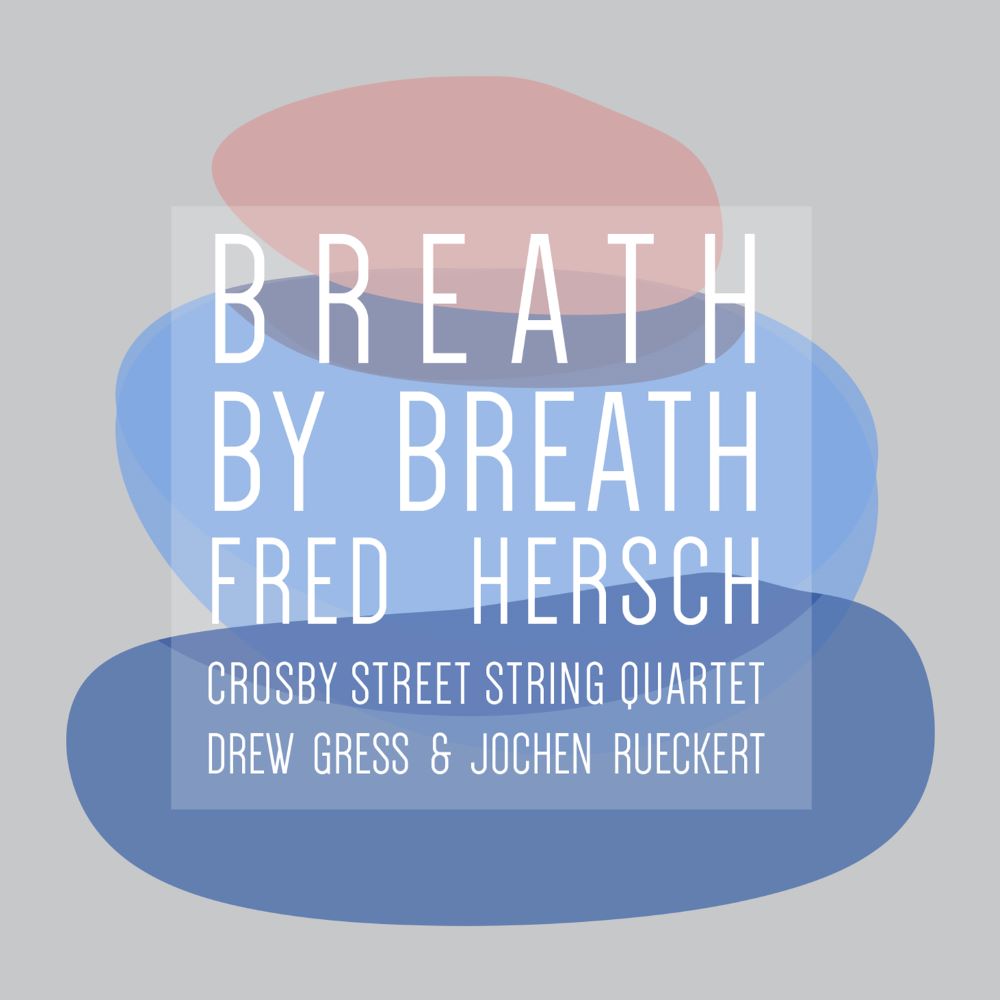
Fred Hersch's Breath by Breath out Jan. 7, 2022 via Palmetto

Pianist/Composer Fred Hersch reemerges from pandemic isolation with an ambitious new album pairing jazz piano trio with string quartet
 
Breath By Breath, due out January 7, 2022 via Palmetto Records, features a stunning new suite inspired by Hersch’s meditation practice performed by Hersch with Drew Gress, Jochen Rueckert, Rogerio Boccato, and the Crosby Street String Quartet

"[Fred Hersch is] a pianist, composer and conceptualist of rare imaginative power.” 
– Nate Chinen, The New York Times

“Hersch’s work has developed an intensity of intelligence and emotional directness unparalleled among his peers.”
– Steve Futterman, The New Yorker 

Album release concert January 9 at Village Vanguard, NYC 
Pianist Igor Levit premieres new Hersch work January 13 at Carnegie Hall 

Iconic pianist/composer Fred Hersch was an early adopter of new technologies and new ways forward when the pandemic hit in early 2020. But he’s also been among the most eager to return to live performance and collaboration now that life has begun to resume some semblance of normality. In August he returned to the studio to record one of his most ambitious projects to date: Breath By Breath, his first album ever pairing jazz rhythm section with string quartet.
 
“I’ve put all my streaming gear away,” declares Hersch, whose lockdown months started off with daily performances on Facebook and culminated in last year’s solo release Live From Home. “It was great while that was what it was, and now I'm in this place where it's live or nothing.”
 
Due out January 7, 2022 via Palmetto Records, Breath By Breath draws inspiration from the pianist’s longtime practice of mindfulness meditation, centered on the new eight-movement “Sati Suite.” But while the album is certainly contemplative and lustrous, it’s far from being merely an ambient backdrop for blissful relaxation – the music on Breath By Breath is as fully engaged and emotionally rich as any that Hersch has made over the course of his remarkable career.

In part that’s due to the musicians Hersch has enlisted for the album. Bassist Drew Gress was a member of the pianist’s first trio and has been an inspiring bandstand partner for more than three decades. Jochen Rueckert is one of the most in-demand drummers on the modern scene, having played with such greats as Kurt Rosenwinkel, Mark Turner, Melissa Aldana and Pat Metheny. The Crosby Street String Quartet, named for the NYC address where they first rehearsed with Hersch, combines four of the city’s busiest freelance string players: violinists Joyce Hammann and Laura Seaton, violist Lois Martin, and cellist Jody Redhage Ferber. 

“String quartets have been some of my favorite music to listen to my whole life,” Hersch explains. As he writes in the album’s liner notes, “I grew up listening to string quartets as a very young musician in Cincinnati. My piano teacher was the wife of the cellist in the famous LaSalle Quartet. I used to lie on the rug in their living room as an elementary school student while they rehearsed, quietly following along, hearing how the viola part meshed with the first violin, or the second violin and the cello. And ever since I started studying composition at age eight, almost all of my music has always focused on four melodic parts - so string quartets are a natural musical configuration for me.” 

The string writing on Breath By Breath spotlights the broad scope of Hersch’s compositional imagination. With each piece the quartet seems to take on a new role in relation to the piano trio: a lush background on one tune, an equal partner in dialogue on the next, an abstract instigator on yet another. “It was important to me that we record live with the strings so I could interact with what they were playing,” Hersch says. “I didn't want to lay down the music and then have them come in later and overdub. I felt like the fun of the project was to do it live.”

“Sati” is a Pali word meaning “mindfulness” or “awareness,” an idea that is central to Hersch’s meditation practice – which itself took on an even more profound importance during the pandemic. “It basically saved me,” he says with no hint of exaggeration. “Meditation is not about not emptying your mind; it's about observation. The phrase I like to use is, ‘relax, allow and observe.’ When I meditate it’s about recognizing sensations or thoughts as they come in and out, observing them and realizing that they're just phenomena. The brain thinks, and there's nothing wrong with that.”
The first movement, “Begin Again” references the cycle of renewal that begins fresh with each moment. Other pieces touch on different aspects of the process. “Know That You Are,” the composition that initiated the suite, refers to the foundational instruction, “When you sit, know that you are sitting and when you breath, know that you are breathing.” The often frantic activity of a mind struggling to be at rest is the subject of “Monkey Mind,” while “Mara,” which features a guest appearance by percussionist Rogerio Boccato, is the name of the god who tempted Buddha with wine, women and wealth.

Bringing meditation to the forefront of his music brings Hersch full circle in a sense, as he recognized when he began the practice decades ago. “When I started, I realized that in a way I've been meditating my whole life – but on a piano bench. I close my eyes when I play and I go into in that world. Occasionally I get distracted, but I don't get wrapped up in it. Instead of my breath being an anchor, the anchor is the sound that I get, the tactile feeling of my fingers on the keys, hearing the space around the music, and leaving that space for other musicians to contribute.”

Breath By Breath, then, is a recognition that meditation has been a way for Hersch to align his daily existence with the enlightened state he reaches while playing the piano. With the release of this captivating new recording, the rest of us are fortunate enough to glimpse that place and to feel its life-affirming impact on our own hearts and souls.

Fred Hersch
A select member of jazz’s piano pantheon, Fred Hersch is an influential creative force who has shaped the music’s course over more than three decades. A fifteen-time Grammy nominee, Hersch has long set the standard for expressive interpretation and inventive creativity. A revered improviser, composer, educator, bandleader, collaborator and recording artist, Hersch has been proclaimed “the most arrestingly innovative pianist in jazz over the last decade” by Vanity Fair, “an elegant force of musical invention” by The L.A. Times, and “a living legend” by The New Yorker. For decades Hersch has been firmly entrenched as one of the most acclaimed and captivating pianists in modern jazz, whether through his exquisite solo performances, as the leader of one of jazz’s era-defining trios, or in eloquent dialogue with his deeply attuned duo partners. His brilliant 2017 memoir, Good Things Happen Slowly, was named one of 2017’s Five Best Memoirs by the Washington Post and The New York Times.

The Sati Suite

1. Begin Again 6:52
2. Awakened Heart 4:13
3. Breath by Breath 6:22
4. Monkey Mind 4:01
5. Rising, Falling 5:03
6. Mara* 4:38
7. Know That You Are 3:41
8. Worldly Winds 5:26

Fred Hersch, piano

Crosby Street String Quartet
Joyce Hammann & Laura Seaton, violins
Lois Martin, viola
Jody Redhage Ferber, ‘cello

Drew Gress, bass
Jochen Rueckert, drums
*Rogerio Boccato, percussion

Fred Hersch – Breath By Breath
Palmetto Records – PM2198 – Recorded Aug. 24-25, 2021
Release date January 7, 2022

Wednesday, October 20, 2021

Fred Hersch to release major new album Jan. 7, 2022

Pianist/Composer Fred Hersch reemerges from pandemic isolation with an ambitious new album pairing jazz piano trio with string quartet
 
Breath By Breath, due out January 7, 2022 via Palmetto Records, features a stunning new suite inspired by Hersch’s meditation practice performed by Hersch with Drew Gress, Jochen Rueckert, Rogerio Boccato, and the Crosby Street String Quartet

"[Fred Hersch is] a pianist, composer and conceptualist of rare imaginative power.” 
– Nate Chinen, The New York Times

“Hersch’s work has developed an intensity of intelligence and emotional directness unparalleled among his peers.”
– Steve Futterman, The New Yorker 

Album release concerts January 4 – 9 at Village Vanguard, NYC 
Pianist Igor Levit premieres new Hersch work January 13 at Carnegie Hall

Iconic pianist/composer Fred Hersch was an early adopter of new technologies and new ways forward when the pandemic hit in early 2020. But he’s also been among the most eager to return to live performance and collaboration now that life has begun to resume some semblance of normality. In August he returned to the studio to record one of his most ambitious projects to date: Breath By Breath, his first album ever pairing jazz rhythm section with string quartet.
 
“I’ve put all my streaming gear away,” declares Hersch, whose lockdown months started off with daily performances on Facebook and culminated in last year’s solo release Live From Home. “It was great while that was what it was, and now I'm in this place where it's live or nothing.”
 
Due out January 7, 2022 via Palmetto Records, Breath By Breath draws inspiration from the pianist’s longtime practice of mindfulness meditation, centered on the new eight-movement “Sati Suite.” But while the album is certainly contemplative and lustrous, it’s far from being merely an ambient backdrop for blissful relaxation – the music on Breath By Breath is as fully engaged and emotionally rich as any that Hersch has made over the course of his remarkable career.

In part that’s due to the musicians Hersch has enlisted for the album. Bassist Drew Gress was a member of the pianist’s first trio and has been an inspiring bandstand partner for more than three decades. Jochen Rueckert is one of the most in-demand drummers on the modern scene, having played with such greats as Kurt Rosenwinkel, Mark Turner, Melissa Aldana and Pat Metheny. The Crosby Street String Quartet, named for the NYC address where they first rehearsed with Hersch, combines four of the city’s busiest freelance string players: violinists Joyce Hammann and Laura Seaton, violist Lois Martin, and cellist Jody Redhage Ferber. 

“String quartets have been some of my favorite music to listen to my whole life,” Hersch explains. As he writes in the album’s liner notes, “I grew up listening to string quartets as a very young musician in Cincinnati. My piano teacher was the wife of the cellist in the famous LaSalle Quartet. I used to lie on the rug in their living room as an elementary school student while they rehearsed, quietly following along, hearing how the viola part meshed with the first violin, or the second violin and the cello. And ever since I started studying composition at age eight, almost all of my music has always focused on four melodic parts - so string quartets are a natural musical configuration for me.” 
The string writing on Breath By Breath spotlights the broad scope of Hersch’s compositional imagination. With each piece the quartet seems to take on a new role in relation to the piano trio: a lush background on one tune, an equal partner in dialogue on the next, an abstract instigator on yet another. “It was important to me that we record live with the strings so I could interact with what they were playing,” Hersch says. “I didn't want to lay down the music and then have them come in later and overdub. I felt like the fun of the project was to do it live.”

“Sati” is a Pali word meaning “mindfulness” or “awareness,” an idea that is central to Hersch’s meditation practice – which itself took on an even more profound importance during the pandemic. “It basically saved me,” he says with no hint of exaggeration. “Meditation is not about not emptying your mind; it's about observation. The phrase I like to use is, ‘relax, allow and observe.’ When I meditate it’s about recognizing sensations or thoughts as they come in and out, observing them and realizing that they're just phenomena. The brain thinks, and there's nothing wrong with that.”

The first movement, “Begin Again” references the cycle of renewal that begins fresh with each moment. Other pieces touch on different aspects of the process. “Know That You Are,” the composition that initiated the suite, refers to the foundational instruction, “When you sit, know that you are sitting and when you breath, know that you are breathing.” The often frantic activity of a mind struggling to be at rest is the subject of “Monkey Mind,” while “Mara,” which features a guest appearance by percussionist Rogerio Boccato, is the name of the god who tempted Buddha with wine, women and wealth.

Bringing meditation to the forefront of his music brings Hersch full circle in a sense, as he recognized when he began the practice decades ago. “When I started, I realized that in a way I've been meditating my whole life – but on a piano bench. I close my eyes when I play and I go into in that world. Occasionally I get distracted, but I don't get wrapped up in it. Instead of my breath being an anchor, the anchor is the sound that I get, the tactile feeling of my fingers on the keys, hearing the space around the music, and leaving that space for other musicians to contribute.”

Breath By Breath, then, is a recognition that meditation has been a way for Hersch to align his daily existence with the enlightened state he reaches while playing the piano. With the release of this captivating new recording, the rest of us are fortunate enough to glimpse that place and to feel its life-affirming impact on our own hearts and souls.

Tuesday, July 27, 2021

Pianist/Composer Fred Hersch earns multiple DownBeat Critics Poll accolades, tours Europe, and announces new album

Fred Hersch: Refuge, due out January 7, 2022 via Palmetto Records, features Hersch with Drew Gress, Jochen Rueckert & The Hudson String Quartet
 
“Fred Hersch belongs to the jazz piano aristocracy, that small elite called to leave a lasting mark.”
– Louis-Julien Nicolaou, Télérama, June 2021
 
“Fred Hersch is always on target. Right in the heart. By playing ‘Songs from Home.’ Fred Hersch makes Bal Blomet his home. The audience's silence is worthy of that of the forest that surrounds the house where this album was recorded…. Fred Hersch makes the piano sing…. The public does not want to leave. Fred Hersch either.”
– Guillaume Lagrée, Le jars jase jazz, June 2021

Iconic pianist/composer Fred Hersch – one of the first to find a new way forward in the pandemic both through his Facebook Tune of the Day performances and via his reflective solo album Songs from Home – heads to the studio in August to record Fred Hersch: Refuge, his first-ever album with rhythm section and string quartet.  It will be released January 7, 2022 via Palmetto Records.
 
Featuring Hersch with Drew Gress, Jochen Rueckert and the all-female NYC-based Hudson String Quartet: Joyce Hammann and Laura Seaton-Finn, violins; Lois Martin, viola; and Jody Redhage Ferber, cello, the album was inspired by Hersch’s Buddhism and his 20-year insight mindfulness meditation practice. The bulk of the album is an eight-movement suite that reflects on different aspects of that practice
 
“In Buddhism, there are the three refuges: refuge in the Buddha, refuge in the sangha (community of practitioners) and refuge in the dhamma (the teachings),” says Hersch. “At this time of global impermanence, I have found some degree of comfort in these refuges – places that I can turn to and feel somewhat less affected by it all of the suffering and toxicity around me. And these refuges also give me some strength to stay in the present and know that there are many things that are out of my control – but I can call upon my practice to be with my experiences instead of reacting to them.”
Hersch recently earned accolades in DownBeat Magazine’s 2021 Critics Poll as #2 Jazz Artist, #3 Pianist, and #4 Jazz Album of the Year for Songs From Home. Hersch also earned a spot as one of the best pianists of 2020 in the JazzTimes Readers Poll.  He is currently on tour in Europe where he’s earning wide critical acclaim for his over a dozen shows – his first concerts before an audience in 14 months. Reviewing his concert in Paris, Guillaume Lagrée wrote “Fred Hersch is always on target… The public does not want to leave. Fred Hersch either.” Hersch also performed in Recklinghausen, Rome, Carpi, Vicenza, Pescara, Bari, Perugia, Umbria, Montreux, and Brescia – as a solo pianist, with trio and duo in a new partnership with Italian jazz legend trumpeter Enrico Rava. 
 
Hersch will continuing touring both the U.S. and Europe throughout the fall. His dates include a week at the Village Vanguard in a duo with Julian Lage October 19-25, and a series of duo shows in Europe with Enrico Rava in October and November. Click HERE for upcoming tour dates.

Friday, February 5, 2021

Fred Hersch - Songs from Home (Palmetto Records)

Fred Hersch, who has calmly, sensibly, and passionately bequeathed us some of the most lyrical jazz of the past few decades, was lucky enough to have a house built around a piano. Specifically, a seven-foot Steinway B, with a certain percussive thunkiness to the D above middle C. The breezy way of describing Hersch’s solution to that thunk is that he turned a bug into a feature, as you can hear especially on this album’s versions of Cole Porter’s “Get Out of Town” and Jimmy Webb’s “Wichita Lineman.”
 

More elegantly, more emotionally, we could say Hersch’s found the best possible way to live with these times. Stuck at home because of the pandemic, alone for some of that time, he flipped over to playing one tune a day for his Facebook audience—solo piano, natch. That project eventually evolved into what’s here, although if I understand correctly, none of the Facebook outings made it onto the new set. “Wichita Lineman” sprints along, pulls back, and Hersch unassumingly (he’s always avoided flash) finds spaces between chords that lead to chord substitutions that lead to unexplored territory in the world-famous tune—Zeno’s infinities between two points, or even two measure markers.

He concludes by rolling out another famous tune, “When I’m Sixty-Four.” Stride piano transmutes into new shadings, new volleys, as if he’d collected every single rainstorm of his life, gathered choice raindrops varied by size, shape, color, tinge, velocity, and shade of overhead sky, then let only those fly. I know Hersch’s brilliance isn’t effortless; he’s spoken and written about what he had to go through to reach it. I’m grateful that he did, though, and that he’s here, free to thunk away for (let’s hope) another few decades. - Andrew Hamlin (jazztimes.com)

1. Wouldn't It Be Loverly 6:09
2. Wichita Lineman 5:50
3. After You've Gone 5:15
4. All I Want 7:16
5. Get Out Of Town 4:38
6. West Virginia Rose / The Water is Wide 5:47
7. Sarabande 5:57
8. Consolation (A Folk Song) 5:10
9. Solitude 6:04
10. When I'm Sixty Four 5:02

Fred Hersch: piano
buy here

Tuesday, October 16, 2018

Out Dec. 7 – Fred Hersch Trio '97 @ The Village Vanguard


Acclaimed Pianist/Composer Fred Hersch Revisits his First Stint as a Bandleader at New York’s Most Iconic Nightclub on
Fred Hersch Trio ’97 @ The Village Vanguard

Never-before-released recordings from 1997 showcase Hersch and the much-loved 1990s incarnation of his trio, with bassist Drew Gress and drummer Tom Rainey, on their only live album  

“[A] pianist, composer and conceptualist of rare imaginative power…”
–Nate Chinen, New York Times

"A living legend.
– Jonathan Blitzer, The New Yorker

For jazz fans in 2018, it might be difficult to imagine a time when pianist/composer Fred Hersch was not intimately associated with the Village Vanguard. For more than two decades the iconic New York City nightclub has been a home base for Hersch, who performs there for packed houses three times a year and has recorded some of his most acclaimed albums on its historic stage.

But there is, of course, a first time for everything – and for Fred Hersch that first time was in July 1997. Not his first time playing at the Vanguard, which he’d done regularly since 1979 with a host of legendary bandleaders including Joe Henderson, Art Farmer, Lee Konitz, Ron Carter, Al Foster and others. That mid-summer week in 1997 was his first of many stints at the venue as a bandleader in his own right, placing him in the hallowed company of such icons as John Coltrane, Sonny Rollins, Miles Davis, Thelonious Monk, and Charles Mingus.

Fortunately, Hersch and his trio’s three Friday night sets were captured for posterity and now, after 21 years, the pianist has hand-picked his favorite moments on Fred Hersch Trio ’97 @ The Village Vanguard, due for release on December 7, 2018 via Palmetto Records. The album’s eight tunes – a mix of Songbook standards, classic jazz compositions and original pieces – captures the Fred Hersch Trio of that time at the height of their estimable powers. Bassist Drew Gress and drummer Tom Rainey had been working with Hersch for five years at the point that they took the Vanguard stage, and those years shine through in the band’s vigorous swing, highly charged interplay, and sheer joy in discovery that they find in one another’s playing.

“It meant everything,” Hersch says of his first week at the Vanguard. “For me, it’s equivalent to the first time a classical musician plays at Carnegie Hall. It’s the greatest jazz club in the world.”


Beyond its historical significance in Hersch’s career, this new collection is also a welcome addition to his discography in that it’s the only live recording of this much-loved trio. For those who weren’t fortunate enough to catch them live, Hersch’s work with Gress and Rainey could only be heard in its purest form on a pair of studio albums released by the Chesky label: 1993’s Dancing in the Dark and 1994’s Plays. (On Point in Time (1995) they were supplemented by trumpeter Dave Douglas and saxophonist Rich Perry, while they were joined by a full string orchestra on 1996’s Passion Flower: Fred Hersch Plays Billy Strayhorn. This release also marks the earliest available live recording by Hersch aside from his solo concert Live at Maybeck from 1993.

It had taken Hersch 18 years to graduate from sideman to leader at the Vanguard simply because he insisted on waiting until he could be joined by his own trio rather than an all-star band assembled for the occasion. “I was very stubborn about wanting to do it on my own terms with my own band,” Hersch recalls. “That’s why it took so long. I didn't want to just go in there once and then not come back. That does happen. I insisted on throwing it down the way I wanted to.”

The wisdom of that decision is amply evident in the profound chemistry shared by the trio throughout Fred Hersch Trio ’97 @ The Village Vanguard. The album opens with a robust romp through “Easy To Love” that showcases the trio’s muscular but elastic way with rhythm. The sensitivity of Gress’ playing comes to the fore on “My Funny Valentine,” while Rainey’s sharp-honed propulsion drives “Three Little Words” and prompts Hersch to take sharp curves at breakneck pace in his solo. The first of two Hersch originals, “Evanessence” pays homage to one of the pianist’s most respected predecessors on the Vanguard bench, Bill Evans. “Swamp Thang,” meanwhile, digs deep into the murky groove suggested by the title.

Gress contributes “Andrew John,” introduced by a compelling solo rumination by Hersch before the trio contributes some of its most sparse and tender accents. With a contained intensity, “I Wish I Knew” exercises the bandmates’ gifts for subtle dynamic shifts, and “You Don’t Know What Love Is” ends the album at a blistering pace, at once staggeringly virtuosic and gleefully thrilling.

Listening back to the recordings all these years later, Hersch hears a band playing with remarkable confidence and abandon given the HIV-positive pianist’s personal health concerns at the time. Just over a decade later he would be placed in a medically-induced coma after a bad case of pneumonia; another ten years have passed since, affording the pianist an insightful perspective. “I was pleasantly surprised at how much authority and attention to detail everyone was playing with,” he says. “Maybe if I would have listened to it a week after the concerts I would have heard the flaws, but with this much distance I think it stacks up with any of my better trio albums.”


The album is certainly a worthy addition to Hersch’s catalogue, even at a time when his current trio (with John Hébert and Eric McPherson) is scaling unprecedented heights, as it did on this year’s highly-acclaimed Live in Europe. But just as importantly, Fred Hersch Trio ’97 @ The Village Vanguard adds another chapter to the rich history shared by a revered artist and a legendary venue.

“Having my photo on the wall of the Village Vanguard means more to me than a Grammy Award,” Hersch reflects. “That’s one of the accomplishments that I’m proudest of, and it signifies my long and deep relationship with the club. There is magic there.”

A select member of jazz’s piano pantheon, Fred Hersch is a pervasively influential creative force who has shaped the music’s course over more than three decades as an improviser, composer, educator, bandleader, collaborator and recording artist. He has been proclaimed “the most arrestingly innovative pianist in jazz over the last decade” by Vanity Fair, “an elegant force of musical invention” by The L.A. Times, and “a living legend” by The New Yorker. A twelve-time Grammy nominee, Hersch has regularly garnered jazz’s most prestigious awards, including recent distinctions as a 2016 Doris Duke Artist, 2016 and 2018 Jazz Pianist of the Year from the Jazz Journalists Association, and the 2017 Prix Honorem de Jazz from L’Acádemie Charles Cros for the totality of his career. With more than three dozen albums to his credit as a leader or co-leader, Hersch consistently receives lavish critical praise and numerous international awards for each highly anticipated new release. In 2017, he released his acclaimed memoir, Good Things Happen Slowly (Crown Archetype Books/Random House), which compellingly reveals the story of his life in music along with a frank recounting of his struggles and triumphs as the first openly gay, HIV-positive jazz musician. The book was named one of 2017’s Five Best Memoirs by the Washington Post and The New York Times. As a composer, Hersch has earned distinction with such visionary pieces as 2003’s Leaves of Grass, a large-scale setting of Walt Whitman's poetry, and the 2010 multimedia project My Coma Dreams.

Thursday, May 17, 2018

Fred Hersch Trio - Live in Europe (PALMETTO RECORDS 2018)

Celebrated jazz pianist/composer Fred Hersch releases 
luminous new trio recording Live in Europe


"One of the major jazz ensembles of our times." — Will Friedwald, The Wall Street Journal 

“Hersch leads one of the most sensitive and nimble trios in jazz.” — Howard Reich, Chicago Tribune

“An imposing level of collective empathy." — Nate Chinen, The New York Times


Live in Europe (May 11, 2018, Palmetto Records) crowns what was a momentous year for pianist Fred Hersch. Capturing his trio–with longtime associates, bassist John Hébert and drummer Eric McPherson–in peak form, the new album signals a high level mark for an ensemble that has been garnering critical and popular praise for nearly a decade. Consisting of six Hersch originals and two significant compositions apiece from Thelonious Monk (“We See,” “Blue Monk”) and Wayne Shorter (“Miyako,” “Black Nile”), Live in Europe demonstrates how a working trio breathes as one. 

“The trio has a shared language; by now we each contribute an equal part in what goes on musically during a performance,” Hersch says. He has made a dozen trio albums over the last 30 years, and he states that “This is the best trio recording we’ve yet made, and pretty much as well as I can play in terms of energy and technical command.”

Serendipity played its role in the birth of the album. The penultimate engagement of the band’s three-week European tour in November of 2017 was held at Flagey Studio 4, in Brussels’ former National Institute for Radio Broadcasting. “After the show, I realized that this was one of the two or three best performances we had given. The band was in terrific playing form, the acoustics were perfect and the piano was outstanding,” Hersch recalls. “On returning to New York, I thought about the show and was then pleasantly surprised to find out that it had indeed been recorded. On hearing it, I was again struck by the level of creativity, content and energy.” 


Live in Europe finds the trio in near telepathic communion. While each band member is a virtuoso player, individual bravura is always subordinate to group interplay. Lyricism, open-eared interaction and a respect for the power of space are all invaluable components of the trio’s identity. In such performances as the frisky “Skipping,” the affecting ballad, “Bristol Fog” (dedicated to the late British pianist John Taylor), the joyous “Newklypso (dedicated to Hersch’s hero Sonny Rollins) and the bluesy tribute to New Orleans “The Big Easy,” Hersch, Hébert and McPherson give a master class in ensemble communication, uniting as one yet allowing each other to freely react with spontaneous invention. A masterful solo encore of “Blue Monk” spotlights the depth of Hersch’s undiminished improvisational skills and expressive powers.

2017 was as a particularly bountiful period for the always-productive Hersch. Highlights included the publication of Hersch’s acclaimed autobiography Good Things Happen Slowly: A Life In and Out of Jazz (named one of the Five Best Memoirs of 2017 by both The Washington Post and The New York Times) and two Grammy Award nominations for his revealing solo album Open Book on Palmetto Records: 
Best Jazz Instrumental Album and Best Improvised Jazz Solo (Benny Golson’s “Whisper Not”). In addition, Hersch was awarded the 2017 Prix in Honorem Jazz for the entirety of his career from l'Académie Charles Cros in France. Hersch also opened the Jazz At Lincoln Center 2017 Season with his "Leaves of Grass," a full-evening setting of Walt Whitman's words for vocalists Kurt Elling, Kate McGarry and an instrumental octet.

Add to that such recent accolades as the 2016 Doris Duke Artist award and the 2016 Jazz Pianist of the Year award from the Jazz Journalists Association–not to mention the release of the feature documentary The Ballad of Fred Hersch, premiered at the prestigious Full Frame Film Festival in March 2016 to rave reviews and now streaming on Vimeo–and you have that most auspicious of times when an artist is being rightfully acknowledged for attaining new pinnacles of ability and inventiveness.

That Hersch is reaching such artistic heights after his well-publicized battle with HIV and a subsequent 2-month coma in 2008 is extraordinary.  “The release of this album is also a personal triumph in that it once again reminds me of how lucky I’ve been,” Hersch states. “It’s been nearly ten years since my coma and to find that I can play with the focus and energy that I have now is remarkable to me.”   

A select member of jazz’s piano pantheon, Fred Hersch is a pervasively influential creative force who has shaped the music’s course over more than three decades as an improviser, composer, educator, bandleader, collaborator and recording artist. Hersch has earned a total of twelve Grammy nominations since 1993 in the categories of Best Jazz Instrumental Performance, Best Instrumental Composition and Best Improvised Jazz Solo. Nine of his nominations have come since his recovery from a coma in 2008.


Hersch has long defined jazz’s creative edge in a wide variety of settings, from his breathtaking solo recitals and exploratory duos to his extraordinary trios and innovative chamber settings. With some three dozen albums to his credit as a leader or co-leader, he consistently wins an international array of awards and lavish critical praise for his albums. Hersch has earned similar distinction with his writing, garnering a 2003 Guggenheim Fellowship in Composition. He’s collaborated with an astonishing range of artists throughout the worlds of jazz (Joe Henderson, Charlie Haden, Art Farmer, Stan Getz, Bill Frisell); classical (Renée Fleming, Dawn Upshaw, Christopher O'Riley); and Broadway (Audra McDonald). Long admired for his sympathetic work with singers, Hersch has joined with such notable jazz vocalists as Nancy King, Janis Siegel, Cecile McLorin Salvant, Norma Winstone and Kurt Elling.

For two decades Hersch has been a passionate spokesman and fund-raiser for AIDS services and education agencies. He has produced and performed on four benefit recordings and in numerous concerts for charities including Classical Action: Performing Arts Against AIDS and Broadway Cares/Equity Fights AIDS. To date, his efforts have raised more than $300,000. He has also been a keynote speaker and performer at international medical conferences in the U.S. and Europe.

A committed educator, Hersch has taught at New England Conservatory, The Juilliard School, The New School and The Manhattan School of Music. He is currently a Visiting Artist at Rutgers University. He holds honorary doctorate degrees from Grinnell College and Northern Kentucky University. Hersch's influence has been widely felt on a new generation of jazz pianists, from former students Brad Mehldau and Ethan Iverson to his colleague Jason Moran, who has said, "Fred at the piano is like LeBron James on the basketball court. He’s perfection.”


1. We See
2. Snape Maltings
3. Scuttlers
4. Skipping
5. Bristol Fog (For John Taylor)
6. Newklypso (For Sonny Rollins)
7. The Big Easy (For Tom Piazza)
8. Miyako
9. Black Nile
10. Bluemonk

Fred Hersch, piano
John Hébert, bass
Eric McPherson, drums


Friday, September 8, 2017

Fred Hersch - Open Book (The new abum out Sep 8 2017 in PALMETTO RECORDS)


OUT FRIDAY: Fred Hersch's "captivating" new solo CD "Open Book"

Master Jazz Pianist Fred Hersch Offers His Most Revealing, Intimate Solo Recording To Date With Open Book, out September 8, 2017 on CD and LP

The uniquely personal, reflective album is a companion piece to Hersch’s long-awaited memoir, Good Things Happen Slowly

Release also coincides with September 15 & 16 performances of Hersch’s Leaves of Grass at Jazz at Lincoln Center, celebrating the poetry of Walt Whitman with acclaimed vocalists Kurt Elling and Kate McGarry and an octet


Open Book is already earning wide critical acclaim.

★★★★★ “This is a recording that makes it seem as though Fred Hersch is the finest jazz pianist in the world. That’s an impossible assertion, of course. There are a dozen, maybe more pianists who have achieved this level of artistry. But for now, with ‘Open Book’, he can wear that title. – Dan McCleneghan, All About Jazz

“After Keith Jarrett, Fred Hersch is our leading exponent od solo jazz piano. The secret to Hersch’s work is that he does not fundamentally alter his engagement with the instrument. Understanding that the piano’s essence is to sing, he remains quintessentially, lyrically pianistic. Hersch’s touch with melody is extraordinary.” – Thomas Conrad, Stereophile

“Seemingly contrapuntal and contrary exchanges of left and right hand, tenderly emerging climaxes and the feeling that he is always whispering in your ear are a few of the major attractions of this captivating set…a pianist at the height of his powers.” – Selwyn Harris, Jazzwise (UK)


September 12: Crown Archetype releases Hersch's memoir Good Things Happen Slowly: A Life In and Out of Jazz

September 15 & 16: Jazz at Lincoln Center presents Hersch's Leaves of Grass with vocalists Kurt Elling and Kate McGarry and an octet in Hersch's widely heralded work celebrating the life and poetry of Walt Whitman.


The seven pieces on Open Book (out September 8 on Palmetto Records) offer some of the finest, most unguardedly emotional solo music that Hersch has created in a career unique for its profound poignancy and passion. Recorded in a South Korean concert hall on a superb Hamburg Steinway concert grand piano, the album captures the vital essence of the revelatory adventurousness and intense beauty that have made Hersch one of the most important solo artists in jazz. With more than 40 albums to his credit as a leader or co-leader, Hersch remarkably continues to discover new areas of inspiration and depths of feeling.

“For the last two and a half decades I’ve been pretty open about who I am, what I like and what I’m dealing with at times,” Hersch says. “But I’ve always got to dig deeper, and I thought this might be a chance to make an album that’s a window into the kinds of things that I play at home or don’t play in public all that much.”

The album arrives during a momentous month for Hersch. On September 12, the esteemed publishers Crown Archetype (Penguin Random House) will release Good Things Happen Slowly, Hersch’s bravely confessional memoir. The book covers the pianist’s meteoric rise in jazz from his sideman days alongside masters like Art Farmer and Joe Henderson to his gradual recognition as one of the most individualistic and innovative artists of his generation, a ten-time Grammy Award nominee and winner of countless accolades including being named a 2016 Doris Duke Artist as well as the same year’s Jazz Journalists Association Pianist of the Year. But it also frankly reveals his story as the first openly gay, HIV-positive jazz musician, tracing his path through hedonistic post-Stonewall New York City to the dramatic two-month medically induced coma in 2008 from which he emerged to make some of the most stunning and captivating music of his career.


Later that month Hersch will reprise his ambitious Leaves of Grass full-evening piece at Jazz at Lincoln Center’s Appel Room, the first time the song cycle has been performed in New York City since 2005.

Vocalists Kurt Elling and Kate McGarry will reprise their roles from the original project, which sets the verse of American bard Walt Whitman. The legendary poet’s timeless ode to the miracle of nature and openhearted love of all beings seems especially vital in our present socio-political moment.

The centerpiece of Open Book, and the spark that ignited the album, is the nearly 20-minute improvisation “Through the Forest.” Unique in Hersch’s extensive discography, the stream-of-consciousness gem is a miniature masterpiece of narrative development, a compelling journey through an abstract, glimmering landscape, revealing that in his early 60s Hersch continues to take creative risks and daunting inventive leaps.

The creation of “Through the Forest” was as unplanned and spontaneous as the music itself. In Seoul for a pair of solo concerts during a break in a tour of Asia with his esteemed trio, Hersch overslept during an after-breakfast nap and rushed to take the stage at JCC Art Center Concert Hall for his afternoon performance. The titular forest is, in part, a jetlag and coffee-fueled dreamscape through which Hersch wanders, applying his vivid powers of observation to unusual terrain. “I was a little groggy, my defenses were down, and rather than fight it I just gave in to it,” Hersch recalls. “I’d never really done anything of that length in public where I had no agenda and was able to stay in that zone for such an extended period of time. I realized it was something special, something different that might be the core of an album.”

“Through the Forest” became the leaping-off point for an album intended to be singularly divulgent and reflective. A few months later, Hersch returned to the same hall and recorded the remainder of Open Book alone in the empty venue (with the exception of Benny Golson’s classic “Whisper Not,” taken from a concert during that return engagement).

The album opens with the stark musings of “The Orb,” taken from Hersch’s autobiographical music-theater piece My Coma Dreams. A love letter to Hersch’s longtime partner, AIDS activist Scott Morgan, “The Orb” is the final dream depicted in the show, and in this solo rendition becomes a nakedly heartfelt outpouring of raw but tender emotion. The mood then takes a turn for the playful and swinging on “Whisper Not,” a longtime staple of Hersch’s repertoire that here becomes a vibrant, virtuoso marathon of thematic exploration.

The piece also serves as an ideal mirror to the album’s other composition from the pen of a jazz icon, Thelonious Monk’s “Eronel.” Hersch has long been recognized as one of the premier interpreters of the Monk songbook, but despite including one of the iconic composer’s pieces in every one of his sets for most of his career, Hersch had never tackled this particular tune, co-written by pianist Sadik Hakim. Monk’s original stride-inflected lines come in for a dizzying array of variations in Hersch’s endlessly imaginative take.


The music of Brazil has also been a constant in Hersch’s career, in particular the music of Antonio Carlos Jobim, the subject of one of the pianist’s earlier solo efforts, 2009’s Fred Hersch Plays Jobim. “Picture in Black and White” is a new addition to that repertoire, majestically transformed from a bossa nova feel to a crystalline hybrid with Chopin’s last nocturne. On the other side of “Through the Forest” in the album’s symmetrical structure comes Hersch’s own classical-flavored “Plainsong,” a spare, lyrical piece composed in the bucolic setting of the MacDowell Colony, the inspirational artists’ retreat in rural New Hampshire.

Open Book ends on a meaningful ellipsis, Billy Joel’s moving “And So It Goes.” In title alone it’s an apt conclusion, suggesting an embrace of life as lived and hinting at its open-ended continuation. The full lyrics, which Hersch has performed in duo settings with singers including frequent collaborator Kate McGarry, remain unspoken here but obviously deeply felt in every note. “I connect with the sentiment of the words,” Hersch says, “and it felt like a good benediction to the whole album.”


Saturday, August 19, 2017

Matt Wilson's "irresistible" Honey and Salt tribute to Carl Sandburg (Coming August 25)


Drummer/Composer Matt Wilson Pays Tribute to “Poet of the People” Carl Sandburg on his Long-Awaited New Recording Honey and Salt

Coinciding with the 50th anniversary of the poet’s death, the album features readings by Jack Black, Christian McBride, John Scofield, Carla Bley, Bill Frisell, Joe Lovano and Rufus Reid, with music by Wilson and longtime collaborators

“Matt Wilson has never failed to bring an element of surprise and unabashed joy to the bandstand.” – Bill Milkowski, JazzTimes

“Wilson's recordings as a leader are characterized by an adventurous, eclectic spirit, as well as musical humor."  Mark Sullivan, All About Jazz


Wilson celebrates recording in concert:

September 3 - Chicago Jazz Festival

September 12 - Redwood Jazz Alliance, Arcata, CA

September 13 - Healdsburg, CA

September 14 - Take 5 Jazz Club, Stockton, CA 

September 15 - Monterey Jazz Festival

September 19-20 - The Jazz Standard, NYC

September 21 - Clark University Worcester, MA 

When Carl Sandburg died in 1967, President Lyndon B. Johnson hailed the famed poet as “more than the voice of America, more than the poet of its strength and genius. He was America.” Fifty years after Sandburg’s passing, drummer/composer Matt Wilson’s Honey and Salt pays tribute to the “poet of the people,” who won three Pulitzer Prizes, wrote the definitive biography of Abraham Lincoln, advocated for civil rights and traveled the country collecting traditional folk songs.

Sharing both Sandburg’s Midwestern roots and his gift and passion for communicating lofty art to a broad and diverse audience, Wilson has been a lifelong admirer of the poet’s work and has been setting his words to music for more than 15 years. The long-awaited release of Honey and Salt (out August 25 on Palmetto Records) coincides with the 50th anniversary of Sandburg’s death in July 1967 and looks ahead to January 2018, when the 140th anniversary of his birth will be celebrated.


“Sandburg was a Renaissance man and a poet of the people,” Wilson says. “I feel sometimes that of all the celebrated American poets, he doesn't really get his due. Hopefully we can help his work get more recognition in some small way.”

To recite Sandburg’s poems, Wilson enlisted a stellar list of jazz greats whose spoken voices are as expressive and eloquent as their better-known instrumental voices, including Christian McBride, John Scofield, Bill Frisell, Carla Bley, Joe Lovano and Rufus Reid, along with actor/comedian/ musician Jack Black – an honorary member of the jazz family through his marriage to Charlie Haden’s daughter Tanya. Wilson sets these recitations in an eclectic variety of settings for the ensemble that he’s formed expressly to pay homage to Sandburg: guitarist/vocalist Dawn Thomson, cornetist Ron Miles, multi-reedist Jeff Lederer, and bassist Martin Wind, along with Wilson’s familiarly jubilant and spirited drumming.

Sandburg was born in Galesburg, Illinois, on January 6, 1878; in 1964, Wilson was born one town over, in Knoxville. That proximity meant that the drummer became acquainted with the poet’s name and iconic silhouette almost from birth; there was a junior college nearby named for Sandburg, as well as a shopping mall. At home, the Wilson family read and discussed Sandburg’s poetry and listened to recordings of his readings.

Later, finding himself in the frantic metropolitan surroundings of New York City, Wilson found nostalgic solace in Sandburg’s transporting verses. But he also found, in Sandburg’s free verse, a parallel to his own adventurous musical proclivities. “As you get older you start to appreciate your regional connections a lot more,” Wilson says. “But I was always fascinated because it didn't rhyme. That aligned with my tastes in music at that time, when I was exploring all different kinds of music.”


Sandburg’s influence has emerged sporadically throughout Wilson’s career. His leader debut, As Wave Follows Wave, was named for a Sandburg poem that is reprised here; his 2003 album Humidity included a setting of Sandburg’s “Wall Shadows;” and An Attitude for Gratitude, the 2012 release by Wilson’s Arts and Crafts quartet, features the Sandburg-inspired “Bubbles.” The Honey and Salt project began life in 2002 with the help of a Chamber Music America New Works Grant and has since toured the world while Wilson has continued to delve into Sandburg’s volumes for new additions to the band’s repertoire.

Honey and Salt is loosely divided into three chapters and an epilogue: the first, urban-leaning poems; the second, more rural themes and ideas; the third examining the collision and overlap of the two; and the epilogue serving as a meditative leave-taking. Lee Morgan-esque horn lines over a gut-rumbling blues bassline open “Soup,” Sandburg’s more-timely-than-ever musing about a celebrity caught in the ordinary act of slurping soup from a spoon. Christian McBride’s gregarious baritone intones “Anywhere and Everywhere People,” with a series of horn motifs for the poem’s key repeated words. Wilson himself recites the contemplative “As Wave Follows Wave,” ultimately joined by a host of collaborators, friends and family members. “Night Stuff” unfolds against a slow, twilit landscape, while John Scofield recites “We Must Be Polite” in a hilarious deadpan against Wilson’s New Orleans shuffle. Sandburg’s own voice can be heard in duet with Wilson’s drums on his most revered poem, “Fog.” Chapter one closes with the raucous march of “Choose.”

Lederer reads “Prairie Barn” (which references a barn owned by a relative by marriage of Wilson’s) against Thomson’s American-tinged guitar and clattering wind chimes to open chapter two. “Offering and Rebuff” becomes a country love song, while “Stars, Songs, Faces” takes on an Ornette-inspired harmolodic tone. “Bringers” closes the chapter with a taste of down-home gospel. Chapter three opens with Black reading “Snatch of Sliphorn Jazz” in a cantankerous rasp while Lederer and Wilson duet – a happy accident occasioned by a power outage at the studio. Bill Frisell’s soft-spoken voice on “Paper 1” contrasts with Joe Lovano’s hep-cat enthusiasm on its companion piece. The two are separated by Rufus Reid’s throaty purr on Wilson’s Beat-era throwback take on “Trafficker,” and the chapter ends with the lyrical “I Sang.”

Bley reads “To Know Silence Perfectly,” for which Wilson made silence the vehicle for improvisation; in an approach that John Cage would have appreciated, the tune’s theme is the same every time, while the length of silences vary based on the performers’ whims. Finally, “Daybreak” ends the album on a celebratory note.


As always, Wilson revels in a wide variety of moods and styles throughout Honey and Salt, which takes its name from a 1963 collection of Sandburg’s poetry. The title captures the delectable combination of sweetness and spice that characterizes the poet’s – and Wilson’s – work. “That’s my favorite volume of his poetry and I love the title,” Wilson says. “It has some collision, some rub. Music isn’t all flowers and candy; it has to have some edge to it.”


Thursday, December 15, 2016

Dec. 20: Fred Hersch in Facebook Live Concert + Q & A with Larry Blumenfeld


Internationally renowned jazz pianist/composer Fred Hersch

In Facebook Live Concert + Q & A with acclaimed journalist Larry Blumenfeld

Tuesday, December 20 at 11 a.m.

Hersch nominated for two 2017 Grammy Awards for Palmetto CD Sunday Night at the Vanguard


Internationally acclaimed jazz pianist and composer Fred Hersch will perform solo for a Facebook Live Concert on Tuesday, December 20 at 11 a.m. The event, which will include questions from renowned music journalist Larry Blumenfeld, will last approximately 30 minutes and will take place in Hersch’s NYC apartment.

To watch the concert, go to https://www.facebook.com/fredherschmusic/ at 11 a.m. Eastern time on Tuesday, December 20.

Hersch, who will just have returned from a 10-date European tour, has received two 2017 Grammy nominations for the Fred Hersch Trio’s recent Palmetto Records CD Sunday Night at the Vanguard. Hersch has been nominated in the categories of Best Jazz Instrumental Album and Best Improvised Jazz Solo (Monk’s “We See”, Fred Hersch, soloist). The Grammy Awards ceremony will take place in Los Angeles on Sunday, February 12, 2017.

Hersch has now earned a total of ten Grammy nominations since 1993 in the categories of Best Jazz Instrumental Performance, Best Instrumental Composition and Best Improvised Jazz Solo.

A select member of jazz’s piano pantheon, Fred Hersch is a pervasively influential creative force who has shaped the music’s course over more than three decades as an improviser, composer, educator, bandleader, collaborator and recording artist. A ten-time Grammy Award nominee, he continues to earn jazz’s most prestigious awards, including recent distinctions as a 2016 Doris Duke Artist and 2016 Jazz Pianist of the Year from the Jazz Journalists Association.


Hersch has long defined jazz’s creative edge in a wide variety of settings, from his breathtaking solo recitals and exploratory duos to his extraordinary trios and innovative chamber settings. With some three dozen albums to his credit as a leader or co-leader, he consistently wins an international array of awards and lavish critical praise for his albums. The 2015 Palmetto album Fred Hersch SOLO won a Coup de Coeur from L’Academie Charles Cros – his third such award – as well as the French Grand Prix de L’Académie de Jazz.

The feature documentary The Ballad of Fred Hersch premiered at the prestigious Full Frame Film Festival in March 2016 to a sold-out house and rave reviews. His memoir, Good Things Happen Slowly, will be published in 2017 by Crown Books/Random House.

Sunday Night at the Vanguard featuring Hersch with his trio of bassist John Hébert and drummer Eric McPherson, has earned wide critical acclaim.


“The resulting album…confirms that he’s still one of the most insightfully lyrical searchers in his field. It also underscores how his bond with the bassist John Hebert and the drummer Eric McPherson, while never less than strong, reaches a rarefied plane in this particular room.” – Nate Chinen, New York Times

“His sparkling tone, harmonic inventiveness, dynamic control, and mastery of rubato are striking from the opening seconds of the first track.” – Fred Kaplan, Stereophile

“It is, perhaps, his trio work that will be his legacy to the jazz pantheon. He is Hersch. A combination of fearless determination and sensitive interpretation. *****” – Mark Corroto, All About Jazz

“…’Sunday Night At The Vanguard’ takes the trio’s propensity for dramatic lyricism, harmonic exploration and rhythmic experimentation to new levels of poise and audacity.” – Ed Enright, DownBeat Magazine (Editor’s Pick)

“Like the Modern Jazz Quartet, the Fred Hersch Trio is an entity where the indiidual parts coalesce into a greater whole. Sunday Night at the Vanguard is an instant classic, and the best piano trio album I have heard in years.” – Thomas Cunniffe, Jazz History Online

“This is as good as it gets.” ***** – Cormac Larkin, The Irish Times

“You’ll hear a Monk tune that sounds nothing like Monk, and you’ll hear originals that sound like standards and standards that sound like originals.” – Rick Anderson, CD Hotlist (Rick’s Pick)

“Fred Hersch chose to give listeners what he thought was the ‘lightning in a bottle’ of a night when the band was ‘in the zone’ - this glorious album should make you want to see the band live. And, do go see and hear them, as the Fred Hersch Trio is among the best ensembles of any size playing in this day and age.” – Richard Kamins, Step Tempest

“Hersch is one of the major living jazz pianists but he has never quite become a star.  Perhaps because he is so technically refined, so comprehensive in his coverage of the maistream piano universe, he evades categorization. In a perfect world where you were king, you would sit Fred Hersch down and make him play every song you ever loved.” – Thomas Conrad, New York City Jazz Record

“.... their empathetic interplay makes them the natural heirs to the Evans/LaFaro/Motian unit the revoloutionized the jazz-piano trio on the Village Vanguard stage.” – Matt R Lohr, Jazz Times

“A pianist of uncommen senitivity combined with sn infinite capacity to swing, Hersch benfits greatly from a remkable intective, elastic rhythm section in bassist John Hébert and drummer Eric McPherson.” – Bill Milkowski, Absolulte Sound

 “Pianist Fred Hersch is a painter of musical portraits that are infused with tonal color and harmonic depth, all presented within a frame of originality, sophistication, and virtuosity.  His latest trio recording, Sunday Night At The Vanguard continues to demonstrate his commitment to these traits.”  – Pierre Giroux, Audiophile Audition

“Few pianists have possessed a more comprehensive, magisterial technique or musical integrity.... Fred Hersch is both the grandest and most lyric of virtuosos.” – Raul Da Gama, Jazz DaGama

“It’s a good thing then that Hersch’s disc is filled with so much lyricism, creative sparkle and personality. We’ll leave it to a later date to figure out where Sunday Night at the Vanguard fits in the jazz pantheon, but for now, let’s call it a richly satisfying listen that represents this latest edition of Hersch’s trio, which has already recorded once at the Vanguard, in full bloom, striving and succeeding in many musical directions.” – Peter Hum, The Ottawa Citizen

“After all their years together, take it for granted that pianist Hersch, bassist John Hébert and drummer Eric McPherson listen intently to one another and mesh with elegance on every level. However, taking for granted anything about the Hersch trio can only open you up to surprises. Close listening to this album brings great rewards.” – Doug Ramsey, Rifftides


Hersch has earned similar distinction with his writing, garnering a 2003 Guggenheim Fellowship in Composition. He’s collaborated with an astonishing range of artists throughout the worlds of jazz (Joe Henderson, Charlie Haden, Art Farmer, Stan Getz, Bill Frisell); classical (Renée Fleming, Dawn Upshaw, Christopher O'Riley); and Broadway (Audra McDonald). Long admired for his sympathetic work with singers, Hersch has joined with such notable jazz vocalists as Nancy King, Janis Siegel, Cecile McLorin Salvant, Norma Winstone and Kurt Elling.