Showing posts with label Chad Taylor. Show all posts

Saturday, January 22, 2022

Luke Stewart's Silt Trio - The Bottom (January 22, 2022 Cuneiform Records)

Called “one of the 25 most influential jazz artists of his generation” by DownBeat Magazine and a member of several earth-shaking ensembles, including Irreversible Entanglements and Heroes Are Gang Leaders, polymathic bassist Luke Stewart, a creative catalyst on the Washington D.C. (and beyond) music scene for almost two decades, introduces his protean trio with Chicago drum legend Chad Taylor and powerhouse DC saxophonist Brian Settles.

A casual observer of the Washington D.C. music scene could easily get the mistaken impression that there are four or five guys coincidentally named Luke Stewart playing leading roles in a disparate array of musical communities. In fact, Stewart is a singular, uncontainable artist whose work as a bassist, saxophonist, producer, broadcaster, and all-around mover and shaker has deepened and extended the District’s legacy as a hotbed for creative music.

Given his many pursuits, a single album can only capture a small portion of Stewart’s oceanic sonic continuum, but The Bottom offers a deep dive into a particularly inviting pool with his loose and limber trio making their debut here.

A highly cohesive triumvirate in close communion, the band plays with the conversational ease of longtime, comfortable friends. Untethered to any particular stylistic convention, particularly bebop’s head-solo-head format, the music’s ebb and flow feels utterly in the moment.

“I approached the recording session as closely as possible to playing a set, arranging the sequence with that in mind,” says Stewart, who was born and raised in Mississippi. “Like a set compositions are coupled by moments of free improvisation, but that free improv is contextualized by what happened before and after. It’s a journey, and the recording session reflects that.” 

1. Reminiscince
2. Roots
3. Angles
4. The Bottom
5. Circles
6. Dream House

Luke Stewart – Bass
Brian Settles – Tenor Sax
Chad Taylor – Drums, Mbira

Friday, December 3, 2021

Dave Easley - Byways of the Moon (December 3, 2021)

Dave Easley plays the pedal steel guitar, but this is not a “pedal steel guitar” album; it’s an album by a gifted musician at the peak of his career. His phrasing, sense of touch, harmonic sensibilities, and sheer virtuosity put him in a league with greatest musicians of our time. So I won’t go into how difficult an instrument to play the pedal steel guitar can be or the extraordinary coordination and control is takes to play chords with a light touch. I’ll talk about the album and the music.

I had heard about Dave Easley playing with Brian Blade in the early nineties and over the years. Whenever I encountered New Orleans musicians, the first thing they would say to me (a fellow steel guitarist) was always, “Have you heard Dave Easley?”, but I hadn’t. I finally had that opportunity in 2012 at the International Steel Guitar Convention in St. Louis in a rather sterile environment, a convention and a hotel that had seen better days. I played in the main ballroom where half the audience left during the first song and Dave was playing in a conference room to fifty or sixty rapt steel guitarists hanging on to every note. I walked in just as Dave said, “People say you should play from your roots, but what if your roots are in the sky?” and lit into Roger McGuinn’s “Eight Miles High”. It was a revelation.

The pedal steel guitar, an infant in the family of instruments, is an enigma. Perhaps the last musical instrument borne of the mechanical age before the beeps, blips, and cold comforts of electronic music, it is one of the most expressive instruments on the planet and one of the least understood: a neck of anywhere from 8 to 14 strings, a set of pedals for the feet, knee levers and inside the guitar, a Rube Goldberg contraption, a Mondrian painting, a cluster of rods, levers, cogs, and springs to enable the pedals change the tension and thus the pitch.
Like all instruments, the pedal steel guitar has unlimited musical possibilities, but unlike most other instruments, these possibilities have barely scratched the surface. In the right hands, an instrument leaves an indelible mark on the styles of music it touches. This is what Dave Easley has done for jazz — and for everything else he has played. We came up listening to Buddy Emmons, Curly Chalker, and Joaquin Murphy. Now another name can be added to that pantheon.

There is plenty to love in this album - the lyricism displayed on “My Foolish Heart” and “Ruby My Dear”, a version of “In a Silent Way” that Brian Wilson would love and an interpretation of “In My Room” that I think Miles Davis would have approved of; and, of course, John Coltrane’s formidable composition “Giant Steps”. The deft and tasteful ensemble-like accompaniment of drummer Chad Taylor and double bassist Dave Tranchina. Cathlene Pineda’s piano rhapsodic solo on “Jesus Maria” and more. This is one of the very few albums by a pedal steel guitarist that simply takes my breath away, and I, as surely will you, will treasure this record, returning to it again and again through the years, each time discovering something new. - Susan Alcorn, Baltimore, Maryland 

1. Jesus Maria
2. Giant Steps
3. My Foolish Heart
4. Battle of Evermore
5. Ruby, My Dear
6. In A Silent Way / In My Room

Dave Easley - pedal steel guitar
Cathlene Pineda - Wurlitzer electric piano
Chad Taylor - drums
Dave Tranchina - double bass

Produced Chris Schlarb

Mixed by Chris Schlarb and Devin O’Brien
at BIG EGO, Long Beach, CA.

Recorded January 7, 2016
at All Welcome Records, Inglewood, CA.
Engineered by Devin O'Brien
Assistant engineered by Jeff Lewis and Steve Krolikowski

Mastered by JJ Golden

Cover artwork by M P Landis
Composition Two: for Dave Easley (2021)
Mixed media on paper, 72 x 72”

Cover photograph by Gary Lowell
Back cover photography by Ian Souter

Layout by David J. Woodruff

Friday, October 15, 2021

James Brandon Lewis Quartet with Aruán Ortiz, Brad Jones and Chad Taylor - Code of Being (October 15, 2021 Intakt Records)

The charismatic saxophonist and composer James Brandon Lewis is the musician of the moment in the broad field of contemporary jazz. With Code of Being, James Brandon Lewis now presents his second album. The debut CD Molecular, which Lewis recorded with his quartet in 2020 just a few months before Lockdown, was roundly acclaimed as one of the most exciting releases in 2020 (Intakt CD 350). Code of Being is a powerful work consisting of eight compositions by James Brandon Lewis. Beautiful melodies are responsible for the magic of the songs. 

The four exceptional musicians, each with personalities of their own, create an urgent ensem ble sound, moving through a broad palette of sound-colours, rhythms and moods, charged with energy. With a profound sense for lyrical melodies, tonal concision and dynamics, the quartet develop a spirited interplay, reacting to the tiniest atmospheric oscillations on the sound and groove level. “This is captivating music which it is hard to resist, especially the melodies with their thematic beauty.," writes Florian Keller in the liner notes.
1. Resonance
2. Archimedean
3. Every Atom Glows
4. Per 4
5. Code of Being
6. Where is Hella
7. Per 5
8. Tessera

James Brandon Lewis: Tenor Saxophone
Aruán Ortiz: Piano
Brad Jones: Bass
Chad Taylor: Drums

All compositions by James Brandon Lewis (James Brandon Lewis Music/ascap).

Recorded on May 16 and 17 2021 by Michael Brändli at Hardstudios Winterthur. Mixed and mastered in July 2021 by Michael Brändli at Hardstudios Winterthur, Switzerland.
Cover art and graphic design: Paul Bieri, Berlin.
Photo: Palma Fiacco, unerhört!-Festival Special Edition, Rote Fabrik, Zürich, May 15, 2021.
Liner notes: Florian Keller.
Produced and published by Intakt Records.

Friday, May 21, 2021

Jaimie Branch - Fly or Die Live (May 21, 2021 International Anthem)

Full flight capture of the full Fly or Die suite, parts 1 & 2 compounded & flawlessly communicated in a singular epic of raw cosmic brilliance.

Full story in the words of Piotr Orlov here:

There is a moment near the top of jaimie branch’s FLY or DIE LIVE, the new album recorded by the trumpeter’s quartet in Zurich, Switzerland on January 23rd, 2020, which feels like it bears the weight of both that specific pocket of time, and a prophecy for all that was soon to come. branch and her Fly or Die crew — cellist Lester St. Louis, double bassist Jason Ajemian, and drummer/percussionist/mbira player Chad Taylor — had just kicked off the concert at Moods, with the opening tracks off their then-new studio album FLY or DIE II: Bird Dogs of Paradise, the second of which, “Prayer for Amerikkka” is among the best political songs written during the Tr*mp Era, and when the moment in question pops off.

The multi-part “Prayer” begins as a goth-blues stomp, its moaning ghosts flying around the room. A week into a European tour and after three months of constant live performance, Fly or Die is at home in this new song’s contours, messing with its internal machinery while guiding its meaning. By now, “Prayer” had gained a tough spoken-word intro, bringing the context as it slowly gearshifts the intensity: “It’s a song about America,” off-the-cuffs branch while the band seethes behind her, “but it’s about a whole lotta places — ‘cause it’s not just America where shit’s fucked up...” Then arrives the climax, at once site-specific and far-reaching: “...and it’s not always time to be neutral, do you know what I mean?”

The gathered Swiss crowd knows, understands, and responds vocally, as Taylor’s backbeats cue branch to bring the trumpet to her lips, and let out a high-pitched wail. Her horn doesn’t know what’s about to happen to our world, and yet, somehow, it does — with only the catastrophic details needing to be worked out. For the next 12 minutes, “Prayer” careens through its twists of wide-eyed racism and family separation, Ajemian and Taylor driving branch’s punk-jazz Morricone horn line. “This is a warning, honey…” cries the song, and over the ensuing 70 minutes, the band echoes its sentiment, filled with glee and terror.

Where were you in January of 2020, those last moments of the Before Times? Where was your mind, your body, your soul? Did you have plans, hopes and aspirations for the oncoming calendar trip around the sun just starting its initial turn? Were you embroiled in the turmoil continuing to roil the feeds and the headlines, or steeling yourself for the ones that we all knew were incoming during an especially contentious American election year? Maybe both. Or maybe you felt there was some hope blowing in the air.

“There was so much promise for the year,” remembers branch. A world of possibilities was certainly pending for Fly or Die leading into 2020 and that Zurich gig. The group was in their favored environment, the stage, where their individual relationships had been molded. branch and Ajemian had been playing together since the mid-’00s in Chicago, and admiring Taylor’s work with the Chicago Underground and at the city’s legendary Velvet Lounge jam-session for just as long.

When Fly or Die made its debut at Brooklyn’s Manhattan Inn in 2016, they made up three-quarters of the band. branch and St. Louis met in 2015 after jaimie first moved to New York, while St. Louis was working at the Spectrum club where branch played on occasion. (Soon St. Louis replaced original Fly or Die cellist Tomeka Reid, who departed the band to concentrate on her own myriad of commitments.) In the years since, this quartet had grown into a powerful unit, adept at conjuring musical environments that could be forceful and rhythmic one moment, and fragile the next.

“So much of what the band is about is the trust between the players and the rapport on stage,” says branch. “The trust means no one's going to drop the ball. The band is all improvisers, that's a really key thing. (A lot of people improvise, but not everybody's an improviser.) And I feel like this band especially is made up of them. So much of the music is led with the ears first.”

On Fly or Die’s sophomore album Bird Dogs of Paradise, which dropped in October 2019, branch had composed and recorded a batch of songs that showcased a political perspective and cutting sense of humor, balancing experimentalism and accessibility, party and erudition, “jazz” and the next thing. They were now headed out on the road to show off these songs — “the most touring this band would have ever done,” according to branch — integrating them in suite-like fashion with music from branch’s critically acclaimed 2017 debut. High on the work they were presenting, ready to lock into, and have some fun with it.

The late fall saw a month-long tour of Europe; December featured record release shows in LA, Brooklyn and Chicago; then in January, it was back to the EU for a two-week (no days off) sprint, of which the Thursday night at Zurich fell almost directly in the middle. The night before, January 22nd, at Oslo’s Victoria Nasjonal Jazzscene was an upbeat one — St. Louis’ partner had surprised him by flying in from the States; and branch, who earlier thought she’d lost a bag with her passport, documents and cash, had it returned by their van driver after the gig. (No reason for anyone to notice that the Coronavirus had made its debut on the front-page of the New York Times that day.)

The positive energy carried over to Switzerland. Soundcheck at Moods, “a big, nice theater in the middle of Zurich,” went well. branch had to talk the venue into the band doing one long set instead of two, but she also agreed to them making a multi-track recording of the set. “The vibe in the band was pretty high,” says Branch.

From the offset, it sounds like that’s the case on both sides of the stage. The calm before the “Prayer” storm finds Taylor’s mbira and branch’s muted horn in a gentle duet, interweaving textures and melodies. The storm’s aftermath, “Lesterlude,” is a St. Louis-bowed solo feature turn, moving the strings towards the noise. Each individual song connects to the next, performed in a continuous, no-stop style, a part of the group’s DNA on record as well as stage. By “Twenty-Three N Me,” they are beginning to stretch into free spaces, and the crowd’s timely enunciations betray the fact that the audience too is up on every note. “Whales,” an Ajemian-led interlude, brings the sound palette to the bottom of the ocean, before Taylor’s intricate, rim-heavy beat returns us to the surface and gets the debut album’s “Theme 001” rolling into a full-on dance number. Approving screams pile up. The quiet-loud/fast-slow alteration continues: Taylor solos softly (“Meanwhile”), before exploding alongside Ajemian to push branch on a supple, double-time swing (“Theme 002,” with branch in Cootie Williams mode).

Later Ajemian’s bass is joined by Taylor’s thumb-piano and St. Louis’ arco, before going on a solo stroll, upping the tempo and ending in the funky second-line swagger of “Simple Silver Surfer” (with great melodic counterpoint by St. Louis). It’s crisp and fun, the laughter in the audience answered on-stage. By the forever set-ending, self-indicting new-bar-standard, “Love Song (For Assholes and Clowns),” branch is conducting the sing-along. Then, soon, it is over.

So, how was it? At the time, Moods was just another stop on a never-ending tour. Italy next, we gotta go. The following month and a half was a blur too, amidst the increasingly dire headlines: the February Pacific Northwest dates found Fly or Die slaying PDX Jazz, but “we keep hearing whispers of this COVID stuff,” and less than 10 days after playing in Seattle, the city finds itself as the first American virus hotspot. In early March, before a gig at DC’s Kennedy Center, there’s a cancellation or two (“a little bit of gloom”). The following night at Brooklyn’s Roulette — the last gig many in attendance would see before quarantine — the bottom drops out (“six cancellations in an hour”). 

The tour ends, and everything stops. Forever — or what increasingly feels like it. Though a tape arrived from Zurich in early May, branch didn’t actually listen to it until the Fall. “I didn't want to be disappointed,” she says. Such was the headspace.

“I didn't have a memory of the show being an amazing show,” branch says. “But sometimes when you have zero memory of it being good or bad, those are the best shows. Because when you're in the zone, in those moments of channeling creativity, there isn't time for judgment. So oftentimes a memory is not created around that judgment, and that's actually a good indication.” When branch did pop the tape in, she was unequivocal: “I think this is like the best that we've ever played.”

Branch’s personal highlight of FLY or DIE LIVE also comes on “Prayer,” and it too speaks of something greater than what you’ll hear on the recordings, or that the audience at Moods is likely to have picked up on: “There’s a moment in Part Two of the song when Jason flips the bassline and there's this moment of weirdness, but nobody even stops—this is what I'm talking about with trust. So I just added half a bar more of a vocal, because I heard Jason got wonky. And then Chad added a [verbalizes a fill]. It's my favorite part of the whole record because I hear the mistake and I hear us bulldoze through it, turn the mistake into a dance — because that's really what it is at the core of all of this, music as dance.” No neutrality there either. 

1. birds of paradise
2. prayer for amerikkka pt. 1 & 2
3. lesterlude
4. twenty-three n me, jupiter redux
5. reflections on a broken sea
6. whales
7. theme 001
8. ...meanwhile
9. theme 002
10. sun tines
11. leaves of glass
12. the storm
13. waltzer
14. slip tider
15. simple silver surfer
16. bird dogs of paradise
17. nuevo roquero estéreo
18. love song
19. theme nothing

Jaimie Branch – trumpet, vocals, vibraslap
Lester St. Louis – cello, vocals, tiny cymbal
Jason Ajemian – bass, vocals, egg shakers
Chad Taylor – drums, vocals, mbira

Recorded Live at Moods, Zurich, Switzerland, 1/23/2020

Engineered by Thierry Looser
Mixed by Dave Vettraino
Mastered by David Allen

Thursday, May 13, 2021

Chris Schlarb & Chad Taylor - Time No Changes (May 2021 Astral Spirits)

It can be tempting to describe the interplay of certain musicians as “telepathic.” But that might be an unnecessarily supernatural term. The best musicians don’t read minds, after all. They do something far simpler, something much more down to earth. They listen. They absorb. And then they respond. Music – especially improvised music – is an exchange between the players, a give-and-take. It’s a gradually unfolding conversation that, at its best, reveals a hidden layer. Or maybe a whole hidden universe.

The record you now hold in your hands is one of those conversations. On Time No Changes, Chris Schlarb and Chad Taylor invite the listener to eavesdrop on a musical dialogue that blossoms over the course of 40 enveloping minutes. The album was recorded in a single session at BIG EGO in Long Beach, California, where Schlarb has been dreaming up various parallel dimensions for the past decade or so, either with his always evolving Psychic Temple collective or with an ever-expanding cast of characters drawn from various SoCal scenes.

Taylor, of course, is best known for his work with Rob Mazurek in the Chicago Underground Duo — though that long-running project is just the very tip of the iceberg when it comes to his ongoing explorations. Taylor and Mazurek recently contributed to Psychic Temple’s sprawling Houses of the Holy double LP, backing Schlarb on a side of gorgeous orchestral jazz.

With Schlarb on 6- and 12-string acoustic guitars (plus subtle keyboard accents) and Taylor on drums (plus mbira interludes), the most obvious touchstones for Time No Changes are Sandy Bull and Billy Higgins’ collaborations, which fearlessly crossed currents and blew minds back in the 1960s. With sharp simplicity, Bull called those long improvisations Blends; they blended not only a variety of musical concepts (raga, folk, jazz, etc.), but also two keen musical imaginations. Bull and Higgins were certainly listening to one another, sending and receiving transmissions from moment to moment.

A somewhat under-appreciated aspect of those Bull/Higgins Blends is their unabashed looseness. They’re far from perfectly rendered; the thread is sometimes lost entirely. For Schlarb, that was an inspiration in the making of Time No Changes. “Listening back, there were a few moments here and there when I felt a little self-conscious,” he remembers. “Like, ‘Oh man… I fall out of time!’ Or ‘I flubbed that picking pattern!’ Then I went back to listen to Sandy and Billy and remembered how fucked up and beautiful that album was.” In other words, Bull and Higgins weren’t interested in perfection. They were interested in flow.

In her recent book Transcendent Waves, sound healing practitioner Lavender Suarez describes the “flow state” as a “trancelike space of deep focus” where “we can create freely, letting go of ego and self-criticism.” That’s the vibe that you’ll get throughout Time No Changes, as Schlarb and Taylor glide through two spontaneously generated 20-minute song suites. Taylor’s sensitive playing is fluid and forward moving, delivering a feel that’s free flying without ever losing momentum. Schlarb, playing in the EEEEBE tuning used by Stephen Stills and Bruce Palmer, floats down this rhythmic river, finding mystical modalities and luminous melodies along the way.

Throughout, there’s an easy, warm rapport between the two musicians. They’re not trying to impress one another with flashy technique or unnecessary embellishments. But the results are impressive, nonetheless — even to the players themselves. “The OGs return!” Taylor exclaims at the end of Side A. You’re very likely to agree with his sentiment. - Tyler Wilcox, Longmont, Colorado 

1. Time No Changes (Part One) 13:09
2. Creedmoor 07:39
3. Time No Changes (Part Two) 08:40
4. Mother With Child 03:10
5. Sassafras 08:25

Chris Schlarb - 6- and 12-string acoustic guitar, Moog synthesizer, Hammond organ
Chad Taylor - drums, mbira

Produced by Chris Schlarb
at BIG EGO, Long Beach, California

Mixed by Chris Schlarb and Devin O’Brien

Recorded Saturday, December 14th, 2019
Engineered by Devin O’Brien

Monday, March 22, 2021

Jeff Chan In Chicago (March 2021)

This album is dedicated to Ameen Muhammad who passed away on February 28, 2003. His life and his music will be remembered and celebrated.

Not long after I moved to from SF to Chicago, I recorded this album for Asian Improv Records. Presenting my original compositions, In Chicago was a chance to record with an all-star band of Tatsu Aoki (bass), Chad Taylor (drums) and the great Ameen Muhammad (trumpet).

1. 'Round and 'Round 07:38
2. Persistence of Vision 08:22
3. Sunbeams 09:54
4. Bells/Falling 10:38
5. Waiting 08:49
6. Twilight 03:34
7. Waiting (reprise) 00:54
8. Centuries 12:06

Jeff Chan - soprano and tenor saxophones
Ameen Muhammad - trumpet, conch shell and small instruments
Tatsu Aoki - bass
Chad Taylor - drums

Saturday, March 6, 2021

James Brandon Lewis / Red Lily Quintet - Jesup Wagon (May 7, 2021 Tao Forms / Aum Fidelity)

TAO Forms is =very= excited to [soon!] present the entirety of this astonishing new work from the fertile creative mind of tenor saxophonist–composer James Brandon Lewis. Performed by the Red Lily Quintet, an exceptional & singular inter-generational ensemble, this album speaks to the forever-evolving continuum of the jazz tradition.

Voted Rising Star Tenor Saxophonist in the 2020 DownBeat Magazine International Critic’s Poll, James Brandon Lewis supercharges his remarkable evolution with Jesup Wagon, a brilliant and evocative appreciation of the life and legacy of turn-of-the-19th century African-American renaissance man George Washington Carver. The album – to be released on May 7, 2021 – consists of seven pieces that create a portrait of stunning clarity and depth.

There is so much special about this recording, James’ 9th, starting with [on the way in] the lavish artwork, including a reproduction on the cover of Carver’s own tantalizing drawing of the Jesup Agricultural Wagon, which is shown in a photograph on the back cover, rendering a dialogue of representation and abstraction that Lewis models in the music. And while liner notes are generally more relied upon than celebrated, Jesup Wagon’s are delivered by the great UCLA American historian Robin D.G. Kelley, who in 2009 released the definitive Thelonious Monk biography 'Thelonious Monk: The Life and Times of an American Original'. His notes, printed lovingly on an ochre background, contain much historical detail about Carver, particularly as they relate to the tunes. The fact that Kelley was willing to write them tells you something about the power of the music on the album, which Kelley calls “a revelation.”

If “revelation” is a word commonly used to describe master saxophonists like John Coltrane, Albert Ayler, Pharoah Sanders and Dewey Redman, then it fits easily in the horn of James Brandon Lewis, who is a keen student of those and many other elders. But while boundless energy characterizes his playing, it is also grounded by a deep sense of narrative, which is why he is attracted to histories, like Carver’s, or to theories like his own Molecular Systematic Music, used on his superb previous 2020 Intakt album, 'Molecular', or to artistic genres such as surrealism, modeled by Lewis on the stunning 'An UnRuly Manifesto' from 2019.

Helping James get it all out on Jesup Wagon is the Red Lily Quintet, anchored by the tectonic rhythm section of bassist William Parker and drummer Chad Taylor, and rounded out by cornetist Kirk Knuffke and cellist Chris Hoffman. Parker, who James says “has looked out for me ever since I arrived in New York City,” is a genius of the stand-up bass who performed with grand-master Cecil Taylor for 11 years straight. He is also a renaissance man in his own right. Chad Taylor, “one of the most melodic drummers I’ve ever played with,” James says, is a Chicagoan who has gifted to New York some of the energy and drama the windy city is known for. Kirk Knuffke is one of New York’s rare cornet players, using that instrument’s impish tone to explosive effect on dozens of records by New York jazz heavies. Chris Hoffman made his bones playing Henry Threadgill’s demanding music in a few of the great alto saxophonist’s bands, and has worked with artists as diverse as Yoko Ono, Marc Ribot and Marianne Faithful.

James grew up in Buffalo, which he calls a “groove town” of “hard workers” like Grover Washington Jr., Charles Gayle, Rick James, and Ani DiFranco, among them. Starting out on clarinet when he was 9, James moved to alto sax at 12 then tenor at 15. He attended Howard University in Washington, D.C. where he studied jazz fundamentals, then enrolled at Cal Arts in Southern California, working with greats like Wadada Leo Smith, Charlie Haden, and Joe LaBarbara. Notching his MFA there, he did a residency at the Banff International Workshop in Jazz and Creative Music where he worked with trumpeter Dave Douglas, pianist Angelica Sanchez and saxophonist Tony Malaby, among others. It was in Banff where he dove into the world of free jazz, continuing in that vein at an Atlantic Center for the Arts residency led by iconic New York City pianist Matthew Shipp.

Shipp and a few others lured him to New York City in 2012, where he quickly fell in with the cutting-edge artists, including drummer Gerald Cleaver and William Parker, that populate the jazz scene there. His second album, 'Divine Travels', released in 2014, featured the latter two musicians. Two albums he made in duets with Chad Taylor – 'Radiant Imprints' (2018) and 'Live in Willisau' (2020) – demonstrated that James had no hesitation dancing on the same wild turf that John Coltrane entered with his latter-day records featuring Rashied Ali on drums, although James says the inspiration was more Dewey Redman and Ed Blackwell’s duet, 'Red and Black in Willisau', recorded live in 1980. “Chad and I bonded over that one,” James says. Either way, it’s heady company.

Lewis also has an affinity for the spoken word, demonstrated on Jesup Wagon by a few timely placed short recitations. “Music is enough. But the older I get it’s important for me to have the listener hear my speaking voice,” he says. “Makes it more organic. I like to tell a story with an album.”

Poetry is just one of Lewis’ many obsessions, which also include painting, hip-hop and philosophy. “All of the people I admire have that kind of depth,” Lewis says. “William Parker, Oliver Lake, Yusef Lateef, all these amazing artists. George Washington Carver was a musician, a painter, a prolific writer, in addition to what most people know about him. Having a broad range just makes the cast iron skillet more seasoned.”

And now, in our pandemic era, James soon delivers Jesup Wagon, essentially a collection of tone poems – or, as Duke Ellington might have called them, “tone parallels” – Duke being the instigator of this type of programmatic jazz.

Poetry in music is what we get in this new masterpiece from James Brandon Lewis, who may well be crowned a master himself in the not-too-far future.
1. Jesup Wagon
2. Lowlands of Sorrow
3. Arachis
4. Fallen Flowers
5. Experiment Station
6. Seer
7. Chemurgy 09:52

James Brandon Lewis: tenor saxophone, composition
Kirk Knuffke: cornet
William Parker: bass, gimbri (on tracks 2 & 7)
Chris Hoffman: cello
Chad Taylor: drums, mbira (on track 6)

Thursday, February 18, 2021

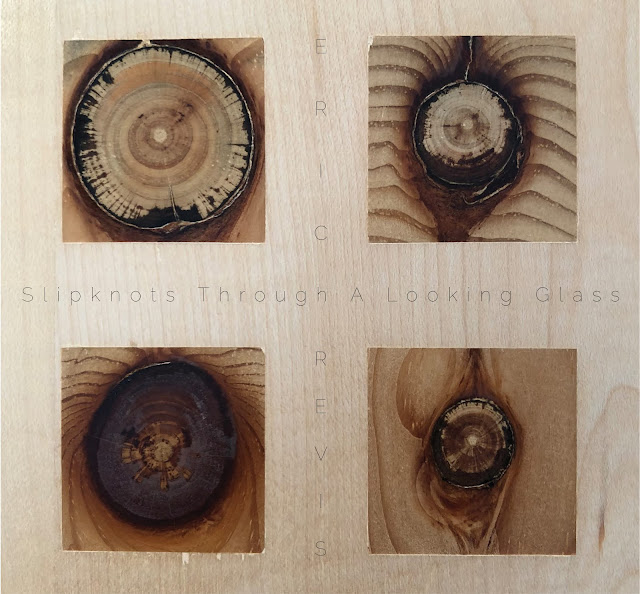
Eric Revis - Slipknots Through A Looking Glass (Pyroclastic Records)

Eric Revis flexes conceptual sensitivity with release of 
Slipknots Through A Looking Glass 

Featuring Revis with Chad Taylor, Kris Davis, Darius Jones and Bill McHenry

“A bassist with a strong rhythmic compass and a stout, beefy tone” — The New York Times


A highly skilled master of sound and sense, GRAMMY award-winning bassist and composer Eric Revis has crafted his artistic legacy around asking the same question again and again: Why not? Experimenting remains integral to his expression. Over the years, the critically-acclaimed artist’s willingness to traverse the unknown has prompted collaborative partnerships with Branford Marsalis, Nasheet Waits, Kris Davis, Peter Brötzmann and Jason Moran.

Heralded by critics as “powerful,” “raw” and “fierce,” Revis’ playing frequently becomes mischaracterized by way of omission. While he plays and composes with master-level intensity, the intrinsic vulnerability present in any form of experimenting — and deeply present in Revis’ artistry — rarely yields recognition among music writers. “I don’t mind those kinds of descriptions or monikers,” he says, “but not when it’s at the negation of everything else. There may be an air of robustness around my music, but there is a lot of sensitivity and intellectual content.”

Poised to challenge those limited views of Revis’ expression, Slipknots Through a Looking Glass — his eighth solo-led album, and first release on Pyroclastic Records — explores new territory alongside familiar travelers: drummer Chad Taylor, pianist Kris Davis and saxophone masters Darius Jones and Bill McHenry. “The band is kind of an amalgam of groups I’ve previously recorded with,” says Revis, who sought to combine the energies of various project iterations on a single record.

Much of the album’s music — primed for enquiry and collaborative input — emerged during several weeks of solitude. Through a partnership with The Jazz Gallery, the LA native received a 2017 grant from The Rockefeller Foundation to spend some time at the Kykuit estate in Pocantino Hills, NY. Two compositions from that retreat found their way on to Marsalis’ 2019 GRAMMY-nominated recording The Secret Between the Shadow and the Soul. Revis sought to interpret the remaining music through a range of treatments — both scripted and spontaneous — on Slipknots Through a Looking Glass, an album that exposes the full flower of his conceptualism. Master producer Ron St. Germain serves as production and mixing engineer for the recording – an instrumental force in the development of its character, at once sprawling and intimate. 

Beginning as a developing conversation between Revis and Taylor, “House of Leaves” represents a conceptual flex for Revis as a composer. The track centers around textural shapes — each, according to Revis, its own island. Exploiting space, the artists leave one island and reenter “nothingness” before traveling to the next. “It was interesting to see how the band could collectively navigate these islands,” says Revis. “Without giving it over to the musicians entirely, the process was more, ‘I have this sparse idea; let’s develop it into this next sparse idea, and then go on from there.”
Rendered as a “visceral approach to melody,” according to Revis, “Vimen” serves the artist’s appetite for exploring energies that surround the music — and the session — thoroughly and critically. “I wanted more emphasis on the energy than on exact notes or notation,” he says. He asked his collaborators to approach title track “SpÆ” with similar controlled spontaneity. “We kind of deconstructed the composition,” says Revis. The trio tune features Davis on prepared piano and Taylor on mbira. “We just played,” he says. 

Incorporating three separate takes, the track features crossfades leading from one take to the next. “It’s almost like if you had people speaking in three separate rooms, and then you put them together — all of a sudden you have this great conversation that, even though it was intended to be about disparate things, really makes a whole lot of sense.” 

An artist fascinated by the surrealist movement, Revis keeps a digital journal of images and concepts flashing before him so that he might one day use them in his music. “The image of slipknots through a looking glass came up and I thought, ‘Wow — this is really cool.’” Immediately he connected his own artistry to the image’s inherent symbolism: the slipknot’s ephemeral nature further complicated by its reflection through the looking glass — was it even there to begin with, and where does it go when it disappears? “All those ideas are very, very much a part of this record,” he says. “The idea of a journey — although it wasn’t something that I set out to do, it’s a theme that runs through all of this record.” 

How listeners might interpret his music matters less to Revis than the act of composing and recording it. “We can hear things and say, ‘Wow, I feel a certain foreboding quality about this,’ and the next person says, ‘Wow, this is such a happy song,’ or for example, Tchaikovsky being able to evoke all this emotional gravitas and almost melancholy — out of major chords! He’s able to exact pathos from major chords.” 

“Hopefully, it’ll be heard,” he says. “When somebody really doesn’t like something, I think that’s incredibly honest and beneficial. If [my music] truly evokes real happiness, that is absolutely beautiful. But if it makes you uncomfortable, that’s a real emotion. And to have something do that — I think that that’s amazing.”

1. Baby Renfro 04:59
2. SpÆ 04:47
3. Earl & The Three-Fifths Compromise 07:14
4. Slipknots Through A Looking Glass, Part 1 02:21
5. Shutter 04:43
6. ProByte 06:19
7. Slipknots Through A Looking Glass, Part 2 01:28
8. House Of Leaves 07:07
9. When I Become Nothing 03:30
10. Vimen 11:33
11. Slipknots Through A Looking Glass, Part 3 03:10

Kris Davis Piano
Bill McHenry Tenor Saxophone
Darius Jones Alto Saxophone
Chad Taylor Drums, Mbira
Justin Faulkner Drums on Tracks 1 and 3

All compositions by Eric Revis except:
Track 2: Eric Revis, Kris Davis and Chad Taylor
Track 5: Darius Jones Track 9: Bill McHenry

Wednesday, October 10, 2018

Hearts & Minds - Electroradiance (ASTRAL SPIRITS 2018)


"Drawing inspiration from the astral explorations of vintage Sun Ra but relocating them in gritty Chicago” – Peter Margasak, Chicago Reader 

“Prog-rock rears its ugly head in the best possible way” – Tom Burris, Free Jazz Collective 

“. . . raucous and scintillating” – Nate Chinen, Jazz Times 

Soon after the catchy synth-bass line that opens Electroradiance, listeners will start to suspect they’re in for something different. The synth-bass line has a herky-jerky contour that does fit a basic pattern of power-rock bands over the decades, but the bass clarinet melody that follows? Not so much. And halfway through, when the bass line becomes a vamp, and the improvisation enters a realm of altissimo squawks and thrillingly convoluted deep runs – well, we’re not in Kansas anymore, are we? 

Electroradiance, the captivating new collection of grooves and freedom from Chicago trio Hearts & Minds, teems with such episodes. “Future Told” marches to a humorously ominous riff rooted in the cartoonish melodies of Raymond Scott in the 1930s. The dance-inducing beat of “Step’n” supports a stuttering melody from bass clarinet – and then some whole-tone keyboard swaths, pockmarked by synthesized percussion blips – before shifting to a fast swing beat and back again. That same dynamic comes into play on “Slippery Slope,” while a modified New Orleans street beat drives “Shreveport”. On the other hand, though, “Treeline” opens with a mournful melody and retains its lovely rubato tempo for the first portion; and the title track offers a space-agey tone poem – night-lonely and a little eerie – in which synthesized keyboard sounds and bass clarinet gargles become almost interchangeable. 

Hearts & Minds is the brash and ballsy brainchild of Jason Stein and Paul Giallorenzo, who have remained friends since they met as grade-school classmates almost three decades ago. Employing an unusual, not to say bizarre, instrumentation, they make music that loops the solar system but maintains an irresistibly grounded pulse (despite the lack of a bassist). Giallorenzo’s keyboard work reaches back to the fledgling electronics of the 60s to encompass synth lines as well as asymmetrical tones and textures, which embrace Stein’s rangy command of bass clarinet techniques. Joining them for the first time on disc, drummer Chad Taylor simmers or percolates, utilizing his wealth of experience with such artists as Chicago tenor-sax legend Fred Anderson and his Chicago Underground cohorts Jeff Parker and Rob Mazurek. 

Taylor’s history made him the perfect choice to replace Hearts & Minds’ original drummer, Frank Rosaly (who moved to Europe shortly after the trio’s debut recording). Working with Fred Anderson allowed him to learn from a free-jazz contemporary of Cecil Taylor, Ornette Coleman, and Pharoah Sanders, whose pioneering improvisations of the 1960s are one touchstone for Hearts & Minds. And Taylor’s collaborations with trumpeter-electronicist Rob Mazurek honed his ability to support and shape music made by electronics – the other major inspiration for Hearts & Minds, whose music reverberates with memories of Sun Ra and the jazz fusion of Miles Davis and Herbie Hancock. 

As the title of the opening track indicates, this ability to go “Back And Forth” between two seemingly opposed camps distinguishes Hearts & Minds – as does the ability to find a fusion path that skirts them both. This same dialectic applies to the name of the band itself, as these musicians seek to achieve an aesthetic unification of expressionistic energy (heart) and intellectual formalism (mind) – all with a 21st-century voice that refers to but does not imitate past influences. 

Jason Stein is among the mere handful of improvisers who play the bass clarinet exclusively (rather than doubling on it as a change of pace). He occasionally performs for more people in one night than most jazz musicians see in a year: his free-jazz trio Locksmith Isidore has opened arena shows for comedian Amy Schumer (his half-sister). In addition to that trio and his own quartet, he contributes to several of the leading bands on Chicago’s new-music scene, and has brought a vital voice to the freest of free-jazz jams. But he has also stated a fondness for playing actual tunes, such as those that fill the repertoire of Hearts & Minds. And while several of these songs provide a section for free improvisation, their initial frameworks provide a uniquely inviting showcase for Stein’s extraordinary expertise on the bass clarinet, which ranges from powerful post-bop lines to ear-grabbing wails in the altissimo range. Chicago writer Neil Tesser notes that his playing has “a rawboned swagger particular to Chicago jazz in all its manifestations – from the trad playing of Bud Freeman and Jimmy McPartland in the 20s, through the tenor titans of the 50s, through the adventurers who formed the AACM in the 60s, and right up to the city’s renowned modern cadre of new-music improvisers.” 

Paul Giallorenzo, in addition to leading his own groups – particularly his GitGO quintets and the widely admired acoustic piano trio heard on the 2018 album Flow – has emerged as a leading virtuoso on the analog synthesizer. Giallorenzo’s work has been praised for its “inside-out” nature – his ability to push the boundaries of “conventional” jazz toward more freedom but also, on the other side, to bring a measure of structure to more avant-garde material. In addition, he is a co-founder of Elastic Arts, an important Chicago performance space and gallery, where he curates concert series, produces individual programs, and performs. Writing in the online journal Point Of Departure, John Litweiler said, “His solos and aggressive duets are gems of after-Bop, after-Bley melody,” while AllAboutJazz.org lauded music that “smudges the lines between the tradition and the avant-garde.” 

Stein and Giallorenzo first met in sixth grade in Rockville Centre, a mid-sized Long Island suburb of New York City. Giallorenzo attended Northwestern University just north of Chicago; Stein, studying at University of Michigan, traveled frequently to Chicago before graduation, then moved there in the early 2000s. Each settled quickly into the city’s burgeoning jazz/new-music environment, which by then was attracting attention throughout North America and Europe. 

They first performed in the format that evolved into Hearts & Minds in 2003; Frank Rosaly came on as drummer in 2005, ably succeeded by Chad Taylor, who grew up in Chicago and now lives in New York. His discography includes more than a dozen albums under the Chicago Underground rubric, starting with the Chicago Underground Duo formed by him and Rob Mazurek; multiple albums recorded with Fred Anderson, guitarist Jeff Parker, and award-winning flutist and composer Nicole Mitchell; and one of the most critically respected albums of 2017, trumpeter Jamie Branch’s Fly Or Die.

HEARTS & MINDS is: 
Jason Stein -- bass clarinet 
Paul Giallorenzo -- synthesizer, keyboards 
Chad Taylor -- drums, percussion 

Recorded October 24-25, 2017 by Zach Goldstein at Kawari Sound, Philadelphia, PA. 
Mixed by Liberty Ellman. 
Mastered by Mikey Young. 
Layout & Design by Jaime Zuverza. 

Tracks 2,5, 8 written by Jason Stein, Steinbassclar Publishing ASCAP 
Tracks 1,3,7,11 written by Paul Giallorenzo, Paul Giallorenzo Music ASCAP 
Tracks 4,9 written by Chad Taylor, Ctorb ASCAP 
Tracks 6,10 written by Hearts & Minds 

1. Back and Forth 04:53
2. Treeline 06:45
3. Step'n 06:58
4. Rivet and Roll 02:31
5. Frencher Frosty's Book 04:14
6. Electroradiance 03:01
7. Slowly Drifting Outward 05:52
8. Future Told 06:03
9. Shreveport 04:02
10. Relativistic 02:36
11. Slippery Slope 05:47


Thursday, June 28, 2018

Steve Swell's Kende Dreams - Hommage à Bartók (SILKHEART RECORDS 2018)


From John Corbett's liner notes: 

« Trombonist Steve Swell's approach to a Bartók homage on Kende Dreams is a synthesis and it advisably leaves the encounter with the Hungarian a relatively loose and oblique affair, with specific points of convergence but an end product that feels more like it was inspired by the composer than obliged to adopt his methods. The seven tracks are creative music pitched at the highest level; as is that music's unalienable right, it absorbs and transforms things that it comes into contact with. So, unlike Milhaud's attempts to quote or characterize jazz, this is jazz eating and fully digesting modern classical music, turning it into something else completely. » 

Chicago, April 2015

1. Roswellian Folk Song 07:57
2. For Will Connell Jr. 07:51
3. After SQ4 09:59
4. Attack of the Mikrokosmos 08:12
5. Bartók Screams 13:40
6. Lent-Oh! 14:09
7. Ultima 08:34

Rob Brown alto saxophone
Steve Swell trombone
Connie Crothers piano
William Parker bass
Chad Taylor drums


Saturday, May 19, 2018

Chad Taylor - Myths and Morals (EARS&EYES RECORDS 2018)


One of the most prolific drummers/percussionists over his three decades of performing and recording with some of the modern, improvised music’s most influential musicians such as the late Fred Anderson, Nicole Mitchell, Matana Roberts, Ken Vandermark, Marc Ribot, and Jeff Parker, Chad Taylor has defined his voice as one that is unique, rawly refined, unending in creativity, and historically relevant in the world of modern creative music. His partnership with Rob Mazurek in the Chicago/ London Underground Duo/ Trio/ Quartet/ Orchestra, has placed him in an individualistic stylistic mode of playing that is distinct and undoubtedly original.

Let's also not forget his contributions to folk/rock/pop groups such as Stereolab, Sam Prekop, Yo La Tengo, Doug McComb’s Brokeback, Glen Hansard and Iron & Wine. Most recently, Taylor’s work can be heard on critically acclaimed releases of 2017 such as Jaimie Branch’s Fly Or Die (praises from The New York Times, Arcade Fire’s Sarah Neufeld, Ryley Walker, Jazz Right Now, BandCamp Best of…, and more) and Eric Revis’ Sing Me Some Cry release alongside MacArthur Fellow Ken Vandermark and Kris Davis.

This album isn’t a typical solo drum recording with the artist playing a drum set the whole time with repetitive beats and/or complex fills. It really resonates as an adventure through a variety of sonic fields. Take ‘Gum Tree’ for example where you can hear the actual fingers hit the keys of this difficult and rare instrument heard in the jazz field: the Mbira, which comes from the Shona people where what is modern day Zimbabwe, Africa. ‘Carnation’ feels as if we’re in the soundtrack recording session of a mystery lo-fi set in the middle of a darkened forest with his use of cymbal treatments.


1. Arcadia 06:47
2. Phoenix 06:02
3. The Fall of Babel 06:14
4. Carnation 04:11
5. Gum Tree 03:32
6. Abtu and Anet 03:28
7. Island of the Blessed 09:05
8. Simcha (bonus track) 01:44

Elliot Bergman - electric kalimba 
Recorded by Will Holland at Selva Recording, Brooklyn NYC

All music by Chad Taylor (CTORB ASCAP)

Recorded, mixed and mastered by Alex Inglizian at Experimental Sound Studio, Chicago USA

except 'Simcha'

Saturday, May 12, 2018

James Brandon Lewis and Chad Taylor - Radiant Imprints (OFF - RECORD label 2018)

Nothing as beautiful as following the course of an interesting, young musician, especially if he has planned not to sit with the suits. Tenor James Brandon Lewis made a furore with his trio in 2017.

On "radiant imprints" he is heard with master drummer Chad Edward Taylor. The result is free and soulful, and sometimes surprisingly catchy.

Radiant Imprints is a strong, soulful statement by musicians who possess baggage and technology, but also instinct, emotion and character. And with that you not only address the head, but also the heart.


Twenty Four
Loved One
With Sorrow Lonnie
Imprints
First Born
Radiance
Improve I

James Brandon Lewis: saxophone
Chad Taylor: drums


Monday, March 12, 2018

Aruán Ortiz Trio - Live in Zurich (INTAKT RECORDS March 16, 2018)


When Aruán Ortiz appeared with his new trio at Zürich’s unerhört!-festival on 26 November 2016, the sense of anticipation was palpable; how would the music from the well-received studio album Hidden Voices feel in a live context. The trio were at the end of their first European tour, and on a roll. Immediately after the concert Ortiz was already enthusing about the interaction and musical dialogue.


“Mulling it over” – like the aging process of wine; carrying one or two pieces around with you for years, till the final versions emerge. In Ortiz’ case this applies to compositions such as “Fractal Sketches” and “Analytical Symmetry”, which were first heard on the studio album Hidden Voices, here in a new line-up, with Brad Jones on bass and Chad Taylor on drums, after an intensive two-week tour. That close relationship between the musicians and the song grows tremendously the more you play it, and it develops a musical trust within the band. When all goes well, the sound and energy are in tune with the compositional idea. On this live CD we can hear just how well it went on 26 November 2016 at the unerhört!-festival in Zürich. From the liner notes by Christian Broecking


Soundsamples of this CD

Wednesday, November 22, 2017

Musicianer - Slow Learner (ILUSO RECORDS 2017)


“Sinton's Barisax has a lot to say about all this existential jazz stuff: whether the universe is actually devoid of meaning or form, what to do when the glorious monster comes to you hard in your dreams.” Greg Tate 

Brooklyn-based baritone saxophonist, bass clarinetist and creative musician Josh Sinton has played an integral part in the renaissance of musical activity thriving in Brooklyn’s creative music scene today. He has performed with countless leading figures from NYC and around the world and has been nominated to the Downbeat Critics' and Readers' Polls, the Jazz Times Poll and El Intruso International Critics' Poll every year since 2012. 

Musicianer (the word used by Sidney Bechet for a fellow musician) are a band that escape the pigeonhole etched by their instrumentation. Their album ‘slow learner’ was born from Sinton’s long yearning to write songs to be played with two of his longest standing musical companions; Chad Taylor (drums and percussion) and Jason Ajemian (acoustic bass), whose deep musical connection traces back to their time living and performing together in Chicago in the 1990s. 

Reaching into the worlds of Sinton’s vast musical influence - from Sonny Rollins to Stevie Wonder, Charlie Parker to Jimi Hendrix, ‘slow learner’ is an open and trusting conversation between three life-long musicianers, effortlessly traversing subject matter - from whimsical jibe to defiant fits of protest – totally unrestricted by that uncomfortable awkwardness often encountered by the unacquainted. 

From the infectious groove of ‘pork bueno’, the hypnotic and sweet tempered ‘can’t really say’ through to the aching sentimental breathiness of ‘fail beautiful’, Sinton’s songs are enchantingly approachable and speak with a comforting lyricism assuring you that, despite it all, everything is going to be alright. ‘slow learner’ is, quite truly, an anecdote of our age - an antidote for these times. 

Aside from musicianer, Josh Sinton leads the innovative Steve Lacy-repertory band Ideal Bread (with Kirk Knuffke, Tomas Fujiwara and Adam Hopkins) and is a long-standing member of the Nate Wooley Quintet and Anthony Braxton’s Tri-Centric Orchestra. Drummer Chad Taylor is the founder of the Chicago Underground ensembles. He leads his own band Circle and has played with Jeff Parker, Marc Ribot, Derek Bailey and Peter Brotzmann. Jason Ajemian is one of the Chicago areas most in demand bass players. He leads the groups Folklords and High Life and is Helado Negro’s musical director. He has performed with Jeff Parker, Tony Malaby, Marc Ribot and Matana Roberts. 

‘Slow learner’ was recorded in February 2017 at Greenwood Underground, Brooklyn, NY and mixed by the inimitable Eivind Opvisk (leader of Overseas and member of Opsvik & Jennings), whose role as co-producer made a significant contribution to the album’s innate sensibility. 

The album includes liner notes by famed Village Voice contributor and iconic critic, Greg Tate, providing a unique insight into Sinton’s creative process and the album’s message – informing and enhancing the listening experience. 

1. Outside (today) 4:40
2. Can't Really Say 4:31
3. And then It came To me 5:21
4. Sunday's Rehearsal 3:28
5. Pediments 2:52
6. JiMmY 4:00
7. Evening of Mourning (Ferguson Goddam) 3:58
8. Pork Bueno 5:04
9. Devoid of Form, Devoid of Meaning 5:49
10. Left-Side Paralysis 3:37
11. Fail Beautiful 3:47

Josh Sinton baritone saxophone
Jason Ajemian contrabass
Chad Taylor drums