Showing posts with label Wadada Leo Smith. Show all posts

Saturday, December 18, 2021

Wadada Leo Smith's Special 80th Birthday Concert Video! on Saturday, December 18

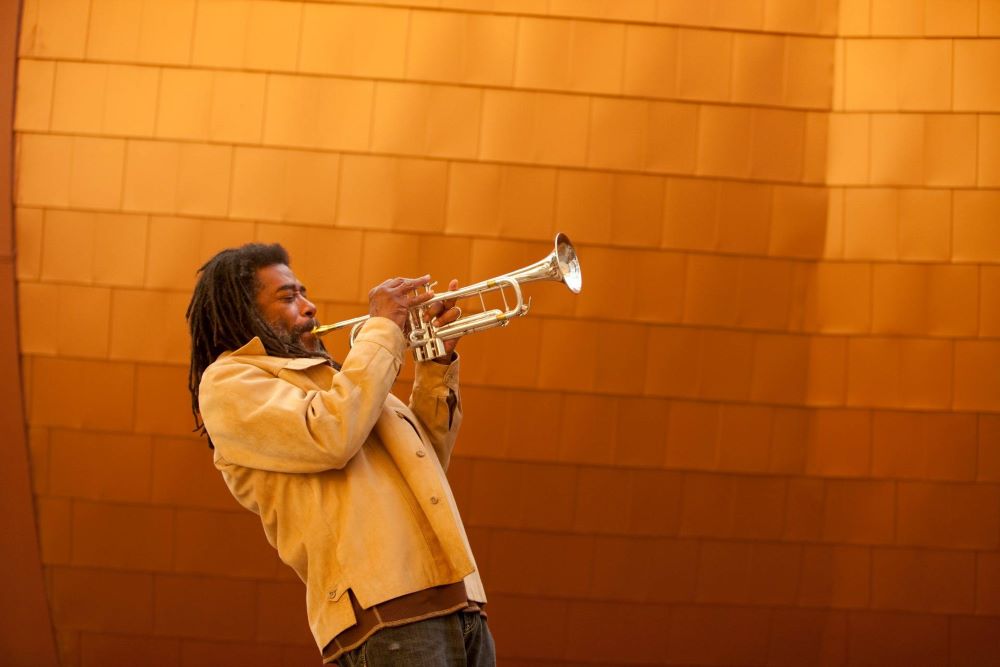
Photo by Dominik Huber

The iconic composer/trumpeter/creative visionary Wadada Leo Smith turns 80 on Saturday, December 18 and he celebrates with a special Eightieth Birthday Celebration video performance as a "thanks to my fans and all who appreciate my music.” 


Also available at Vimeo 

Featured are Wadada Leo Smith on trumpet, Pheeroan akLaff on drums, Erika Dohi on piano, and Lamar Smith on guitar. Pianist/composer Sylvie Courvoisier contributes a separate video.
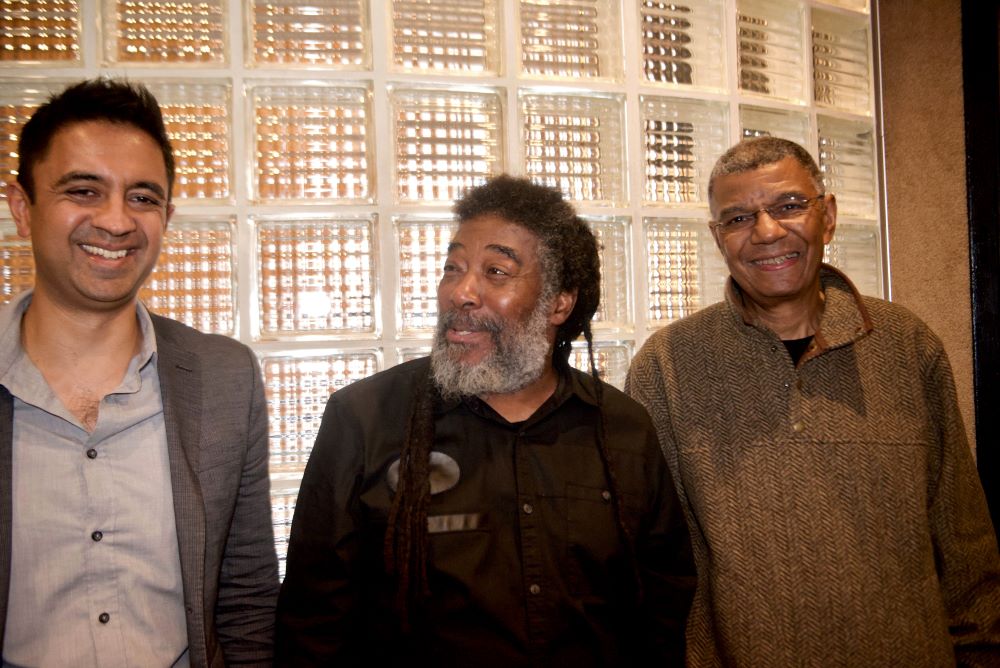
Photo by Jimmy Katz

Wadada Leo Smith Eightieth Birthday Celebration Program 

– “Butterfly Silver," a film by Robert Fenz. Ep 1, soundtrack from Wadada’s Creative Music-1, 1971.

– "Sustained Melody” – Wadada Leo Smith, Pheeroan akLaff on drums, Erika Dohi on piano. 

– "For Wadada" – Composed and performed by Sylvie Courvoisier

– "Spiritual Horizon" – Wadada Leo Smith, Pheeroan akLaff, Erika Dohi, and Lamar Smith.

– "Yellow Stone" – Wadada Leo Smith, Pheeroan akLaff, Erika Dohi 

All compositions copyrighted by Wadada Leo Smith, except “For Wadada,” composed and performed by Sylvie Courvoisier.  "Muhammed Ali, Spiritual Horizon {song no 2} (*pre-recorded soundtrack with Bill Laswell and Melvin Gibbs plus Mauro Refosco)

Taped at Firehouse 12 in New Haven on December 4, 2021. Sylvie Courvoisier’s performance was taped separately. Mixed by Greg DiCrosta, Firehouse 12 Studio; Filmed and Edited by Nicki Chavoya.
Photo by Dominik Huber

About Wadada Leo Smith 
Trumpeter, multi-instrumentalist and composer Wadada Leo Smith is one of the most boldly original and influential artists of his time. Transcending the bounds of genre or idiom, he distinctly defines his music, tirelessly inventive in both sound and approach, as "Creative Music."
 
For the last five decades, Smith has been a member of the legendary AACM collective, pivotal in its wide-open perspectives on music and art in general. He has carried those all-embracing concepts into his own work, expanding upon them in myriad ways.
 
Throughout his career, Smith has been recognized for his groundbreaking work.  A finalist for the 2013 Pulitzer Prize in Music, he received the 2016 Doris Duke Artist Award and earned an honorary doctorate from CalArts, where he was also celebrated as Faculty Emeritus. In addition, he received the Hammer Museum's 2016 Mohn Award for Career Achievement "honoring brilliance and resilience." In 2018 he received the Religion and The Arts Award from the American Academy of Religion.
 
Smith regularly earns multiple spots on the DownBeat International Critics Poll and has won poll in the categories of Best Jazz Artist, Trumpeter and Jazz Album of the Year. The Jazz Journalists Association has also honored Smith as their Musician of the Year, Trumpeter of the Year, Composer of the Year, and Duo of the Year for his work with Vijay Iyer. He has also earned top billing as Artist of the Year and Composer of the Year in the JazzTimes Critics Poll as well as top spots on the NPR Jazz Critics Poll.
 
In October 2015 The Renaissance Society at the University of Chicago presented the first comprehensive exhibition of Smith's Ankhrasmation scores, which use non-standard visual directions, making them works of art in themselves as well as igniting creative sparks in the musicians who perform them. In 2016, these scores were also featured in exhibitions at the Hammer Museum, and the Kalamazoo Institute of Arts and Kadist in San Francisco.
 
Born December 18, 1941 in Leland, Mississippi, Smith's early musical life began at age thirteen when he became involved with the Delta blues and jazz traditions performing with his stepfather, bluesman Alex Wallace. He received his formal musical education from the U.S. Military band program (1963), the Sherwood School of Music (1967-69), and Wesleyan University (1975-76).
 
Smith has released more than 50 albums as a leader on labels including ECM, Moers, Black Saint, Tzadik, Pi Recordings, TUM, Leo and Cuneiform. His diverse discography reveals a recorded history centered around important issues that have impacted his world, exploring the social, natural and political environment of his times with passion and fierce intelligence. His 2016 recording, America’s National Parks earned a place on numerous best of the year lists including the New York Times, NPR Music and many others. Smith’s landmark 2012 civil rights opus Ten Freedom Summers was called “A staggering achievement [that] merits comparison to Coltrane’s A Love Supreme in sobriety and reach.”  His most recent recordings include 2021’s Sacred Ceremonies, a 3 CD set featuring Smith, Bill Laswell & Milford Graves; Trumpet, a 3 CD solo trumpet set; The Chicago Symphonies a 4-album set celebrating the Midwest with his Great Lakes Quartet; and A Love Sonnet for Billie Holiday. In March 2022 TUM will release two major box sets of Smith’s work. The include Wadada Leo Smith: String Quartets No. 1 - 12, a 7-CD box set featuring RedKoral Quartet plus featured soloists including Smith, Anthony Davis, Alison Bjorkedal, Thomas Buckner and more; and Wadada Leo Smith: Emerald Duets a set with 4 CDs, one each with Pheeroan akLaff, Han Bennink, Andrew Cyrille and Jack DeJohnette, adding to Smith’s long history of duo recordings with some of the greatest drummers in the history of creative music. Writing about Smith’s 2017 album Solo: Reflections and Meditations on Monk in the New York Review of Books, Adam Shatz notes: “For all the minimalism of his sound, Smith has turned out to be a maximalist in his ambitions, evolving into one of our most powerful storytellers, an heir to American chroniclers like Charles Ives and Ornette Coleman.” 

Wednesday, December 15, 2021

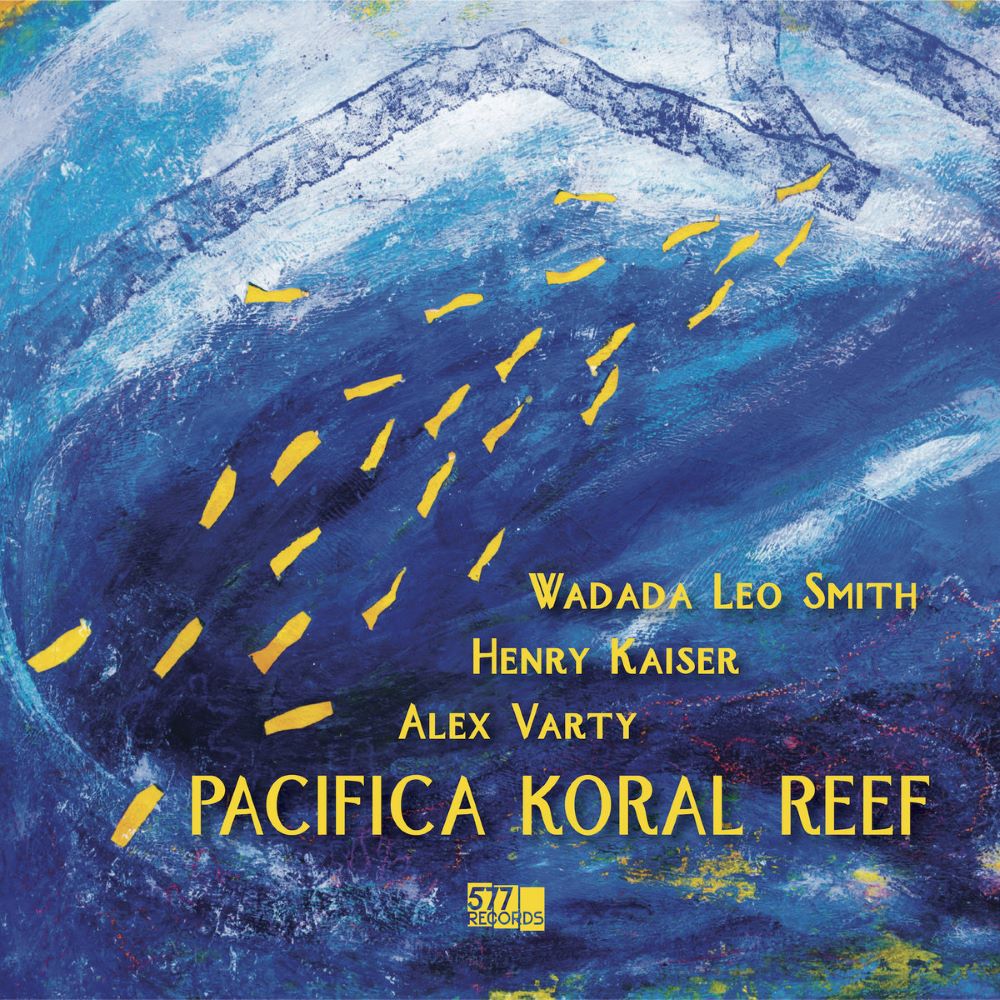
Wadada Leo Smith / Henry Kaiser / Alex Varty - Pacifica Koral Reef (December 15, 2021 577 Records)

"I’m supposed to be writing about Pacifica Koral Reef, this record that I’ve made with my friend Henry Kaiser and his friend Wadada Leo Smith. And while the music it contains is, for me, a miraculous late-career achievement after 50 years of mostly playing in alternative rock bands, writing about it is a downright odd thing to have to do. In my parallel life as an arts journalist, I’ve interviewed everyone from Ornette Coleman to John Cage to Robert Plant but I’ve rarely had to write about myself, and I much prefer it that way. Fighting against my natural tendency towards self-effacement is the fact that Pacifica Koral Reef is more than just a record. Yes, everybody says this about their latest slab of black plastic or their shiny new optical disc, but this time it’s true.

Everybody says this, too, but wait.

The multidimensional experience that is Pacifica Koral Reef began life in trumpet player and composer Smith’s prodigious imagination, and then found a home on a single sheet of paper, inscribed with sinuous lines, bright blocks of spring green and earthy ochre, radiant pools of blue, circuit-board computations, and ancient glyphs.

You could call it a painting. The University of Chicago’s Renaissance Society, which hosted an exhibition of Smith’s graphic scores in 2015, probably would.

It’s also a portal, as Kaiser and I found when we began, with Smith’s inspiration and help, to translate it into sound. Over the course of several recording sessions, made next door to a sumptuous collection of vintage ukuleles and utilizing an array of microphones made of purest Soviet unobtanium, we were transported to locales as dramatically different as a steamy Chicago nightclub, a Third Stream concert hall, the crystalline world under the Antarctic ice, and a lonely Scottish moor (with hints of a lost tanpura droning in the distance).

Tracking the Pacifica Koral Reef score took us out of familiar habits and into new terrain. It sparked music that will never be duplicated, because if we tried we’d of necessity be expressing a different moment, a different feeling. And it strengthened preexisting bonds of friendship and respect. I met Kaiser in 1978, after seeing a poster advertising a concert of “weird guitar music”, and Smith perhaps a year after that, when he led a workshop for improvisers in Vancouver. Meanwhile, Henry has collaborated with Leo on a number of projects, most notably three 2-CD sets and two single album releases with their Yo Miles! band. Henry, who has known Leo since 1976, tells me that he thinks of Wadada as the favorite and wise uncle that he never had in his own family.

All of these visions, connections, and relationships are realized through the score. The music is improvised and ephemeral; the effect is intentional, replicable, and lasting.

That’s the beauty of Smith’s Ankhrasmation system, which combination of visual stimulation, musical notation, and social philosophy that prompts intuition, imagination, and cooperation.

“Ankhrasmation is a musical language, as opposed to a musical notation system,” Leo told music journalist Frank J. Oteri in 2011. “The first part, Ankh, comes from the Egyptian cross. Ras comes from the Ethiopian ‘head’, meaning the leader. And Ma comes from ‘mother’….It could be referenced scientifically, according to nature or biology, or it can be referenced according to fantasy, imagination. The only requirement is that the artists that are performing it maintain a high level of sincerity. That’s all it requires.”
I might argue that Ankhrasmation scores also ask their interpreters to be conscious of the values of “colour, velocity, [and] rhythm”. And when, more recently, I asked Leo if he envisioned Ankhrasmation as a way of integrating the eyes, the ears, and the hands of an improviser, or a group of improvisers, he agreed—but gently reminded me that I’d left out another important dimension: “the heart”.

I can’t speak to the heart that Henry brought to this project, although it’s plainly audible here, and he deserves full production credit for guiding Pacifica Koral Reef from improbable notion to elegant product. I won’t say much about my own heart, beyond noting that when we entered the studio I’d just had it broken, and you can probably hear this in the bagpipe-raga lament that I play on open-tuned acoustic guitar to kick off the record. But Wadada likes to speak about how his heart, his system, and his music are all connected to the need to not only survive, but thrive under injustice.

Obviously he’s talking about the African American experience in the United States—and more. With “African-American culture, the First People in North and Central and South America, the Jewish culture coming out of Asia,” he says, “all these things set in motion to wipe us out, they created something inside of us, all of us, that would not allow that to happen….So inside of that collective consciousness is this will to survive and to prosper. That’s the word I like to use. And when we look at African Americans, having people in business and in politics and in writing and literature and all these other dynamics of artistic and cultural activity achieve the highest level is just magnificent.”

Having been a diver much longer than he has been a musician, Henry is especially aware of the destructive effect of climate change on the coral reef systems that are an essential part of Gaea, the living earth. His many deployments to Antarctica as a working scientific diver for the past 20 years have made him an expert witness to the heartbreaking changes that are happening and accelerating right now. His guitar here reaches with from under-the-polar-ice inspired rhythms and narratives to intertwine with our collective concern for the earth and its elaborately interconnected web of inhabitants.

Snorkelling in the Pacific Northwest’s Salish Sea is a daily part of my own summertime routine. Like participating in collective improvisation, it gives me a sense of being part of a larger whole and an awareness that strange beauties await us just below every surface—along with the presence of risk, and evidence of life’s fragility.

Wadada brings the magnificent courage of his ancestors to this music. Henry is darting and provocative and deep into the practice of listening. Me, I’m just glad to be a part of the team, and I hope Pacifica Koral Reef brings light, warmth, and otherworldly pleasure to all those who hear it.”

- Alexander Varty 

1. Pacifica Koral Reef

Wadada Leo Smith:  Trumpet
Henry Kaiser:  Guitar
Alex Varty: Guitar

Recorded January 2018 by Sandor Nagyszalanczy, Jesse Nichols, Henry Kaiser
at Wise Acres Studio, Santa Cruz, California & Fantasy Studios, Berkeley, California
Production, mixed and mastered by Henry Kaiser

Cover painting by Brandy Gale
Graphic design by Sergio Vezzali

Pacifica Koral Reef is realized from an Ankhrasmation score by Wadada Leo Smith

Friday, November 19, 2021

TUM RECORDS CONTINUES THE CELEBRATION OF WADADA LEO SMITH'S 80th ANNIVERSARY WITH TWO OUTSTANDING NEW RELEASES: Wadada Leo Smith's Great Lakes Quartet - "THE CHICAGO SYMPHONIES" and Wadada Leo Smith / Jack DeJohnette / Vijay Iyer - "A LOVE SONNET FOR BILLIE HOLIDAY" November 19, 2021 via TUM RECORDS

© Dominik Huber

TUM Records releases two stunning new projects on November 19, 2021 from iconic trumpeter and composer Wadada Leo Smith as he approaches his 80th birthday. They include his Great Lakes Quartet (Smith, Threadgill, Lindberg, DeJohnette) in The Chicago Symphonies (4 CDs), and Smith, Iyer and DeJohnette in A Love Sonnet for Billie Holiday.  These are the second batch of TUM releases celebrating Smith’s birthday. All together there are six projects totaling 22 CDs.


Wadada Leo Smith's Great Lakes Quartet - THE CHICAGO SYMPHONIES TUM BOX 004 (4 CDs) November 19, 2021 TUM RECORDS

The Chicago Symphonies represents another magnificent four-disc collection of extended compositions by composer, musician, artist and educator Wadada Leo Smith leading his Great Lakes Quartet in a celebration of Chicago and the rich contributions of the Midwestern artistic, musical and political culture to the United States of America. The first three symphonies, “Gold,” “Diamond” and “Pearl” are performed by Smith with three other contemporary masters of creative music, saxophonist/flutist Henry Threadgill, bassist John Lindberg and drummer Jack DeJohnette. The fourth, “Sapphire Symphony – The Presidents and Their Vision for America,” features saxophonist Jonathon Haffner with Smith, Lindberg and DeJohnette.

“The idea of a symphony composed for a sextet was first presented by composer/performer Don Cherry in his classic recording Symphony For Improvisers in 1966,” says Wadada Leo Smith. “I have broadened this idea to include the social, political and psychological dynamic into the creative space. My Chicago Symphonies are intended to illustrate and preserve the powerfully unique cultural contribution that the Midwesterners made in helping to shape the American society.”
© Dominik Huber

Don Cherry’s classic recording Symphony For Improvisers on Blue Note Records featured Cherry on the cornet with saxophonists Gato Barbieri and Pharoah Sanders, vibraphonist Karl Berger, bassists Henry Grimes and Jean-François Jenny-Clark, and drummer Ed Blackwell. In The Chicago Symphonies, Wadada Leo Smith has expanded his idea of using symphonic form to showcase some of the Midwest’s creative composers/performers, poets, thinkers and political visionaries inside that symphonic form. In particular, The Chicago Symphonies celebrate the historical contributions of creative music in Chicago culture starting with Louis Armstrong and his contemporaries through Sun Ra and others onto the Association for the Advancement of Creative Musicians (AACM) as well as, in the case of “Sapphire Symphony,” two great presidents hailing from Chicago, Abraham Lincoln and Barack Hussein Obama.

Each disc of The Chicago Symphonies includes one of the four symphonies composed by Wadada Leo Smith specifically for the Great Lakes Quartet. The first three symphonies, “Gold Symphony,” “Diamond Symphony” and “Pearl Symphony,” are performed by the original Great Lakes Quartet of Wadada Leo Smith with saxophonist/flutist Henry Threadill, bassist John Lindberg and drummer Jack DeJohnette whereas the fourth, “Sapphire Symphony – The Presidents and Their Visions of America,” features Smith with a representative of a younger generation of creative musicians, saxophonist Jonathon Haffner, as well as Lindberg and DeJohnette.

The Chicago Symphonies follows the release by the Great Lakes Quartet of The Great Lakes Suites (TUM CD 041-2, a double-CD with Smith, Threadgill, Lindberg and DeJohnette) that featured six extended compositions dedicated by Smith to Lake Michigan, Lake Ontario, Lake Superior, Laker Huron, Lake Erie and Lake St. Clair. In 2014, The Great Lakes Suites was broadly hailed as one of the top albums of the year.

Disc 1: GOLD SYMPHONY
01 – 05 Movements 1 –5 39:48

Disc 2: DIAMOND SYMPHONY
01 – 04 Movements 1 –4 36:38

Disc 3: PEARL SYMPHONY
01 – 05 Movements 1 –5 38:45

Disc 4: SAPPHIRE SYMPHONY
01 – 05 Movements 1 –5 49:13

Wadada Leo Smith trumpet, flugelhorn
Henry Threadgill alto saxophone, flute and bass flute (Discs 1–3)
Jonathon Haffner alto and soprano saxophones (Disc 4)
John Lindberg double bass
Jack DeJohnette drums

Wadada Leo Smith, Jack DeJohnette & Vijay Iyer - A Love Sonnet For Billie Holiday (November 19, 2021 TUM RECORDS)

A Love Sonnet For Billie Holiday by Wadada Leo Smith, Jack DeJohnette and Vijay Iyer brings the three artists together for the first time in this meeting of creative giants. The recording is a unique artistic collaboration featuring compositions by all three of its participants.

Wadada Leo Smith first met and played with Jack DeJohnette in the late 1960s and the two have collaborated with increasing frequency since DeJohnette participated in the first recording of Smith’s Golden Quartet more than two decades ago. Smith’s and Iyer’s first collaboration, in a later edition of the Golden Quartet, also goes back almost two decades. Nevertheless, the recording of A Love Sonnet For Billie Holiday marks the first time these three unique artists have participated in the same project and also the first time DeJohnette and Iyer have played together.

In a true collaborative spirit, A Love Sonnet For Billie Holiday features compositions by all three participants. The album opens with Smith’s composition that gave the album its title. “Billie Holiday: A Love Sonnet” is the latest in a line of Smith’s compositions dedicated to Billie Holiday that previously has included the title composition of Dark Lady Of The Sonnets by Wadada Leo Smith’s Mbira (TUM CD 023) as well as “The Empress, Lady Day: In a Rainbow Garden, with Yellow-Gold Hot Springs, Surrounded by Exotic Plants and Flowers” on Najwa (TUM CD 049), among others. Smith’s other contribution, an extended composition titled “The A.D. Opera: A Long Vision with Imagination, Creativity and Fire, a dance opera” is dedicated to his long-time collaborator, pianist Anthony Davis, who already played with Smith in his important early group, New Dalta Akhri, in the mid-1970s, then joined the same first edition of the Golden Quartet that also featured DeJohnette and also participated in numerous other projects by Smith over the years.
© R.I. Sutherland-Cohen

Jack DeJohnette brought to the session his composition “Song for World Forgiveness,” a powerful plea for peace and sanity that has received a number of different treatments on his own recordings ranging from solo piano and saxophone/piano duo to a quartet, whereas Iyer contributed “Deep Time No.1,” which utilizes electronics and includes an excerpt of Malcolm X making his speech “By Any Means Necessary.” Finally, the closing piece “Rocket” was created collectively in the studio.

“A Love Sonnet For Billie Holiday was a dream project to work on with Jack and Vijay where the idea of composition and instrumentation would play a vital part in how the music sounded,” says Wadada Leo Smith. “The keyboards, drum-set/percussion and trumpet would create their own sonic ranges, and with no bass at the ‘bottom’ of the music, Vijay, Jack and Wadada’s instruments could realize wider horizontal sonic fields and emotional ranges. Therefore, the performers could reveal a complete and complex melodic and harmonic spectrum in a clear musical exposition.”

01. Billie Holiday: A Love Sonnet (Wadada Leo Smith) 11:52
02. Deep Time No.1 (Vijay Iyer) 09:20
03. The A.D. Opera: A Long Vision with Imagination, Creativity and Fire, a dance opera (For Anthony Davis) (Wadada Leo Smith) 18:11
04. Song for World Forgiveness (Jack DeJohnette) 13:50
05. Rocket (Wadada Leo Smith, Jack DeJohnette and Vijay Iyer) 04:29

Wadada Leo Smith trumpet
Vijay Iyer piano, Fender Rhodes, Hammond B-3 and electronics
Jack DeJohnette drums and percussion

“Deep Time No. 1” includes an excerpt from the “By Any Means Necessary” speech by Malcolm X

Friday, May 21, 2021

Out May 21 – Two Major Box Sets from Wadada Leo Smith on TUM Recordings

TUM Records Celebrates
Wadada Leo Smith’s 80th Birthday Year!

Throughout 2021, TUM Records will celebrate the coming 80th birthday of renowned composer and trumpeter Wadada Leo Smith with a series of new releases showcasing his monumental artistic vision. The yearlong celebration kicks off on May 21 with a pair of three-CD boxed sets, one an inspiring solo trumpet recording captured in a beautiful historic setting (Trumpet), the other a meeting of three true masters, Smith, Bill Laswell and Milford Graves (Sacred Ceremonies).

The new releases also bring to ten the total number of Wadada Leo Smith’s projects on TUM Records. These releases have ranged from solo and duo settings to large ensembles and an oratorio, always featuring a different aspect of Wadada Leo Smith’s uncompromising artistic vision.

“It is with great pride that TUM Records presents Wadada Leo Smith’s latest releases and thereby commences the celebration of his coming 80th birthday,” says TUM Records founder Petri Haussila. “From the very beginning, it has been our goal to foster longer term relationships with our artists, among whom Wadada Leo Smith has a special place of honor. We now have released ten projects with Wadada, each unique in its own way. Among these, Trumpet and Sacred Ceremonies are the most extensive yet. We salute Wadada for his 80th Anniversary and look forward to our continued collaboration.”


• Sacred Ceremonies – 3 CD Box Set – May 21, 2021
Disc 1: Wadada Leo Smith & Milford Graves
Disc 2: Wadada Leo Smith & Bill Laswell
Disc 3: Wadada Leo Smith, Bill Laswell & Milford Graves

• Trumpet – 3 CD Box Set – May 21, 2021
Featuring 14 new compositions for solo trumpet including four extended works

Other TUM albums coming out in the near future include:
 
• Title TBA – 2 CD Set – Great Lakes Quartet – release date TBA 
Featuring Wadada Leo Smith, Henry Threadgill, Jack DeJohnette, John Lindberg
 
• Title TBA – 4 CD set of trumpet & drum duets – release date TBA 
Featuring Wadada with Jack DeJohnette, Andrew Cyrille, Han Bennink, Pheeroan akLaff
 
• Title TBA – 6 CD set featuring Smith’s 12 String Quartets – release date TBA 
 
2021 CONCERTS AND RESIDENCIES

Wadada’s Winter from Four Symphonies, world premiere 
 
Performed by Ithaca College School of Music Percussion Ensemble directed by Dr Mike Truedell. Live streamed from Ithaca College on March 6 
The Ithaca College’s Percussion Ensemble’s performance of Winter will also be re-broadcast as part of the Necessary Noise Festival in New Jersey in August
 
April 5 - May 15 – Residency at the New School, NYC
A five-week residency focusing on Winter from Four Symphonies for ensemble

May 3 – 11:30 a.m. – Symphony no. 2 Winter, from Four Symphonies 
presented by the New School’s MM Performer-Composer Ensemble
 
June 10-13 – Residency at New Music at the Point, Vermont
The JACK Quartet will perform Wadada’s String Quartet No. 13th at the Vermont Jazz Festival. www.newmusiconthepoint.com
 
June 10, 2021 – Chicago Symphony Orchestra Sessions: World premiere of Wadada Leo Smith’s Delta Blues for violin, flute, clarinet, bass clarinet, piano and cello. CSO Sessions Episode 21: Cult of Electromagnetic Connectivity
 
October 7, 2021 – Harvard University, Cambridge, MA
Elson Lecture and performance of a new work featuring Wadada, Vijay Iyer and Andrew Cyrille
 
October 16, 2021 – Other Minds Festival, San Francisco CA
Wadada’s Reflections and Meditations on Monk Project with video artist Jesse Gilbert

December 18, 2021 – Wadada’s 80th Birthday 
Streaming concert featuring Duet performances. More information TBA

Thursday, March 4, 2021

Wadada Leo Smith / Jamie Saft / Joe Morris / Balazs Pandi - Red Hill (March 2021 Catalytic Sound)

Fueled by the urgent high note blasts and expressive muted trumpet work of avant garde icon Wadada Leo Smith and underscored by and uncanny group-think of RareNoise stalwarts Jamie Saft (Metallic Taste of Blood, Slobber Pup, Plymouth, The New Standard) on keyboards, Joe Morris (Plymouth, Slobber Pup, One) on upright bass and Balazs Pandi (Obake, Metallic Taste of Blood, Slobber Pup, One) on drums, Red Hill is a kind of clarion call for the new avant garde. A dynamic, highly intuitive offering, Red Hill is full of tensions and releases and characterized by dramatic use of space juxtaposed with turbulent crescendos by the provocative collective. That this music really breathes and flows organic is due in no small part to the incredibly sensitive, remarkably flexible playing of Hungarian drummer Balazs, who covers a very wide spectrum on this recording. Pandi's sensitive, highly interactive brushwork and coloristic cymbals underscore Smith's lyrical muted trumpet playing on the sparse opener, Gneiss. And yet, when that piece builds to a turbulent crescendo near the end, the drummer is right there to fuel the frantic proceedings. With mallets, Pandi engages in a conversational duet with Smith at the outset to Janus Face, a piece that evolves from slow, open rubato statements to dense explosions of tumultuous free jazz sparked by Saft's Cecil-esque attack on the piano.

Saft switches to Fender Rhodes electric piano to attain another color on Agpaitic, a conversational romp that features some aggressive bowing on the bass by Morris. And Pandi supplies the rolling free pulse beneath Morris' trance-like bass ostinato and Smith's edgy trumpet excursions on Tragic Wisdom, which also has intrepid improvisor Saft plucking strings inside his piano. Silence is the watchword on Debts of Honor, a thoughtful improvisation which evolves gradually over the course of nine minutes from zen-like tranquility to intense crescendo paced by Pandi's relentless drumming and Saft's spiky piano comping and is highlighted by some of Smith's most powerful blowing of the session. The trumpeter begins the closing number, Arfvedsonite, with a high-note blast before Morris enters with some insistent arco work to create an edgy texture. Pandi's rolling pulse with mallets and Morris' resounding bass tones quickly establish a solid launching pad for Wadada's stratospheric improvisations on trumpet, Bringing this spell-binding collection to a ferocious conclusion.


Gneiss

Janus Face

Agpaitic

Tragic Wisdom

Debts of Honor

Arfvedsonite


Wadada Leo Smith : Trumpet

Jamie Saft : Piano, Fender Rhodes

Joe Morris : Upright Bass

Balazs Pandi : Drums

Thursday, February 25, 2021

Wadada Leo Smith / Douglas R. Ewart / Mike Reed - Sun Beans of Shimmering Light (April 16, 2021 Astral Spirits)

Thrilled to announce the upcoming release of "Sun Beans of Shimmering Light" from the trio of Wadada Leo Smith, Douglas R. Ewart & Mike Reed!. The album is out on Vinyl & CD on April 16th.

1. Constellations and Conjunctional Spaces
2. Sun Beans of Shimmering Light
3. Super Moon Rising 10:21
4. Unknown Forces
5. Dark Tango

Thursday, February 18, 2021

Wadada Leo Smith Named a 2021 USA Fellow

Legendary composer and trumpeter Wadada Leo Smith named a 2021 USA Fellow
 
One of five musicians to receive unrestricted $50,000 fellowship from United States Artists
 
“Wadada Leo Smith – National Treasure.” – DownBeat Magazine
 
“For all the minimalism of his sound, Smith has turned out to be a maximalist in his ambitions, evolving into one of our most powerful storytellers, an heir to American chroniclers like Charles Ives and Ornette Coleman…” – Adam Shatz, The New York Review of Books
Iconic composer and trumpeter Wadada Leo Smith has been named a 2021 USA Fellow by United States Artists. The award honors Smith’s creative accomplishments and supports his ongoing artistic and professional development. 
 
“We’re thrilled to include Wadada Leo Smith in our 2021 fellowship class," says United States Artists' Program Director Lynnette Miranda. "The panelists were drawn not only to Wadada’s singular voice as one of the most important living American composers, but also his legacy as one of the architects of the Association for the Advancement of Creative Musicians (AACM), an organization crucial to nurturing visionary talent and cultivating exciting new music. Wadada’s innovative approach to composition and musicianship make him a clear fit within this group of bold artists shaping our country today.”
 
Smith is one of sixty artists across ten creative disciplines to receive this unrestricted $50,000 cash award. USA Fellowships are awarded to artists at all stages of their careers and from all areas of the country through a rigorous nomination and panel selection process. Fellowships are given in the following disciplines: Architecture & Design, Craft, Dance, Film, Media, Music, Theater & Performance, Traditional Arts, Visual Art, and Writing.
 
Since 2006, the USA Fellowship has provided direct support to artists across the country. With this unrestricted award, Fellows decide for themselves how to best use the money—whether it is creating new work, paying rent, reducing debt, getting healthcare, or supporting their families. To make its work possible, United States Artists actively fundraises each year and is supported by a broad range of philanthropic foundations, companies, and individuals committed to cultivating contemporary culture across the country.
 
About United States Artists
United States Artists is a national arts funding organization based in Chicago, IL. We raise money and redistribute it in the form of unrestricted awards to the country’s most compelling artists and cultural practitioners. Since our founding in 2006, we have awarded more than 700 individuals with over $33 million of direct support. Additional information is available at unitedstatesartists.org.

About Wadada Leo Smith  
Trumpeter, multi-instrumentalist and composer Wadada Leo Smith is one of the most boldly original and influential artists of his time. Transcending the bounds of genre or idiom, he distinctly defines his music, tirelessly inventive in both sound and approach, as "Creative Music."
 
For the last five decades, Smith has been a member of the legendary AACM collective, pivotal in its wide-open perspectives on music and art in general. He has carried those all-embracing concepts into his own work, expanding upon them in myriad ways.
 
Throughout his career, Smith has been recognized for his groundbreaking body of work.  A finalist for the 2013 Pulitzer Prize in Music, he received the 2016 Doris Duke Artist Award and earned an honorary doctorate from CalArts, where he was also celebrated as Faculty Emeritus. In addition, he received the Hammer Museum's 2016 Mohn Award for Career Achievement "honoring brilliance and resilience." In 2018 he received the Religion and The Arts Award from the American Academy of Religion, and in 2019 he received the UCLA Medal, the University’s highest honor.
 
Smith regularly earns multiple spots on the DownBeat International Critics Poll. In 2017 he topped three categories: Best Jazz Artist, Trumpeter of the Year and Jazz Album of the Year, and was featured as the subject of a cover story in August 2017. The Jazz Journalists Association also honored Smith as their 2017 Musician of the Year as well as 2017 Duo of the Year for his work with Vijay Iyer. The JJA named him their 2016 Trumpeter of the Year, 2015 Composer of the Year, and 2013 Musician of the Year, and he has earned top billing in two categories in the JazzTimes Critics Poll as Artist of the Year and Composer of the Year.
 
In October 2015 The Renaissance Society at the University of Chicago presented the first comprehensive exhibition of Smith's Ankhrasmation scores, which use non-standard visual directions, making them works of art in themselves as well as igniting creative sparks in the musicians who perform them. In 2016, these scores were also featured in exhibitions at the Hammer Museum, and the Kalamazoo Institute of Arts and Kadist in San Francisco.
 
Born December 18, 1941 in Leland, Mississippi, Smith's early musical life began at age thirteen when he became involved with the Delta blues and jazz traditions performing with his stepfather, bluesman Alex Wallace. He received his formal musical education from the U.S. Military band program (1963), the Sherwood School of Music (1967-69), and Wesleyan University (1975-76).
 
Smith has released more than 50 albums as a leader on labels including ECM, Moers, Black Saint, Tzadik, Pi Recordings, TUM, Leo and Cuneiform. His diverse discography reveals a recorded history centered around important issues that have impacted his world, exploring the social, natural and political environment of his times with passion and fierce intelligence. His most recent recording is 2019’s Rosa Parks: Pure Love, an Oratorio of Seven Songs. His 2016 recording, America’s National Parks earned a place on numerous best of the year lists including the New York Times, NPR Music and many others. Smith’s landmark 2012 civil rights opus Ten Freedom Summers was called “A staggering achievement [that] merits comparison to Coltrane’s A Love Supreme in sobriety and reach.”  Writing about Smith’s 2017 album Solo: Reflections and Meditations on Monk in the New York Review of Books, Adam Shatz notes: “For all the minimalism of his sound, Smith has turned out to be a maximalist in his ambitions, evolving into one of our most powerful storytellers, an heir to American chroniclers like Charles Ives and Ornette Coleman.” 

Monday, November 19, 2018

Wadada Leo Smith & Sabu Toyozumi - Burning Meditation (NO BUSINESS RECORDS November 2018)


Wadada Leo Smith - trumpet, koto, bamboo-flute, voice and percussion
Sabu Toyozumi - drums

1. Creative Music-1- Red Mountain Garden, Wild Irises and Glacier Lines 15:53
2. Burning Meditation – Uprising 14:30
3. Voices - Agano River Flow 10:32
4. Don Cherry, A Silver Flute Song 7:51
5. There are Human Rights Blues 8:27
6. Stars, Lightening Bugs and Chrysanthemum Flowers 5:28

All music composed by Wadada Leo Smith and Sabu Toyozumi, except otherwise noted
Recorded live on the 22nd March 1994 at C.S Akarenga in Yamaguchi City, Yamaguchi, Japan by Takeo Suetomi
Concert produced by Takeo Suetomi
Mastered by Arūnas Zujus at MAMAstudios
Front cover photo by Akihiro Matsumoto
Photos inside the booklet by Takeo Suetomi
Design by Oskaras Anosovas
Produced by Danas Mikailionis and Takeo Suetomi (Chap Chap Records)

Thursday, November 15, 2018

Andrew Cyrille / Wadada Leo Smith / Bill Frisell - Lebroba (ECM November 2018)


Andrew Cyrille’s title Lebroba is a contraction of Leland, Brooklyn and Baltimore, birthplaces of the protagonists of an album bringing together three of creative music’s independent thinkers.  Each of them made his first ECM appearance long ago: drummer Andrew Cyrille on Marion Brown’s Afternoon of a Georgia Faun (1970), trumpeter Wadada Leo Smith on his own classic Divine Love (1978), and guitarist Bill Frisell on Eberhard Weber’s Fluid Rustle (1979); these are, of course, players of enduring influence.  Frisell contributed to Cyrille’s previous ECM disc The Declaration of Musical Independence, but Lebroba marks a first-time meeting for the guitarist and Wadada Leo Smith.  A generous leader, Cyrille gives plenty of room to his cohorts, and all three musicians bring in compositions, with “Turiya”, Wadada’s elegant dedication to Alice Coltrane, unfurling slowly over its 17-minute duration.  In his own pieces, including the title track and the closing “Pretty Beauty”, Cyrille rarely puts the focus on the drums, preferring to play melodically and interactively, sensitive to pitch and to space.  There are references to West African music and the blues as well as the history of jazz drumming, but Cyrille’s  priority today is an elliptical style in which meter is  implied rather than stated.

Andrew Cyrille   Drums
Wadada Leo Smith   Trumpet
Bill Frisell   Guitar

1 WORRIED WOMAN (Bill Frisell) 07:35
2 TURIYA: ALICE COLTRANE MEDITATIONS AND DREAMS LOVE (Wadada Leo Smith) 17:24
3 LEBROBA (Andrew Cyrille) 05:44
4 TGD (Andrew Cyrille, Bill Frisell, Wadada Leo Smith) 05:17
5 PRETTY BEAUTY (Andrew Cyrille) 06:24

Wednesday, March 21, 2018

Apr. 7 & 8 Wadada Leo Smith presents the 2nd Annual CREATE Festival at Firehouse 12 in New Haven, CT

© Michael Jackson

Iconic composer and trumpeter Wadada Leo Smith 
presents the Second Annual CREATE Festival in New Haven, CT 

Saturday, April 7 & Sunday, April 8, 2018 at Firehouse 12

Two-day celebration of Wadada’s inventive spirit will feature world or U.S. premieres of four new suites along with an exhibition of Smith’s Ankhrasmation scores and a performance by his grandson Lamar Smith

“…one of the most innovative bodies of work in American music since the 1960s.”
– Adam Schatz, The New York Review of Books

“A trumpeter and composer of penetrating insight.”
– Nate Chinen, The New York Times

Legendary composer and trumpeter Wadada Leo Smith presents the Second Annual CREATE Festival in New Haven, CT, a two-day celebration and exploration of his inventive and unclassifiable music that will feature world or US premiere performances of four new suites. Taking place Saturday, April 7 and Sunday, April 8, 2018 at Firehouse 12, 45 Crown Street, New Haven, CT, the festival will include performances by five separate ensembles over two evenings and include an exhibit of Smith’s Ankhrasmation Symbolic Language Scores.  Performances take place at 7 p.m. each evening; exhibition walk-through on Sunday at 3 p.m. A full schedule of events is below. Tickets are $30 for each of the concerts; $55 for both.  There is no charge for the exhibit. For information, please call 203-785-0468 or go to Firehouse 12

The festival debuted in April 2017 with a weekend of performances and discussions in New Haven, CT, where it will continue each year.  Create West followed at the Lab in San Francisco in December 2017.  This year’s edition will include two World and two U.S. premieres of suites penned by Smith, with inspiration culled from the natural world, the cosmos, politics and a much-needed plea for tolerance. These pieces add significantly to what Adam Schatz of the New York Review of Books calls, “one of the most innovative bodies of work in American music since the 1960s.”

“This idea had been in a dream state for many, many years,” Smith says of the festivals. That long-cherished dream is being realized with support from the Doris Duke Charitable Foundation, which awarded Smith the Doris Duke Artist Award in 2016.  CREATE offers a thrilling, rare opportunity to delve deeply into the full scope of Smith’s sui generis compositional voice and approach, which – in their category-defying range and breadth – can only be classified using Smith’s preferred term, “Creative Music.” 

The weekend opens with an ensemble led by guitarist Lamar Smith (Wadada’s grandson), featuring electronic artist Hardedge and drummer Thurman Barker.  Saturday’s program continues with the world premiere of Dark Matter, Dark Energy: The Unseen Suite, a piece inspired by the great mysteries of the universe. The suite features Smith’s Kosmic Music Ensemble, in which Wadada’s trumpet is joined by vibraphonist Bobby Naughton, pianist Sylvie Courvoisier, guitarist Lamar Smith, drummer Thurman Barker, and Jawara on jimbe and percussion.


© Michael Jackson

The opening evening will conclude with Smith’s latest composition drawing on his love for America’s natural splendor, The Great Lakes. Following in the spirit of his widely-acclaimed America’s National Parks, Smith wrote the piece for his newly-assembled Great Lakes Quartet: himself, saxophonist Jonathan Haffner, bassist John Lindberg, and drummer Thurman Barker.

Sunday’s line-up begins with the U.S. premiere of President Obama's Speech At The Selma Bridge, a suite written for the renowned power-jazz trio Harriet Tubman. Wadada will join the band, which includes bassist Melvin Gibbs (Rollins Band, Sonny Sharrock), guitarist Brandon Ross (Henry Threadgill, Cassandra Wilson), and drummer J.T. Lewis (Whitney Houston, Bill Laswell). The piece recalls Barack Obama’s historic speech commemorating the 50th anniversary of “Bloody Sunday” on the historic Edmund Pettus Bridge in Selma, Alabama in front of a crowd of 40,000.

The ideals represented by that speech are also beautifully represented in the festival’s final piece, the world premiere of Peace, Love and Liberty: Compassion and Respect For a Tolerant World: A Suite. Performed by Smith’s longstanding Golden Quintet – Wadada, pianist Anthony Davis, cellist Ashley Walters, drummer Pheeroan akLaff, and video artist Jesse Gilbert – the new suite is the composer’s plea for understanding, compassion and tolerance at an incredibly divisive time. As President Obama’s Speech provides a poignant look back at another fraught chapter in our history, Peace, Love and Liberty offers an optimistic and embracing look forward.

Both of Saturday’s premieres as well as the Golden Quintet performance will be supplemented by images provided by video artist Gilbert, who Smith says adds integral visual context to the aural elements. “The music and imagery don’t move in separate streams,” he says. “They’re actually intimately connected and responsible for each other, allowing us to create a narrative that transcends space and time. It’s twofold: there’s a technical and musical connection, and then there’s a psychological and historical connection that helps to provide for comprehension of the work.”

In order to further that comprehension, the Festival will include an exhibition of 20 of Smith’s Ankhrasmation Symbolic Language Scores in a special gallery at Firehouse 12.  On Sunday, April 8, Smith will lead a walk-through of the exhibition along with curator Lyn Horton. He will also lead a discussion of his unique compositional approach. Curators and the general public are invited to join. 

“For all the minimalism of his sound,” writes Adam Schatz, “Smith has turned out to be a maximalist in his ambitions, evolving into one of our most powerful storytellers, an heir to American chroniclers like Charles Ives and Ornette Coleman.” That ambition will be on prismatic display throughout the CREATE Festival, allowing Smith to weave multiple tales across the sweeping breadth of his formidable imagination.

© Jimmy Katz

CREATE Festival 

Saturday, April 7, 2018

7 p.m. Concert

1. Lamar Smith Ensemble

Lamar Smith, Guitar
Hardedge, Electronics
Thurman Barker, Drums

2. Dark Matter, Dark Energy: The Unseen Suite – World Premiere
Kosmic Music Ensemble

Wadada Leo Smith, Trumpet and Composer
Bobby Naughton, Vibraphone
Sylvie Courvoisier, Piano
Lamar Smith, Guitar
Thurman Barker, Drums
Jawara, Jimbe and Percussion

3. The Great Lakes – USA Premiere
Wadada Leo Smith Great Lakes Quartet

Wadada Leo Smith, Trumpet and Composer
Jonathan Haffner, Alto and Soprano Saxophone
John Lindberg, Bass
Thurman Barker, Drums

Jesse Gilbert, Video Artist for all performances on April 7

Sunday, April 8, 2018

3 p.m.  Exhibition

Walk-through and discussion for exhibit of 20 new art-scores in Smith’s Ankhrasmation Gallery.

7 p.m.  Concert

1. President Obama's Speech At The Selma Bridge – USA Premiere
Harriet Tubman performing with special guest Wadada Leo Smith

Brandon Ross, Guitar
Melvin Gibbs, Bass
J.T. Lewis, Drums
Wadada Leo Smith, Trumpet

2. Peace, Love and Liberty: Compassion and Respect For a Tolerant World: A Suite – World Premiere
Wadada Leo Smith’s Golden Quintet

Wadada Leo Smith, Trumpet and Composer
Anthony Davis, Piano
Ashley Walters, Cello
Pheeroan akLaff, Drums
Jesse Gilbert, Video Artist

CREATE Festival is made possible with generous support from the Doris Duke Foundation in partnership with Creative Capital. Smith received a Doris Duke Artist Award in 2016.

© Jimmy Katz

About Wadada Leo Smith 

Trumpeter, multi-instrumentalist, composer, and improviser Wadada Leo Smith is one of the most boldly original and influential artists of his time. Transcending the bounds of genre or idiom, he distinctly defines his music, tirelessly inventive in both sound and approach, as "Creative Music."

For the last five decades, Smith has been a member of the legendary AACM collective, pivotal in its wide-open perspectives on music and art in general. He has carried those all-embracing concepts into his own work, expanding upon them in myriad ways.

Throughout his career, Smith has been recognized for his groundbreaking work.  A finalist for the 2013 Pulitzer Prize in Music, he received the 2016 Doris Duke Artist Award and earned an honorary doctorate from CalArts, where he was also celebrated as Faculty Emeritus. In addition, he received the Hammer Museum's 2016 Mohn Award for Career Achievement "honoring brilliance and resilience." 

In 2017 Smith topped three categories in DownBeat Magazine’s 65th Annual Critics Poll: Best Jazz Artist, Trumpeter of the Year and Jazz Album of the Year, and was featured as the subject of a cover story in August 2017. The Jazz Journalists Association also honored Smith as their 2017 Musician of the Year as well as 2017 Duo of the Year for his work with Vijay Iyer. The JJA named him their 2016 Trumpeter of the Year, 2015 Composer of the Year, and 2013 Musician of the Year, and he earned top billing in two categories in the JazzTimes 2016 Critics Poll: Artist of the Year and Composer of the Year.

In October 2015 The Renaissance Society at the University of Chicago presented the first comprehensive exhibition of Smith's Ankhrasmation scores, which use non-standard visual directions, making them works of art in themselves as well as igniting creative sparks in the musicians who perform them. In 2016, these scores were also featured in exhibitions at the Hammer Museum, and the Kalamazoo Institute of Arts and Kadist in San Francisco.


Born December 18, 1941 in Leland, Mississippi, Smith's early musical life began at age thirteen when he became involved with the Delta blues and jazz traditions performing with his stepfather, bluesman Alex Wallace. He received his formal musical education from the U.S. Military band program (1963), the Sherwood School of Music (1967-69), and Wesleyan University (1975-76).

Smith has released more than 50 albums as a leader on labels including ECM, Moers, Black Saint, Tzadik, Pi Recordings, TUM, Leo and Cuneiform. His diverse discography reveals a recorded history centered around important issues that have impacted his world, exploring the social, natural and political environment of his times with passion and fierce intelligence. His 2016 recording, America’s National Parks earned a place on numerous best of the year lists including the New York Times, NPR Music and many others. Smith’s landmark 2012 civil rights opus Ten Freedom Summers was called “A staggering achievement [that] merits comparison to Coltrane’s A Love Supreme in sobriety and reach.”


Wednesday, January 10, 2018

Sat, Jan. 27: Wadada Leo Smith's America's National Parks at Univ. of VA

Wadada Leo Smith © Michael Jackson

Iconic composer and trumpeter Wadada Leo Smith and his Golden Quintet Perform Music from America’s National Parks


“A trumpeter and composer of penetrating insight.”– Nate Chinen, The New York Times

Iconic composer, trumpeter and Pulitzer Prize finalist, Wadada Leo Smith and his Golden Quintet – Smith, pianist Anthony Davis, bassist John Lindberg, drummer Pheeroan akLaff, and cellist Ashley Walters along with video artist Jesse Gilbert – will perform music from Smith’s masterwork America’s National Parks on Saturday, January 27 at the University of Virgina’s Old Cabel Hall as part of the school’s Impulse Festival. The performance is part of the group’s residency, which includes a public talk, a gallery exhibition of Smith’s Ankhrasmation scores, workshops by Quintet members and more. The performance takes place at 8 p.m. Tickets are $15 for the general public, $13 for UVA faculty and staff, $10 for students and free for UVA students in advance from the UVA Box Office.  For a full schedule and more information, log on to http://music.virginia.edu/impulse-festival.

America’s National Parks is a six-movement suite inspired by the scenic splendor, historic legacy, and political controversies of the country’s public landscapes. Cuneiform’s 2-CD recording of the work was named the Jazz Album of the Year by DownBeat’s 65th International Critics Poll and was at or near the top of most annual lists of best releases. JazzTimes wrote that the album “unites political engagement with a soul-deep connection to nature… rich with ineffable majesty, [the suite] fully engages with tensions at the heart of the American experience.” 

Wadada Leo Smith © Jimmy Katz

Trumpeter, multi-instrumentalist, composer, and improviser Wadada Leo Smith is one of the most boldly original and influential artists of his time. Transcending the bounds of genre or idiom, he distinctly defines his music, tirelessly inventive in both sound and approach, as "Creative Music."

For the last five decades, Smith has been a member of the legendary AACM collective, pivotal in its wide-open perspectives on music and art in general. He has carried those all-embracing concepts into his own work, expanding upon them in myriad ways.

Throughout his career, Smith has been recognized for his groundbreaking work.  A finalist for the 2013 Pulitzer Prize in Music, he received the 2016 Doris Duke Artist Award and earned an honorary doctorate from CalArts, where he was also celebrated as Faculty Emeritus. In addition, he received the Hammer Museum's 2016 Mohn Award for Career Achievement "honoring brilliance and resilience." 

In 2017 Smith topped three categories in DownBeat Magazine’s 65th Annual Critics Poll: Best Jazz Artist, Trumpeter of the Year and Jazz Album of the Year, and was featured as the subject of a cover story in August 2017. The Jazz Journalists Association also honored Smith as their 2017 Musician of the Year as well as 2017 Duo of the Year for his work with Vijay Iyer. The JJA named him their 2016 Trumpeter of the Year, 2015 Composer of the Year, and 2013 Musician of the Year, and he earned top billing in two categories in the JazzTimes 2016 Critics Poll: Artist of the Year and Composer of the Year.

In October 2015 The Renaissance Society at the University of Chicago presented the first comprehensive exhibition of Smith's Ankhrasmation scores, which use non-standard visual directions, making them works of art in themselves as well as igniting creative sparks in the musicians who perform them. In 2016, these scores were also featured in exhibitions at the Hammer Museum, and the Kalamazoo Institute of Arts and Kadist in San Francisco.

Born December 18, 1941 in Leland, Mississippi, Smith's early musical life began at age thirteen when he became involved with the Delta blues and jazz traditions performing with his stepfather, bluesman Alex Wallace. He received his formal musical education from the U.S. Military band program (1963), the Sherwood School of Music (1967-69), and Wesleyan University (1975-76).

Smith has released more than 50 albums as a leader on labels including ECM, Moers, Black Saint, Tzadik, Pi Recordings, TUM, Leo and Cuneiform. His diverse discography reveals a recorded history centered around important issues that have impacted his world, exploring the social, natural and political environment of his times with passion and fierce intelligence. His 2016 recording, America’s National Parks earned a place on numerous best of the year lists including the New York Times, NPR Music and many others. Smith’s landmark 2012 civil rights opus Ten Freedom Summers was called “A staggering achievement [that] merits comparison to Coltrane’s A Love Supreme in sobriety and reach.”


The Impulse Festival is sponsored by: McIntire Department of Music, McIntire Department of Art, Arts Administration, Gassmann Fund for Innovation in Music, Acquavella Family, Office of the Provost & the Vice Provost for the Arts, UVA Arts Council, President’s Commission on Slavery and the University, College and Graduate School of Arts & Sciences’ Collective Response: Moving Forward committee, Jefferson School African American Heritage Center, Charlottesville Jazz Society, Office of the Vice President and Chief Officer for Diversity and Equity, Hampton Inn and Suites, University Programs Council and WTJU Radio.