Kraft is a German word that means energy, strength, force. KRAFT is a creative, improvisational quartet formed by drummer Mike Kuhl in 2018. Joining Kuhl are long-time collaborators and some the most stalwart improvisers on the scene today - Dave Ballou (trumpet), John Dierker (reeds), and Luke Stewart (bass).
Over the past ten years, Kuhl hosted a weekly gig at Bertha’s Mussels in Baltimore with his trio of Ballou, Jeff Reed (bass) and later John Lee (guitar). During that time, legendary players including Dave Liebman, Tim Berne, Michael Formanek, Tony Malaby, Drew Gress, Mark Giuliana and many others have performed with the group.
One Tuesday in the summer of 2018, Kuhl took the opportunity to showcase a group he always wanted to play with – the group to be known as KRAFT. There was an instant, beautiful, and natural chemistry to the quartet. On February 19, 2021 KRAFT was invited to perform and record a live stream concert at An Die Musik in Baltimore. That night the group realized they had created a special recording. Stewart, who holds a degree in audio production, offered to mix the recording of the concert during his week-long residency at Pioneer Works in Brooklyn, New York.
Upon hearing the final mixes, their intuitions were confirmed. What is presented on this recording is completely unedited as it was performed that evening.
Mario Pavone / Dialect Trio + 1 - Blue Vertical (OOYH 010)
To be released June 18, 2021 on Out Of Your Head Records
"Mario Pavone’s jazz can possibly be heard two different ways: the rhythmic and harmonic grids of bebop and all that descends from it, and the cathartic tracing-in-air of free jazz." --Ben Ratliff, New York Times
Mario Pavone / Dialect Trio + 1 - Blue Vertical (OOYH 010): Blue Vertical is to be the final recording by the legendary bassist and composer Mario Pavone, who passed on May 15 2021. Though in the final stages of a 17-year battle with cancer, Pavone pushed throughout the past seven weeks to make sure this music would be a part of his recorded legacy. On March 25 and 26 2021 he gathered his Dialect Trio with Matt Mitchell and Tyshawn Sorey (an active group since 2014), and the addition of his longtime collaborator Dave Ballou on trumpet, to record the music that has become Blue Vertical. Blue Vertical is releasing simultaneously with the album Isabella (Clean Feed), both of which are dedicated to Mario's granddaughter, Isabella Pavone, a 23-year-old mother of four who died tragically in June 2020.
In the wonderful interview Mario Pavone Makes His Final Statement with journalist Kevin Whitehead, which was featured recently in Downbeat Magazine, Mario Pavone said:
“I’m just happy to get these two releases done. It took every bit of energy, and the music is what got me through. I’ve had a great life and I’m so appreciative of all the players who jumped in and generously contributed, from the heart. I’m grateful, happy, satisfied with my life, ready to move to this next cycle.”
The recording shows his partners in the Dialect Trio (Mitchell and Sorey) to be in their typical telepathic form, following Pavone into every nook and cranny of these compositions. Dave Ballou on trumpet (who also arranged all of this music for Pavone) adds another very welcome dimension to the overall sound. The way the trumpet melodies align with Mitchell’s right hand is stunning, and Ballou is clearly an equal member of a quartet and not the fourth wheel in a trio. The band plays with a sensitivity that is appropriate for the moment, but the recording is also joyous and celebratory. Mario Pavone has released 34 albums over the course of an almost 60-year career. Blue Vertical is the testament of a life truly well-lived, and a beautiful final gift from an absolute master of this music.
Martin Johnson wrote a heartfelt and enlightening appreciation of Mario Pavone for NPR, which is well worth a read for additional background info. You can find the article HERE
A full bio, additional info, and media spanning Mario's entire careeer are available at mariopavone.com
1. Twardzik
2. OKWA
3. Blue Poles
4. Isabella
5. Philosophy Series
6. Blue Vertical
7. Good Treble
8. Legacy Stories
9. Face Music
Mario Pavone - bass, compositions
Dave Ballou - trumpet, arrangements
Matt Mitchell - piano
Tyshawn Sorey - drums
This album is dedicated to Isabella Pavone (November 12,1996 - June 10, 2020)
All compositions by Mario Pavone (Pavo Publishing ) / BMI, and produced by Mario Pavone.
All arrangements by Dave Ballou.
Recorded on March 25 and 26, 2021 by Dave Stollar at Samurai Hotel Studio, Astoria, Queens, NYC.
Mixed by Ed Tetreault. Mastered by Michael MacDonald at AlgoRhythms Mastering.
Artwork and design by TJ Huff (huffart.com). Cover photo by Maurice D. Robertson.
"A musician-drummer rather than a drummer-drummer, Gray is interested in making music that is deeply evocativeŠ shaped by a fizzing, often restless push-pull energy." - Jazzwise
Oct. 1 - Bowdoin College, Brunswick, ME
Oct. 2 - University of New Hampshire, Durham, NH
Oct. 3 - University of Maine, Augusta, ME
Oct. 4 - SPACE, Portland, ME
Oct. 5 - Firehouse 12, New Haven, CT
Oct. 6 - An die Musik, Baltimore, MD
Oct. 7 - The October Revolution Festival, Philadelphia, PA
There are times when music lovers can just feel a talent coming into his or her own, when that artist is someone to catch onstage or on record at every opportunity. Drummer-composer Devin Gray has arrived at such a moment. The Brooklyn-based artist made his leader debut in 2012 with the Skirl Records release Dirigo Rataplan, which featured him fronting the eponymous band with tenor saxophonist Ellery Eskelin, bassist Michael Formanek and trumpeter Dave Ballou, each a master improviser renowned far and wide among fans of creative music. Cadence magazine declared that initial disc to be "fantastic," while JazzTimes said that Gray's debut represented "the work of a young artist who knows who he is." Now, after six years of intensive experience as a leader and sideman on both sides of the Atlantic, Gray has reconvened this all-star group for Dirigo Rataplan II, which will be released on CD, vinyl, digitally and for streaming via Rataplan Records on Sept. 21, 2018. Time Out New York has praised Gray's compositions for balancing "formal elasticity with a meticulous sense of pacing." The new album brims with more earworm melody, richly implied harmony and a loose-limbed sense of rhythm as something physical and flowing - as blood, as breath. Fans of jazz from Ornette Coleman and Henry Threadgill to Dave Holland and Craig Taborn will dig this organic mix of composition and improvisation, structure and freedom, atmosphere and dynamism. About the evolution of Dirigo Rataplan and his writing for the band, Gray says: "I've become more at ease with following my natural artistic impulses. The experiences I've had over the past six years have been so inspiring - in the intense, ultra-energized New York jazz scene, of course, but also in Europe, where players in improvised music are so open to different genres and have this holistic approach to art and creativity. With Dirigo Rataplan II, there is more free improvisation in the music, but I also think the melodic fluidity between the composition and the improvisation is more seamless, with one flowing into the other in a way that I really like. This music is personal for me, but I want Mike, Ellery and Dave to do what it is they do, to maximize the pieces in the way that I know they can." About working with Gray, Formanek says: "Devin has grown as a composer since that first quartet recording session in 2011, but most important, he has a much more evolved sense of who he is_ as a musician, and also of who we are in the band as improvisers. These instincts take time to develop, and it has been great to see that process unfold in both his playing and his composing. This music is free and open with a lot of room for improvisation, but the tunes also have an intrinsic rhythmic and melodic character to them, a color and energy. With the quartet having played together more now, the sessions for the new album felt even better."
For Gray, what is most vital about Formanek "is not just that his tone and sense of time are so incredible. It's also that he cares so much about doing whatever he can to ensure the quality of the music in front of him. He's a composer's improviser, in that way. I feel this total, unspoken trust with him." About Eskelin, Gray says: "Ellery sets the bar so high for improvisation. The fluidity of his solos, the intense forward motion - that's what New York musicians have more than anyone else." Regarding Ballou, the drummer adds: "I've known Dave's playing intimately since I was a kid. I don't think he has ever sounded better, with that beautiful tone and wide palette of expression. He brings a strong interpretive sense to my music in that he anticipates what I'm looking for, yet via his own sensibility. Working with cats like this, you don't have to worry about individualism - it's in everything they do. They bring what are just notes on a page to real life." Reflecting further on Dirigo Rataplan II, Gray concludes: "I don't set out to make jazz records, per se. I set out to make music, period - to capture the moment, the contemporary feel of the music, hoping that it can reflect in some small way how we live now and what we all have to deal with as human beings in the world." In addition to Dirigo Rataplan, Devin Gray leads the quartet Relative Resonance, featuring Chris Speed, Kris Davis and Chris Tordini. Reviewing that band's eponymous Skirl Records album, All About Jazz said: "The vitality of Relative Resonance can't be deniedŠ the music here literally sparkles with wit and resourcefulness." On record, Gray has also led his Cloudsounds trio (with Ingrid Laubrock and Corey Smythe) and his quartet Fashionable Pop Music (with Tordini, Jonathan Goldberger and Ryan Ferreira). He recently released a hard-grooving digital single fronting his quartet Meta Cache with Jeremy Viner, Elias Stemeseder and Kim Cass. As a sideman, Gray has recorded recent albums as part of Nate Wooley's Argonautica sextet, trumpeter Daniel Levine's trio Knuckleball (with Marc Hannaford) and a trio led by pianist Santiago Leibson (with Drew Gress). Of late, the drummer has played with Dave Liebman and Tony Malaby, along with touring Europe at the head of a trio with Speed and Gress. Gray's recent collaborators also include Gerald Cleaver, Uri Caine, Andrea Parkins, Satoko Fuji, Richard Bonnet, Daniel Guggenheim, Marc Ducret, Frank Gratkowski, Jacob Anderskov, Eve Risser and Susana Santos Silva.
Satoko Fujii Confronts the Fukushima Nuclear Accident
in Major New Work for Orchestra New York
Fujii's nuanced musical response to the disaster features some of her most powerful composing for improvisers
"Satoko Fujii's large ensemble music is one of a kind... For avant big band, this is an outfit on the cutting edge."-Grego Edwards, Gapplegate Music Review
"... a triumph of modern big band music, powerfully brought to life by an immensely talented group."-Stuart Kremsky, Journal of Jazz Record Collectors reviewing 2014's Shiki
"The Ellington of Free Jazz."-Cadence Magazine
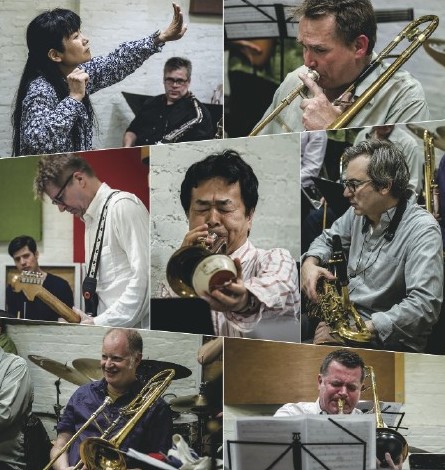
Fujii conducts ensemble featuring Tony Malaby, Ellery Eskelin, Nels Cline, Dave Ballou,Natsuki Tamura, Joey Sellers, Joe Fiedler, Curtis Hasselbring, Stomu Takeishi, Ches Smith,Andy Laster, Oscar Noriega, and Herb Robertson.
Gathering together her all-star Orchestra New York to record for the tenth time, composer-pianist Satoko Fujii releases Fukushima (Libra, available December 15, 2017), a deeply moving and personal contemplation of the nuclear power plant disaster that shook Japan and the world in 2011. Fujii conducts the 13-piece ensemble in a monumental album-length composition that runs the emotional spectrum from despair to hope. With her characteristic attention to form, texture, and melody, she also provides a platform for some of New York's best improvisers, many of whom were founding members of the band 20 years ago, to make powerful statements of their own. The close collaboration between composer-conductor and performers results in one of the most riveting and moving socially conscious musical statements in recent memory.
"Right after the accident, I was afraid that we might not be able to live in Tokyo or even anywhere else in Japan," Fujii says. "A crazy-big area was affected by radiation and our country is not big. The distance between Tokyo and Fukushima is only around 200 kilometers. I felt hopeless. Of course, there were some people who didn't think it was a serious problem. The worst thing for me was the election right after the Fukushima accident. People still supported the politicians who said we need nuclear reactors. Other people in Japan thought differently and didn't support those politicians. And I have found people all over the world who think differently, as well. Fukushima is one of those issues that connects deeply with other matters in the world now-money, power, nationalism."
Fujii's musical response conveys the full weight of her feelings. Her assured handling of drama and pacing have never been more evident or used to such telling effect. The hour-long piece opens with the simple sound of air passing through instruments, echoing the sound of human breathing, creating a sense of vulnerable humanity that suffuses the entire work. "In the context of Fukushima, the breathing or air sound is peaceful, calm, and life-affirming for me," she says.
Shaping the music in real time as she conducts, Fujii leads the band on a spiritual journey through sorrow, rage, and ultimately to a stunning sense of hope and optimism. "I know we human beings can live brightly in any situation and circumstance," Fujii says. "I would like to believe it is not too late for us to make a change for the better."
Of course, Fujii's compositions are incomplete without improvised contributions from her remarkable ensemble. "My charts for large ensemble are not like classical music that can be played only by reading," she says. "With my charts, I need great improvisers to play and develop them. And with all these improvised parts, I need to conduct and give cues to the band to make the charts work, come together, and feel alive. I feel like the whole band is my instrument."
And what an instrument she has in this band, which includes saxophonists Tony Malaby and Ellery Eskelin, guitarist Nels Cline, trumpeters Dave Ballou and Natsuki Tamura, trombonists Joey Sellers, Joe Fiedler and Curtis Hasselbring, and the blue-chip rhythm team of bassist Stomu Takeishi and drummer Ches Smith, among others. With an ear for creative combinations of voices and contrasting textures and density, Fujii deploys them in different combinations, ranging from solo to duos and trios to full ensemble improvisation, throughout the course of the performance. Highlights include the close interplay between baritone saxophonist Andy Laster and guitarist Cline on the first track (the piece is continuous, but split into five tracks on the disc) and Oscar Noriega's melodic solo cradled by a lovely brass choir on Track 3. A sustained series of alternating passages for duet pairings of trumpeter Herb Robertson with drummer Smith and bassist Takeishi with guitarist Cline highlight the fourth track.
Fujii is also making available a second version of Fukushima, featuring her singing on Track 2. CDR copies of the vocal version of the composition can be ordered on her website: www.satokofujii.com/.
Fujii always tackles big musical ideas in her big band writing and sometimes turns to life's deepest spiritual issues as well. With this ambitious album, her first extended piece for large ensemble that addresses social issues, she has made another step forward with her art. "I just would like to have the listener take in the whole piece as an experience," she says, "and feel something."
Critics and fans alike hail pianist and composer Satoko Fujii as one of the most original voices in jazz today. She's "a virtuoso piano improviser, an original composer and a bandleader who gets the best collaborators to deliver," says John Fordham in The Guardian.
In concert and on more than 80 albums as a leader or co-leader, she synthesizes jazz, contemporary classical, avant-rock and Japanese folk music into an innovative music instantly recognizable as hers alone. Over the years, Fujii has led some of the most consistently creative ensembles in modern improvised music, including the ma-do quartet, the Min-Yoh Ensemble, and an electrifying avant-rock quartet featuring drummer Tatsuya Yoshida of The Ruins.
Her ongoing duet project with husband Natsuki Tamura released their sixth recording, Kisaragi, this year. "The duo's commitment to producing new sounds based on fresh ideas is second only to their musicianship," says Karl Ackermann in All About Jazz. Aspiration, a CD by an ad hoc band featuring Wadada Leo Smith, Tamura, and Ikue Mori, was released this year to wide acclaim. "Four musicians who regularly aspire for greater heights with each venture reach the summit together on Aspiration," writes S. Victor Aaron in Something Else.
She records infrequently as an unaccompanied soloist, but her latest solo album, Invisible Hand, led Dan McClenaghan in All About Jazz to praise her "stream of ideas, eschewing repetition and cliché in the crafting of her solo work, her loveliest and most accessible music." Fujii has also established herself as one of the world's leading composers for large jazz ensembles, leading Cadence magazine to call her, "the Ellington of free jazz."