Showing posts with label Mary Halvorson. Show all posts

Wednesday, March 16, 2022

Mary Halvorson - Amaryllis (May 13, 2022 Nonesuch Records)

Amaryllis is a six-song suite performed by a newly formed sextet of master improvisers, including Halvorson, Patricia Brennan (vibraphone), Nick Dunston (bass), Tomas Fujiwara (drums), Jacob Garchik (trombone), and Adam O’Farrill (trumpet). The Mivos String Quartet joins for three of the songs, making this the largest ensemble for which Halvorson has written to date. The suite showcases Halvorson’s many musical influences from jazz, experimental, new music, and beyond.

1. Night Shift
2. Anesthesia
3. Amaryllis
4. Side Effect
5. Hoodwink
6. 892 Teeth

Mary Halvorson - Belladonna (May 13, 2022 Nonesuch Records)

Belladonna is a set of five compositions written for Halvorson on guitar plus The Mivos Quartet: Olivia De Prato (violin), Maya Bennardo (violin), Victor Lowrie Tafoya (viola), and Tyler J. Borden (cello). It is Halvorson’s first time writing for a string quartet. Mivos’ parts are through-composed and augmented by Halvorson’s guitar improvisations.

1. Nodding Yellow
2. Moonburn
3. Flying Song
4. Haunted Head
5. Belladonna

Friday, March 4, 2022

Tomas Fujiwara’s Triple Double album March 4, via Firehouse 12

Drummer/composer Tomas Fujiwara reconvenes his unique sextet Triple Double for a collection of exhilarating new music inspired by dance and protest

March, due out March 4, 2022 via Firehouse 12 Records, features drummers Fujiwara and Gerald Cleaver, guitarists Mary Halvorson and Brandon Seabrook, and trumpet/cornet players Ralph Alessi and Taylor Ho Bynum

"Deliberately seeing double in the cause of exploratory jazz, Fujiwara brings together instrumentalists primed to rub each other in all the right and creatively wrong ways."
– The New Yorker

"[The six musicians’] collective talent and Fujiwara’s innovative leadership make for a tonic of unpredictability… A triple scoop of great music."
– Britt Robson, JazzTimes

Tomas Fujiwara’s Triple Double celebrates album Friday, March 4 at The Stone, NYC
Tomas Fujiwara, photo by Brian Cohen

Parsing out the various combinations possible within Tomas Fujiwara’s Triple Double feels something like wandering through a hall of mirrors. Look at it one way and you might see two horn/guitar/drum trios; turn slightly and suddenly it becomes three paired artists taking their shared instruments in radically different directions. Despite the unusual instrumentation of the ensemble, however, Triple Double is at its core a group of six distinctive individuals, each among the most innovative and singular voices in contemporary creative music – drummers Tomas Fujiwara and Gerald Cleaver, guitarists Mary Halvorson and Brandon Seabrook, and trumpeter Ralph Alessi and cornet player Taylor Ho Bynum. 

On the sextet’s second album, March (due out March 4, 2022 via Firehouse 12 Records), Triple Double has also become a band in the most thrilling sense, sharing a scintillating chemistry and a sense of musical mission that remains evident no matter how far apart the various pairings and triplings stretch the music in far-flung directions.
Tomas Fujiwara's Triple Double, photo by Nicki Chavoya

“On the first album [2017’s Triple Double], the band was still relatively new,” Fujiwara explains. “There were a few people in the group that had never played together before. Since then we’ve spent a lot more time touring and playing together, so I feel like those connections and the rapport within the group have really deepened. That influenced my writing for this album because now I had a reference point for different places the band had gone, and I was also conscious of where else I wanted to push us as a group.”

The formation of Triple Double did bring together some new pairings – Alessi and Bynum had never crossed paths, and the drummers had never had the opportunity to share the stage despite Fujiwara’s longheld admiration for Cleaver. At the same time, the grouping also reconvened some well-established hook-ups (to borrow the name of another Fujiwara ensemble). Bynum and Halvorson are both among Fujiwara’s most frequent collaborators, in each other’s ensembles as well as (in Fujiwara and Halvorson’s case) in the collective trio Thumbscrew. Triple Double grew out of a trio that the drummer formed with Alessi and Seabrook.

“When I first put the band together I made a pretty exhaustive list of all the different combinations of the six of us,” Fujiwara says. “On this album I really wanted to hone in on the subtle shifts that can happen with the addition and subtraction of different musicians in the ensemble. It feels like there are endless possibilities, which is really exciting.”

Opener “Pack Up, Coming For You” offers perhaps the most explicit example. The tune begins with the trio of Fujiwara, Bynum and Halvorson. After they trade improvisations their counterparts emerge and the second trio takes over for a time. Finally all six combine and the full scope of the group dynamic is revealed. Like its predecessor, March includes an improvised duet by Fujiwara and Cleaver in tribute to the bandleader’s childhood teacher, Alan Dawson.

The unique combination of instruments is in some ways a challenge, offering little guidance for a composer. At the same time, Fujiwara found the lack of precedent refreshing. “Not having a blueprint can be challenging,” he explains, “but at the same time it can be quite liberating and inspiring. If you’re leading a guitar trio and want to do something personal with it, it can be difficult to get out from under the shadow of all the great guitar trios that came before. With this there isn't that history, so it takes away expectations. That challenge is fun for me.”
Tomas Fujiwara's Triple Double, photo by Nicki Chavoya

Fujiwara took on several disparate challenges in the crafting of March. His vibraphone playing is given a much more prominent role, while the floating, airy “Life Only Gets More” was instigated by the fact that drummers are so rarely asked to solo over ballads. The album was also recorded fairly quickly and spontaneously, despite the challenging material – an approach prompted by Fujiwara’s love of classic Blue Note Records.

“On many of the sessions they would just call in a group of musicians, they’d show up, the bandleader would have some charts on the music stand, they’d run through them and just record them. And yet they're now eternal classics that we love. I wanted to capture some of that magic.”

Like the name of the ensemble, the new album’s title also folds multiple meanings into a deceptively simple word. At its most basic, March is the month of the album release – but of course it’s a loaded date, falling exactly two years after much of the world went into pandemic lockdown and ensembles like Triple Double were suddenly indefinitely separated. The gulf has proved a long one for this band in particular, having recorded the album in late 2019.

But March also implies movement, as suggested by the felt assemblages that grace the album’s colorful artwork. The multi-hued group embracing on the cover could be dancers stepping in rhythm or protesters parading for a cause. All of those meanings danced in Fujiwara’s head as he penned the music for March, especially as he titled the tunes in the midst of the tense protests that erupted throughout 2020.

“There's something about marching that is very evocative to me,” the drummer explains. “It's a coordinated activity that always has a group intent behind it – which could be peaceful, violent, revolutionary, stifling or joyful. Marching can take on so many different forms, but it's always a group activity for a group cause that represents those intentions or feelings by a show of numbers together in one direction. Oftentimes it's not about getting from point A to point B, it's simply the act of marching and of being together that expresses the point.”


Tomas Fujiwara
Described as “a ubiquitous presence in the New York scene…an artist whose urbane writing is equal to his impressively nuanced drumming,” Brooklyn-based Tomas Fujiwara is an active player in some of the most exciting music of the current generation. He leads the bands Triple Double (with Gerald Cleaver, Mary Halvorson, Brandon Seabrook, Ralph Alessi, and Taylor Ho Bynum), 7 Poets Trio (with Patricia Brennan and Tomeka Reid), and Tomas Fujiwara & The Hook Up (with Jonathan Finlayson, Brian Settles, Halvorson, and Michael Formanek); has a collaborative duo with Bynum; is a member of the collective trio Thumbscrew (with Halvorson and Formanek); and engages in a diversity of creative work with Anthony Braxton, John Zorn, Halvorson, Matana Roberts, Joe Morris, Bynum, Nicole Mitchell, Ben Goldberg, Reid, Amir ElSaffar, Benoit Delbecq, and many others. In 2021, he won the DownBeat Critics Poll for Rising Star Drummer, and premiered two suites of new music as part of his Roulette Residency: “You Don’t Have to Try” (with Meshell Ndegeocello) and “Shizuko” (with Bynum, Reid, Rafiq Bhatia, and Davi Vieira). “Drummer Tomas Fujiwara works with rhythm as a pliable substance, solid but ever shifting. His style is forward-driving but rarely blunt or aggressive, and never random. He has a way of spreading out the center of a pulse while setting up a rigorous scaffolding of restraint…A conception of the drum set as a full-canvas instrument, almost orchestral in its scope.” 

Friday, October 29, 2021

Sylvie Courvoisier & Mary Halvorson - Searching For The Disappeared Hour (October 29, 2021 Pyroclastic Records)

Pianist Sylvie Courvoisier and guitarist Mary Halvorson combine their singular voices in startlingly inventive form on their second duo collaboration

Searching for the Disappeared Hour, due out October 29, 2021 via Pyroclastic Records, finds the two acclaimed artists exploring notions of time through evocative original compositions and thrilling improvisations

"[Courvoisier and Halvorson are] two of New York’s most idiosyncratic and distinctive improvisers... [Their debut recording] Crop Circles is deeply chamber-like in its deft, interactive intimacy."
– Peter Margasak, Downbeat

"This meeting of two of the brightest minds on the edgier side of jazz today produces music that’s astonishing both in its fluency and ceaseless ingenuity."
– S. Victor Aaron, Something Else!

To paraphrase the late Douglas Adams, “Time is an illusion. Pandemic time doubly so.” On their brilliant new duo album, Searching for the Disappeared Hour, pianist Sylvie Courvoisier and guitarist Mary Halvorson make up for lost time with an hour’s worth of kaleidoscopic beauty and startling invention.

Due out October 29, 2021 via Pyroclastic Records, Searching for the Disappeared Hour marks the second collaboration for these two singular musicians. Their initial collaboration, 2017’s Crop Circles, was recorded after a single concert (at New York’s now-defunct Cornelia Street Café) and found them repurposing existing compositions for the duo context. By contrast, the music on Searching for the Disappeared Hour was composed expressly for the duo, taking stunning advantage of the chemistry and familiarity forged during tours of Europe and the States in the intervening years.

“I think this album is much more developed,” Courvoisier says. “When I wrote pieces for Mary, I really thought about all the possibilities of the guitar. And her music has pretty tonalities, great melodies and a very clear sense of harmony and melody, so I love to darken it.”

“We both have an affinity towards darkening things,” adds Halvorson, “which is great because you can start with a joyous melody and there's all kinds of room to mess with it. We're both really open to that. And Sylvie is great at adding harmonies and filling stuff in, so I was happy to leave space for her to do her thing, not only in the improvised sections but also within the written parts.”

Both Courvoisier and Halvorson are among the most idiosyncratic and distinctive voices in modern creative music, so a meeting between the two couldn’t help but venture into unexplored territory and return with thrillingly original results. With each new piece they revel in striking new ways of melding their sounds, utterly original yet very aware of the history of piano-guitar duos.

“People have this misconception that guitar and piano get in the way of each other,” Halvorson says, singling out the revered Bill Evans-Jim Hall album Undercurrent as a particularly strong refutation of that idea. “I've always personally enjoyed playing with pianists, and when you strip away everything else and have just the two instruments, I think they make a really great blend. There's such a wide sonic range you can achieve with that instrumentation." 

The evidence reveals itself immediately with Halvorson’s bracing opener, “Golden Proportion.” A collage piece stitched together from scraps of ideas the guitarist had collected over time, it works like a roiling stream of consciousness as lines and notion bubble up and dissipate, from a wiry guitar line to a funhouse-mirror “Moonlight Sonata.”
“They're not even really ideas – they’re like little nuggets of beginning of ideas,” Halvorson explains. “I put them on top of each other in a patchwork and I would give one of them to guitar and one to piano. It’s just a little vignette where we play around with these ideas and then it all unravels.”

Courvoisier’s “Lulu’s Second Theorem” is a Schrödinger box of a composition, somehow both playful and complex – a notion vividly captured by the fact that its titular theorist is in fact the pianist’s cat. Halvorson penned the tense ballad “Faceless Smears” on the most dramatic day of Congressional hearings for now- Supreme Court Justice Brent Kavanaugh, along with the companion piece “Last-Minute Smears,” recorded with her band Code Girl on last year’s Artlessly Falling.

“Moonbow” is one benefactor of the duo’s shared experiences, drawing on a mistake during the recording of Crop Circles. Halvorson accidentally played a unison piece a half step off, but the “gnarly” sound that resulted excited both of them. Courvoisier seized on that approach when composing this slowly unfolding tune. Halvorson’s “Torrential,” while built on a folk-inspired guitar melody, opens itself for two extended solo improvisations.

“Mind Out of Time” and “The Disappearing Hour,” both written by Courvoisier, suggest the skewed relationship with time that we’ve all endured over this unusual year and a half. Likewise Halvorson’s “Bent Yellow” feels urgent and constantly shifting, while “Gates and Passes” suspends time as its graceful melody hangs portentously in the air, basking in breath and silence.

The album is completed by three improvised pieces: the stark and strident “Four-Point Play,” with Courvoisier exploring the interior of the piano; the lovely and meditative “Party Dress,” captured in a moment when the duo was unsure that they were even being recorded; and the concluding “Blizzard Rings,” alternately taut, pointillist and ethereal, seeming to dissolve into air as the hour draws to a close.

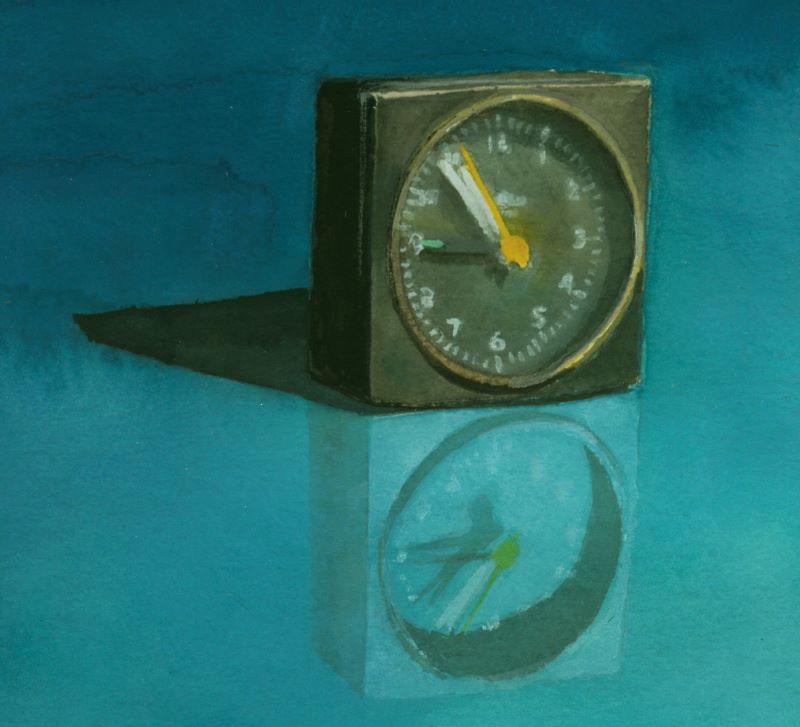
“Because of Covid, I think we’ve all had a weird relationship with time passing,” Courvoisier says, as Halvorson chimes in with her own interpretation of the album’s evocative title – vibrantly depicted in artist Dike Blair’s gouache images of clock in liminal spaces.

“A month would pass and I’d feel like no time had passed at al, or vice versa. It was very weird, and would leave you feeling disoriented all the time. At the same time, this album is almost exactly an hour long – so once you’ve listened to it an hour has disappeared.” Vanished, perhaps – but a well spent sixty minutes ripe with inspiring discoveries and inviting mysteries, elusive in the way it warps and transforms time.

1. Golden Proportion
2. Lulu's Second Theorem
3. Faceless Smears
4. Four-Point Play
5. Moonbow
6. Torrential
7. Mind Out Of Time
8. Party Dress
9. Bent Yellow
10. The Disappearing Hour
11. Gates & Passes
12. Blizzard Rings

Sylvie Courvoisier piano
Mary Halvorson guitar

Produced by David Breskin

Recorded by Ron Saint Germain & Ryan Streber at Oktaven Audio, Mount Vernon, NY June 2 & 3, 2021

Mixed by Ron Saint Germain at Saint’s Place, July 27 & 28, 2021

Mastered by Scott Hull, Masterdisk, Peekskill, NY

Album art: five gouaches by Dike Blair, courtesy the artist and Karma, New York City

Mary’s songs: 1,3,6, 9, 11 – Meltframe Music (BMI)
Sylvie’s songs: 2, 5, 7, 10 – Sylvie Courvoisier (SUISA, ASCAP)
Shared songs: 4,8,12

Album design and layout: Spottswood Erving and July Creek for Janky Defense

Monday, July 19, 2021

Ben Goldberg - Everything Happens To Be. (BAG Production Records 2021)


The echoes of traditional jazz bounce off the walls of Ben Goldberg’s music. The music is warped and strange, as if buckling beneath the strain of being compressed to fit the length of the clarinetist’s latest recording. For this session, Goldberg collaborates with musicians who have a proven track record with that kind of approach. Guitarist Mary Halvorson, tenor saxophonist Ellery Eskelin, bassist Michael Formanek, and drummer Tomas Fujiwara traverse time and distance, recalling the sound of New Orleans one hundred years ago as they offer a vision of what it could become a hundred years from now.

1. What About 05:41
2. 21 06:14
3. Fred Hampton 04:48
4. Everything Happens To Be. 07:04
5. Cold Weather 06:23
6. Chorale Type 09:53
7. Tomas Plays the Drums 05:51
8. Long Last Moment 05:10
9. To-Ron-To 05:32
10. Abide With Me 01:10

Mary Halvorson - electric guitar
Ellery Eskelin - tenor saxophone
Michael Formanek - bass
Tomas Fujiwara - drums
Ben Goldberg - clarinets

All compositions by Ben Goldberg, except "Abide With Me," by William Monk (by way of Thelonious Monk).

Recorded June 2018 at Firehouse 12 Studio, New Haven
Nick Lloyd, engineer
Mixed January 2021 by Michael Coleman

Tuesday, October 30, 2018

Mary Halvorson & Joe Morris - Traversing Orbits (ROGUEART 2018)


“Two masterful artists who happen to play guitar – their marks on the music far transcend their instruments.”

All recordings, especially those of improvised music, try to freeze the sound of a present moment, but invariably melt into the past and the future, real and imagined. Listening to this album, I can’t help but think of the classic meeting of Sonny Rollins and Coleman Hawkins, where two titans of the same instrument across different generations displayed mutual love and respect through stylistic contrast and playful jousting. Or I create a fiction, of Django Reinhardt and Freddie Green crossing paths in some distant hotel, staying up late one night and pushing each other to new ideas. (I don’t make that allusion lightly – for the abundance of virtuosic extended technique, don’t miss the profound swing of the articulated lines and the chunky chords.) Taylor Ho Bynum, excerpt from the liner notes

Joe Morris: guitar
Mary Halvorson: guitar

Brain Draft (2:33)
Shivering Sunshine (3:50)
Traces of Three (4:11)
Silence Invasion (3:42)
Semaphore (11:44)
Full of Somehow (9:02)
Constant Between (7:29)
In Other Terms (6:14)
Over the Line (5:39)

All compositions by Joe Morris (RITI, ASCAP) and Mary Halvorson (Mary Halvorson, BMI)

Recorded by Aaron Nevezie on April 9th 2018 at The Bunker Studios, Brooklyn, New York, USA
Mixing: Aaron Nevezie
Mastering: Greg DiCrosta, Firehouse 12 Studios, New Haven, Connecticut, USA
Liner notes: Taylor Ho Bynum
Photographs: Aaron Nevezie
Cover design: Max Schoendorff
Cover realization: David Bourguignon
Executive producer: Michel Dorbon

Monday, October 15, 2018

INGRID LAUBROCK ANNOUNCES CONTEMPORARY CHAOS PRACTICES ON INTAKT RECORDS (OUT NOVEMBER 16)


CONTEMPORARY CHAOS PRACTICES:

Why does a composer write for orchestra? The amount of time, labor, expense, and struggle involved, not just in composing an orchestral work but in having it accepted, rehearsed, performed, and (in a perfect world) documented, would seem to indicate a Sisyphean chore. Why would anyone invite the risk of pushing that mythic boulder to the mountaintop, only to be flattened by its descent?

“Because it’s there,” the celebrated mountaineer George Mallory is famously reported by The New York Times to have said, when asked – after he’d attempted to climb Mount Everest in 1921 and 1922 – why he intended to have another go in 1924. The quotation might be apocryphal; it doesn’t matter. To the alpinist, the risk of the journey and the cost of the venture are far outweighed by the potential reward of an achievement few people can claim.

Ingrid Laubrock is a born alpinist, to judge by this, her first recorded collection of orchestral works. Perhaps it should come as no surprise: She is, after all, a saxophonist and composer who risked much in venturing from Berlin via London to establish a base in busy, competitive New York City – an improviser’s Everest, one might claim. From her arrival in 2009, she wasted no time in making an impression with her piquant writing and potent playing.


Ingrid Laubrock ©Caroline Mardok

Laubrock, it bears asserting, had nothing to prove when she set her sights on the orchestra. Her credentials as an ambitious, skillful composer of intricate yet visceral works for small ensembles is well established—not least on the evidence of her excellent, much-admired Intakt recordings. Whether writing for conventionally constituted assemblages like her quintet Anti-House and trio Paradoxical Frog, or for a more unusual complement, like the mix of tuba, koto, electronics, and more that she convened two years ago for Serpentines, Laubrock has demonstrated a formidable capacity for writing music of intricacy, integrity, and broad appeal.

Still, no adventurous soul is content to stay in place. “The mountains are calling & I must go,” the naturalist John Muir is quoted as having said about his own call to action. Laubrock, an artist whose influences and formative experiences were many and varied, likewise felt the call of heights intrinsic to the orchestral experience: the mighty presence of massed musicians, the elemental weight and prismatic variety of the sounds they can produce, perhaps even the daunting scale of the venture itself.

Both of the works included on this album are of recent vintage: Laubrock wrote Vogelfrei for the second Jazz Composers Orchestra Institute Reading, presented by the American Composers Orchestra at Columbia University in 2013, and created Contemporary Chaos Practices for the 2017 moers festival. But the creative spark that led to their conception came many years before, shortly after Laubrock landed in New York, when she attended a program of large-ensemble works led by Anthony Braxton and Walter Thompson at Brooklyn’s Irondale Center.

Braxton, among the most original, accomplished artists America has produced, needs no introduction in this context. Thompson, less well known outside a circle of cognoscenti and devotees, is a bandleader, multi-instrumentalist, and composer who developed a practice called “Soundpainting,” a system in which an elaborate vocabulary of hand signals is used to initiate and shape large-ensemble improvisations. (The practice is distinct from Butch Morris’s similarly conceived “conductions,” but not wholly dissimilar in practice.)

For Laubrock – who had encountered conduction previously as a performer with the London Improvisers Orchestra, and who had been mulling notions of orchestral composition already – the seamless blend of composition, improvisation, and conduction she encountered at Irondale proved invigorating. Still, that a largely self-taught musician would entertain the notion of orchestral writing was itself a show of courage and resolve. The orchestral world, even in the 21st century, is a gated community, seemingly off limits to composers whose background, heritage, or training deviates from narrowly conceived standards. Fundamental characteristics, like race and gender, also pose obstacles, if tacitly.

Ingrid Laubrock &  Nate Wooley

Such issues were what motivated the American Composers Orchestra and the Institute of Jazz Studies at Columbia University to establish the Jazz Composers Orchestra Institute. “A stupid word like jazz is not going to hold me back from doing what I want to do with a set of instruments, or with a set of people, or with an environment, or with discourse,” the great composer and improvising trombonist George Lewis said during a public event in the institute’s first year.

Taking Lewis’s message to heart, Laubrock participated in the second institute, held in Los Angeles. She produced the first version of Vogelfrei for that occasion, and then had opportunities to revisit and refine it subsequently for performances by the Tri-Centric Orchestra in New York and the EOS Chamber Orchestra Cologne at the moers festival— in the process adding an instrumental soloist (pianist Kris Davis), prominent parts for amplified contrabass clarinet (Josh Sinton) and trumpet (Nate Wooley), guided orchestral improvisations, and eight vocalists. The happy serendipity of a Moers curator being present for the Tri-Centric performance also led to Laubrock’s second opportunity to write for orchestra, resulting in Contemporary Chaos Practices, which involves an orchestra augmented with improvisers on saxophone, trumpet, guitar, and piano.


Mary Halvorson

Kris Davis

Gazing at the scores for both works, one senses immediately the formal discipline Laubrock derived from close studies of scores by Ligeti, Lutoslawski, Xenakis, and other modern composers, who all had found practical, effective ways to codify spontaneous performance into their rigorously scored works. Laubrock goes even further to establish a confident détente between control and chance by employing two conductors: one to guide the ensemble in exactingly scored material, and another to reconcile Laubrock’s architecture with the players’ elaborations in improvised sections, tailoring the work to a given setting and circumstance.

The present recording, recorded in a studio by an ensemble of first-call freelancers led by two ideally sympathetic conductors, Eric Wubbels and Taylor Ho Bynum, provides eloquent evidence of what Laubrock has achieved. Both of her orchestral pieces – Vogelfrei, with its variegated textures, animated rhythms, swooping vocals, and inexorable momentum; and Contemporary Chaos Practices, where four instantly distinguishable soloists (Mary Halvorson, Davis, Wooley, and Laubrock herself) retain their individuality while negotiating a brilliantly rendered aural landscape – serve notice of an estimable composer who has something to say, and knows exactly how to say it.

Shout it from the mountaintops.

Steve Smith is the director of publications for National Sawdust, a performing-arts venue in Williamsburg, Brooklyn. His writing has appeared in The New York Times, the Washington Post, the Village Voice, and other publications, and he previously served as a staff editor and writer for the Boston Globe and Time Out New York.


PERFORMANCES:

with Tom Rainey's Obbligato
10/15 JazzClub Hannover, DE

with GGRIL (Grand Groupe Régional d'Improvisation Liberée)
10/27 Rimouski, QC
10/28 Casa del Popolo, Montreal, QC

with Zeena Parkins & Tom Rainey
10/29 I-Beam, Brooklyn, NY

with Mary Halvorsen and more musicians TBA
11/03 Berlin Jazz Festival, Berlin, DE 

with Mary Halvorsen Octet
11/04 Berlin Jazz Festival, Berlin, DE 
11/08 Oslo, NO
11/09 Bergen, NO
11/10 Gdansk, PL
11/11 Mantova Auditorium Monteverdi, Mantova, IT
11/12 Venice  Auditorium Santa Margherita, Venice, IT
11/13 Madrid, ES

with Nate Wooley's Battle Pieces
12/03 Roulette, New York, NY

with Tom Rainey Trio
12/30 Cornelia St. Cafe, New York, NY


Sunday, October 7, 2018

UPLIFT 10: Fear No Love | Rudy Royston Podcast & New Single (GREENLEAF MUSIC)


Join us to hear our latest track

Our October UPLIFT track supports Lamda Legal and their important work on behalf of LGBTQ legal and civil rights.


We've posted some excerpts and complete tracks on Bandcamp and Soundcloud so you can preview the entire subscribers series featuring Dave Douglas, Joe Lovano, Mary Halvorson, Julian Lage, Bill Laswell and Ian Chang.

Rudy Royston introduces Flatbed Buggy

This special edition of the podcast features Rudy Royston previewing tracks from his upcoming album Flatbed Buggy, discussing the inspirations for his compositions and giving an insider's view on how the record came together.


We've also released the third single from the album, Hourglass, ahead of the release date on October 26. Check it out here.

Saturday, July 14, 2018

Thumbscrew at the Village Vanguard


Hi there!

Speaking of 'jazz' (well, we will be in a moment), we'd like to take a moment and make sure that everyone on this list, especially folks in the New York City area, are aware of / are reminded about THUMBSCREW's residency at the legendary and legendarily great sounding Village Vanguard next week : July 17-22!

Mary Halvorson (guitar)

Michael Formanek (bass)

Tomas Fujiwara (drums)

Saturday, February 17, 2018

Mary Halvorson - Code Girl (FIREHOUSE 12 RECORDS 2018)


Code Girl is the latest project of guitarist and composer Mary Halvorson, and her first project for which she has composed both lyrics and music. The band has already been described as “...a bold experiment in song form” by The New York Times. Deftly interpreted by Amirtha Kidambi (vocals), Ambrose Akinmusire (trumpet), Michael Formanek (bass) and Tomas Fujiwara (drums), the music synthesizes influences of jazz, folk and improvisation to create an original take on songwriting. The debut album will be released on Firehouse 12 Records March 2018.

“Halvorson has set her sights high with Code Girl. It is the first time she has worked with a vocalist, not to mention writing lyrics for another member of an ensemble. The group exhibited some characteristic features of a Halvorson ensemble—tight associations between members where each musician develops their voice, responds directly and confidently with each other, connects at multiple points simultaneously. Meanwhile, the compositions also brew a rare cohesion that never feels forced and draws each member toward their greatest potential. Trumpet and voice mixed quite profoundly, at times, and the vocal styling of Kidambi—drawing from a broad range of influences ranging from the Carnatic tradition to old blues—created a haunting and emotionally rich panorama of colors, shapes, and images that made for both tangible and abstract consumption by the attentive audience.”


Amirtha Kidambi, vocals
Ambrose Akinmusire, trumpet
Michael Formanek, bass
Tomas Fujiwara, drums


Thursday, November 2, 2017

Tomas Fujiwara - Triple Double (FIREHOUSE 12 RECORDS 2017)


Bandleader, composer, and drummer Tomas Fujiwara possesses a musical dexterity that could go unnoticed if not for its ripple effect. He has brought his rhythmic and compositional imprint to a wide variety of settings – as a member of the collective trio Thumbscrew (with Mary Halvorson and Michael Formanek), in a long-standing duo with Taylor Ho Bynum, and as a supporting member in groups led by Bynum, Halvorson, Matana Roberts, Tomeka Reid, Amir ElSaffar, and Nicole Mitchell. While these collaborative efforts could define and sustain him, a more ambitious musical intelligence emerges on closer inspection.

1. Diving For Quarters 11:00
2. Blueberry Eyes 05:58
3. Hurry Home B/G 03:32
4. Pocket Pass 02:46
5. For Alan 08:00
6. Love And Protest 07:43
7. Decisive Shadow 05:52
8. Hurry Home M/T 03:21
9. Toasting The Mart 04:02
10. To Hours 06:20


Tomas Fujiwara – drums
Gerald Cleaver - drums
Mary Halvorson – guitar
Brandon Seabrook - guitar
Taylor Ho Bynum – cornet
Ralph Alessi - trumpet


Mary Halvorson Quartet – Paimon: Book of Angels Volume 32 (2017)


After thirteen years and thirty-two CDs Zorn's expansive Book of Angels project is now complete! This final installment presents the last ten unrecorded compositions from Masada Book Two and the variety, drama and lyricism is just as strong as the very first volume. Mary Halvorson, a long time Masada fan and one of the most acclaimed guitarists of her generation leads a dynamic quartet featuring Miles Okazaki, Drew Gress and Tomas Fujiwara. The music is intense, wild and incredibly varied, a beautiful and fitting conclusion to this historic Masada series, hailed as one of Zorn's best!


1 Chaskiel
2 Beniel
3 Ruhiel
4 Dahariel
5 Yeqon
6 Uzza
7 Verchiel
8 Jesodoth
9 Phul
10 Rachmiah

Drew Gress: Bass
Tomas Fujiwara: Drums
Mary Halvorson: Guitar
Miles Okazaki: Guitar

Thursday, June 8, 2017

Elliott Sharp, Mary Halvorson & Marc Ribot - Err Guitar (INTAKT RECORDS 2017)


Last summer in Elliott Sharp’s recording studio in Manhattan, New York guitarist Sharp spent a day with guitar colleague Mary Halvorson and another with Marc Ribot, legendary guitarist of Tom Waits, The Lounge Lizards and Marianne Faithful. The result was a series of recordings that could only be created by friends. They represent the great art of guitar playing by three exceptional musicians looking for new sonic adventures in search of the sound of our time.

“I hear in their playing both a step into an unknown future and wild growth from a deep past,” says Elliott Sharp. “The contradiction is resolved in improvisation – the transcendent sonic path of the now.”

01. Blindspot 07:22
02. The Ship I Am On 02:46
03. Wobbly 07:14
04. Shredding Light 06:59
05. Sinistre 03:47
06. I’m Gonna Party Like It’s 1988 02:40
07. Sequola Pt. 1 04:22
08. Sequola Pt. 2 02:59
09. Oronym 09:07
10. Sea Buzz 05:03
11. Nektone 03:02
12. Kernel Panic 10:12

Elliott Sharp: Guitar 
Mary Halvorson: Guitar 
Marc Ribot: Guitar

Friday, January 27, 2017

Sylvie Courvoisier & Mary Halvorson - Crop Circles (RELATIVE PITCH RECORDS 2016)


A mere two months following yet another highly thought-of ensemble record, guitarist/composer Mary Halvorson has returned with some stimulating one-on-one. In this latest such instance, Crop Circles (Relative Pitch) pits her against (or rather, with) Sylvie Courvoisier.

Halvorson has always thrived in a duo setting: Jessica Pavone, Noël Akchoté, Stephan Crump to name a few; Halvorson’s duets with the violinist Pavone even got her much of her initial notice some ten years ago. This time she goes toe-to-toe with a pianist who is likewise one of the most creatively distinctive women in avant-garde jazz.

The Swiss-born Courvoisier is the fairly rare highly trained musician who has been able to apply her ample skills toward developing a voice all her own. She leads or co-leads a number of mostly small ensembles that include Mark Feldman, Drew Gress, Marc Ribot, Kenny Wollesen and Ellery Eskelin. Numerous collaborations have involved John Zorn, Erik Friedlander, Herb Robertson, Enrico Rava and Evan Parker. Given hers and Halvorson’s predisposition for working with any musician who shares a zeal for crafting challenging scores and carrying them out in extemporaneous performances, it was perhaps only a matter of time before the paths of these two extraordinary women would cross.

That finally happened last year with an engagement at New York’s Cornelia Street Cafe, leading eight months later to a single day recording session at Courvoisier’s home studio. Each brought tunes and worked them out together and by the end of the day, ten tracks were in the can.

It’s a given that Crop Circles was going to be highly artful — and it is — but the affinity heard between the two is something that can’t be taught. The two often navigate across a tightrope of synchronicity, such as on “La Cigale,” where they erupt with clusters of notes with such density it sometimes seems that there are three or four of them playing, especially when Halvorson turns her guitar into a tornado-making machine. The unison, impossibly knotty avant-bop lines that forms the head are remindful of Lennie Tristano. The clipped notes on the brief “Water Scissors” is so synergistic and telepathic, there are practically four hands with one mind. “Eclats for Ornette” begins and ends with a precarious, harmolodic head that they somehow make it through in tight conformity. For “Downward Dog,” Courvoisier splits her brain with her right hand following the serpentine path of notes with Halvorson as her left hand effortlessly offers up the complementing chords.

Other performances are much more spacious but no less full of intrigue. The spare “Aftershock” sports subtleties like pairing the bass strings of the guitar with the left side of the piano and a symmetry that’s maintained through the slight mood adjustments. Halvorson is heard playing slide like no one else on “Woman In The Dunes” and later brandishes effects pedals as the two ride the song on swelling and receding tides of emotion.

With “Your Way,” the two demonstrate how pretty melodies have a place in avant-garde. Although it’s Halvorson’s song, Courvoisier immerses herself in it and totally inhabits it. Those wanting to hear Halvorson go crazy with her signature guitar effects need to look no further than “Absent Across Skies,” where she deploys them so effectively to add both jarring eccentricities and shape to Courvoisier’s dark, strange chord progression.

This meeting of two of the brightest minds on the edgier side of jazz today produces music that’s astonishing both in its fluency and ceaseless ingenuity. Crop Circles can be purchased directly from Relative Pitch Records here.


1. La Cigale ... SC  5:37
2. Aftershock ... MH 5:09 
3. Eclats for Ornette ... SC  3:45   
4. Absent Across Skies ... MH 7:08
5. Downward Dog ...  SC  3:59 
6. Your Way ... MH 4:50 
7. Water Scissors ... MH 1:54 
8. Woman in the Dunes ...  SC 6:56
9. Double Vision ... MH 4:31
10. Bitter Apple ... SC + MH 2:23