Monday, January 31, 2022
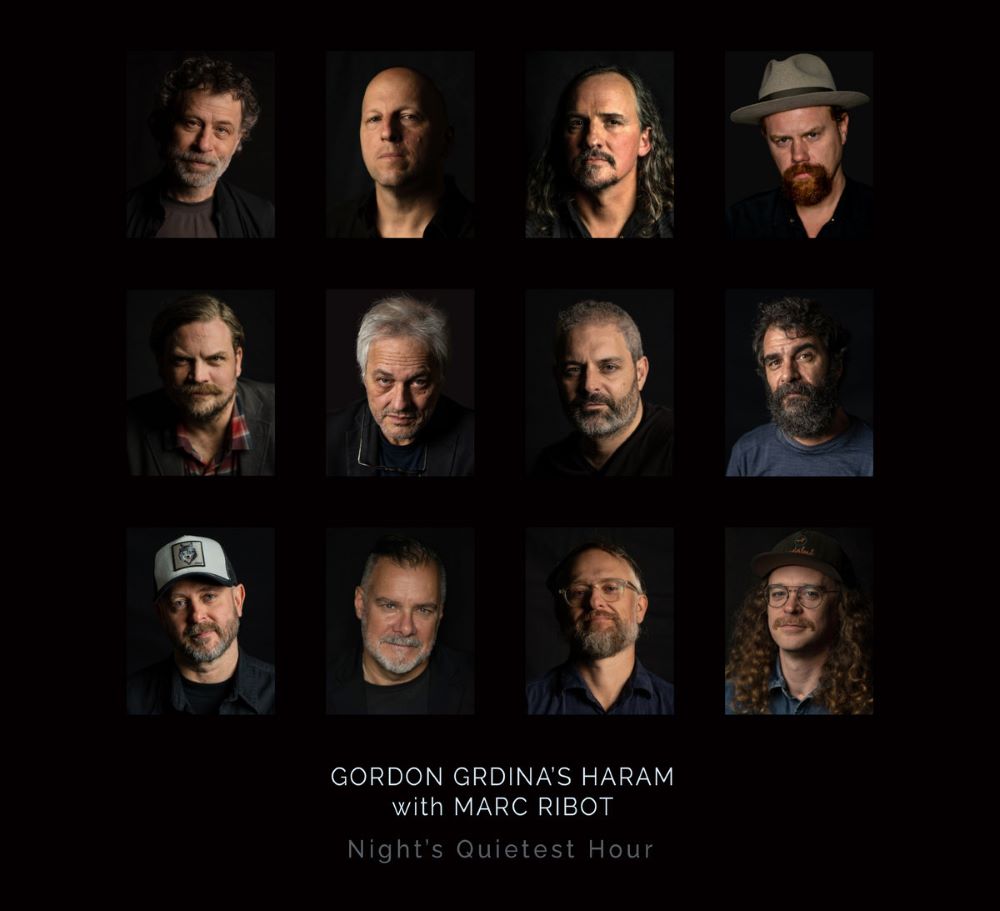
Gordon Grdina's Haram with Marc Ribot - Night's Quietest Hour (February 18, 2022 AttaBoyGirl Records)
Friday, June 25, 2021
Marc Ribot's Ceramic Dog - Hope (June 25, 2021 Northern Spy Records)
Sunday, March 7, 2021
Marc Ribot Plays Solo Guitar Works of Frantz Casseus (May 14, 2021)
Long before Marc Ribot made a name for himself as a pioneering force in NYC's downtown music scene, and as guitarist for luminaries like Tom Waits, Wilson Pickett and The Lounge Lizards, he began his guitar studies as a teenager with close family friend, the Father of Haitian classical guitar, Frantz Casséus. In 1946, Frantz came to NYC from his native Port-au-Prince, Haiti with the ambition to compose a distinctly Haitian classical guitar music, to fuse the European classical tradition with Haitian folk elements as Heitor Villa-Lobos had done with his native Brazil’s and as Béla Bartók had done with Hungarian folk songs. His three recordings, Haitian Folks Songs (1953), Haitian Dances (1954) and Haitiana (1969) were released on Folkway Recordings (and since reissued by Smithsonian Folkways) and his compositions have been covered by artists worldwide including the song “Merci bon dieu” by Harry Belafonte.
In effort to preserve Frantz’s musical legacy, Marc edited a collection of Casseus' solo guitar compositions, and performed those same pieces on his 1993 album "Marc Ribot Plays Solo Guitar Works of Frantz Casseus". This remastered and expanded edition, with three additional bonus tracks recorded in 2020, marks the first time Marc's interpretations of this work is available on vinyl. Also available again on CD.
Tuesday, November 13, 2018
Youn Sun Nah - essentials (3 CD Box) ACT MUSIC 2018
Thursday, September 27, 2018
Marc Ribot: Songs of Resistance 1942 - 2018 (Anti- Records September 2018)
“Every movement which has ever won anything has had songs,” says accomplished New York City guitarist Marc Ribot. For his new political album Songs of Resistance 1942-2018 – with a September 14 release date on ANTI- Records - Ribot set out to assemble a set of songs that spoke to this political moment with appropriate ambition, passion, and fury.
Portions of the album’s proceeds will be donated to The Indivisible Project, an organization that helps individuals resist the Trump agenda via grassroots movements in their local communities. More info on The Indivisible Project can be found at www.indivisible.org.
Tuesday, January 9, 2018
Gregory Lewis with Marc Ribot - Organ Monk Blue (2018)
Adapting the music and mood of Thelonious Monk to a Hammond B3 organ might be a tricky proposition but Gregory Lewis has literally made a career out of it. Organ Monk Blue is already Lewis’ fifth record since his 2010 debut Organ Monk, quickly following Organ Monk, The Breathe Suite just seven months earlier (in between these two dates was the 100th anniversary of Monk’s birthday, by the way). While the 2017 effort featured a six movement suite that tied to a theme of African-American lives wiped out by deadly police force, Organ Monk Blue is a return to Monk covers, like those found on Lewis’ first two albums. As the title implies, this collection of Monk covers sets out to illuminate the blues that’s found at the core of most every song he composed.
Guitarist Marc Ribot and Jeremy Bean Clemons are held over from The Breathe Suite, and so is Lewis’ inclination to ignore the need to consciously play ‘jazz.’ Broadly speaking, of course, that’s what this music is, but like all the best jazz artists, Lewis stretches that genre to the point that listeners forget what kind of music is being presented, because the presentation successfully transcends that.
Having said all that, I’d call this a blues record. Since the participants involved aren’t ordinary, neither is this an ordinary blues album. The very presence of Ribot insures there’s nothing run-of-the-mill about this organ-guitar-drums combo, but Ribot isn’t such an outlier that he doesn’t understand how a guitar and B3 interacts. After all, he was in Brother Jack McDuff’s band early in his career. He’s not here to do skronky freak outs, but he does lend a whole lot of diverse approaches, which is just what Lewis needs for a record that varies its plan of attack from track to track.
So for example, the basic thematic strain of “Green Chimneys” is retained but that swing is turned into a funky blues-rocker and Ribot complements Lewis’ thick slabs of B3 with jazzy guitar lines. On the other hand, Ribot rhythm guitar is dubbed over itself on “Blue Hawk,” and his lead part tilts on the rock side. The solo he leaves on “Mysterioso” [sic] sounds like no one else, full of inventive licks.
As the leader and brainchild, Lewis again demonstrates the countless ways Monk tunes can be refurbished into something that’s just as original as the original. For example, Lewis takes a small riff Monk played on “Raise Four” and turns it into the opening vamp for his way more combustible version. Lewis, Ribot and Clemons start “Blue Sphere” by playing extemporaneously until Lewis introduces Monk’s key figure nearly two minutes in. From that point, the trio quickly coalesces into a slow burning blues, Ribot and Lewis taking turns making fervent, blues-soaked statements. That epochal melodic figure of “Mysterioso” is retained, but once that’s out of the way, the boys ease back into another slowly-simmering blues.
“Nutty” is another Monk song distinctive for its off-kilter but endearing main figure, and the three exploit it fully. Once again playing untethered at the intro, Lewis & Co. settle into their jazziest stride of the whole album and Ribot is emulating bits of Wes Montgomery and Grant Green in his leads while Lewis evokes a lot of both Charles Earland and Larry Young.
The catawampus tempo “Ba-Lue Bolivar Ba-Lues-Are” is straightened out and made into a hard groove, while “Blues Five Spot” is played as a straight-up blues with a walking bass line. And Lewis doesn’t stick strictly to the classic numbers; “Blue Hawk” is a Monk obscurity but he rightly recognizes its potential and makes a funky little number out of it.
Tuesday, July 25, 2017
The Jazz Passengers - Still Life with Trouble (2017)
Note from Roy Nathanson: The magnificent chaos of creating this 30th anniversary Jazz Passengers CD kicked off some serious personal introspection. So, if this press release appears to double as memoir, it's no coincidence.
Most of us had been playing in the Lounge Lizards and several of us blended our appreciation for jazz with a deep affection and involvement in the east village culture of those late 80s early 90s days: punk music and poetry, gender bending theatre, and avant musics of different types in the context of venues that allowed for real experimentation with the support of cheap rents. Somewhere in this "downtown" universe we found a political/cultural/psychological world that valued stupid jokes and serious commitment to various types of exploration equally, and it was from this world that the Passengers emerged.
Then like the rest of our money infused global city and the world, the guys and guise in the band got shoved along in a variety of separate directions. But we liked each other enough, and valued these influences enough that somehow we hung in there. Somehow we stayed deeply connected and continued to evolve. No longer centered in a geographical location we managed to nurture and grow a collective sound and sensibility that has imbued quite a list of projects, which I recently digitized and got a chance to watch and listen to.
The Fire at Keaton's Bar and Grille, 2000 (the song cycle about a mythical bar with loads of mythical guests), The Rock Concert, 2005 (commissioned by the University of Wisconsin Science Museum to contextualize their discovery of the world's oldest piece of geological material), You're the Fool, 2003, (my semi-autobiographical Radio play for NPR), Jazz Passengers in Egypt (our own 1990 Marxist ? as in the brothers - musical comedy featuring members of the downtown Ridiculous Theatre community), and tons of our live performances from 1987 to today.
Seeing all this work ? all these crazy solos and stories, jokes and nuts arrangements was something of an epiphany. What struck me most was how the work sung of community and shared language, the weight of a collective life's work. It is in that spirit we carved out time in these last 2 years to work on this 30th Anniversary CD, "Still Life With Trouble". Thankfully, deep into our late 50's and mid 60's we've managed to record a CD that is a pure representation of this very particular Passengers language. It contains nine musical stories about trouble and the passage of time that describe a Still Life of odd birds native to these parts whose calls employ a variety of pitches, words, harmonies and rhythms that collectively translate into the following sentence: If there's still life, there's certainly still trouble!
This new CD finds inspiration in the intuitive abandon that characterized our first two CDs recorded in the late 1980s. "Paris," which opens this recording, is a blues dedication to the great city whose beleaguered banlieus has been a home to our band through the wonderful Banlieus Bleus Jazz Festival. "Everybody Plays the Fool" is a rearrangement of the great R and B classic. I was always so touched by the first verse when Cuba Gooding of the Main Ingredient asks, "I hear you're even thinkin' about dyin' / but before you do anything rash / dig this!". Such a thing to say in a pop tune! I thought we should try to make our sense of that.
"Trouble" is a multi-meter piece of mine with a blues head that moves between solo set-ups to give several of us a well-organized opportunity to complain with some eloquence. Brad's tune "Gleis, Spoor, Binario" is dedicated to all these years of European touring that have enabled so many of us to continue to play this eccentric heartfelt music. Next is my Passengers style pop tune, "Wake Up, Again," an off kilter groove in 5/4 featuring Curtis' mellifluous voice. Curtis wrote the next tune, "Where's Lonely Junior" and it features his distinctive loping trombone, one of the great delicacies of this peculiar world we all live in.
The seventh song "We're All Jews" references Lenny Bruce's perfect description of New Yorkers. True, no? The last two tunes are by Bill Ware whose vibes and arrangements have provided a whole lot of sheen on all of our work. Bill claims that the first of the two, "Friends", was given to him in a dream by Louis Armstrong, and who am I to quibble? The last tune, "Spring Flowers" celebrates the miracle of chemical enhancement.
Simply put, I'd like to share the joy and enthusiasm I feel about this CD - and about being a passenger on this 30 year ride with these very special odd musicians - and to offer you a seat.