Showing posts with label Sun Ra. Show all posts

Friday, April 8, 2022

Sun Ra Arkestra & Salah Ragab - Sun Ra Arkestra Meets Salah Ragab In Egypt (April 8, 2022 Strut)

Strut present the final instalment in their series of reissues of Sun Ra’s historic recordings in Egypt with The Sun Ra Arkestra meets Salah Ragab in Egypt plus the Cairo Jazz Band, originally released on Greek label Praxis in 1983.

Salah Ragab first encountered the Arkestra at a concert at the house of Goethe Institut ex-pat Hartmut Geerken during the Arkestra’s first visit to Cairo and Heliopolis in December 1971 and, although Ra and Ragab did not meet in person on that occasion, they did meet and bond together when Ra returned to Egypt in 1983, resulting in these recordings. The Arkestra had been touring Europe in March 1983 and made their way to Cairo, playing a number of concerts during April at the Il Capo / Il Buco venue before recording the two superb studio versions of Ragab compositions, ‘Egypt Strut’ and ‘Dawn’, at El Nahar Studios in Heliopolis in May, featuring Salah Ragab on congas.

Kostas Yiannoulopoulos, organiser of the Praxis festival in Greece, released the recordings as the A-side of this album, with three tracks by Salah Ragab and the Cairo Jazz Orchestra on Side B. ‘Ramadan’ and ‘Oriental Mood’ were first heard on the Cairo Jazz Orchestra album Egypt Strut released in 1973 while ‘A Farewell Theme’, received its very first release on this record, written following the death of Gamal Abdel Nasser in 1970; the piece was played at the much-loved President’s funeral.

This first ever official reissue of the album features previously unseen photos and memorabilia alongside brand new liner notes by Hartmut Geerken and Paul Griffiths. The album is released in its original artwork and is fully remastered by Technology Works. 

1. Egypt Strut
2. Dawn
3. Ramadan
4. Oriental Mood
5. A Farewell Theme

Monday, March 7, 2022

Sun Ra & His Arkestra - Omniverse (Expanded) March 2022

Omniverse, recorded in New York in 1979 and released that year on Sun Ra's Saturn label, has been gathering dust for too long. It's a fine, overlooked item in the vast Ra catalog. The tracks aren't so much compositions as they are excursions, with only a few memorable themes or recurring motifs. It's pure jazz, somewhat "inside" (for Sun Ra), with little of the aggressiveness and confrontation for which the bandleader was known. (Track 5, "Visitant of the Ninth Ultimate," is an exception.) Omniverse is a very intimate album, offering lots of reflective piano in trio, quartet, and quintet settings, with spare horns. But instead of exhibiting a keyboard showcase, Sun Ra engages in dynamic interplay with the rhythm section. Moreover, the horns are featured largely as soloists; there are few ensemble passages.

Three of the works (tracks 3, 4 and 5) exist as recordings only on this album; there are no documented concert performances of these titles. "West End Side of Magic City" (a reference to the bandleader's birth town of Birmingham, Alabama) doesn't reappear in the known repertoire for twelve years—it surfaces at a May 1991 Atlanta concert, and was reprised in August at a New York club date (for which the piece was announced from the stage as "Vita Number 5"). "The Place of Five Points" is known to have been performed at a smattering of gigs between 1985-1988.

The massive and authoritative Campbell/Trent discography, The Earthly Recordings of Sun Ra (2nd ed.) lists personnel provided retrospectively by drummer Samarai Celestial, whose account includes two baritone saxophones and trumpet on tracks 4 and 5, as well as Ra overdubbing drums on 5. However, no baritone or trumpet can be heard on either track, although there are baritone and muted trumpet on track 3, and there is a second drummer on track 1. (This is not a knock on The Earthly Recordings, which is encyclopedic in scope, and which has required the authors to sort through contradictions, uncertainties, and unknowables inherent in the cosmic legacy of Sun Ra.) An LP copy with a plain white label turned up on eBay, and bears a circular pen inscription indicating six musicians, who are listed here.
There was no official album sleeve for the Omniverse LP. Existing copies feature hand-artwork and pasted graphics on generic cardboard sleeves. One of these has been adapted for the "cover" of this digital release.

The 2021 Modern Harmonic CD edition included two bonus tracks, both of which were issued for the first time on two of our expanded digital releases: a Sun Ra solo piano rendition of "Over the Rainbow," one of Sunny's favorite and often-performed standards. This performance originated from Germany's Moers Music Festival in June 1979, and was added to our digital remastering of the all-solo piano album AURORA BOREALIS. Finally, "The Sound Mirror," featuring the Arkestra, is not the version which appeared as the title track on Saturn #19782 in 1978. This performance, believed to date from late 1977 or early 1978, features a tighter arrangement and greater sonic clarity. We first issued it on the digital remastering of TAKING A CHANCE ON CHANCES. The versions of both tracks are identical to the digital versions found on those two albums, so pardon the overlap.

– I.C.

NOTE: This is a 2021 remaster of Omniverse, which is also available from Modern Harmonic on LP and CD. The CD and digital editions contain two bonus tracks (details below). The following liner notes are adapted from our 2015 five-track digital reissue of the original Saturn album.

1. Place of Five Points 04:17
2. West End Side of Magic City 05:58
3. Dark Lights in a White Forest 10:42
4. Omniverse 08:33
5. Visitant of the Ninth Ultimate 09:25
6. Over the Rainbow (piano solo) 02:54
7. The Sound Mirror (live 1977) 09:02

All tracks produced by Sun Ra
Produced for reissue by Irwin Chusid

Tracks 1 thru 5 recorded at Variety Recording Studios, New York, September 1979
Track 6 recorded at the Moers Music Festival, Germany, June 1979
Track 7 recording date and location unknown, ca. 1977-78

Sun Ra: piano, 2nd drums (1)
John Gilmore: tenor sax (1–5)
Michael Ray: trumpet (3)
Charles Davis: baritone sax (3)
Hayes Burnett: bass (1–5)
Samarai Celestial [Eric Walker]: drums (1–5)

Personnel on track 7 can be identified if you know the styles of Ra's sidemen.

Digital restoration by I.C.
Mastering by Joe Lizzi

All titles composed by Sun Ra © Enterplanetary Koncepts (BMI)
except "Over the Rainbow" by Arlen & Harburg © EMI Feist
Issued under license from Sun Ra LLC. Thanks to Thomas Jenkins, Jr.

Cover design by Irwin Chusid and Jon Hunt, adapted from a hand-colored Saturn sleeve

Tuesday, December 28, 2021

Sun Ra and His Arkestra - Omniverse (December 2021 Sundazed Music / Modern Harmonic)

Recorded in New York in 1979 and released that year on Sun Ra's Saturn label, this is a solid, overlooked set in the vast Ra canon. The tracks aren't so much compositions as excursions, pure jazz, lots of reflective piano in trio, quartet, and sextet settings.

1. The Place Of Five Points 04:17
2. West End Side Of Magic City [Vita No. 5] 05:58
3. Dark Lights In A White Forest 10:42
4. Omniverse 08:33
5. Visitant Of The Ninth Ultimate 09:25
6. Over The Rainbow 02:54
7. The Sound Mirror 09:02

Friday, September 17, 2021

Sun Ra Arkestra - Angels and Demons at Play (featuring Marshall Allen) September 17, 2021 Art Yard Records

1. Angels and Demons at Play 02:57
2. Between Two Worlds 01:58
3. Spontaneous Simplicity 07:58

The album Angels And Demons At Play was compiled from two different sessions, recorded four years apart (1956 and 1960), that reflect Sun Ra's evolution from hard Chicago bop towards exotic styles that transcended easy categorization. The album was released in 1965 with a distinctive sleeve design by Sun Ra, featuring an identical illustration on both sides, and no sleeve notes. Besides the leader, there's overlapping personnel at the two sessions, yet the two LP sides were somewhat incongruous, demonstrating how much the Arkestra had evolved in four years.

Side A (tracks 1–4) consists of four performances from the marathon 1960 Chicago recording session that produced dozens of tracks released over the subsequent decade on a series of Saturn releases. Two idiosyncratic works, "Tiny Pyramids" and the title track (the latter featuring a flute solo by Marshall Allen), were composed by bassist Ronnie Boykins. "Between Two Worlds," a Sun Ra original, is a short, springy cha-cha. The colorfully abstract "Music From The World Tomorrow," featuring Sun Ra on Cosmic Tone Organ and Phil Cohran on "violin-uke," is the album's revelation — a short "sound experiment" rather than a composition, hinting more than any work on the collection Sunny's future direction.

The B-side of the album (tracks 5–8) goes back to the 1956 first Arkestra sessions, featuring Sunny's emerging "Hard Space Bop." The work is solid, and representative of the foundational years of the Sun Ra legacy. Three of the tracks had been released as singles by Saturn.

The respective sides document two early periods of Sun Ra's musical trajectory. But by the time the album was released in 1965, neither side accurately reflected what Sun Ra was offering fans on the concert stage or on new album releases, much less where his music would head as the decade continued to unfold. Compare Angels and Demons to the albums Strange Strings (recorded 1965) and Atlantis (recorded 1967-68), which sonically and stylistically are, as Sun Ra might say, "from another planet."

1 - 2 recorded at either Hall Recording Company or RCA Studios, Chicago, June 1960

PERSONNEL Tracks One and Two - Angels and Demonds at Play / Between Two Worlds:
Sun Ra: piano, Cosmic Tone Organ, percussion
Phil Cohran: trumpet (1)
Nate Pryor (1) and Bo Bailey (2): trombone
John Gilmore: tenor sax (1, 2,), clarinet (1,)
Marshall Allen: alto sax (2), flute (1)
Ronnie Boykins: bass
Jon Hardy: drums (1)
Robert Barry: drums (2)
Art Hoyle: trumpet
Pat Patrick: baritone sax
Julian Priester: trombone
Wilburn Green: bass
Jim Herndon: tympani

PERSONNEL: Track 3 - Spontaneous Simplicity
Sun Ra: piano, Clavioline
Marshall Allen: alto sax, flute, piccolo, percussion
Danny Davis: alto sax, flute, alto clarinet, percussion
Danny Ray Thompson: alto sax, percussion
John Gilmore: tenor sax, percussion
Pat Patrick: baritone sax, flute, percussion
Robert Northern: French horn
Bernard Pettaway: trombone
Ali Hassan: trombone
Teddy Nance: trombone
Robert Cummings: bass clarinet, percussion
Ronnie Boykins: bass
Clifford Jarvis: drums
Lex Humphries: drums
Nimrod Hunt [Carl S. Malone]: hand drums
James Jacson: Ihnfinity (log) drum

All tracks produced by Sun Ra, recorded 1966
All titles composed by Sun Ra © Enterplanetary Koncepts (BMI)

Tape transfers by Michael D. Anderson of the Sun Ra Music Archive
Digital restoration by Michael D. Anderson and Irwin Chusid

Issued under license from Sun Ra LLC 

Copyright Sun Ra LLC / Publishing Enterplanetary Koncepts

Thursday, July 22, 2021

Sun Ra & His Arkestra - Sleeping Beauty (Expanded) July 2021

A number of sessions recorded by Sun Ra from 1978 to 1980—issued on the albums Lanquidity, On Jupiter, and Sleeping Beauty—reflect the influence on Ra of commercial musical and production trends of the mid- and late-1970s, especially heavy, studio-enhanced dance floor grooves (traceable from soul and funk to disco), and atmospheric New Age "dream" pieces. But Ra neither surrendered to nor fully embraced these styles—he simply added these techniques to his toolkit, always stretching beyond the genres. The only aspect that eluded him was commercial success.

Sleeping Beauty (Saturn 79) was recorded in New York in June 1979 and released later that year. Like many Sun Ra albums from the 1970s and '80s, it was pressed in a limited (and unknown) quantity, packaged with generic (albeit often hand-decorated) sleeves, and distributed by Rounder and sold at concerts. Also like many releases of the period, it was known by a second title — Door of the Cosmos. Those alternate titles derived from two of the album's three tracks. Oddly, "Sleeping Beauty" had an alternate title — "Black Beauty," which was printed on some labels (and typed on others). Affirming that this release should be filed under "Alternative," the band was identified as "Sun Ra and His Arkestra" on most labels and as "Sun Ra Omniverse Jet Set Arkestra" on at least one extant sleeve.

Three additional tracks were recorded at the June '79 session: "Celestial Road," "Say," and "I'll Wait for You." Those tracks were licensed to Rounder Records, who issued them on the LP Strange Celestial Road (Rounder 3035) in 1982. (Note: The Rounder label and Rounder Distribution were related companies, but separate operations. Saturn LPs were distributed by Rounder, but were not released by Rounder. However, there were, in time, three Sun Ra albums issued on Rounder—Strange Celestial Road, Somewhere Else, and Sun Ra Sextet at the Village Vanguard—but none of the three had been previously issued on Saturn.)

Art Yard released an authorized edition of Sleeping Beauty on CD in 2010. (Those rights reverted to Sun Ra LLC in 2021.)

This digital edition combines all tracks from the June 1979 Variety studio session, along with two bonus tracks: an alternate of "Door of the Cosmos" recorded in Philadelphia at the club Grendel's Lair in 1978, and a live version of "Strange Celestial Road" recorded in Detroit in 1980. Both tracks were derived from tapes in Michael D. Anderson's Sun Ra Music Archive. 

1. Springtime Again 09:15
2. Door of the Cosmos 09:00
3. Sleeping Beauty (a.k.a. Black Beauty) 11:49
4. Celestial Road 07:02
5. Say 12:10
6. I'll Wait For You 16:05
7. Door of the Cosmos (live Grendel's Lair, 1978) 03:06
8. Strange Celestial Road (Live Detroit, 1980) 06:41

Mixed and mastered at Variety Recording Studio, NYC, June 1979
Engineer: Mike Dacek
Mixed by Sun Ra, Michael Ray, Mike Smith

Except:
Track 7 - Recorded live at Grendel's Lair, Philadelphia, 1978
Track 8 - Recorded live in Detroit, 1980

All compositions by Sun Ra © Enterplanetary Koncepts (BMI)

Sun Ra: piano, electric piano, organ, synth, vocals
Michael Ray: trumpet, vocals
Curt Pulliam: trumpet
Walter Miller: trumpet
Craig Harris: trombone
Tony Bethel: trombone
Vincent Chancey: French horn
Marshall Allen: alto sax, flute
John Gilmore: tenor sax, percussion
James Jacson: flute, bassoon, Infinity-drum
Eloe Omoe: bass clarinet, flute, percussion
Danny Ray Thompson: baritone sax, flute, percussion
Kenny Williams: tenor and baritone sax, flute
Noël Scott: alto and baritone sax, percussion
Hutch Jones: alto and tenor sax
Sylvester Baton: various reeds
Skeeter McFarland: electric guitar
Taylor Richardson: electric guitar
Steve Clarke: electric bass
Richard Williams: bass
Harry Wilson: vibraphone
Damon Choice: vibraphone, vocals
Eddie Thomas: drums
Luqman Ali: drums
Reg McDonald: drums
Atakatune: percussion
June Tyson: vocals
Rhoda Blount: vocals

Friday, May 14, 2021

Sun Ra & His Arkestra - Somewhere Over the Rainbow (Beyond Saturn) May 14, 2021

As live, late-1970s Sun Ra albums go, Somewhere Over the Rainbow is a cut above. It's similar to and contemporaneous with The Soul Vibrations of Man and Taking a Chance on Chances, two live sets also issued on Saturn in 1977 (and available in our remastered digital catalog).

Tape was not available, but we worked from a solidly transferred, clean 1977 Saturn LP (catalog #7877). As with many limited-release Saturn pressings, Somewhere Over the Rainbow offers exciting performances and solos preserved with dollar-store acoustics. Audio restoration can't add what the gear didn't capture—e.g., you can't "remix" the balance of instruments recorded with ad hoc mic placement—but these tracks here benefit from digital cleanup and sonic improvements (including phase correction, an issue with a number of Saturn releases).

This expanded Beyond Saturn edition includes two bonus tracks sourced from a stray tape from the original live 1977 dates. These tracks are not previously unreleased—they were previously and deliberately "misfiled" by the artist. That is, they were included on the A-side of a 1985 Saturn LP whose other content was unrelated.

The original 1977 release alternates four Sun Ra originals with three Tin Pan Alley favorites. It was during the 1970s that Ra began peppering his sets with Big Band-era standards, especially titles originally recorded by his heroes Fletcher Henderson and Duke Ellington. However, "Gone With the Wind," "Over the Rainbow," and "Take the 'A' Train" recur frequently in the career-spanning Ra discography.

Also of interest in this set is "I'll Wait for You," whose throbbing disco pulse prefigures the dance floor stylings pursued by Ra on his later albums Lanquidity, On Jupiter, and Sleeping Beauty.

The performances were recorded at the Bluebird in Bloomington, Indiana. The discographic Earthly Recordings of Sun Ra (by Robert Campbell and Christopher Trent, 2nd ed. 2000) notes: "Michael Weiss says that the Arkestra played two nights at the Bluebird; each night consisted of two 3-hour sets. He recalls that 'the band paraded around playing "Lights on a Satellite" like on the Montreux album'. [Two] dancers were identified from two local newspaper accounts. These articles say there were 18 people in the band, and imply the presence of Pat Patrick and Vincent Chancey, plus a possible third drummer—none of them audible on these tracks. Weiss, however, is sure that Patrick and Chancey were not present."

The two bonus tracks, "Outer Reach Intensity-Energy" and "Cosmos Rendezvous," were first issued by Sun Ra on the 1985 LP known as Stars That Shine Darkly Vol. 2, and alternately called Outer Reach Intensity-Energy. There was no identifying information included with the release—typical of Ra during the 1980s, it was issued in a generic sleeve which may or may not have been adorned with hand-art and no info except track titles on the label. However, Michael D. Anderson of the Sun Ra Music Archive found these tracks on a tape associated with the Bluebird dates.

1. We Live to Be 04:46
2. Gone with the Wind 02:47
3. Make Another Mistake 03:43
4. Take the 'A' Train 11:21
5. Amen Amen (Amen, Meni, Many Amens) 07:36
6. Over the Rainbow 07:33
7. I'll Wait for You 03:33
8. Outer Reach Intensity-Energy (bonus track) 03:53
9. Cosmos Rendezvous (bonus track) 04:19

Sun Ra: piano, organ, vocal
Ahmed Abdullah: trumpet
Akh Tal Ebah: trumpet, flugelhorn, vocal
Marshall Allen: alto sax, flute, percussion
Danny Davis: alto sax, flute, percussion
John Gilmore: tenor sax, timbales, vocals
Danny Ray Thompson: baritone sax, flute, percussion
James Jacson: bassoon, flute, Infinity Drum
Eloe Omoe: bass clarinet
ShooBee Doo [Reginald J. Fields]: bass
Tommy Hunter: drums
Luqman Ali [Edward Skinner]: drums
Atakatune: congas, percussion
June Tyson: vocals
Performers not heard:
Judith Holton [Wisteria el Moondew]: dancer
Cheryl Banks: dancer

Tracks 1, 3, 5, 7, 8, 9 composed by Sun Ra © Enterplanetary Koncepts (BMI)
"Gone with the Wind" by Herb Magidson & Allie Wrubel © Bourne Co./Music Sales Corp. (ASCAP)
"Take the 'A' Train" by Billy Strayhorn © Billy Strayhorn Songs Inc./Reservoir Media Music (ASCAP)
"Over the Rainbow" by Harold Arlen & Yip Harburg © EMI Feist (ASCAP)

Tracks produced by Sun Ra
Tracks 1–6: Vinyl transfer by Timothy Stollenwerk from an original Saturn LP in the collection of Craig Koon
Tracks 7–9: Tape transfer by Michael D. Anderson, Sun Ra Music Archive
Digital audio restoration by Irwin Chusid
Cover reconstruction by I.C.
Recorded at the Bluebird, Bloomington, IN, ca. July 18, 1977

Friday, March 12, 2021

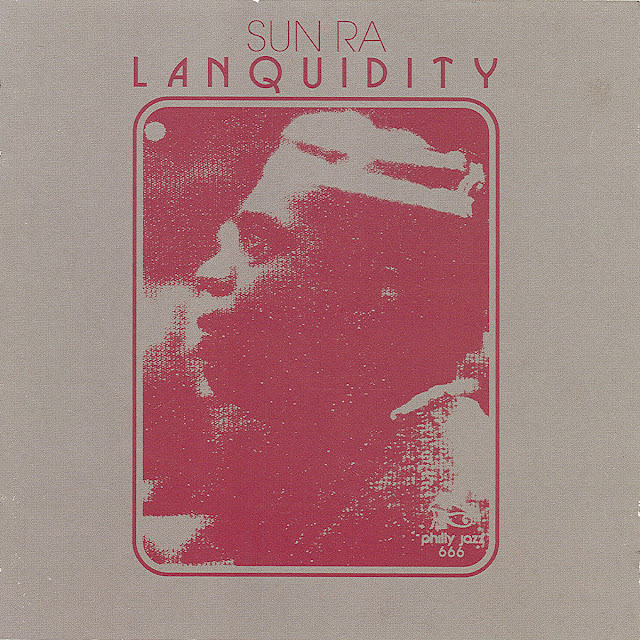
Sun Ra - Lanquidity (Definitive Edition) May 14, 2021 Strut Records

Strut present the definitive edition of Sun Ra’s classic ‘Lanquidity’ album from 1978 with brand new 4LP box set and 2CD editions, featuring the widely distributed version of the album alongside alternative mixes by Bob Blank originally released in limited quantities for a 1978 Arkestra gig at Georgia Tech. Both versions of the album are cut loud at 45 rpm over 2LPs each.

Recorded overnight at Bob Bank’s Blank Tapes on 17th July 1978 after the Arkestra had appeared on Saturday Night Live, the album is unique in the Ra catalogue. “Most critics felt that it was more of a fusion-inspired record,” explains Michael Ray. “As the name suggests, the album is liquid and languid.” Bob Blank continues, “Musically, it was very ad hoc and freeform. There were horn charts but most tracks came out of improvised jams. Sun Ra just did his thing.”

Comprising five effortlessly fluid pieces, the album eases in with Lanquidity. Danny Ray Thompson remembers, “This was one of Sun Ra’s on-the-spot compositions. It is almost like an Ancient Egyptian Stargazing Ceremony, mapping out the stars and the planets.” Where Pathways Meet is “Sun Ra’s funky version of an Egyptian march. Pharaoh is sending his troops off to fight and this is his pep-talk!” continues Thompson. “The music seems to take different pathways but still converges.” The loping groove of That’s How I Feel, features the reflective trumpet lines of Eddie Gale with solos by John Gilmore and Marshall Allen: “Marshall comes in with that snake charming oboe.” Says Thompson. The funky Twin Stars Of Thence weaves around Richard Williams celebrated elastic bassline while the haunting closer, There Are Other Worlds (They Have Not Told You Of), is pure “space music.” The poet Mama Nzinga described it as ‘The essence of light. Spirit takes a ride inside the deep dark space of just being.”
1. Lanquidity (Remastered)
2. Where Pathways Meet (Remastered)
3. That’s How I Feel (Remastered)
4. Twin Stars of Thence (Remastered)
5. There Are Other Worlds (They Have Not Told You Of) (Remastered)
6. Lanquidity (Alternate Mix)
7. Where Pathways Meet (Alternate Mix)
8. That’s How I Feel (Alternate Mix)
9. Twin Stars of Thence (Alternate Mix)
10. There Are Other Worlds (They Have Not Told You Of) (Alternate Mix)

CD 1
1. Lanquidity (8.19)
2. Where Pathways Meet (6.30)
3. That’s How I Feel (8:03)
4. Twin Stars Of Thence (9:55)
5. There Are Other Worlds (They Have Not Told You Of) (10.58)

CD 2
1. Lanquidity (Alternate version) (8.17)
2. Where Pathways Meet (Alternate version) (6.27)
3. That’s How I Feel (Alternate version) (12.06)
4. Twin Stars Of Thence (Alternate version) (9.49)
5. There Are Other Worlds (They Have Not Told You Of) (Alternate version) (10.54)

Wednesday, March 7, 2018

Sun Ra & His Arkestra with Salah Ragab - Egypt Strut Dawn (EP) 2018


SUNNY MEETS SALAH 

Drummer/composer/bandleader Salah Ragab (ca. 1936–2008) was a pivotal figure in Middle Eastern jazz. He is considered by many authorities to be the founder of Egyptian jazz, having formed his first ensembles in the 1960s. Sun Ra's friendship and musical interplay with Ragab began in 1971 on the Arkestra's first visit to Egypt. (See remembrance by Hartmut Geerken below.) Ra issued a number of albums from recordings made on that tour, including Live in Egypt Volume I (a.k.a. Dark Myth Equation Visitation, a.k.a. Nature's God); Nidhamu (a.k.a. Live in Egypt Vol. II); and Horizon (a.k.a. Starwatchers, a.k.a. Live in Egypt Vol. III). 

Ragab composed "Egypt Strut" and "Dawn" and accompanied the Arkestra on congas for this May 1983 studio session, which was recorded at El Nahar Studio, Heliopolis, Cairo, on Sun Ra's second tour of Egypt. These two stellar tracks were issued that year by the Greece-based Praxis label on a hybrid album that coupled these two Ra-Ragab collaborations with three early 1970s recordings by Ragab (without Sun Ra) leading the Cairo Jazz Band and an unnamed quintet. 

The five Praxis tracks were later reissued by the UK-based Leo label in 1999. The '99 package added two tracks: a 1971 recording of "Music for Angela Davis" (comp. Hartmut Geerken) by the Cairo Free Jazz Ensemble (conducted by Geerken), and a third Ra-Ragab track: a live-in-Cairo 1984 version of "Watusa," a decades-old staple in Sunny's repertoire. A freewheeling 18-minute tour-de-force, this "Watusa" nonetheless constitutes one of the worst audio captures of a Sun Ra performance ever commercially issued (Transparency-grade atrocious). You had to be there. It is not here. 

THE DIGITAL EP 

Due to the somewhat mismatched programming of the Praxis and Leo albums, as well as their limited circulation, "Egypt Strut" and "Dawn" may have been overlooked by many Ra fans. We've coupled them here into an essential digital EP so these tracks can receive the focus they deserve. "Egypt Strut" might fittingly be subtitled "Egyptian Sidewinder," as certain passages echo Lee Morgan's 1964 classic, with a Middle Eastern flavor. "Dawn" is a perfect crossover collaboration that highlights how Ra's and Ragab's styles overlap and where they diverge. 

Art Yard Records proprietor Peter Dennett, who has been toiling for years to preserve Salah Ragab's artistic legacy, issued a superb set of 1968–1973 recordings by Ragab and the Cairo Jazz Band. It is available on Bandcamp at: salahragab.bandcamp.com/album/egyptian-jazz. 

HARTMUT GEERKEN RECALLS: 

"In June 1971, I sent an invitation to Sun Ra from Cairo and six months later the Arkestra came to the land of the pharaohs to play at the foot of the pyramids. When they played in my living room in Heliopolis on December 12, 1971, Salah Ragab was one of my guests. It was their first personal contact. 

"Sun Ra set out again 12 years later to gaze into the eyes of Sphinx. In May 1983 he went into El Nahar Studio in Heliopolis with Salah Ragab to record two Ragab compositions. To my knowledge it had never happened before that Sun Ra and his Arkestra played compositions of a contemporary musician from outside [the band]. Maybe he was taken with the initials of Salah Ragab-which were the same as his own-or he was fascinated with the fact that his own name was part of Ragab's. To my knowledge, Salah was the only non Afro-American, apart from Leah Ananda from Kashmir and Roger Aralamon Hazoumè from Dahomey, to be documented on record with Sun Ra. 

"In 1984 Sun Ra came to Egypt for the third time. For this last visit Salah played drums in the Arkestra when the band played at the small Jazz club Il Capo in Zamalek." 

HISTORICAL FOOTNOTE 

From The Earthly Recordings of Sun Ra (by Robert L. Campbell and Christopher Trent, 2nd edition, 2000): 

"According to Hartmut Geerken, the entire [1971 Sun Ra and his Astro Intergalactic Infinity Arkestra in Cairo] concert (3-1/2 hours) was taped by [Arkestra drummer/engineer] Tommy Hunter; it is not known whether additional material survives. All of the band's instruments (except Ra's synthesizer) had been impounded by Egyptian customs and consequently instruments had to be borrowed from the Egyptian Army (courtesy of Salah Ragab). The Tiger organ was obtained locally as a substitute for Ra's Farfisa or Spacemaster. Clifford Jarvis used Geerken's elaborate percussion set during the concert."

1. Egypt Strut 06:38
2. Dawn 12:12

Sun Ra: Hohner melodica, synthesizer, Ondioline
Salah Ragab: congas
Tyrone Hill: trombone
Marshall Allen: alto sax, flute
John Gilmore: tenor sax
Danny Ray Thompson: baritone sax
Eloe Omoe [Leroy Taylor]: bass clarinet
James Jacson: bassoon
Chris Henderson: drums
Claude Broche: drums
Samarai Celestial [Eric Walker]: drums
bassist unidentified 

Both works composed by Salah Ragab © Art Yard Music
All rights reserved

Recorded at El Nahar Studio, Heliopolis, Cairo, May 1983
Annotation and cover design by Irwin Chusid
Special thanks to Peter Dennett and Hartmut Geerken

Recordings issued under license from Sun Ra LLC

Sun Ra & His Arkestra - Taking a Chance on Chances (2018)


This is not The Great Lost Sun Ra Album. It's a GOOD Lost Sun Ra Album, and it's been more or less found. Taking a Chance on Chances (or "… on Chancey," as some typographically allege) was recorded at the Jazz Showcase, Chicago, in 1977, and issued on Saturn vinyl in 1977 (catalog #772). Only one problem: according to the authoritative Earthly Recordings of Sun Ra, by Robert L. Campbell and Christopher Trent (2nd ed., 2000), "all known copies of Saturn LP 772 have a defective pressing on Side A." 

Taking a Chance was a companion volume to The Soul Vibrations of Man (Saturn 771), issued around the same time. The two albums share comparable origins, personnel, and dollar-store acoustics. Soul Vibrations can be found here: sunramusic.bandcamp.com/album/the-soul-vibrations-of-man 

Both emerged from the Alton Abraham–Chicago division of Saturn, an operation that in Ra's omniverse was slowly approaching its sell-by date. Soul Vibrations was issued with a lavishly illustrated front cover; Taking a Chance was sent to market with various covers ranging from a grainy, underlit black & white photo of Ra crowned in Egyptian headdress, to generic sleeves festooned with taped-on strips of paper bearing the title and a small inset photo. Taking a Chance was apparently a very limited press run, perhaps as few as one or two hundred copies, and very few are known to exist. 

As for the manufacturing flaws in Taking a Chance, here's a description by blogger Rodger Coleman: "The pressing defect manifests itself in a woefully unbalanced stereo presentation and a near-constant overlay of scratchy noises and horrifically ugly distortion which only begins to clear up towards the end of the side. Ugh. Pressing the mono button helps a little (if you have one) but not much. As listeners to Soul Vibrations already know, these are not great-sounding recordings to begin with; the pressing flaw renders them almost unlistenable." 

We can attest, having borrowed a sealed Saturn original from our friend Freddie Patterson, who allowed us to slit the shrinkwrap and drop a stylus in the LP's virgin grooves. Hoping to discover the world's only sonically pristine copy for a premiere reissue, we were disappointed to hear on Side A the "horrifically ugly distortion" described by Coleman. (Someone suggested we issue it that way for its "exotic mix." We demurred.) 

Fortunately, Michael D. Anderson of the Sun Ra Music Archive unearthed a tape in 2016 that proved to be the closest thing to a "pristine" version. It's got problems, sure, but compared to the Saturn pressing, it's Rudy Van Gelder-grade. For the first time, we can hear what Side A was intended to sound like. The recordings capture some incidental noise (beyond applause) from patrons, but these artifacts convey an intimate club atmosphere and are not intrusive. 

The first three titles on this digital reissue originally appeared on Side A of the LP. Some notes: 

"Taking a Chance on Chances" (6:27, stereo) 
There's some conjecture about the title of the album, and about this alleged "title track," which may or may not involve Ra wordplay on the name of the band's French horn player, Vincent Chancey. Campbell/Trent: "According to Chancey, the first title on Saturn LP 772 was supposed to be 'Taking a Chance on Chancey,' which makes eminent sense: the piece is an improvised Ra/Chancey duet" for organ and French horn. 

"Lady Bird"/"Half Nelson" Medley (8:32, stereo) 
"Lady Bird" is a vintage Tadd Dameron chestnut, "Half Nelson" a Miles Davis classic. Inexplicably, the SRMA tape contains a different take than the LP version. It's a half-minute shorter, but it's the same arrangement, the solos are comparable, the instrumentation and personnel sound identical, and it was likely recorded at the same venue during the same booking, perhaps even on the same date during a different set. The trumpet solo on the unlistenable LP version is over a minute and a half longer; Gilmore's masterful sax solos clock three minutes on both LP and tape. The mix is off on the ensemble passages, the horns somewhat buried beneath Ra's dominant Yamaha YC-30 Combo Organ, which remains dense even during the horn solos, but the powerful performances shine through. As ad hoc Ra live recordings go, this is worse than a few, but better than most. 

"Over the Rainbow" (5:21, mono) 
Ra switches to piano for what is essentially a rollicking solo, with a bit of restrained trap accompaniment from either Tommy Hunter or Luqman Ali (both of whom are cited as having been on the gig). 

On the original pressings of Saturn 772, side B was the GOOD side. Ironically, with the sonic upgrades to side A, Side B is here downgraded to a raucous clatter. The inferior audio isn't a pressing flaw; it's attributable to a woeful recording set-up at the club. Distortion, limited frequency spectrum, ad hoc mic placement, and ambient noise combine to produce one of those lo-fi captures with which any deep Sun Ra fan is familiar, and which generally appeals only to the most faithful of those fans. That said, the recordings are not without charm and archival significance. 

"St. Louis Blues" (5:09, mono) 
Still on piano accompanied by drums, Ra has Richard Williams on bass rounding out this trio rendition of the W.C. Handy relic (with a quick nod to Gershwin at 4:43). The tracks are identical on tape and LP, but the latter sounds terrible—the speed and pitch are off, and the mastering is egregious. The tape was excellent by comparison (a relative standard); it's on-pitch, faster, and offers greater clarity. 

"What's New" (10:09, mono) 
This tune was a hit for Bing Crosby in 1939, and performances and recordings dot the Ra discography spanning 1962 to 1991. It's evident why Sunny felt compelled to issue this badly recorded performance—the smoking, extended tenor solo by John Gilmore, who is turned loose for five breathtaking minutes. The final minute and a half constitute a literal solo, as Ark and leader step aside while Gilmore dives into the vortex. The band then returns for an Ahmed Abdullah trumpet solo, which, following Gilmore's masterful tapestry, sounds like an afterthought. 

"Take the 'A' Train" (9:51, mono) 
See "What's New." Another audio snapshot with dust, wrinkles, discoloration and worn edges. But once again, Gilmore redeems. 

A bonus track has been added: 

"The Sound Mirror" (9:03, stereo) 
This is a previously unissued recording. A regrettably lo-fi 14-minute version was issued as the title track on Saturn 19782 in 1978. This performance, believed to date from late 1977 or early 1978, features a tighter arrangement and greater sonic clarity. – I.C.

1. Taking a Chance on Chances 06:27
2. Lady Bird/Half Nelson (Medley) 08:32
3. Over the Rainbow 05:20
4. St. Louis Blues 05:09
5. What's New? 10:09
6. Take the 'A' Train 09:50
7. The Sound Mirror (live 1977, bonus track) 09:02

All tracks produced by Sun Ra
Tape transfers by Michael D. Anderson of the Sun Ra Music Archive
Audio restoration and cover design by Irwin Chusid
Mastering by Joe Lizzi, Van Alst Sound, Brooklyn (tracks 1–6)

Sun Ra: piano, organ, vocals (7)
John Gilmore: tenor sax, clarinet, timbales
Michael Ray: trumpet
Ahmed Abdullah: trumpet
Vincent Chancey: French horn
Marshall Allen: alto sax, flute, oboe, percussion
Danny Davis: alto sax, flute, percussion
Danny Ray Thompson: baritone sax, flute, percussion
Eloe Omoe: bass clarinet, flute, percussion
James Jacson: flute, bassoon, Infinity-drum
Richard "Radu" Williams: bass
Tommy Hunter: drums
Luqman Ali: drums
Atakatune: conga
Eddie Thomas: percussion
June Tyson: vocals (7)

"Taking a Chance on Chances" and "The Sound Mirror" by Sun Ra © Enterplanetary Koncepts (BMI)
"Lady Bird" by Tadd Dameron
"Half Nelson" by Miles Davis
"Over the Rainbow" by Harold Arlen and Yip Harburg
"What's New" by Johnny Burke and Bob Haggart
"St. Louis Blues" by W.C. Handy, trad. arr. by Ra
"Take the 'A' Train" by Billy Strayhorn

Issued under license from Sun Ra LLC

Sun Ra & His Arkestra - Strange Celestial Road (2018)


These recordings originated at the same Variety Studio sessions that resulted in the 1979 Saturn release SLEEPING BEAUTY (a.k.a. Door of the Cosmos). Based on known departures and arrivals of various players in the Arkestra, Sun Ra historians have cited a likely recording date of June 1979. These three tracks were sold to Rounder and issued on LP in 1980; Sun Ra retained "Springtime Again," "Door of the Cosmos," and "Sleeping Beauty" for release on Saturn. 

Excerpts from the AllMusic Review by Ra authority Sean Westergaard:

The band Sun Ra had at the end of the '70s was surely the funkiest he ever had, with electric bassist Steve Clarke (in tandem with upright player Richard Williams) and the twin guitars of Taylor Richardson and Skeeter McFarland. 

"Celestial Road" kicks things off, where electric bass, arco bass and wah-wah guitar set the stage for a great June Tyson vocal, followed by solos from John Gilmore [tenor sax], Michael Ray [trumpet], Sun Ra [keys], and Damon Choice [vibes]. "Say" has a great electric bassline and joyous horn charts, and swings mightily with a vaguely Latin rhythm. There's a fine electric guitar solo, as well as some more fantastic playing from Gilmore. Ra's keyboard sounds and soloing are particularly deranged on this album, but never get into the purely noisy realm. 

"I'll Wait for You" is the real treat of this album, featuring a great mellow groove and wonderful ensemble vocals led by the beautiful June Tyson. There's plenty of fine soloing on this track as well, but the main attraction is the mix by Ra and Michael Ray. There's a dub-like element to the way the instruments and voices are treated and mixed in and out, but this is dub by way of Saturn, and the mix is at least as weird and wonderful as anything Lee Perry has done. This is an overlooked album in an unwieldy discography, but it's a real gem. Recommended.

1. Celestial Road 07:02
2. Say 12:10
3. I'll Wait for You 16:06

Recorded, mixed and mastered at Variety Recording Studio, NYC 
Probably recorded June 1979 
Engineer: Mike Dacek 
Mixed by Sun Ra, Michael Ray, Mike Smith 

All compositions by Sun Ra © Enterplanetary Koncepts (BMI)
Originally issued on Rounder Records
All rights reserved

Sun Ra: piano, electric piano, organ, synth, vocals
Michael Ray: trumpet, vocals
Curt Pulliam: trumpet
Walter Miller: trumpet
Craig Harris: trombone
Tony Bethel: trombone
Vincent Chancey: French horn
Marshall Allen: alto sax, flute
John Gilmore: tenor sax, percussion
James Jacson: flute, bassoon, Infinity-drum
Eloe Omoe: bass clarinet, flute, percussion
Danny Ray Thompson: baritone sax, flute, percussion
Kenny Williams: tenor and baritone sax, flute
Noël Scott: alto and baritone sax, percussion
Hutch Jones: alto and tenor sax
Sylvester Baton: various reeds
Skeeter McFarland: electric guitar
Taylor Richardson: electric guitar
Steve Clarke: electric bass
Richard Williams: bass
Harry Wilson: vibraphone
Damon Choice: vibraphone, vocals
Eddie Thomas: drums
Luqman Ali: drums
Reg McDonald: drums
Atakatune: percussion
June Tyson: vocals
Rhoda Blount: vocals

Sun Ra & His Arkestra - Sun Ra Plays Gershwin (2018)


Sun Ra admired George Gershwin and paid musical tribute to the great composer's legacy countless times over his 50-year performing and recording career. This digital-only release, spanning 38 years (1951–1989), compiles some of the best recorded examples of Ra's idiosyncratic takes on the Gershwin catalog. These performances encompass a variety of styles and personnel — full Arkestra, trio with vocalist (Hattie Randolph), duo (Sun Ra and Wilbur Ware), and doo-wop (The Nu Sounds, arranged and accompanied by Sun Ra). 

Most tracks have been previously issued, although in most cases the audio has been remastered to fix flaws in previous versions. The live version of "Rhapsody in Blue," recorded at New York's Squat Theater in 1979, has never before been commercially available. The 1950s rarity "Nice Work if You Can Get it," previously only available on an Atavistic CD titled Spaceship Lullaby, has benefited from 60+ digital repairs. 

The encyclopedic compendium The Earthy Recordings of Sun Ra (by Robert L. Campbell and Christopher Trent, 2nd edition) lists other Gershwin titles known to have been performed by Ra over the years: Lady Be Good; I Got Rhythm; Embraceable You; I Can't Get Started; and Liza. These titles have been documented by existing tapes in the hands of collectors. However, at present these recordings are not available, nor do we know if the audio quality of any would merit commercial release. There might be other Gershwin titles by Ra which have escaped the chroniclers. – I.C.

Great review at Pitchfork: pitchfork.com/reviews/albums/sun-ra-sun-ra-plays-gershwin — unfortunately written without benefit of the above album annotation, which was published belatedly on Bandcamp. 


Bonus round: Here's a 2014 article from the Guardian which makes the case that Sunny and George were both freemasons: bit.ly/2kFVxDQ

1. Sun Ra & His Arkestra - Rhapsody in Blue (previously unissued) 09:20
2. Sun Ra & His Arkestra - 'S Wonderful 05:33
3. The Nu Sounds with Sun Ra - Nice Work If You Can Get It 01:45
4. Sun Ra & His Myth Science Arkestra - But Not for Me 06:48
5. Sun Ra & Wilbur Ware - The Man I Love 03:26
6. The Cosmic Rays with Sun Ra - Summertime 01:53
7. It Ain't Necessarily So 04:42
8. Sun Ra Trio with Hattie Randolph - 'S Wonderful (early version) 02:16
9. The Nu Sounds with Sun Ra - A Foggy Day 01:02
10. Sun Ra & His Myth Science Arkestra - I Loves You Porgy 03:30

All original tracks produced by Sun Ra
Compilation and audio restoration by Irwin Chusid
Tape transfers by Michael D. Anderson of the Sun Ra Music Archive
Issued under license from Sun Ra LLC

Tuesday, March 6, 2018

Sun Ra And His Interplanetary Vocal Arkestra - The Space Age Is Here To Stay (SUNDAZED MUSIC-MODERN HARMONIC 2018)


The first-ever collection of Arkestra vocal tracks! Over 75 minutes of vocal performances - audible perfection! Across the history of jazz, there is no wilder, more future-forward composer and performer than Herman Poole Blount, aka Sun Ra. Known as much for his wild on-stage persona as his innovative compositions, Sun Ra was the avant-garde bleeding edge of the jazz genre, introducing modal composition and electronic instrumentation before almost anyone else – not to mention bringing the space age to life with his obsession with all things extraterrestrial. Across more than 100 LPs released in his lifetime, Sun Ra charted a course to space and far, far beyond. Known primarily for his keyboard improv and freeform band arrangements, Sun Ra could also write great vocal songs when he set his mind to it. Such songs as "Space Is The Place" and "Interplanetary Music No.1" show Ra's unique approach to songwriting, using eerie chanting and repetition to create hypnotic moods. And Ra could get swingy when he wanted to as well -- "Enlightenment" and "Sometimes I'm Happy" are gorgeous ballads, as pretty as any Tin Pan Alley tune. Of course, it wouldn't be Sun Ra without his space age lyrics -- "Take your first step out to outer space/You're like a little baby who never walked before" shows up in the future-predicting "Walking On The Moon." At long last, Modern Harmonic has put together The Space Age Is Here To Stay, the very first collection of Sun Ra’s vocal tracks - two album’s worth of mind-blowing tunes from the mind of the Man from Saturn himself. Cue this one up and get ready to visit other worlds in Sun Ra's jazz rocket ship!

1. Along Came Ra / The Living Myth 04:17
2. Interplanetary Music, No. 1 02:27
3. Back In Your Own Back Yard 02:03
4. Enlightenment 02:36
5. 'Round Midnight 03:52
6. Sometimes I'm Happy 04:28
7. The Antique Blacks 04:16
8. Moorish Nights 03:46
9. Walking On the Moon 06:15
10. This Song Is Dedicated to Nature's God 03:55
11. 1984 07:01
12. Space Is the Place 09:47
13. The Forest of No Return 03:05
14. The Truth About Planet Earth 06:36
15. Nuclear War (Live) 05:40
16. Space Chant (Third Heaven) 06:04

John Cage Meets Sun Ra - The Complete Concert (SUNDAZED MUSIC-MODERN HARMONIC 2018)


If you were going to envision the ultimate avant-garde meeting-of-the-minds jam session, who would you pick? Even the most hopeful fan of strange and innovative music couldn't have seen this one coming: on one afternoon in 1986, at Coney Island's dilapidated freak show, space-age avant-jazz genius Sun Ra met avant-garde "serious music" composer John Cage in an unforgettable performance. 

You couldn't imagine two figures more opposite. Cage was known for his unusual approach to composition, using objects such as radios and television sets, as well as pure silence, as instruments, often encouraging his musicians to do other things at their whim on stage. Sun Ra, on the other hand, was a jazz arranger known for his "space-age" approach to jazz, adding free-jazz and surrealist elements into a musical form that Cage often disdained -- improvisational music. And yet, for one afternoon, they pooled their talents -- Ra playing keyboards, leading his small group and reading his unusual poetry; Cage "performing" vocal readings and passages of vocal sound -- plus his trademark silence -- designed to baffle and disorient. The combination is breathtaking, both organic and mechanical, free-form and totally composed. 

For the very first time, Modern Harmonic presents the full and unexpurgated concert from 1986. In addition to never-before-heard songs and musical passages, this album at last presents the long-rumored co-performance between the two musical giants. Take yourself back to 1986 and a once-in-a-lifetime performance that you can finally hear as it was intended. 

"This live album documents the meeting of two avant-garde legends." - Pitchfork 

"This month?s WTF prize goes to John Cage Meets Sun Ra, a monophonic double LP released on clear vinyl by the Modern Harmonic label, which documents a performance by the two eponymous giants of the 20th century avant-garde in a Coney Island freak show in June 1986. With the whole concert released for the very first time, including 25 minutes of previously unheard material, it’s an absolute no-brainer for friends of the strange." 
-Daniel Spicer, What's New In Vinyl--JAZZWISE Magazine

1. Rick Russo - Introduction 01:11
2. Marshall Allen - Untitled Wind Synthesizer Intro 01:02
3. Sun Ra - Untitled Keyboard Solo 1 06:43
4. John Cage - Empty Words (Vocal Solo) 02:39
5. John Cage - Empty Words (Silent Solo) 03:03
6. John Cage - Empty Words (Vocal Solo) 04:46
7. Sun Ra - Untitled Keyboard Solo 2 02:54
8. Sun Ra - We Hold This Myth To Be Potential 02:41
9. Sun Ra - The Damned Air 02:51
10. John Cage - Empty Words (Vocal Solo) 01:29
11. John Cage - Empty Words (Silent Solo) 02:37
12. John Cage - Empty Words (Vocal Solo) 04:01
13. Sun Ra - The Living Parable 00:37
14. Sun Ra - This Is The Space Age 01:25
15. Sun Ra - Untitled Keyboard Solo 3 06:55
16. Sun Ra - Enlightenment (featuring June Tyson) 02:28
17. Sun Ra - Untitled Keyboard Solo 4 02:03
18. John Cage and Sun Ra - Silent Duet 02:14
19. John Cage and Sun Ra - Empty Words and Keyboard 05:23
20. John Cage and Sun Ra - Silent Duet 2 02:47
21. Sun Ra - Untitled Keyboard Solo 5 10:05