Showing posts with label PIANO. Show all posts

Tuesday, October 18, 2016

ELEW - And To The Republic (2016) SUNNYSIDE RECORDS


present


Releases September 9, 2016

Sometimes it takes an outsider to show the current pecking order what is amiss. There are revelations to be heard by those who distance themselves from their native tongue to find a place for themselves. A return can then be revelatory to both the outsider and the republic, as it stands…. 

Pianist Eric Lewis grew disheartened by the jazz music industry in the late ‘90s after a promising start in the ensembles of Wynton Marsalis and Elvin Jones. Subsequently, Lewis won the Thelonious Monk International Piano Competition only to find that he wasn’t connecting to the material any longer. Lewis withdrew from the jazz world and reemerged with a new moniker and style, namely ELEW and rockjazz, a piano specific blend of contemporary pop and rock music in an aggressive acoustic improvisatory setting amplified by the artist’s endurance and intensity. 

ELEW has found himself in a new world where the crossover potential of his creation opened doors for him in fields beyond jazz and beyond music. He has collaborated with world-renowned popular artists like Lil Wayne and found a partnership with the Complexions Contemporary Ballet as Composer in Residence. ELEW has also begun a foray into screenwriting and directing. 

After years of distancing himself from the jazz world, ELEW has decided to make a return in a remarkable triumvirate featuring bassist Reginald Veal and drummer Jeff “Tain” Watts. His new recording, And To The Republic, features the forceful pianist’s fantastic prowess expressed in the genre that he first caught the attention of the listening public with, mainstream jazz. The recording is a sincere olive branch to jazz purists and the jazz community that he had spurned earlier. 

The choice to return wasn’t one of necessity. ELEW has been successful throughout his career, which continues to branch into many streams. His intention in releasing this new recording is to reengage with the world that inspired him initially, to play with masters of the craft and to pay homage to his heroes, especially his former employer, drum legend Elvin Jones. 

Who better to fill the role on drums that the great Jeff “Tain” Watts? He is a true disciple of Elvin Jones and has the power, drive and knowledge within the full scope of jazz, having been part of the Young Lion generation led by Wynton and Branford Marsalis. The fantastic Veal has just as distinguished a résumé, being another Marsalis alumni and Elvin Jones protégé. 


The recording begins with the laidback yet playful “Medicine Man,” a tribute to a physician friend, which is followed by the energetic and spontaneous “Ornette,” a tribute to the legendary Ornette Coleman, who had passed on the day of recording. “Lil Luba,” named for Lewis’s nickname for his girlfriend (Luba is her mother’s name), is a gutbucket blues, featuring percussionist Ricky “Dirty Red” Gordon. The surging “Tones for Elvin Jones,” written while on tour with the song’s namesake, is an evocative tribute to the master drummer and a showcase for Watts, a drummer who proudly carries Jones’s torch. 

The incredible reinterpretation of Swedish electronic duo The Knife’s “Heartbeats” is a tremendous example of ELEW’s mastery of the keyboard and modern influence. The propulsive “Quirkwork” utilizes the rhythm changes to Gershwin’s “I Got Rhythm” and highlights the trio’s dynamically charged relationship. Named for a short chance encounter, “Jamaica Girl” is a beautiful ballad with a hint of dance hall beat. The startling “And To The Republic” finds the great actor Harry Lennix reciting Mark Antony’s speech from Shakespeare’s Julius Caesar over a tense improvised background. 

Thelonious Monk was obviously the inspiration for “Monk,” a compelling composition utilizing some of the unanticipated stylings of the master pianist. A radical take on the Rodgers and Hammerstein classic “My Favorite Things” was played to emulate the Coltrane “sheets of sound” playing style. The recording closes with ELEW revisiting his “Philly Groove,” a laid back yet declamatory piece full of swagger. 

Presenting a program of music that highlights all of his strengths, ELEW has returned to the world of modern jazz on his new And To The Republic. Reunited with the incredible rhythm section of Veal and Watts, ELEW’s trio is equal parts bombast and control, frenzy and smooth, proving that though he might have left for other musical spheres, ELEW’s still a heavy hitter in his first language, where he has found his own way.

1. Medicine Man 04:58
2. Ornette
3. Lil Luba
4. Tones For Elvin Jones
5. Heartbeats (The Knife)
6. Quirkwork
7. Jamaica Girl
8. And To The Republic: Act 3, Scene 2 Of Shakespeare's Julius Caesar
9. Monk 05:21
10. My Favorite Things
11. The Philly Groove

ELEW - piano 
Reginald Veal - bass 
Jeff "Tain" Watts - drums


Monday, August 22, 2016

Avishai Cohen - Into the Silence (2016) ECM RECORDS


Avishai Cohen impressed a lot of listeners with his soulful contributions to Mark Turner’s Lathe of Heaven album in 2014. Now the charismatic Tel Aviv-born trumpeter has his ECM leader debut in a programme of expansive and impressionistic compositions for jazz quartet (trumpet, piano, bass, drums), augmented by tenor saxophone on a few pieces. Into The Silence is dedicated to the memory of Avishai’s father David, reflecting upon the last days of his life with grace and restraint. Avishai’s tender muted trumpet sets the emotional tone of the music in the album’s opening moments and his gifted cast of musicians explore its implications. Israeli pianist Yonathan Avishai has played with Cohen in many settings and solos creatively inside the trumpeter’s haunting compositions, sometimes illuminating them with the phraseology of the blues. Cohen and drummer Nasheet Waits have a hypersensitive understanding and their interaction can, from moment to moment, recall the heyday of Miles Davis and Tony Williams or Don Cherry and Billy Higgins. Yet this music, while acknowledging inspirational sources, is very much of our time. Bassist Eric Revis, a cornerstone of the Branford Marsalis quartet for two decades, provides elegant support throughout. And saxophonist Bill McHenry, a subtle modernist who has worked with Paul Motian and Andrew Cyrille, shadows Cohen’s lines with feeling. Into The Silence was recorded at Studios La Buissonne in the South of France in July 2015 and produced by Manfred Eicher.


1. Life and Death 9:18 
2. Dream Like a Child 15:30 
3. Into the Silence 12:12 
4. Quiescence 5:10 
5. Behind the Broken Glass 8:12 
6. Life and Death (Epilogue) 2:43

Avishai Cohen, trumpet
Bill McHenry, tenor sax
Yonathan Avishai, piano 
Eric Revis, double bass
Nasheet Waits, drums

BUY THIS ALBUM

Wednesday, August 17, 2016

Scott Morgan - Songs of Life (September 12, 2016)


Vocalist Scott Morgan draws on a lifetime of experience and emotion for his moving debut recording, out September 12 on Miranda Music

Songs of Life features Fred Hersch, Joel Frahm and Janis Siegel 
on a stunning set of Songbook and pop classics

“Scott Morgan’s singing is warm and loose. He has taste, heart, and musical intelligence.” —David Hajdu, Music Critic, The New Republic

“Scott Morgan’s voice wafts gently through your ears and heads straight to your heart.”– Janis Siegel, Manhattan Transfer

One advantage to making a belated debut is the depth of life experience that enriches an artist’s work. Scott Morgan may be a name new to listeners outside of New York City, where he’s garnered a devoted following for his moving live performances, but Songs of Life reveals a vocalist with a lifelong passion for and immersion in music. The title reflects both a songbook developed over a lifetime’s listening and performing, but also Morgan’s expressive interpretations, deeply imbued with the loves and losses that accumulate over a life well lived.

The repertoire on Songs of Life (due out September 12 via Miranda Music) span the spectrum from Great American Songbook standards to pop classics by revered songwriters like James Taylor and The Beatles to more recent contributions by pianist/composer Fred Hersch, Morgan’s partner in both life and music. Hersch’s sensitive accompaniment can be heard throughout Songs of Life, along with the singer’s flexible, supportive rhythm section of bassist Matt Aronoff and drummer Ross Pederson. The impeccably eloquent tenor saxophone of Joel Frahm graces three tracks, while Manhattan Transfer’s Janis Siegel is Morgan’s duo partner for the soaring “I’ll Follow,” with lyrics by Morgan to Hersch’s piece “Mandevilla.”

“Every song has its own story,” Morgan says, “and I hope that when people listen to the record they can identify with some if not many of the songs in a personal way. Everybody’s had unrequited love as well as fulfilling relationships. And I imagine most people have suffered existential angst as well - so Songs of Life is a musical photo album of the touchstones in our lives.”


Some of the songs in particular offer snapshots of very vivid memories from Morgan’s past. The breathtaking coupling of Dave Catney’s “Little Prayer” and the Lerner and Loewe standard “Wouldn’t It Be Loverly” is a particular standout. The first half is the work of a jazz pianist/composer who passed away from complications of AIDS, sung by Morgan in memory of a friend lost to the disease in the 1980s. The latter half wistfully captured the imagined dreams of a woman that Morgan met while traveling in Tanzania, widowed by HIV and living in a mud hut. “She took me into her house and fed me though she had nothing at all,” he recalls. “I thought that from her perspective, wouldn't it be lovely to have heat, chocolate, someone to care about.”

Morgan brings the same profound humanity and empathy to all of his work. In part, his gift for storytelling and capturing character in song stems from his earliest experiences with music, performing in musical theater productions in his native Sarasota, Florida. “Without my musical theater background I wouldn't be able to tell the stories the way that I’m able to tell them, particularly in live performance,” Morgan says. “It’s very easy for singers to just get up and run through the songs jazz singers are expected to sing, but I try to make every song special and really engage the audience with what’s going on in the story.”

After playing piano and singing throughout his time at Florida State University, Morgan took a 15-year break from music while he concentrated on his career in the technology and then in the nonprofit sector, a pursuit that continues to be rewarding off the stage. It was his arrival in New York City in 2001 that led to his reengagement with music, which was only fueled further a few months later when he met Hersch and was ushered into the thriving NYC jazz scene. He studied with influential modern jazz singers like Kate McGarry, Peter Eldridge and Rene Marie, gaining confidence from their encouragement and from the enthusiastic response of audiences as he performed live. Hersch says, “I always knew Scott was a great musician – I am glad that he is now finding that out for himself.”

“I’ve always been close to music, and I was looking for a creative outlet to round out my life,” Morgan explains. “I felt like all I was doing was working, working, working, so music started calling me back. I never thought it would turn into anything initially, but I gradually got more serious and my desire to do something more with music than just sing around the house started to grow.”


If the arc of Songs of Life can be seen as the story of a life, then it’s clear that in Morgan’s view love, in its many facets, is central to existence. The album begins with a brisk romp through “It’s You or No One,” a lively ode to fidelity by Sammy Cahn and Jule Styne with a dazzling vocalese lyric by Morgan to a classic Chet Baker solo. New romance is celebrated on “I Just Found About Love” and “This Heart of Mine,” while Dori Caymmi’s bossa nova classic “Like a Lover,” performed in an intimate duo with Hersch, luxuriates in the morning light on a lover’s face. The first of two James Taylor compositions on the album, “Don’t Let Me Be Lonely Tonight,” becomes a poignant plea for connection. The second, “Secret O’ Life,” resonates with Morgan’s Buddhist leanings in its celebration of being present in the moment.

The album closes with The Beatles’ “I Will,” rendered in Morgan and Hersch’s duo performance as a tender promise of devotion. Its sentiments are echoed in Morgan’s lyrics to Hersch’s music on “I’ll Follow,” with Morgan and Siegel painting a vivid portrait of two people in love worthy of a Broadway stage. “It’s a story about how when two lives and loves intertwine with each other, things can happen in a beautiful way,” Morgan explains.

All of the moments that have inspired Songs of Life are expressed with the same sense of beauty and passion. Like the love stories woven throughout the album, Morgan’s auspicious debut combines the thrill of the new with the wisdom and depth of feeling that can only come from a lifetime of experience.


Song of Life

Sunday, August 14, 2016

Bobby Kapp & Matthew Shipp - Cactus (2016) NORTHERN SPY RECORDS


Releases September 16, 2016


present


In Valerie Wilmer’s important socio-political history of the jazz vanguard As Serious As Your Life (Serpent’s Tail Press, 1977), the chapter on pianist Cecil Taylor is subtitled “Eighty-Eight Tuned Drums.” Textually this reference advances the role of the piano in free music as percussive in large part, especially as the chordal and melodic directions taken after Ornette Coleman in the late 1950s often appeared to circumvent the more fixed tonalities of the keyboard. Drummers and pianists have been one core team in this music, going back to the forbears and scions of the modern-jazz era — Buddy Rich and Nat Cole; Art Blakey and Herbie Nichols or Thelonious Monk; Denis Charles, Sunny Murray and Andrew Cyrille with Taylor — whether the pianist may work percussively or sculpt the music temporally and melodically. 

Drummer Bobby Kapp (b. Robert Kaplan on April 11, 1942 in Perth Amboy, NJ) and pianist Matthew Shipp (b. December 7, 1960 in Wilmington, DE) are a team that has only recently come together, though their affinity for one another is natural and rewarding. Cactus is their first duo recording, a spontaneous set coming on the heels of 2015’s Themes 4 Transmutation, the latter waxed under the drummer’s leadership and featuring Shipp, reedist Ras Moshe and bassist Tyler Mitchell. While the cognoscenti may be aware of Kapp’s name as a firebrand in the mid-60s New York free music underground, he didn’t record as a leader back then. In recent years, after relocating to Mexico, he’s co-led the standards-rooted Fine Wine Trio with pianist Richard Wyands and bassist Gene Perla, and reunited with alto saxophonist Noah Howard before the latter’s untimely passing. 

Kapp’s restless energy and streetwise lyricism, yen for the blues and supple templates for unfettered expression took him from New Jersey and Staten Island to Berklee College of Music, where he studied with Alan Dawson, and then Lower Manhattan. There, he played and recorded with alto saxophonists Marion Brown and Noah Howard, pianist Dave Burrell and tenor saxophonists Leandro ‘Gato’ Barbieri and Pharaoh Sanders before eventually settling in an artist’s colony in San Miguel de Allende. Kapp’s sideman recordings in the 1960s are scant, comprising two full LP appearances (Barbieri’s In Search of the Mystery and Howard’s At Judson Hall, both on ESP), two individual LP halves (Brown’s watershed Three for Shepp on Impulse! and Burrell’s High on Douglas), and film footage of Brown’s trio was captured in 1967 by Henry English, but all of this work presents a rolling, massive and fleet economy somewhere between Elvin Jones and Shelly Manne. 

His more recent outings have been somewhat under the radar, but the aspects that entice—a sure, tempestuous detail—are toned with age, experience and fidelity. 


Shipp’s piano is the perfect foil for Kapp’s dryly doled-out metric inventions, his sinewy but factual movements through erudite melody, resonant stomps and granular sideways gestures creating fields and objects through which the drummer’s open, supple brushwork and woody rolls float, undercut and weave. Shipp has worked with a wide range of individual, creative drummers—including Newman Taylor Baker, Whit Dickey, Guillermo E. Brown, Susie Ibarra, Marc Edwards and Steve McCall—and says of Kapp that “Bobby is a marvel as he combines the best of old school drumming with a real feel for pulse and breaking the circle that exists in the avant-garde. However, he can open the beat up in a way where you can flow with the wave and never lose the line. His touch is really refined and that adds to the beauty of his sound. 

I am always looking for ways to make my comping deeper and working with someone who has played with all the people he has deepens my thing. Also, the sound he gets off the cymbals has a resonance that is beyond deep—it’s like swimming in pure vibration.” On Cactus, nine spiny and flowering dialogic arms are presented in gorgeous sound, creating a language that stems from bebop, free improvisation and classicism but are of the present and specific to these two musicians. Rigorous, spontaneous play that feels this good is something to hold onto. 
– Clifford Allen 

“Practically without parallel — Matthew Shipp is the connection between the past, present and future for jazzheads of all ages.” - Downbeat 


“...In the 1960’s, Bobby was a seminal figure in the so-called new music movement in NYC, recording with Gato Barbieri, Archie Shepp, Noah Howard and others.” - Ron J. Pelletier

1. Overture
2. Before 04:26
3. During
4. Money
5. Cactus
6. After
7. Good Wood
8. Snow Storm Coming
9. The 3rd Sound

Matthew Shipp, piano
Bobby Kapp, drums


Before

Pablo Sanguinetti Cuarteto - Dionisio (2016)


Por: Rodrigo Pallares / Revista Influencia

El pianista y compositor se estará presentando el próximo viernes 6 de mayo en Palermo y contó todo acerca de su carrera y su nuevo trabajo discográfico junto a músicos de la talla del “Pipi” Piazzolla.
Bar La Apasionada en Florida, provincia de Buenos Aires. 

Pablo Sanguinetti está sentado en una mesa cerca de la puerta y toma una limonada con menta y jengibre, en un tarro de mermelada. “Me gusta definirme como músico y punto”, explica el pianista. Es que la obra de Pablo mezcla muchos ritmos variados como el jazz, la bossa nova y el candombe uruguayo. “Me gusta mucho el lenguaje del jazz, la posibilidad de improvisar. Es un género al que respeto profundamente, hay que estudiarlo muchísimo para tocar, pero así mismo me gustan todos los estilos”.IMG_9955

Pablo comenzó a aprender música desde muy chico. “Dejé el secundario por varios motivos, entre ellos, mis ganas de dedicarme a la música”, cuenta el compositor y agrega que en el colegio, “la pasaba muy mal y me aburría”. Vale aclarar que, sin embargo, finalizó sus estudios años más tarde. Apenas entró en el conservatorio su vida cambió. Le empezó a ir muy bien y a “mejorar también como persona”, había una fuerte vocación. Comenzó a conseguir laburos de músico en hoteles, colegios y bueno, afirma Pablo con una sonrisa: “La vida me fue llevando por este camino que tanto disfruto”.

Recuerda las enseñanzas de muchos de sus maestros. “La que más me marcó fue mi profe de piano clásico, Susana Bonora. Una de las mejores del país”. También aprendió improvisación con Hernán Lugano, quién definió su gusto por el jazz, y pasó tardes escuchando vinilos de Chick Corea, abstraído de toda realidad, en el living de “Pichona” Sujatovich.

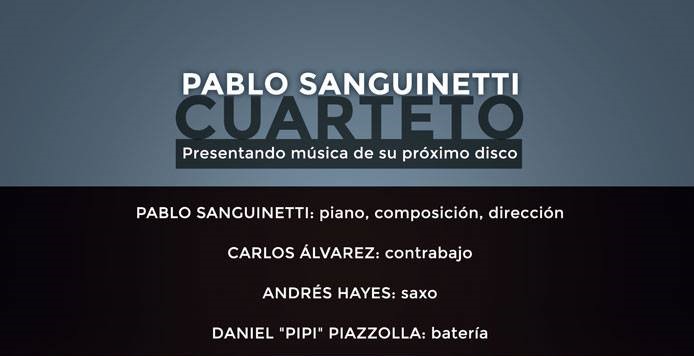
Este hombre es un tipo que nunca para de producir, y hoy en día está terminando de grabar su último disco, Dionisio, acompañado de un bandón. Se va a estar presentando el próximo viernes 6 de mayo en el Espacio Cultural Borges.


Entre los músicos que lo acompañan se encuentra Daniel “Pipi” Piazzolla. “Es un placer estar tocando con el “Pipi”. Es un tipo al que yo admiré toda la vida. La tiene re clara y hace sonar cualquier música a un nivel mayor”, se alegra Pablo. “Pipi” forma parte del Pablo Sanguinetti Cuarteto junto a Carlos Álvarez y Santiago Martínez.

Formaste una banda de puta madre para grabar tu disco y presentarlo. ¿Es fácil congeniar entre tanto cerebro musical todos juntos en un mismo espacio?

Si, la verdad que sí. Mira, lo que creo que tienen estos músicos es mucha experiencia. Entonces es fácil tocar con ellos. Enseguida captan el estilo y lo captan a uno como persona. Tienen mucha experiencia en acompañar solistas, tocan con medio mundo todo el tiempo. Eso les da una flexibilidad tanto en lo musical como en lo humano, es increíble. Son personas súper abiertas, divinas. La grabación fue muy fluida, muy rápida y lo digo en el buen sentido. Esperamos que en vivo suene igual, seguro que sí.

Si uno escucha tu discografía de principio a fin, se percibe como una especie de evolución, de progreso, de variadas experiencias. ¿Te conectas de esta manera con la música a la hora de componer?

Yo creo que sí. Que en todo mi trabajo están presentes mis experiencias de vida. Uno va viviendo cosas y las va volcando al material que va haciendo, que va produciendo. Me pasa que hay experiencias de hace muchos años que recién ahora las plasme en la música. En este disco por ejemplo, hay una canción que es para mi abuelo y otra que cuenta de un viaje a Brasil que hice hace un tiempo con unos amigos. Tal vez para el que hace música comercial es otro el juego, se busca crear otro producto y bueno, ahí no sé. Pero en mi obra yo cuento mucho de mí mismo.

Pablo es un músico muy capaz, un buen compositor y una gran persona. “Cuando tocamos en vivo yo me la paso muy bien, más con tremendos músicos como estos, y como yo la paso bárbaro creo que transmito un poco esa alegría, y la gente piensa: Mira este tipo se está divirtiendo, y la pasa igual”. Sobre su próximo espectáculo, el pianista asegura que, “va a ser un show muy emocional, donde se presentarán temas de Dionisio interpretados por músicos excelentes”. 

En Dionisio se combinan temas con temáticas profundas, algunos otros más oscuros, otros más tranquilos y algunos bastantes melancólicos. Hasta hay un tango. “A esta altura de la vida lo mejor es poder sentir placer por hacer lo que a uno le gusta”, concluye Pablo. Termina su limonada y ríe, siempre ríe.


1. Milongas Blues 05:08
2. No todo es color de rosa 04:48
3. Por segundos veo 03:09
4. Algún dia 04:41
5. Almendron 06:23
6. Concreto 05:08
7. Para Tati 04:44
8. Melo y el rio 05:32
9. Dentro de tus ojos 05:21
10. Trueque 05:46
11. Nisio 05:49
12. Habana Vieja 04:44


+

Andres Chorny (armonica y voz, invitado) 
Pablo Aragona (bateria, invitado) 
Juan Maria Benitez (percusión invitado)


Friday, August 12, 2016

Daniela Schächter explores the Jimmy Van Heusen Songbook on her 4th CD Available September 9, 2016


On Vanheusenism, the Sicilian-born pianist, vocalist and songwriter gorgeously interprets the celebrated songwriter, best known for his work with Frank Sinatra

“The Italian-born Schächter never seemed to run out of ideas. Often unfurling long, cascading runs, she balanced fluid improvisations with a soulful touch, adding subtle harmonic accents here and there…” —Mike Joyce, The Washington Post

“Daniela Schächter cements traditional idioms with modern ideas, and boasts a melodic voicing that is easy on the ears and comfortable on the senses.” – Susan Frances, JazzTimes.com

Performances:

October 18 Sahara Club, Methuen, MA

October 20 at Thelonious Monkfish, Cambridge, MA

October 22 at Chris’ Jazz Café, Philadelphia, PA

October 27 at Kitano in NYC


A gifted composer in addition to being an expressive vocalist and pianist, Daniela Schächter focuses her attention on a single songwriter for the first time in her career on her fourth album, Vanheusenism: A Tribute to Jimmy Van Heusen (due out September 9). The album features 11 tunes from the pen of Van Heusen, one of the most prolific and celebrated songwriters of the 20th century, along with the title track, written as a tribute by Schächter.

Born in 1913, Jimmy Van Heusen wrote dozens of songs that have become timeless standards, several of which are included herein – including “All the Way,” “Darn That Dream,” “Here’s That Rainy Day,” and “Come Fly With Me.” He was best known for his long association with Frank Sinatra (he rushed Ol’ Blue Eyes to the hospital after Sinatra’s failed suicide attempt in the aftermath of his split with Ava Gardner), his collaborations with lyricist Sammy Cahn providing the titles for several of Sinatra’s classic albums from the late 1950s. But he composed hundreds of songs over the course of his long career, writing for film, television and theater and garnering an Emmy and four Academy Awards.

On Vanheusenism, these songs are reinvigorated by a skilled and deftly communicative band, all longtime associates of Schächter’s. Both tenor saxophonist Mike Tucker and drummer Mark Walker are frequent collaborators in the singer/pianist’s adopted hometown of Boston, where she teaches at Berklee College of Music. Bassist Michael O’Brien, who engages Schächter in a playful, spirited duo version of “Call Me Irresponsible,” enjoyed a lengthy trio stint with her during a residency at the New York City club The Garage.

Born in Sicily, Schächter studied at Berklee College of Music and the Henry Mancini Institute at UCLA. She went on to win Betty Carter’s Jazz Ahead Competition in 2002 and the Mary Lou Williams Jazz Piano Competition in 2005, and has performed with influential artists including the Clayton-Hamilton Jazz Orchestra, Terri Lyne Carrington, Patti Austin, Marian McPartland, Regina Carter, Kevin Mahogany, Christian McBride, Tiger Okoshi and Shirley Horn, among others. She has also performed under the baton of such notable jazz and classical conductors as Quincy Jones, Patrick Williams, Jerry Goldsmith, John Clayton Jr., Elmer Bernstein, Bob Brookmeyer, Justin DiCioccio and Phil Wilson.

While she’d performed many of Van Heusen’s songs during her career, Schächter hadn’t looked closely into his repertoire until she was interviewed for Jim Burns’ documentary on the songwriter, Jimmy Van Heusen: Swingin; with Frank & Bing. “Since then I’ve been exploring his music more in-depth,” Schächter says. “His songs have both clever lyrics and intriguing harmonic progressions: appealing to the new generation and the old generation as well.”

Throughout Vanheusenism, Schächter puts her own unique and elegant spin on Van Heusen’s classic songs, often reimagining the songs’ harmonic texture or rhythmic sensibility to make them her own. “Polka Dots and Moonbeams,” for instance, typically rendered as a winsome ballad, takes on a bright mid-tempo pace in Schächter’s version, her harmonic changes capturing the sense of wonder and discovery in the lyrics. Similarly, “Darn That Dream” captures the mystified consternation of the lyrics, Schächter vividly rendering the groggy frustration as dream dissipates into lovelorn wakefulness.


There’s a hint of bossa bounce to “The Second Time Around,” a danger-courting freneticism in “It Could Happen To You,” a simmering pop cool on “But Beautiful,” and a bluesy swing to the album-closing, unaccompanied “I Thought About You.” Knowing when not to mess with perfection, Schächter maintains the breezy, jet-setting spirit of “Come Fly With Me” and the yearning wistfulness of “All the Way.”

Schächter combines “Like Someone in Love” and “Imagination” into a medley, a recognition of the kinds of harmonic patterns that recurred frequently in Van Heusen’s work, making such pairings natural. “Once I started researching, I could see how similar some of his tunes were to one another,” Schächter says. “But at the same time, every tune was completely different. Melodically he could really develop the ideas in different ways, with very interesting musical details, despite the similarities between some of the tunes.”

She added a new intro and outro to “Here’s That Rainy Day,” which opens the album, and contributed a brand new song in the composer’s recognizable style. “Vanheusenism” combines several elements gleaned from Van Heusen’s oeuvre (check the motif that the bass and sax play in unison, for instance) into a new love song featuring a romantic solo by Tucker.

While Vanheusenism marks Schächter’s first foray into Songbook territory, it follows her previous releases in building an album around a unifying central concept. Her last release, Purple Butterfly, focused on the feeling of loneliness and yearning through changing seasons, moving thematically through nearly a full calendar year; its predecessor, I Colori Del Mare, was centered on her Sicilian motherland.

 “I like to make an album sound connected, with a definite direction, so a listener understands immediately what I’m trying to deliver,” Schächter explains. “In this case, Vanheusenism is my way of representing an expression that comes from listening to and playing his tunes all the time.”

It’s also a way of looking back at a bygone era, when singers and songwriters were two different creatures, each an expert in their own unique form. “Now we have songwriters who do everything: they sing, they compose, they write lyrics,” says Schächter, who can certainly count herself in that category. “Back then how music was made was so different. The result is that the songs are amazingly written and are still played after so many years. The ideas are still so strong and the melodies are still so interesting. I’d like to keep that tradition alive and perform those tunes in a way that might interest a new generation.”


Faïz Lamouri - Wonders (2016)


French saxophone player Faïz Lamouri began the study of saxophone and music at a very early age. After eight years of classical studies, he became interested in jazz through musicians like Paul Desmond, Lester Young, Charlie Parker, Sonny Rollins and John Coltrane.

Faïz received a scholarship in 2008 to attend the prestigious New School for Jazz and Contemporary Music in New York. There he refined his craft with internationally renowned jazz musicians including Mark Tuner, Reggie Workman, Abraham Burton, Joel Frahm, Vincent Herring, Wayne Escoffery and Andy Milne. Faïz graduated with honors in May 2011 from the New School.

In New York, Faïz also performed regularly with his own band in famous Jazz venues. He was notably featured at the Iridium Jazz Club as part of their Rising Stars Series. Faïz moved back to Paris in 2013 and continues to perform in Jazz clubs and Festivals around the world.

Comprised mostly of his original compositions, his debut album transports the listener into a highly captivating and creative musical universe. It also brings together world class musicians such as bassist Vicente Archer and drummer Damion Reid as well as talented Italian pianist Sam Mortellaro.

Vicente and Damion play together since the early 2000's and are an essential part of today's jazz scene. Just like them, Faïz and Sam shared the stage around the world for many years. The recording of this album was thus a true dialogue between musicians who share a deep connection.

Jazz is created in the moment and with great complicity. It is an essential condition for it to convey sincere and intense emotions to the listener. And that’s exactly what Wonders do.


Open Dream
Onyr
Blue Waltz
Songe
Project 13
Alice in Wonderland
Bustling
Reveries
Wanderer

Faïz Lamouri: tenor saxophone
Sam Mortellaro: piano
Vincente Archer: bass
Damion Reid: drums

BUY THIS ALBUM

Tuesday, August 9, 2016

Jacám Manricks Band - Chamber Jazz (2016)


Collection of original compositions and two reinterpretations by New York Jazz artists. Chamber Jazz combines traditions from Jazz with Classical Music and their many sub-genres. In addition, the influence of world music is present. Influence from specific artists such as Miles Davis, Beethoven, Milton Nascimento, Jean Sibelius, Charlie Parker, Ornette Coleman.

Jazz and Classical hybrid style also drawing from traditional folk and world music.


1. Thread 08:12
2. En Etsi Valtaa Loistoa (Julvisa) I Seek No Power or Glory 06:38
3. ECMish 10:06
4. Wandina 07:53
5. Mood Swing 08:27
6. Jazz, Classical Music, Miles Davis, Beethoven, Milton Nascimento, sibelius, World Music, - Beethoven 06:45
7. Deception 06:33
8. Forbidden Fruit 04:50
9.. Cry 07:10
10.. Cloud Nine 04:43

Released August 7, 2016 

Jacám Manricks, sax / winds and composition 
Kevin Hays, piano and fender rhodes 
Gianluca Renzi, bass 
Ari Hoenig, drums

BUY THIS ALBUM

Monday, August 8, 2016

Satoh Masahiko Trio - Hyojun Gigaku (2016)


Satoh Masahiko Trio - Hyojun Gigaku (2016)

1. Mon Beulk
2. Well I Need It
3. Loeo
4. Whatever!
5. Interlude to a Kiss
6. My Fave Rave
7. Not Bad for Me
8. 'S One to Fool
9. March 14th
10. It's All Night with Me
11. Ais Inut
12. Ant Steps
13. Satanic Doll
14. Pumpkin Man

Masahiko Satoh: piano
Shinichi Kato: bass
Hiroshi Murakami: drums

Recorded by Takashi Akaku at Onkio Haus Studio 1, February 24 and 25, 2016
Mixed by Takashi Akaku
Mastered by Wataru Ishii at Onkio Haus Mastering Room
Produced by Masahiko Satoh
Design by Makoto Wada
Includes a 12-page booklet with liner notes by Masahiko Satoh in Japanese and English (translation by Mike Molasky)

Released in June 2016


Alfonso Peduto - Sequences (2016)


Sequences is a set of 6 pieces written for 'automated live looping': the sound of the piano is fed realtime to software programmed to trigger looping at specific instances (record/play/stop). The set is written for an increasing number of pianos, where the instrumentation of each composition is determined by its numerical collocation on the set (Sequence I for one piano, Sequence II for two up to Sequence VI, for six pianos). 


1. Sequence I: Waves (1 Piano) 5:41
2. Sequence II: Pulses (2 Pianos) 6:55
3. Sequence III: Echoes (3 Pianos) 7:40
4. Sequence IV: Voids (4 Pianos) 8:52
5. Sequence V: Vertices (5 Pianos) 10:54
6. Sequence VI: Variances (6 Pianos) 10:59


Sequence I: Waves (1 Piano - a prelude to Live Looping) from Alfonso Peduto on Vimeo.

Reis / Demuth / Wiltgen - Places in Between (2016)


Pianist Michel Reis, bassist Marc Demuth and drummer Paul Wiltgen formed the Reis-Demuth-Wiltgen Trio in 1998 while still in high school and performed on a regular basis in and around Luxembourg (their home country) for a couple of years. The trio reunited in 2011 and released their self-titled first album on Laborie Jazz (France) to widespread critical acclaim. Since the release, the band has toured extensively throughout the world and has appeared at major international jazz festivals in Europe and Asia. The band's sophomore album "Places In Between" was recorded in New York City and released on the German label Double Moon Records (Laborie Jazz/France, Mocloud Records/Japan).

Reis Demuth Wiltgen are presented with the kind support of the Consulate General of Luxembourg in New York.


Michel Reis, piano

Marc Demuth, bass

Paul Wiltgen, drums

1. Small Talk
2. Cross Country
3. Bleecker Street
4. Where the Heart Beats
5. Kamome
6. Bored and Briliant
7. Joule's Last Glimpse
8. The Story of You and Me
9. Shai
10. Surreal Kinda Deal
11. Kilonova
12. Me Dire

BUY THIS ALBUM