Friday, October 13, 2017

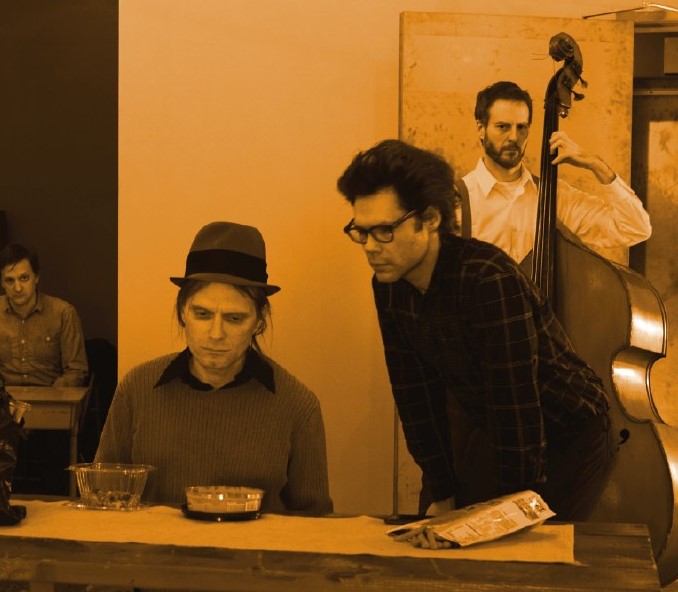
Benjamin Petit, l'album 5 Degrés Sud // Invitation au Pan Piper le 20/10


Benjamin Petit,
Nouvel album 5 degrés Sud
Sortie le 20 octobre chez French Paradox/Antipodes Music
En concert le 20 octobre au Pan Piper


Pour être invité le 20 octobre au Pan Piper, merci de confirmer votre présence !

Après de multiples collaborations artistiques (Michel Jonasz, Eric Legnini, Lionel Richie, No Jazz, Hadrien Feraud, Benjamin Henocq Quartet), le saxophoniste Benjamin Petit présente le 20 octobre 5 Degrés Sud, son premier album comme saxophoniste leader et compositeur.

Enregistré avec l'appui d'André Manoukian à Chamonix, 5 Degrés Sud dévoile le jeu fluide et aérien de Benjamin Petit qui a composé dix compositions originales de haut vol. Une évidence pour ce musicien par ailleurs pilote de ligne, qui file la métaphore volante tout au long d'un album sur lequel il s'est entouré de Jerry Leonide (piano), Zacharie Abraham (contrebasse) et Francis Arnaud (batterie).


Après une carrière de sideman dans l'univers de la pop aux côtés notamment de Michel Jonasz ou Lionel Richie, Benjamin Petit, personnage aux multiples facettes, présente "5 degrés Sud" son premier album d'artiste saxophoniste leader et compositeur.

Entouré d'une solide équipe: Jerry Leonide (piano) Zacharie Abraham (contrebasse) Francis Arnaud (batterie). Cet opus enregistré sous le parrainage d'André Manoukian à Chamonix dévoile l'univers jazz aérien de ce saxophoniste au travers de dix compositions originales qui évoquent souvent son autre passion : l'aviation.

En effet, en plus du saxophoniste émérite et désormais jeune leader d'un quartet prometteur, Benjamin se réalise aussi comme pilote de ligne, commandant de bord sur Boeing 737.

Autant dire que ce personnage atypique qui possède aujourd'hui deux solides cordes à son arc, cultive une détermination sans faille qui s'entend dès les premières notes de ce disque.


Benjamin Petit a collaboré au cours de sa carrière avec : Michel JONASZ, André MANOUKIAN, Flavio BOLTRO, Eric LEGNINI, Michael LEAGUE,  Larnell LEWIS, Bobby Ray SPARKS Jr, Paco SERY, Didier LOCKWOOD, le groupe No JAZZ.

Jerry Leonide : Piano 
Zacharie Abraham : Contrebasse 
Francis Arnaud : Batterie 
Sylvain Gontard : Bugle & Trompette sur "Liam"et "I Taw A Putty Tat" 

Enregistré à la Maison des Artistes d'André Manoukian à Chamonix par Nicolas Falque et Balthazar Varin

En concert au Pan Piper le 20 octobre 2017, 2-4 Impasse Lamier, 75011 Paris

CONCERTOS PORTA-JAZZ: Este Sábado 14 de Outubro MIKE MORENO TRIO - Sala Porta Jazz !

MIKE MORENO TRIO -  WORKSHOP + CONCERTOS

14-Outubro Mike Moreno Trio - Sábado Sala Porta Jazz 

Workshop -  17.00h - 18.00h 
Concerto - Duas sessões que iniciam às 19:00h e às 22:00h

Mike Moreno é uma figura que dispensa apresentações. O norte americano é reconhecido como uma das mais predominantes vozes da guitarra no jazz, tanto como líder ou como sidemen.

Tem participado com figuras de renome mundial tais como Joshua Redman Elastic Band, Lizz Wright Band, Nicholas Payton Quartet, Stefon Harris Sonic Creed, Me'Shell N'Degeocello, Jason Moran, Terence Blanchard, Robert Glasper, Ambrose Akinmusire, Gretchen Parlato, Aaron Parks, Claudia Acuña, Greg Osby 4, Wynton Marsalis and the Jazz At Lincoln Center Orchestra, Jeff "Tain" Watts, Jeremy Pelt, John Ellis, Myron Walden, Kenny Garret, entre muitos outros.

Neste dia vem apresentar na PortaJazz musicas do seu ultimo trabalho "Lotus", Imperdível.


Mike Moreno - guitarra
Demian Cabaud - contrabaixo
Marcos Cavaleiro - bateria


Neste workshop, Mike Moreno vai partilhar com os presentes as suas experiências como sidemen de artistas como Wynton Marsalis, Joshua Redman ou Kenny Garret. Falará da sua abordagem harmónica / melódica tanto nos standards como nos originais e a interação entre a secção ritmica e os solistas.

Tópicos como Improvisação, comping , composição e de como gerir uma carreira musical nos dias que decorrem também serão abordados.

Será uma oportunidade unica para interagir com uma das vozes mais predominantes da actualidade na guitarra jazz Nova Iorquina.


Tim Miller Trio - Vol. 3 (2017)


The compositions and performances on this album are top notch, but when the album ended after only 38 minutes, I assumed I hadn't put all the songs in the player. Alas, beautiful and exciting music, but not nearly enough of it. So much less than on his last two albums. 5 stars for the music, but only 3 stars for the brevity of the listening experience which was truly a letdown.

1. Lift 5:07
2. Stowed 3:51
3. New York 6:06
4. Roller Coaster 3:03
5. Breathe 5:44
6. RB 6:49
7. Up the Steps 3:20
8. Three Sides 3:37

SAM MINAIE bass
NATE WOOD drums

Gary Peacock Trio – Tangents (ECM 2017)


Some of Gary Peacock’s finest music has been made in piano trios. Early in his musical life, Peacock established a fresh role for the bass as an independent melodic voice, a concept carried forward in the history-making groups he’s played with – from Paul Bley’s Bill Evans’s trios to Keith Jarrett’s. As a bandleader he has also been influential: Tangents is the second release from the great bassist’s trio with Marc Copland and Joey Baron and draws on years of shared playing in diverse contexts. All three band members contribute compositions, Peacock’s including “December Greenwings”, revisiting a piece Gary introduced on his ECM recording December Poems. Repertoire includes five tunes from Peacock, two from Baron, one from Copland, and an outstanding group improvisation, “Empty Forest”. The trio also plays Miles Davis’s “Blue In Green” and, perhaps surprisingly, Alex North’s theme for the film Spartacus, which also proves a fine vehicle for improvising.  Tangents was recorded in Lugano in May 2016, and produced by Manfred Eicher.

1 CONTACT (Gary Peacock) 06:39
2 DECEMBER GREENWINGS (Gary Peacock) 04:50
3 TEMPEI TEMPO (Gary Peacock) 04:10
4 CAULDRON (Joey Baron) 02:29
5 SPARTACUS (Alex North) 05:10
6 EMPTY FOREST (Gary Peacock, Joey Baron, Marc Copland) 07:11
7 BLUE IN GREEN (Miles Davis) 04:42
8 RUMBLIN' (Gary Peacock) 04:07
9 TALKIN' BLUES (Marc Copland) 04:04
10 IN AND OUT (Joey Baron) 02:53
11 TANGENTS (Gary Peacock) 06:50

Gary Peacock   Double Bass
Marc Copland   Piano
Joey Baron   Drums


Paa Kow - Cookpot (October 13, 2017)


Polyglot Polyrhythms: The High-Energy Drum-Powered Highlife, Funk, and Jazz Jams of Paa Kow

"Ghana's most artistic drummer." - Modern Ghana

"Paa Kow has taken the world music of his native Ghana, and tossed it into a basket with heaps of American influences to create an album that the great purveyors of world music - the Paul Simon's and the Bela Fleck's of the world - would envy." - Marquee Magazine

“Take the beat of Ghana’s traditional sound, add some American flavor, and mix it with Paa Kow’s stellar drumming chops. That is the musical recipe for a flavoursome sound." - Soul Safari

“The drumming makes the music such a captivating and bewitching listen, and that’ll make you want to dance along to the infectious rhythms.  This is proper fusion music." - Louder Than War


Colorado-based drummer Paa Kow speaks a dozen musical languages, from the deep rhythmic traditions of his native Ghana to the patois perfected by the likes of George Clinton and George Benson. “My music isn’t traditional, but it has deep roots. I want to invent my own style,” he explains. “The highlife music is there, but when you listen, it’s kind of jazz, too. It’s funk. It’s the way the music comes to me.”

Whatever the style, Paa Kow’s tracks hit the sweet spot between addictive groove and delectable complexity on his latest album, Cookpot (release: October 13, 2017). Lines shift and lock, all entwined with Paa Kow’s effortless precision, showcased prominently on solo track “Details.” “Forced Landing” switches from funk to highlife and back again, while tracks like “P??t?? P??t??” and “Meetu Ehum” speak loudly to Paa Kow’s Ghanaian side. 

“I feel like music is all about the ingredients. You have different backgrounds, someone from the US, from Europe, from Ghana,” muses Paa Kow. “Then the pot part, that’s the container, the way the groove set. It’s like something’s boiling on the fire. The whole album brings together all these different energies and inspirations together.”


aa Kow knows how to harness these varied energies, blending differences in his own unique way. Two years ago, for example, Paa Kow headed back home, to rural Ghana. He wanted something rare: A traditional drum set. Paa Kow knew exactly what size, what drums. He tracked down a drum maker who was up to the task. 

“We had talk a lot about it. It was hard to find a bass drum that big. The makers told me ‘We don’t think we can get this for you,’” Paa Kow recalls. “One day, I woke up and they told me they had found a tree. The bass drum is made from a single tree. It gives me a really nice sound that I love. It’s the same drum kit I used on the album.” 

Paa Kow was used to crafting his own kit, something he did obsessively as a small boy, using whatever he had on hand, old buckets, cans, sandals, anything. From a musical family, he grew up living and breathing music, to the point he would stow away in a bass drum in hopes of getting to gig with his relatives instead of going to school. With time, he became a regional whizkid, eventually landing in Accra and gaining a reputation for astounding playing, despite his youth. 

There he met another young percussionist, American Peyton Shuffield, who was visiting Ghana as part of a semester abroad. He kept hearing about this young, brilliant drummer and sought out Paa Kow as a teacher. The two hit it off. Their friendship opened a door for Paa Kow, who came to Colorado at first to teach, and then to live and play.


He settled in the Denver area and decided to start a band to play his original music. “I had lived in Ghana my whole life. I’d played with successful bands and toured Europe. But I trusted this was what I wanted to do. I wanted to spread my music,” says Paa Kow. “I love Colorado, and there’s lots of opportunity if you want to take advantage of it. I’ve played with a lot of different musicians, and some of them come and go. But I write my own songs, and gradually it’s leading me where I want to be.”

Where he’s going requires fellow travelers, ones passionate about learning all they can about Paa Kow’s musical worlds. “I believe that music is a language. But it’s not universal, you have to learn it. You learn, oh, you don’t say that in our language. It’s a conversation. You don’t have to be from Ghana, say to learn my language,” notes Paa Kow. “When the musical skills are there, I have been able to get American musicians to speak the same language I speak. They love what I do, and what they do. It makes it a lot easier.”

Dedication to music “is like breathing,” adds Paa Kow. “I didn’t go to music school to start playing. The more I learn, the more it comes to me. I love every minute of it.”


REPUBLIC BAR
WED, DEC 6 @ 8:00 PM No 4 Asafoaste Tempong St , Accra, Ghana

REPUBLIC BAR
WED, JAN 3, 2018 @ 8:00 PM No 4 Asafoaste Tempong St , Accra, Ghana


Schnellertollermeier - Rights (CUNEIFORM RECORDS 2017)


A Stunning Album of Immense Depth and Beauty and Unfathomable Power, Swiss Power Trio & Singular Musical Organism
Summon Jazz Magic, Minimalist Focus, and a Progressive Attitude Towards Music’s Universe to Breathe new Life into Rock Forms, Creating a New, 21st Century Specie


Clarity. Attitude. Skill. These really aren’t qualities that define our present time. All too often, our ephemeral reality finds itself reflected in a jittery retro-music that sucks its data from the Cloud that atomised archive accessible to all.

Schnellertollermeier’s fourth album, to be released October 2017 by Cuneiform Records, is their reply to all this: Rights, and it offers ample demonstration of their own clarity and ability. Rights comprises four pieces, every one of them inscribed with radicalism. Each is built on just a few ideas and develops out of them until it sounds like a Cubist work of art that seems to gaze out from the most varied of perspectives, but always in the same direction. This is the key to the immense depth and beauty of this album. Apart from the fact that it simply blows you away.

Schnellertollermeier still has its original line-up: Andi Schnellmann (bass), Manuel Troller (guitar) and David Meier (drums). These three musicians attended jazz schools in Switzerland and Scandinavia and have been working together as a band for more than ten years. And although they today live in different towns in Switzerland, their collaboration is even more intense than in their early years. After Holz (2008) and Zorn einen ehmer üttert stem!! (2010) it was above all their third album, X (2015), their first release on Cuneiform, that took the band onto a different level, both in compositional and career terms. Whereas Schnellertollermeier had until then played some 20 concerts per year, today it’s 40. X was named one of the 12 most important records of the year by the Wall Street Journal, and the trio went on tour in the USA, Great Britain, Russia and the rest of Europe.

You could say that Rights is the result of this process of consolidation. Schnellertollermeier has an immense presence that’s the first thing you notice. Initially, you only hear concise, repetitive patterns, but you can already feel their powerful energy while performing, their will to play out and not to yield to any ceremonial, reductionist modes.

The pressure is high, their concentration levels too, and their energy levels aren’t a sudden spasm but a prerequisite. This music is complex, but never so much so that the band couldn’t play it with something in reserve. That keeps their music open and free for themselves, and also for those who hear it. Schnellertollermeier is never brash. They regulate the intensity of their sound with the highly controlled nuances of a precision engineer handling thumbscrews. They never discharge an impertinent punch instead it’s outstretched, held out, and offered up.


This new album was made in 2016 during the band’s residency at the cultural centre “Südpol” in Lucerne. Schnellertollermeier composed and rehearsed in the different rooms of the house, and presented their interim results in a series of concerts. They sketched out their material, adapted it, took it apart, and blew it up. This was an intentional dissolution of all boundaries for purposes of concentration. The stress test of playing these pieces live helped to make them better: not because Schnellmann, Troller and Meier paid particular attention to what people said after their performances, but because they themselves noticed on stage where the new tracks felt good and where they didn’t. Thus the four pieces on Rights developed over five months and eight concerts before they were all recorded on the spot. Two or three finished tracks were dropped; what remained was “Rights”, the title piece, “Piccadilly Sources”, “Praise/Eleven” and “Round” four pieces ranging in length between 6 minutes 58 seconds, and 13 minutes 20 seconds.

If we compare Rights with the earlier albums by Schnellertollermeier, it is immediately apparent how little it sounds like improvised music or “jazz”. In others of their many bands, Schnellmann, Troller and Meier still regularly play that kind of music with abandon. But here, we detect their expertise in jazz and improvisation primarily in how they take a rock riff in “Piccadilly Sources” and twist and turn it around, or how, in “Praise/Eleven”, these three musicians turn high, diaphanous sounds into filigree sculptures like freely hovering mobiles. Then there are times when the band sounds like a classic power-rock trio but one that’s not merely a platform to showcase three soloists. No, Schnellertollermeier is a morphing organism.

There are no solos here, no show-offs, for their sound remains that of a straight-up-and-down band. They move through minimal patterns and ambient zones, they build up into brutal rock and arrive more than once on the dance floor with a kind of nimble, danceable headbanger music.

It is astonishing how natural it all sounds. How little Schnellertollermeier’s music sounds like crossover music or some other mind game. This is not least because the band constructs each of its pieces from the bottom up, using one or two clearly defined motives that remain throughout and leave their mark on the piece. Every note has a function, every element is the prerequisite for the next. These pieces are long, but they aren’t suites. Instead, the band members asked themselves: what form will emerge if we take a single idea, think it through consistently, and play it? The electric sound of the guitar has already been composed “into” these electronic textures right from the start. Brutal backbeats rise up out of the serial structure and are expanded and radicalised by the band. Riffs push the tracks over the edge, but then open up for drones and overtone concerts; then they draw themselves in again and push the piece onto the next level. Whoever thought that rock was as dead as a dinosaur will here experience the birth of a highly alert, viable new species.

This works because Schnellmann, Troller and Meier are not jazz musicians simply kowtowing before rock music and refining it. They belong to a generation that grew up with grunge, hip-hop and electronic club music, and they learnt it all by osmosis. Whoever personally knows these three musicians has probably gotten to know them at someone else’s concert in the bar during a performance of a singer-songwriter or at an improvisers’ retreat, at a big indie event or at a club night or at a dance performance where you chat afterwards about the impact of rhythms and repetition. If Schnellertollermeier is able to hold its own at jazz festivals from Willisau to Moers and Cheltenham as well as in rock and metal clubs or at a festival of contemporary music, then it’s because they know what they’re playing. They know it, and they believe in it. You can call this clarity; or you can call it skill. Or attitude.

1. Rights 13:16
2. Piccadilly Sources 06:59
3. Praise / Eleven 08:22
4. Round 10:38

Andi Schnellmann - bass 
Manuel Troller - guitar 
David Meier - drums 

Rights was recorded in July 2016 at Südpol Lucerne 
Engineered and recorded by Alan Benz 
Mixed by Manuel Egger and Schnellertollermeier at Suburban Sound Studio, Winterthur 
Mastered by Greg Calbi at Sterling Sound NYC 
Cover design by Camillo Paravicini | Published by Cuneiform Records 2017 | Produced by Schnellertollermeier 

All music and arrangements by Schnellertollermeier 
Rights by Manuel Troller 
Piccadilly Sources and Praise / Eleven by Andi Schnellmann, Manuel Troller, David Meier 
Round by David Meier


BAND BIOGRAPHIES

ANDI SCHNELLMANN
Besides Schnellertollermeier, Andi Schnellmann plays with the pop bands Henrik Belden and Monotales as well as with the minimal jazz quintet Akku. He is in demand as a sideman and is regularly booked for studio recordings. He can also be heard on Christy Doran’s 144 Strings for a broken chord and in the quartet of the writer Michael Fehr.

He has toured Europe, Russia, Siberia and the USA.

COLLABORATIONS with Sophie Hunger, Christy Doran, Bruno Spörri, Caroline Chevin, Serpentine, Khasho’gi, Jack Gordon Group, Martina Linn, Pamela Mendez, Seven, Hans-Peter Pfammatter, Merz, etc.

FESTIVALS / CONCERTS such as the Montreux Jazz Festival (CH), Jazz Festival Willisau (CH), Jazz Festival Schaffhausen (CH), 12 Points Festival (IRL/S), Open Air St. Gallen (CH), Open Air Gurten (CH), Open Air Gampel (CH), Heitere Openair (CH), Hallenstadion Zurich (CH), La Cigale Paris (F), The Vortex London (UK), Jazz Workshop Graz (A), Zemlika Festival (LV), KKL Lucerne (CH), Suisse Jazz Diagonales (CH) and others.

MANUEL TROLLER (www.manueltroller.com)
Through pushing the boundaries on his instrument with preparations, extended techniques, sound manipulation and a fine sense for the moment, Troller has become one of the most in-demand guitarists in Switzerland. Besides his work with Schnellertollermeier, Troller works as a solo artist, in close collaboration with the writer Michael Fehr, and he plays free improvisation with the bands Tree Ear Trio with Gerry Hemingway and Sebastian Strinning (Clean Feed) and Le Pot (Everest Records). He also performs in a duo with the drummer Julian Sartorius.

He has toured throughout Europe, the USA, Russia and Siberia.

COLLABORATIONS with Sophie Hunger, Gerry Hemingway, Nik Bärtsch, Julian Sartorius, Hans Koch, Frantz Loriot, Stephan Eicher, Merz, Michael Fehr, Ensemble Neue Musik Zürich, Christian Weber, Fred Lonberg-Holm, Martin Schütz, Christoph Erb, Philipp Gropper, Keefe Jackson u.v.a.

FESTIVALS / CONCERTS such as the Montreux Jazz Festival (CH), Glastonbury Festival (UK), Olympia Paris (F), Haldern Pop Festival (D), North Sea Jazz Festival (NL), Jazz Festival Willisau (CH), London EFG Jazz Festival (UK), Cheltenham Jazz Festival (UK), Jazz Festival Moers (D), Café OTO (UK), Bad Bonn Kilbi (CH), Enjoy Jazz Festival Mannheim (D), International Theaterhaus Jazz Days Stuttgart (D), Zemlika Festival (LV), Leipzig Jazz Days (D), 12 Points Festival (IRL/S), Match & Fuse (UK), Jazz Festival Skopje (MK), The Vortex (UK), Jazz Festival Schaffhausen (CH) and others.

DAVID MEIER (www.d-meier.ch)
David Meier’s energetic playing and organic sound have made him an in-demand drummer in Switzerland and beyond its borders. Besides his work with Schnellertollermeier, he explores the possibilities of percussion in the context of free improvised music in a trio with Alfred Zimmerlin and Flo Stoffner and in the band Things to Sounds (both on WideEarRecords). He directs the quintet Hunter-Gatherer and plays in the bands Day & Taxi (Percaso), Leon and Equally Stupid (FIN, Eclipse Music).

He has toured throughout Europe, the USA, Argentina, Chile, Russia, Siberia, China and Japan.

COLLABORATIONS with Mette Rasmussen, Ingrid Laubrock, Axel Dörner, Frantz Loriot, Sam Andreae, Mikko Innanen, Colin Vallon, Lotte Anker, Philipp Gropper, Ohad Talmor, Kalle Kalima, Liz Kosack, Donat Fisch, Christian Weber, Christoph Erb, Pauli Lyytinen and many more.

FESTIVALS / CONCERTS such as the Jazz Festival Willisau (CH), Cheltenham Jazz Festival (UK), Moers Festival (D), 12 Points Festival (IRL/S), Pori Jazz Festival (FIN), Bad Bonn Kilbi (CH), unerhört! Festival (CH), Jazz Festival Schaffhausen (CH), B-Sides Festival (CH), Match&Fuse Festival (UK), A L’ARME Festival (D), Leipzig Jazz Days (D), Zemlika Festival (LV), Arhus Jazz Festival (DK), South Tyrol Jazz Festival (I), Ai Confini Tra Sardegna e Jazz (I)


Stefano Battaglia - Pelagos (ECM 2017) 2-CD


David Bressat - Alive (2017)


Pianiste, compositeur et arrangeur, David Bressat est présent depuis plus de 15 ans sur la scène jazz en France et à l’étranger. Il a joué aux côtés de musiciens de renom tels que Marcus Strickland, Dave Liebman, Dee Dee Bridgewater, Christian Escoudé, Nelson Vera...

Après avoir enregistrés 3 albums en trio et en studio, entourés par les fidèles Florent Nisse à la contrebasse et Charles Clayette à la batterie, David Bressat nous livre dans ce 4ème album un projet plus organique et plus réel, un enregistrement en live et en quintet, avec Eric Prost au saxophone et Aurélien Joly à la trompette.

Dans « Alive », le quintet joue et rentre en interaction avec le public, offre à l’auditeur l’intimité d’un son qui s’élabore devant lui. Chacun peut sentir le souffle des cuivres, deviner les improvisations qui se dessinent, sursauter au gré des humeurs d’une rythmique enragée, entre forces et fragilités, soleils et ombres, au cœur du cheminement artistique...

Album enregistré en live au Crescent – Mâcon, le 8 mars 2017. Compositions // David Bressat

01. Tous les choix
02. Cocoon
03. Nuages
04. Shake Everything
05. Méditation
06. 5 à 6
07. Pastel Song

David Bressat : piano, compositions, arrangements
Florent Nisse : contrebasse
Charles Clayette : batterie
Eric Prost : saxophone
Aurélien Joly : trompette

Thursday, October 12, 2017

Jonathan Saraga - Lourney to a New World (FRESH SOUND RECORDS 2017)

Manhattan, NYC native, trumpeter and composer Jonathan Saraga has been said by All About Jazz to possess the musical “wisdom and maturity of veterans more than twice his age,” and that “his chops, lust for musical life and don't-box-me-into-a-stylistic-corner mentality make him seem like the musical offspring of trumpeters Dave Douglas and Ambrose Akinmusire."

Jonathan's professional music career officially began in 2002 when he was cast as an orchestral trumpeter in the Paramount film, Changing Lanes. That same year he would begin performing at the Jazz Standard (NYC) with their Youth (jazz) Orchestra. In '05, after receiving the Fred Mazart Music Award as he began his collegiate studies, Jonathan Saraga would win the 2007 International Trumpet Guild Jazz Solo Competition, and shortly after receiving his Bachelor of Music degree, he competed again, this time as one of five finalists in the 2009 Carmine Caruso International Jazz Trumpet Competition. Saraga was also one of two trumpeters selected from an international pool to participate in the 2010 School for Improvisational Music summer intensive program, just before completing graduate school. Read more...

01. Uprising 9:28
02. The Great Journey 10:52
03. Firm Roots 8:56
04. Sabbath Prayer 9:53
05. The Guardians 8:49
06. Lullaby 7:16
07. The Fool On the Hill 9:17
08. New World 9:29

All tracks composed and arranged by Jonathan Saraga, except #3 composed by Cedar Walton, #4 by J.Bock-S.Harnick and #7 by J.Lennon-P.McCartney


Jonathan Saraga (trumpet)
Remy Le Boeuf (alto sax)
Aki Ishiguro (guitar)
Chris Pattishall (piano)
Rick Rosato (bass)
Kenneth Salters (drums)

Recorded at Peter Karl Studios, New York City, on November 25, 2015

Recording Engineer: Peter Karl
Mastering by Dave Darlington at Bass Hit Recording
Photos by Tayla Nebesky

Produced by Jonathan Saraga
Executive Producer: Jordi Pujol

Wednesday, October 11, 2017

Mostly Other People Do the Killing - Paint (out Oct. 20 on HOT CUP RECORDS)


Moppa Elliott’s Mostly Other People Do the Killing
Presents Paint


DownBeat Critics’ Poll Winners: Rising Star Ensemble
El Intruso Best Band to see Live, 2013
El Intruso Jazz Group of the Year, 2011

“With each album, [MOPDtK’s] reach gets deeper and more convincing.” – Mike Shanley, JazzTimes

“The group that has always straddled the broad and fuzzy line between tradition and chaotic improvisation, has nevertheless managed that process with a mixture of sophistication, revelation and unbridled enthusiasm.” – Karl Ackermann, All About Jazz

Featuring: Ron Stabinsky (Jazz Journalists Association Best Debut Album, Free For One), Moppa Elliott (DownBeat Critics’ Poll Rising Star Bassist, Composer, Arranger), Kevin Shea (2012 Best Drummer, Village Voice)

Upcoming Performances:  • October 13 – Seattle, WA   • October 15 – Los Angeles, CA

Hot Cup Records is proud to present Paint, the first release by the piano trio configuration of Mostly Other People Do the Killing. Paint features seven new compositions by bassist/composer Moppa Elliott written after pianist Ron Stabinsky joined the ensemble in 2014. Also featured on the recording is drummer Kevin Shea. Each composition on the album is named after a small town in Pennsylvania that contains a color, and the town of "Paint, PA" lent its name to the title. All of the compositions are by Elliott, except "Blue Goose" which was written by Duke Ellington who apparently also had a fondness for strangely named places in the Keystone State.

Jazz listeners often remark that the piano trio format allows each of the members more space than other, larger ensembles, but in the case of MOPDtK, their unrestricted style is instantly recognizable in configurations ranging from trio to septet. The trio does afford each member more time in the spotlight, and none more than pianist Stabinsky who provides the lion's share of lead and solo work here. Elliott continues to eschew bass and drum solos, utilizing them only in compositionally specific sections of music.

The album opens with the lilting "Yellow House," a composition consisting of four distinct sections and a melody that recalls the hard bop era of the 1950s.  The solo form of the composition alternates between the initial melody and an Afro-Cuban feel in a minor key.  Stabinsky's solo builds to a climax and dissolves the form before bassist Elliott restates the opening theme. The interplay between the members of the trio is easy to hear as drummer Shea and Stabinsky exchange high-pitched interjections.

The slow blues "Orangeville," written in 5/4 time, has undergone several revisions and represents the oldest composition on the recording. First composed for the original pianoless quartet configuration of the band, the tune was heavily rewritten for the band's current incarnation. The two solo sections are over vamps and Stabinsky was instructed to "play as many notes as possible" at the beginning of his improvisation before cuing a modulation leading to the bass solo.

"Black Horse" is based on a rising chord progression that provides the framework for both the opening vamp and the first melodic statement. The bridge of the tune is more blues-based and draws from the compositions of post-bop musicians of the 1960s. The ensemble maintains the up-tempo groove and moves through the different sections of the form before becoming stuck on a two-chord vamp which Elliott escapes by restating the melody. 

The Duke Ellington composition "Blue Goose" may or may not be named after the eponymous location in Pennsylvania, but Moppa Elliott hopes so. Regardless, Elliott composed a piece with this title only to find out that America's greatest composer already beat him to it. He changed the name of his composition to "Whitehall" (since the titles have nothing to do with the music, anyway) and decided to record a trio version of Ellington's piece. The original recording was made by the "Blanton/Webster" version of the Duke Ellington Orchestra in 1940 and adapted for trio by Elliott.

The slow, minor key waltz "Plum Run" begins the second half of Paint. Elliott states the initial theme and takes the first solo over a form that alternates between a diminished chord section and the changes to the A section. Again, Stabinsky's solo builds to a spectacular climax before returning to the mellow, bluesy theme.

"Green Briar" is an up-tempo tune based on several repeated note figures that are harmonized in a variety of ways. This performance serves as a vehicle for Stabinsky to improvise over a repeated form with relatively stable harmonic and rhythmic support.

The last composition written for this album was "Golden Hill," a lyrical melody in triple meter. The melody is played first by the piano followed by the bass with extensive embellishments featuring tremolos and other flurries of notes. This may be the most lyrical playing ever heard on a MOPDtK record, but the ending interplay between Shea and Stabinsky eventually removes any trace of sentiment.

The album ends with the aforementioned "Whitehall" that began life as Elliott's "Blue Goose."  The piece consists of a single melody that is reharmonized and expanded each time it is stated with short interludes in the key of A. The solo form incorporates all of the harmonizations of the melody as well as an open section over the note "A" used as a pedal-point.


Over the past thirteen years, MOPDtK, led by bassist/composer Moppa Elliott, has earned a place at the forefront of jazz and improvised music, performing in a style that is at once rooted in the jazz tradition and highly improvised and unstructured. Billed as a "Bebop Terrorist Band," their music melds history and tradition with cutting-edge vibrancy and the underlying imperative that jazz is alive and well, and most of all, fun. Their initial albums explored the intersection between common practice hard bop compositions and free improvisation, incorporating a kaleidoscopic wealth of other influences from pop music to the classical European repertoire. In 2010, Elliott expanded the group's framework and began exploring specific eras of jazz, resulting in 2011's Slippery Rock (an investigation of smooth jazz and fusion styles) and 2012's Red Hot (featuring an expanded lineup recalling the jazz and blues recordings of the late 1920s and early 1930s). 

2014 saw the release of Blue, a note-for-note recreation of Miles Davis' classic album, Kind of Blue that evoked a wide range of strong responses from both the public and critics and will likely be a part of the discussion of the state of jazz in the 21st century for years to come. In 2015, the band returned to a quartet format for the album Mauch Chunk, which explored the hard bop styles common in the 1950s. Since the release of Mauch Chunk, all four members of the core quartet have released solo recordings including Moppa Elliott's Still, Up In the Air, and pianist Ron Stabinsky's Free For One, both on Hot Cup Records. In February 2017 MOPDtK the band released the septet album Loafer's Hollow to wide critical acclaim.

Pianist Ron Stabinsky first joined MOPDtK in 2013 as part of a project at the Bimhuis in Amsterdam commemorating the anniversary of Eric Dolphy and Booker Little Live at the Five Spot. In addition to his work with MOPDtK, Stabinsky is an accompanist in virtually every possible context from classical recitals, to community choirs, to improvised music, jazz, pop, and rock. Stabinsky lives in Plains, PA and is a member of the Peter Evans Quartet and Quintet, Charles Evans Quartet (no relation), and recently recorded his first solo album Free For One on Hot Cup Records.

Kevin Shea was named "Best Drummer in New York" by the Village Voice and regularly tours with the noise-rock-improv duo, Talibam! Shea recently released a third album with the band People featuring Mary Halvorson.

Bassist Moppa Elliott teaches music at St. Mary's High School in Manhasset, NY and double bass and trombone at the Long Island Conservatory.  He also produces and releases albums on Hot Cup Records including his solo bass recording Still, Up in the Air.

Unitrio - Picasso (FRESH SOUND RECORDS 2017)

“PICASSO”, the third effort by UNITRIO, was born on the road, somewhere between here and there, while the trio was touring. Our daily exchanges revealed a common wish to write music based on the work of another artist… a musician, painter, cinema director…

Very soon we were drawn towards the art of painting, and then naturally to Picasso, his work, his paintings and designs reached us and talked to us. The fact that just his name summons a whole different universe, using such a powerful , uniquely personal language, made the choice easier.

In addition to pushing us out of our comfort zone, this exercise gives the listener a singular approach to the works of Picasso we have chosen: it allows him to “read” a canvas while being guided by the musical highlights proposed by UNITRIO, and to “travel” inside the music while looking at a pictorial score, the original source.

"Buste de femme" and "Femmes d’Alger d’après Delacroix" become then three different versions, with each composer proposing his own interpretation of the painting. “L’Acrobate,” on the other hand, is told by par Frederic Borey, “La nouvelle ronde de la jeunesse” by Alain Tissot and “Massacre en Corée” by Damien Argentieri.

We hope this album will take you somewhere you may not have gone by yourselves, a place where your imagination, ours and who knows, maybe even Pablo Picasso’s, meet. Have a good listen and a good trip.


Buste de Femme
01. Vu par Alain Tissot 4:22
02. Vu par Damien Argentieri 5:34
03. Vu par Frederic Borey 6:01

La nouvelle ronde de la jeunesse
04. Vu par Alain Tissot 5:40

L’Acrobate
05. Vu par Frederic Borey 6:14

Femmes d’Alger d’après Delacroix
06. Vu par Damien Argentieri 5:48
07. Vu par Frederic Borey 5:23
08. Vu par Alain Tissot 5:55

Massacre en Corée
09. Vu par Damien Argentieri 2:53

All tracks written and arranged by Unitrio


UNITRIO are:
Damien Argentieri (Hammond organ)
Frederic Borey (tenor sax)
Alain Tissot (drums)

Recorded, mixed and mastered at Studio Mesa, Soignolles-en-Brie (France), January 13, 14 & 15, 2017

Sound engineer: Charles Frossard
Graphic Design: Yves Juillerat, Moutier (Switzerland)
Paintings reproductions by Peter Cox & Bridgeman Images
Thanks to Picasso Administration, Paris - Sandra Houel

Produced by UNITRIO
Executive Producer: Jordi Pujol