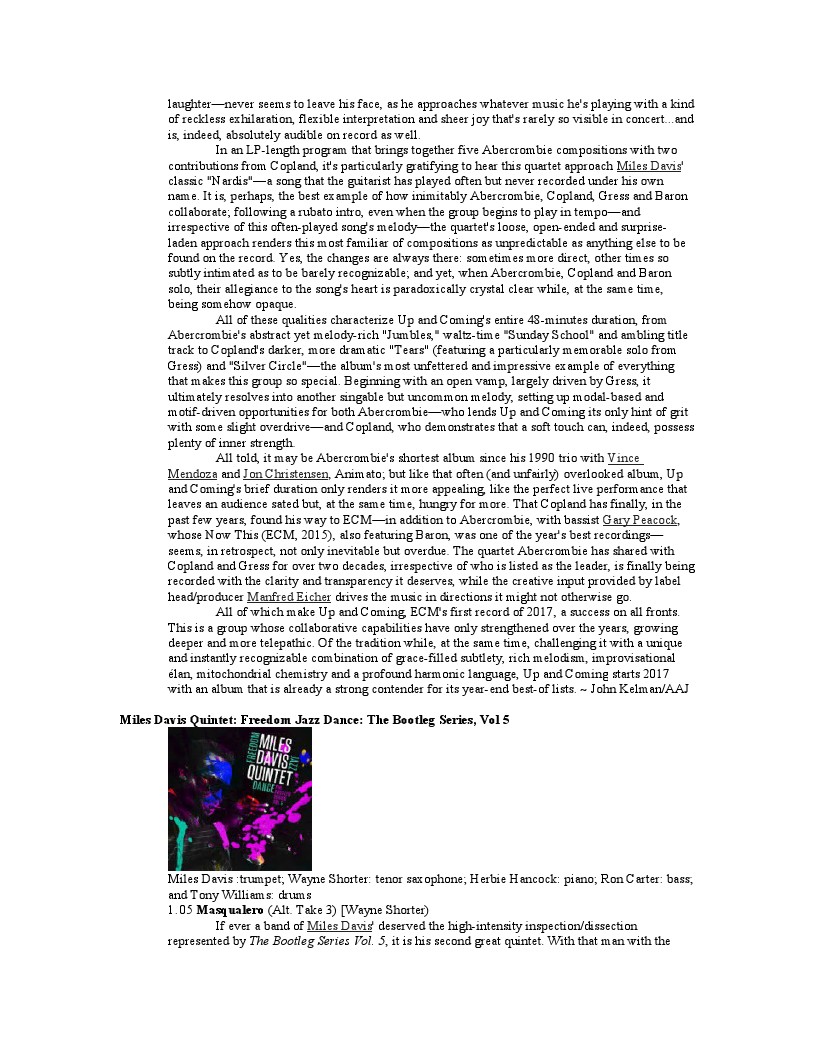
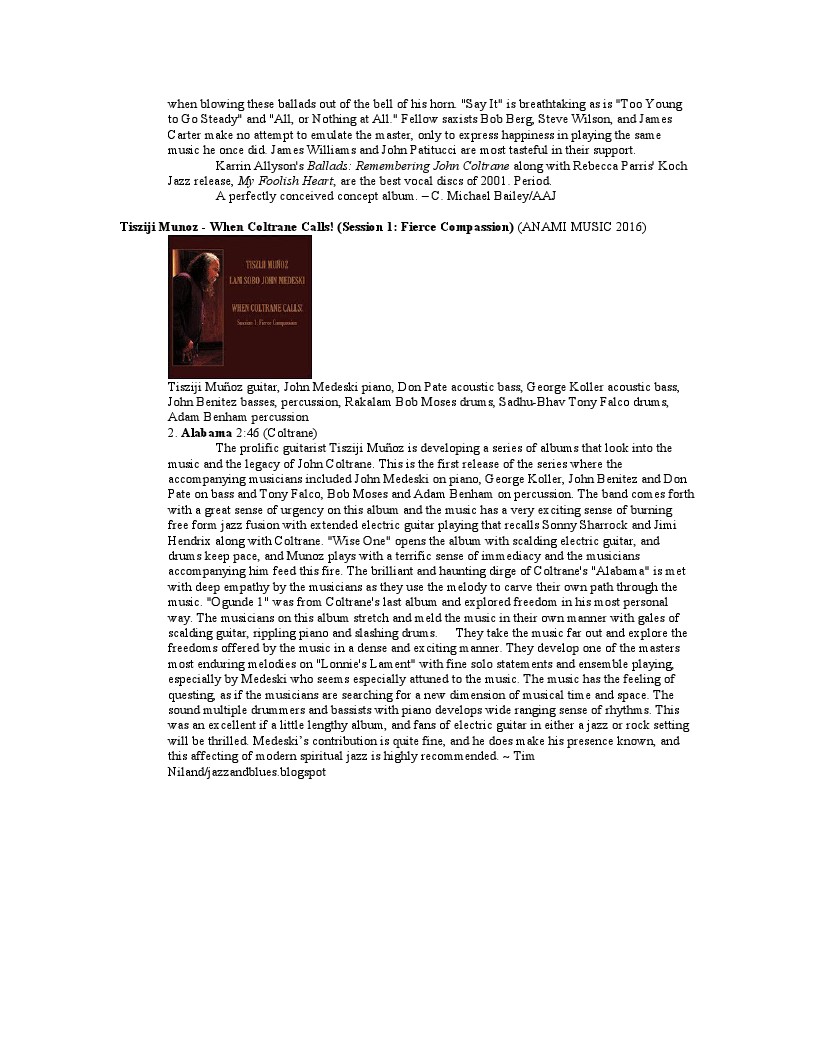
With his brass project 'Maha Samadhi' saxophonist/composer Paul Dunmall takes a rare step into the world of composition; the suite is based on episodes from the life of Sri Ramakrishna, 19th century Indian mystic and yogi. The group includes trumpeter Percy Pursglove and drummer Tony Bianco. Paul's four previous albums on SLAM have defined his Coltrane interests and influences; the choice of the brass project picks up further on his love of everything Coltrane. Paul writes: "I've been wanting to do a brass project for many years and finally I got the chance. I've enjoyed writing for it and have had some very positive feedback so maybe this will encourage me to do more writing in the future."
1. Ecstatic, Unbearable Love 12:24
2. Temple Of The Mother's Presence 14:04
3. In The Cossipore Garden 12:36
4. Maha Samadhi14:12
5. Infinite Cry5:24
Paul Dunmall (tenor saxophone)
Olie Brice (bass)
Tony Bianco (drums)
Percy Pursglove, Aaron Diaz, Alex Astbury (trumpet)
In 2015, saxophonist-composer Hugues Mayot decided to form his own group and become the leader of a new quartet, What If?
For the previous ten years, Hugues had played a brilliant part in other projects, either as a committed sideman (with Olivier Benoit’s Orchestre National de Jazz ONJ, with Marc Ducret, André Minvielle, Sylvaine Hélary Spring Roll and the Pierre Durand Roots Quartet), or else co-leading such bands as Radiation 10, La Poche à Sons or GleizKrew.
Mayot’s taste and singular vision of music, together with his concept of working within a group, are derived from his confrontations with other aesthetics and cultures: notably his rich associations with ensembles such as Magma, Le Sacre du Tympan and United Colors of Sodom, and his work with Orlando Poleo, Doctor L, Rover, Mike Ladd, Gustavo Ovalles, Chérif Soumano, Brice Wassy or François Jeanneau.
In his permanent quest for things that are both magic and indescribable at the same time, with this new project Hugues Mayot felt the need to be surrounded by people of a free nature who had a gift for instantly proposing contributions that served the music. The monolithic sound of Joachim Florent’s bass was an obvious factor — they were longstanding partners with Radiation 10 and the collective named Coax —, as was the unique drumming of Franck Vaillant. Together they form a mineral-sounding rhythm ensemble that has a multitude of colours in its palette, and this was the first facet of What If?
Together they transcend an invariable sound to constitute a kind of lunar landscape with an arid, raw beauty, one where the keyboards of Jozef Dumoulin and the saxophone of Hugues Mayot can circulate inventively in their constant search for weightlessness. The album’s repertoire consists entirely of Mayot compositions matching tunes that are ethereal and poetic, close to the songs of post-pop, with a powerful machine generating a hypnotic groove. Both those entities share the ambition of the jubilant trance-like sound that provides them with their raison d’être. What If? oscillates between the written and the improvised, moving from minimalist sound tableaux to baroque, even orgiastic phrases, including a mix of acid riffs inclining towards decadent, live electro.
Album recorded at Studios Midilive in October 2015 – mixed and mastered in September 2016 at Studio des Résistants by Matthieu Metzger.
Après 2 albums en trio et un opus remarqué en solo, le pianiste Xavier Thollard (3ème prix au concours international de piano jazz de Fribourg/Allemagne), revient en trio avec Matyas Szandai à la contrebasse et Simon Bernier à la batterie. Autour de nouvelles compositions et standards revisités, le répertoire se développe et s'enrichit à l’occasion de concerts parisiens, et aboutit au projet de cet album titré « Nardis » en référence à la célèbre composition de Miles Davis. L’originalité et la modernité de ce trio réside à la fois dans l’écriture musicale (développement d’ostinatos avec des métriques dansantes et complexes, travestissement harmonique et rythmique des standards), mais également dans le son même du trio avec ses interactions et nombreuses variations, en alternant les moments improvisés très aérés avec des parties écrites plus denses. Mais le fil conducteur de cet album reste avant tout le moteur rythmique, presque inépuisable, mis au service par la solidité de la contrebasse de Matyas Szandai, et la finesse sonore des cymbales de Simon Bernier. L’interprétation audacieuse du grand standard de Miles Davis « Nardis », titre donné également à l’album, représente bien le parti pris tout au long de ce disque : un goût immodéré pour le développement de rythmiques presque jubilatoires, tout en restant dans une parfaite maîtrise sonore.
EnTranement is the new release from Philadelphia “underground jazz heavy” Ben Schachter. Ben’s new band QuadraPhilya features the legendary John Swana on Electronic Valve Instrument, and two of the most compelling younger voices in jazz - Leon Boykins on bass and Matt Scarano on drums. Acclaimed pianist Bruce Barth guests on the title track. The recording is an homage to the great John Coltrane, yet is fresh and unique in sound and presentation. Ben Schachter is a powerful and original saxophonist and composer who has recorded and performed with Tim Hagans, Conrad Herwig, John Zorn, Gary Bartz, Sam Rivers, Dave Holland, Jeff "Tain" Watts, Kurt Rosenwinkel, George Garzone, Jamaaladeen Tacuma, James Genus, Jef Lee Johnson, etc., etc. He has been awarded grants from the American Composers Forum, Pennsylvania Council on the Arts, and the Pew Fellowships in the Arts, and has been cited in Phialdelphia press as "Best Jazz Artist" and "Best Saxophonist". EnTranement is Ben’s seventh release as a leader, and the first from new band QuadraPhilya. (A second QuadraPhilya release is scheduled for Fall 2017.) Ben is also a dedicated educator, having taught at Berklee College of Music, The University of the Arts, and numerous other colleges. He is currently an Assistant Professor in Temple University's renowned Jazz Studies department.
About Ben Schachter... “...the power of...Dave Holland...or Steve Coleman...the authority of Joe Lovano...” Jason Bivins, Cadence “...Schachter fired up his heavy tenor to display some serious monster chops...he could be king of the mountain.” Ken Weiss, Cadence “...advanced harmonic capabilities and fluid, sure-fire rhythmic drive....a personal and present-tense sound.” Nate Chinen, Philadelphia CityPaper “...Schachter writes peppery tunes that tapdance on the subconscious before his searing saxophone takes over to blow down the house.” Karl Stark, Philadelphia Inquirer “...a highly personalized style...beautifully arranged interludes offset by passages of boundless improvising...something special is happening here.” Michael Mellia, JazzImprov “...has a fire in his soul that he vents through angular, topsy-turvy modified bop explosions.” Brian Howard, Philadelphia CityPaper “…plays with a tone like a fine carving knife - buffed and burnished and sharpened to a fine edge.” David Dupont, All Music Guide
On June 15th 2016 the website jazzarium.pl celebrated its fifth anniversary. It wasn't turning 18, but in the virtual reality time flows a bit differently, you count it not the same way as outside the Internet. Little or full-grown, we are very happy that thanks to you we were able and we are still able to do what we do. For you. Without you: both listeners and concert-goers, both CD producers and organisers of concerts, we wouldn't have been at the place we are now and most probably we wouldn't have found the power to continue. We are not big fans of exuberant celebrations and grand gala evenings, or PR slogans which are often much louder than the music they are supposed to promote. However, our fifth birthday was so important to us, that we decided to celebrate it in an appropriate way. What was the way? Music, obviously – but what music? On such occasion we wanted to hear music that was unheard before. Music, that gives you no chance to prepare for or to anticipate its perception; music that is full of risk on one hand, and that can open new horizons for both listeners and musicians on the other. Therefore, we decided to invite artists, who in theory have very little in common (country of origin, years of stage experience, range of musical background), but in fact are not that different from one another – they have all dedicated their whole life to music and they've been doing it consequently and with just as much enchantment as at the beginning of their career. And, what's even more important, they keep taking their own way. It was a great honour to host the great magician of improvisation, Even Parker together with the most promising, in our opinion, formation of the Polish jazz scene, RGG. They played together on the hospitable stage of legendary Alchemia club inKrakow and today we're handing the recording of this meeting to you, believing that their music will be remembered by you as long as it's remembered by us.
Released February 6, 2017
Live At Alchemia
Part One 16:54
Part Two 18:31
Part Three 18:07
Part Four 19:05
All music improvised by Evan Parker / Łukasz Ojdana / Maciej Garbowski / Krzysztof Gradziuk
Recorded June 12, 2016 at Alchemia, Kraków by Rafal Drewniany
Mixed & Mastered at studio TOKARNIA by Jan Smoczyński
Special thanks to: Evan Parker / Łukasz Ojdana / Maciej Garbowski / Krzysztof Gradziuk / Rafał Drewniany/ Jan Smoczyński / Lucjan Towpik
‘No Parking Any Time’ is a very powerful statement by Niculin and his crew, with superb playing by everyone and a repertoire that keeps it interesting throughout. The originals are specially strong and the choice of standards is refreshing to hear. Greatly enjoyed listening to this one and I’m sure I won’t be the only oneMiguel Zenón, Saxophonist, NYC (2016) Niculin Janett auf Wallfahrt im Big Apple […[ Was wiederum nicht heisst, dass «No Parking Any Time» die Musik eines Gurus und seines Meisterschülers böte. Von den Spielanteilen her ist immer klar, dass hier Niculin Janett sein eigenes Album vorstellt. Ohnehin sind Janetts Töne erstaunlich stark und ausgereift. Und keine Sekunde lang braucht der junge Zürcher sich zu verstecken hinter Perry, dem New Yorker.– Christoph Merki, Tagesanzeiger (07. Dec. 2016) Niculin Janett Quartet – Einladung zum parkieren Locker, Luftig, Cool […] Der Jungmusiker Janett gibt also ordentlich Gas. Vom faszinierenden Tempo und vom nimmermüden Puls der Stadt New York spricht er auch im CD-Booklet – und im Titel des Albums. Doch seine Musik ist keineswegs rasend oder gehetzt.– Jazz’n More (Jan. 2017) Auch im Flüsterton durchaus dringlich Ob vertrackte Eigenkompositionen oder zeitlose Standards: Dieses Quartett meistert jede Herausforderung mit Bravour und Souplesse.– Tom Gsteiger, St. Galler Tagblatt (04.Jan. 2017)
The Microscopic Septet takes the Blues Uptown, Downtown, and All Around on
Been Up So Long It Looks Like Down to Me: The Micros Play the Blues
What happens when you put the blues under a microscope? When the lens is wielded by the incisive deconstructivists of the Microscopic Septet, the musical odyssey traverses territory that’s disarmingly strange, pleasingly familiar and consistently revelatory. It takes an unusual band to make news out of the blues, and the Micros deliver a gripping investigation of the form on Been Up So Long It Looks Like Down to Me: The Micros Play the Blues. The new album continues the Micros’ brilliant resurgence, storming back into action in 2006 after a 14-year hiatus to reissue its old and release new recordings on Cuneiform Records. Since then, the radically old-school new-context combo has continued to evolve, extending its reputation as one of New York’s most ardently inventive ensembles of the 1980s to being recognized as one of the 21st Century’s most accomplished, informed, and iconoclastic jazz groups. Throughout, they maintained their distinctive modus operandi: exploring and unraveling jazz’s myriad strains, the Micros re-weave a century of jazz into modern tunes of equal popular and critical appeal. Since 2006, they’ve collaborated with known cartoonists and/or illustrators for their album art, including Art Spiegelman, New Yorker cover artist Barry Blitt, Australian graphic artists Antonia Pesenti and Keith Lobue. The Micros Play the Blues builds on the band’s longstanding love of that most basic and profound musical form, bringing the same reverently irreverent and insistently playful approach to the blues that has marked the Micros’ music from the beginning. This album’s cover art is by Kaz, best known for his comic Underworld and his writing for SpongeBob SquarePants. “We’ve always loved the blues,” says soprano saxophonist/composer Phillip Johnston, who co-founded the Micros with pianist/composer Joel Forrester. “We’ve recorded blues on every record we’ve made. I don’t think there’s anything more sophisticated than the blues. Our only fear was that the tunes would sound too much alike, and we made a conscious effort to cast a wide net. Every tune sounds different.”
Along with the co-founders, the seven-piece ensemble features largely the same cast of improvisers with which it emerged from Manhattan’s wild and wooly Downtown scene in 1980. Drummer Richard Dworkin, baritone saxophonist David Sewelson, bassist David Hofstra, and altoist Don Davis (who replaced John Zorn in 1981) have all been along for almost the entire Microscopic sojourn, while Mike Hashim came on board for the 2006 reboot, taking over the tenor sax chair from Paul Shapiro (the only Micros spot that’s seen real turnover). As on previous projects, Johnston and Forrester provide the lion’s share of tunes and arrangements, and they both dig deep into their voluminous catalogs for interesting material. The album opens with Johnston’s late-night cinematic joy ride “Cat Toys,” a piece inspired by Hammond B-3-driven soul jazz and originally written for the credit sequence of a short film about a San Fernando Valley-dwelling space alien with a taste for felines (seriously).
Johnston’s cascading 14-bar “Blues Cubistico” features some brawny baritone sax work by Dave Sewelson, while his cheerful soprano sax intro on “Don’t Mind If I Do” sounds like a rent party picking up steam around 11 pm on a Saturday night. Johnston repurposed “When It’s Getting Dark” from his rock band The Public Servants (which featured guitarist Bill Horvitz, vocalist Shelley Hirsch, and several Micros), and the tune retains its predatory rock ‘n’ rhythm vibe. “12 Angry Birds” delivers a triumphant verdict on the enduring power of Ellingtonian cadences, as the piece sounds like a forgotten number from the 1927 session on Victor, complete with a deliciously squally soprano sax solo. Long time Micros fans will be delighted to hear tunes that have been in the repertoire for decades but never recorded, like “I’ve Got a Right to Cry.” While not actually a blues, the piece was a 1950 hit for the great Los Angeles R&B band Joe Liggins and the Honeydrippers. “That’s a tune we did from the very beginning,” Johnston says. “We’ve always played tunes by other people, but didn’t record a lot of them. We have a number of vocal tunes, and we never recorded any of those and I love Dave’s singing on this. ‘I’ve Got a Right to Cry’ isn’t a blues, but it fit in so well with the rest of the album.” Forrester contributes about half of the album’s tunes, including the sensually slow drag “Dark Blue,” a feature for bassist David Hofstra (who’s walking figure guides the band even when he sits out). The pianist offers a propulsive jazz march with “Migraine Blues,” and designs a deliciously woozy and off-kilter jaunt with “Simple-Minded Blues.” In another utterly surprisingly but entirely sensible move, Forrester turns the carol “Silent Night” into a convincing blues that captures the angst too many people feel as the holidays approach. In fact, Forrester staked a claim to the song at a Christmas party where he “took it into my head to derange Silent Night, which has always struck me as close to the blues,” he says. “During the improvisation the chords were really stripped down. I wanted people to take a more primal approach.” Whatever the music’s origin or vintage, the Micros put their indelible stamp on each piece, with loose and limber arrangements combining stellar craftsmanship and extroverted improvisation. The blues provide another avenue for the band to explore jazz history while forging a sound quite unlike any other ensemble. Simultaneously embracing the past and the future makes perfect sense when you consider the fraught time and place that gave birth to the Microscopic Septet. In the early 1980s the New York jazz scene was bitterly divided. Irony-laced Downtown players explored new territory drawing on free jazz, rock, funk and later, Balkan influences. At the same time, other young players, following in the footsteps of trumpeter Wynton Marsalis, defined mainstream jazz by looking backwards to 1950s hard bop and 1960s post bop. Rejecting allegiance to any particular camp or faction, the Micros forged their own path with an ethos succinctly summed up by Johnston: “Break all the rules and respect all the saints.”
Embracing jazz’s populist legacy, the Micros brought Uptown jazz back Downtown, where they made a compelling case that swing could look forward as well as backward. The band adopted a name that playfully alluded to its orchestral palette. As Johnston explained at the time, “The instrumentation is enough to give us a big range of colors and work compositionally in a more expansive way.” But the name also described their compositions, which often distilled the essence of an era within an artfully executed voicing. “Through its command of idiomatic detail,” opined The New York Times, “the group summons the sound of an Ellington orchestra, or the feel of a 50’s rhythm-and-blues band, with a few well-chosen phrases and sonorities.” The band was built upon the felicitous partnership of Johnston and Forrester, who met in the early 70s and bonded over shared musical aesthetics, humor, and similarly skewed worldviews. Eager to break away from the jazz straightjacket of head-solo-head formats, they honed extended, lapidary jazz compositions that segued gracefully between different themes in a single piece, hearkening forward to forms employed by Sun Ra, Duke Ellington and Jelly Roll Morton. The music drew on the entire history of jazz, as well as polkas, tangos, antic cartoon themes, klezmer, and new wave rock. No matter how eclectic their influences, the Micros always hewed to the band’s prime directive. “It’s gotta swing, whether its Latin or R&B or straight-ahead blowing,” Johnston says. “That’s the foundation of what we do.” Prolific composers, Forrester and Johnston had created a songbook of nearly 200 tunes by the time the band called it a day in 1992. During the Micros’ first incarnation they only got around to recording 34 pieces on four albums, which were all released on small labels to an impressive array of critical acclaim. The band’s 1983 debut LP, Take the Z Train, came out on Press Records and featured cover art by San Francisco artist Bill Paradise. “It is as if the entire history of improvisatory music is on parade,” Cadence exclaimed. A live album, Let’s Flip!, followed in 1985, recorded in Rotterdam and released by Dutch label Osmosis Records, which also released 1986’s Off Beat Glory. Stash put out Beauty Based on Science in 1988 with liner notes by “New York School” poet, Ron Padgett, cover art by painter Bob Tuska, and cartoons by Collin Kellogg.
In keeping with the band’s perverse ways, they were reaching a vast new audience when they disbanded. Forrester’s theme song for the long-running NPR show Fresh Air with Terry Gross, which continues to be heard by millions of public radio listeners every day, was introduced in 1990. Cuneiform’s decision to reissue the band’s albums on two double albums in 2006, Seven Men in Neckties and Surrealistic Swing, introduced the band to a generation of jazz fans who came of age in the ensuing years. Featuring striking CD artwork by Pulitzer Prize-winning New York cartoonist Art Spiegelman, (creator of the graphic novel Maus), the History of the Micros albums contain all the music from the four original albums and 11 previously unreleased tracks. The reception was so positive that the band reunited for a European tour, which led to the Micros returning to the studio for 2008’s Lobster Leaps In, an acclaimed Cuneiform album featuring beloved tunes and overlooked gems from the band’s original book. They followed up two years later with the masterful Monk album Friday the Thirteenth: The Micros Play Monk, illustrated with Barry Blitt’s artwork, and made another major leap back into the future with 2014’s acclaimed Manhattan Moonrise, an album that shows the Micros are still a cutting-edge ensemble forging boldly into old territory. “Neither Phillip nor I want to settle into any definite harmonic groove,” Forrester says “Coming up with an array of the blues is just a means taking the Micros into the next century.”
Cuneiform asked Phillip Johnston [PJ] & Joel Forrester [JF], The Microscopic Septet’s co-leaders/ co-composers, questions about the Micros’ new album.
Tell us about the ALBUM’S NAME: Been Up So Long It Looks Like Down To Me: The Micros Play The Blues.
PJ: A pun on the title of Richard Fariña’s 1966 novel, the title speaks to the essential optimism of the Micros’ music, and the paradox that the blues ostensibly a music that is meant to express suffering and longing can as easily express joy, rebellion and boisterous eroticism.
JF: PJ chose the name but I like it because it reflects the Micros' approach to the Blues: to the content, whole hearted; to the form, unfaithful.
Tell us what the music on THIS album means to you, any personal thoughts.
PJ: Blues and jazz have been inextricable since the beginning, and the blues have been a substantial part of the Micros’ repertoire since our beginning. Every one of our recordings contains a blues in one form or another and the blues language is part of the expression of every soloist here. It made sense to devote an entire recording to various expressions of the blues.
JF: I love the music on this recording because it underscores that although our lives have gone in seven differing directions, we can still get together as a band.
The TRACK titles: how did they come about?
PJ: (This information is already in the liner notes)
JF: Nearly each of my titles is a verbal glove that fits snugly over the principal hook of the tune.
How does this album DIFFER from your previous works - and how is it the SAME?
PJ: Different: The CD is different in that it focuses on one particular form–the blues–(like the Micros Play Monk focussed on the music of Thelonious Monk). It also maybe focuses on the soloists a little more.
The Same: It is the same in that Joel and I are writing in the Micros idiom that we have established over the past 35 years or so, combining arrangements which invoke various eras of the history of jazz ensemble writing (Ellington/Mingus/Gil Evans) with other elements from free jazz to R&B and our own personal peculiarities.
JF: We are older than we were. We're thinking younger than we did.
Tell us about the COVER ART.
PJ: The cover art is by the great comix artist Kaz, best known for his comic Underworld, and his writing for SpongeBob SquarePants. Post 2005 Micros cover art has included works by Art Spiegelman, New Yorker cover artist Barry Blitt, Australian graphic artists Antonia Pesenti and Keith Lobue, and this wonderful cover extends that tradition in his own unique style. Check out Underworld online!
JF: Well-chosen as almost always.
What would YOU like the public to REMEMBER about this album?
JF: I'd like the public to recognize that "Silent Night' has always been a blues.
Do you see your music as part of any musical movement?
PJ: No, not really. I do consider us to be part of a peer group that has continued since our youth, so that would include groups like the Jazz Passengers, Kamikaze Ground Crew, Steve Bernstein’s groups, all of whom are currently performing. While none of us have ever really fit into any movement or style, we have all individually found a place four ourselves in music, and continued to make our own idiosyncratic contribution.
JF: All music can be viewed as commentary. And you can't escape your time. But I think the Micros continue to speak to the present.
Tell us about other interesting projects that each of you are working on outside of The Micros.
PJ: [currently based in Sydney, Australia] I have been touring internationally with my collaboration with graphic artist Art Spiegelman, Wordless!.
We just opened the London Jazz Festival at the Barbican Centre, and recent gigs have included Comicópolis in Buenos Aires, and a 10-city tour of the US. I’ve also been touring my original silent film scores, primarily Lotte Reiniger’s The Adventures of Prince Achmed, in Australia at venues including the Sydney VIVID Festival, the Capital Jazz Project (Canberra), MONA FOMA (Tasmania) and the upcoming Woodford Folk Festival (Queensland). A 2015 residency at John Zorn’s The Stone was also a recent highlight.
I’m doing the Australian premiere of Page of Madness: Suite for Improvisers, in 2017 at SIMA’s Sound Lounge, a large ensemble piece based on one of my silent film scores that premiered at The Stone. I also have a once-a-month residency at Foundry616 in Sydney with a band of great Sydney jazz musicians, which plays (mostly) my arrangements of jazz tunes from the 1920s and 30s, focussing on early Duke Ellington and Jelly Roll Morton.
I’m soon going to start some other new projects but right now I’m focussing on continuing to tour Wordless! and Prince Achmed.
JF: [based in NYC] In January 2017, I’ll be touring all over France. Proudest claim: steady work in a falling New York market for music of our sort. I will have written 2000 tunes, by sometime in 2017.
What do you want to do NEXT / in the FUTURE?
JF: I want to keep playing with the Microscopic Septet. I want people to keep wondering, "How many people are in that band?"
- Joel Forrester & Phillip Johnston, November 2016