Showing posts with label PI RECORDINGS. Show all posts

Tuesday, January 11, 2022

Miles Okazaki - Thisness (March 20, 2022 Pi Recordings)

"convulsive beauty, propulsive rhythm, elusive meaning...a spontaneous and unpredictable work of art, accordingly discordant, subversively accordant, a pendulum crushing the cage of temporality. This is Surrealism in practice. This is jazz. This is freedom."
- from the liner notes by Robin D.G. Kelley

Thisness is Miles Okazaki's third volume of compositions for Trickster, a quartet featuring Matt Mitchell on piano, Anthony Tidd on drums, and Sean Rickman on drums. The album is a set of themes that are shuffled and connected in different ways to make four large movements. Okazaki describes the process in the liner notes:

"Our previous albums were made up of what I would simply call "songs," but for this project I decided to expand the format. The intention was to make something like an exquisite corpse, the collective improvisations developed by the Surrealists. So for this album my job as composer was to bring in some ideas, set them in motion and then listen, trying to recognize the value of serendipitous events at transitional points in the music and lead the band down whatever path may be opening. The borderlands are where the Trickster hangs out, the undefined space where logic dissolves and creativity thrives. My hope was that the listener would enjoy the experience of passing through these boundaries between contrasting episodes."

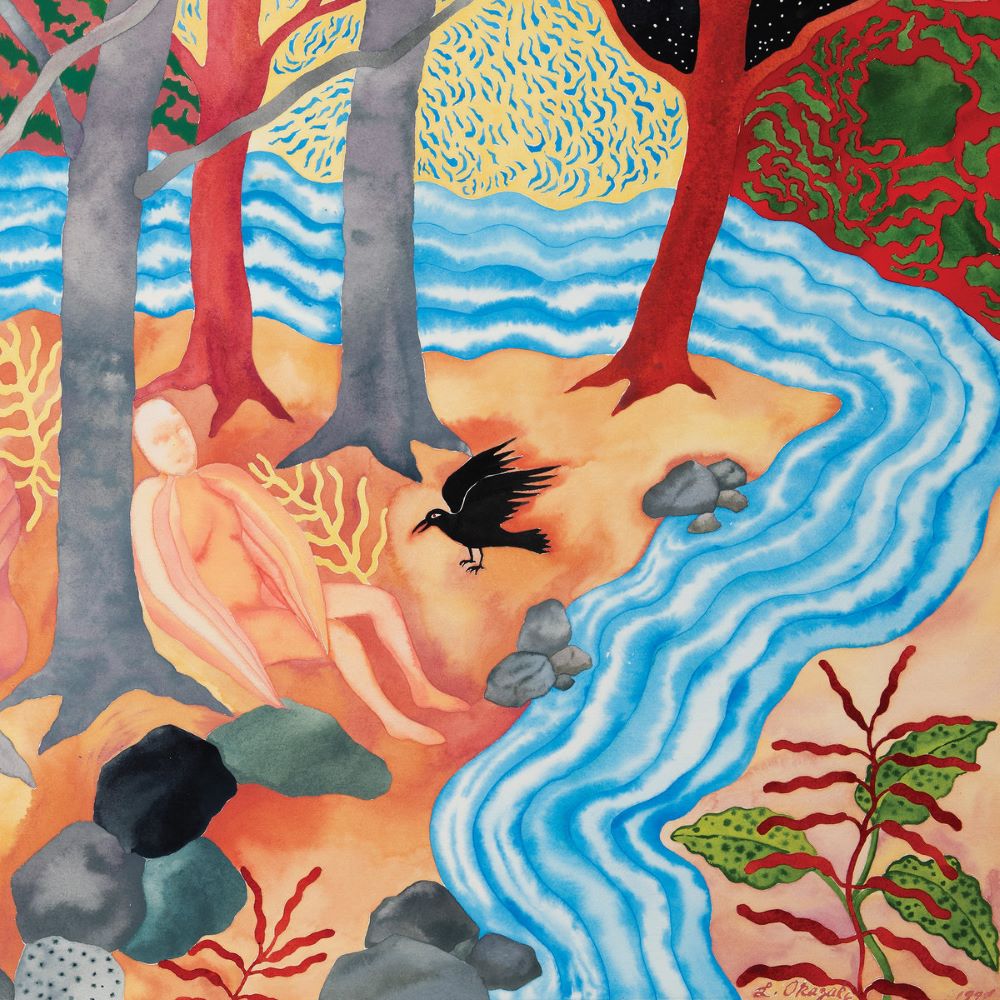
The music draws on a few sources of inspiration that have connected creative elements: a magical "far off place" called Salt Creek, from a watercolor by Linda Okazaki, the writings on Surrealism by Robin D.G. Kelley, architectural concepts from producer David Breskin, and the poetry of Sun Ra. The idea that this band has been working toward since their first album is most fully realized on Thisness, a sound that discards notions of logic and control and strives toward something more like collective dreaming.
1. In Some Far Off Place
2. Years in Space
3. I'll Build a World
4. And Wait for You

Miles Okazaki – Guitar, Vocals, Robots
Matt Mitchell – Piano, Fender Rhodes, Prophet-6
Anthony Tidd – Electric Bass
Sean Rickman – Drums

Friday, October 29, 2021

Steve Coleman - Live at the Village Vanguard Vol. 2 (MDW NTR) October 29, 2021 Pi Recordings

Recorded live in performance at the renowned Village Vanguard in New York City, "Mdw Ntr," finds MacArthur Fellow Steve Coleman exploring new terrain in his use of non-linear performance practices in his music. Featuring his long-running flagship ensemble Five Elements, he utilizes spontaneous and pre-composed modules, or motivic cells that can be played in any order, allowing each musicians to spontaneously jump forward or backward to different sections – even between compositions – highlighting different strata of the music and reinventing the form each time in a completely interactive way. Coleman often composes these modules by envisioning them as chains of tonal dyads that are strung together along rhythmic patterns to create melodic structures, something he sees as an analogue of DNA sequences. 

The work also reflects his research into the connection between language and music, in particular the early attempts at music notation using shapes and glyphs in ancient Egypt and the structural and functional similarities between spontaneous composition and Mdw Ntr, a transliteration of the writing system usually called hieroglyphics. Coleman’s use of complex rhythmic cycles is a consistent hallmark of his work, and the roiling, surging momentum found here is no exception. Featured prominently is a long-time collaborator, spoken word artist Kokayi, who brings a freewheeling, rhythmically-acute, almost tent revival aesthetic to the proceedings. Together, they continue to push the possibilities for spontaneous composition and improvisation. 

1. Menes to Midas
2. Unit Fractions
3. Little Girl I'll Miss You
4. Compassion (drum solo) - Ascending Numeration - DeAhBo (Reset)
5. Pad Thai-Mdw Ntr
6. 9 to 5
7. Mdw Ntr
8. Rumble Young Man, Rumble
9. Khet & KaBa
10. DeAhBo (Reset)
11. 9 to 5 - Mdw Ntr

Steve Coleman (alto saxophone)
Jonathan Finlayson (trumpet)
Kokayi (wordsmith)
Anthony Tidd (bass)
Sean Rickman (drums)

Friday, September 24, 2021

Henry Threadgill - Poof (September 24, 2021)

For over forty years, Henry Threadgill has been celebrated as one of the most forward-thinking composers and multi- instrumentalists in American music. The New York Times has called him “perhaps the most important jazz composer of his generation.” Threadgill is a recipient of the 2016 Pulitzer Prize in Music for "In for a Penny, In for a Pound." Threadgill is an early member of the AACM.

1. Come And Go
2. Poof
3. Beneath The Bottom
4. Happenstance
5. Now And Then

Henry Threadgill – alto saxophone, flute, bass flute
Liberty Ellman – acoustic guitar
Jose Davila – tuba, trombone
Christopher Hoffman – cello
Elliot Humberto Kavee – drums

Friday, July 30, 2021

Matt Mitchell & Kate Gentile - Snark Horse [Box Set] July 30, 2021 Pi Recordings

Snark Horse is a book of 70 highly-detailed one-bar compositions by pianist / composer Matt Mitchell and percussionist / composer Kate Gentile designed to incite inventive, multi-directional improvisation. It is also the name of a revolving cast of musicians – including Mitchell and Gentile – who have performed this music in various combinations since 2013. Mitchell's prior release, Phalanx Ambassadors, was called by Popmatters "a high watermark for the new jazz... a breathtaking jawdropper from one of the best pianists and composers now working." Gentile's 2017 debut release, Mannequins, was described by The New York Times as "full of stuttering rhythms and teetering intervallic jumps; an array of textures — sometimes chiming, sometimes abraded — disorient you even as they deepen your listening."

For this new recording, Mitchell and Gentile convened eight other singular musicians – all of whom have taken part in Snark Horse performances over the years – in varying combinations. Despite the small nuggets of musical information, their approach is still jazz-oriented: the musicians first play, and then improvise on the tunes. The one-bar compositions can be looped, connected, made into vamps, transposed, inverted, alternated, played together to create other-worldly counterpoint, basically in infinite permutations. Ultimately, Mitchell and Gentile’s intention behind Snark Horse is to make a highly improvisational and expansive environment using compressed versions of the kinds of material they use in their longer pieces. The compositions help foster a unique, highly imaginative universe for the musicians to show off their individual takes on this truly idiosyncratic music. Their energy is captured in over 270 minutes of music, interwoven with 60 additional minutes of electronic material composed and constructed by Mitchell in response to the group recordings. The entire daunting project presents the musicians’ resourceful creativity to full effect. 
1. flock adulation
2. compartments | 's partial
3. hem(atoadaso)da
4. a pouting grimace | greasy puzzle
5. forn
6. pheromone quiz
7. deep recess
8. fertile pinwheels
9. key tettle | FLARDLE
10. igh | dogmacile
11. trapezoids | matching tickles
12. all tall ghosts
13. nudgelet
14. thumbly
15. asymptotic rest area
16. underblobb sys
17. feral pineals
18. torpid blather | fuck your capitalization style | pendulum wobbles
19. teeming molten holdings
20. thing-fact | theoretical muscle
21. adrenal halos | dog mma((t)t)gic
22. alphabotanical
23. bogs and silence
24. fickle laughing
25. for teens | spinal thought | peripheral drome
26. infractal sentences
27. glubz | spelling bad on purpose
28. garlic plastics
29. f tessellations | chimeric numbers
30. tooth helmet
31. Tørn
32. feebleau
33. fruit velvet
34. mind google | end of something
35. regular falutin'
36. supple bicepsual | is jingles | utter balbis
37. phoofaux | rejected names | high popes
38. startling and diaphanous | the gnostic and the spastic
39. B
40. strikes me as wanting to make me barf | clump 3
41. mad homonyms | phex
42. plungeon
43. ought gobs | T
44. breach zone
45. elegiac foldouts | gluey clamor
46. mighnutes
47. glue cubes | inkblot terrain | clock levitation | cat secrets | bludgement
48. catjinx
49. fettleau | a spree...canopy

the Snark Horsekestra:
Kate Gentile - compositions, drums & percussion
Matt Mitchell - compositions, piano, modular synthesizer, Prophet-6, MicroFreak & electronics
Kim Cass - acoustic & electroacoustic bass
Ben Gerstein - trombone
Jon Irabagon - tenor, mezzo-soprano, sopranino, soprillo, & mezzo-soprano saxophones & alto clarinet
Davy Lazar - trumpet, piccolo trumpet & cornet
Mat Maneri - viola
Ava Mendoza - guitar
Matt Nelson - tenor & alto saxophones
Brandon Seabrook - guitar & tenor banjo

All 6 discs in a clamshell style box. Comes with a beautiful 12-page booklet containing a breakdown of which musicians play on which tracks, which pieces are by Matt and which are by Kate, and words by each band member of the Snark Horsekestra and mixing/mastering wizard David Torn.

Includes digital pre-order of Snark Horse [Box Set]. You get 10 tracks now (streaming via the free Bandcamp app and also available as a high-quality download in MP3, FLAC and more), plus the complete album the moment it’s released.

Digital Album
Streaming + Download
Pre-order of Snark Horse [Box Set]. You get 10 tracks now (streaming via the free Bandcamp app and also available as a high-quality download in MP3, FLAC and more), plus the complete album the moment it’s released.

Monday, February 15, 2021

Jen Shyu & Jade Tongue - Zero Grasses: Ritual for the Losses (April 2, 2021 Pi Recordings)

Jen Shyu is a groundbreaking, multilingual vocalist, composer, producer, multi-instrumentalist, dancer, 2016 Doris Duke Artist, and was voted 2017 Downbeat Critics Poll Rising Star Female Vocalist. Shyu is widely regarded for her virtuosic singing and riveting stage presence, carving out her own beyond-category space in the art world.

1. Living's a Gift | Part 1: Springtime
2. Living's a Gift | Part 2: Everything for Granted
3. Living's a Gift | Part 3: My Unsolved Regrets
4. Living's a Gift | Part 4: Joyful
5. Lament for Breonna Taylor
6. The Human Color
7. A Cure for the Heart's Longing
8. Body of Tears
9. When I Have Power
10. Finally She Emerges
11. Display Under the Moon | 月下の陣
12. Father Slipped Into Eternal Dream
13. With Eyes Closed You See All
14. Life As You Envision

Jen Shyu: Composition, vocals, percussion, piano, Taiwanese moon lute, Japanese biwa
Ambrose Akinmusire: trumpet
Mat Maneri: viola
Thomas Morgan: bass
Dan Weiss: drums

Hafez Modirzadeh - Facets (March 5, 2021 Pi Recordings)

Facets is saxophonist/composer Hafez Modirzadeh’s latest radical entreaty against the cultural hegemony of the Western notion of equal temperament and his argument that musicians should be free to explore a variety of tonal possibilities, even on piano. His 2012 release Post-Chromodal Out! was the first documentation of this concept, where the piano was tuned to a variety of temperaments. Performed with pianist Vijay Iyer, The New York Times called that album “Dauntless… There’s heady discipline at work here, along with the stirrings of a hard-fought individualism.” With his new release, Modirzadeh has distilled the idea to a single re-tuning, which is performed in duets with three towering musicians in contemporary improvised music: Kris Davis, Tyshawn Sorey and Craig Taborn, each interrogating the piano’s new possibilities with imagination and ingenuity. Modirzadeh himself utilizes alternate fingerings and embouchure adjustments on his instrument to achieve intervals between major and minor, and the pieces sway with an elasticity reminiscent of Persian poetic meter. With eight keys re-tuned and the remainder left in equal temperament, the music explores the coexistence of familiar with unfamiliar, and in the process, discovers new logic and mysterious beauty within.

Modirzadeh, who the San Jose Mercury News has called “visionary,” described the imperative to re-tune the piano this way: “The standardized temperament for piano, as beautiful as it is, carries an unbalanced weight of influence over players and listeners, leading many to believe that there is no other resonance to work with but this one. This creates a value system that is unjust and ultimately limits the discovery of other, more personal tuning possibilities. By retuning the piano – the one instrument that imposes a dominant influence on the world’s music – the musician is freed to explore all tonal possibilities.” This urge is the culmination of a system he originally called “chromodality,” which he developed to explore the harmonic possibilities of integrating Persian tones with Western equal temperament. The concept has since evolved to allow all intervals to co-exist, which empowers each musician to use their own distinctive voice to explore music from a full palette of tonal possibilities, irrespective of cultural background. The tuning Modirzadeh has chosen for this program was one that spoke to him personally after much testing and tweaking. Vijay Iyer says of Modirzadeh: “The scope of Hafez’s synthesis of concepts across cultures is staggering. There is great detail in his critical engagement with traditional intervallic systems, tuning systems, and modes, and there is also a grand sweep to his vision across disciplines and historical eras. In spite of its technical complications, there is genuine heart to this music and a real spiritual clarity. Modirzadeh is not simply a ‘scholar’ or ‘musicologist,’ but a genuine artist, with a profound, lifelong stake in the unification of research, creative work, and personal inner quest that is expressed in his music.”

Interested in hearing the different approaches that each musician will bring to the concept, Modirzadeh has been inviting pianists from various disciplines to engage with this music. For the recording of Facets, Modirzadeh chose three of the most acclaimed musicians in improvised music: Kris Davis is recognized as one of the foremost pianists in jazz. Her release Diatom Ribbons (2019) topped most year-end lists as best album of the year. For a quarter century, Craig Taborn has been similarly recognized as a master of sheer invention on the piano. Tyshawn Sorey, who is a stalwart with Pi Recordings, has won recent praise for the premiere for his new works with the Seattle Symphony and Detroit Symphony Orchestra. Primarily known as a drummer, he brings the same sensitivity and openness to discovery as the other pianists. They were sent the scores in advance, but their first encounter with the actual re-tuned piano was at their respective recording sessions. Each musician works from the same set of pieces, spending time exploring the novel resonances, before running through the entire book of compositions. Modirzadeh gave minimal instructions, preferring to allow each musician to shape the music as they imagine it. As Modirzadeh said in an interview: “It takes more heart than head, with the intention of something beautiful.” He subsequently chose what he felt to be the most magical of these performances for this release.

The program unfolds with “Facet Taborn,” which was improvised by the pianist at the very end of his session after intense focus on the compositions. The otherworldly resonances are introduced, opening the door to further mysteries within. “Dawn Facet” and “Facet 27 Light” are interpretations of the same composition, first by Sorey, then by Davis. Modirzadeh’s saxophone is gentle, vulnerable, as if opening himself to all possibilities from his partners. Modirzadeh calls “Facet 28 Nora” “the cornerstone melody of all Facets.” His playing is delicate and loving, tender and haunting. “Facet 34 Defracted” is Davis’s radical mash-up of Thelonious Monk’s “Pannonica” and “Ask Me Now,” compositions that Modirzadeh separately interprets in duet with Taborn. For Davis, “It all made sense when we started playing the Monk tunes. Monk had this effect where he would try to ‘bend’ the note on the piano by adding a note below the melody subtly for a moment, and I heard that connection right away between Hafez’s tuning system and the Monk tunes he chose. It’s like living in those bends that Monk was creating, committing fully to the microtones he was trying to achieve in that effect. I believe that if he heard these versions of his compositions, he would consider re-tuning his piano for good!”

As Iyer notes: “This album signals that we are entering a crucial new phase in this journey: a collective meditation, an unlocking of forms and truths. I can hardly imagine a clearer monument, to our cataclysmic year than this set of stark, intimate, heartfelt jewels by these four singular truth-seekers.”

1. Facet Taborn
2. Dawn Facet
3. Facet 27 Light
4. Facet 28 Nora
5. Facet 29 Night
6. Facet 34 Defracted
7. Ask Me Now
8. Facet Sorey
9. Facet 31 Wake
10. Ebb Facet
11. Facet 33 Tides
12. Flow Facet
13. Pannonica
14. Facet BB
15. Facet 35 Ode B'kongofon
16. Facet 32 Black Pearl
17. Facet 39 Mato Paha
18. Ode Reprise

Hafez Modirzadeh - tenor saxophone (2-5, 7, 10, 11, 13, 15, 17)
Kris Davis - piano (3, 4, 6, 9, 12, 16)
Tyshawn Sorey - piano (2, 5, 8, 10, 14, 17)
Craig Taborn - piano (1, 7, 11, 13, 15, 18)

Thursday, September 20, 2018

David Virelles - Igbó Alákọrin (The Singer’s Grove) Vol. I and II (PI RECORDINGS October 26, 2018)


This album was made possible by the generous support of The Shifting Foundation. Research for this project was completed thanks to The Diaz-Ayala Cuban and Latin American Popular Music Collection, Florida International University Library. 

Igbó Alákọrin (a phrase in Yoruba which can be loosely translated as The Singer’s Grove) is the realization of my dream to document the under-sung musicians of my birthplace, Santiago de Cuba. Each time I go back to visit my family, I have made it a practice to seek out and reconnect with the music's elder statesmen and women whom I grew up knowing through my parents, who are also musicians. I feel extremely fortunate to have been able to assemble for this album some of the legends, all of whom are still at the peak of their craft. Most of them are not household names and have never received recognition beyond their Santiago community, but they remain arguably amongst the last living sources of our music's golden era. The album was recorded at Santiago's E.G.R.E.M. - Siboney studios, where I grew up attending my father's late night recording sessions and also where I made some of my first record dates. The Singer’s Grove is a homecoming of sorts as it documents a collaboration with roots in family, community and culture. As I strive to make original music that is equal parts folk and contemporary expressions, this is another step in my pursuit to understand the essence of music, beyond styles or vocabularies.


Volume I - David Virelles Introduces Orquesta Luz de Oriente 

The picturesque southeastern Cuban town of Santiago has historically been considered an important breeding ground for music on the island. Volume I encompasses genres/styles associated with key figures of the rich musical legacy of the city: danzón Oriental, chepinsón, pregón, bolero and trova. In compiling this material, I received the blessing and guidance of Enrique Bonne, a world-renowned composer whose work has been recorded by a who’s who of Cuban music giants. Most of this volume was conceived for a big band of seasoned veterans. Visionary Santiago musicians Electo Rosell (Chepín) and Mariano Mercerón pioneered the big band sound propelled by Cuban percussion in the 1930s. Their work was inspired by African- American groups, yet kept very profound connections to folklore native to this part of Cuba.

The Oriente region is home to son, changüí, nengón, conga, as well as traditions inherited from Haiti. The legendary Chepín-Chovén Orchestra was the brainchild of Chepín and the outstanding yet obscure pianist Bernardo Chauvín (Chovén), whose pianistic style is referenced on our renditions of Chepín classics. In their heyday, the Chepín-Chovén Orchestra was a fixture at many venues, including the sociedad de mulatos Luz de Oriente. This long-vanished society club, which was located in a building still standing in Santiago, is the inspiration behind the name of our ensemble.

It features the voices of Emilio Despaigne Robert, a veteran sonero (lead vocalist) of Los Jubilados, one of the funkiest Santiago groups, and Alejandro Almenares, who is also featured on his sublime requinto guitar. Many consider Alejandro – the son of trova legend Ángel Almenares – the last of the old style trovadores, a lineage dating back to the 19th century with deep roots in Santiago. The younger Almenares learned his craft at informal home gatherings from his father and his father’s friends, which included the prophet Sindo Garay. Volume I spans several decades of important music from Santiago. These sounds tell the history of our people.


Vol II - Danzones de Romeu at Café La Diana 

Volume II is focused on the iconic Cuban pianist/composer Antonio María Romeu, who played his danzones on piano accompanied only by güiro starting in 1899 at the legendary Café La Diana in Havana. Romeu introduced an improvised piano solo on the montuno section of his quintessential “Tres Lindas Cubanas,” which revisits and expands Guillermo Castillo’s son of the same name. I reproduced Romeu’s solo on our interpretation of “Tres Lindas” because it is considered part of the piece, following the tradition of virtually every performance of this composition by any Cuban pianist, from Odilio Urfé to Chucho Valdés. 

On this recording I also explored specific Romeu pianistic devices. To my knowledge, there are just a few recordings that feature only piano and güiro in all of Cuba’s vast musical output. Romeu himself did various sessions in this format for Radio Cadena Suaritos from the end of the 1940s until his death in 1955, released posthumously on one LP. The other recordings documenting this rare combination are by the late piano god Frank Emilio Flynn and the magician of the güiro Gustavo Tamayo. Their stunning interpretations date from the 1960s. Romeu’s and Emilio’s albums were my primary inspiration for this volume. I was fortunate enough to meet Emilio in Havana where he was a judge for the first young musicians' competition I participated in (JoJazz), when I was 14 years old.

The master güirero on our recording is the danzón specialist Rafael Ábalos, a veteran of Oriente charangas such as Típica Juventud and Estrella De La Charanga. I first met Ábalos when I was eight years old when members of Estrella realized the beautiful idea of coaching a charanga of children in which I played piano. Ábalos has been an invaluable resource in realizing this entire project, hipping me to long forgotten recordings, providing historical context and passing on secrets of this much talked-about but forever mystical genre of Cuban music, the danzón.

David Virelles 

What a marvel! Tradition and avant-garde come together in this offering of the highest order. In my opinion, David Virelles is a young virtuoso immersed in research. He knows our African roots with depth. He is an innovator, a perfectionist, and the most creative and advanced of our jazz pianists. Thank you, David, for making us happy and proud, and for updating our traditions. Ashé! Never stop! 

Chucho Valdés


1. Bodas de Oro 04:51
2. El Rayaero
3. Grato Recuerdo
4. Echa Pa' Allá
5. Canto a Oriente
6. Un Granito de Arena
7. Sube La Loma
8. Cosas de Mi Cuba
9. Ojos de Sirena
10. Tápame Que Tengo Frío
11. Tira la Cuchara y Rompe el Plato
12. Mojito Criollo
13. Mares y Arenas
14. Tres Lindas Cubanas

Alejandro Almenares: requinto, lead vocals (3,5,8,9), chorus
Emilio Despaigne Robert: lead vocals (2,7) , chorus
Rafael Ábalos: timbal, guiro, chorus
José Ángel Martínez: bass
Lázaro Bandera: congas
Román Filiú: alto saxophone
René "La Flor" Domínguez: tenor saxophone
Baudelis Rodríguez: baritone saxophone
Abel Virelles: trumpet
José Aquiles Virelles: chorus
Gabriel Montero: pailitas criollas, claves (2,7)
— with John Benitez: bass (5,8)

Recorded March 1-7, 2017 at Estudios
Siboney - E.G.R.E.M., Santiago de Cuba
Additional recording and mixing at
The Bunker Studio, Brooklyn, NY
Producer, musical direction, arrangements,
transcriptions: David Virelles
Executive producers: Seth Rosner and Yulun Wang
Production coordinator: José Aquiles Virelles
Cultural resources: Rafael Ábalos, Alejandro
Almenares and Enrique Bonne
Engineer: Todd Carder
Assistants: Máximo Espinosa and Iván Salas
Mixed by Todd Carder and David Virelles
Mastered by Alex DeTurk at Strange Weather,
Brooklyn, NY
Piano technician: Brian Whiton
Art direction and photography: Rómulo Sans
Graphic design: Simon Grendene

Composition credits:

#1-2:  Electo Rosell (Chepín) – Peer International Corp.
#3:  Alejandro Enis Almenares Sanchez – Music Sales Corporation OBO Tumi Editorial Ltd.
#4:  Mariano Mercerón Maso – Peer International Corp.
#5:  Manuel (Manolo) Meléndez – Copyright Control
#6:  Enrique Bonne Castillo – Peer International Corp.
#7:  David Virelles – SOCAN
#8:  Ángel Almenares Guirola – Music Sales Corporation OBO Tumi Editorial Ltd.
#9:  Sindo Garay - Peer International Corp.
#10-11:  Antonio María Romeu – Copyright Control
#12:  Antonio María Romeu – Spirit Music Inc. (ASCAP) OBO Hadem Music Corp. / Copyright Control
#13:  Rosendo Ruíz and Antonio María Romeu – Peermusic III Ltd.
#14:  Antonio María Romeu – Peer International Corp.


Saturday, July 14, 2018

Steve Coleman and Five Elements - Live at the Village Vanguard, Vol. 1 (The Embedded Sets) PI RECORDINGS August 10, 2018


Steve Coleman and Five Elements - Live at the Village Vanguard, Vol. 1 (The Embedded Sets) PI RECORDINGS August 10, 2018

Alto saxophonist Steve Coleman’s Live at the Village Vanguard, Vol. I (The Embedded Sets) is his first live release in over 15 years. It captures his band Five Elements in two joyous sets at the historic New York venue where some of the most famous jazz recording from the likes of John Coltrane, Sonny Rollins, and Bill Evans have been made. Coleman’s personal history is tied deeply with the club: One of the main reasons he moved to New York City from Chicago was for the opportunity to play in the Thad Jones/Mel Lewis Orchestra, of which he was a member from 1978 to 1980. After playing there with singer Abbey Lincoln in 1984, there followed by a hiatus of over 30 years before he was invited to perform at the club as a leader in 2015. Since then, he has led his band Five Elements at the Vanguard every year, including these two sets recorded in May, 2017.

Unlike his two most recent releases, Morphogenesis (NPR Critics Poll #2 album of 2017) and Synovial Joints (New York Times #1 jazz album of 2015), both of which are highly composed and arranged, Coleman’s recent goal has been to compose as spontaneously as possible, often completely extemporaneously. Interspersing the set with tracks that feature these new compositional tactics with long-time Coleman favorites, the musicians tackle Coleman’s typically intricate music with an effortless grace. The band’s mastery over the cross-hatching rhythms, tricky counterpoint and percolating funk, inspired by the magical vibe of the Village Vanguard, is captured here at its absolute peak.


1. Horda 7:35
2, Djw 6:47
3. Little Girl I'll Miss You | Embedded #1 16:53
4. idHw 6:46
5. twf 7:16
6. Figit Time 8:05
7. Nfr 8:06
8. Little Girl I'll Miss You 7:36
9. Change The Guard 7:00
10. rmT | Figit Time 16:18
11. Nfr 9:47
12. idHw 7:42
13. twf 6:36
14. Horda 6:26
15. Embedded #1 6:58
16. Djw 7:34
17. rmT | 9 to 5 14:55

Steve Coleman - alto saxophone
Jonathan Finlayson - trumpet
Miles Okazaki - guitar
Anthony Tidd - bass
Sean Rickman - drums


Tuesday, April 10, 2018

Henry Threadgill - Double Up, Plays Double Up Plus (PI RECORDINGS May 18, 2018)


Game Is Up 22:48
Clear And Distinct From The Other A 9:56
Clear And Distinct From The Other B 6:15
Clear And Distinct 8:38

Henry Threadgill saxophone
Curtis Macdonald saxophone
Román Filiú saxophone
David Virelles piano
Luis Perdomo piano
David Bryant piano
Christopher Hoffman cello
Jose Davila tuba
Craig Weinrib drums

Henry Threadgill 14 or 15 Kestra: Agg - Dirt… And More Dirt (PI RECORDINGS May 12, 2018)


Comprised of two full-length works, Dirt… And More Dirt, is composed for Henry Threadgill’s band 14 or 15 Kestra: Agg, which features 15 musicians (guitar, bass, drummers (2), cello, tuba, alto saxophone (3), flute (2), trumpet (2), trombone (2), and piano (2). The works are part of Threadgill’s ongoing exploration for integrating composition with group improvisation, in particular an entirely new system of improvisation based on preconceived series of intervals. They bear the unmistakable stamp of all Threadgill compositions: complex forms, multi-layered counterpoint, rigorous polyphony, and timbral contrasts all wrapped up in a swirl of rhythmic convolution. The use of multiple horns and woodwinds on Dirt… vastly expands the music’s harmonic and tonal palette at Threadgill’s disposal, adding a much wider range of color, texture, and weight. At the age of 73, Threadgill remains at the peak of his powers, yet remains completely open to all possibilities in expanding and refining his craft.


1. Dirt - Part I
2. Dirt - Part II
3. Dirt - Part III
4. Dirt - Part IV
5. Dirt - Part V
6. Dirt - Part VI
7. And More Dirt - Part I
8. And More Dirt - Part II
9. And More Dirt - Part III
10. And More Dirt - Part IV
11. Credits

Henry Threadgill - alto saxophone, flute, bass flute
Chris Hoffman - cello
Liberty Ellman - guitar
Jose Davila - tuba
Ben Gerstein – trombone
Jacob Garchik – trombone
Jonathan Finlayson - Bb trumpet, F trumpet
Stephanie Richards –Bb trumpet
Curtis Robert Macdonald – alto saxophone
Roman Filiú - alto saxophone, alto flute
David Bryant - piano
David Virelles – piano
Thomas Morgan - bass
Elliott Humberto Kavee
Craig Weinrib - drums, percussion


Dan Weiss - Starebaby (PI RECORDINGS 2018)


Starebaby is the upshot of drummer/composer Dan Weiss’s long-running dream to bring together some of the most accomplished players on the jazz scene to play music that combines the improvisation nature of that music with the power of heavy metal and electronic new music. One of the most in-demand drummers in jazz, Weiss performs with such disparate artists as Rudresh Mahanthappa, Chris Potter, John Zorn and Jen Shyu, evidence of the breadth of his artistry. As with his two critically-acclaimed previous releases — Fourteen, which was named one of the best releases of 2014 by The New York Times, and Sixteen: Drummers Suite, — Starebaby is a decidedly original work that is largely without precedence, reflecting the power of conviction coming from a single, brimming wellspring.

Weiss has wanted to put this particular project together for over a decade. As with his prior output, it reflects his catholic taste in music, where jazz improvisation, doom metal, electro-acoustic music, Indian beat cycles, and innumerable other influences are all compounded into an outpouring of personal expression completely beyond musical boundaries. Starebaby, though, definitely tilts towards the heavy, and Weiss, in particular, cites as influences metal bands such as Meshuggah, Burning Witch, High on Fire, Gorguts, early Metallica, Wormed, and Confessor; electronic and electro acoustic composers such as Karlheinz Stockhausen, Bernard Parmegiani, and Luc Ferrari; and every type of jazz ranging from Sidney Bechet to Threadgill. It is also inspired by Season 3 of the television show Twin Peaks, whose surreal, ominous emotional landscape helped shape the overall feel of this music. The music ebbs and flows, surging to thundering swells of foreboding doom before tempering to quiet reflection, finding a deep space where brutal aggression meets ghostly vulnerability. The expansive soundscape ranges from fortissimo to pianissimo, grave to presto, and dense, roiling dissonance to exquisite, pellucid melodies.


All of the musicians: Craig Taborn and Matt Mitchell on keyboards, piano, and electronics, Ben Monder on guitar, and Trevor Dunn on bass, along with Weiss – some of the heaviest hitters in the jazz/improvised music scene – share a love for heavy metal. It’s an astonishment to hear them play in this distinctly different setting, but perhaps the absolute authority they display should not be a complete surprise. Weiss played with the doom metal band Bloody Panda a dozen years ago and Dunn was a member of the experimental rock bands Mr. Bungle (with Faith No More singer Mike Patton) Fantômas (also with Patton), and Secret Chiefs 3. Weiss’s thundering gestures and Dunn’s shuddering, sludgy bass serve as the backbone of this music. Mitchell and Taborn are well known for their adroit experimentation on electronics, and they deliver to the music a huge variety of swirling textures and color. Monder’s own music usually tilts toward the spacious, so it’s somewhat of a surprise to hear him outright shredding with overdriven distortion. Together, they perform this music with complete conviction, melding meticulous precision, prodigious power, and masterful improvisation.

According to Matt Mitchell: “One thing I admire about Dan’s composing it’s how he manages to transcend stylistic issues. Although heavy music is undoubtedly the primary inspiration for this batch of material, I notice here many updated examples of forms that I associate with Dan’s composing: strong, direct melodies; long cycles allowing for building towards ecstatic climaxes; multiple instruments asymmetrically orbiting each other. Unique to this project is the combination of a very strong and distinctive compositional voice and extensive contribution from each of the musicians. Although this is Dan’s music through-and-through in a very specific way, he asked for a lot of input, especially regarding timbre, and he provided many novel spaces in which to improvise or act as a sonic free agent. All these qualities taken together result in an extremely powerful and multifarious musical message, one in which it is a privilege to take part.”

1. A Puncher's Chance 03:10
2. Depredation 05:32
3. Annica 09:04
4. Badalamenti 06:53
5. Cry Box 06:20
6. The Memory of My Memory 10:18
7. Veiled 04:23
8. Episode 8 14:28

Dan Weiss (drums, compositions)
Ben Monder (guitars)
Trevor Dunn (electric bass)
Craig Taborn (keyboards, piano)
Matt Mitchell (keyboards, piano)

Friday, November 17, 2017

Matt Mitchell - A Pouting Grimace (PI RECORDINGS 2017)


A regular member of Tim Berne’s Snakeoil and the Dave Douglas Quintet, pianist / keyboardist / composer Matt Mitchell has recently appeared on Rudresh Mahanthappa’s Bird Calls (2015) and Jonathan Finlayson’s Moving Still (2016). Mitchell has worked with a broad array of top-name artists including Steve Coleman, John Hollenbeck and Mario Pavone. Mitchell is a chameleon, able to take on completely different musical personas across of fast array of situations. His own Vista Accumulation (2015) was one of the most highly regarded releases of that year. Frequently in demand, he has managed to produce ten albums as a leader or co-leader. The most recent, A Pouting Grimace, is an eclectic collection that defies categorization.

Mitchell’s previous albums have been elatively small formations -solo through quartet and so the twelve- person ensemble on a A Pouting Grimace is new territory for him, as a leader. In that company of players are exceptional names. Saxophonist Jon Irabagon (Mostly Other People Do the Killing), flautist Anna Webber and percussionists Ches Smith and Dan Weiss are on hand, and Tyshawn Sorey serves as conductor on two pieces.

The very brief “Bulb Terminus” is a bit of programmed reverie that leads to the loosely structured “Plate Shapes,” a multifaceted maelstrom of cadences and noises with an impulsive sense of movement. Irabagon and bassoonist Sara Schoenbeck spend much of the time searching for their own alternate routes. “Brim” is the centerpiece of A Pouting Grimace as it provides a platform for the development of the surrounding compositions. At the core of “Brim” is a phantasmagorical, full-ensemble mélange that feels omnidirectional and free-flowing. The longest piece on the album, “Sick Fields” is an episodic anomaly that moves in fits and starts; it is as unstoppable as it is—at times—impenetrable. “Ooze Interim” concludes the album with a floating, solo electronics performance from Mitchell.

The free nature, density and complexity of A Pouting Grimace does not give way to blowout solos or overall chaos. The musicians wander a marauder’s map, at times, interacting with each other, or occasionally looking for their own opening. This is an album focused on detail; it can be identified in slight, contrasting hues and in unflinching statements. It is certainly a unique and challenging listen.


1. bulb terminus 01:10
2. plate shapes 08:12
3. mini alternate 05:32
4. brim 06:49
5. deal sweeteners 01:38
6. squalid ink 00:15
7. gluts 04:28
8. heft 04:16
9. sick fields 09:10
10. ooze interim 05:07

Produced by David Torn and Matt Mitchell 
Mixed and mastered by David Torn 

Matt Mitchell - piano, Prophet 6, electronics 
Kim Cass - upright bass 
Kate Gentile - drums, gongs, percussion 
Ches Smith - vibraphone, glockenspiel, bongos, timpani, gongs, Haitian tanbou, percussion 
Dan Weiss - tabla 
Patricia Brennan - vibraphone, marimba 
Katie Andrews - harp 
Anna Webber - flute, alto flute, bass flute 
Jon Irabagon - sopranino sax, soprano sax 
Ben Kono - oboe, English horn 
Sara Schoenbeck - bassoon 
Scott Robinson - bass sax, contrabass clarinet 
Tyshawn Sorey - conductor

Friday, March 31, 2017

Miles Okazaki - Trickster (PI RECORDINGS 2017)


Trickster is guitarist Miles Okazaki’s first album in five years and his much anticipated debut on Pi Recordings, having been featured on six other releases in the label’s catalog in groups led by Steve Coleman, Jonathan Finlayson, and Dan Weiss, along with associations with other Pi artists such as Matt Mitchell, Jen Shyu, and Amir ElSaffar. Perhaps best-known as a member of Steve Coleman and Five Elements, with whom he has played for the last eight years, Okazaki has also built a solid reputation for himself as one of the most adventurous composers and guitarists on the current scene. The New York Times says of Okazaki, “Even by the standard of his hyper-literate post-bop peer group, Mr. Okazaki is an unusually calculating musical thinker,” and as a guitarist, “exceedingly skilled with a head for rhythmic convolution.”

Originally from Port Townsend, Washington, Okazaki began playing classical guitar at age six, and was playing regular gigs on electric guitar by age fourteen. He moved to New York after graduating from Harvard University (he also holds degrees from Manhattan School of Music and The Juilliard School) to pursue a career in music. His teacher on guitar at the time was Rodney Jones, who got Okazaki’s career in motion by recommending him for early gigs with Stanley Turrentine, Lenny Pickett, Regina Carter, and studio session work. He has received many awards as a guitarist including placing second in the 2005 Thelonious Monk International Jazz Competition. Okazaki spent four years on the road with vocalist Jane Monheit and became known as an expert vocal accompanist, but he also started to develop an experimental streak in his own music. His first album as a leader, Mirror (2006), received a “Critics Pick” in the New York Times, who called it “a work of sustained collectivity as well as deep intricacy.” His second album, Generations (2009), was described by pianist Vijay Iyer in Artforum as “the sonic equivalent of Escher or Borges, but with real emotional heft.” His next album, Figurations, was selected as one of the New York Times top ten albums of 2012, described by Ben Ratliff as “slowly evolving puzzles of brilliant jazz logic.”


Okazaki subsequently entered a period of focused guitar study, which resulted in the book Fundamentals of Guitar, published by Mel Bay in 2015. When he began to compose again, he went at it from a fresh perspective, placing greater emphasis on guitar playing and improvisation. Steve Coleman describes Okazaki’s development during this period: Miles has always been a very intense cat. Ive always been impressed with his perseverance and how deep he gets into his research. When he first came to me years ago, all he wanted to talk about was conceptual stuff, but now that hes internalized it, it just comes out organically. You can really hear that in his playing now. For his new music, Okazaki decided to use Anthony Tidd on bass and Sean Rickman on drums, the long-running rhythmic engine and his bandmates in Steve Coleman and Five Elements, with whom he has performed with hundreds of times. Its a fascinating opportunity to hear their unique chemistry — the quicksilver ability to process and internalize complex information, transform musical material

Through improvisation, and do it all while staying “in the pocket” — in a wholly different context. Both Tidd and Rickman have deep roots in funk, R&B, and hip hop, and it is fascinating to hear Okazaki’s music through the filter of these musical sensibilities. Okazaki’s next call went to pianist Craig Taborn, perhaps the most widely-admired pianist on the cutting-edge of jazz, who brings a supremely inventive musical sense to everything he plays. Together they have created a breakthrough statement by Okazaki, a unified book of compositions that grooves from beginning to end.


Monday, November 7, 2016

Jonathan Finlayson & Sicilian Defense - Moving Still (PI RECORDINGS 2016)


Moving Still is the eagerly-awaited follow-up to trumpeter Jonathan Finlayson’s Moment and the Message (Pi 2013), which was voted the top Album by a Debut Artist in the 2013 NPR Jazz Critics Poll and proclaimed “intricate and alluring, melodic but daring, riveting and rare” by Popmatters. Well regarded among fellow musicians for his ability to negotiate complex musical material and his decidedly personal sound and improvisational style, Finlayson was named the Number One Rising Star Trumpeter in the 2014 Downbeat Critics Poll. He has been a member of alto saxophonist Steve Coleman’s Five Elements for over 15 years, while also playing regularly with the likes of such cutting-edge artists as Steve Lehman, Mary Halvorson, Muhal Richard Abrams and Henry Threadgill.

Moving Still is filled with enthralling twists and turns, a hallmark of Finlayson’s compositional style. As usual, there is far more to his work than might readily appear. Even though the pieces move forward with a clear thrust, instrumental voices rarely move in unison and counterpoint almost always holds sway. This is apparent on “Flank and Center,” where the melody utilizes hockets - a series of three and two notes played in turn by three voices, a pointillistic effect that is carried throughout the piece. “Space And” is based on a traditional bell pattern of the Dagomba of present-day Northern Ghana while “Folk Song” is inspired by an Afro Cuban melody from the song cycle devoted to Oshun, a deity that reflects one of the manifestations of God in the Ifá and Yoruba religions. “Cap vs Nim” is based on a celebrated chess match between the grandmasters José Raúl Capablanca and Aron Nimzowitsch wherein Finlayson assigned harmonic values to positions on the board with the melody determined by the origin and destination of each move. Guitarist Mile Okazaki states of the music: “It demands restraint and balance. It breathes and moves along unencumbered. You join in for the trip, but travel light and watch your step, because Finlayson will surely take a turn that you don’t expect.”

Finlayson’s band, Sicilian Defense, is named after the popular chess opening counter move, and most of the composition titles on Moving Still are also allusions to some aspect of the game of chess, which he plays with great zeal. This latest iteration of the band includes guitarist Miles Okazaki, who is also a member of Steve Coleman’s Five Elements and with whom Finlayson has played with consistently for ten years. Trickster, his next release, will be out on Pi in 2017. Pianist Matt Mitchell (Tim Berne, Dave Douglas, Rudresh Mahanthappa, John Hollenbeck) has also released two of his albums on Pi. Finlayson has played alongside bassist John Hebert (Andrew Hill, Fred Hersch) for years, most recently in the bands of guitarist Mary Halvorson. And the young drummer Craig Weinrib, best known for tackling the challenges of Henry Threadgill’s music as a member of his Ensemble Double up, a band that released the acclaimed Old Locks and Irregular Verbs earlier this year.

Finlayson has been a professional musician for a decade and a half despite being only 34 years of age. It’s not uncommon for musicians years younger with far less experience to have multiple albums as leaders under their belt already yet Moving Still is just the second release under his own name. According to Okazaki: “You can’t rush Finlayson. He’s not concerned with expectations. He has confidence that his preparation will allow things to fall into place when the time is right. It has to do with timing and nuance, and allowing the story to reveal itself to those who are leaning in and paying attention.” Or as Steve Coleman puts it: “Jonathan was aware of the entire spectrum of this music from a young age and he’s always taken a panoramic view of what has come before. But for him it’s not about imitating the great players. He has the patience to find his own way and it’s important to him for his music to reflect his own personality and philosophy, to create his own style and sound. He has made a conscious choice to be on the cutting edge so that he continues to make an individual contribution to the continuum of this music.” The result is a daring work with a firm sense of purpose.


1. All of the Pieces 11:15
2. Flank and Center 04:34
3. Space And 08:33
4. Cap vs. Nim 08:58
5. Between Moves 08:08
6. Folk Song 10:47

Miles Okazaki - guitar
Matt Mitchell - piano
John Hébert – bass
Craig Weinrib - drums