Showing posts with label Johnathan Blake. Show all posts

Saturday, March 19, 2022

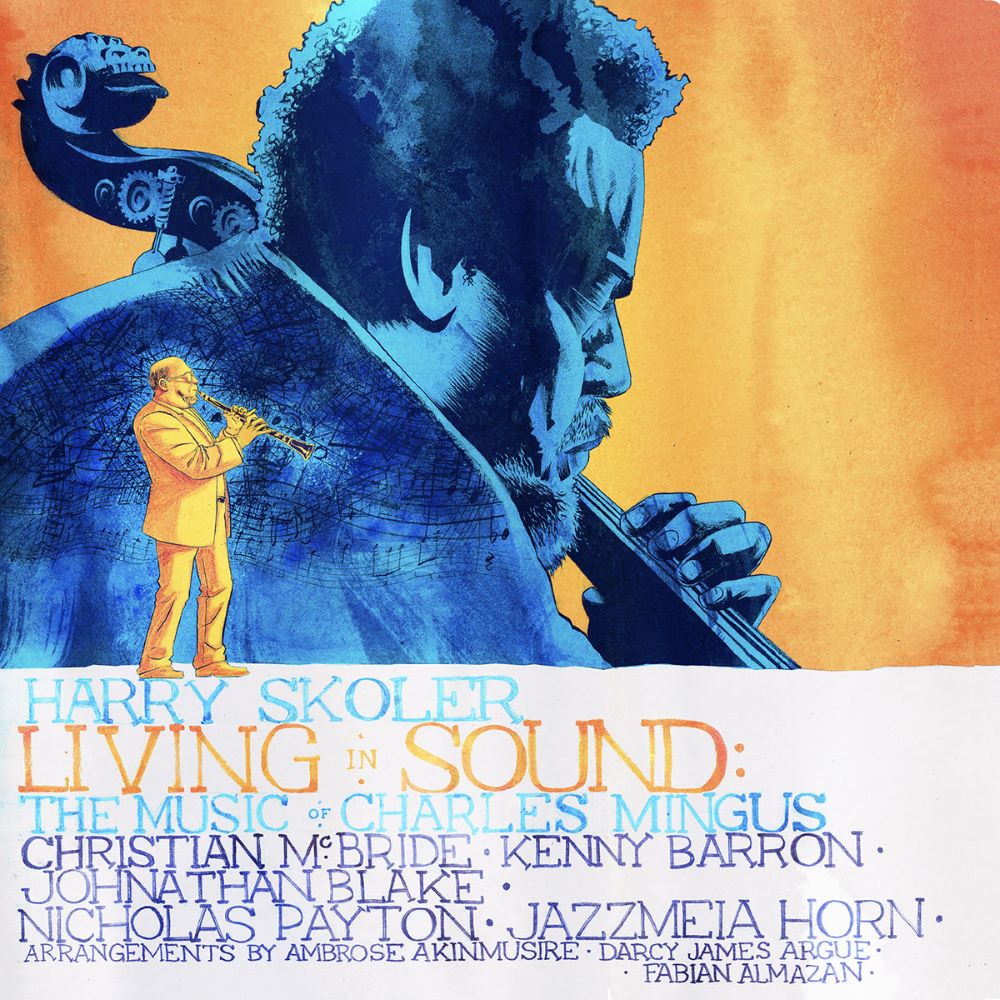
Harry Skoler - Living In Sound: The Music of Charles Mingus (April 22, 2022 Sunnyside Records)

The righteous and bombastic nature of the great bassist/composer Charles Mingus made him a polarizing personality. His unique personality, combined with his groundbreaking music, were magnetic for open-minded listeners. Clarinetist Harry Skoler discovered Mingus and his music early in life. This discovery would change his entire trajectory as a person and musician, which Skoler celebrates on his new recording, Living In Sound: The Music of Charles Mingus.

Skoler had a challenging adolescence while growing up in Syracuse, New York during the 1960s and early 1970s. While seeking solace from a traumatic event, he discovered the world of Charles Mingus, initially from the bassist’s Mingus Moves LP (Atlantic, 1974). The overwhelming impact on Skoler led him to investigate both Mingus’s legendary musical oeuvre and his autobiography, Beneath the Underdog. Mingus’s words and music resonated with the young musician. It is as though he had found truth in the work of one artist.

It wasn’t long before Skoler was able to experience Mingus in the flesh at Syracuse University’s Jabberwocky student club. The experience was beyond anything that Skoler had experienced up until then. Mingus’s powerful presence and command were larger than life. The experience was imprinted deeply on Skoler and is represented in an original graphic story by Dave Chisholm included with Living In Sound.

Over forty years later, Skoler already had a wonderful career as a working musician and professor at the celebrated Berklee College of Music. In 2018, his life was saved from a ruptured artery; then depression set in. This is when Skoler met saxophonist Walter Smith III. Meeting Smith proved to be the catalyst and spark that Skoler needed. Skoler immediately felt that he needed to record again and asked Smith if he would be willing to produce a new album, to which Smith agreed.

It was the collaborative effort of Skoler and Smith that proposed a project celebrating Mingus with strings. Skoler was excited by the possibilities and the project went forward with Smith suggesting the string quartet, jazz accompanists, and arrangers for the pieces. The producer was able to gather an all-star group, which included pianist Kenny Barron, bassist Christian McBride, drummer Johnathan Blake, trumpeter Nicolas Payton, and vocalist Jazzmeia Horn. A string quartet of violinists Megan Gould and Tomoko Omura, with violist Karen Waltuch and cellist Noah Hoffeld was also commissioned.

The recording features arrangements by some of the brightest compositional minds in jazz, namely Darcy James Argue, Ambrose Akinmusire, and Fabian Almazan. The pieces to be performed were selected ad hoc by the arrangers or by Skoler and Smith. The arrangers were trusted to do whatever they wanted in the arrangements. The pieces were ready in August 2021, when Skoler met the band and string quartet at Sear Sound for two days of recording.

The recording begins with Fabian Almazan’s arrangement of “Goodbye Pork Pie Hat,” bittersweet strings leading to Skoler’s laid back reading of one of Mingus’s most beloved tunes. Darcy James Argue twists “Peggy’s Blue Skylight” dramatically, as the rhythmic strings bounce intricately off one another and McBride and Barron stretch out on their individual solos. Argue created a perfect showcase for Skoler on “Duke Ellington’s Sound of Love,” providing an at times lush, then spare, arrangement allowing the clarinetist to dial into the same wistful feelings of respect and love for Mingus’s hero, Duke Ellington, with the aid of McBride’s supportive bass.

Mingus’s striking “Remember Rockefeller at Attica” is filled by Almazan’s pen with the chilling effect and violence that its namesake event inspired; Skoler’s pained screaming through his clarinet, and Payton’s thoughtful trumpet are highlights of the recording. Akinmusire’s arrangement of Don Pullen’s “Newcomer” is nuanced and deep, the tune being from the Mingus Moves LP that was the origin of Skoler’s Mingus appreciation. Brilliant vocalist Jazzmeia Horn brings Doug Hammond’s “Moves” to life, the subtlety and strength of her voice amplified by the meditative tone poem arranged by Almazan.

Argue chose to tackle “Sue’s Changes” for a thrilling and inventive suite with ever changing emotions and transitions, played masterfully by the ensemble and providing Payton some true solo highlights. “Invisible Lady” is a gorgeous, mysterious piece loved by Skoler; Akinmusire’s arrangement provides languid, noirish tones. Skoler’s original, “Underdog,” was completed under the wire, although the conception was developed over months. The composer wrote the piece just prior to the final recording session as a sketch that provides freedom for all the musicians to express themselves without hindrance.

The music that Harry Skoler, Walter Smith III, and their brilliant cast recorded on Living In Sound captures the many moods of the iconoclastic Charles Mingus. There are shades of tumult, harmonic depth, conceptual depth, and abandon. A perfect tribute to the legend to mark his centennial year. 

1. Goodbye Pork Pie Hat
2. Peggy's Blue Skylight
3. Duke Ellington's Sound of Love
4. Remember Rockefeller at Attica
5. Newcomer
6. Moves
7. Sue's Changes
8. Invisible Lady
9. Underdog

Harry Skoler - clarinet
Kenny Barron - piano
Christian McBride - bass
Johnathan Blake - drums
Jazzmeia Horn - vocals
Nicholas Payton - trumpet
Megan Gould - violin I
Tomoto Omura - violin II
Karen Waltuch - viola
Noah Hoffeld - cello

Monday, February 14, 2022

Alan Kwan Quartet - Petrichor (February 2022)

“Incisive, beautiful playing and gorgeous writing. Great record, Alan is a voice worth listening to!”
- Paul Bollenback

"Alan is a next-generation modern player/composer on the rise, from Hong Kong but with NYC pedigree. Beyond his lush harmonies, seamless rhythmic sophistication and breathy melodies, I connect with the expressiveness and honesty I hear in this array of original compositions that are beautifully recorded. It's music that will appeal to musicians who love this idiom, and to listeners new to jazz who love soothing textures and ethereal melodies. I hear the budding of a prolific composer who I think people will be excited to see/hear where he goes”
- Peter Mazza

“…The guitar artistry is exceptional, the tone is warm and rich, the technique is clear, precise and very fluid….”
- Fred Hamilton

“This album is full of his brilliancy, warmth and tenacity. The tone heals the listener.”
– Daiki Yasukagawa

1. Voyage 06:45
2. When Will I See You Again? 06:01
3. Central Escalators 06:20
4. Montauk 04:55
5. Petrichor 07:57
6. Hold True 06:39
7. Tread Softly 03:17

Alan Kwan / guitar, compositions
Fabian Almazan / piano
Linda May Oh / bass
Johnathan Blake / drums

Special Guest: 
Dayna Stephens / tenor saxophone, soprano saxophone

Thursday, June 17, 2021

Dara Tucker - Dreams of Waking: Music For a Better World (2021 Green Hill Music)

Award-Winning Vocalist Dara Tucker Announces the Release of Her Transcendent New Album, Dreams of Waking: Music For a Better World via Green Hill Music

Green Hill Music is proud to announce the May 28th, 2021 release of Dreams of Waking: Music For a Better World, the new album by consummate vocalist, songwriter and bandleader Dara Tucker. With fresh, inspired arrangements of classic singer-songwriter and soul compositions of the protest era, Tucker’s powerful new release gives voice to the cry for social justice and change that has swept across the United States in the new decade. Songs from such legendary songwriters as Stevie Wonder, Donny Hathaway and Paul Simon are presented through a jazz lens with a compelling performance from the vocalist and her illustrious band of musicians. Dreams of Waking: Music for a Better World features Tucker alongside pianists Cyrus Chestnut and Sullivan Fortner, bassists Dezron Douglas and Vicente Archer, drummers Johnathan Blake and Joe Dyson along with saxophonist John Ellis and trumpeter Giveton Gelin.

“Dreams of Waking refers to the hope that our society will develop an awareness of the inequities that still exist,” Tucker said. “It’s the dream that we will become fully conscious and attuned to the hopes, dreams and needs of every human being.”

As a songwriter, Tucker is no stranger to composition as commentary as she teamed up in a similar spirit with blues & Americana artist Keb Mo’ to co-write the title track to his 2020 Grammy-winning album Oklahoma. Tucker’s sole original composition for her new album, “Do We Sleep?” issues a passionate call for cultural awakening that echoes the title of the album. “Many of my original songs are internal statements that help to chronicle my growth, experiences and evolution that I hope will inspire others,” Tucker said. “This time, I decided to focus on the external. Are we really awake? What are we doing to give attention to the cries of injustice and inequality, or are we complicit by silence, ignorance or lack of interest and awareness?”
Drawing from the 1960’s and 1970’s, an era that holds special significance to her musical journey, Tucker’s new album brings life to a collection of songs that reaffirm her belief in our shared humanity. The jazz waltz reimagining of James Taylor’s, “Secret O’ Life” and pianist Cyrus Chestnut’s arrangement of Donny Hathaway’s, “Someday We’ll All Be Free” allows Tucker to soar, sonically capturing the spirit of hope and reflection.

The Motown-meets-New Orleans buoyancy of Stevie Wonder’s, “You Haven’t Done Nothin,’” arranged by saxophonist John Ellis, blends party with protest, while Sullivan Fortner’s recast of Paul Simon’s, “Bridge Over Troubled Water” flows both turbulently and steadily with Tucker at the helm.

Dara Tucker is making her mark in the world of organic, heartfelt music by blending the melodic and lyrical richness of the central plains with the soulful strains of the African American experience. Her eclecticism is guided by the diversity of her narrative. Born in Tulsa, Oklahoma to a family of singers and ministers, Tucker and her siblings traveled across the US singing with their parents. From there, Tucker has experienced a diverse array of locales that she has called home including Interlaken, Switzerland; Nashville, and finally, New York City. Tucker has since toured nationally with her own bands and also with renowned hybrid guitarist Charlie Hunter.

Dreams of Waking: Music For a Better World is her latest in a compendium of innovative studio releases. The resulting 12-song project, recorded by GRAMMY-winning engineer Mike Marciano and produced by Greg Bryant, delves deeply into the national Zeitgeist with a clarion call to all agents of change to build a world that embraces the dignity and humanity of all people.

1. Secret O' Life (James Taylor) 4:02
2. You Haven't Done Nothin' (Stevie Wonder) 4:43
3. Someday We'll All Be Free (Donny Hathaway/Edward Howard) 4:00
4. Do We Sleep? (Dara Tucker) 4:13
5. Bridge Over Troubled Water (Paul Simon) 8:02
6. Make Someone Happy (Jule Styne/Adolph Green/Betty Comden) 5:48
7. What The World Needs Now (Burt Bacharach/ Hal David) 3:50
8. What's Going On? (Marvin Gaye/Renaldo Benson/Al Cleveland) 5:18
9. Love's In Need Of Love Today (Stevie Wonder) 4:12
10. You've Got A Friend (Carole King) 6:12
11. Wade In The Water (traditional arr. David M. Rodgers) 5:47
12. I Think It's Gonna Rain Today (Randy Newman) 4:02

Dara Tucker - vocals (all tracks) & arrangements (1, 6, 12)
Cyrus Chestnut - piano (1, 3, 6, 7, 9, 10, 11) & rhodes piano (3, 10) & arrangements (3, 6, 7, 9)
Sullivan Fortner - piano (2, 4, 5, 8, 12) & rhodes piano (2) & arrangements (5, 8, 12)
Dezron Douglas - bass (1, 3, 6, 7, 9, 10, 11)
Vicente Archer - bass (2, 4, 5, 8)
Johnathan Blake - drums (1, 3, 6, 7, 9, 10, 11)
Joe Dyson - drums (2, 4, 5, 8) & tambourine (2) 
Giveton Gelin - trumpet (2, 4, 5, 8)
John Ellis - tenor saxophone (2, 4, 8) & soprano saxophone (5) & arrangement (2) & horn arrangements (2, 4)

* "You've Got A Friend" & "Wade In The Water" arranged by David M. Rodgers

Recorded November 29th, November 30th & December 1, 2020 at Samurai Hotel Studios, Astoria, NY
Engineered & Mixed by Mike Marciano for Systems Two Recording
Mastered by Mike Haynes for ENSO Mastering
Produced by Greg Bryant for Watchman Music
A & R Direction by Greg Howard for Green Hill Productions
Cover and liner photography by Andreas Hofweber
Makeup: Tanya Alvarado
Album Design by: Chad Smith

Friday, May 7, 2021

Rale Micic - Only Love Will Stay (May 7, 2021 Whaling City Sound)

A World of Talent
Rale Micic's heartwarming fusion of heritage, taste, and jazz guitar sophistication shines on
Only Love Will Stay

It goes without saying, though we’ll say it once, right from the top here, that Rale Micic is a unique voice in jazz guitar. He combines an absurdly melodic approach and an intricate insight into harmonies, with a sort of deep personal story from his native Serbia. His life experience and heritage exert a soft and loving influence on his artistic approach: the rhythm, tone, and feel of the music of his life. This approach, in the works for a while now, culminates on his new recording, Only Love Will Stay.

Micic has played with such artists as Tom Harrell, Don Friedman, Peter Bernstein, Eric Alexander, and Greg Hutchinson, but it’s the striking originality with which he plays his own music that really distinguishes him from other jazz guitar talents. The session, with Jared Gold on keys and Geoff Clapp and Johnathan Blake on drums, is both relaxed and substantial, joyful and chill, starring the filigreed sounds of Micic’s Sadowsky archtop and the tasty choices of empathic accompanists. “I first played with Johnathan Blake when we were in Tom Harrell’s group,” says Micic. “We have been playing together for over 10 years and he was also on my previous album, Night Music. Geoff is another great drummer and we have toured and played quite a bit in the last four, five years. It’s great how both of them brought something special to the music. This is the first time I worked with Jared Gold, but it felt so nice and easy. I think the musical chemistry is pretty apparent.”
Only Love Will Stay features Micic and the band creating layers of original sounds, featuring a backbone in acoustic jazz ala John Abercrombie, the intricate textures of his internal conversations, and continuing through the loving melodic rhythms of his native Serbia. “Early on,” he says, “I loved listening to the very different way that John Abercrombie was using organ with his groups and keeping it very open and cool sounding. So, I guess this record is a nod to John. He was a big influence on me. I was fortunate to play and record with him before he passed away. That’s one of the reasons I included his song ‘Even Steven’ on the album.”

Elsewhere, tunes like the dark and dramatic title track which opens the record, right through to the lush, atmospheric closer “Lipe Cvatu,” in 7/8, are enrapturing without going too far astray, too deep into the margins. They are intoxicating without over-exerting. Micic’s Only Love Will Stay is a joyful experience and a stunning excursion into the mind of a truly original artist.

Thursday, April 8, 2021

Greg Abate - Magic Dance (The Music of Kenny Barron) April 2021 Whaling City Sound Records

Theres a beautiful marriage happening with Greg Abates Magic Dance."" Its the union between Abates multi-instrumental gift of bebop and Kenny Barrons varied and sublime compositions. Abate, with Barron, who handles keys on this recording session, are soulmates sharing this epic musical space. On their own, Barrons melodies are transcendent. In Abates skillful hands, thanks to his ability to shift between alto, tenor, baritone and soprano saxes and flute, the material takes on new tones, colors and patterns. One of the liberties Abate took with the material involved varying the choice and number of horns on these tracks. On two tracks, he even went so far as to arrange and overdub four additional sax parts, modeled on the reed section of the traditional big band, which give Barron's lush sounds even greater texture and intricacy.

Underneath it all is the hot-shot rhythm section of bass player Dezron Douglas and drummer Johnathan Blake, a New York City tandem born to support and elevate these arrangements. In fact, the ensemble work throughout this two-disc project is incredible, and reaffirms the health of 'real' bebop, a genre in which Abate has, through a five-decade career, been a dependable flame keeper. With this collaboration, Abate, with sidemen Barron, Douglas and Blake prove that the glory of straight-ahead jazz can still be purposeful, exhilarating, and, above all, like all great marriages, faithful and true.

1. Sunshower
2. Cook's Bay
3. Golden Lotus
4. Innocence
5. Water Lilly
6. Sonya Braga
7. Bud Like
8. Lemuria
9. Concentric Circles
10. Rain
11. Voyage
12. Magic Dance
13. Song for Abullah
14. And Then Again

Wednesday, March 31, 2021

Dr. Lonnie Smith - Breathe (March 2021 Blue Note)

Breathe captures the Hammond B-3 organ legend Dr. Lonnie Smith during his 75th birthday run at the Jazz Standard in NYC in 2017, the same week he recorded his acclaimed trio album All In My Mind. On this night the good doctor took the stage with an expanded line-up featuring Jonathan Kreisberg on guitar, Johnathan Blake on drums, John Ellis on tenor saxophone, Jason Marshall on baritone saxophone, Sean Jones on trumpet, and Robin Eubanks on trombone. Two additional studio tracks that open and close the album present the unique collaboration between Doc and Iggy Pop including a sublime cover of Donovan’s 1966 hit “Sunshine Superman.”

The legendary Hammond B-3 organist Dr. Lonnie Smith has recorded over thirty albums as a leader, but his favorite setting to document his creativity is live. “It’s so hard to capture what I’m feeling at the moment in the studio,” he says. “Hearing me live is catching me playing in the moment. It’s a good vibe. It’s a loving situation.”

During the 2017 celebration of his 75th birthday, basking in the glow of being named an NEA Jazz Master, Smith settled into the Jazz Standard in New York City for a live recording date. With his steady trio of guitarist Jonathan Kreisberg and drummer Johnathan Blake, the master of improvisational innovation delightfully delivered the spirited All In My Mind album, which was released in 2018.

That celebratory week has now yielded a second fantastic album with Breathe, a dynamic eight-song set that includes six thrilling pieces brimming with foot-tapping grooves, sophisticated harmonic voicings, indelible melodicism, and ethereal atmospherics that were captured on the Jazz Standard stage with the trio as well as an expanded septet. Notably, the album is bookended by two remarkable studio collaborations between Smith and the legendary vocalist Iggy Pop.

“I was playing with my trio at Arts Garage in Delray Beach in Florida,” says Dr. Lonnie, who lives in Ft. Lauderdale. “Iggy would come by and say he wanted to play with me. I let him play slaparoo and he loved it. He enjoyed playing with us. We thought about recording a few songs, so we went in with my trio backing us up, and it worked.”

Pop, Smith, Kreisberg, and Blake headed into a Miami studio with the addition of percussionist Richard Bravo and discovered a unique chemistry that resulted in two striking performances including the album’s opening track “Why Can’t We Live Together,” a 1972 R&B hit by Timmy Thomas that was later recorded by Sade on her 1984 debut album. With its call for unity, the song is given an eased, soulful read by Pop while Smith plays gentle grooves before diving into a juicy solo. “That’s a great tune with a great message,” he says. “It really says something to you. We enjoyed it very much.”
The album closes with Iggy and Dr. Lonnie taking Donovan’s 1966 hit “Sunshine Superman” for a funkified joyride. “Ah, hah!” exclaims Doc. “That’s another good one. You can hear the ones we both like. This fits his voice.”

The entire album is rooted in the deep musical communication Smith has developed with his trio mates over many years. “It’s hard to keep a working group like this,” the good Doctor says. “But my group has been together a long time. It’s a brotherhood. It’s a family. It’s exciting. They’re playing from their hearts. They know what I’m trying to do and enhance what I play. They hear me. I play in the moment all the time, and they’re there for me.”

In the trio takes from the Jazz Standard, Dr. Lonnie’s B-3 sounds like it’s wailing, as on the epic, soulful original “World Weeps” that goes up-tempo with a wall of organ emotion and Kreisberg’s fleet-fingered guitar flight. “It has a New Orleans feel,” says Doc, “like a dirge.”
The trio also takes a playful plunge into Thelonious Monk’s “Epistrophy.” “That’s one of my favorites,” Smith says. “I had to get that in there. It’s a little different, but I think he would have approved of it. There’s funky wisdom.”

The remainder of the album finds the trio expanded to a septet with the addition of John Ellis on tenor saxophone, Sean Jones on trumpet, Jason Marshall on baritone saxophone, and Robin Eubanks on trombone. “Some of my songs need the horns,” Smith says. “I needed that atmosphere.” The lyrical, buoyant “Bright Eyes” is a Dr. Lonnie original that dates back to the days when he played with George Benson. “Too Damn Hot” is another original that starts slowly but then heats up with sizzling solos. “I wrote that song some years ago,” he says. “I like all the surprises. It feels good, almost as if you don’t really know what’s going on.”

Smith’s “Track 9” starts with an edgy horn-filled groove then shifts gears with tempo acceleration that opens into a utopian party. The B-3 maestro steers the proceedings with his bass lines while Jones launches into a scorching solo. “It’s like a train, ‘Track 9.’ It moves like a train. You hear it in the distance, then there’s the horn and the beat is slow then it picks up. I wanted to give it a James Brown feel.”

“Pilgrimage” shines a spotlight on the soulful beauty of vocalist Alicia Olatuja. “Alicia is a helluva singer,” Smith says. “She is something else. The way she sings this song is perfect. She sings it like it’s hers. As her accompanist, my comping was just to lay back and take it easy. I listen carefully, give her what she needs then get the horns to push it. It’s special.”

Breathe is Smith’s third Blue Note album since his 2016 return to the label where he made a name for himself in the late 1960s, first as a sideman with saxophonist Lou Donaldson on soul jazz classics like Alligator Bogaloo, and soon after as a leader with his own classics such as Think! and Turning Point. The 2016 album Evolution marked his Blue Note homecoming, followed by All In My Mind in 2018. His last three albums have all been produced by Blue Note president Don Was. “Don has been hands on, there all the time,” he says. “He believes in you. I’ve worked with producers who don’t understand the musicians they’re working with. But Don, he wants me to be myself, to understand what I like to do. It’s a reminder of the old days when Frank Wolff used to be the same.”

Smith adds, “Blue Note is like family. It’s like I never left. Everybody is great to work with. They give me the opportunity to play my life, to tell my story.”

Monday, March 8, 2021

Michael Thomas - Natural Habitat ( March 26, 2021 Sunnyside Records)

Developing as an artist requires an incredible amount of study and hard work honing skills. During this process, the burgeoning artist will naturally begin to find areas in which he or she feels more comfortable, their comfort zone. This concept reaches beyond a physical location. It can also apply to material and communal elements in the creation of art.

Saxophonist/bass clarinetist/composer Michael Thomas seems to have found his musical domain once he settled in New York City. His new recording, Natural Habitat, illustrates how his path to the City has placed him in a perfect spot, both physically and mentally, to create the best art that he can.

Originally from Florida, Thomas grew up playing classical saxophone and picking up clarinet and flute as doubling instruments in high school. He pursued music as an undergrad at the University of Miami and then went to Boston to get his masters at the New England Conservatory. His three years in Boston would be the most important years in the young reedist’s development. The inspiring tutorship of saxophone legends George Garzone and Jerry Bergonzi and the sweeping breadth of Miguel Zenón’s lessons bridged the gaps between many of the musical elements Thomas was juggling.

Thomas dreamed of reaching New York City, and the Artist Diploma program at Juilliard gave him the opportunity. His immediate contact with some of the best musicians in New York who were involved with the program, including Ron Blake, Steve Wilson and Frank Kimbrough, helped him break into the scene quickly. Working on Zenón’s Identities are Changeable large ensemble project really cemented his credibility, as he worked with a generation of musicians he had previously looked up to, as an equal.

For a number of years, Thomas found himself bouncing between Boston and New York for gigs, including those with his long-time friend and collaborator, trumpeter Jason Palmer. Boston remained an indelible part of Thomas’s maturation, the place where he wrote and crafted much of his original music, including a number of pieces on Natural Habitat.

His arrival in New York led him to change his approach to music making, as his pieces began to open up, becoming more flexible for the expression of the people he began to play with. One of the first musicians Thomas began having regular sessions with was bassist Hans Glawischnig, who he met through Zenón and who happened to be his neighbor.

The supportive Glawischnig was a natural selection for Thomas as he began to establish a quartet to play his music. Pianist Julian Shore was a Boston contemporary, though he had attended Berklee School of Music, and an obvious choice for the group with his attention to the needs of a band. Drummer Johnathan Blake was a more recent association, but one that brought an unbounded freedom to the band’s performances.

The compositions on Natural Habitat underline the comfort that Thomas has in his abilities to write pieces of vastly differing styles and sounds.
The recording begins with “Float,” one of Thomas’s older pieces whose melody sails over a complicated but naturally carried meter in 7/4 and then 5/4. The gorgeous “Different Time” allows Thomas to demonstrate his bass clarinet chops on a lush jazz waltz. “First” comes from a series of pieces Thomas wrote for a 2017 performance; this bright piece bounds with energy from Thomas’s alto and a stunning bass solo from Glawischnig. The swinging title track really cemented the idea of this project, as it was during a Boston performance of the piece in 2018 that Thomas really felt grounded in his place, both his concept and destination.

The tricky “Harbor” emerged from concepts that Thomas had developed with rapidly switching meters and complex harmonies, a musical riddle that he solved on a long evening walk alongside of Boston Harbor. The delicate “Fourth” is a ballad from the 2017 series that begins extremely slowly but builds into a scintillatingly dynamic saxophone solo. “Demise” also began as a rhythmic mystery, this time a lopsided 13/8 piano feature that Thomas shaped by adding bass clarinet and bass accompaniments.

Thomas wrote “No Words” as a freely played piece that he imagined someone could sing, the lyrical piano lines leading to Thomas’s pliantly emotive sax. The recording concludes with “Two Cities,” a piece Thomas wrote while bouncing between New York and Boston for a group of musicians who split their time between the two cities. The dancing piece has two opposing sections that are a study in contrasts and highlight the composer’s ability and breadth.

Though Boston helped shape Michael Thomas, it has been New York City that has allowed him to refine his craft and approach. Natural Habitat highlights Thomas’s dexterity as a musician and composer with an ensemble of that would make any soloist feel right at home.

1. Float
2. Different Time
3. First
4. Natural Habitat
5. Harbor
6. Fourth
7. Demise
8. No Words
9. Two Cities

Michael Thomas - alto saxophone & bass clarinet
Julian Shore - piano, Rhodes & synth
Hans Glawischnig - bass
Johnathan Blake - drums

Sunday, February 14, 2021

Vincent Herring - Preaching to the Choir (Smoke Sessions Records April 30, 2021)

Saxophonist Vincent Herring

Battles Back From Bout with Coronavirus and

Career-Threatening Side Effects with Optimistic New Album


Preaching to the Choir, Due Out April 30, 2021

via Smoke Sessions Records


Album Finds Hope in Face of Pandemics and Politics

with Swinging Help from Cyrus Chestnut,

Yasushi Nakamura and Johnathan Blake


Saxophonist Vincent Herring speaks for nearly all of us when he writes, “2020 into 2021 was a morbid nightmare.” Herring has experienced the effects of the pandemic firsthand, contracting COVID-19 while suffering the same loss of performance opportunities befalling every musician during this trying year. That’s only meant more time spent at home, watching the turbulent presidential election and its violent aftermath.

Despite the prevailing darkness, Herring insists on seeing a silver lining in the looming storm clouds overhead. On his latest album, Preaching to the Choir (due out April 30, 2021 via Smoke Sessions Records), he delivers a sermon of optimism and hope to the jazz faithful, aided by as fervent a congregation as a swing disciple could pray for: pianist Cyrus Chestnut, bassist Yasushi Nakamura, and drummer Johnathan Blake.

“We have to have hope for the future,” Herring insists. “I’ve been in a constant state of disbelief with so much going on that is negative in the world, but I try to look at the positive side of everything. Fate is written with all kinds of twists and turns, and in the end the only thing you can do is realize that as bad as things are – and they are bad –the promise of tomorrow is going to be special.”

Herring’s story has undergone more than its fair share of twists in recent months. Last August, he traveled to Las Vegas to take part in a centennial celebration for one of his heroes, Charlie Parker, with conductor Justin DiCioccio leading a string orchestra. The saxophonist now believes that it was on the flight back to New York that he contracted COVID. “It felt like the flu,” he recalls. “I was tired all the time, but I wasn’t coughing, and I didn’t have any respiratory problems. After less than a week, I felt totally fine.”

Despite the relatively minor effects, though, the virus wasn’t done with Herring yet. A few weeks later he began feeling pain in his joints. “I remembered some comedian talking about when you get to be over 50 you get aches and pains, and when you tell the doctor they’re just like, ‘Yeah, it happens.’ So, I didn’t think anything of it, but then it got progressively worse. My doctor had me do a blood test and she told me I had rheumatoid arthritis – and it was a gift from COVID.”

Chronic joint pain can be a death knell for a musician – it has ended careers, especially for pianists – so Herring entered the studio feeling strong but unsure of his future. “I knew it was a possibility that this would be my last record,” he says. “I wasn’t saying that to other people, but the thought was constantly in my mind.”

“Fear” and “trepidation” are hardly words that come to mind when listening to Preaching to the Choir, however. The buoyant, robust music never sounds like the work of a man in pain, and not once does it take on the solemn character of a swan song. Since the recording, Herring—with the help of specialists—has managed to get the pain under control. And despite the disheartening news of injustice and political divisions, Herring is uplifted by the rallying of young people in support of protest efforts like the Black Lives Matter movement.

The saxophonist’s refusal to let the anxieties surrounding the recording pervade his music is evident from the outset of Preaching to the Choir. The album opens with the relaxed stroll of “Dudli’s Dilemma,” an original tune dedicated to the Swiss drummer Joris Dudli, who the composer calls “a great musician and a true friend.” The warmth of that personal relationship lights up Chestnut’s sprightly solo as well as the gentle precision of Blake’s rhythmic foundation.

Nakamura kicks off the well-worn standard “Old Devil Moon” by crossbreeding it with the famed bass line of Benny Golson’s classic “Killer Joe,” shifting the emphasis to the sly devilishness of the song. “Ojos de Rojo” comes from the prolific pen of the legendary pianist Cedar Walton, in whose band Herring played for more than two decades. The saxophonist feels utterly at home as he unfurls an effortlessly eloquent solo, juggling equal parts intensity and lyricism. The quartet then wrings every ounce of emotion from Lionel Richie’s “Hello,” Blake’s ethereal brushwork embracing the heartfelt yearning of the leader’s keening alto.

The mood turns a complete 180 with the gutbucket groove of guitar great Wes Montgomery’s “Fried Pies.” One can almost smell the sizzling grease during the raucous blues, propelled by the window-rattling bravura of Nakamura and Blake. Chestnut contributes the self-explanatory “Minor Swing,” along with a fleet, explosive solo that leaps around the keyboard with bristling spirit. Herring’s breathy, elegiac tone crafts a haunting atmosphere for Duke Ellington’s immortal “In a Sentimental Mood,” matched by the delicate sensitivities of his bandmates.

The call and response head of the title track is straight out of a roof-raising church service, but the choir being preached to in this instance is multi-denominational, united by the simple love for Herring’s lively brand of swing. “I wrote this song as a tribute to my fans,” he says, recalling the messages of love and support he received throughout his recent ordeal. “During a time like this you need to hear kind words. Thinking this would be my last recording was depressing but hearing from people what my saxophone voice meant to them was very rewarding.”

The band simmers on Joe Henderson’s “Granted,” before bursting out for an incendiary run from Herring and a shimmering turn by Chestnut, capped off by a round of trading with Blake’s effusive outbursts. The album closes on a lovely, tender note with Stevie Wonder’s “You Are the Sunshine of My Life,” which Herring aptly describes as “a classic song played with love.”

That spirit of love, appreciation and, most of all, hope colors every tune on Preaching to the Choir, which arrives as a much-needed salve after such a divisive and disheartening period in history. “In spite of everything,” Herring declares, “even though I’m in constant pain and discomfort, I still feel grateful because it could have been worse. So, I do count my blessings.”

Vincent Herring
Cyrus Chestnut
Yasushi Nakamura
Johnathan Blake

Wednesday, August 1, 2018

Rachel Caswell "We’re All in The Dance" CD Release Jazz at Kitano: Saturday, September 15, 2018


Rachel Caswell
CD Release Concert
Saturday, September 15, 2018
Set Times: 8pm & 10pm
Jazz at Kitano
66 Park Ave. @ E. 38th St.,
New York, NY 10016
Reservations (212) 885-7119

Featuring
Rachel Caswell - vocals
Sara Caswell - violin
Dave Stryker - guitar
Glenn Zaleski - piano
Matt Aronoff - bass
Johnathan Blake - drums


There’s no mistaking the message of “We’re All in The Dance,” the title track of singer Rachel Caswell’s latest album. It’s a lovely waltz that pairs the dance of life with the dance of music and somehow, through her purity of tone, intelligent phrasing, and flowing time feel, Caswell—cosigned by an ascendant solo by her younger sister, Grammy-nominated violinist Sara Caswell—navigates an alternate, bespoke pathway through a song whose simplicity and elegance pose a challenge to a singer steeped in the complexities of jazz expression.

She addresses the subject of love head-on throughout the proceedings, comprising ten songs culled from a long timeline and a panoply of stylistic genres. Caswell tells each story with equivalent levels of individualism and interpretive mojo, imparting a continuity and identity from the first track (an inflamed, incantatory reading of Sting’s “Fragile”) to the last (a mesmerizing meditation on Jon Hendricks’ bittersweet-yet-optimistic lyric to Thelonious Monk’s “Reflections”).


Along the way, Caswell puts deep blues inflections on “Drown in My Own Tears,” the Ray Charles classic, followed by a soulful guitar declamation by master blues practitioner—and album producer—Dave Stryker. She channels her inner Ella Fitzgerald and Sarah Vaughan on “A Lovely Way to Spend an Evening,” eschewing a balladic approach for a well-wrought, lightly swinging delivery of the lyric. She renders the late Bob Dorough’s “Devil May Care” with apropos vertiginous flair, developing her rhythmic ideas on an instrument-like improvisation. She applies a spacious Latin feel to Henry Mancini’s “Two for The Road,” and showcases her broad registral range and deep pocket in conveying Tom Lellis’ evocative lyrics to Herbie Hancock’s “Tell Me A Bedtime Story.” Dave Stryker’s arrangement of Rodgers & Hart’s American Songbook classic “I Didn’t Know What Time It Was” plays on the title, shifting odd meters with finger-popping swing. And Rachel scats the melody of Charlie Parker’s “Dexterity” with an idiomatic bebop feel, giving her A-list partners full autonomy to play it in their manner and responding to their postulations with a pithy scat.

Another of the record’s great pleasures is an opportunity to hear how deftly each world-class member of the kinetic rhythm section locks into their task of reimagining and reconfiguring “standards.” Hopefully, Stryker’s imprimatur and this cutting-edge band will induce gatekeepers from radio and the press to listen closely to this superb album. If they do, and respond accordingly, Caswell may be moving to another level of visibility in the not so distant future.


Edited from liner notes by Ted Panken


“Rachel Caswell is that rara avis who is truly a jazz vocalist. Her intonation is impeccable, her diction precise, her jazz sensibilities above reproach, and she swings like mad!... Few improvisers – vocal or instrumental – have better ears than she possesses and she has an exceptional instrument that is immediately identifiable among a sea of other vocalists.”
David Baker, NEA Jazz Master & jazz education pioneer

1. Fragile – Sting – 7:05
2. A Lovely Way to Spend an Evening – Harold Adamson/Jimmy McHugh – 5:16
3. We’re All in The Dance – Will Jennings/Christophe Monthieux – 5:11
4. Devil May Care – Bob Dorough/Terrell P. Kirk Jr. – 6:46
5. Two for The Road – Leslie Bricusse/Henry Mancini – 5:42
6. Drown in My Own Tears – Henry Glover – 4:58
7. I Didn’t Know What Time It Was – Lorenz Hart/Richard Rodgers – 6:06
8. Tell Me A Bedtime Story – Tom Lellis/Herbie Hancock – 6:05
9. Dexterity – Charlie Parker – 6:01
10. Reflections (Looking Back) – Jon Hendricks/Thelonious Monk – 5:16

Sara Caswell, violin
Dave Stryker, guitar
Fabian Almazan, piano & fender rhodes
Linda May Han Oh, bass
Johnathan Blake, drums


NATIONAL PRESS CAMPAIGN
JIM EIGO, JAZZ PROMO SERVICES
jim@jazzpromoservices.com • www.jazzpromoservices.com
“Specializing in Media Campaigns for the music community, artists, labels, venues and events.”

Sunday, June 17, 2018

Black Art Jazz Collective - Armor of Pride (HIGHNOTE RECORDS 2018)


The Black Art Jazz Collective's mission statement celebrates African-American cultural and political icons. At the core is a modernism that conjures up the classic bands of Art Blakey and acoustic Miles Davis. But with the contemporary soul-fuelled solos and locked-in rhythm the band is more likely to launch into a counterpoint riff or the spacious funk of hip-hop than the svelte lines of a classic walking bass. The Black Art Jazz Collective delivers strong original tunes and purposeful, form-hugging improvisation that keeps things looking forward rather than back. And with trumpeter Jeremy Pelt on ebullient form, and saxophonist Wayne Escoffery's muscularity contrasting with the tenderness of James Burton III's trombone, the focus never becomes diffuse or wavers.

Miller Time
Armor of Pride
Awuraa Amma
The Spin Doctor
And There She Was Lovely as Ever
Pretty
When Will We Learn
Black Art

Wayne Escoffery, tenor saxophone
Jeremy Pelt, trumpet
James Burton III, trombone
Xavier Davis, piano
Vicente Archer, bass
Johnathan Blake, drums

Thursday, April 5, 2018

Kenny Barron Quintet - Concentric Circles (BLUE NOTE May 4, 2018)

On his last two on impulses! Records released albums provided Kenny Barron with small casts for magical moments. In 2014, the pianist demonstrated "The Art Of Conversation" in intimate musical dialogues with bassist Dave Holland. The recording was named the album of the year by the Jazz Journalists Association. His "Book Of Intuition" he played in 2016 again in a trio with bassist Kiyoshi Kitagawa and drummer Johnathan Blake. The extensive discography of Kenny Barron is paved with such high-profile duo and trio recordings abundantly. Following his move to Blue Note Records, Barron is back on Kitagawa and Blake on his latest album "Concentric Circles". However, the sonic palette will be greatly enhanced this time by the addition of saxophonist Dayna Stephens and trumpeter Mike Rodriguez. "I've always wanted to record with a quintet because it gives me the opportunity to compose more," Barron notes soberly.

Of course, "Concentric Circles" is by no means Barron's first album in this format. Both the 1968 published album "You Had Better Listen", on which he was named alongside the trumpeter Jimmy Owens as a co-leader, as well as his 1973 launched solo debut album "Sunset To Dawn" he had already recorded with quintet ensembles. In the 1980s he directed another quintet with saxophonist John Stubblefield, trumpeter Wallace Roney, bassist Cecil McBee and drummer Victor Lewis, who recorded the critically acclaimed 1986 album "What If". Two years later, with only a slightly changed line-up (Eddie Henderson replaced Roney), the no less excellent album "Live At Fat Tuesdays".

Barron's quintet from the late 1990s, made up of Henderson, saxophonist David Sánchez, bassist Rufus Reid and drummer Billy Hart, also formed the core of the ensemble, with which Barron recorded "Spirit Song" in 2000. For "Images", he completely reorganized his quintet four years later, occupying it with vibraphonist Stefon Harris, flutist Anne Drummond, Kitagawa, and drummer Kim Thompson. Concentric Circles is now Barron's first true quintet publication since Images.

Kenny Barron presents not only his latest quintet, but also some of his own original compositions never before recorded by him. He opens with "DPW", a brisk hard-bop number, in which he pays tribute to the Brooklyn neighborhood of Ditmas Park West, where he is at home today. With the melody and its urban harmonies played in unison by trumpet and tenorsax, this 2013 song is reminiscent of the classics known from Art Blakey's Jazz Messengers or the Miles Davis Quintet of the mid-sixties. Through a first-class groove that moves between straight hard-bop and Afro-Latin rhythms, Barron beats a crystalline, yet lyrical, improvisation into the keys that makes it clear what a master of touch, phrasing and harmonic finesse he is is.

The title track "Concentric Circles" is followed by a tantalizing waltz, which is carried by the flickering rubato of the rhythm section and embellished with smooth solos by Barron, Stephens and Rodriguez. Blake's urging 6/8 rhythms drive "Blue Waters," another new Barron composition that is peppered with smart, blues-laden passages. After that, the sunny atmosphere of the first pieces in "A Short Journey" gives way to a more subdued timbre. The underworld ballad is characterized by casual brass melodies, pensive piano lines, floating cymbals and pulsating bass accompaniment.


But the mood cheers up in the next issue again. Barron surprises here with a charming reworking of Caetano Veloso and Cézar Mendes' "Aquele Frevo Axé". With this lithe samba jewel that Barron became aware of through a recording by Gal Costa, the pianist continues his ongoing love affair with Brazilian music. The contemplative mood contrasts sharply with the unpredictable nature of Barron's next original "Von Hangman," in which the piano, trumpet, and saxophone navigate through a maze of zig-zagging phrases, while the rhythm section propels them forward in a stirring gait.

Contemplatively, it is again in Barron's heartbreaking play "In The Dark", which he had originally composed in 2009 for the soundtrack of the movie "Another Harvest Moon". The song reveals Barron's talent for composing scenic music. He indulges in his penchant for Latin American rhythms again in the lively original "Baile". "L's Bop" was written by the drummer Lenny White and offers the two brass players and the leader an ideal opportunity to let off steam. In "I'm Just Sayin '", Barron provides a funky bass line that Kitagawa soon picks up before the piece hits an implied Crescent City groove.

The mind of Thelonious Monk is always present on Barron's recordings in one way or another. Here, he pays tribute to the jazz icon, which has influenced and inspired him so much, with a grand piano solo interpretation of the classic "Reflections". The pianist had recorded the number several times before, the first time in 1982 with the Monk tribute band Sphere for the album "Four In One", the - macabre coincidence! - just recorded the day Thelonious Monk died.

With "Concentric Circles," Kenny Barron, who turns 75 in June, underscores that he does not intend to rest on his laurels. Because as he shows on this album with eight own compositions and three fabulous interpretations, he still has a lot to tell his audience.

01 DPW
02 Concentric Circles
03 Blue Waters
04 A Short Journey
05 Aquele Frevo Axé
06 Von Hangman
07 In the Dark
08 Baile
09 L's Bop
10 I'm Just Sayin'
11 Reflections


Dayna Stephens, saxophone
Mike Rodriguez, trumpet bugle
Kiyoshi Kitagawa, bass
Johnathan Blake, drums

Sunday, January 7, 2018

Groundbreaking Support for Artists with Jimmy Katz's Giant Step Arts


Renowned Photographer Jimmy Katz Announces Giant Step Arts, an Innovative, Artist-Focused Non-Profit Presenting and Recording Concerts by Modern Jazz Innovators

Launching in January, Giant Step Arts will present one-of-a-kind performances by acclaimed artists, recorded for independent release and documented by Katz in stunning short films

Series kicks off January 21-22 with four sets at NYC’s Jazz Gallery with The Johnathan Blake Trio featuring Chris Potter and Linda Oh

“[Katz] has developed an exceptional body of work in the jazz field, covering the elder statesmen, the icons, the mainstream and the young lions. In the process, he has developed his own style with the camera that is as identifiable as Armstrong’s tone on trumpet or Coltrane’s sound on tenor sax.” 
– Michael Cuscuna, producer, Blue Note Records

For nearly 30 years, photographer Jimmy Katz has documented the world of jazz – crafting iconic portraits of legendary artists, capturing historic moments in the recording studio, or encapsulating the thrill of a nightclub performance in a single fleeting image. Now, with his groundbreaking new non-profit Giant Step Arts, he’ll not only shoot those indelible musical moments, he’ll create them – and the artists themselves will reap the rewards.

Beginning in January, Katz will present a series of live concerts featuring some of modern jazz’s most innovative artists in unique premiere performances and workshops, all recorded for independent release and captured by Katz’s perceptive eye. Instead of using these events for personal reward, he’ll pass the recordings on to the musicians to sell themselves, an unprecedented deal that feels especially rare in today’s self-obsessed cultural climate. The musicians will be well compensated, own their own masters, and Katz will provide them with 700 CDs as well as digital downloads to sell directly, bypassing the profit-sharing incurred in the record label model.

“Giant Step Arts will not be selling any music,” Katz says. “We have two goals: help the musicians and raise more money so we can help more musicians.”

Giant Step Arts will launch with two nights at New York City’s Jazz Gallery on January 21-22, featuring what are sure to be four unforgettable sets by The Johnathan Blake Trio featuring saxophonist Chris Potter and bassist Linda Oh. This singular trio brings together one of the most influential tenor saxophonists in modern jazz with a highly-regarded, rising star bassist, under the leadership of one of the music’s most adventurous drummers. In coming months, the series will also present acclaimed saxophonist Rudresh Mahanthappa leading a new trio, and brilliant trumpeter Jason Palmer leading a quartet featuring sax giant Mark Turner and bassist Ben Williams.

Each of these concerts promises to be among the highlights of the 2018 jazz calendar, but even more importantly they’ll be recorded for posterity. Katz is an esteemed recording engineer who has worked with artists including David S. Ware, Joe Lovano, Harold Mabern, William Parker, Benny Golson, Jason Palmer, Chris Potter, Rudresh Mahanthappa and Mark Turner among others.

Katz will also create a short film specially tailored to each of the artists – living portraits that will be available online to the public and will help introduce the musicians’ unique personalities to the world in the way that his photos have done for decades. Katz’s striking images will play a role in every Giant Step Arts presentation via slideshows or gallery exhibitions.

The musicians will be given total freedom to choose their collaborators, musical direction, and even the venue for their performances. In return, they’ll give back by teaching master classes to students and the general public, which will be filmed by Katz. Each event will take place at a not-for-profit institution of the artist’s choosing, with free tickets available for students of the New School.


“I feel very strongly that the arts are not supported in this country,” Katz says. “I’d like to raise the profile of each of the musicians. I’m interested in supporting the highest level of creativity in what I believe is the greatest art form - jazz. Giant Step Arts will give musicians the opportunity to fulfill their dreams with no strings attached.”

The only stipulation that Katz places on the artists is that they perform original compositions, and that they strive to offer impassioned, truly remarkable music – none of which should be a challenge given the caliber of the names involved. “I’m looking for raw, intense, emotional playing.” Katz says. “That’s the kind of feeling that I believe is at the heart of jazz. I expect these artists to try to create a masterpiece - however they define it.”

In partnership with his wife Dena, Katz has shot more than 520 recording projects and created more than 180 magazine covers in the jazz arena alone. It’s been not only a profession and a passion, but a source of unending inspiration that he hopes to repay through this exciting new endeavor. “I shoot based on the philosophy of Ornette Coleman and Andrew Hill,” Katz says, praising those pioneering artists’ dedication to following a path of individuality and total freedom. “I always strive to make sure that there’s a unique sound to every image, the same way that Pharoah Sanders or Joe Lovano have achieved a recognizable tone on the tenor saxophone.”

To that end, he’s hoping to frame these once-in-a-lifetime concerts with the same distinctive eye – and ear - that he brings to each photograph. “In my images, I’m always looking for intimacy and emotional intensity,” he says. “That’s what I’m looking for when I do portraits, that’s what I’m looking for when I make films, and that’s what I’m looking for from the musicians when they play.”

Giant Step Arts was born from a generous gift by a group of anonymous donors, and Katz hopes that the stellar nature of the series’ initial offerings will entice additional contributions. Having been a keen observer of the jazz industry for so many years, he’s seen drastic changes in the nature of the record business and the political climate of the country and was moved to offer his own innovative solution.

“I’ve seen the industry from lots of different angles: from the musician’s perspective, from the media perspective, and from the record label perspective,” Katz explains. “In the current political climate, I feel it’s really important to support positive ideas in the arts. As artists, it’s our role to stand for the greatest aspects of American culture. This, after all, is what has always made America great.”


Johnathan Blake  © Jimmy Katz

SUN 21 JAN

JOHNATHAN BLAKE TRIO
LIVE RECORDING

Johnathan Blake – drums
Chris Potter – saxophone
Linda Oh – bass

sets at 7.30pm + 9.30pm
$25 / $10 Members
$35 reserved table seating / $20 for members


Johnathan Blake  © Jimmy Katz

MON 22 JAN

JOHNATHAN BLAKE TRIO
LIVE RECORDING

Johnathan Blake – drums
Chris Potter – saxophone
Linda Oh – bass

sets at 7.30pm + 9.30pm
$25 / $10 Members
$35 reserved table seating / $20 for members


Jimmy Katz

Award-winning photographer Jimmy Katz has documented the lives and music of the most illustrious jazz musicians performing in New York City over the past two and a half decades. Katz has photographed more than 520 recording sessions, many historic, and over 180 magazine covers, gaining unprecedented access to the major players.  Whether taken in the studio, in the clubs, on the streets or in the musicians’ homes, his photographs offer intimate portraits of the artists at work and in repose and capture the collaborative and improvisatory process of jazz itself. Recipient of the Jazz Journalists Association award for jazz photography in both 2006 and 2011, Katz is represented by the PDNB Gallery in Dallas TX and Phocus Agency in Italy. His work has been exhibited in Germany, Italy, Austria, The Netherlands and Japan. Among the world-renowned artists he’s photographed are Sonny Rollins, Keith Jarrett, Ornette Coleman, Freddie Hubbard, Roy Haynes, Cassandra Wilson, Dianne Reeves, Joe Henderson, McCoy Tyner, Ray Charles, Dave Brubeck, Ron Carter, Quincy Jones, George Benson, Joe Lovano, Herbie Hancock, Wayne Shorter, Max Roach, Wynton Marsalis, John Zorn, Christian McBride, Dave Holland, Brad Mehldau, Chick Corea, Elvin Jones, Jim Hall, Abbey Lincoln, Pat Metheny, Dizzy Gillespie, Betty Carter, Lee Konitz and Tito Puente. In addition to his well-known visual art, Katz is also a renowned recording engineer.