Showing posts with label David Wong. Show all posts

Friday, September 17, 2021

Helen Sung with special guest Harlem Quartet - Quartet+ (September 17, 2021 Sunnyside Records)

Pianist/composer and 2021 Guggenheim Fellow Helen Sung celebrates the work of influential women composers on her latest album Quartet+, crafting new arrangements of tunes by Geri Allen, Carla Bley, Mary Lou Williams, Marian McPartland and Toshiko Akiyoshi while carrying the tradition forward with her own stunning new works. Co-produced by violin master Regina Carter, the album pairs Sung’s quartet with the strings of the GRAMMY® Award-winning Harlem Quartet in an inventive meld of jazz and classical influences.

Available September 17, 2021, on Sunnyside Records, Quartet+ was conceived and produced during the Covid-19 pandemic and made possible by a grant from the NYC Women’s Fund for Media, Music and Theatre with additional support from the Aaron Copland Fund for Music. It allows Sung, who also studied classical violin, to realize a long-held dream of writing for strings while maintaining the improvisatory spark of her stellar quartet, featuring saxophonist and flutist John Ellis, bassist David Wong, and drummer Kendrick Scott.

The double quartet format is the latest evolution of Sung’s career-long search for inspiration beyond the boundaries of jazz. Her classical background emerged before on 2007’s Sungbird (After Albéniz) – the title track of which is reprised for Quartet+ – a thrilling dialogue between modern jazz and 19th century Romanticism. Her most recent album, Sung With Words, incorporated the words of poet Dana Gioia, while upcoming projects delve into the pianist’s Asian-American heritage and the intersection of jazz and neuroscience.

While the Houston native veered away from her classical training after undergraduate studies at the University of Texas at Austin, Sung admits that the early influence has maintained a strong pull on her musical thinking. “I guess I can't escape my classical heritage,” she says with a laugh. “It's definitely part of how I hear and how I write.”

It also gives her a connoisseur’s ear for the many ways in which jazz and classical music have converged, not always successfully. “Since I also studied violin, I'm really picky about how I want it to sound in a jazz setting,” she explains. “When I first heard Regina Carter she was playing with Kenny Barron at the Blue Note, and I remember thinking, ‘That's how I would want to play jazz violin.’ When I heard the Harlem Quartet I had that same feeling.”

Sung crossed paths with the acclaimed quartet during a cross-genre performance with clarinetist Eddie Daniels at Jazz at Lincoln Center in 2018. She immediately approached the musicians after the show to suggest a collaboration. The opportunity came with the NYC Women’s Fund grant, which also gave the project a direction Sung had not previously ventured into with her own music, following on work undertaken with Terri Lyne Carrington’s Berklee Institute of Jazz and Gender Justice and Roxy Coss’ Women In Jazz Organization.

“In the past I tried to avoid the whole ‘women in jazz’ thing because I felt music should speak for itself,” she says. “But as I've gotten older, I’ve begun to feel that’s not the most complete way to deal with it. So I’m starting to grapple with the issues, and will do my best to approach things with honesty and candor.”

It’s hardly the first time she’s explored the work of the composers represented on Quartet+, however. In 2007 she won the Kennedy Center’s Mary Lou Williams Jazz Piano Competition and has since paid tribute to the history-spanning pianist at Harlem Stage and on NPR. She was a guest on Marian McPartland’s revered Piano Jazz in 2006 and has performed in tributes to Geri Allen in the wake of Allen’s untimely death in 2017.

Allen’s “Feed the Fire” begins the album in dramatic fashion, with a striking new counter melody added to the original’s blistering rhythms. Williams’ “Mary’s Waltz” is refashioned in a way that draws from the classical tradition as well as the blues, a multi-faceted approach that the history-spanning composer would surely have appreciated. Sung heard a symphonic element to Akiyoshi’s “Long Yellow Road” which she elaborated on in her arrangement, while “Wrong Key Donkey” vividly captures the originality and eccentricity of Carla Bley’s complex whimsy.
photo by Margot Schulman

Sung’s homage to McPartland fuses a string quartet rewrite of “Melancholy Mood” with a group improvisation on “Kaleidoscope,” the theme from her iconic radio show. These pieces are interspersed with snippets of Dr. Billy Taylor’s “A Grand Night for Swinging.” Sung discovered the piece from a Mary Lou Williams’ recording, and decided to add it to honor Taylor’s early championing of female jazz musicians, which included founding the Mary Lou Williams Women In Jazz Festival.

In addition, Sung’s original composition “Coquette” was inspired by one of German composer Clara Schumann’s “Romance” pieces, with Ellis’ playful, lilting flute flirting with the elegant strings. “Lament for Kalief Browder,” dedicated to the Bronx teenager who committed suicide following his arduous three-year imprisonment without trial at Rikers Island, was previously recorded on Sung With Words. Sung had long envisioned the piece with strings, realized here in a breathtaking rendition. “Sungbird,” meanwhile, is reimagined from the original’s Latin-inflected jazz quintet version as a passionate dance sans drums.

While the entire album was created during the pandemic, the two-movement “Temporality,” a Jazz Coalition commission, directly addresses the strange year (and counting) we’ve all just come through. “The way I experienced time became very elastic during the pandemic,” Sung says. “Each day felt interminably long, one blurring into the next, and then suddenly an entire month had passed! ‘Time Loops’ is about that, while ‘Elegy for the City’ is my lament for the terrible human loss suffered by New York and other cities.”

Despite the stresses of the pandemic, Sung is enjoying a particularly fruitful period, with several fascinating projects in the works aside from the release of Quartet+. She’ll apply her 2021 Guggenheim Fellowship to a multi-movement piece for big band slated for completion in 2022. With a Chamber Music America Digital Residency grant, she’s producing a series of events this year using the tragic recent attacks on the AAPI community as a catalyst for interdisciplinary events with her quartet and a poet, a DJ and an installation artist. Sung also received a New Music USA 2021 Music Creator Development Fund grant for a collaborative project with dancer and neuro-rehabilitation researcher Miriam King to create a dance program with original music for dementia/Alzheimer’s patients. Sung remarks, “If I’ve learned anything this past year and a half, it’s to not take anything for granted, be it people, relationships, opportunities…so I’m jumping in with arms wide open. I want to swallow life whole!” 

1. Feed the Fire
2. Mary's Waltz
3. Coquette
4. Elegy for the City
5. Time Loops
6. A Grand Night for Swinging (Intermission)
7. Long Yellow Road
8. Wrong Key Donkey
9. Melancholy Mood
10. Kaleidoscope
11. Lament for Kalief Browder
12. Sungbird
13. A Grand Night for Swinging (Reprise)

Helen Sung - piano
John Ellis - tenor sax (1, 5, 6, 7, 8), soprano sax (11, 13) & flute (2, 3, 4)
David Wong - bass
Kendrick Scott - drums

Harlem Quartet:
Ilmar Gavilan - violin I
Melissa White - violin II
Jaime Amador - viola
Felix Umansky - cello

Friday, June 4, 2021

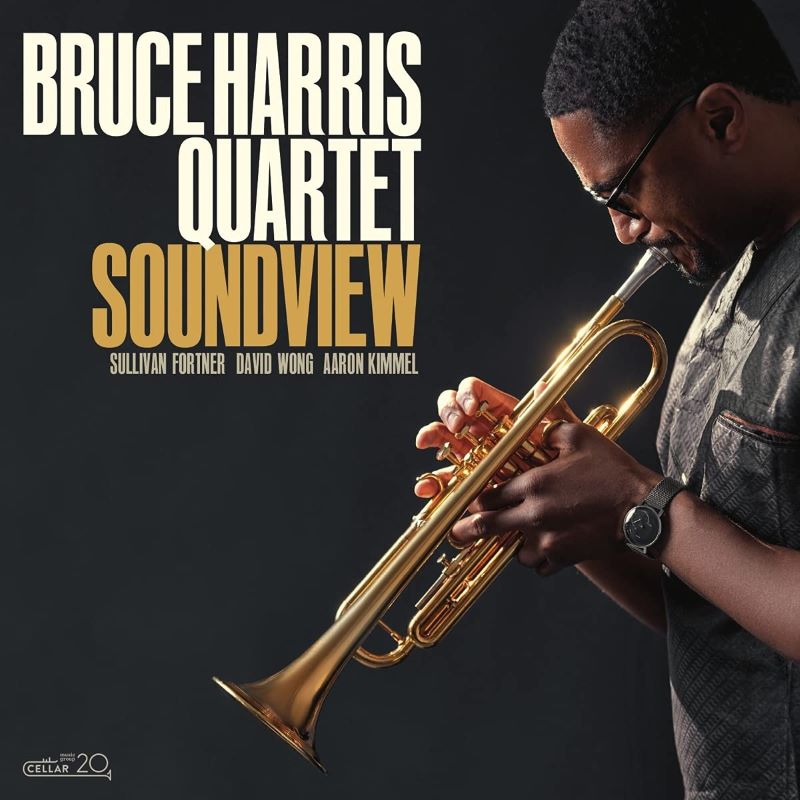
Bruce Harris - Soundview (June 4 via Cellar Music Group)

Celebrated Trumpeter Bruce Harris Announces the Release of His Latest Quartet Album, Soundview, Out June 4, 2021 On Cellar Music Group

Cellar Music Group is thrilled to announce the release of Soundview, the latest studio album from trumpeter, composer and educator Bruce Harris and his A-list quartet of masterful musicians. Striking a personal note with Harris, as it speaks to his upbringing in the Bronx neighborhood of Soundview New York, this Jeremy Pelt-produced masterwork celebrates Harris’ ancestors and the architects of the Black American Songbook to which he is so fervently and passionately devoted. Joining Harris is Sullivan Fortner on piano, David Wong on bass, Aaron Kimmel on drums and rising star vocalist Samara Joy, who guests on two tracks. This release marks the first of several collaborative efforts between Cellar Music and Pelt; an initiative which is geared toward showcasing the voices of Black artists. Keeping in line with Soundview’s theme, a donation has been made on behalf of Bruce Harris to the Bronx Charter School of the Arts in conjunction with this release.

The bandleader remarks that “during the pandemic I looked further and got more into the history of Black people in America. It was a time to learn and reflect. In gratitude, I wanted to pay tribute to all of the African American creators of this music.” All but one of the nine tunes on Soundview were written by Black architects of this music, who all happened to live and thrive in Harris’ birthplace of NYC. A testament to the longevity and vivacity of the artform, Harris’ music harkens back to the spirit of his musical ancestors while remaining an innovative and captivating new work.

This iteration of the Bruce Harris Quartet sees its recording debut with Soundview, however, the deep personal connections within this outfit are made evident in the group’s stellar interplay. Harris first met fellow New Yorker David Wong in the late 1990s when the two players were in the same All City and All State jazz bands. From there, a fruitful collaboration took shape. Since, Wong has gone on to play with the likes of Roy Haynes and Jimmy Heath. Harris has worked extensively with drummer Aaron Kimmel for the past decade, who he dubs “one of the greats here in New York; a young master,” and one of his “top five” in the city. Soundview marks the first collaboration between Harris and pianist Sullivan Fortner whom Harris has long admired.
Harris reflects that his relationship with Soundview’s famed album producer Jeremy Pelt began many years ago when Harris was a college student. Pelt’s words of encouragement for Harris left an impact on him. “We’re all in the rat race here. There’s something for you – just get in,” he said. Over the years, Pelt has become a sort of big brother to Harris. 

Upon producing this message-driven release, Pelt remarks that “…contrary to opinion, Jazz has always reflected the times. Sadly again, we are bearing witness to the racial injustice in the United States, wherein Black people’s lives are constantly at risk, particularly by those sworn to protect its citizens. As harrowing as this is, there seems to be a dialog in which Black voices are finally being heard. The Cellar Music Group recognizes that Jazz is not only a music native to America, but that the progenitors of this music are the very lives that are being threatened daily.” Pelt is pleased to bring this conversation to the fore with Harris’ release. 

Soundview is full of several bright moments. As Harris began writing the title track, he visualized scenes of where he was from. “I almost feel like the chords tell the story of my upbringing; a little dark in the beginning, some conflict worked through in bridge, and a new height harmonically resolving in a beautiful major chord,” he says. It is no mistake that the rhythm of the piece is a mambo rhythm, which Harris dubbed ‘the underlying clave of the Bronx’. ”Although it was not a place filled with privilege and opportunity, Soundview was and is rich in artistic excellence and indomitable spirit.” The piece begins with an ostinato from Wong followed by some rhythmic vamping by the rhythmic section, stating the clave of the composition. This sets the stage for Harris to take it by storm with fiery, soulful melodic musings. The recording features masterful improvisations from Harris and Wong.
Another highlight, “Bird of Red and Gold”, features the gifted Samara Joy on vocals. A fellow Bronx native and former student of Harris’, Samara lends her rich dulcet tones to this composition written by jazz luminary and renowned educator Barry Harris. The bandleader notes that Barry Harris was instrumental in his own musical upbringing and that of pianist Sullivan Fortner’s, and Samara is a current student of his. The powerful musical connection between these players is informed by the fact that all of the players are subscribers to Barry Harris’s unique and powerful conceptions of jazz harmony. 

“Saucer Eyes” is a composition by the late jazz luminary Randy Weston who Harris fondly remembers spending a short time with while on tour in Oman. The track has become a live performance staple for Harris. In the spirit of lineage, Harris is thrilled to now see younger generations of musicians performing this Weston piece more frequently. The melody is delivered here with a gleeful energy. Harris and Fortner soar over the changes in their solos conjuring Weston’s immense spirit. 

With the release of Soundview, Bruce Harris has surely earned his reputation as one of the most important and emerging voices in jazz today. Soundview will be available everywhere on June 4, 2021. 

1. Soundview (Bruce Harris)
2. Satellite (G.Gryce / SECOND FLOOR MUSIC)
3. Maybe It’s Hazy (Bruce Harris)
4. If You Were Mine (J. Mercer, M Malneck / BOURNE CO.)
5. Hank’s Prank (H. Mobley /  EMI UNART CATALOG INC.)
6. You’re Lucky To Me (E. Blake, A. Razaf / SHAPIRO BERNSTEIN & CO INC./RAZAF MUSIC)
7. Ellington Suite (arr. Andy Farber)
8. Bird Of Red and Gold (Barry Harris)
9. Saucer Eyes (R. Weston / MAYFLOWER MUSIC CORP.)

BRUCE HARRIS trumpet
SULLIVAN FORTNER piano
DAVID WONG bass
AARON KIMMEL drums
SAMARA JOY voice

Sunday, May 23, 2021

Ray Gallon - Make Your Move (May 2021 Cellar Live)

Pianist Ray Gallon’s debut recording, Make Your Move, certified, approved and endorsed by the legendary Ron Carter, who contributed the liner notes, comes to us after more than three decades of Gallon plying his trade on stages and in studios around the world with the crème-de-la-creme of jazz. The NYC native (born in 1958), and longtime professor (currently a full-time faculty member of the BFA Jazz Program at The City College of New York), finally leaps into the fray as a bandleader with a stellar debut, featuring his favorite trio of first-call drummer Kenny Washington (the “Jazz Maniac”) and the much sought-after mainstay on the scene, bassist David Wong (Roy Haynes, The Heath Brothers, Clark Terry, Illinois Jacquet, Benny Green, Eric Reed, Wynton Marsalis, and many others). The exemplary trio is comprised of artists all born and raised in New York City!

Ray Gallon’s impressive CV does not indicate an artist “of the tradition,” or “from the tradition”, but rather an artist who embodies the tradition, one who is a modern-day, current, active jazz artist of the highest order. It includes appearances and recordings with the likes of Ron Carter, Lionel Hampton, Art Farmer, T.S. Monk, Dizzy Gillespie, Milt Jackson, Harry “Sweets” Edison, Wycliffe Gordon, Les Paul, Benny Golson, Frank Wess, Lew Tabackin George Adams, and The Mingus Big Band. Gallon has also been called upon to accompany many vocal greats (often indicative of a pianist’s elevated musicianship), including Jon Hendricks, Sheila Jordan, Grady Tate, Nnenna Freelon, Gloria Lynne, Dakota Staton, Joe Williams, Chaka Khan, Jane Monheit and others.

So, the looming question is, why now? What took Gallon so long to unleash his debut? “I needed to feel ready - that I had something special to offer, with a personal identity and a refined concept in terms of my playing, repertoire, and overall trio conception, all while being steeped in the classic tradition of swing and blues. What struck me most when I was coming up, spending countless nights at the Village Vanguard, Sweet Basil, and Bradley’s, seeing/hearing Hank Jones, Tommy Flanagan, Cedar Walton, Kenny Barron, Ahmad Jamal, Bill Evans, Jimmy Rowles, Steve Kuhn (and many other masters), was how they each sounded uniquely original while remaining grounded in the tradition. These values were also instilled in me by my teachers, John Lewis, Jaki Byard and Hank Jones – who all stressed the importance of ‘finding your own voice’,” explains Gallon.

Also, simply put, Gallon has been busy working, fully engaged for the first fifteen years of his career as a valued sideman in studios and stages around the globe. This was followed by a period of forced retreat from the scene while he faced, battled, and recovered from colon cancer, while, at the same time, caring for his parents, both of whom were slowly succumbing to long term terminal illnesses. For the past 10 years, he’s finally had the chance to work steadily as a leader, doing countless gigs in local clubs, and having the opportunity to develop and fine-tune his personal, and trio, conception.

“With Make Your Move, everything came together just at the right time. I knew I wanted my first album to be in a trio setting, and I always had it in the back of my mind to do an album with David and Kenny, two dear friends who happen to make for a dream-team of a rhythm section. I’ve been playing regularly with David now for well over a decade - aside from being such a wonderful, special player (both as an accompanist and a soloist) with a great sound, he knows my music inside & out. I continually have to remind him that it’s bad etiquette to play better solos than the bandleader! It was very special for me to be able to do my first album with Kenny. Though I had not previously played in a trio setting with him, Kenny played a huge role in my early musical development, dating way back to when we first met as teenagers just out of high school. I had recently discovered (and become obsessed with) jazz and was working in the jazz aisle at J&R Records where Kenny was a regular customer; we’d hang for hours talking music, as he schooled me on who was who and what was what - even at that young age, Kenny already possessed an encyclopedic knowledge of jazz recordings! One of the key reasons for Kenny’s preeminence as a drummer is his remarkable arrangement-oriented concept; his ability to bring every detail to light. This is exactly what he did with my music, even though he was playing it all for the first time,” says Gallon.

Some of the music on Make Your Move has been in Gallon’s book for a while, evolving and growing over the years in the process of Gallon honing in on the finer details, and bringing them to their full realization. While other compositions came out fully formed and ready to go!:
Kitty Paws – While playing for one of Sheila Jordan’s vocal workshops at City College, on a break, “I started fooling around with the chords of a standard song one of the singers had just performed, ‘The Song Has Ended but the Memory Lingers On,’ and out popped this playful melody that seemed to have the vibe of a tap-dancing feline,” says Gallon.

Out of Whack – An off-kilter Gallon composition that has alternating time feels and sections of uneven lengths (4+8+4+7 bars).

Craw Daddy – Gallon sees this composition as, “a modern take on an old-time blues; something that sounds both new and old at the same time. The title just seemed to capture this feeling.” “Craw Daddy” was previously recorded by T.S. Monk on his album Higher Ground (featuring Ray Gallon).

Harm’s Way – Aptly titled for the challenging up-tempo of the piece, and also because Gallon based the composition on the harmonic minor scale.

Back to the Wall – A play on words from a fond memory in Gallon’s life. He explained, “Academy Records, near Union Square, had this wall of super discounted CDs – I was hooked, regularly going ‘back to the wall’ to load up on gems of jazz and classical you could find amongst the flotsam and jetsam”. As for the composition, Gallon says, “While my tunes are generally melody-driven, they tend to include written-out bass figures and rhythmic hits that are structural parts of the compositional fabric – this reflects my love of Horace Silver and the way his compositions often include fully integrated rhythm section parts.”

I Don’t Stand a Ghost of a Chance – “I love playing standard songs, particularly those I feel I can offer a personalized interpretation of. This arrangement includes moving bass figures and rhythmic hits within the context of a slow, spacious ballad. I originally conceived of this as a slow bossa, but, over the years, it evolved into what you hear on the record,” states Gallon.

That’s the Question – An early composition of Gallon’s, based on “Getting Sentimental Over You,” with some variation to the song’s chord progression. It’s a nod to bebop and a lot of fun for Gallon and Co. to play on gigs as a set opener or closer. It was first recorded by the Harper Brothers on their album You Can Hide Inside the Music. There is also a vocal version entitled, "I'm Running Late," with lyrics by Angela Verbrugge, on her album, The Night We Couldn't Say Good Night.

Hank’s A Lot – “Of all the great pianists I got the see play live, no one influenced me more than Hank Jones. I used to follow him around from gig to gig as if I were the president of his fan club. I especially loved when he played at Knickerbocker, where I could lean on the railing behind the piano for hours, looking over his shoulders, watching his hands, trying to “cop” as much as I could. One of the highlights of my student years was receiving an NEA grant to study with Mr. Jones privately. When I wrote this tune, it reminded me so much of him, it seemed only fitting to offer it as a dedication (and a huge “’Hank you”) to one of my true musical heroes,” says Gallon.

Yesterdays – Ahmad Jamal, upon hearing Gallon’s rendition of this Jerome Kern classic, enthusiastically responded to this tip-of-the-hat to Art Tatum. “While I in no way intended to emulate Tatum directly (I couldn’t if I tried!), I was inspired to utilize a few of his devices – the way he transitions from rubato into a spirited tempo through an ostinato bass line, his remarkably dissonant voicings, and that little riff he plays to signal the end of each chorus. Mr. Jamal recognized these references right away and, so far, he’s the only one who’s noticed!,” says Gallon.

Plus One – A contrafact based on Fat’s Waller’s “Honeysuckle Rose,” this original is filled with breaks and rhythmic hits, and offers the familiar chord progression with a bit of a twist.

Make Your Move – Of the title track, Gallon says, “I’m particularly proud of how this piece balances a sunny, accessible melody with a harmonic structure and phrasing full of twists and turns. Whenever I see drummer Quincy Davis, he always requests this one. Nothing means more to me than the support of fellow musicians I respect and admire”. 

1. Kitty Paws 05:08
2. Out Of Whack 05:28
3. Craw Daddy 06:07
4. Harm's Way 04:56
5. Back To The Wall 05:22
6. I Don't Stand A Ghost Of A Chance 05:21
7. That's The Question 05:31
8. Hanks A Lot 04:36
9. Yesterdays 04:59
10. Plus One 04:05
11. Make Your Move 06:17

Ray Gallon – piano
David Wong – bass
Kenny Washington - drums

All compositions by Ray Gallon unless noted

Executive Producer: Cory Weeds
Produced by Ray Gallon
Recorded at Acoustic Reocrding, Brooklyn New York,
Engineered and mixed by Michael Brorby
Mastered by Dave Darlington
Photography by Anna Yatskevich
Design and layout by John Sellards

Thursday, March 4, 2021

Charlie Porter - Hindsight (2021 OA2 Records)

Internationally acclaimed GRAMMY Award Winning trumpeter and composer Charlie Porter first cut his teeth on the New York jazz scene, while simultaneously studying classical trumpet performance at The Juilliard School under the tutelage of famed trumpeter and composer Wynton Marsalis.

Not a stranger to the idea of infusing one's art with examinations of societal conditions, Grammy-winning trumpeter Charlie Porter follows 2019's "Immigration Nation" with thoughts of how we act in hindsight to deal with the collateral damage of 'progress' and the centuries-old struggles with racism, inequality and corruption. Born during the upheavals of 2020, "Hindsight" reflects the tumult, uncertainty, and fiery emotions of the times, yet with the recent birth of his son, and thoughts of how we're going to leave the planet for the next generation, his "For Ellis" closes the album with a gospel choir and a hymn of hope. Joining Porter on the wide-ranging set of originals are saxophonist Nick Biello, pianist Orrin Evans, guitarist Mike Moreno, bassists David Wong & Damian Erskine, Behn Gillece on vibes, drummer Kenneth Salters, along with several guest performers. "Porter's playing is fluid, expressive, and magnificent." - DOWNBEAT

1 Tipping Point 5:49
2 Hindsight 7:00
3 Walking The Plank 6:51
4 Things Fall Apart 7:53
5 Requiem 7:38
6 In Short Supply 9:45
7 Going Viral 5:55
8 Paradise Lost 5:33
9 For Ellis 4:18

All music by Charlie Porter
Porter House Music (ASCAP)
(4) lyrics by Majid Khaliq
(6) lyrics by Madelaina Piazza

Charlie Porter - trumpet
Nick Biello - alto & soprano saxophones (1,6,8), keyboards (7,8)
Mike Moreno - guitar (3-6,8)
Behn Gillece - vibraphone (2,6)
Orrin Evans - piano/keyboards
David Wong - bass
Damian Erskine - fretless electric bass (4)
Kenneth Salters - drums
Jimmie Herrod - vocals (4,6)
Rasheed Jamal - rap vocals (6)
Majid Khaliq - violin (4)
Bassekou Kouyate - ngoni (African traditional guitar) (6)
Mahamadou Tounkara - ntama (African talking drum) (6)
Hallowed Halls Gospel Choir (9)

Wednesday, October 3, 2018

Benny Green - Then and Now (SUNNYSIDE RECORDS November 2, 2018)

Throughout his career as one of the world’s premier living Jazz musicians, legendary bebopper Benny Green has established himself as a powerhouse pianist and bandleader, boasting concert appearances and recording credits with giants of the industry over the past 35 years. But prior to his forthcoming record Then And Now (his 20th album as leader), Green has never featured either vocals or flute on any of his albums. Painting with rich aural colors and textures, Green boldly steps into new musical space for Then And Now, featuring both vocal sensation Veronica Swift and flautist Anne Drummond. 

Jazz sensibility comes naturally to Green, the NYC-born son of a jazz saxophonist and a Berkeley, California native. At a young age Green’s ear became fine-tuned to the art form, and he soon found himself invited to perform alongside Jazz icons like Betty Carter, Freddie Hubbard and Ray Brown. Art Blakey found Green’s swinging musicality to be the right ingredient and invited Green to join the ranks of his elite Jazz Messengers – this relationship would prove deeply influential to Green, who has since dedicated his career to straight-ahead hard bop. 

Although featured in a wide variety of performance arenas, Green is in his element and shines as the leader of the Benny Green Trio. With drumming master Kenny Washington and revered bassist David Wong completing the piano trio, Green commands the stage, delighting international audiences in his 38th year as a bandleader. It was only natural that this trio would become the springboard for Green’s recent new musical adventures.


A recording session led by prodigy vocalist Veronica Swift made such an impact on Green that he expanded his own generally instrumental traditions and began collaborating with both Swift and his trio. Green’s authoritative skill at the keyboard and hard-swinging ensemble were the perfect sonic landscape for Swift’s masterful musicianship and organic approach to scat singing, with Swift proving her voice was the perfect soloing instrument to complement Green’s stylistic swing. 

Swift, like Green, grew up in a musical family – her father a world-renowned bebop jazz pianist Hod O’Brien, along with her mother, vocalist Stephanie Nakasian, had made Swift’s young life rich with Jazz tradition. Swift and Green were a well-matched pair, each dedicated to bebop and swinging Jazz styles. When Swift began performing together with the Benny Green Trio, they discovered a dynamic element of interactive group synergy and interplay. They regularly perform together still, celebrating the musical vision they share. 

With Then And Now, Green explores yet more new ideas and soundscapes, delving into the rich sounds of a Rhodes electric piano on a few tracks. The vintage Rhodes, with Green at the helm, becomes a new and darker sonic foundation for Swift’s voice. Flautist extraordinaire Anne Drummond joins Green on the new record as well, after having previously performed some of Green’s own original music on her recording Revolving. 

Green’s compositions for Then And Now exemplify the album’s title: this record is musically distinct from any of his previous records. Longtime fans of Green’s will immediately recognize his unparalleled mastery and swing, but will also hear him stretching out comfortably in these new colors. The juxtaposition of Green’s familiar trio format and the new voices and textures on Then And Now create a heartfelt program, anchored in the swinging tradition that’s always been so central to Green’s heart. The new album is definitively, authentically Benny Green – but it conveys a side of Benny Green you haven’t heard before. 


Then And Now begins with Green’s salute to revered soul singer, pianist, composer Donny Hathaway which quotes both the singer’s “Valdez in The Country” and his duet with Roberta Flack, “The Closer I Get to You; Green’s “Donny Hath A Way” is a hard-grooving tune featuring flute, percussion and Green on Rhodes. 

Swift joins Green on Dexter Gordon’s “For Regulars Only,” a childhood favorite of hers, and performs her own stunning vocal transcription of Freddie Hubbard and Dexter Gordon’s original trumpet and tenor saxophone parts. For Cedar Walton’s “Latin America,” Green explores the duality of the keyboard itself, playfully balancing the Rhodes and acoustic piano as two characters: the Latin character and the gringo character, respectively. 

Swift’s touching lyrics about life lessons, set to Green’s “Naturally,” feature Swift exploring her own sonic comfort zone, with her voice eventually layered over itself in delicious triple texture. Driven by Washington and Wong, Green and the trio lay down a hard-hitting arrangement of Hank Jones’s “Minor Contention”, followed by a meditative dedication to California wildlife, Green’s calming “Enchanted Forest” as chamber trio of flute, piano and bass. 


Washington plays a classic Art Blakey-style 4-bar introduction out front on Horace Silver’s “Split Kick,” for which Swift rejoins the trio, covering the original trumpet and alto saxophone parts as played by Clifford Brown and Lou Donaldson with her voice. Green pays tribute to Duke Pearson, one of his favorite composers, with “Say You’re Mine”, and along with Swift recalls his mentor Walter Davis, Jr. with “Humphrey”, first recorded by Green in 1991 on his album Testifyin’. Swift’s vocals follow the trio’s opening chorus on “Something I Dreamed Last Night,” harkening Anita O’Day’s classic ballad style. 

But the crowning moments of the album are the “then” and the “now.” With “Hipsippy Blues” Green calls to mind his greatest musical influence, Art Blakey, and the time they’d spent playing together: a mindful musical glace back to “then.” Then Green turns to the “now”, celebrating the 25th anniversary of the release his own composition “Wiggin” (first recorded in 1993 on Green’s That’s Right. Green stands firmly in the present, surrounded by fascinating musical colors, textures, collaborators, and ideas. 

With the release of Then and Now, listeners get a rare glimpse of Benny Green, a giant of Jazz in his own right, both then and now.

Anne Drummond - flute & alto flute
Benny Green - piano & electric piano
David Wong - bass
Josh Jones - percussion
Kenny Washington - drums

1. Donny Hath A Way
2. For Regulars Only
3. Latin America
4. Naturally
5. Minor Contention
6. Enchanted Forest
7. Split Kick
8. Say You're Mine
9. Humphrey
10. Hipsippy Blues
11. Something I Dreamed Last Night
12. Wiggin'

Friday, January 26, 2018

Gary Smulyan - Alternative Contrafacts (SteepleChase Productions ApS February 15, 2018)


Baritone saxophonist Gary Smulyan brings here his trademark “contrafacts” (a music making method that shares the chord progressions with other compositions) approach to this first SteepleChase leader outing challenging us (maybe?) to guess the tunes he is employing.

Smulyan whose professional career took shape by joining Woody Herman’s Young Thundering Herds at age 22 (1978) has won Critics’ and Readers’ Poll awards numerous times by Downbeat and JazzTimes, among others.

1. Vodka (Mal Waldron)
2. Deep People (Jimmy Guiffre)
3. Tale Of The Fingers (Paul Chambers)
4. Cohn Pone (Al Cohn/Nick Travis)
5. Moodamorphosis (Gil Fuller,Dave Burns)
6. Ahma See Ya (Ted Curson)
7. I've Changed (Gary Smulyan)
8. On The Minute (John Eardley)
9. Hand (Coleman Hawkins)

David Wong bass
Rodney Green drums

Sunday, April 16, 2017

Benny Green - Happiness! Live At Kuumbwa (SUNNYSIDE RECORDS 2017)


The brilliant pianist Benny Green has made it his purpose to pass on the essence and tools of the masters of jazz. He was fortunate enough to grow up at a time when a young musician could still approach and apprentice with a legend like drummer Art Blakey, as Green did as a member of the Jazz Messengers. Green continues to honor both the musicians and the sound of the music that he grew up admiring on his new album, Happiness!

Green grew up in 1970s Berkeley, California, where he devoured all the jazz he could. He listened to 1950s and 1960s Blue Note recordings relentlessly, imprinting the sound and feel of his heroes into his psyche. In the early 1980s Green was able to put his knowledge to the test as an accompanist for singer and mentor Betty Carter. He then went on to have valuable tenures in the bands of two of his heroes: Art Blakey and bassist Ray Brown. 

The experiences with these exceptional musicians, all scholars of jazz, helped to shape Green’s own music, which grew to embrace swing and blues as essential elements. Green’s subsequent career has shown him to be a true standard bearer for jazz music and it is no surprise that his recordings give testament to that. 

Green’s new recording, Happiness!, came about in serendipitous fashion. On June 13, 2016, Green found himself along with his trio mates, bassist David Wong and drummer Rodney Green, on the stage at his favorite venue, Kuumbwa Jazz Workshop in Santa Cruz, California. As is his custom, Green brought his Sony PCM-M10 recorder to capture the evening. The results of the recording astounded the pianist and he knew that it was something that he wanted to release. 

Unlike his two previous recordings on Sunnyside, Happiness! is entirely devoted to interpreting the music of other composers. The composers whose work is featured all fit within the arc of jazz classicism that Green holds so dear. The recording is also special because of the energy generated by the ensemble in front of an enthusiastic and appreciative audience.

The program begins with an effervescent take on Horace Silver’s “The St. Vitus Dance,” propelled with aplomb by Wong and Green. Freddie Hubbard’s “Down Under” is played with a bombastic swagger, while Cedar Walton’s “Martha’s Prize” is a dynamic piece with many twists and turns. The bluesy “Sixth Avenue” is another by Walton and showcases a warm, gospel sensibility. 

Thad Jones’s “50-21” is played regally with Green’s graceful touch and poignant harmonic sense. The blues are highlighted again in Duke Pearson’s standout “Chant,” while Green’s original “Pittsburgh Brethren” is a lengthy tribute to one of the most important jazz towns in the country and its progeny, including Blakey, Sonny Clark and Erroll Garner. The recording concludes with Wes Montgomery’s knottily titled “Twisted Blues,” a blues workout with some unexpected turns.

A live performance by a master and keeper of the flame is worthy of celebration. This recording provides a wonderful reminder of what it means to find ecstasy in music. Naturally, Benny Green is delighted to spread Happiness! everywhere he goes.


1. Introduction 00:35
2. The St. Vitus Dance 04:33
3. Announcement 00:16
4. Down Under 06:53
5. Martha's Prize 06:46
6. Sixth Avenue 06:37
7. 50-21 06:12
8. Chant 04:27
9. Pittsburgh Brethren 10:13
10. Twisted Blues 03:35

Benny Green - piano
David Wong - bass
Rodney Green - drums


Thursday, March 16, 2017

Peter & Will Anderson - Clarinet Summit (SteepleChase Records 2017)


Young Anderson Brothers (Peter and Will are identical twins) both on clarinet here band together with two veteran clarinetists Ken Peplowski with rich background in big band jazz and multiple Grammy Award winner Paquito D’Rivera to perform live to a jubilant audience.

“They are sparkling virtuosos and their clever, tidy arrangements for various combinations of clarinet, alto and tenor saxophone are smart and refreshing…. everything they play sounds fresh, creative and in the moment.” (Paul de Barros – Soundposts)

01. How About You? 6:37
02. When You Wish Upon a Star 6:08
03. Very Saxy 6:43
04. Prelude to a Kiss 2:14
05. I'll Never Be the Same 2:06
06. Cry Me a River 2:42
07. Make Someone Happy 5:33
08. How Insensitive 4:23
09. Groovin' High 6:12
10. Creole Love Call 8:41
11. A Night in Tunisia

Will Anderson clarinet
Peter Anderson clarinet
Paquito D'Rivera clarinet
Ken Peplowski clarinet
Tardo Hammer piano
David Wong bass
Kenny Washington drums


Wednesday, February 17, 2016

Bob Kenmotsu Quartet - I'm in Love with You (2015)


Bob Kenmotsu, tenor sax
David Hazeltine, piano
David Wong, bass
Billy Drummond, drums

A superior tenor saxophonist, Bob Kenmotsu has long been a soulful bop-oriented player. In his career, in addition to leading his own groups, he has worked with the likes of Jack McDuff and Ruth Brown and recorded with Billy Hart and Pat Martino. On I’m In Love With You, he leads an all-star quartet through nine of his originals and two standards.

While some of the songs on this CD utilize chord changes from vintage tunes, Bob gives each of them fresh and inventive new melodies. And although his tenor playing is a logical extension of his roots in straight ahead jazz, his tone and choice of notes are unlike anyone else’s.
Bob’s rhythm section includes David Hazeltine (one of New York’s finest pianists) and two musicians (bassist David Wong and drummer Billy Drummond) who, like Hazeltine, have an endless amount of credits. The reason is obvious for they not only take concise and purposeful solos that fit the songs but are always tasteful and quietly stimulating in support of the saxophonist.

The opener, “I'm In Love With You,” has a particularly likable and memorable melody. Bob Kenmotsu’s solo is thoughtful and logical with each spontaneous phrase logically leading to the next one. One could imagine this song being outfitted with lyrics and becoming a standard. “What Is This” is an intense revival of “What Is This Thing Called Love” while “I Like Someone” has a new lyrical melody over the chords of “Like Someone In Love.” “BK Blues” features a classic piano solo worthy of Wynton Kelly. The program also includes three ballads (“Jun-Ko,” “Archipelago” and “Sachan’s Lullaby”), two cookers (“RCB3” and “Brilliant Bicycle”) and warm renditions of “Monk’s Dream” and Gershwin’s “But Not For Me.” Each performance is strong, swinging and contains subtle surprises.

Throughout I’m In Love With You, Bob Kenmotsu and his quartet revitalize straight ahead jazz with consistently creative ideas, resulting in one of his finest recordings.

SCOTT YANOW, author of 11 books including Bebop, The Jazz Singers and Jazz On Film 1917-76

01. I'm in Love With You
02. What Is This
03. I Like Someone
04. Bk Blues
05. Jun-Ko
06. RCB3
07. Archipelago
08. Brilliant Bicycle
09. Sachan's Lullaby
10. Monk's Dream
11. But Not for Me


Domi